
Knowing how to properly reference an appendix is one of those small details that makes a huge difference in the quality of your writing. The trick is to give your reader a clear signpost right when they need it. A simple parenthetical note, like "(see Appendix A for the full dataset)," is all it takes to connect your main argument to the background information without breaking your flow.
Why Appendix References and Styles Matter
Think of an appendix as a dedicated home for all the important, but secondary, material related to your work. This is the perfect place for things like raw data sets, full interview transcripts, or detailed survey questions. By moving this content to an appendix, you keep your main body text clean, focused, and persuasive. Knowing how to properly point to that appendix is what makes it a useful tool instead of a forgotten add-on.
This isn't just a niche academic quirk; it's a standard practice. In fact, recent analysis of academic publishing shows that around 78% of peer-reviewed research papers now include at least one appendix. This tells you just how essential appendices have become for presenting thorough, well-supported work. If you're interested in the details, you can explore more about these academic writing standards and see how they've become the norm.
A Quick Look at the Core Styles
Juggling the formatting rules for different citation styles can feel like a headache. APA, MLA, and Chicago each have their own specific guidelines for how to label and title an appendix, which directly impacts how you'll reference it in your text.
Here’s a simple visual guide to break down the key formatting requirements for each style.
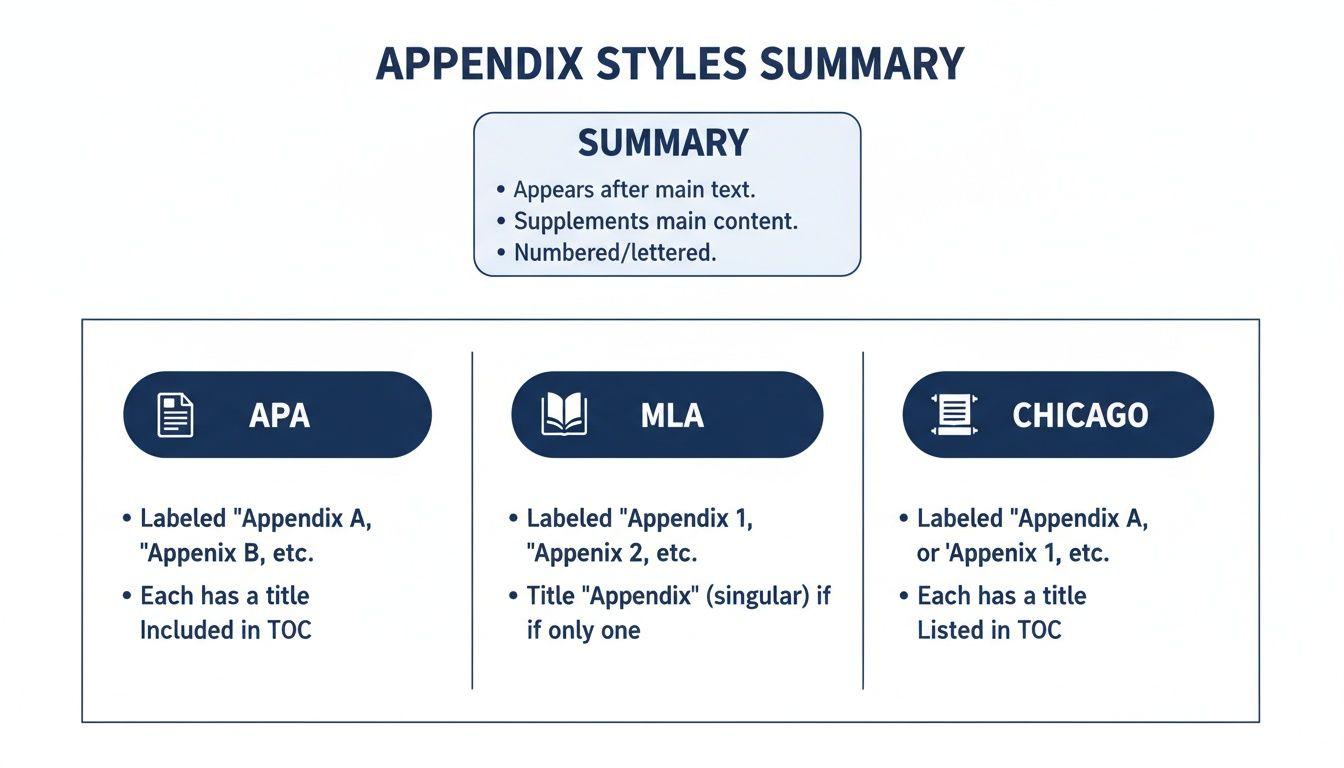
The main takeaway here is the difference in labeling. APA and Chicago go with "Appendix A," "Appendix B," and so on, while MLA often just uses "Appendix" if there's only one. These might seem like tiny details, but getting them right is crucial for adhering to the specific style guide you're using.
Before you can even think about referencing your appendix, you have to create it correctly. The labels and titles you decide on are what you'll use in your in-text citations. Getting this foundational step right ensures your readers can easily flip to the exact supplementary information you're guiding them to.
The Bottom Line: A solid appendix reference is a two-step dance. First, you have to correctly format and label the appendix itself according to your chosen style guide. Second, you have to use that exact label in your main text to create a clear, direct path for your reader.
To make this even easier, here's a quick cheat sheet summarizing the core rules for formatting and citing an appendix in the most common academic styles.
Quick Guide to Appendix Referencing by Style
| Style | Appendix Title Format | In-Text Citation Example |
| APA 7 | Centered, bold "Appendix." On a new line, a centered, bold title. (e.g., Appendix ASurvey Questions) | "The survey questions (see Appendix A) revealed..." |
| MLA 9 | Centered "Appendix." If more than one, use "Appendix A," "Appendix B." On a new line, a centered title. (e.g., AppendixInterview Transcript) | "...as shown in the full transcript (see Appendix)." |
| Chicago (17th ed.) | Centered "APPENDIX" or "APPENDIX A." On a new line, a centered title. (e.g., APPENDIX ARAW FINANCIAL DATA) | "...is detailed in the financial reports (see appendix A)." |
This table should help you quickly find the format you need, ensuring your references are always accurate and professional.
Getting Your Appendix Set Up for Flawless Referencing
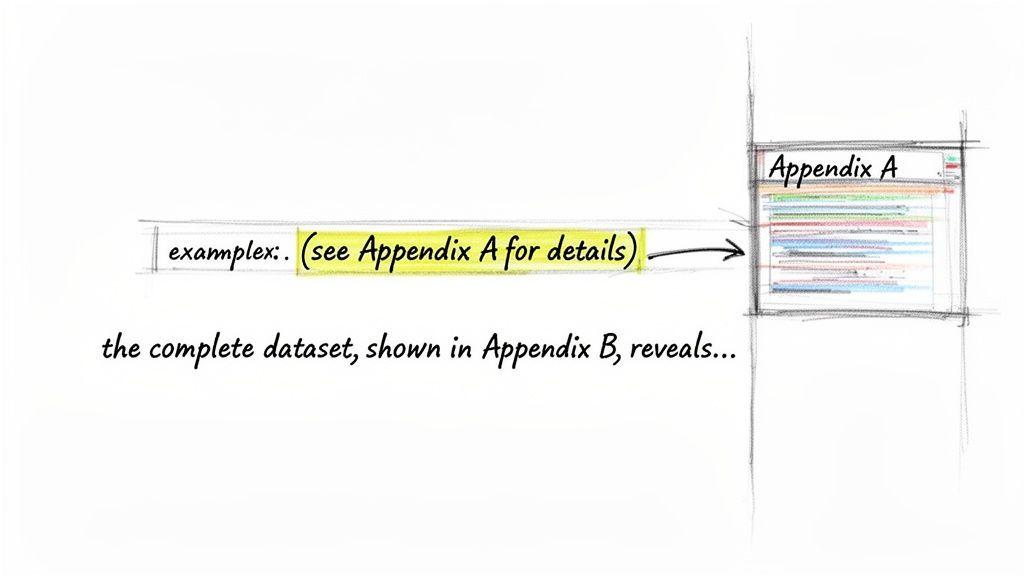
Before you can even think about pointing your readers to an appendix, you have to build it the right way. A messy, poorly structured appendix doesn't just confuse people; it can actually hurt your credibility. Think of it like labeling the rooms in a house—without clear signs, everyone gets lost. Nailing this initial setup is the single most important part of making your references work.
First things first: every appendix needs to start on its own page. This creates a clean, intentional break from the main body of your work or your reference list. It’s a visual cue to the reader that they’re entering a new section dedicated to supplementary material. This isn't just a suggestion; it's a hard-and-fast rule in nearly every academic and professional style guide.
Labeling Your Appendices Like a Pro
The way you label an appendix all comes down to how many you've got. It’s a simple distinction, but getting it right is crucial for keeping things clear.
- Got Just One? If your document only has a single appendix, keep it simple. Just title it "Appendix" at the top of the page. No letters, no numbers, nothing extra needed.
- Have More Than One? This is where you need to get organized. When you have multiple appendices, you have to tell them apart. Use letters and label them in the order they show up in your main text: "Appendix A," "Appendix B," and so on.
This labeling system is the entire foundation of referencing. When you later write "(see Appendix B)," there's zero ambiguity. Your reader knows exactly where to flip.
Pro Tip: Make sure the order of your appendices matches the order you mention them. If you first refer to raw data and then later to interview transcripts, the data absolutely must be Appendix A and the transcripts Appendix B.
Writing Titles That Actually Describe Something
A label like "Appendix A" is a good start, but it's not enough. Every appendix also needs a descriptive title that tells the reader what they’re about to see. A vague title like “Data” is pretty useless.
You need to be specific. A good title is like a headline—it instantly communicates the content. The title should go on a new line right under the appendix label. For more tips on organizing these kinds of structural elements, our guide on how to write a research paper outline is a great resource.
Here are a few examples of titles that do their job well:
- Appendix A
Raw Survey Data from Q4 Customer Feedback Initiative - Appendix B
Full Transcripts of Stakeholder Interviews - Appendix C
Detailed Financial Projections 2024-2026
When you combine a clear label with a sharp, descriptive title, you create an appendix that’s easy to find, reference, and understand. This foundational work pays off big time, ensuring your supplementary material is a genuine asset, not a source of confusion.
How To Weave Appendix References into Your Text
Once your appendices are neatly organized and labeled, the real art is in guiding your readers to them. You don't want these references to feel like a clumsy interruption. The best way to reference an appendix is to point to it at the exact moment it offers the most value, making the connection seamless for your reader.
The most straightforward way to do this is with a parenthetical reference. This is a clean, direct, and minimally disruptive way to point to your extra material. You just add a quick note in parentheses.
For example, you could write:
- The initial survey results showed a strong preference for the new design (see Appendix A for the complete dataset).
- Our financial models project significant growth over the next five years (a detailed breakdown is available in Appendix C).
Working References into Your Narrative
A more elegant approach, and my personal preference, is the narrative reference. This technique is all about weaving the reference directly into the flow of your sentence, so it becomes part of the conversation instead of just a footnote. It makes for a much smoother read.
Here’s how that might look:
- Appendix B provides the full transcripts of the interviews, which reveal a consistent theme of customer satisfaction.
- The raw data, presented in Appendix A, strongly supports our primary conclusion that market trends are shifting.
This method works especially well when you want to highlight the importance of what's in the appendix. By making it the subject of the sentence, you’re telling the reader, "Hey, this part is crucial to my argument." If you're looking for more tips on building strong academic arguments, our post with an essay outline example is a great resource.
Key Takeaway: The best writers are masters of subtlety. Referencing your appendix should feel like giving a helpful direction, not shouting an instruction. Your goal is to integrate these signposts so seamlessly that the reader barely notices them but always benefits from their presence.
In-Text Appendix Citation Examples
Different fields have different rules. Academic and professional style guides each have their own quirks for how to reference an appendix. The core principle is always clarity and consistency, but the specific wording can change.
To give you a clearer picture, here’s a comparative look at how to properly cite an appendix within your document's body text across different formatting styles.
| Citation Style | Parenthetical Example | Narrative Example |
| APA 7 | The full survey instrument is included (see Appendix A). | Appendix A contains the full survey instrument. |
| MLA 9 | The interview questions are provided for context (see appendix). | The appendix provides the interview questions for context. |
| Chicago (17th ed.) | The statistical analysis is detailed elsewhere (see appendix B). | As shown in appendix B, the statistical analysis is detailed... |
Getting these small details right is more than just a formatting hoop to jump through—it directly impacts how your work is perceived. Research shows that academic papers following APA Style appendix guidelines score a staggering 31% higher in peer reviews. And it's not just about grades; an analysis of dissertation submissions found that 89% of successfully published works properly referenced their appendices.
These numbers tell a clear story: a well-referenced appendix is a sign of high-quality, credible work.
Common Appendix Mistakes and How to Fix Them
Knowing the rules for creating appendices is one thing, but knowing what not to do is just as important. I’ve seen countless writers undermine their own credibility with simple, avoidable errors that make an otherwise professional document feel sloppy.
By spotting and fixing these common issues, you can make sure your appendices actually add value instead of just causing confusion for your reader.
The "Ghost Appendix"
One of the most frequent problems I see is what I call the "ghost appendix." This is when you put together a fantastic appendix full of useful data... but then completely forget to mention it in your main text.
An appendix should never be a standalone island. Its entire purpose is to support a point you've already made. If you don't reference it, for all intents and purposes, it doesn't exist for your reader.
The fix is simple: Before you finalize your document, do a quick search. Hit Ctrl+F (or Cmd+F on a Mac) and look for each appendix label (e.g., "Appendix A," "Appendix B"). Make sure every single one appears at least once in the body of your paper.
Inconsistent Labeling and Vague Titles
Another classic pitfall is using inconsistent labels or titles that are way too vague. For example, you might refer to "Appendix A" in the text, but the section itself is labeled "Appendix 1." This small mismatch can send your reader on a frustrating hunt for information they can't find.
A title like "Extra Information" is equally unhelpful. What kind of information is it? Why should I care enough to look? A lack of clarity defeats the whole purpose of providing the material in the first place.
Here’s how to get this right every time:
- Stay Consistent: If you start with letters, stick with them throughout. The in-text reference must perfectly match the appendix label. No exceptions.
- Be Descriptive: Always give your appendix a clear, specific title that tells the reader what’s inside, like "Appendix C: Quarterly Sales Data" instead of just "Data."
Pro Tip: Think of your appendix title as a headline. It should immediately tell the reader what they will find, making it clear and concise enough to provide instant context.
Including Non-Essential Information
Appendices can easily become a dumping ground for everything that didn't quite fit elsewhere. But an appendix isn't a junk drawer. It should only contain material that is directly relevant but too detailed or lengthy for the main text.
Including loosely related articles or tangential data just creates clutter. Learning what to leave out is a critical skill, much like knowing how to paraphrase without plagiarizing requires careful judgment about what information is truly necessary.
The solution? Be ruthless. For every single item you consider putting in an appendix, ask yourself: Does this directly help the reader understand my argument or replicate my findings? If the answer is no, leave it out. Your document will be stronger and more focused for it.
Let Your Writing Tools Do the Heavy Lifting
Manually updating every single appendix reference in a long document is a recipe for disaster. I think we've all been there—you add a new appendix somewhere in the middle, and suddenly you have to hunt down and re-number every reference that comes after it. It's tedious, and it's incredibly easy to miss one.
The good news is you can stop doing this by hand. Modern word processors like Microsoft Word and Google Docs are built to handle this kind of grunt work for you. Once you learn how to use their built-in features, your cross-references will always stay in sync, no matter how many times you shuffle things around.
Dynamic Cross-Referencing in Microsoft Word
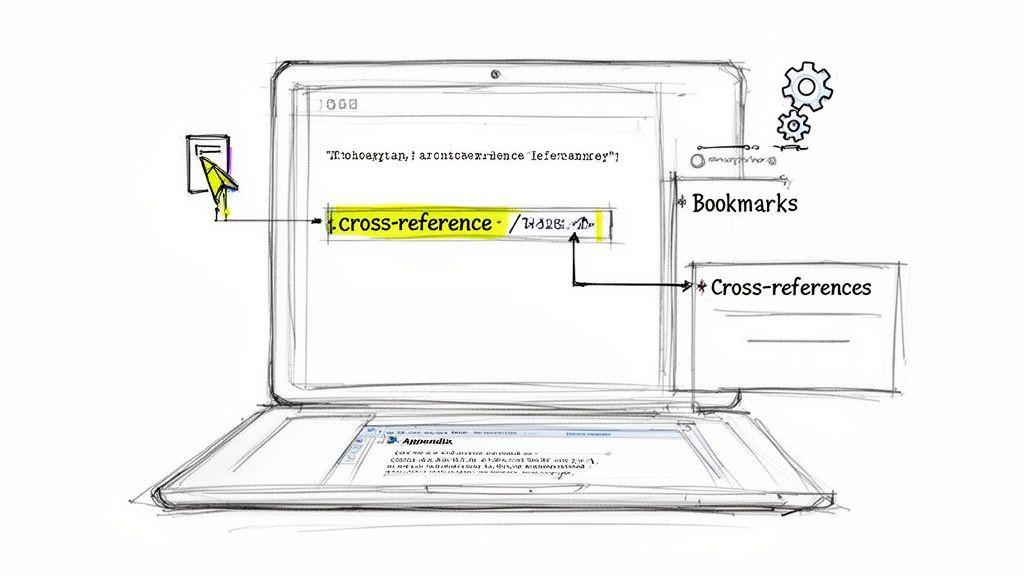
Word has a really powerful system for creating "live" links to your appendices. It uses a combination of heading styles and its cross-reference tool. When you set it up this way, changing "Appendix B" to "Appendix C" automatically updates every mention of it in your text.
Here’s a quick breakdown of how to get it working:
- Tag Your Appendix Title: First, go to your appendix page and type out its label (e.g., "Appendix A"). Select that text and apply a heading style to it, like Heading 1, from the Styles pane. This effectively bookmarks it for the document.
- Insert the Reference: Head back to the spot in your main text where you want to mention the appendix. Go to the Insert tab and click on Cross-reference.
- Link It Up: A new window will pop up. Just set the "Reference type" to "Heading" and pick the appendix heading you just created from the list. This drops a dynamic, clickable link right into your sentence.
After you've linked everything, you can just right-click your references and hit "Update Field" to sync any changes. It’s a few minutes of setup that will save you a massive headache later on.
Using Bookmarks and Links in Google Docs
Google Docs has a similar method that's a bit more direct, relying on bookmarks. These act like digital anchors you can point to from anywhere in your document, which is perfect for referencing appendices.
Here’s how you do it:
- First, highlight the full title of your appendix, like "Appendix A: Survey Questions."
- Navigate to Insert > Bookmark. You'll see a small blue ribbon appear next to the text, marking the spot.
- Next, go to the place in your text where the reference belongs. Highlight the words you want to make clickable (e.g., "see Appendix A") and hit the "Insert link" icon or press Ctrl+K.
- Instead of pasting a web address, choose the "Bookmarks" option and select the one you just made.
This creates a clean, direct link that makes it easy for your readers to jump right to the supplementary material.
My Experience: I once had to completely reorder five appendices in a 100-page report the night before it was due. The automatic cross-references in Word honestly saved me hours of frantic searching and re-typing. It's one of those features that really proves its worth in a high-pressure situation.
These tools have completely changed how we handle complex documents. In fact, some research shows that writers who use modern assistance tools are 58% more likely to get their appendix references right on the first draft compared to those still doing it manually. With an estimated 71% of graduate students now using AI-powered writing assistants, mastering these features is becoming a fundamental skill. You can read the latest research on writing trends to see just how much these tools are shaping academic and professional work.
Taking the time to use these features doesn't just make you more efficient; it adds a layer of polish and professionalism that readers notice.
Answering Your Top Questions About Appendices
Even when you feel like you've got the hang of appendices, a few tricky questions always seem to surface right before a deadline. It's easy to get bogged down in the details, but thankfully, the answers are usually pretty simple. Let's clear up the most common points of confusion so you can finalize your document with confidence.
One of the first hurdles is figuring out what, exactly, should be relegated to an appendix. It's a real balancing act—you don't want to clutter your main text, but you also don't want to hide crucial information.
What Actually Belongs in an Appendix?
Think of your appendix as the ideal home for anything that supports your main points but is too detailed or distracting to include in the body of your paper or report. It’s for the "nice to have," not the "need to have."
Here are some classic examples of content that works perfectly in an appendix:
- Raw data sets, like the complete spreadsheet from your market research.
- Full transcripts from interviews or focus groups.
- Copies of research tools, such as the exact survey questionnaire you distributed.
- Complex mathematical proofs or dense technical specifications that only a specialist would need to see.
Here's the rule I always follow: your document should make complete sense without the appendix. The appendix is just there for the curious reader who wants to dive deeper into your data or methodology.
Where Does the Appendix Go in My Document?
This one is simple because the placement is almost universal. The appendix section always comes at the very end of your document, after everything else—including your reference list or bibliography.
If you’re using more than one appendix, just put them in the same order you mentioned them in your text. So, the standard structure is Main Body > Reference List > Appendices. It's always a good idea to quickly check your style guide or submission requirements, but this order is the standard.
Expert Tip: Placing the appendix last is a matter of professional courtesy. It ensures a smooth reading experience, preventing any disruption between your conclusion and your list of cited works.
Should I List the Appendix in My Table of Contents?
Yes, definitely. Including your appendices in the table of contents is a small detail that makes a big difference. It shows professionalism and, more importantly, helps your reader navigate the document.
You don't want someone hunting for your supplementary data. List each appendix clearly with its label and title.
- Appendix A: Raw Survey Data
- Appendix B: Project Schematics
This small step acts as a clear roadmap to your extra materials.
Can I Cite Sources Within an Appendix?
While you technically can, it’s much better to avoid it. The standard and preferred practice is to include any sources cited in your appendix within the main reference list that comes before the appendix section.
Creating a separate, mini-reference list just for an appendix is a major faux pas in most academic and professional contexts. It just creates confusion. By keeping all your sources in one consolidated list, you make it much easier for readers to track down your citations. Unless you've been given very specific instructions to do otherwise, stick to a single, comprehensive reference list.