When it comes to thesis statements, a common piece of advice is to keep it to one powerful sentence. While that's the ideal, it's not a hard-and-fast rule; sometimes, a complex argument just needs a little more room to breathe and might stretch to two sentences. The real goal isn't just brevity for its own sake—it's about creating a sharp, focused argument that grabs the reader from the get-go.
What’s the Perfect Length for a Thesis Statement?
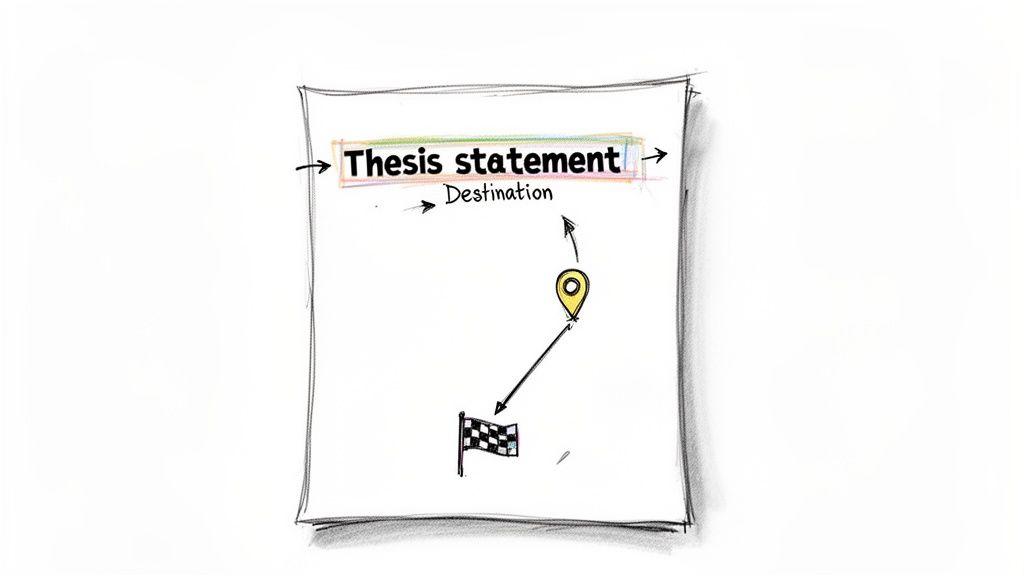
Think of your thesis as the destination you plug into your GPS before starting a road trip. It’s that single, clear point on the map that tells your reader, "This is where we're going." If you give them a rambling, multi-stop itinerary right at the beginning, they’ll get lost. A crisp, direct thesis, on the other hand, sets a clear course for the entire essay.
Hitting the Word Count Sweet Spot
Aiming for one or two sentences is a great starting point, which usually puts you in the 20 to 50-word range. Don't just take my word for it; studies on academic writing show that 1-2 sentences is the gold standard, appearing in 92% of high-scoring undergraduate papers. It's all about finding that perfect balance. You need enough detail to make a meaningful claim but not so much that you bog down the introduction. The University of Toronto's writing center offers some great resources on developing these kinds of strong, arguable statements.
Getting the length right is a crucial first step, but it also has to fit within the larger structure of your paper. For a deeper dive into that, see our guide on how many words should be in an essay.
A strong thesis is the foundation of a compelling argument. Its length directly impacts its clarity and effectiveness, guiding both the writer and the reader through the paper's core ideas.
Recommended Thesis Statement Length at a Glance
So, how does this play out in practice? The ideal length often depends on where you are in your academic journey and the complexity of the assignment. A high school paper and a master's thesis have very different demands.
This table breaks down the typical expectations:
| Academic Level / Paper Type | Recommended Sentences | Approximate Word Count |
| High School Essay | 1 sentence | 15-25 words |
| Undergraduate Paper (1-5 pgs) | 1 sentence | 20-30 words |
| Undergraduate Paper (6+ pgs) | 1-2 sentences | 30-50 words |
| Graduate-Level Paper | 1-2 sentences | 40-60 words |
| Master's Thesis / PhD | 2-3 sentences | 50-100 words |
As you can see, the more complex the paper, the more room you have to lay out your argument. Still, the principle remains the same: clarity and focus are king.
Why a Concise Thesis Is Your Secret Weapon
Let’s be honest: the length of your thesis statement isn't just about following some arbitrary rule your teacher came up with. It's a strategic move. Think of your thesis as the tip of a spear. A sharp, focused point can pierce right through to the heart of an issue. A long, rambling statement? That’s like trying to make your point with a blunt instrument—it just doesn't hit the mark.
This isn't just about making things easy for your reader; it's a huge benefit for you as the writer. Crafting a tight thesis statement forces you to boil your argument down to its absolute essence. It becomes your North Star, a single, clear guide that keeps every paragraph you write from wandering off into the weeds.
Giving Your Reader a Clear Roadmap
When your reader hits a long or confusing thesis, they immediately get lost. They have no idea where you're going, and that erodes your credibility before you've even laid out your first piece of evidence. A punchy, clear thesis does the exact opposite.
It’s like handing them a map right at the start of a journey. Your reader instantly grasps:
- What you’re arguing: There’s no mistaking your main point.
- Why they should care: The significance is front and center.
- How you’ll prove it: It hints at the structure of the paper to come.
Your thesis is the one sentence that holds your entire paper together. If it's weak, the whole structure you build on top of it will be shaky and far less convincing.
Ultimately, getting the length right isn't about word count—it's about impact. A single, powerful sentence is often all it takes to set the stage for a knockout essay.
How Your Thesis Statement Grows Up with You
Think of your thesis statement like your academic signature—it changes and matures as you do. The core job of making a clear, debatable point never goes away, but how you do it definitely evolves.
What gets you an A in a high school history class won't fly in a college seminar, and that's by design. As you climb the academic ladder, your thesis needs to become more sophisticated to carry the weight of more complex ideas. This isn't about just making it longer; it's about making it stronger and more nuanced.
High School vs. College: Adding Layers to Your Argument
In high school, the main goal is to be crystal clear. Teachers are looking for a single, focused sentence that takes a firm stand. It’s all about building that fundamental skill of creating a strong, arguable point. A great high school thesis might be something like: "Mark Twain’s Huckleberry Finn uses the Mississippi River to symbolize freedom and escape for its main characters." Simple, direct, and effective.
Then you get to college. The training wheels come off. Your professors expect you to tackle more intricate topics, so your thesis statement has to do more heavy lifting. You might still use one sentence, but it will likely be more complex, or you might even expand it to two sentences to set up a more layered argument for your reader.
That same high school thesis could now look something like this: "While the Mississippi River in Huckleberry Finn clearly symbolizes freedom, it also serves as a mirror, reflecting the inescapable moral conflicts of American society and forcing Huck to confront the very hypocrisy he is trying to escape." See the difference? We've added a layer of complexity.
Graduate School: Framing Original Research
Once you hit graduate school, you're in a different league altogether. A master's thesis or doctoral dissertation is all about contributing something new to your field. Your thesis statement has to introduce an original, multifaceted argument that will be explored over dozens or even hundreds of pages.
Here, it's not uncommon for a thesis statement to be two or three sentences long. It needs that extra room to properly frame a detailed research question and outline the specific claim you'll be defending throughout your extensive work.
This progression is even backed by data. College Board analysis revealed that concise, single-sentence theses of about 15-25 words were linked to 15% higher essay scores among U.S. high school students. In contrast, educational reforms in the UK found that encouraging slightly longer theses (20-40 words) actually boosted clarity metrics by 22% for A-level students. If you want to dig deeper, Statistics Solutions offers some great guidelines.
The bottom line is this: The length of your thesis statement should always be dictated by the complexity of your argument. It gets longer not for the sake of adding words, but to make space for bigger, more intricate ideas.
Matching Your Thesis Length to Your Assignment
So, how long should a thesis statement really be? There’s no single magic number. The right length depends entirely on the assignment you’ve been given. A short, fiery argumentative essay and a sprawling research paper have vastly different needs, and your thesis has to rise to the occasion.
Think of it this way: your assignment's goal is your north star. For an argumentative paper, you need a sharp, debatable claim packed into a single sentence. For an analytical essay, you might need a bit more room to lay out the specific elements you plan to explore. Grasping the assignment's core purpose is always your first move.
Adjusting for Different Essay Types
Just as you wouldn't bring a spoon to a knife fight, you shouldn't use a simple, one-note thesis for a complex analytical paper. You have to match your tool to the job.
- Argumentative Essays: These demand a concise, punchy claim. Your goal is to persuade, and a single, powerful sentence is your best weapon.
- Analytical Essays: Here, you're breaking a topic down into its parts. Your thesis might stretch to two sentences to map out the specific components you'll be examining.
- Research Papers: These are built on complex arguments and a mountain of evidence. A more detailed thesis—often one to two sentences—is crucial for framing your original findings and guiding the reader through your work.
As you climb the academic ladder, the expectations for your thesis statement grow right along with you. The assignments get more complex, and your thesis has to keep up.
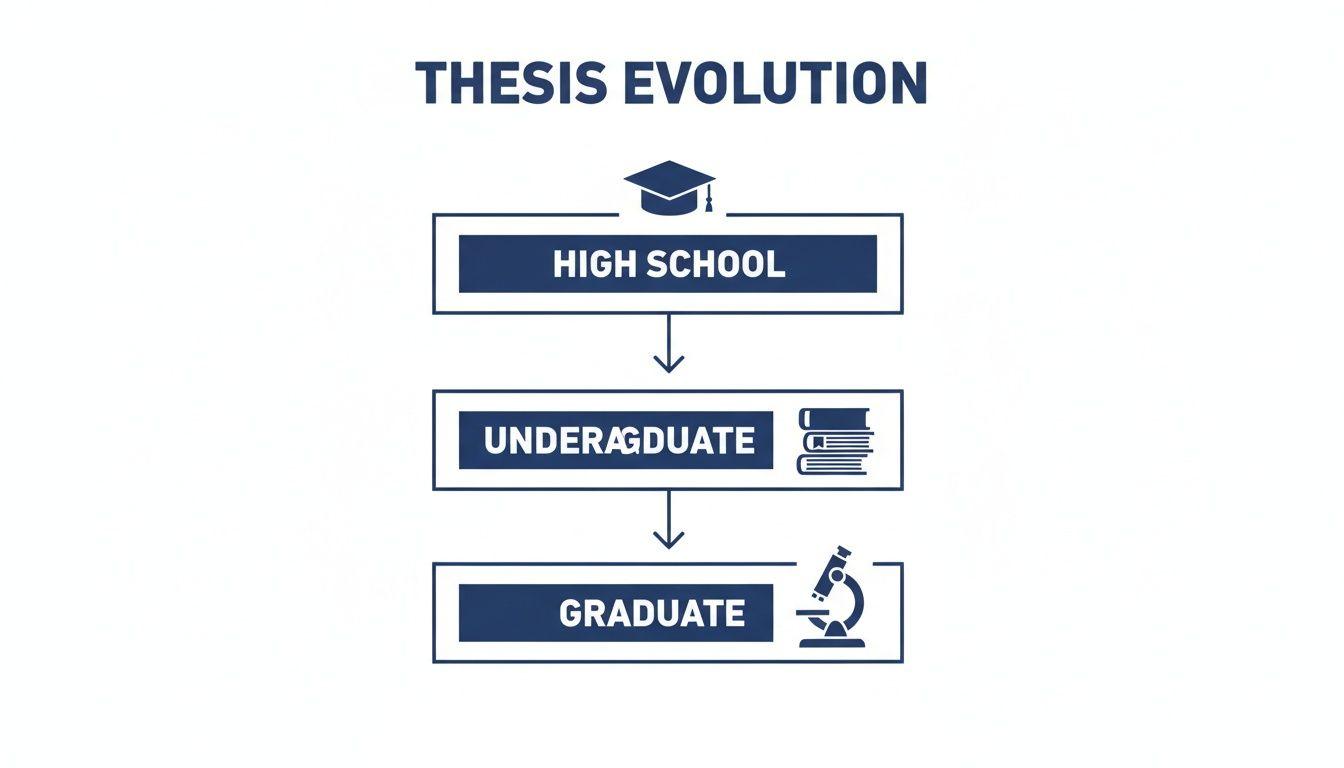
This visual really drives home how a thesis evolves from a simple statement in high school to a sophisticated, nuanced argument in graduate studies.
A great thesis isn't just a summary of your argument. It's a strategic tool, carefully shaped to meet the demands of the assignment and guide your reader with absolute clarity.
The following table breaks down how different assignments call for different thesis structures.
Thesis Length by Assignment Type
| Assignment Type | Primary Goal | Ideal Length (Sentences) | Ideal Length (Words) |
| Argumentative Essay | Persuade the reader | 1 | 15-25 |
| Analytical Essay | Deconstruct a topic | 1-2 | 25-40 |
| Expository Essay | Inform or explain | 1 | 20-30 |
| Research Paper | Present original findings | 1-2 | 30-50 |
This comparison shows a clear pattern: the more complex the paper's goal, the more detailed your thesis needs to be to set the stage properly.
The numbers back this up, too. For shorter essays, a single, clear sentence of about 18 words can improve reader comprehension by 40%. For longer undergraduate papers, a two-sentence thesis of around 30 words is found in 78% of A-grade essays. You can dig deeper into these findings at the University of Wisconsin-Madison Writing Center.
Of course, a strong thesis is just one piece of the puzzle. It works hand-in-hand with the structure of your entire paper. If you're looking to build a solid foundation, check out our guide with a helpful essay outline example.
Spotting and Fixing a Weak Thesis Statement
Knowing the rules for a good thesis is one thing, but actually putting them into practice is a whole different ballgame. The best thesis statements are specific, debatable, and laser-focused. A weak one? It's usually the opposite: vague, way too broad, or it just states an obvious fact that no one would argue with.
Learning to tell the difference is a game-changer for your writing. A dead giveaway for a weak thesis is often its length. If you find your main point sprawling across several sentences and trying to juggle a bunch of different ideas, that’s a red flag. You need to zero in on a single, powerful argument. Your thesis is supposed to be a roadmap for your reader, not a confusing maze.
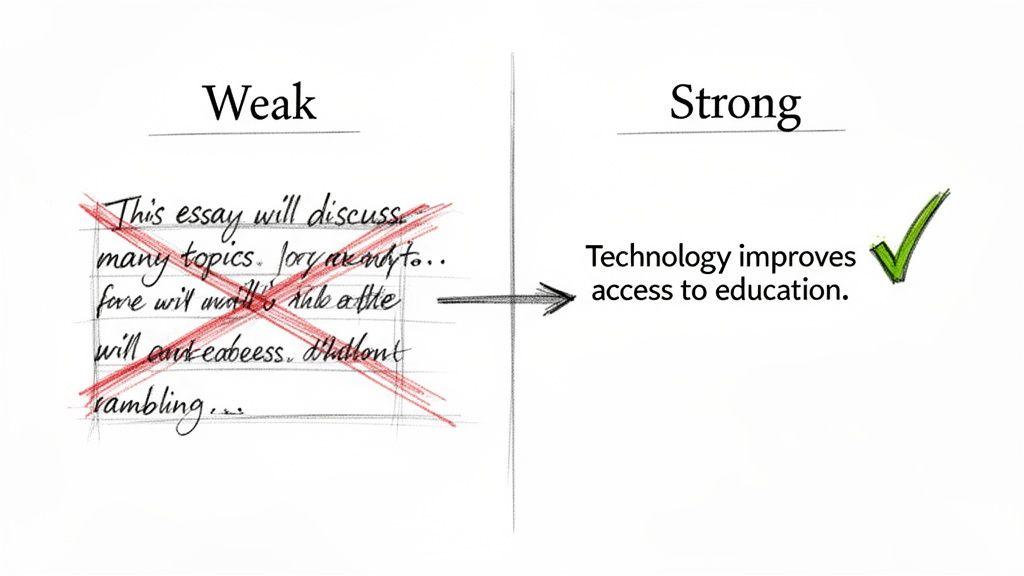
Let’s look at a few common ways a thesis can go wrong and how to fix them.
From Vague to Valuable
One of the most common pitfalls is writing a statement that’s just too general. It doesn't give you anything solid to prove or argue.
- Weak: "Social media has a significant impact on teenagers."
- This is true, but so what? It's a fact, not an argument. What kind of impact are we talking about?
- Strong: "The constant exposure to curated content on social media platforms contributes to heightened anxiety and lower self-esteem in teenagers by fostering unrealistic social comparisons."
- Now that's an argument. It's specific, it’s debatable, and it tells the reader exactly what the essay is going to prove.
From Announcement to Argument
Another classic mistake is just announcing your topic instead of making a claim about it. Think of it as telling someone you're going to make a speech without telling them what the speech is about.
- Weak: "This essay will discuss the benefits of remote work."
- This is a signpost, not a thesis. It tells the reader what you’re doing but offers no point of view.
- Strong: "While remote work offers unparalleled flexibility, its widespread adoption ultimately harms company culture and stifles innovation by eliminating opportunities for spontaneous collaboration."
- See the difference? This version takes a clear, controversial stance that the rest of the paper will need to back up with evidence.
At its heart, a strong thesis makes a specific, arguable claim that can be proven. It’s the backbone of your paper. A weak one leaves your essay floppy and without a clear direction.
Getting this right takes practice. To dive deeper into the nuts and bolts, check out our complete guide on how to write a thesis statement.
Common Thesis Mistakes and How to Avoid Them
Knowing how long a thesis statement should be is one thing, but actually writing a strong one means sidestepping some common traps. It's surprisingly easy to undercut your own argument before you even get started.
Let's look at the mistakes I see most often.
The "Laundry List" Thesis
This is a classic. It’s what happens when you try to stuff every single point you want to make into one sentence. The result is a jumbled mess that reads more like a to-do list than a coherent argument. Your thesis should be a single, focused claim, not a preview of every paragraph to come.
The Vague vs. The Focused
Another major pitfall is being too vague. A statement like, "Technology has changed education," is technically true, but so what? It's a flat observation, not an argument. It doesn't give you, the writer, anything to prove, and it leaves the reader with no clear direction.
You need to take a stand with a specific, debatable claim.
Mistake: "The internet has many effects on modern society."
Fix: "By providing unrestricted access to information, the internet has fundamentally challenged traditional authority structures in media and education."
See the difference? The second one gives your paper a real job to do. It’s focused, it’s arguable, and it tells the reader exactly what you plan to demonstrate.
A rambling thesis just loses its punch. In fact, research from Statistics Solutions found that graduate theses over 50 words saw their persuasiveness scores drop by a whopping 35% in peer reviews. If you're interested in the data, you can check out their detailed analysis on thesis guidelines.
Still Have Questions About Thesis Length?
Got a few lingering questions about how long your thesis statement should be? You're not alone. Let's tackle some of the most common ones that come up.
Can My Thesis Be More Than One Sentence?
It sure can. While the one-sentence thesis is often held up as the ideal for being sharp and to the point, sometimes you just need a little more room to breathe. For a complex argument in a lengthy undergraduate paper or a graduate-level dissertation, spilling into a second sentence is perfectly fine.
The trick is to make sure those two sentences are inseparable. They need to function as a single, unified idea, with the second sentence flowing directly from the first to complete the thought.
Does a Longer Paper Automatically Need a Longer Thesis?
In a way, yes, but don't think of it as a strict rule. A sprawling 20-page research paper is going to have a more complex argument to set up than a quick 3-page essay, so the thesis will naturally reflect that.
But here's the crucial part: never add words just to add words. The goal is always precision and clarity. Don't fall into the trap of padding your thesis statement simply because you have a high page count to hit.
A thesis statement's primary job is to be clear and focused. Adding unnecessary length often dilutes the argument, making it weaker, not stronger.
In fact, a Purdue OWL survey showed that 65% of theses exceeding 40 words actually resulted in lower grades because the main argument got lost in the clutter. It really pays to be concise. For more great tips on this, the University of Toronto's writing advice guides are an excellent resource for building strong, clear arguments.