If you’ve ever stared at a blank page wondering, “How long does this essay actually need to be?” you’re not alone. The truth is, there's no magic number. The right length hinges entirely on where you are in your academic journey and what the assignment demands.
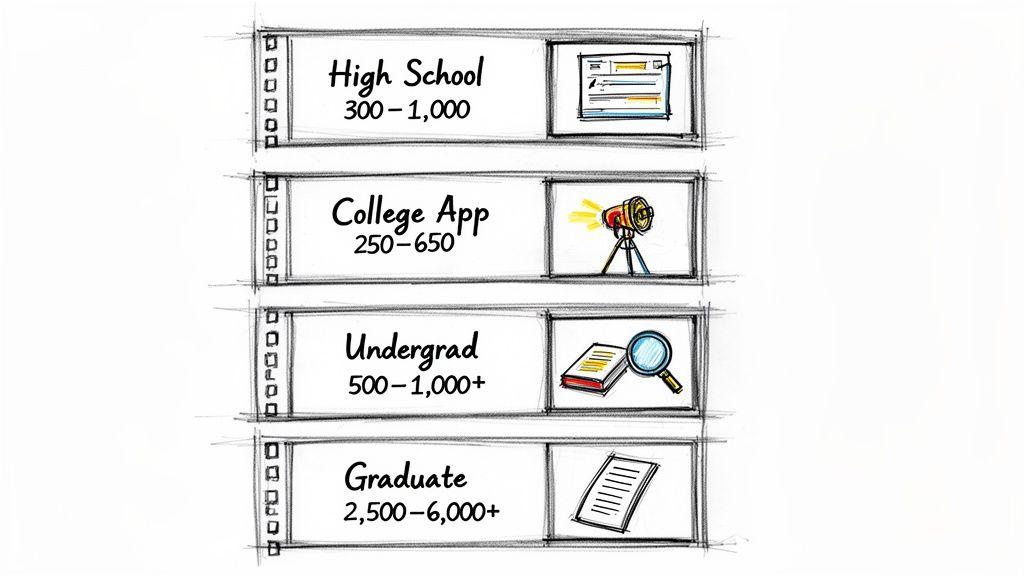
Think of it this way: a word count isn't a restrictive rule but a helpful roadmap. It signals the depth of detail and analysis your instructor is looking for. A high school essay might only be 300-1,000 words, while a typical college paper often lands in the 500-1,500 word range.
Cracking the Essay Word Count Code
An essay's word count is a lot like a recipe. A short, 500-word essay is like a quick omelet—it just needs a few core ingredients (your main ideas) mixed together efficiently to make one solid point. On the other hand, a 2,500-word research paper is more like a multi-course dinner. It requires more ingredients, careful preparation, and a thoughtful presentation to really impress.
You wouldn't try to make an omelet with thirty ingredients, and you can't build a complex, convincing argument with too few words. The word count tells you what kind of "meal" you're expected to cook.
This chart breaks down how those expectations evolve as you move up the academic ladder.
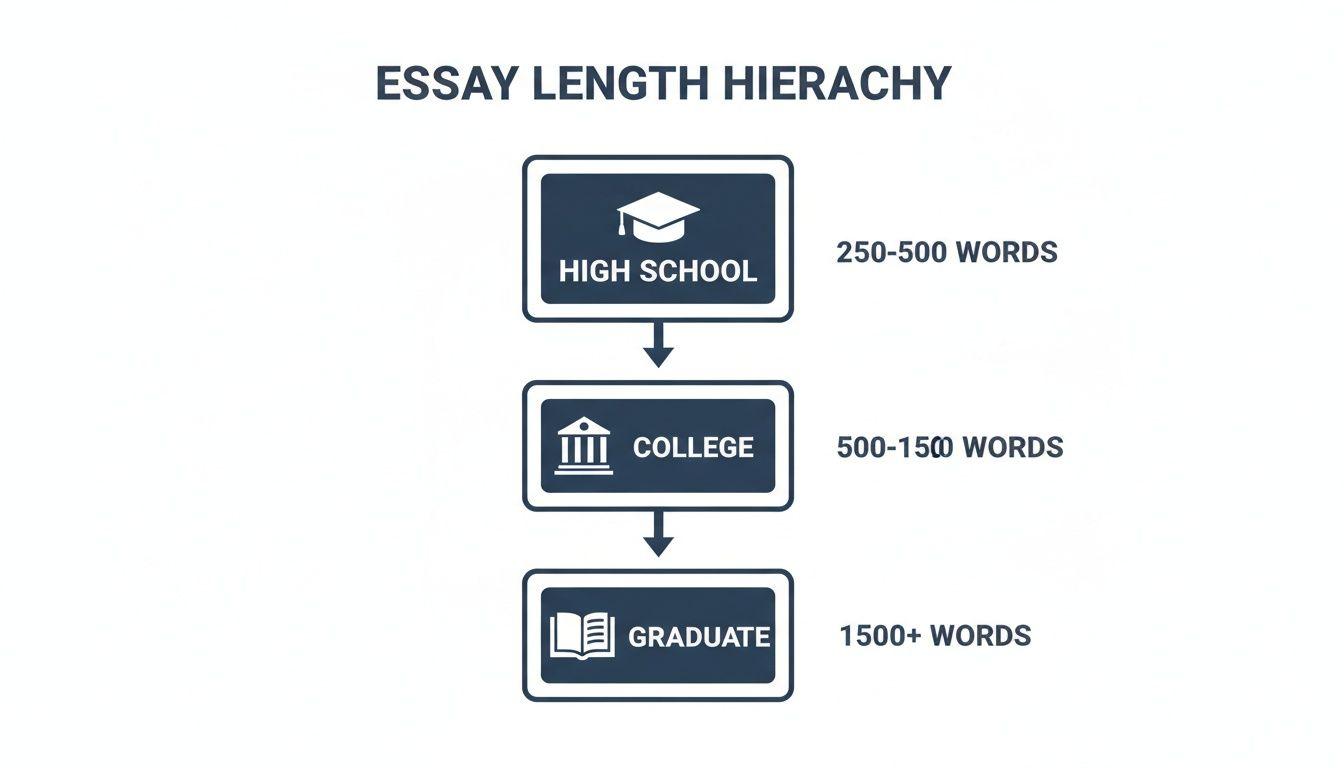
As you can see, the bar for depth and complexity rises at each new level.
Understanding the Standard Ranges
Let's break down those expectations. The following table offers a quick glance at what's considered standard at each educational stage.
Typical Essay Word Counts at a Glance
| Educational Level | Typical Word Count Range | Approximate Pages (Double-Spaced) |
| High School | 300–1,000 words | 1–4 pages |
| College Application | 250–650 words | 1–2 pages |
| Undergraduate | 500–1,500 words | 2–6 pages |
| Graduate | 2,500–6,000+ words | 10–25+ pages |
These ranges aren't set in stone, but they provide a solid frame of reference for what's typically required.
A Closer Look at Each Level
In high school, essays between 300 and 1,000 words are the norm. The goal here is to help you build foundational skills in structuring an argument and supporting it with evidence.
Then you have college application essays, a unique beast altogether. These are usually tight, requiring just 250 to 650 words. Every single sentence has to pull its weight to make a powerful impression.
Word count guidelines are not arbitrary limits; they are carefully chosen to match the scope of the topic. An instructor sets a word count to signal the level of detail, research, and analysis required to explore the subject thoroughly.
Once you’re in college, standard assignments often fall between 500 and 1,500 words. But the real jump happens at the graduate level. Here, papers can easily range from 2,500 to 6,000 words (or much more), demanding deep research and truly original thinking.
Getting a handle on these academic expectations for essay word count is the first step toward interpreting your assignments correctly and building arguments that hit the mark every time.
Navigating Word Counts at Every Academic Level
Think of your academic journey as a climb. The higher you go, the more is expected of you—and your writing is no exception. Word count requirements aren't just arbitrary rules; they're a reflection of the depth and complexity of thought you're expected to show at each stage.
It all starts in high school. This is where you learn the ropes with the classic five-paragraph essay, which usually clocks in between 300 and 1,000 words. These assignments are your boot camp for academic writing. They force you to build a solid foundation: a clear thesis, a few supporting points, and a neat conclusion.
The College Application Gauntlet
Right after high school comes one of the most stressful writing assignments of your life: the college application essay. Here, the word count shrinks dramatically to just 250 to 650 words. The goal isn't to write a research paper. It's to make an impact.
You have a tiny space to show admissions officers who you are. Every single word has to pull its weight. It's less about what you've done and more about what it means to you. This is your first real lesson in making every character count.
Undergraduate and Beyond
Once you're in college, the landscape changes again. Undergraduate essays are a step up, typically ranging from 500 to 1,500 words. Now, it's not enough to just have a good argument. You need to back it up with scholarly sources, dig deeper into the analysis, and build a more sophisticated case.
Learning to write a strong 500-word essay is a core skill you'll use constantly.
You can actually see this progression in the data. One Cambridge Assessment research study found that A-level students write just over 1,000 words per hour in exams, which shows the kind of sustained thinking needed to bridge the gap to university. And for college applications, that sweet spot is now firmly in the 400-600 word range for most personal statements.
Finally, if you head to graduate school, you’re at the peak. Graduate-level papers can easily stretch from 2,500 to 6,000 words, and often much longer. At this point, you're not just completing an assignment; you're contributing to your field with original research and an exhaustive understanding of the existing literature.
Knowing what’s expected at each level is half the battle. These word counts aren't just hoops to jump through—they’re guideposts that tell you what kind of thinking and writing is required to succeed.
Does a Longer Essay Actually Mean a Better Grade?
It's the classic student dilemma: you're staring at a word count requirement, wondering if adding just a bit more will nudge your grade from a B+ to an A. We've all been tempted to think that more words automatically signal more effort, which should translate to more points. But does it really work that way?
The truth is, it's not quite that simple.
While there's often a connection between longer essays and higher marks, it’s not because your professor is impressed by the sheer volume of text. The length is usually just a side effect of something far more critical: depth. A longer essay gives you the space to build a truly convincing argument, flesh out your examples, and support your claims with solid research.
Think of it like a documentary. A five-minute YouTube clip can give you the basic facts, but a feature-length film has the time to explore every angle, interview experts, and present compelling evidence. A sophisticated, high-scoring argument needs that same kind of room to breathe and develop properly.
Quality Always Trumps Quantity
Here’s where a lot of students go wrong. They see a word count as a finish line to be reached at all costs and start "padding" their work. This is a massive mistake, and instructors can spot it from a mile away.
Padding an essay is like adding extra water to a soup. You make it bigger, but you also dilute the flavor until it’s bland and unmemorable. A short, powerful essay will always beat a long, rambling one filled with fluff.
Filler content—like repeating the same idea in different ways, using vague statements, or dropping in irrelevant details—doesn't just take up space; it actively weakens your essay. It tells your reader you've run out of meaningful things to say and are just trying to stretch weak points to their breaking limit. Your goal should be to make every single word earn its place on the page.
What the Numbers Say About Length and Grades
Interestingly, statistics do show a link. One major study on SAT essays revealed that word count was responsible for about 39% of the variation in scores. Consistently, the longer essays did better. This even sparked some debate among experts, who worried it might encourage students to be wordy instead of clear. You can dig into the specifics of these findings on essay length and scoring yourself.
So, what should you take away from this? It confirms that a well-developed essay—which naturally takes more words to build—is what gets rewarded.
But don't get it twisted. The goal isn't just to write more. The real lesson here is to focus on building an airtight, evidence-rich argument. When you pour your energy into that, you'll find the essay naturally grows to the right length. Stop chasing the word count and start chasing a powerful argument. The length will take care of itself.
How to Decode Your Assignment Instructions
Think of your professor's instructions as a treasure map. They're not just a list of rules; they're your guide to hitting the mark and getting the grade you want. But to follow that map, you have to speak the language. Phrases like "approximately 1,500 words" or "a 3-5 page paper" aren't just thrown in there for fun—they're specific clues about the depth of analysis your instructor expects.
Let's put it another way. A 500-word essay is like a snapshot—a quick, focused look at a single idea. But a 2,000-word paper? That's a full-blown portrait, complete with a detailed background and all the subtle shading. Your first job is to figure out which one you’re being asked to create.
Translating Pages to Words
One of the first hurdles students run into is the classic "pages vs. words" confusion. What does "four pages long" actually mean in terms of word count? While there can be slight variations, the academic world runs on a pretty reliable standard.
The Conversion Rule: One double-spaced page, set in a standard 12-point font like Times New Roman, is about 250 words.
Once you know this, you can quickly turn any page requirement into a clear target.
- A 2-page essay = Roughly 500 words
- A 4-page essay = Roughly 1,000 words
- A 10-page essay = Roughly 2,500 words
This simple bit of math takes all the guesswork out of the equation. Now you have a concrete number to aim for as you start outlining and writing.
Understanding Word Count Flexibility
So you have your target number. How close do you actually need to get? This is where you have to put on your detective hat and scan the instructions for keywords that signal how much wiggle room you have.
Look for words like "approximately," "around," or "roughly." These are your green light. They tell you the word count is a guideline, not a hard-and-fast rule.
On the flip side, phrases like "no more than," "a maximum of," or "do not exceed" are firm boundaries. Treat these as red lights. Going over will likely cost you points because it signals you can't follow basic directions.
So, how much leeway does a guideline give you? A good rule of thumb that's widely accepted is the 10% rule. This means you're generally safe if you're within 10% of the target, either over or under. For a 1,000-word essay, that gives you a comfortable range of 900 to 1,100 words. Unless your instructor has specified a strict limit, this buffer lets you focus on the quality of your ideas instead of obsessing over the word counter.
Smart Strategies to Adjust Your Essay Length
Let's be honest: hitting a word count perfectly on the first draft almost never happens. It’s far more common to find yourself either agonizingly short of the goal or frustratingly over. The secret isn't to stuff your paragraphs with fluff or gut your best ideas—it's to edit with a purpose, making your essay even stronger in the process.
This is where the real craft of writing comes into play. Think of yourself as a sculptor. Your first draft is the raw block of marble. Now, you either need to chisel away the excess to reveal the masterpiece inside or carefully add more material to build out its form. These professional techniques will help you do just that, improving your essay's quality as you adjust its length.
How to Shorten Your Essay
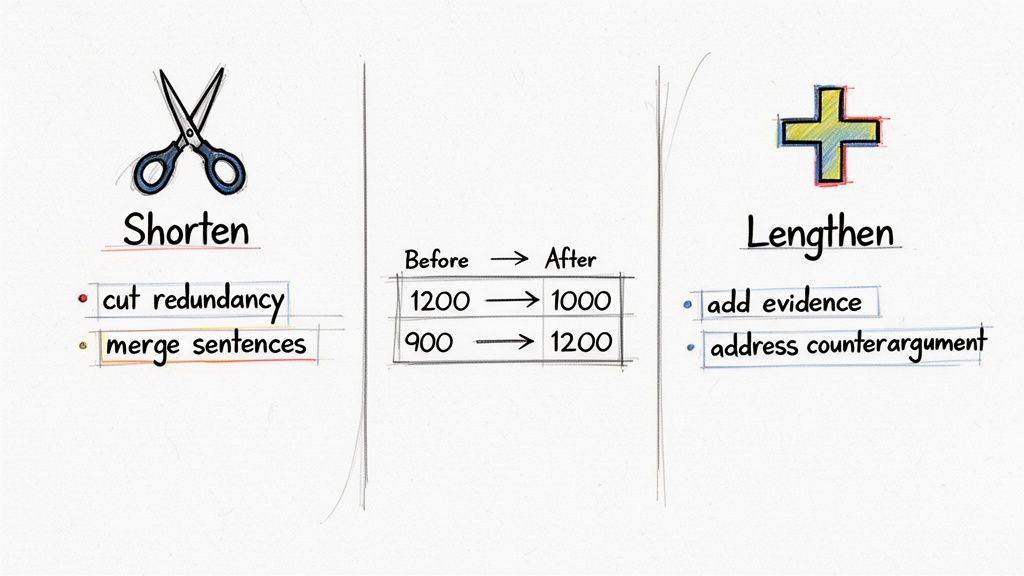
When your word count is too high, the temptation is to start hacking away at entire sentences. A better approach is to make your existing language more efficient and impactful.
- Hunt down redundant phrases: Keep an eye out for wordy culprits. Phrases like "in order to" can just be "to," and "due to the fact that" is a long way of saying "because." Simple swaps make a big difference.
- Eliminate weak modifiers: Words like "really," "very," "quite," and "basically" are often just filler. Cutting them makes your statements sound more confident and direct.
- Combine choppy sentences: Got two short, related sentences back-to-back? See if you can merge them into a single, more sophisticated sentence. It improves flow and cuts down on repetition.
This isn’t about removing your core ideas. It’s about learning to express them with greater precision.
How to Lengthen Your Essay
Falling short of the word count? Don't panic and start repeating yourself. See it as an opportunity to add more depth to your analysis and make your argument more bulletproof. A solid plan is your best friend here, and you can get great ideas from our essay outline example.
- Add more supporting evidence: Is there a key point that could be strengthened with another statistic, a relevant quote, or a more detailed example? Dig deeper.
- Address a counterargument: Show the professor you've thought critically about the topic. Acknowledge a potential objection to your thesis and then explain why your position holds up against it.
- Elaborate on your examples: Don't just drop an example in and move on. Unpack it. Explain why it's significant and clearly connect it back to your main argument.
These strategies add genuine substance, not just words, turning a short essay into a much more comprehensive and persuasive piece of work.
The editing process is where a good essay becomes a great one. Whether you're cutting or adding, every change should serve one purpose: to make your argument clearer, stronger, and more convincing.
Editing Techniques in Action
It's one thing to talk about these techniques, but seeing them applied makes their impact crystal clear. The table below shows a few before-and-after examples of how to tighten or expand your writing without hurting its quality.
Editing Techniques to Adjust Essay Length
| Goal | Technique | Before (Weaker Example) | After (Stronger Example) |
| Shorten | Eliminate Redundancy | Due to the fact that the study was new, its results were really interesting. | Because the study was new, its results were interesting. |
| Shorten | Use Active Voice | The ball was thrown by the boy. | The boy threw the ball. |
| Lengthen | Add Evidence | The policy was unpopular. | The policy was unpopular, with a recent poll showing 68% of constituents disapproved. |
| Lengthen | Address Counterargument | Some may disagree with this view. | While some critics argue the policy is too expensive, they overlook its long-term economic benefits. |
Once you get the hang of these simple adjustments, you can confidently hit any word count requirement while making your work that much better.
A Few Lingering Questions About Essay Word Counts
Let's tackle some of the most common questions that pop up when students are trying to nail down their essay length. Getting these details right can make a big difference.
Do My Title Page and Bibliography Count Toward the Total?
Almost certainly not. Your professor is interested in the body of your work—the actual argument you're building from the introduction to the conclusion.
Think of it like a movie. The word count is for the main feature, not the opening credits or the list of all the crew members at the end. Your title page, abstract, bibliography, and appendices are standard parts of the packaging, not the core content.
Unless your instructions are crystal clear that these elements should be included, always assume they don't count toward your final word total.
What About Footnotes or Endnotes?
This one is a bit of a gray area. The answer really depends on the citation style you're using (like Chicago, for instance) and, more importantly, your instructor's personal preference.
Some will want them included, while others won't. If the assignment guidelines don't specify, don't guess. It’s always best to just ask.
What Happens If I'm Way Over or Under the Word Count?
Sticking close to the target is key. A little wiggle room, usually within a 10% margin, is often acceptable. Straying too far, however, can hurt your grade.
Writing too little suggests your ideas aren't fully fleshed out or your research is thin. On the other hand, writing too much can signal that you haven't mastered the art of concise, focused writing.
Timed exams are a whole different beast. If you find yourself struggling to get enough words on the page when the clock is ticking, our guide on how to write essays faster has some great strategies to help you work more efficiently under pressure.