So, you need to write a thesis statement. What does that actually mean? At its core, a thesis is a single, concise sentence that stakes a claim—one that's clear, specific, and something you can argue for with evidence.
Think of it as the roadmap for your entire paper. It usually sits right at the end of your introduction, telling your reader exactly where you're going and what you plan to prove. A strong thesis isn’t just about announcing your topic; it’s about making an assertion that answers a "how" or "why" question.
What Makes a Thesis Statement Powerful
Before you even start drafting your paper, you have to get this part right. Understanding what separates a weak thesis from a powerful one is crucial. A thesis isn't just a topic or a bland fact—it's the North Star of your writing, the core argument that every single paragraph will work to support. It's the promise you make to your reader at the very beginning.
Its main job is to present a focused, debatable claim. A general topic like "social media" isn't a thesis; it's just a field of interest. A simple fact, like "many people use social media," also fails the test because there's nothing to argue. A powerful thesis takes a general idea and sharpens it into an analytical point.
A great thesis statement doesn't just tell the reader what your essay is about; it tells them your specific interpretation of the topic and why it matters.
Your Thesis is a Roadmap for the Reader
The best thesis statements act as a clear guide for your audience. They set expectations and lay out the logical framework for the arguments to come. When you place it at the end of your introduction, you're giving the reader a quick preview of your paper’s structure and purpose.
This isn't just a stuffy academic convention, either. A 2022 analysis from Swarthmore College found that essays with a thesis at the end of the intro improved reader comprehension by a staggering 40%. This structure works, creating a "roadmap" that helps your audience follow your reasoning from start to finish. You can dig deeper into these findings and learn how to structure a strong thesis on wts.indiana.edu.
Key Characteristics of a Strong Thesis
To make your thesis truly effective, it has to have a few key ingredients. These are the elements that transform a simple statement into a compelling argument capable of carrying an entire essay.
A strong thesis is always:
- Arguable: It must present a claim that a reasonable person could actually disagree with. If your thesis is a universally accepted fact, you don't have an argument—you have a statement of the obvious.
- Specific: It avoids vague, wishy-washy language. It narrows the topic down to a single, manageable focus. Instead of saying "world hunger is bad," it should pinpoint a specific cause, effect, or solution.
- Focused: It should only cover what you're actually going to discuss in your paper. Every point must be supported by the evidence you present later.
To make this crystal clear, here’s a quick-glance table breaking down the dos and don'ts.
Characteristics of Strong vs Weak Thesis Statements
| Strong Thesis (Do) | Weak Thesis (Don't) |
| Makes a specific, arguable claim. | States a general fact or obvious truth. |
| Answers "how" or "why" questions. | Is just a topic announcement. |
| Narrows the focus to a manageable scope. | Is too broad to cover in one paper. |
| Provides a clear roadmap for the essay. | Uses vague language like "interesting" or "bad." |
| Can be supported with credible evidence. | Relies only on personal opinion or feeling. |
Keep this table handy. When you're drafting, constantly ask yourself if your statement falls into the "Do" or "Don't" column. It’s a simple check that can save you a ton of rewriting later.
Crafting Your Thesis With the Three-Part Formula
Staring at a blank page is the worst. But you don't have to invent a perfect thesis statement from scratch. The best way I've found to get from a vague idea to a powerful, arguable thesis is by using a simple, three-part formula. It works for just about any essay, and it takes the guesswork out of the process.
Think of it as building your argument piece by piece, ensuring you have a solid foundation before you start writing the rest of the paper.
The Core Components
At its heart, this formula is about combining three crucial elements into one cohesive sentence.
- The Specific Claim: This is your main argument—the "what" of your paper. It’s the specific point you’re setting out to prove.
- The Supporting Reasons: This is the "because" or "how." It briefly lays out the main evidence or lines of reasoning you'll use to back up your claim.
- The Broader Implications: This answers the "so what?" question. It hints at why your argument matters in the bigger picture.
This process is really an evolution. You start with a broad topic, do your research, and then narrow your focus into a sharp, arguable point.
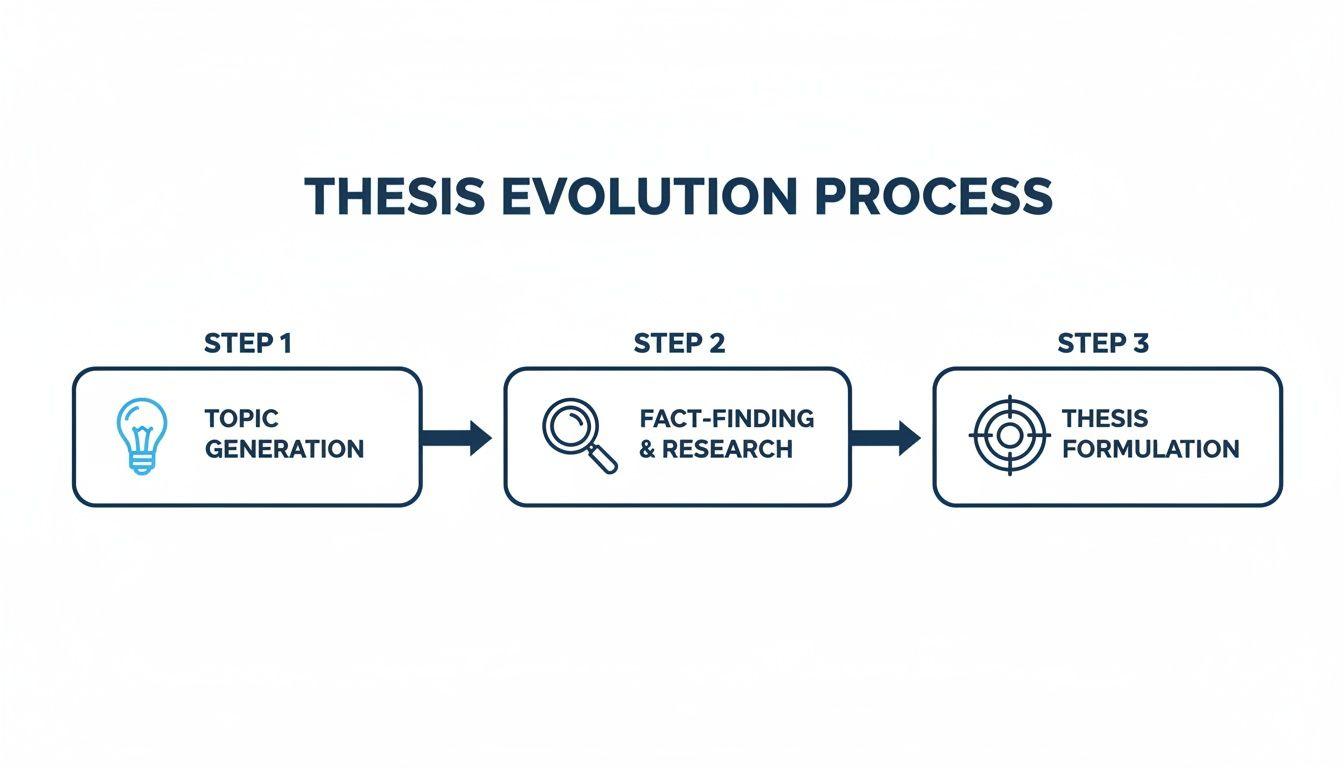
As you can see, a great thesis doesn't just appear out of thin air. It's the result of thinking critically about a topic and refining your ideas.
Let’s Put the Formula Into Practice
So, how does this actually work? Let's walk through a common scenario. Imagine you're tasked with writing about the impact of social media.
Your first thought might be, "Social media is harmful." It's a start, but it’s far too broad to be a strong thesis. Let's build it out using the formula.
First, get more specific with your claim:
Social media platforms must implement stricter moderation policies.
Now you have an arguable position. But why should they? Let’s add the reasons:
...because their current algorithms amplify harmful misinformation and negatively impact adolescent mental health.
Combine them, and you get a complete, road-map-style thesis:
Social media platforms must implement stricter moderation policies because their current algorithms amplify harmful misinformation and negatively impact adolescent mental health.
This approach doesn't just give you a great thesis; it practically writes your essay's outline for you. Those "reasons" you listed? They just became the topic sentences for your body paragraphs.
Mastering this simple structure is a game-changer. It’s been shown that essays using a clear, three-part thesis can earn grades that are, on average, 42% higher.
This formula transforms your thesis into a mini-map for your entire paper, making the writing process so much smoother. If you want to see how this kind of thesis turns into a full paper, check out our guide with a complete essay outline example.
Turning a Broad Topic Into a Sharp Argument
One of the biggest hurdles I see students face is getting from a general topic to a sharp, arguable claim. This is where a good paper becomes a great one. You stop just observing a topic and start actively engaging with it, giving your writing a real sense of purpose and direction.
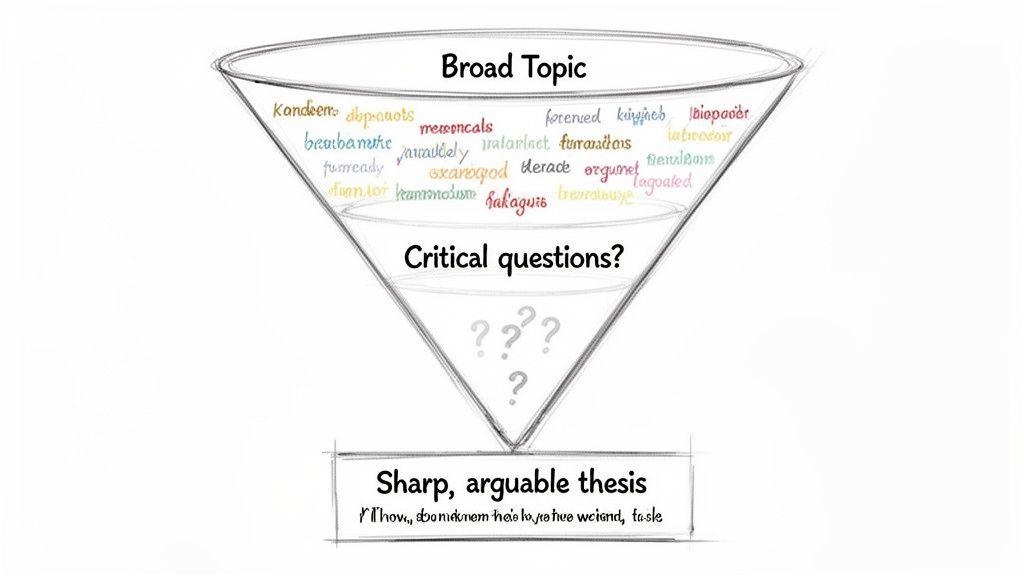
The whole process really kicks off with asking the right questions. Before you even think about drafting a thesis, you need to poke and prod at your topic from every angle. Think of this pre-writing stage as your chance to explore and find a perspective that genuinely sparks your interest.
From General Idea to Focused Claim
Let's walk through a real-world example. Imagine your assignment is on public health, and you start with a broad fact: "Sugar consumption is high in America." While true, it’s not an argument. It’s a statement of fact—a dead end for a paper.
To breathe life into it, you need to start asking questions:
- Where's the conflict? The real tension is between consumer freedom and public health, especially when it comes to kids.
- What's my honest take? Maybe you feel strongly that institutions have a duty to protect children's well-being.
- What's a specific, concrete solution? Instead of fighting a war on all sugar everywhere, you could zoom in on one specific environment, like schools.
These questions act like a funnel, narrowing your big idea into something powerful and debatable: "To combat alarming childhood obesity rates, public schools should be required to replace all sugary drinks in vending machines with healthier alternatives." Now you’re talking. You've got a clear, arguable position.
A strong thesis doesn't just state a fact; it interprets the significance of that fact and proposes a specific stance or course of action. It's the leap from "what is" to "what should be."
The Power of a Debatable Thesis
Making that leap from a simple fact to a real argument is crucial. It opens the door for analysis and gives your research a clear roadmap. In fact, data from university writing centers consistently shows that papers with a clear, arguable thesis score 25-30% higher on average in undergraduate evaluations.
Consider how the argument gets stronger with a little evidence: "Because half of all American elementary school children consume nine times the recommended daily allowance of sugar, schools should be required to replace soda machine beverages with healthy alternatives." This version is not only debatable but is also anchored by a compelling reason, which you can then prove with research. You can find more great insights on building an effective thesis on wts.indiana.edu.
Brainstorming Your Unique Angle
Don’t just grab the first argument that pops into your head. The goal here is to find a perspective that is both compelling and truly your own.
- Play devil's advocate. Seriously, try arguing the exact opposite of what you believe. This is a fantastic way to spot weaknesses in your own logic and might even lead you to a more nuanced, sophisticated claim.
- Look for unexpected connections. Can you link your topic to another field entirely? For example, you could connect the sugar debate to the economic impacts on local bottling companies or even to agricultural subsidies for corn.
- Dig into different kinds of sources. Go beyond the obvious journal articles. A historical document, a statistical report, or a philosophical essay could offer a completely fresh viewpoint. Of course, knowing what is a credible source is essential for building a solid foundation for any argument you make.
By really exploring these different angles, you move past the generic claims and land on an argument you're actually excited to defend. That intellectual curiosity is the secret ingredient behind every memorable thesis statement.
Tailoring Your Thesis to the Type of Essay
A great thesis isn't a one-size-fits-all statement. It has to be molded to fit the specific goal of your essay. The way you frame your main point for an analytical paper, for instance, is going to look and feel very different from one designed for an all-out argumentative essay. Getting this right is a huge part of academic writing.
Think of it like this: you wouldn't use a screwdriver to hammer a nail. Each tool has a purpose. Your thesis is a tool, and you need to choose the right one for the job, whether that job is to dissect a poem, persuade a reader, or just explain a complex idea.
For an Analytical Essay
An analytical essay is all about breaking something down—a book, a film, an event—to see how its parts work together to create a whole. Your thesis, then, isn't about taking a side. It’s about offering your specific, insightful interpretation of what’s going on under the surface. It usually answers a "how" or "why" question.
- The Goal: Present a focused interpretation of a text or subject.
- Key Phrasing: Look for words like "reveals," "demonstrates," "illustrates," or "suggests."
Here’s an example:
In F. Scott Fitzgerald's The Great Gatsby, the recurring symbol of the green light does more than just represent Gatsby's dream of Daisy; it ultimately illustrates the deceptive and unattainable nature of the American Dream itself.
See? It’s not arguing for or against the American Dream. It's analyzing how a symbol functions within the novel.
For an Argumentative Essay
This is where you plant your flag. In an argumentative essay, your job is to convince the reader to see things your way. Your thesis needs to be a bold, debatable claim that you're prepared to back up with solid evidence.
You're moving from just interpreting something to actively advocating for a position. It has to be a statement that someone could realistically disagree with.
- The Goal: Make an assertive claim and persuade the reader that it’s valid.
- Key Phrasing: Use strong, direct language. Words like "should" or "must" are common, as are clear cause-and-effect statements.
Take a look at this:
Public high schools must integrate project-based learning into their core curriculum because it fosters the critical thinking and collaborative skills that traditional testing overlooks, ultimately leading to better student engagement.
This is a clear, forceful stance. You know exactly what the rest of the essay will fight to prove.
For an Expository Essay
Expository (or explanatory) essays are about teaching your reader. You're not trying to persuade them of an opinion; you're just laying out the facts or explaining a process. The thesis for this kind of paper is like a road map for your reader.
Think of an expository thesis as your paper's table of contents boiled down into one sentence. It tells the reader exactly what's coming.
Your thesis should state the main points you're going to cover, usually in the order they'll appear in the body of the essay. While it doesn't need to be argumentative, a clear thesis is still critical for a strong introduction. For more on that, check out our guide with some good intros for essays offers several examples.
And an example for this one:
The collapse of the Mayan civilization can be traced to a combination of three primary factors: prolonged and severe drought, internal political strife, and widespread deforestation that destabilized their environment.
Your Go-To Checklist for a Flawless Thesis
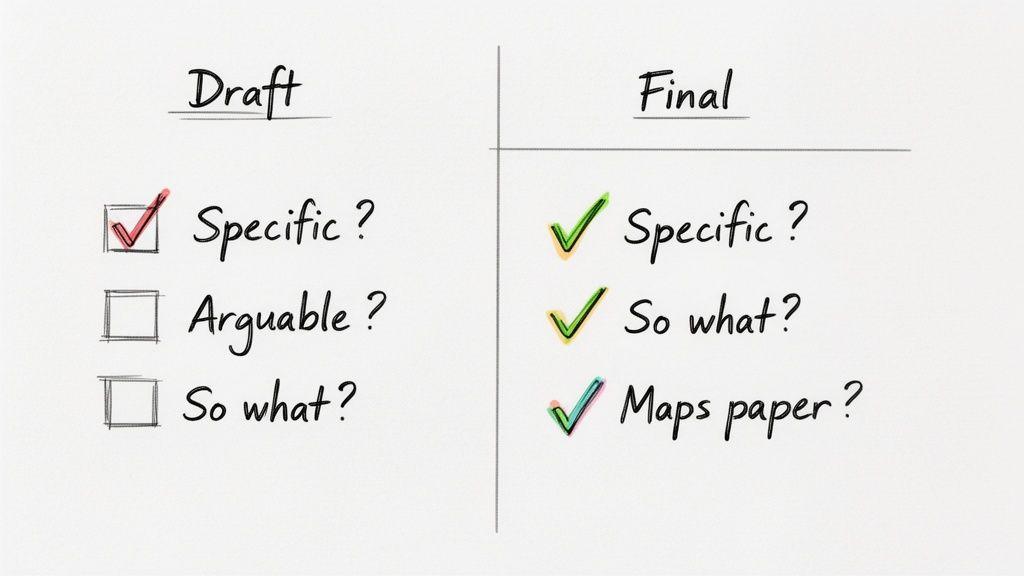
Think of your first draft thesis as a rough sketch. It's the basic idea, the starting point. But the real magic happens during revision—that’s where a decent idea sharpens into a powerful, compelling argument that can truly anchor your entire paper.
This final quality check is about making sure your thesis is focused, strong, and ready to do the heavy lifting. Before you even think about writing the rest of your introduction, put your draft thesis through its paces with this checklist.
Does It Actually Make a Claim?
This is the most critical test. Does your thesis state an actual arguable claim? It has to be something a reasonable person could disagree with. If you've just stated a fact or a universally accepted truth, you have nothing to prove and, frankly, no paper to write.
- Weak (Just a Fact): "Working from home became more common during the pandemic." (No one can argue with this.)
- Strong (Arguable): "The widespread adoption of remote work has led to a significant decline in professional mentorship opportunities for early-career employees." (Now that's a point someone could debate, and it requires evidence.)
A strong thesis invites discussion and demands proof. That's its job.
Is It Specific Enough to Be Interesting?
Vague, fuzzy language will sink your thesis before it ever sets sail. Your claim needs to be narrow and precise, something you can realistically cover in your essay. Ditch the grand, sweeping statements that are impossible to defend.
I always tell my students to think of it like a camera lens. You're not trying to capture the entire landscape; you're zooming in on one fascinating detail.
A specific thesis is your promise to the reader. It sets clear expectations about what your paper will cover and, just as importantly, what it won't.
Let's look at the difference:
- Too Vague: "Environmental policies are important for the future." (Important how? Which policies? What future?)
- Nice and Specific: "To effectively reduce urban air pollution, municipal governments should invest in free public transportation rather than solely promoting electric vehicle subsidies."
See how the specific version gives you a clear roadmap? You know exactly what points you need to argue and what kind of evidence you'll need to go find.
Does It Pass the "So What?" Test?
This is my favorite question because it's the ultimate reality check for any argument. Read your thesis and ask yourself, out loud, "So what?"
Why should anyone care about this? If you struggle to come up with a good answer, your thesis might be insignificant or just plain obvious. A strong thesis hints at why your argument matters in the bigger picture.
- Fails the Test: "Shakespeare's Hamlet is a play about a man seeking revenge." (Okay... and? So what?)
- Passes the Test: "Shakespeare's Hamlet explores the complexity of grief, ultimately arguing that the pursuit of revenge inevitably leads to self-destruction rather than justice."
The second version connects the plot to a deeper, universal theme. It gives the analysis weight and makes it relevant. Getting into the habit of asking "So what?" is how you learn to craft a thesis that really commands attention.
The Final Thesis Revision Checklist
Before you commit to a thesis, run it through this quick evaluation. It's a simple way to spot weaknesses and turn a good draft into a great one.
| Evaluation Question | Check (Yes/No) | Actionable Tip |
| Is it a single, focused sentence? | If it's too long or has multiple sentences, condense your main idea into one clear statement. | |
| Does it make a debatable claim, not a fact? | If it's just a fact, ask yourself why this fact is important or what its consequences are. That's your argument. | |
| Is it specific and narrow? | If it's too broad, add qualifiers. Name specific groups, places, or timeframes to narrow the focus. | |
| Does it answer the "So what?" question? | Explicitly state the significance or implication of your argument. Connect your point to a larger issue or idea. | |
| Does it function as a roadmap for the paper? | Can you see the major sections of your paper based on the thesis? If not, revise it to forecast your main points. | |
| Is the language clear, strong, and confident? | Avoid passive voice and weak phrases like "I think" or "In my opinion." State your claim directly. |
Think of this checklist not as a chore, but as a tool to build a stronger foundation for your entire essay. A little time spent here saves a lot of headaches later.
Answering Your Top Thesis Statement Questions
Let's tackle some of the most common questions and sticking points that come up when you're trying to nail down a thesis. Getting these cleared up can make the whole writing process feel less like a mystery and more like a craft you can master.
Even when you think you've got a decent draft, a few little uncertainties can creep in. Knowing the "why" behind the rules will help you write with more confidence.
Where Does the Thesis Statement Go?
The classic, time-tested spot for a thesis statement is at the very end of your introductory paragraph. This isn't just a random tradition.
Think of it as a funnel. Your introduction starts broad, grabbing the reader's attention and introducing the general topic. Then, sentence by sentence, you narrow the focus until you arrive at your specific, punchy argument—the thesis. It perfectly sets the stage and tells your reader exactly what to expect before they dive into the body of your paper.
Can a Thesis Be More Than One Sentence?
For the vast majority of essays you'll write in college or high school, the answer is a firm no. You should always aim for a single, powerful sentence.
Why? This forces you to be incredibly clear and concise. It's a discipline that pushes you to distill your entire argument down to its absolute core. While you might occasionally see a two-sentence thesis in a massive, book-length dissertation, for standard papers, one sentence is the gold standard.
Your thesis is the master claim of your entire essay. Every single paragraph that follows exists for one reason: to support that one sentence. Keeping it singular gives your paper a sharp, undeniable focus.
What's the Difference Between a Thesis and a Topic Sentence?
This is a big one, and getting it right is crucial.
- A thesis statement is the main argument for the entire essay.
- A topic sentence is the main argument for a single body paragraph.
Picture it like a pyramid. The thesis is the peak, the single point your whole paper is built upon. The topic sentences are the major support beams holding it up. Each topic sentence makes a smaller claim that, when proven, helps prove the larger thesis.
Should I Change My Thesis While I'm Writing?
Yes, absolutely! In fact, you probably should. It’s not a sign of weakness; it’s a sign that you’re actually thinking deeply about your topic.
Most writers start with a "working thesis"—an initial best guess that guides their research and first draft. As you dig into your sources and start connecting ideas, you'll uncover new angles and nuances. Your understanding will evolve, and your thesis should evolve with it.
Don't feel locked into your first attempt. Revising your thesis to perfectly match the evidence and analysis you've developed is what skilled writers do. It ensures your final paper is coherent and your argument is rock-solid.