Before you even think about writing the first sentence of your research paper, you need a plan. That plan is your outline. It's essentially a blueprint for your entire paper, a hierarchical map that organizes your thesis, key arguments, and the evidence you've gathered into a logical sequence. It's the tool that turns a jumble of ideas and notes into a coherent structure, saving you from the agony of endless revisions and the dreaded writer's block.
Why An Outline Is Your Most Powerful Writing Tool
Let's get one thing straight: outlining isn't just another tedious box to check. I know many students see it that way and are tempted to skip right to the writing. But from experience, that's a huge mistake. A good outline is the single most effective way to transform a chaotic, stressful writing process into a clear, manageable path forward.
Think of yourself as an architect. You wouldn't start building a house without a detailed blueprint, would you? An outline serves the exact same purpose. Without it, you’re just piling up paragraphs, hoping they form a sound argument. More often than not, that approach leads to a structure that collapses under scrutiny or needs massive, painful renovations later.
The Strategic Edge of Planning
The real magic of an outline is that it forces you to do the heavy intellectual work before you get bogged down in sentence structure and word choice. It’s a low-stakes sandbox where you can test your logic, arrange your arguments, and critically evaluate whether your evidence actually holds up.
By mapping out your paper, you can quickly identify critical flaws:
- Logical Gaps: Do your points connect, or are there massive leaps in reasoning that will confuse your reader?
- Weak Arguments: Is one of your main points propped up by flimsy evidence while the others are solid?
- Repetitive Ideas: Are you accidentally saying the same thing in three different sections?
- Poor Flow: Does the journey from your introduction to your conclusion make sense, or does it feel like a random detour?
Trust me, it's far less painful to spot these issues on a one-page outline than it is after you've already poured hours into writing ten pages of dense prose. It’s a classic case of working smarter, not harder.
From Chaos to Clarity
You've done the research. You have piles of articles, pages of notes, and maybe some raw data. It’s overwhelming. An outline is your organizational best friend—it gives every single piece of information a specific home. This isn't just about being tidy; it directly elevates the quality of your final paper.
The numbers don't lie. A major 2018 meta-analysis on academic writing strategies revealed something telling: students who used pre-writing tools like outlining produced papers that scored, on average, 28% higher on clarity, organization, and argument strength. That's not a small bump. It's a clear indicator that planning pays off. You can dig into similar research on what drives academic output and its contributing factors.
Key Takeaway: You need to shift your mindset. An outline isn't a cage that restricts your creativity. It's the scaffolding that allows your ideas to be built into something strong, clear, and persuasive.
To help drive this home, let's break down exactly what you gain by dedicating time to an outline.
Core Benefits of a Research Paper Outline
This table really puts into perspective the advantages you get from investing just an hour or two in a solid plan before you dive into writing.
| Benefit | Impact on Your Writing Process | Long-Term Advantage |
| Organizational Clarity | Provides a clear roadmap, preventing you from getting lost in your own ideas. | Develops stronger analytical and organizational skills applicable to all future projects. |
| Improved Logical Flow | Ensures your arguments are presented in a coherent, persuasive sequence. | Teaches you how to build a compelling narrative, a crucial skill in any field. |
| Efficient Time Management | Breaks the project into smaller, manageable tasks, reducing procrastination. | Saves dozens of hours in revision, leading to less stress and better final grades. |
| Early Problem Detection | Helps you spot gaps in research or weak points in your argument early on. | Prevents major structural issues that could derail your paper late in the process. |
| Increased Confidence | Writing becomes a "fill-in-the-blanks" process, eliminating writer's block. | Builds confidence in your ability to tackle large, complex academic assignments. |
Ultimately, a thoughtful outline is your best defense against late-night panic and frustrating rewrites. It’s the foundation for a paper that is focused, compelling, and impressive from start to finish.
The Building Blocks of a Strong Outline
A good outline is so much more than a simple to-do list. Think of it as the architectural blueprint for your entire argument, mapping everything out from your opening sentence to your final conclusion. Getting a handle on its core components is the first real step toward creating a research paper outline that actually does its job. These elements give your paper a solid frame, making sure every paragraph has a purpose.
It all starts with the thesis statement. This single, punchy sentence isn't just a topic—it's the core argument you're setting out to prove. I like to call it the North Star of the paper. Every major section, every piece of evidence, has to point directly back to and defend that thesis. If a point doesn't serve the thesis, it's just noise.
This visual shows how a solid outline creates a domino effect, leading to a clearer, more structured, and more efficient writing process.
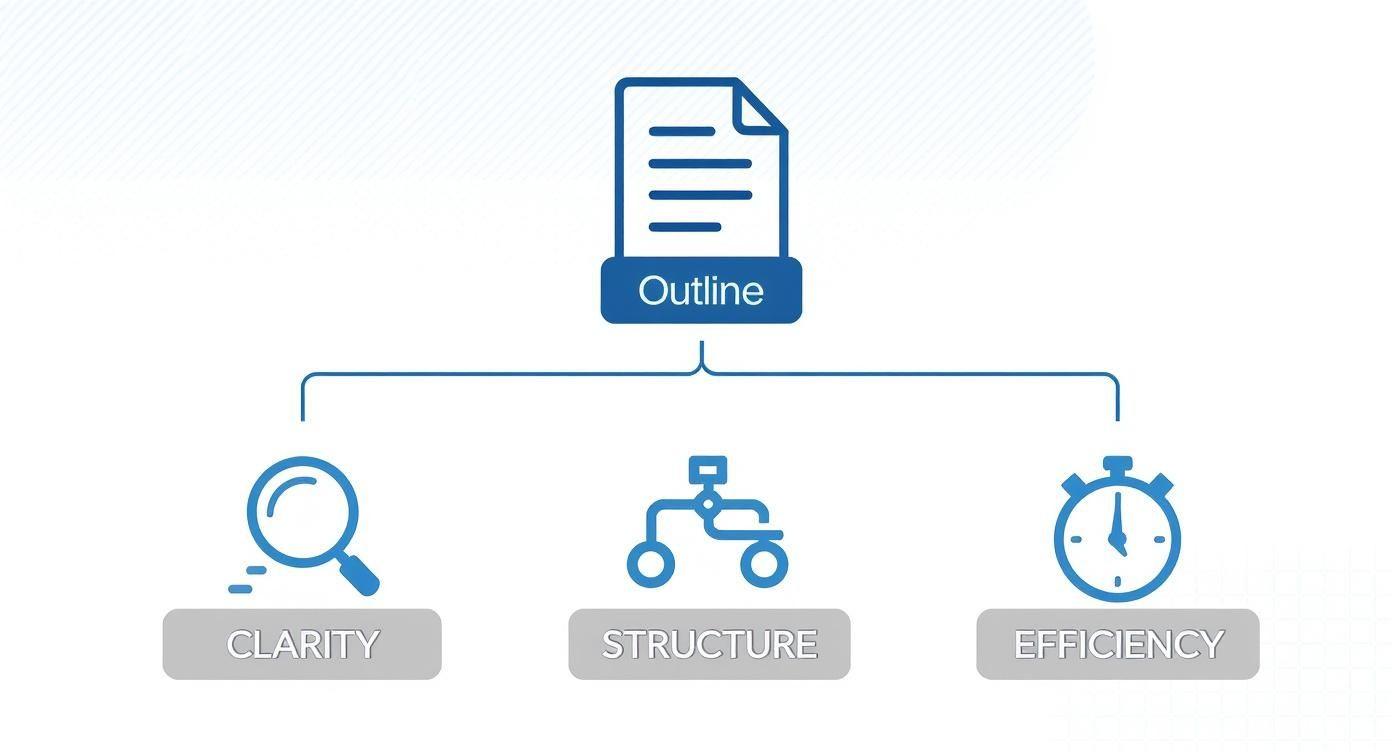
As you can see, a well-thought-out outline is the foundation. Get that right, and the rest of the structure practically builds itself.
Crafting a Compelling Thesis Statement
A great thesis has to be arguable, specific, and focused. A weak thesis just states a fact, something like, "Climate change is impacting coastal cities." It's true, but where's the argument?
A strong thesis takes a stand and needs evidence to back it up. For example: "The economic survival of coastal cities in Southeast Asia depends on immediate investment in adaptive infrastructure to mitigate rising sea levels." See the difference? Now you have a claim that needs proving.
To nail down your thesis, just ask yourself a few questions:
- What's the main question my research is trying to answer?
- What’s my specific take on this?
- Why does my argument even matter?
The answers to these will give you the heart of your thesis statement and the guiding light for the rest of your outline.
Developing Your Main Sections
Once your thesis is locked in, you need to figure out the main pillars that will support it. In a traditional outline, these are your big Roman numerals (I, II, III). Each one should tackle a distinct idea that directly reinforces your thesis.
Let's stick with our coastal cities example. The main sections might look something like this:
- I. Introduction: Lay out the problem and state the thesis.
- II. Current Economic Vulnerabilities: Detail the financial risks these cities already face.
- III. Case Studies of Successful Adaptive Infrastructure: Show, don't just tell, with real-world examples.
- IV. Projected Costs of Inaction vs. Investment: Use data to compare the economic outcomes.
- V. Conclusion: Bring it all together and drive the thesis home.
This creates a logical journey for your reader, moving them from understanding the problem to seeing evidence for your proposed solution. If you're looking for more ways to structure your ideas, check out this collection of essay outline examples for some inspiration.
Expert Tip: Don't just list generic topics for your main sections. Instead, frame them as mini-arguments. So, instead of a heading like "Economy," try something more active like "Current Economic Models Are Insufficient to Address Climate-Related Financial Shocks." This forces you to think argumentatively from the get-go.
Adding Supporting Points and Evidence
Okay, you've got your main sections. Now it's time to get granular. Under each of those big headings, you'll flesh things out with supporting points (A, B, C) and the specific evidence (1, 2, 3) that proves them. This is where all that research you've been doing finally comes into play.
Your supporting points are the smaller claims that build the argument within each section. The evidence is your proof. This can be anything from:
- Statistics and hard data
- Direct quotes from other scholars
- Findings from case studies
- Results from experiments
Don't underestimate how critical this level of detail is. A 2021 study looked at over 100,000 research papers and found that those with a clear, logical structure were 42% more likely to get accepted by peer-reviewed journals. A disorganized paper often gets rejected before the argument is even fully considered.
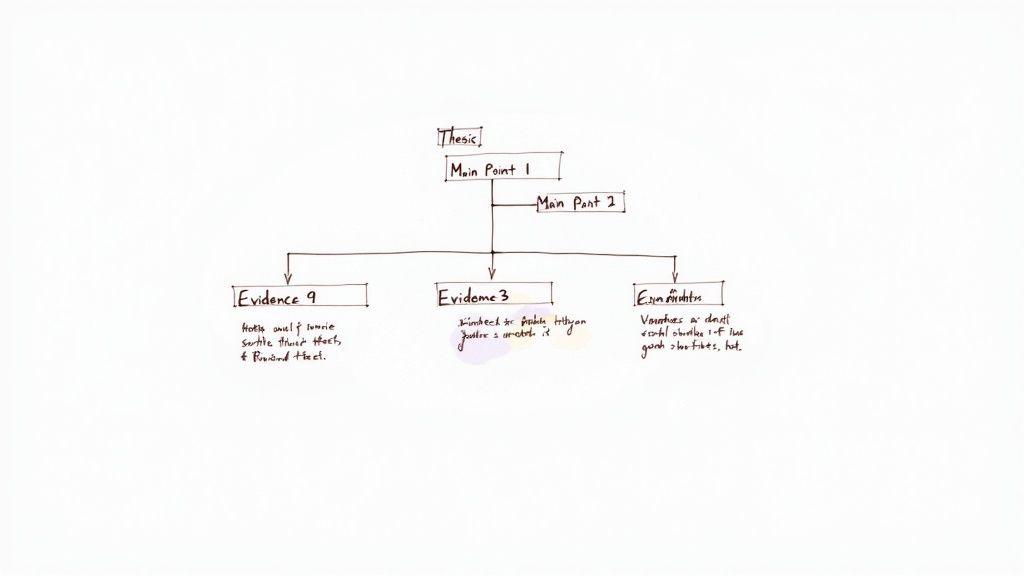
By breaking your argument down into this hierarchy—thesis, main sections, supporting points, and evidence—you create a powerful blueprint. Your outline stops being a simple list and becomes a strategic map. Trust me, it makes the actual writing process less about staring at a blank page and more about connecting the dots you’ve already laid out.
A Practical Approach to Building Your Outline
Alright, let's get tactical. We've covered the why behind outlining, but how do you actually get from a blank page to a working blueprint for your paper? Think of this less as following a rigid set of rules and more as building a flexible framework to guide your thoughts.
The beginning can feel like you're trying to untangle a giant knot of ideas, notes, and sources. The trick is to forget about perfection for now. Just focus on getting everything down on paper first; you can organize it all later.
First, a Brainstorming Free-for-All
Before you can build a structure, you need the raw materials. The absolute first step is a completely freeform brainstorming session. Don’t even think about hierarchy or logical flow yet. The only goal here is to dump every single idea, argument, and piece of evidence from your brain onto the page.
Let’s say you’re researching the impact of remote work on employee productivity. Your first pass might look like a chaotic jumble:
- Zoom fatigue is a real issue
- 2022 study showed productivity jumped in the tech sector
- What about team collaboration challenges?
- Work-life balance is crucial
- Mental health effects
- Find that quote about asynchronous communication
- Companies save money on office space
This "brain dump" is supposed to be messy. It’s a low-stakes way to start without getting paralyzed by the need to find the "perfect" opening. Once you have a big list, you can start seeing connections and grouping related ideas. For instance, "Zoom fatigue," "team collaboration," and "asynchronous communication" all fit nicely under a bigger topic like communication challenges. This is your first real step toward creating structure.
A Pro Tip From Experience: I always recommend using a tool that lets you move things around easily. Physical sticky notes are great, but so are digital versions on platforms like Miro, a mind map, or even just bullet points in a document that you can drag and drop. The ability to visually shuffle your ideas is a huge help at this stage.
Arranging Your Main Points for a Logical Flow
Now that you have your ideas in rough clusters, the next job is to sequence them in a way that tells a coherent story. A great research paper outline is all about crafting a narrative that guides your reader from one point to the next without leaving them confused.
The arrangement should always serve your thesis. If your central argument is that the benefits of remote work ultimately outweigh the drawbacks, you could structure your paper to first acknowledge the challenges, and then systematically tear them down with evidence of the benefits.
A flow that almost always works looks something like this:
- Introduction: Hook the reader, present the core problem, and state your thesis.
- Background/Context: Give the reader any historical or foundational info they need to understand your argument.
- Argument #1: Lay out your first major point that supports your thesis.
- Argument #2: Build on that with your second major point.
- Addressing Counterarguments: Acknowledge and dismantle opposing views. This makes your own position much stronger.
- Conclusion: Briefly summarize your points and restate your thesis, reinforced by the evidence you've presented.
Following a structure like this creates a clear path, making your argument persuasive and easy to follow.
Choosing Your Outlining Format
Before you start filling in the details, pick the format that feels right for you. The two most common options for a research paper outline are the alphanumeric system and the decimal system. Neither is inherently superior, but one might click better with your brain or your project's needs.
The alphanumeric outline is the classic you probably learned in high school. It uses a mix of Roman numerals, letters, and numbers to show hierarchy.
- I. Main Section
- A. Supporting Point
- Specific Evidence
- Another Piece of Evidence
- A. Supporting Point
- a. Minor Detail
The decimal outline accomplishes the same thing with a system of numbers. It often looks a bit cleaner and is pretty common in scientific and technical writing.
- 1.0 Main Section
- 1.1 Supporting Point
- 1.1.1 Specific Evidence
- 1.1.2 Another Piece of Evidence
- 1.1.2.1 Minor Detail
- 1.1 Supporting Point
This really comes down to personal preference. The alphanumeric style’s visual variety makes it easy to scan, but the decimal style can feel more intuitive for really complex papers with tons of sub-levels, since it clearly shows how every point nests within the larger structure.
Fleshing Out Each Section with Hard Evidence
Now it’s time to put it all together. Take the main points you sequenced and slot them into the top level of your outline (e.g., I, II, III or 1.0, 2.0, 3.0). Then, place your supporting claims under each main point as sub-points (A, B, C or 1.1, 1.2, 1.3).
This next part is the most important step: assign specific evidence to every single claim. Don't just write a placeholder like "add statistic here." Go ahead and plug in the actual data, quote, or source you plan to use.
For example:
III. Remote Work Boosts Employee Well-being
A. Increased Autonomy Leads to Higher Job Satisfaction
1. Cite Smith (2021) study showing a 45% increase in reported job satisfaction among employees with schedule flexibility.
2. Quote from employee interview: "Being able to manage my own time has been a game-changer for my mental health."
When you plug your evidence directly into the outline, you transform it from a simple to-do list into a detailed roadmap. Taking this extra step now makes the actual writing process infinitely smoother because you've already done the heavy lifting of connecting your claims to their proof.
Discipline-Specific Outline Examples and Templates
Not all research papers are built the same way. The path you take to build a compelling argument from primary sources in a history paper is worlds away from the methodical, empirical journey of a psychology experiment. If you try to shoehorn a humanities paper into a rigid scientific structure, you’ll end up with a mess. It just won't work.
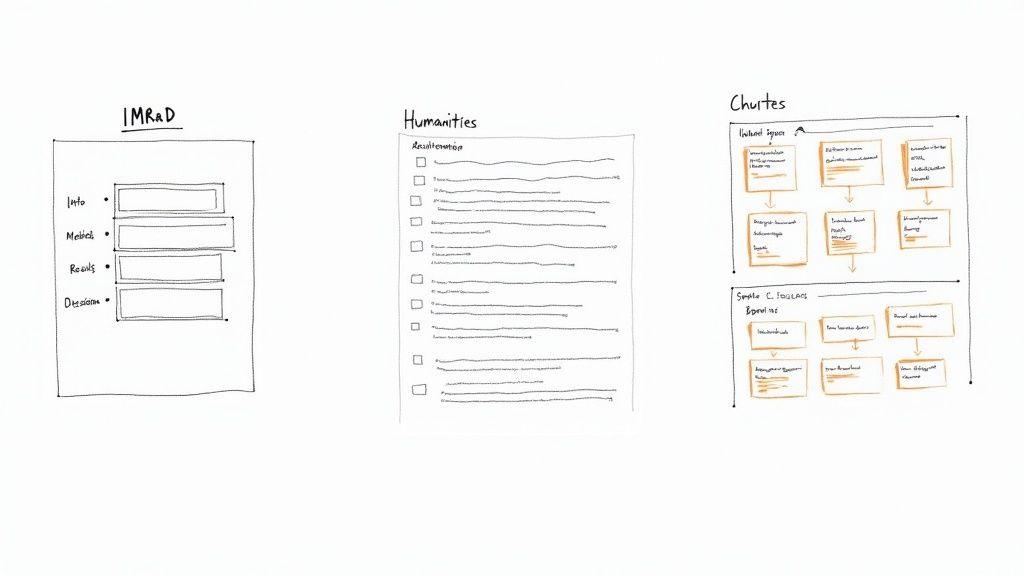
Knowing how to tailor your outline to your specific field is a skill that separates the pros from the amateurs. It signals to your professor that you're not just completing an assignment; you're participating in your discipline's academic conversation. Let's look at the two most common frameworks: the IMRaD structure for sciences and the argumentative model for the humanities.
The IMRaD Structure for Scientific Papers
In the sciences and social sciences, the name of the game is clarity, objectivity, and, most importantly, replicability. The IMRaD structure is the gold standard for a reason. It gives researchers a universal format for presenting empirical work in a logical, straightforward story: here’s the question we asked, here’s how we tried to answer it, here’s what we found, and here’s what it all means.
Think of it this way:
- Introduction: You’re setting the stage. What’s the problem? What do we already know? What gap in the knowledge are you trying to fill? This is where you state your clear research question and hypothesis.
- Methods: This is your recipe. You need to describe exactly what you did with enough detail that another researcher could repeat your study perfectly. This covers your participants, materials, and step-by-step procedures.
- Results: Just the facts, ma'am. Here, you present your findings raw and without interpretation. This section is all about the data, usually shown in tables, graphs, and statistical summaries.
- Discussion: Now it’s time to connect the dots. What do your results actually mean? How do they answer your original question? You’ll also discuss the study's limitations and suggest where future research could go from here.
The real power of IMRaD lies in its clean separation of objective findings (Results) from your subjective interpretation (Discussion). This builds immense credibility by letting readers evaluate your data on its own before they even consider your analysis.
Let's see what this looks like in practice.
Example IMRaD Outline for a Psychology Study
Thesis: Exposure to 15 minutes of guided mindfulness meditation daily will significantly reduce self-reported anxiety levels in college students compared to a control group.
- I. Introduction
- A. Hook: The growing anxiety crisis on college campuses.
- B. Lit Review: Brief overview of existing interventions (CBT, medication).
- C. The Gap: Introducing mindfulness as an accessible, low-cost alternative.
- D. Research Question & Hypothesis: Can daily guided meditation reduce student anxiety?
- II. Methods
- A. Participants: 80 undergraduate volunteers, randomly assigned to either the experimental or control group.
- B. Materials: Pre- and post-testing using the Beck Anxiety Inventory (BAI); one 15-minute guided meditation audio file.
- C. Procedure: Experimental group listens to the audio daily for 4 weeks. The control group does not. Both groups complete the BAI at week 1 and week 4.
- III. Results
- A. Baseline Data: Present pre-test BAI scores to show no significant difference between groups at the start.
- B. Outcome Data: Present post-test BAI scores for both groups.
- C. Statistical Analysis: Report results of a t-test showing a statistically significant reduction in BAI scores for the meditation group (p < .05), with no significant change in the control group.
- IV. Discussion
- A. Interpretation: The findings strongly support the hypothesis.
- B. Context: How this result aligns with (or challenges) previous studies on mindfulness.
- C. Limitations: Note the small sample size and reliance on self-report measures.
- D. Future Research: Suggest exploring long-term effects or comparing different types of meditation.
The Argumentative Structure for Humanities Papers
Research in the humanities isn't about running an experiment. It's about building a powerful argument, offering a fresh interpretation of a text, or re-examining a historical event. Here, the outline is your argumentative roadmap, organized thematically to support a central thesis. Each section is a key pillar holding up your main claim.
While this structure is much more flexible than IMRaD, it still demands a crystal-clear logical flow. You’re guiding the reader through your reasoning, using evidence from primary and secondary sources to build your case piece by piece. If you do it right, your conclusion should feel not just supported, but inevitable.
Example Argumentative Outline for a History Paper
Thesis: While economic grievances were a significant factor, the collapse of the Roman Republic was primarily driven by the erosion of political norms and the rise of personal armies loyal to individual generals rather than the state.
- I. Introduction
- A. The Conventional Wisdom: Most arguments point to economic inequality as the main culprit.
- B. My Intervention: Introduce a counter-argument that political and military decay were the true fatal wounds.
- C. Thesis Statement.
- II. Body Paragraph Block 1: The Crumbling of Political Norms
- A. Point 1: The Gracchi brothers' challenge to senatorial authority.
- B. Point 2: Sulla's use of proscriptions to wipe out his political rivals.
- C. Point 3: How the First Triumvirate openly disregarded constitutional rules.
- III. Body Paragraph Block 2: The Rise of the Client Armies
- A. Cause: The Marian reforms shifted soldier loyalty from the Roman state to their general.
- B. Evidence: A case study on Caesar's legions in Gaul and their fierce personal loyalty to him.
- C. Consequence: The civil wars became battles between commanders (Caesar vs. Pompey), not conflicts over the future of Rome.
- IV. Addressing the Counter-Argument
- A. Acknowledge the role of economic pressures (land distribution, slave labor).
- B. Rebuttal: Argue these economic problems only became fatal once the political institutions that could have solved them had failed.
- V. Conclusion
- A. Synthesize the political and military evidence.
- B. Restate Thesis in a new light: The Republic's fall was a political failure that enabled an economic collapse, not the other way around.
- C. "So What?": Briefly discuss the broader implications for understanding why any political institution fails.
The structure you choose isn't just a matter of preference; it's about speaking the language of your discipline. The table below gives a quick side-by-side look at how these two approaches organize information.
Comparison of Outline Structures Across Disciplines
| Component | Scientific Papers (IMRaD) | Humanities Papers (Argumentative) |
| Primary Goal | To report objective, replicable findings from an experiment or study. | To build a persuasive, evidence-based argument or interpretation. |
| Introduction | Establishes context, identifies a research gap, and states a testable hypothesis. | Introduces a topic, presents a scholarly debate, and asserts a clear thesis statement. |
| Body Structure | Rigid sections: Methods (how it was done), Results (what was found). | Flexible thematic or chronological sections, each supporting a key point of the main argument. |
| Evidence | Quantitative or qualitative data collected through systematic procedures. | Textual analysis, primary source documents, historical records, philosophical reasoning. |
| Conclusion | Discussion section interprets results, notes limitations, and suggests future research. | Synthesizes the main points of the argument, restates the thesis, and discusses broader implications. |
Ultimately, whether you're working with data or texts, the goal is the same: to present a clear, logical, and convincing piece of scholarship. Choosing the right framework is the first and most critical step.
Modern Tools and Techniques for Better Outlining
Sure, the classic pen-and-paper outline has its charm, but let's be honest—going digital can make the whole process faster, more flexible, and a lot less messy. Modern tools do more than just create a digital to-do list; they can actually help you organize your thoughts and build a dynamic blueprint for your paper.
You might be surprised to learn that powerful outlining features are already hiding in the software you use every day. Both Microsoft Word and Google Docs have robust tools that let you collapse, expand, and reorganize entire sections with a simple drag-and-drop. This makes it incredibly easy to experiment with the flow of your argument without the headache of endless copying and pasting.
Dedicated Outlining and Research Apps
For bigger projects like a thesis or dissertation, you'll probably want something with a bit more muscle. That's where dedicated research and writing apps come in. These platforms are built from the ground up to help you manage mountains of notes, sources, and drafts all in one place.
A few favorites among students and seasoned researchers include:
- Scrivener: This is the heavyweight champion for long-form writing. It allows you to break your paper into small, manageable pieces and rearrange them on a virtual corkboard. It’s a lifesaver if you don’t think in a perfectly straight line.
- Notion: Think of Notion as a set of digital LEGOs for your research. Its flexibility is its greatest strength. You can create nested pages for your ideas, databases for tracking sources, and even kanban boards to visualize your progress. It’s perfect for visual thinkers who love to organize.
- Miro or Mural: These are essentially infinite digital whiteboards. They are fantastic for that messy, initial brainstorming phase where you’re just trying to get ideas out. You can create mind maps, flowcharts, and cluster concepts with digital sticky notes before locking anything into a formal structure.
This isn't just about a new trend; it's about a smarter way to work. A 2023 survey of 5,000 students revealed that 68% were already using digital tools for their outlines. The results? They reported a 25% increase in drafting efficiency and needed 33% fewer major revisions than students who stuck with analog methods. You can dig into the impact of digital tools on academic writing to see the data for yourself.
Key Insight: The best tool isn't the one with the fanciest features—it's the one that clicks with how you think. If you’re a visual planner, a mind-mapping tool will feel natural. If you're juggling hundreds of sources, something like Scrivener is a sound investment.
Choosing the Right Tool for Your Workflow
So, how do you actually choose? It really boils down to your project's complexity and your personal style.
If you’re tackling a standard-length paper and already live in Word or Docs, just learning to use the built-in "Outline View" or "Document Outline" is probably all you need. It’s simple, effective, and you don’t have to learn a new piece of software.
On the other hand, if your project is a beast—involving a massive literature review, multiple datasets, or a non-linear writing process—a dedicated app will pay for itself in saved time and sanity. These tools help you keep an eye on the big picture while your detailed notes and sources are always just a click away.
Ultimately, picking up any of these tools can lead to a clearer outline and a much stronger final paper. Once your structure is solid, you might find our guide on the best AI paragraph writer helpful for fleshing out those well-planned ideas.
Common Questions About Outlining a Research Paper
Even with a solid plan, a few questions always seem to pop up when you get down to the business of outlining. Getting these sorted out early can save you a ton of headaches down the road, turning what could be a major roadblock into a minor speed bump. Let's dig into some of the most common things that trip people up.
So, how detailed should this thing actually be? A good rule of thumb is to have each major point or sub-point in your outline represent roughly one paragraph in the final paper. It's a balancing act. If it's too vague, it won't help you write, but if it's too detailed, you're basically writing the first draft twice.
A really effective outline will always feature your complete thesis statement, the topic sentence for each main body section, and a note on the specific evidence—like a key statistic, a powerful quote, or a particular source—you'll use to back it up. When you get this right, writing the paper feels less like inventing something from scratch and more like connecting the dots.
Topic Outlines Versus Sentence Outlines
Another big question is about the format itself. Should you go with a topic outline or a sentence outline?
A topic outline is your best friend during the early brainstorming phase. It uses short phrases and keywords, which makes it perfect for getting your big ideas down on paper and rearranging them quickly. It’s all about speed and flexibility.
On the other hand, a sentence outline is much more rigorous. Every single point is a full, grammatically complete sentence. It definitely takes more work upfront, but for a complex research paper, it’s a game-changer. This format forces you to really think through your logic and articulate your arguments clearly before you’ve written a single paragraph of prose, exposing any weak links in your reasoning from the get-go.
Think of your outline as a living document, not something carved in stone. It’s supposed to evolve as your research deepens. Don't be afraid to go back and tweak it—that’s a sign you're thinking critically, not that you planned poorly.
Can I Change My Outline After I Start Writing?
Not only can you, but you absolutely should. The research and writing process is one of discovery. You’ll stumble upon new evidence, see a new connection between ideas, or realize one of your arguments would be much stronger if you presented it earlier. That's all a natural part of doing good academic work.
Trust me, it's far easier to move a couple of lines around in a one-page outline than it is to perform major surgery on a 15-page draft. Your outline is a tool to serve your paper, not the other way around. Once it feels solid, it becomes the perfect roadmap for writing each section, starting with a strong introduction. For more on that, take a look at our guide on how to write an introduction for a research paper.
Common Mistakes to Avoid
Finally, let's talk about the classic pitfalls. Knowing what they are is half the battle. The single biggest mistake I see is creating an outline that's just too vague. Points like "Discuss history" or "Analyze data" give you zero direction when you're staring at a blank page.
Keep an eye out for these common blunders:
- Vague Entries: Instead of "Analyze data," get specific: "Analyze Q3 sales data to show a 15% decline post-campaign." Actionable details make all the difference.
- Unbalanced Structure: If one major section has ten sub-points and another has only one, that's a red flag. It usually means your argument is lopsided and needs to be rebalanced.
- Creating a Simple List: An outline shouldn't just be a laundry list of facts. It needs to tell a story, showing the logical flow of your argument and guiding the reader from your thesis all the way to your final conclusion.