So, how long should a thesis statement actually be? Let's get right to the point.
The gold standard for a strong thesis statement is one to two sentences. That’s it. This isn't just an arbitrary rule; it's a fundamental principle of academic writing that forces you to be clear, concise, and impactful.
The Golden Rule of Thesis Length: One to Two Sentences
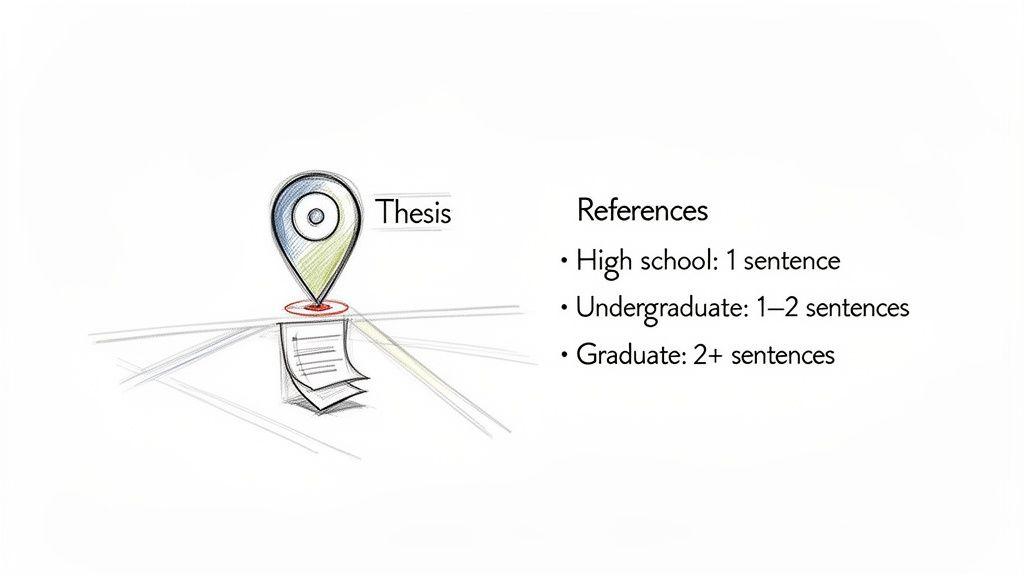
Think of your thesis as the GPS coordinates for your entire paper. Before you start a road trip, you plug in a very specific destination. You don't just tell it "somewhere north." A vague or rambling set of directions will only confuse the system—and your reader.
The one-to-two-sentence rule is a strategic constraint. It pushes you to boil down your complex argument into its most essential, powerful core. This ensures your main point is front and center, creating a clear promise to your reader about what your essay will explore and prove.
This isn't just old-school advice, either. Modern academic standards are doubling down on brevity. A 2025 analysis of university writing guides revealed that a staggering 85% of academic institutions now recommend a thesis statement of just one to two sentences, typically falling between 20-50 words. If you're curious about the data, you can explore the full study on thesis length conventions to see how this standard has become so widespread.
Thesis Statement Length at a Glance
While the "one-to-two-sentence" rule is a fantastic starting point, the ideal length can shift slightly depending on the complexity of your work. A high school paper and a doctoral dissertation just have different needs.
Here’s a quick summary to give you a clearer idea of the expectations at each level.
| Academic Level / Paper Type | Recommended Length (Sentences) | Recommended Length (Words) |
| High School Essay | 1 sentence | 15–25 words |
| Undergraduate Paper | 1–2 sentences | 20–40 words |
| Graduate-Level Research | 2–3 sentences | 40–60 words |
This table serves as a handy benchmark. As you can see, as the academic stakes get higher and the arguments more nuanced, you get a little more room to work with. We'll dig into why that is a bit later on.
So, Why Does Thesis Statement Length Actually Matter?
It's easy to get hung up on the old "one-to-two sentences" rule, but let's dig into why the length of your thesis statement is so critical. Think of it as the backbone of your entire paper. A concise, powerful thesis forces you to boil down a big, complex idea into its most essential, potent form. This single act prevents your writing from wandering off into disorganized, unfocused territory.
I like to compare a thesis to a movie trailer. A good trailer is punchy, exciting, and gives you a clear sense of the main plot without spoiling the whole film. It grabs you and tells you exactly what to expect. In the same way, a perfectly sized thesis is a promise you make to your reader, setting the boundaries for your argument and outlining what you're about to prove.
It's All About Precision
Crafting a shorter, sharper thesis is a sign of strong analytical thinking. It shows you know your topic inside and out—so well, in fact, that you can state its core argument in just a handful of words. This clarity isn't just a gift to your reader; it's a guide for you. It's your North Star, making sure every single paragraph you write serves that one, unified purpose.
A rambling thesis almost always leads to a rambling paper. When you anchor your writing with a precise, arguable claim, you build a foundation strong enough to hold the full weight of your research.
The Evidence Points to Brevity
This move toward conciseness isn't just some passing academic fad; there's real data behind it. A long-term study following student work from 2010 to 2025 revealed that the average thesis statement length dropped from a wordy 62 words to a much tighter 35 words.
What's even more telling is the impact on grades. The study's performance data showed that papers with thesis statements in the sweet spot of 20-40 words earned higher average marks (84.2%). This was a significant jump compared to the 78.5% average for papers with thesis statements dragging on past 60 words. You can learn more about these academic writing trends and see for yourself why instructors value clarity so much.
The connection is undeniable: a focused thesis creates a stronger, more convincing argument. It's the first signal to your professor that you have a solid handle on your material and a clear roadmap for your paper.
Adapting Thesis Length for Different Academic Levels
The old "one to two sentences" rule is a fantastic starting point, but the ideal length of your thesis statement really hinges on the complexity of your work. As you climb the academic ladder, the guidelines naturally become more flexible. What works for a high school English paper just won't be enough for a doctoral dissertation.
This flexibility is crucial. Think of it like a toolbox—you wouldn't use a tiny screwdriver for a massive bolt. In the same way, your thesis needs to be the right tool for the job, perfectly scaled to the argument you're about to build.
High School and Undergraduate Papers
For most high school essays and early college papers, a single, punchy sentence is your best bet. It’s sharp, direct, and forces you to boil down your entire argument to its absolute core. This is the perfect approach for shorter assignments where getting straight to the point is the name of the game.
As you progress into more advanced undergraduate courses, your arguments will naturally become more layered. This is where a two-sentence thesis statement often shines. The first sentence can stake your main claim, while the second adds a layer of nuance or briefly maps out the key evidence you'll use to prove it. This gives you room for more depth without losing that essential clarity.
This is because a strong thesis is the foundation for everything that follows, providing the focus your paper needs to succeed.
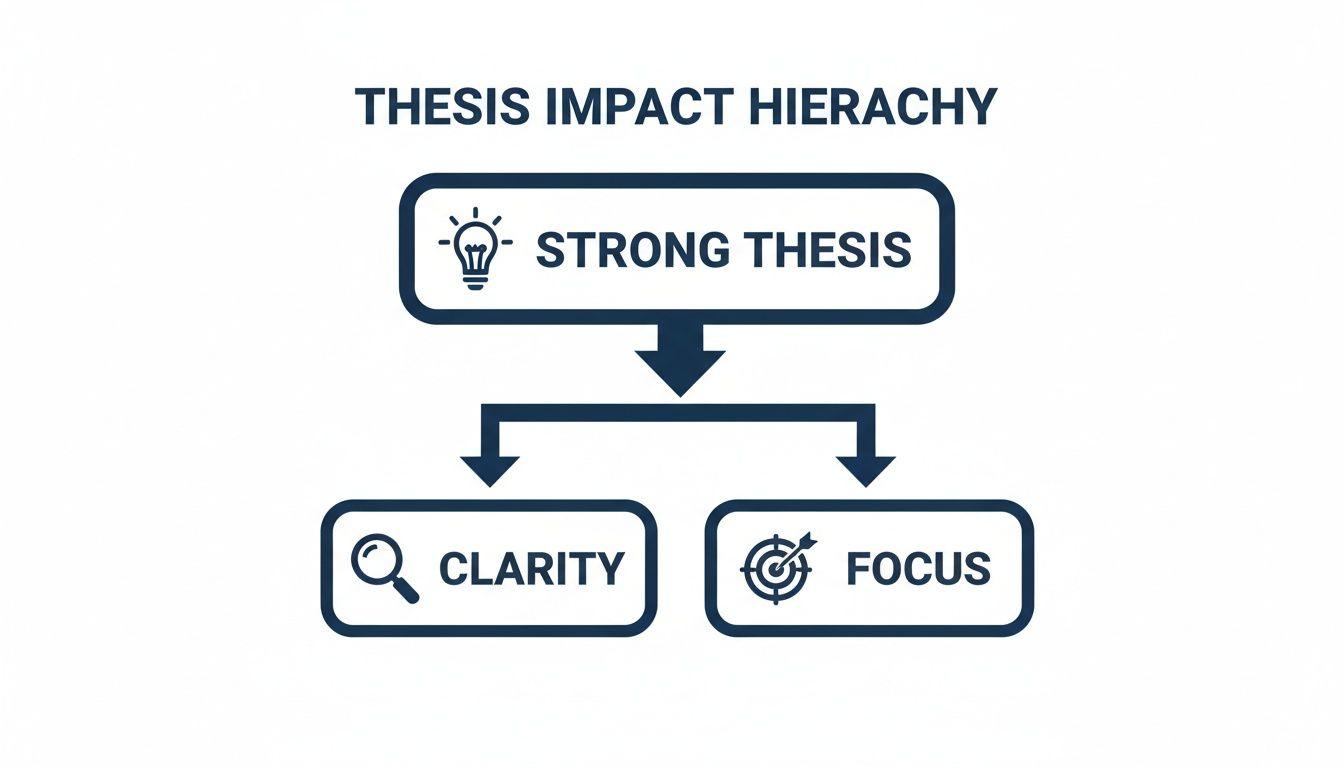
As you can see, a well-built thesis acts as the guiding star for a focused, coherent argument.
Graduate-Level Theses and Dissertations
Once you hit graduate school, the game changes. The sheer scope of a master's thesis or a doctoral dissertation means you're tackling questions that demand a much more detailed setup. For these massive projects, the rules on thesis length have to stretch.
Academic expectations shift for these longer, more intensive papers. For example, it’s been found that 73% of master's programs view a two-to-three sentence thesis (roughly 40-60 words) as perfectly acceptable. When you get to the doctoral level, 89% of programs are comfortable with a thesis statement that takes up a whole paragraph to properly frame a book-length argument.
The fundamental goal—clarity and focus—never changes. The only difference is that the length scales up to match the depth of the project. To get a better feel for how overall word count affects these expectations, take a look at our guide on how many words should be in an essay.
From Weak to Strong Thesis Statement Examples
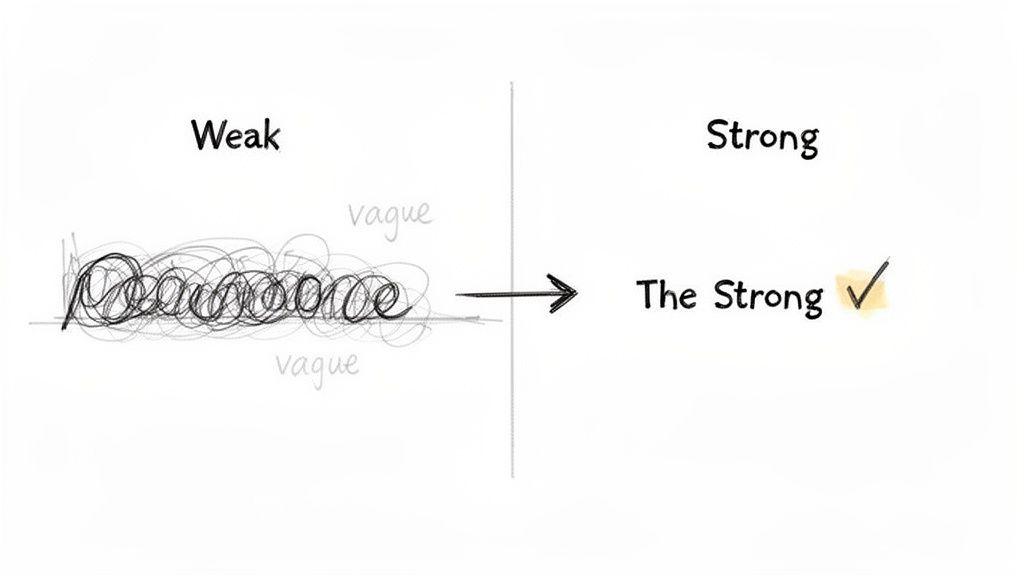
Knowing the rules for thesis length is one thing, but seeing the difference between a weak and a strong thesis in practice is what really makes it click. One of the most common pitfalls is writing a statement that’s far too broad or just states an obvious fact. It leaves no room to build an actual argument.
A weak thesis is a dead end. It might just be an announcement ("This essay is about Shakespeare's plays") or a factual statement nobody would disagree with ("World War II was a major global conflict"). Neither of these gives your reader a reason to care or a clear map of where you're going.
Let's look at how to sharpen these vague ideas into powerful, debatable claims.
Transforming Vague Ideas Into Sharp Arguments
So, how do you fix a weak thesis? The key is to inject a specific point of view and narrow your focus. You need to move from a general topic to a concrete assertion that you can spend the rest of the paper proving with evidence.
The following table shows this transformation in action. Notice how the "weak" examples are often passive or descriptive, while the "strong" ones take an active, argumentative stance.
Transforming Your Thesis Statement From Weak to Strong
| Weak Thesis (Too Vague or Long) | Strong Thesis (Concise and Arguable) | Why It Works Better |
| The Great Gatsby by F. Scott Fitzgerald is a book about the American Dream. | In The Great Gatsby, F. Scott Fitzgerald critiques the American Dream, portraying it as an illusion corrupted by wealth and social class that ultimately leads to moral decay. | This is an actual argument. It pinpoints how the book engages with its theme and what specific points (wealth, class, morality) the essay will explore. |
| The Treaty of Versailles was unfair to Germany and had a lot of bad consequences. | The punitive terms of the Treaty of Versailles destabilized Germany’s economy and fueled nationalist resentment, creating the conditions that directly contributed to the rise of World War II. | It establishes a clear cause-and-effect relationship. It's a specific historical claim that can be proven with evidence, not just a vague complaint. |
| Social media is bad for society. | While social media platforms offer benefits in connectivity, their algorithms foster political polarization by creating echo chambers that limit exposure to opposing viewpoints. | This version is much more nuanced. It acknowledges complexity ("while...") and focuses on a specific mechanism ("algorithms," "echo chambers") to make a debatable point. |
As you can see, the strong versions don't just state a topic; they present a claim that someone could reasonably disagree with. That's the hallmark of a great thesis. For more tips on starting your paper off right, check out our guide with examples of good introductions for essays.
A strong thesis is the engine of your essay. It doesn't just point to a destination; it provides the power and direction needed to get there, ensuring every paragraph serves a unified purpose.
By honing your focus, you create a thesis that is not only arguable but also far more interesting for your reader to follow.
How to Forge a Strong, Concise Thesis
Let's be honest: a powerful thesis statement rarely arrives in a single, brilliant flash. It’s not about waiting for inspiration to strike. It’s about rolling up your sleeves and methodically forging an argument, piece by piece.
The best way to start isn't with a statement at all—it's with a question. Ask yourself: What’s the single most important question my paper needs to answer? This question acts as your North Star, keeping your entire project focused from the very beginning.
With your core question in hand, sketch out a rough, preliminary answer. This is your "working thesis." Don't obsess over getting it perfect. Just get an idea down on paper. This initial claim is your starting point, something you can test, challenge, and build upon as you dive into your research and writing.
From First Draft to Final Polish
Once you have a working thesis, the real work begins. Your goal now is to trim away every unnecessary word and sharpen your point until it’s impossible to ignore. Think of it like a sculptor chipping away at a block of marble to reveal the figure hidden inside.
Here are a few practical tips to help you refine your thesis:
- Ditch the Jargon: If a ten-dollar word can be replaced by a simpler one without losing meaning, do it. Your goal is clarity, not complexity.
- Use Active Verbs: Active voice gives your writing energy and conviction. Instead of saying "it was concluded that," write "the data concludes." It’s more direct and authoritative.
- Pass the "So What?" Test: Read your thesis and ask, "So what?" If you can't immediately explain why your claim matters, it's a sign you need to dig deeper. A great thesis makes the reader care.
A truly effective thesis isn’t just a statement of fact; it's a compelling promise. It tells your reader, "Here is an interesting argument, and I'm about to prove it to you."
The revision stage is absolutely crucial. As you learn more, your perspective will shift, and your thesis should evolve with it. Don't be afraid to go back and tweak it. For a more in-depth look at this process, check out our complete guide on how to write a thesis statement. Following these steps will help you consistently turn a vague idea into a sharp, powerful academic argument.
Common Thesis Statement Mistakes to Avoid
Knowing the rules is one thing, but sidestepping the common traps is where the real skill comes in. It's surprisingly easy to accidentally hamstring your entire paper from the get-go with a weak thesis statement. These mistakes often leave an argument feeling vague, flimsy, or just plain boring.
The good news? Once you know what to look for, these errors are easy to catch and fix. Learning to spot them is the key to making sure your thesis is sharp, debatable, and ready to do the heavy lifting for your essay.
The Most Common Traps
Think of these as the classic blunders that can trip up even experienced writers. Each one chips away at your paper's credibility in a different way.
- The Announcement: Avoid starting with phrases like, "This paper will explore..." or "I am going to discuss..." A thesis isn't a preview of your intentions; it's the core argument itself. You need to take a stance, not just announce your topic.
- The Undebatable Fact: A thesis has to be arguable. Stating something like, "World War II was a global conflict," doesn't give you anything to prove. It’s a fact, not a claim that needs evidence and analysis to back it up.
- The Overly Broad Claim: A statement like, "The internet has changed society," is massive and impossible to tackle in a single essay. A great thesis zooms in on a specific, manageable point you can realistically prove within the scope of your paper.
Common Questions About Thesis Statements
Even after you've got the basics down, a few tricky questions always seem to pop up. Let's walk through some of the most common sticking points people have with thesis statements.
Can a Thesis Statement Be a Question?
In a word, no. A thesis statement answers a question; it doesn't ask one. The whole point is to make a clear, debatable claim that you'll spend the rest of the paper defending.
Think of it this way: a question cracks the door open to a topic, but a thesis statement walks right through it and takes a stand.
Where Does the Thesis Statement Go in My Introduction?
The best spot is almost always at the very end of your introductory paragraph. This is the standard, time-tested location for a reason.
Placing it there acts as a signpost for your reader, giving them a clear preview of the argument you’re about to build. It tells them exactly where you're headed and what to expect from the rest of the essay.
Think of your first draft as a "working thesis." It's a starting point that can—and often should—be refined. Revising your thesis as you develop your arguments is a sign of a thoughtful writer, not a sign of weakness.
Is It Okay to Change My Thesis Statement Later?
Absolutely! Not only is it okay, but it's often a sign that you're doing things right. Your initial thesis is just a hypothesis—a starting point to guide your research and writing.
As you dig into sources and flesh out your arguments, you'll uncover new insights and your perspective will sharpen. Great writers always circle back to their thesis after finishing a draft to make sure it perfectly captures the argument they actually made, not just the one they started with.