To get market research right, you have to start with a solid foundation. This means getting crystal clear on your goals, nailing down your specific questions, and then building a simple, structured plan. If you get this part right, every survey you send and every competitor you analyze will be laser-focused, saving you from chasing irrelevant data that wastes time and money.
Setting the Stage for Smart Market Research
Jumping into research without a plan is a classic mistake. It feels like you're doing something productive, but you're really just sailing without a compass. For a small business, where every dollar and every hour is precious, that's a risk you can't afford.
This initial setup phase is all about defining what you truly need to know and why it matters to your bottom line. It’s what turns a vague fishing expedition for data into a targeted mission to answer your most critical business questions.
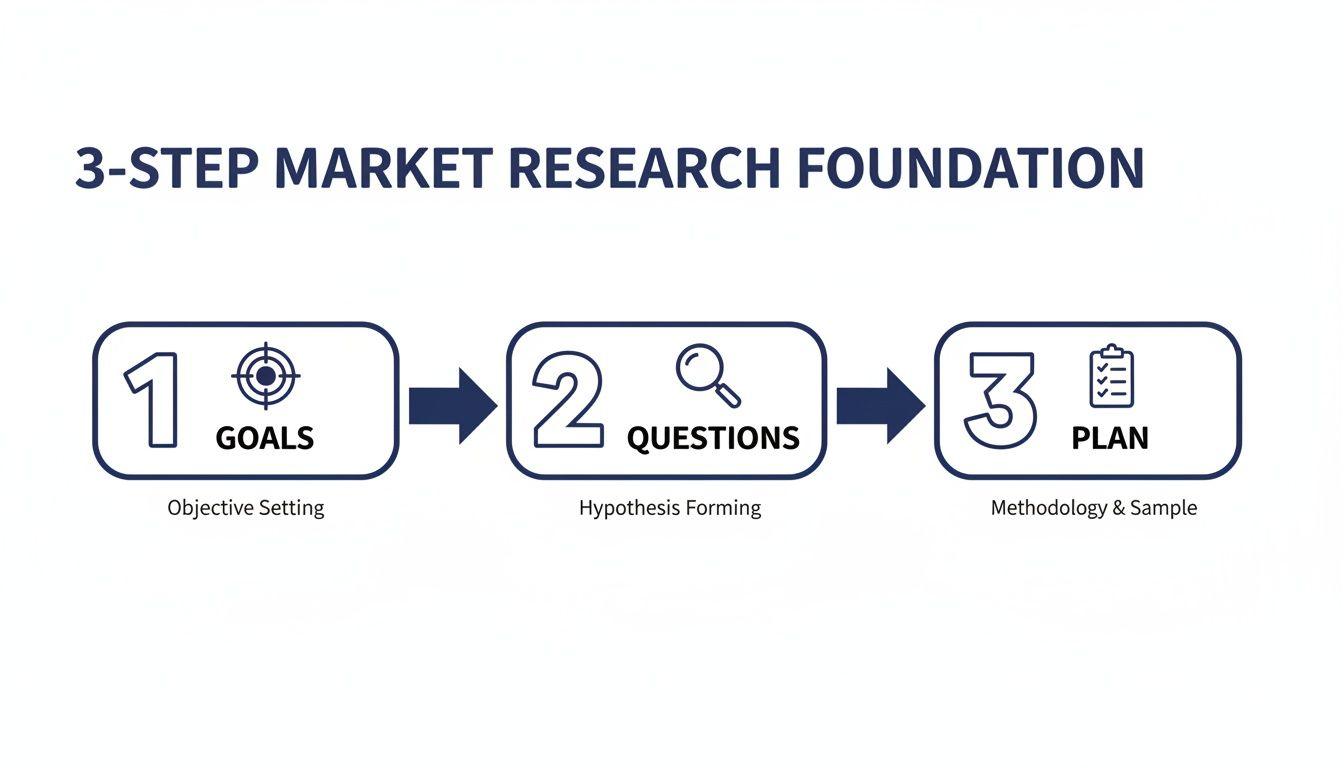
Start With Your Business Objectives
Before you draft a single survey question, step back and look at the big picture. What are you actually trying to accomplish with your business? Are you aiming to boost sales by 20% this quarter? Thinking about opening a second location? Maybe you want to add a new service to your lineup.
Your research objectives need to flow directly from these business goals. Think of it this way:
- If your business goal is to… increase customer retention,
- Then your research objective should be to… understand the top three reasons customers choose your coffee shop over the one down the street.
- If your business goal is to… successfully launch a new vegan pastry line,
- Then your research objective should be to… gauge the local demand and find the perfect price point for those pastries.
This alignment keeps your work grounded. You're not just collecting interesting facts; you're gathering intelligence to make a specific, high-impact decision.
A well-defined objective is your North Star. It helps you say "no" to interesting but ultimately distracting rabbit holes and keeps you focused on information that moves the needle.
Translate Objectives Into Precise Questions
Once your objective is locked in, it's time to break it down into specific, answerable questions. Vague questions yield vague, useless answers. Don't just ask, "What do people think of our website?" That's too broad.
Get granular. Good research questions are specific and measurable.
- Instead of: Do people like our new feature?
- Ask: How much would our current paying customers be willing to pay per month for the new invoicing feature?
- Instead of: Is our branding working?
- Ask: What three words do local residents aged 25-40 associate with our brand after seeing our latest social media campaign?
These sharp questions become the blueprint for your surveys and interview scripts. When you have these nailed down, you’re ready to think about your methods. To see how all these pieces fit together, take a look at our guide for creating a sample research plan.
The stakes are high. Between March 2021 and March 2022, small businesses created 1.2 million new establishments in the US but also saw 833,979 closures. Good research is what helps you end up on the right side of that statistic.
Picking the Right Research Tools (Without Breaking the Bank)

Let's be honest: when you hear "market research," it's easy to picture a team of expensive consultants and massive budgets. But that's not the reality for most small businesses. The good news is, you don’t need a corporate-sized wallet to get powerful insights.
You just have to be a little scrappy and smart about it.
Your research tools will generally fall into two buckets: quantitative and qualitative. The easiest way to think about them is the "what" versus the "why."
- Quantitative Research is all about the numbers. It gives you the hard data to answer questions like "how many," "how often," and "what percentage." This is how you spot trends and validate your gut feelings with actual evidence.
- Qualitative Research is about the stories and feelings behind those numbers. It digs into the "why" by exploring customer motivations, frustrations, and experiences in their own words.
The smartest small business owners I know use a mix of both. They might run a quantitative survey that reveals a problem, then follow up with qualitative interviews to truly understand what’s causing it.
Getting the Numbers: Low-Cost Quantitative Methods
Gathering cold, hard data is cheaper and easier than you might think. The goal here is to get measurable feedback from enough people to see clear patterns emerge.
Online Surveys are the absolute workhorse of budget-friendly research. They’re a fantastic way to reach a lot of people quickly without spending a dime.
- The Go-To Tools: Free platforms like Google Forms or the free tier of SurveyMonkey are perfect for this. They're simple to use and even give you basic charts to help you make sense of the answers.
- A Real-World Example: Imagine a local bakery wants to add a new gluten-free line. They could whip up a quick 10-question survey and post the link in local Facebook groups and on their Instagram. This gives them a feel for demand and what people are willing to pay before they buy a single bag of expensive flour.
Social Media Polls are perfect for getting a quick pulse-check from your existing followers. Platforms like Instagram, X (formerly Twitter), and Facebook have built-in polling features that are ideal for simple, direct questions. Use them to A/B test a new logo concept or see which promotional offer gets more people excited.
Finding the "Why": Budget-Friendly Qualitative Methods
This is where you uncover the rich, detailed insights that numbers alone can never give you. It requires a bit more hands-on effort, but it's where the real magic happens.
One-on-One Customer Interviews are pure gold. I'm not kidding—a single 30-minute chat with a real customer can teach you more than 100 survey responses. These conversations let you ask follow-up questions and dig deep.
- The Go-To Tools: You don't need fancy software. Free video conferencing tools like Zoom or Google Meet work perfectly for scheduling and conducting these calls.
- An Expert Tip: Don't just cherry-pick your happiest, most loyal customers. Make a point to talk to people who canceled their subscription or left a so-so review. Their feedback can be tough to hear, but it's often the most valuable for figuring out how to improve.
Observational Research sounds more complicated than it is. It's simply about watching how people actually interact with your business. If you run a coffee shop, hang out for an hour and see which part of the menu people stare at the longest. If you have a website, use a free heat-mapping tool to see where people are actually clicking.
The most powerful insights often come from observing what people do, not just what they say they do. Actions speak louder than survey responses.
Another no-cost powerhouse is simply listening online. Scour your social media comments, read your Google reviews, and lurk on forums like Reddit. See what people are saying about you and your competitors. This is raw, unfiltered feedback straight from the source. You can even explore how AI tools for competitive analysis can help automate some of this listening, saving you precious time.
Low-Cost Market Research Methods Comparison
To help you decide where to start, here's a quick breakdown of the most common budget-friendly methods. Each has its own strengths, so think about what you're trying to learn.
| Method | Best For | Pros | Cons | Estimated Cost |
| Online Surveys | Validating ideas, measuring satisfaction, segmenting your audience | Scalable, fast, low-cost, easy to analyze quantitative data | Lacks deep context, low response rates can be an issue | $0 - $50 (with free tools) |
| Social Media Polls | Getting quick feedback, testing simple ideas, engaging your audience | Instant results, free, high engagement with existing followers | Limited to simple questions, only reaches your current audience | $0 |
| Customer Interviews | Understanding motivations, exploring problems in-depth, getting rich stories | Deep insights, builds customer relationships, flexible | Time-consuming, not statistically significant, hard to scale | $0 (or small incentives like gift cards) |
| Observational Research | Seeing how users actually behave, identifying usability issues | Unbiased (actions, not words), reveals unexpected behaviors | Can be difficult to interpret the "why," may require specific tools | $0 - $30 (for basic online tools) |
| Secondary Research | Analyzing competitors, understanding industry trends, finding existing data | Saves time and money, provides broad context, great starting point | Data may be outdated, not specific to your exact questions | $0 (using public sources) |
Ultimately, the best approach is often a blend. Start with some free secondary research to understand the landscape, then launch a survey to get some hard numbers, and finally, conduct a few interviews to bring those numbers to life.
Digging for Gold: Uncovering Insights with Secondary Research
Before you even think about writing a survey or scheduling an interview, you need to do your homework. There's a mountain of valuable information already out there, just waiting for you to find it. This is the world of secondary research, and it’s always the smartest place to start.
Think of it as reconnaissance. You’re gathering existing data that others have already collected, which saves you an incredible amount of time, money, and headaches. You wouldn't build a house without surveying the land first, right? Same principle. This step gives you the lay of the land—the foundational context you need before you invest in your own research.
Start with Public and Government Data
Believe it or not, some of the most powerful and reliable data is completely free, courtesy of government agencies and public institutions. These organizations spend millions of dollars collecting the very information that can give you a bird's-eye view of your industry and potential customers.
Here are a few of my go-to sources:
- The U.S. Small Business Administration (SBA): The SBA is a goldmine. It's packed with data on industry trends, business statistics, and even economic insights specific to your region.
- The U.S. Census Bureau: This is your best friend for understanding demographics. You can get incredibly detailed data on age, income, location, and family size to start painting a clear picture of your ideal customer.
- Bureau of Labor Statistics (BLS): The BLS is fantastic for understanding consumer spending habits. It shows you what people are actually spending their money on.
Tapping into these resources means your initial strategy is built on solid ground, not just a hunch. For example, Census data can quickly tell you if there are enough young families in a specific neighborhood to support that new toy store you're dreaming of.
Dive into Industry Reports and Trends
Beyond government stats, tons of private organizations publish deep dives on specific industries. While the full, in-depth reports from firms like Gartner or Forrester can be pricey, you can often find free summaries, articles, or white papers that pull out the most important stats and insights.
Keep an eye out for info from:
- Trade associations for your specific industry
- Market research firms (even their blog posts are valuable)
- Major business publications and news sites
One of my favorite free tools for this is Google Trends. It’s a simple but powerful way to see how interest in certain topics or products has changed over time. Are people searching more for "vegan bakeries" in your city? Google Trends gives you a quick, visual answer, helping you spot opportunities as they emerge.
Secondary research sets the context. It tells you the size of the playing field, who the major players are, and which way the wind is blowing before you even step onto the field yourself.
Analyze Your Competitors Strategically
Your competitors are one of the richest sources of secondary data you have. They're out there actively testing the market every single day, and you can learn a ton from their wins and losses without spending a dime.
It’s time to put on your detective hat and systematically check out their online presence.
- Website and Pricing: How do they talk about their products? What features do they brag about most? Is their pricing clear and simple, or is it bundled into confusing tiers? This reveals how they’re positioning themselves.
- Customer Reviews: Scour their reviews on Google, Yelp, social media—anywhere customers are talking. Look for patterns. What do people consistently love? And more importantly, what are the most common complaints? A competitor's weakness is your opportunity.
- Marketing Efforts: What's their game plan? Are they all-in on Instagram, running Google ads, or building an email list? This shows you who they're trying to reach and the channels they think are most effective.
This kind of analysis is absolutely essential to understanding how to conduct market research for small business, because it shines a spotlight on the gaps you can fill. Of course, you need to make sure the data you're finding is solid. Our guide on what is a credible source can help you sharpen your evaluation skills.
Getting this landscape right is more critical than ever. As of 2025, there are 34.8 million small businesses in the US, making up 99.9% of all businesses. According to research from SellersCommerce, they’re wrestling with huge challenges like inflation (24%) and labor quality (21%), making sharp market research a non-negotiable for survival and growth.
How to Craft Surveys and Interviews That Get Real Answers
Let’s be honest: the quality of your entire market research project hinges on how good your questions are. A poorly worded survey can be worse than no survey at all. It can send you sprinting in the wrong direction, armed with a false sense of confidence built on bad data.
This is where you need to put on your psychologist hat. Your job isn't just to ask questions; it's to create a space where people feel comfortable telling you the unvarnished truth. That means designing questions that are clear, neutral, and focused on uncovering genuine insights—not just confirming what you hope to hear.
The Art of Asking the Right Questions
I see this all the time: a small business owner crafts a question that subtly nudges people toward the "right" answer. We all do it subconsciously. It's called a leading question, and it's poison for your research.
- Leading: "Don't you agree that our new coffee blend is much smoother?"
- Better: "How would you describe the taste of our new coffee blend?"
See the difference? The second version is completely neutral. It lets the customer give their real opinion, good or bad, without feeling pressured. Before you finalize any question, read it aloud and ask yourself, "Am I hinting at the answer I want?" If so, rewrite it until it's impartial.
The other key is to find the right balance between open-ended and closed-ended questions. Using a mix keeps your audience engaged while making sure you get both the hard numbers and the rich stories you need.
- Closed-Ended Questions: These are your multiple-choice, yes/no, or rating scale questions ("On a scale of 1-5..."). They give you clean, quantitative data that’s a breeze to analyze. They're perfect for the beginning of a survey to get a few quick wins and build momentum.
- Open-Ended Questions: These are the "why" and "how" questions ("What was the biggest challenge you faced when...?"). They take more effort to answer, but they deliver the juicy, qualitative insights that numbers just can't capture.
A well-designed survey often starts with a few simple closed-ended questions, strategically places a couple of crucial open-ended questions in the middle, and wraps up with basic demographic questions.
Designing a Survey People Will Actually Finish
We’ve all been there—stuck in a long, confusing survey that feels like a homework assignment. That's survey fatigue, and it's the fastest way to get a low completion rate. Your mission is to make the experience as painless as possible.
Here’s a quick checklist to help you get it right:
- Keep It Short and Sweet: Aim for a survey people can finish in 5-7 minutes, tops. Be ruthless. If a question isn't absolutely critical to your research goal, cut it.
- Use Simple Language: Ditch the industry jargon and complex phrasing. Write like you're having a simple, one-on-one conversation.
- One Idea Per Question: Avoid "double-barreled" questions like, "Was our service fast and friendly?" What if it was fast but the person was grumpy? Split that into two separate questions.
- Make it Mobile-Friendly: A huge chunk of your audience will be on their phone. Use a tool that creates a clean, responsive design so they aren't stuck pinching and zooming.
Pro Tip: Before you launch your survey, grab a couple of friends or colleagues and watch them take it. Don't say anything. Just observe. Where do they get stuck? What makes them hesitate? This simple five-minute test will reveal flaws you’d never spot on your own.
Finding the Right People Without a Big Budget
Okay, your questions are polished and ready to go. Now, who are you going to ask? As a small business, you don't need a massive, statistically perfect sample. You just need to hear from a solid, representative group of your target customers.
Here are a few budget-friendly ways to find them:
- Your Existing Crew: Start with the folks who already know and (hopefully) love you. Share your survey with your email list and social media followers. Offering a small incentive, like a 10% discount or a chance to win a gift card, can work wonders for participation.
- Local Community Groups: If you're a brick-and-mortar business, tap into local Facebook groups or online forums. A neighborhood bakery, for instance, could pop into a "Town Moms" group to ask about interest in a new line of kids' birthday cakes.
- Niche Online Hangouts: Go where your people are. If you sell specialized hiking gear, forums on Reddit like r/hikinggear or niche Facebook Groups are gold mines for finding passionate people who would be perfect for a short interview or survey.
The goal here is to be strategic. It's far better to get 25 thoughtful responses from your ideal customers than 200 random answers from people who will never buy from you anyway. That’s the heart of smart market research for a small business—it’s focused, intentional, and always tied directly to your goals.
Turning Your Research Data Into Smart Decisions
Collecting all that data feels good, but it's really just the starting line. The real magic happens when you start to make sense of it. All those survey responses, interview notes, and competitor profiles are just raw material until you shape them into something meaningful.
Let's be honest, this is the part where a lot of small business owners get stuck. The idea of "data analysis" can sound intimidating, bringing up images of complex software and endless spreadsheets. But you don't need to be a data scientist to find the gold in your research. It’s about looking for the stories your customers are trying to tell you.
Getting Your Findings Organized
Before you can spot any trends, you’ve got to get organized. The easiest way to start is by splitting up your quantitative data (the numbers from surveys) and your qualitative data (the stories from interviews). Trying to tackle them both at once is like trying to solve two different jigsaw puzzles mixed together in the same box.
For your numbers, simple tools are your best friend. A Google Sheet or the built-in analytics from your survey tool are often more than enough. You're not aiming for a PhD-level statistical analysis here; you're just trying to get a clear overview.
- What percentage of people said they were "very satisfied"?
- Which feature did everyone seem to love the most?
- Did customers aged 25-34 answer differently than those over 50?
With your qualitative data, you need to be a bit more hands-on. Open a document and start pulling out the most interesting quotes or recurring ideas from your interview notes and open-ended survey answers. You can use different colored highlighters or tags to group similar comments, slowly building up piles of common themes.
Spotting the Key Themes and Patterns
With everything neatly sorted, it’s time to start connecting the dots. This is where your intuition as a business owner really shines. As you sift through everything, keep asking yourself one simple question: “What’s the story here?”
Look for patterns that seem to jump off the page. Maybe you notice that 70% of the people who complained about your pricing also mentioned a specific competitor. That’s not a coincidence—that’s a story about your value proposition. Or perhaps in five separate interviews, customers used the exact word "confusing" to describe your checkout process. That’s a massive clue telling you where to focus your website improvements.
You're essentially on the hunt for three kinds of insights:
- Confirmations: These findings prove your gut feelings were right. It’s always nice to know you were on the right track!
- Contradictions: This is the data that challenges what you thought you knew. Pay close attention here—these insights can save you from making expensive mistakes.
- Surprises: These are the "aha!" moments that uncover an opportunity or problem you never even considered.
Your best business decisions will almost always spring from the insights that surprise you. Don't fall into the trap of only looking for data that confirms what you already believe. Actively search for the information that challenges your entire perspective.
From Insights to Actionable Steps
An insight is completely useless until you do something with it. The last, and most important, part of this process is turning each key finding into a concrete action. I find a simple three-column table is the best way to do this: "The Insight," "The Decision," and "The Next Step."
| The Insight | The Decision | The Next Step |
| "Customers are abandoning their carts because our shipping costs are too high." | "We will test a free shipping threshold to see if it boosts our conversion rate." | "Set up an A/B test offering free shipping on all orders over $75." |
| "Our competitor's customers consistently complain about slow customer service." | "We will make outstanding, fast support our main point of difference." | "Draft new ad copy and website banners that highlight our 24/7 support and great reviews." |
| "During interviews, several people wished we had a subscription box option." | "We'll launch a small pilot subscription program to test real-world demand." | "Create a simple landing page to collect email addresses for a waitlist." |
This simple framework forces you to move from just knowing something to actually doing something. It makes sure all your hard work doesn't just sit in a forgotten folder. This is how you close the loop on how to conduct market research for a small business.
For example, understanding broader consumer habits can reveal huge opportunities. Since Small Business Saturday started in 2010, shoppers have spent a whopping $163 billion at local businesses. This kind of data shows that supporting local is a powerful trend, especially when you learn that $0.67 of every dollar spent locally stays right in the community. You can find more powerful numbers like these in various small business statistics on LawnStarter.com.
Got Questions About Market Research? We’ve Got Answers.
Even with the best playbook in hand, it's completely normal to have a few questions rattling around before you dive in. After all, you’re investing precious time and money, and you want to get it right. Let's tackle some of the most common uncertainties I hear from small business owners.
Think of this as your go-to spot for clearing up those final doubts so you can move forward with confidence.
How Often Should I Be Doing This?
Here’s the thing: market research isn't a one-time task you can just check off your launch list. The smartest businesses I know treat it like a constant conversation with their market. It’s a cycle, not a single event.
Of course, you'll want to do a big, foundational deep-dive when you're first starting out or launching a significant new product. That’s what sets your baseline.
But after that, it's all about creating a rhythm of smaller, regular check-ins to keep your finger on the pulse. A practical schedule might look something like this:
- Quarterly: Send out a short customer satisfaction survey. This is perfect for tracking sentiment over time and spotting small frustrations before they balloon into major problems.
- Twice a Year: Do a proper competitor analysis. See what your rivals have been up to—new marketing campaigns, product changes, what their latest customer reviews are saying.
- Annually: Take a step back and conduct a broader market analysis. Are customer needs evolving? Are there new technologies shaking up your industry? This is what keeps your strategy fresh and prevents you from falling behind.
What are the Biggest Mistakes People Make?
Knowing what not to do is just as important as knowing what to do. I’ve seen so many well-intentioned entrepreneurs stumble over the same few hurdles. If you know what they are, you can sidestep them completely.
The biggest mistake, by far, is just not doing it. People think it's too expensive or too complicated and skip it altogether. But as we've already covered, there are tons of powerful, low-cost methods. Another classic trap is confirmation bias—you only ask your friends and family for feedback, and of course, they tell you your idea is amazing. You need honest, impartial opinions.
The most critical error? Collecting a mountain of data and then doing absolutely nothing with it. Research that doesn't inspire action is just a time-consuming hobby. Always, always connect your findings to a concrete next step.
Finally, watch out for asking leading questions. If you phrase a question in a way that nudges someone toward the answer you want to hear, your results are worthless. Keep your questions neutral to get the real, unvarnished truth.
Can I Really Do This Myself, or Do I Need to Hire an Expert?
Absolutely, you can do this yourself. In fact, for most small businesses, I’d argue that doing it yourself produces better, more authentic insights. Professional agencies have their place for massive corporate projects, but DIY research keeps you—the owner—directly connected to the voice of your customer. Nothing is more powerful than that.
There's never been a better time to take research into your own hands. The sheer number of free and affordable tools available today is incredible.
For instance, you can easily:
- Build and send a professional-looking survey with Google Forms.
- Dig into existing industry data from free sources like the SBA or the Census Bureau.
- Schedule and record customer interviews using simple video conferencing software you probably already have.
A great starting point is to begin with secondary research to get the lay of the land, then move into simple primary methods like surveys or short interviews. This approach is highly effective and can cost you next to nothing.
How Do I Make Sure I'm Respecting People's Privacy?
This is non-negotiable. Protecting the privacy of the people who give you their time and opinions is a matter of basic ethics and building trust. If people feel like their data isn't safe with you, you won't get the honest answers you’re looking for.
Always be upfront from the very beginning. Clearly explain how you plan to use their feedback and assure them it will be kept confidential. Whenever you can, anonymize the responses by stripping out personally identifiable information like names and email addresses.
If you do need to collect personal data, store it securely and never, ever share it without getting explicit permission first. It's also a good idea to quickly review the privacy policies of any third-party tools you use. For example, some platforms like 1chat are built specifically with a privacy-first approach, making them a solid choice for analyzing feedback from sensitive conversations without putting user data at risk.