Welcome to your ultimate toolkit for sparking creativity and building essential writing skills. The ability to craft compelling narratives is a powerful asset, but the blank page can be intimidating for anyone, from young learners to professional teams. This guide moves beyond simple story starters, offering a comprehensive collection of creative writing prompts for students designed to cultivate specific literary techniques and strengthen communication.
This article is structured to be immediately practical. We will explore 10 distinct categories of writing prompts, each engineered to target a core element of storytelling. You will find exercises focused on everything from detailed character development and immersive worldbuilding to mastering authentic dialogue and experimenting with narrative perspective.
For each category, you will receive:
- Actionable Tips: Clear, direct advice on how to approach the prompt.
- Scaffolded Variations: Adaptations for different ages and skill levels, ensuring the prompts are useful for elementary students, high schoolers, and even adults in a business setting.
- Quick Lesson Extensions: Ideas for teachers and parents to expand on the initial writing exercise.
- Practical Examples: Concrete illustrations to demonstrate how each prompt can be put into action.
Our goal is to provide a versatile resource that helps transform that daunting empty page into a canvas for limitless possibilities. Whether you are a teacher designing a lesson plan, a parent encouraging a child's imagination, a student working on an essay, or a team looking to improve its storytelling, these prompts provide the structure needed to unlock powerful ideas. Let’s begin.
1. Character Development Through Backstory Creation
Moving beyond one-dimensional figures is a cornerstone of compelling storytelling. This prompt guides students to build characters from the ground up by focusing on their history. Instead of just describing what a character looks like, students explore the formative experiences, family dynamics, and core motivations that shaped who they are. This process transforms a simple idea into a fully realized, authentic individual whose actions and decisions feel earned and believable within a narrative.
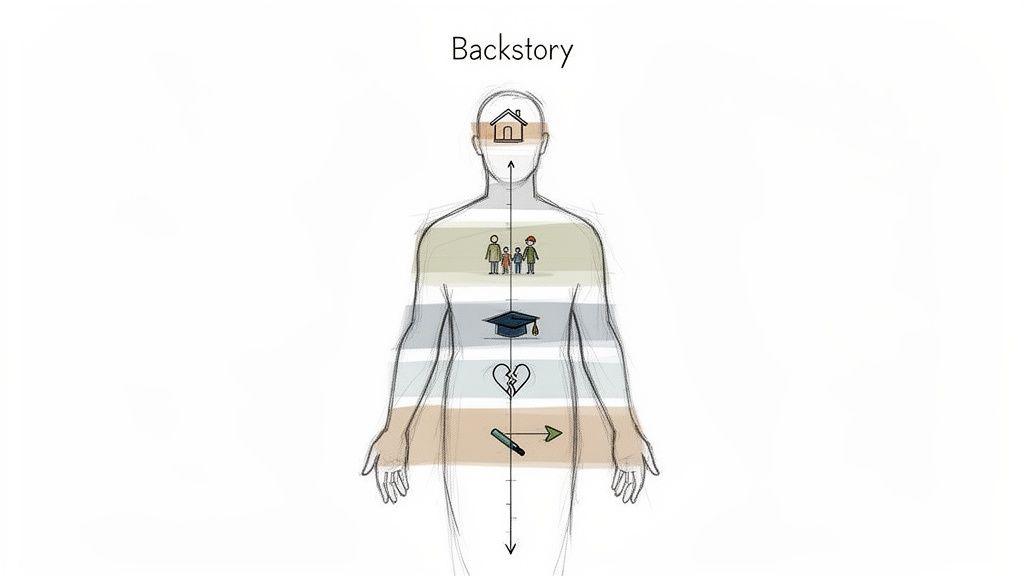
This approach is one of the most effective creative writing prompts for students because it serves as a foundation for any genre or story type, from a short fantasy quest to a complex novel. A well-developed backstory gives the writer a deep well of information to draw from, making it easier to predict how their character would react in any situation.
How to Implement This Prompt
Start with a simple character questionnaire. Begin with basic details like name, age, and occupation, then gradually add layers with more profound questions.
- Childhood & Formative Years: What was their relationship with their parents? What is their happiest childhood memory? Their worst?
- Values & Beliefs: What does the character value most in life? What moral code do they live by, and has it ever been tested?
- Fears & Flaws: What are they secretly afraid of? What is a significant character flaw they struggle with?
Actionable Tips & Variations
- Generate an Interview: Use an AI tool like 1chat to act as an interviewer. Have it ask your character probing questions about their past, forcing you to develop answers on the fly.
- Create Conflicting Traits: Ask an AI to suggest two contradictory personality traits (e.g., "cautious but impulsive" or "generous but deceitful"). Then, create a backstory that explains how both can be true.
- Collaborative World-Building: In a group setting, have each student create one member of a family. They must then work together to build a shared family history that explains each character's individual personality and their relationships with one another.
2. "What If" Scenario Exploration
This prompt challenges students to think beyond the confines of reality by posing a single, powerful question: "What if?" By altering one key element of history, technology, or even a well-known story, students are pushed to explore the cascading consequences of that change. This exercise develops crucial critical thinking and problem-solving skills as they must logically map out the ripple effects of their hypothetical scenario. It transforms a simple premise into a complex world of possibilities.
This method is one of the most versatile creative writing prompts for students because it can be applied to any subject, from history and science to literature. It encourages students to think about cause and effect on a grand scale, forcing them to justify their creative choices with logical reasoning. For instance, exploring "What if social media never existed?" requires a deep analysis of communication, society, and personal relationships.
How to Implement This Prompt
Start with a broad, world-altering question and encourage students to drill down into the personal and societal implications. Establish clear rules and parameters before they begin exploring to provide a focused framework.
- Historical Divergence: What if a major historical event had a different outcome? (e.g., What if the Titanic never sank?)
- Technological Absence/Presence: What if a key invention was never created, or a futuristic one appeared today? (e.g., What if electricity suddenly disappeared?)
- Narrative Alteration: What if a classic story's hero was actually the villain? (e.g., What if Romeo and Juliet's families supported their love?)
Actionable Tips & Variations
- Debate the Consequences: Use an AI tool to act as a debate partner. Present your "what if" scenario and have the AI challenge your conclusions, forcing you to defend the logical consequences you've mapped out. A free AI writing assistant can be an excellent tool for this.
- Create a Divergence Timeline: Have students create a visual timeline showing the point of divergence from our reality. They must then map out key events that would change in the subsequent years or decades.
- Test Multiple Interpretations: Prompt different AI models with the same "what if" scenario to see the varied creative directions they take. Use these different interpretations as inspiration for unique storylines.
3. Sensory Writing Exercises
Great writing pulls the reader directly into the scene, making them feel as if they are experiencing it firsthand. This prompt trains students to achieve that immersion by focusing on all five senses: sight, sound, smell, taste, and touch. Instead of only describing what a setting looks like, students learn to weave a rich tapestry of sensory details that create a tangible, memorable atmosphere. This technique transforms a flat description into a vibrant, multi-dimensional world.
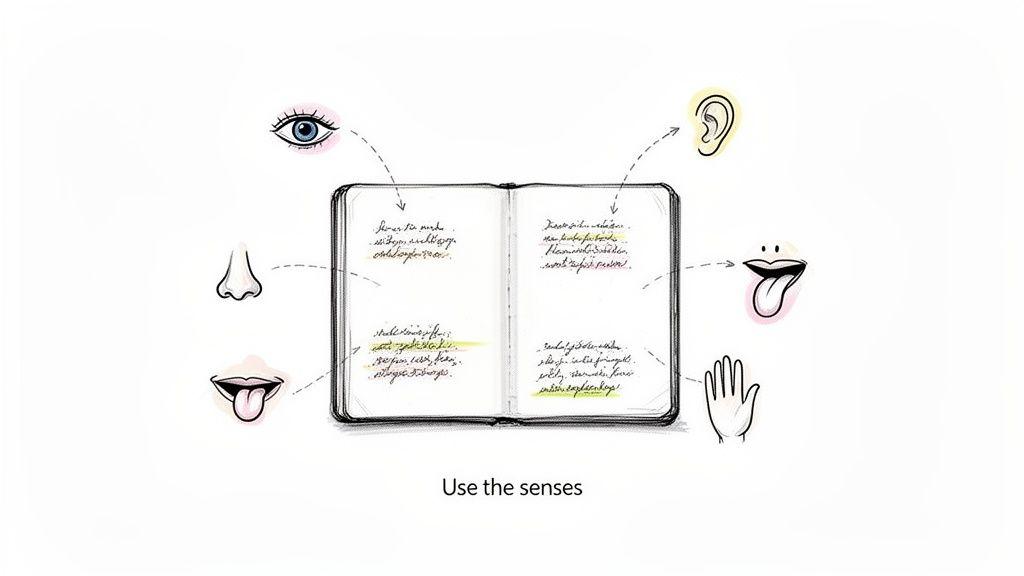
This method is one of the most powerful creative writing prompts for students because it is fundamental to every genre. A horror story becomes terrifying through the sound of a floorboard creaking or the smell of damp earth. A food description becomes irresistible through the taste of spices and the feel of a texture. Mastering sensory language gives writers the tools to control mood and evoke a strong emotional response from their audience.
How to Implement This Prompt
Ask students to choose a familiar location, like a bustling restaurant, a quiet library, or a crowded beach. Then, have them create a detailed description by dedicating a paragraph to each of the five senses.
- Sight: What are the dominant colors? What small details might someone miss at first glance?
- Sound: Is it loud or quiet? What are the distinct noises, both near and far?
- Smell: Are the scents pleasant or foul? Are they sharp or subtle?
- Taste: If applicable, what flavors are in the air or associated with the place (e.g., salty sea spray)?
- Touch: Describe the temperature, the humidity, and the texture of surfaces.
Actionable Tips & Variations
- Generate Sensory Lists: Use an AI tool like 1chat to generate a list of sensory words related to a specific environment (e.g., "sensory words for a forest at night"). This can help expand a student's descriptive vocabulary.
- Sensory Focus: Challenge students to write a short scene describing an action, like opening a door, but focusing entirely on one sense, such as sound or touch.
- Revise and Enhance: Have students take a piece of their previous writing and revise it with the specific goal of adding at least two new sensory details to every paragraph. This teaches them to layer descriptions effectively.
4. Dialogue-Focused Writing Prompts
Great dialogue does more than just move the plot forward; it reveals character, builds tension, and establishes tone through what is said and, more importantly, what is left unsaid. This prompt challenges students to create conversations between characters with conflicting goals, hidden secrets, or fundamental misunderstandings. By concentrating solely on the back-and-forth, students learn to convey personality and subtext without relying on narration.
This method is one of the most practical creative writing prompts for students because it hones a skill essential to nearly every form of storytelling, from screenplays to novels. Crafting authentic, engaging dialogue teaches students how to show rather than tell, allowing readers to infer motivations and relationships directly from the conversation. This practice develops a keen ear for natural speech patterns and the subtle art of building suspense.
How to Implement This Prompt
Provide a scenario with built-in conflict and ask students to write only the dialogue. The context should force characters to navigate their conversation carefully.
- Opposing Goals: Two business partners debate the future of their failing company, one wants to sell, the other wants to take a risky loan.
- Hidden Information: A teenager tries to convince their parents to let them go on a trip, without revealing who they are really going with.
- Emotional Tension: Two old friends meet for the first time after a major argument that ended their friendship years ago.
Actionable Tips & Variations
- Write Without Tags: Have students write an entire scene of dialogue first, without any attribution tags like "he said" or "she shouted." This forces the character voices to be distinct enough to be recognizable on their own. Add tags later, only where necessary for clarity.
- Generate Dialogue Variations: Use an AI tool like 1chat to suggest different ways a character could respond in a scene. Ask it to generate three versions of a line: one angry, one sarcastic, and one deceptively calm.
- Read it Aloud: The best test for natural-sounding dialogue is to hear it spoken. Have students read their scenes aloud, either to themselves or with a partner, to catch clunky phrasing and unnatural rhythms.
5. Perspective and Point-of-View Shifting
The narrator’s voice is the lens through which a reader experiences a story. This prompt challenges students to rewrite the same scene from different narrative perspectives, such as first-person, third-person limited, and third-person omniscient. This exercise demonstrates how point-of-view fundamentally shapes the reader's perception, dictates the flow of information, and builds emotional engagement with the narrative.
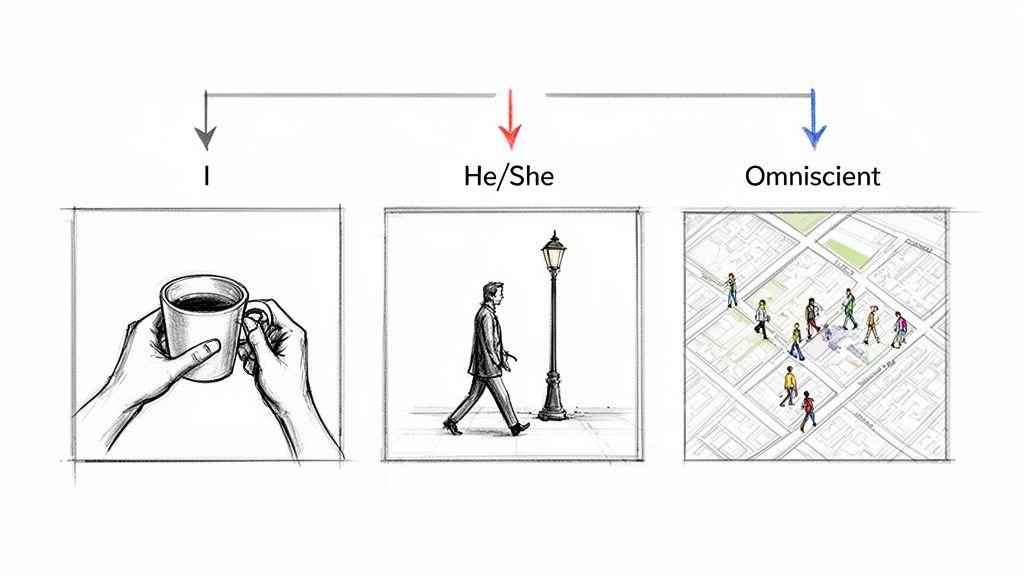
Exploring different viewpoints is one of the most powerful creative writing prompts for students because it cultivates a deep understanding of narrative control. By stepping into the shoes of different characters or an all-knowing narrator, students learn how to reveal or conceal information strategically. This skill is crucial for creating suspense, irony, and complex character dynamics.
How to Implement This Prompt
Start with a simple, action-oriented scene, such as two characters having a disagreement or someone discovering a mysterious object. First, have the student write the scene from one character's first-person ("I") perspective. Then, ask them to rewrite it.
- Third-Person Limited: Rewrite the scene following only one character's thoughts and feelings. The reader knows only what that character knows.
- Third-Person Omniscient: Rewrite it again, but this time, the narrator knows the thoughts and feelings of all characters involved.
- Antagonist's View: Write the scene from the perspective of the opposing character to explore their motivations and justifications.
Actionable Tips & Variations
- Create an Unreliable Narrator: Challenge students to rewrite a factual account, like a simple news report, from the perspective of an unreliable narrator who misinterprets events or has a hidden agenda.
- Perspective Comparison Chart: Have students create a chart comparing what each character knows, feels, and sees in the scene from each point-of-view. This visually highlights how perspective changes the story.
- Identify Inconsistencies: Use an AI tool like 1chat to analyze a piece of writing and identify potential point-of-view inconsistencies, helping students refine their control over the narrative voice.
6. Constraint-Based Writing (Flash Fiction and Micro-Stories)
Sometimes, the greatest creativity comes not from infinite freedom but from strict limitations. This prompt challenges students to tell a complete story within a tiny space, forcing them to be incredibly deliberate with every word choice. By working within constraints like a 100-word limit or a 10-minute timer, students learn the art of narrative efficiency, concise prose, and making an impact with minimal language. This sharpens their editing skills and teaches them to focus on the most essential story elements.
This method is one of the most versatile creative writing prompts for students, as it can be adapted for any skill level and builds a foundational understanding of storytelling mechanics. It trains the writer's mind to identify and trim away anything that doesn't serve the central narrative, a crucial skill for all forms of writing. Famous examples like Hemingway's six-word story ("For sale: baby shoes, never worn") prove that a powerful emotional punch doesn't require a high word count.
How to Implement This Prompt
Start with a clear, non-negotiable constraint. The goal is to make the limitation feel like a puzzle to be solved rather than a frustrating barrier. Provide a simple story concept and challenge students to execute it within the given rules.
- Word Count Limit: Ask students to write a complete story (beginning, middle, end) in exactly 50 words.
- Time Limit: Give students a compelling opening line and set a timer for five minutes. They must complete the scene before the time is up.
- Word Inclusion/Exclusion: Challenge them to write a story that must include three specific words (e.g., "umbrella," "secret," "clock") but cannot use the word "and."
Actionable Tips & Variations
- Write First, Trim Later: Encourage students to write a longer draft without constraints, then ruthlessly cut it down to meet the word count. This teaches them to identify and eliminate filler words and phrases.
- Focus on a Single Moment: Instead of trying to cram a complex plot into a small space, advise students to focus on a single, pivotal moment or a powerful emotional snapshot.
- Twitter-Length Fiction: Use a 280-character limit to tell a story. This modern constraint forces extreme brevity and precision.
7. Emotional Authenticity and Personal Essay Prompts
Tapping into personal experience is a powerful way to develop a unique and compelling authorial voice. This prompt encourages students to move beyond fictional scenarios and explore their own emotions, memories, and reflections. By focusing on authentic expression, students learn to transform personal moments into narratives that resonate universally, building skills in vulnerability, self-awareness, and emotional intelligence.
This method is one of the most impactful creative writing prompts for students because it directly connects the craft of writing to their lived experiences. It teaches them that their own stories have value and provides a framework for exploring complex feelings in a structured, reflective way. The skills developed here are directly applicable to everything from college admissions essays to professional communication.
How to Implement This Prompt
Guide students with prompts that invite introspection and honesty. The goal is not just to recount an event but to explore its emotional and psychological impact.
- Transformative Moments: "Write about a time you failed at something important. What did you learn from the experience?" or "Describe a moment that fundamentally changed your perspective on the world."
- Interpersonal Dynamics: "Explore a significant relationship in your life. What makes it unique, and how has it shaped you?"
- Generational Stories: "Interview a family member about a key event in their life and write their story from your perspective."
Actionable Tips & Variations
- Freewriting First Draft: Encourage students to write their first draft without any self-judgment. The initial goal is to get the raw emotions and memories onto the page, not to perfect the prose.
- AI-Assisted Structuring: Use an AI tool like 1chat to help organize a stream-of-consciousness draft into a logical narrative. Ask it to identify a central theme and suggest a structure (e.g., chronological, thematic) without altering the emotional core of the text. To keep the voice genuine, you can learn how to humanize AI text and ensure the final piece sounds authentic.
- Feedback for Feeling: Have students share their work with a trusted peer or mentor. The feedback should focus less on grammar and more on emotional authenticity: "Did this part feel genuine?" or "Where did you connect most with the story?"
8. Genre Mashup and Cross-Genre Writing
Breaking the established rules of genre is a powerful way to create something entirely new and unexpected. This prompt challenges students to combine elements from two or more distinct genres, such as science fiction and romance or fantasy and mystery. By merging conventions, they learn what makes each genre tick while pushing creative boundaries to develop hybrid narratives that feel fresh and innovative.
This technique is one of the most exciting creative writing prompts for students because it forces them to think critically about storytelling formulas. Instead of just following a template, they must deconstruct different genres to their core elements-like the suspense of a thriller and the world-building of fantasy-and then skillfully weave them together into a cohesive and surprising story. This process builds a deep understanding of narrative structure and audience expectations.
How to Implement This Prompt
Start by having students select two genres they enjoy. Ask them to list the key tropes, character archetypes, and plot structures commonly found in each one. The goal is to identify specific elements they can blend.
- Identify Core Elements: What are the non-negotiable conventions of a Western? What defines a horror story? List three to five for each chosen genre.
- Find Common Ground: Where do the genres overlap? A noir mystery and a sci-fi story might both feature a cynical detective investigating a complex case.
- Create a Hybrid Scenario: Combine the lists to create a unique story concept. For example, a historical fiction piece set in Victorian England where a detective must solve a murder committed using advanced, speculative technology.
Actionable Tips & Variations
- Analyze Existing Mashups: Study popular examples like paranormal romance (fantasy + romance) or sci-fi westerns (Firefly). Discuss what makes them successful.
- AI-Powered Brainstorming: Use an AI tool like 1chat to generate a random pairing of genres. Ask it to suggest three potential plot ideas that combine the core conventions of both.
- Focus on Tone: Challenge students to write a scene where the tone shifts between the two genres. For instance, a humorous horror scene where a comical character faces a genuinely terrifying monster.
9. Research-Based Creative Writing and Worldbuilding
This prompt challenges students to merge factual research with imagination, creating fictional worlds that are firmly grounded in reality. Instead of inventing details from thin air, students use historical periods, scientific principles, or cultural facts as the foundation for their narratives. This approach builds credible and immersive settings, whether for a historical novel set in ancient Rome or a science fiction story obeying the laws of physics.
Integrating research adds a layer of authenticity that makes stories more believable and engaging. This method is one of the most enriching creative writing prompts for students because it develops critical thinking and information synthesis skills alongside narrative abilities. The resulting work feels textured and intelligent, demonstrating a deeper level of engagement with the subject matter.
How to Implement This Prompt
Start by choosing a core area of interest, like a historical event, a scientific theory, or a specific culture. The goal is to gather enough factual information to build a consistent and believable world around it.
- Historical Fiction: Choose a specific decade and location (e.g., Paris in the 1920s). Research the fashion, technology, political climate, and common slang of the era to incorporate into the story.
- Logical Fantasy: If creating a magic system, base it on real-world concepts like thermodynamics or botany. How does the "magic" affect the environment and society in a logical, cause-and-effect way?
- Grounded Sci-Fi: Select a real scientific principle, such as genetic editing or quantum entanglement. Explore its potential real-world consequences through a fictional narrative.
Actionable Tips & Variations
- Summarize First: Before writing any fiction, have students create a one-page research summary outlining the key facts, rules, and details of their chosen topic. This becomes their "world bible."
- Verify Accuracy: Use an AI tool to check the factual accuracy of specific claims or details within the story to maintain credibility. For instance, ask, "Was this type of fabric available in 14th-century England?"
- Balance Story and Facts: Remind students to weave research in naturally rather than info-dumping. The goal is to enhance the story, not write a textbook. Developing these research skills is crucial, and you can learn more about how to improve research skills to support this process.
10. Collaborative Story Building and Iterative Development
Writing is often seen as a solitary act, but this prompt transforms it into a dynamic, team-based exercise. Collaborative story building involves one student writing a section of a narrative, then passing it to the next person to continue, revise, or even pivot in a new direction. This iterative process teaches flexibility, adaptability, and the critical skill of building upon another person’s creative foundation while maintaining a cohesive narrative voice and plot.
This prompt is especially powerful because it mirrors real-world creative environments, like a television writers' room or a co-authored project. It encourages students to let go of creative ownership and embrace the unexpected twists that come from multiple minds working together. The result is a richer, more layered story than any single individual might have created alone.
How to Implement This Prompt
Start by establishing a clear framework. The most common method is a "chain story," where each student contributes a paragraph or page before passing it on.
- Set the Scene: Provide the initial setting, a main character, and a central conflict to give the story a unified starting point.
- Establish Rules: Define the order of writers and the length of each contribution (e.g., exactly 250 words).
- Review & Continue: Before adding their part, each student must read the entire preceding story to ensure their contribution flows logically.
Actionable Tips & Variations
- Create a Style Guide: Before starting, have the group agree on a basic style guide for tone, tense, and point of view to ensure consistency.
- Use AI for Bridging: If a writer gets stuck trying to connect their ideas to the previous section, they can use a tool like 1chat to generate transition sentences or bridge narrative gaps.
- "Choose Your Own Adventure" Model: In a digital format, allow students to branch off from a single point. Multiple groups can take the same story opening and develop it in entirely different directions, showcasing the power of creative choice.
- World-Building Teams: Divide the class into teams responsible for different aspects of a world (e.g., history, geography, culture). They must then collaborate to write a story set within their co-created world, ensuring all elements align.
10-Point Comparison of Student Creative Writing Prompts
| Prompt | Implementation Complexity 🔄 | Resource Requirements ⚡ | Expected Outcomes 📊 / Quality ⭐ | Ideal Use Cases | Key Advantages 💡 |
| Character Development Through Backstory Creation | Medium–High — iterative development and depth 🔄 | Medium — time for detail, optional research ⚡ | Deep, believable characters; empathy building 📊 ⭐⭐⭐⭐ | Middle/High school, college, small business storytelling | Produces reusable character material; maps motivations 💡 |
| "What If" Scenario Exploration | Medium — needs clear constraints and logical follow-through 🔄 | Low–Medium — idea generation and consequence checking ⚡ | Multiple scenario branches and stronger analytical thinking 📊 ⭐⭐⭐ | High school/college, strategy workshops, families | Encourages divergent thinking and strategic exploration 💡 |
| Sensory Writing Exercises | Low–Medium — focused practice routines 🔄 | Low — observation, vocabulary lists, short exercises ⚡ | More vivid, immersive prose and reader engagement 📊 ⭐⭐⭐⭐ | Middle–college students, marketing/content teams | Improves descriptive vocabulary and atmosphere building 💡 |
| Dialogue-Focused Writing Prompts | Low–Medium — practice plus revision for naturalness 🔄 | Low — iteration, feedback, read-aloud testing ⚡ | Authentic voice, dynamic scenes; shows rather than tells 📊 ⭐⭐⭐⭐ | All student levels; professionals; families | Rapid iteration; strengthens character via speech patterns 💡 |
| Perspective and Point-of-View Shifting | High — significant rewriting and voice control required 🔄 | Medium–High — editing, voice coaching, comparative analysis ⚡ | Greater narrative technique and varied reader perception 📊 ⭐⭐⭐⭐ | High school/college, professional writers, communications teams | Reveals how perspective alters meaning; produces multiple versions 💡 |
| Constraint-Based Writing (Flash Fiction & Micro-Stories) | Low — clear rules simplify implementation 🔄 | Low — short timeframes, minimal resources ⚡ | Tight, polished pieces and improved editing skills 📊 ⭐⭐⭐ | All levels, busy professionals, social media creators | Teaches economy of language; produces shareable work quickly 💡 |
| Emotional Authenticity and Personal Essay Prompts | Medium — requires emotional safety and structure 🔄 | Low–Medium — reflection time, trusted feedback ⚡ | Emotionally resonant essays with strong voice 📊 ⭐⭐⭐⭐ | High school/college, admissions prep, legacy projects | Develops authentic voice; therapeutic and highly publishable 💡 |
| Genre Mashup and Cross-Genre Writing | High — balancing competing conventions is complex 🔄 | Medium — genre knowledge, testing with readers ⚡ | Fresh hybrid concepts; potential commercial appeal 📊 ⭐⭐⭐ | High school/college, pro content creators, marketing teams | Encourages innovation and deep genre understanding 💡 |
| Research-Based Creative Writing and Worldbuilding | High — requires extensive research + synthesis 🔄 | High — research sources, fact-checking, time ⚡ | Credible, detailed worlds and accurate speculative fiction 📊 ⭐⭐⭐⭐ | College students, research-oriented writers, content creators | Merges factual accuracy with creativity; educational value 💡 |
| Collaborative Story Building and Iterative Development | Medium — coordination and style consistency required 🔄 | Medium — multiple contributors, communication tools ⚡ | Diverse ideas, improved teamwork and iterative drafts 📊 ⭐⭐⭐ | Middle/High school, families, business team-building | Teaches collaboration, compromise, and narrative synthesis 💡 |
From Prompt to Polished: Your Next Steps in Creative Writing
The journey from a blank page to a finished story can feel immense, but it begins with a single step: a compelling idea. The extensive collection of creative writing prompts for students shared in this article is more than just a list of story starters. It is a comprehensive toolkit designed to build the foundational pillars of powerful storytelling: deep characterization, vivid worldbuilding, authentic dialogue, and innovative narrative structures.
We've explored everything from developing rich character backstories and exploring speculative "what if" scenarios to mastering sensory details and shifting narrative perspectives. Each prompt category is a workout for a different creative muscle. By engaging with these exercises, you are not just writing; you are actively practicing the specific techniques that separate a good story from a truly memorable one. The goal is to transform the abstract concept of "writing" into a series of concrete, manageable, and repeatable actions.
Key Takeaways: The Power of Purposeful Practice
Remember, a prompt is not the destination; it is the launchpad. The true value lies in how you use it to intentionally grow your skills.
- Consistency Over Perfection: The most significant progress comes from a consistent writing habit. Don't wait for inspiration to strike. Choose a prompt, set a timer for 15-20 minutes, and write without judgment. The act of writing itself is the primary victory.
- Focus on a Single Skill: Instead of trying to perfect everything at once, use each prompt to target a specific skill. When using a dialogue prompt, focus solely on making the conversation sound natural. With a sensory prompt, dedicate your energy to sight, sound, and touch.
- Embrace Revision: Your first draft is simply the raw material. The real magic happens during the editing and revision process. Let your initial ideas flow freely, then return later with a critical eye to refine, cut, and clarify your prose.
Pro-Tip: Keep a dedicated journal or digital document for your prompt-based writing. Over time, this will become a portfolio of your progress, a source of inspiration for larger projects, and a testament to your developing voice and style.
Actionable Next Steps: Turning Prompts into Projects
Now that you have this arsenal of ideas, it's time to put them into action. Here’s a structured plan to continue your creative writing journey and make the most of these prompts.
- Create a "Prompt of the Week" Challenge: Select one prompt category to focus on for an entire week. On Monday, you might explore a "What If" scenario. On Tuesday, you could rewrite that same scene from a different character's point of view. This focused approach builds mastery through repetition and variation.
- Connect the Dots: After completing several prompts, look for connections between them. Could the character you created in a backstory exercise be the protagonist in the world you built with a research-based prompt? Combining these smaller pieces can be the spark for a much larger, more complex story.
- Collaborate and Share: Writing doesn't have to be a solitary activity. Use the collaborative story-building prompts with friends, family, or classmates. Sharing your work and receiving constructive feedback is one of the fastest ways to identify your strengths and areas for improvement.
Ultimately, the power of these creative writing prompts for students lies in their ability to unlock your unique voice and perspective. They are tools for exploration, designed to help you discover the kinds of stories only you can tell. By consistently engaging with them, you build not just a collection of written pieces but also the creative confidence and technical skill to tackle any writing challenge. So, pick a prompt that sparks your curiosity, open a new page, and begin the next chapter of your writing adventure. The world is waiting for your story.