Ever had a conversation with a machine that actually felt... like a conversation? That’s Conversational AI in a nutshell. It’s the technology that lets us chat with computers using our own everyday language, moving way beyond rigid commands and robotic menus.
Think of it as teaching a computer to not just hear your words, but to understand what you actually mean.
What’s Really Happening Behind the Screen?
Imagine trying to order a pizza with an old-school app. You’d be forced to click through a maze of buttons in a specific order: "Select Size," "Choose Toppings," "Confirm Order." One wrong move, and you’re back to square one. It's clunky, unforgiving, and feels anything but natural.
Now, picture this instead: you just say to your phone, "Hey, order me a large pepperoni pizza from my usual spot."
That seamless experience is what conversational AI is all about. It’s a set of technologies that allows software to understand, process, and respond to human language—whether spoken or typed—in a way that feels like you're talking to another person. Instead of making you learn the computer's language of clicks and menus, it learns yours.
It’s More Than Just a Q&A
The real power of conversational AI isn't just in understanding a single command. It's about maintaining a real, back-and-forth dialogue. It can remember what you said a few minutes ago, ask smart questions to clarify what you need, and give you answers that make sense in the context of your chat.
This is why the technology is exploding in popularity. The global market is expected to jump from around $19 billion in 2025 to over $155 billion by 2035. You can dig into the market growth data to see just how quickly this is taking off.
To really grasp this shift, let's look at how we interact with technology differently now.
Traditional Software vs Conversational AI
The table below highlights the fundamental change in how we get things done with computers. It's a move from structured, rigid inputs to fluid, natural dialogue.
| Interaction Method | Traditional Software | Conversational AI |
| User Input | Clicks, menus, forms, predefined commands | Natural language (text or voice) |
| Flexibility | Rigid and structured; user must follow a set path | Flexible and adaptive; understands intent and context |
| Learning Curve | User must learn the software's interface | Intuitive; user speaks or types as they normally would |
| Interaction Flow | One-way commands; user tells, software does | Two-way dialogue; can ask questions and clarify |
Ultimately, this comparison shows a move away from forcing humans to think like computers and toward making computers that can understand humans.
This shift from a strict recipe to a helpful conversation is what makes the technology so useful.
Conversational AI is the difference between following a strict, step-by-step recipe and having a helpful chef in the kitchen who understands when you say, "I think it needs a little more spice." The chef gets the intent, while the recipe only understands the literal instructions.
This fundamental difference is what makes conversational AI so powerful. It breaks down the barriers between people and technology, making digital tools feel more intuitive and accessible for everyone—from busy families and curious students to growing businesses.
How Conversational AI Actually Works
To really get what conversational AI is, we need to peek behind the curtain. It’s not a single piece of magic. It’s more like a team of highly specialized components working in perfect harmony to create a smooth, human-like conversation. Each part has a very specific job, and once you understand them, the whole process starts to make a lot more sense.
Step 1: Making Sense of What You Say
It all starts with you. When you type a message or speak a command, the first specialist gets to work: Natural Language Understanding (NLU). Think of NLU as the AI's ears and interpretive brain. Its entire job is to figure out what you actually mean, not just what you typed. It can decipher your intent even if you use slang, make a typo, or ask a question in a roundabout way.
For example, if you ask, "What’s the weather like in NYC tomorrow?" NLU doesn't just register those words. It intelligently identifies key pieces of information (we call these "entities"), like "NYC" and "tomorrow." It also pinpoints your core intent, which is to get a weather forecast. This is the critical first step that allows the system to grasp the goal of your request. This process is a huge part of a field we explore in our guide to Natural Language Processing.
Step 2: Crafting a Human-Like Response
Okay, so the AI understands you. Now what? It needs to formulate a reply. That's where Natural Language Generation (NLG) comes in. If NLU is the brain that understands, NLG is the voice that responds. This technology takes structured data—like the raw weather forecast for New York—and translates it back into language that sounds natural and human.
It's the difference between getting a blunt, data-dump response like "NYC: 75°F, Sunny," and a friendly, helpful one like, "Tomorrow in New York City, you can expect sunny skies with a high of 75 degrees." NLG is all about crafting sentences that are grammatically correct, contextually relevant, and just plain easy to follow.
Here’s a simple look at that three-step flow:
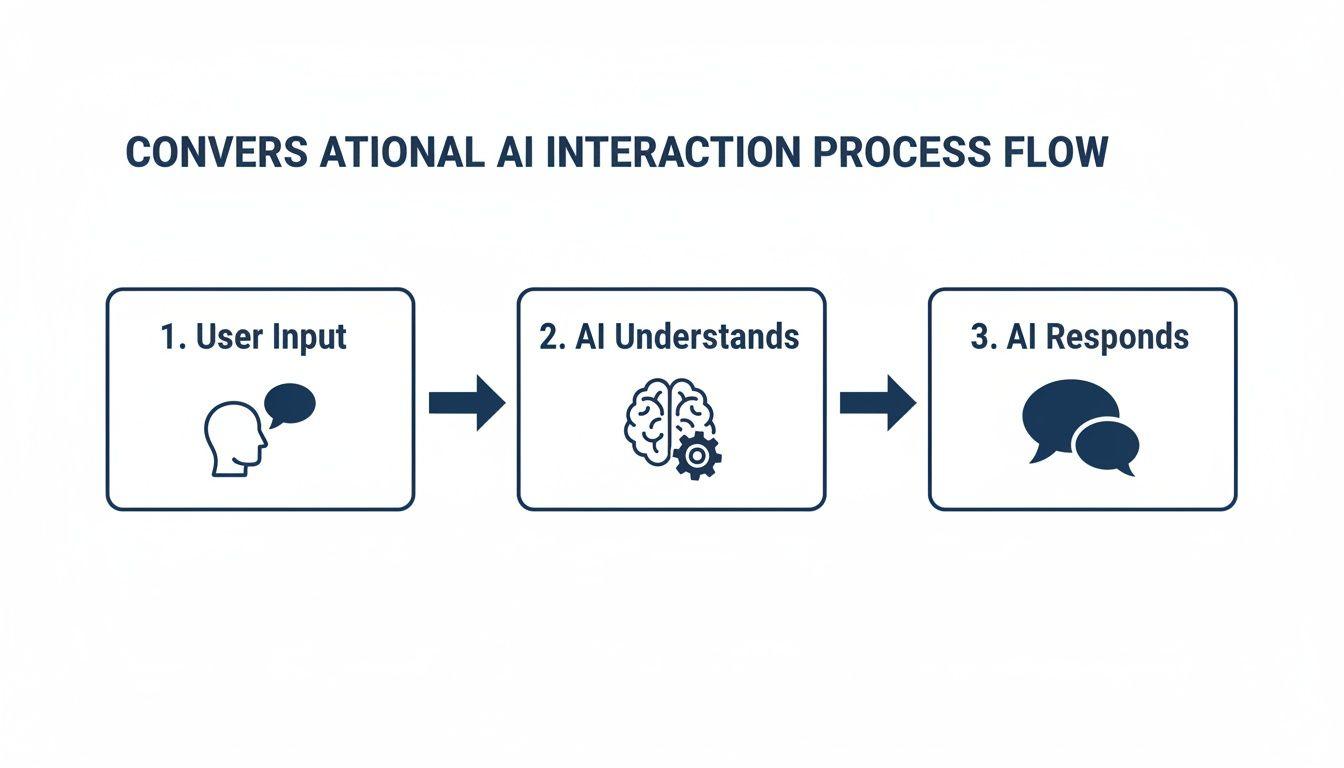
This back-and-forth feels effortless because the technology seamlessly moves from your input, to understanding, to a coherent response.
Step 3: Keeping the Conversation Going
The final piece of the puzzle is arguably the most important for making a chat feel real: Dialog Management. This is the conductor of the orchestra, the AI's short-term memory. It keeps track of the conversation's context, remembering what you’ve already talked about so it can handle follow-up questions without making you start from scratch every single time.
For instance, if you then ask, "What about this weekend?" the Dialog Manager knows you’re still talking about the weather in NYC. It holds the thread of the conversation, making the entire exchange feel connected and intelligent.
This ability to manage a continuous, flowing dialogue is what separates true conversational AI from more basic, one-off command systems. It’s the secret sauce that makes a back-and-forth chat feel natural.
And it’s clear this technology is catching on. While large companies currently make up about 68.2% of the AI chatbot market, it's the small and medium-sized businesses that are the fastest-growing group of adopters. With cloud-based solutions projected to dominate 75.6% of the market by 2035, these powerful tools are becoming more accessible than ever for everyone, from small teams to families.
Real-World Examples of Conversational AI in Action
The best way to really wrap your head around conversational AI is to see where it’s already working in the wild. This isn't some far-off, sci-fi concept. It’s a practical tool that people—from busy parents to small business owners—are using every single day to simplify their lives.
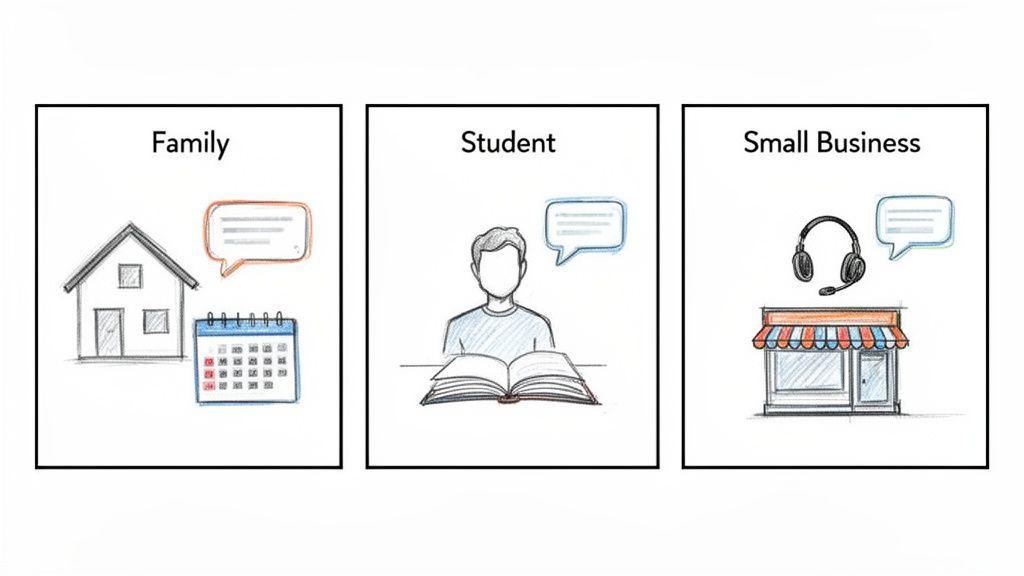
Let’s look at a few places where these AI-powered conversations are already making a big impact.
For Families Managing a Hectic Schedule
Think about the chaos of coordinating a family's schedule. Instead of a fridge calendar covered in scribbles, a family can just talk to their smart assistant. Saying, "Add Timmy's soccer practice to the calendar for Thursday at 5 PM," gets the job done instantly, updating everyone's devices.
It can also be a homework helper or a patient teacher, breaking down tough subjects for a curious kid. This kind of interaction is becoming second nature. The average American adult now owns more than six smart devices, and smart speakers are often the command center for the whole household. These everyday interactions get us comfortable with AI, opening the door for even more helpful, family-focused tools. You can find more details on these device ownership trends in the US.
For Students Streamlining Their Studies
For any student drowning in deadlines, conversational AI is a game-changer. Picture a college student pulling an all-nighter for a research paper. When they hit a wall, they can ask an AI tool to summarize a dense academic article, check their draft for clarity, or even create a custom study guide for their upcoming final.
These aren't just cheat codes; they’re tools that help students sharpen their thinking and produce better work.
By handling the tedious parts of research and writing, conversational AI frees up a student's mental energy to focus on critical thinking and developing their own unique arguments. It’s like having a 24/7 tutor that never gets tired.
For Small Businesses Improving Customer Service
If you run a small online shop, you know that customer questions don't stop at 5 PM. A conversational AI chatbot on your website can provide instant answers 24/7, handling common queries like "Where is my order?" or "What's your return policy?"—no human needed.
This simple step frees up the team to tackle the trickier problems that actually require a personal touch. The AI can even handle other important tasks:
- Appointment Scheduling: It can book meetings directly into an open slot on your calendar.
- Lead Qualification: The bot can ask a few screening questions to see if a new visitor is a good potential customer.
- Internal Knowledge Base: It can act as a search engine for your own team, helping them find company info in seconds.
Automating these routine chats helps small businesses run smarter and keep their customers happy. To learn more, check out our guide on how to automate customer service.
Weighing the Good Against the Bad: Benefits and Limitations
To really get a feel for conversational AI, we need to look at it from all angles—the amazing things it can do and where it still falls short. It's a powerful tool, no doubt, but it isn't a magic wand for every situation. Knowing both sides of the coin makes you a smarter, more discerning user.
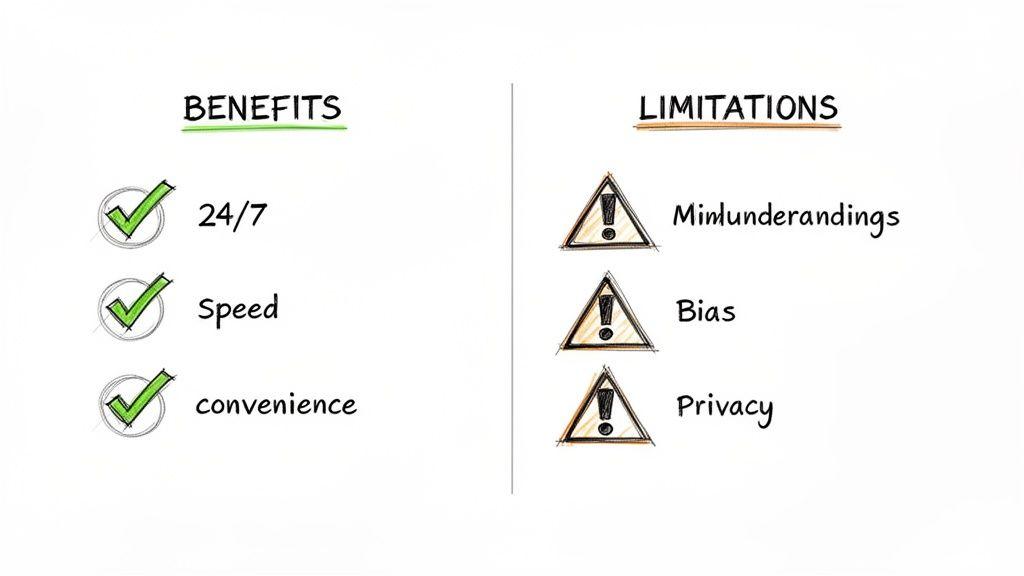
On one hand, the upsides are pretty compelling. For a small business, an AI assistant can be your 24/7 front-line support, answering questions long after your team has gone home. For families and students, they're a quick way to get answers and organize the chaos of daily life.
The Clear Advantages
The most obvious win is efficiency. Conversational AI is fantastic at handling the repetitive stuff, which frees you up to focus on work that actually requires a human brain. For a small team juggling a dozen different things, that’s a game-changer.
The numbers back this up, too. AI-powered chatbots have been shown to cut customer service costs by as much as 30% by fielding all those common, easy-to-answer questions. It's not just about saving money, either; businesses using AI in their sales process have reported boosting their lead generation by an average of 67%. If you're curious about the financial side, you can dig into the ROI of conversational AI on ibm.com.
Other key perks include:
- Always-On Availability: These tools don't sleep. They’re ready to help day or night, whenever you need them.
- Incredible Speed: They can pull up information and give you an answer far faster than you could find it yourself.
- Effortless Scalability: One chatbot can talk to thousands of people at the same time. A human team simply can't do that.
The Important Limitations
But it's not all sunshine and roses. The technology has some real limitations you need to keep in mind. We've all been there—you ask a slightly complex or layered question, and the AI just... breaks. It gets confused and spits out a generic, unhelpful response because your question fell outside its programming.
A crucial limitation of many AI systems is their potential for bias. If an AI is trained on biased data from the internet, its answers can reflect and even amplify those same biases, leading to unfair or inaccurate information.
And that brings us to the biggest red flag of all: privacy. A lot of conversational AI tools learn by collecting data from your conversations. Think about that for a second. When you're talking about sensitive family details or confidential business plans, that data collection becomes a massive risk. It’s absolutely critical to know where your data is going and how it's being used.
This is exactly why choosing a privacy-first tool is so important. Platforms like 1chat are built from the ground up to protect your information, giving families and teams a safe place to collaborate with AI without worrying about their data being harvested.
The Pros and Cons of Using Conversational AI
To make things even clearer, here’s a straightforward breakdown. This table gives a balanced overview of what you gain and what you need to watch out for when bringing conversational AI into your world.
| Benefits (The Pros) | Limitations (The Cons) |
| 24/7 Availability: Provides instant support and information around the clock, without human supervision. | Lack of Nuance: Struggles with complex, emotional, or ambiguous questions that require human understanding. |
| Increased Efficiency: Automates repetitive tasks, freeing up human time for more creative and strategic work. | Potential for Bias: Can produce biased or unfair responses if trained on skewed or incomplete data. |
| Cost Savings: Reduces operational costs, especially in customer service, by handling a high volume of inquiries. | Major Privacy Risks: Many platforms collect user data to train their models, raising security and privacy concerns. |
| Scalability: Easily handles thousands of simultaneous conversations, which is impossible for human teams. | Integration Challenges: Can be complex and expensive to integrate with existing business systems and workflows. |
Ultimately, the key is to have a balanced perspective. Appreciate the incredible benefits this technology offers, but always stay mindful of its limitations, especially when it comes to your privacy. This approach allows you to use AI responsibly and effectively.
Wait, Isn't This Just ChatGPT?
It’s easy to see why so many people think conversational AI and ChatGPT are the same thing. Let's clear that up, because the difference is important.
Think of it this way: "conversational AI" is the whole category, like "cars." ChatGPT, on the other hand, is a specific, incredibly popular model—like a Tesla Model Y. It's a fantastic example of what the technology can do, but it's far from the only car on the road.
Conversational AI is the broader field. It covers any technology designed to chat with us like a person would, from the simple voice assistant on your phone to a highly specialized support bot on a banking website.
The Specialist vs. The Generalist
The biggest difference usually boils down to what the AI is built to do. A tool like ChatGPT is a generalist. It's designed to be a jack-of-all-trades, capable of drafting an email, writing a poem about pirates, or explaining quantum physics. It pulls from a massive ocean of public internet data to do this.
But most other conversational AI systems are specialists. They're trained and fine-tuned for one specific job, and they do it exceptionally well. For example:
- Customer Support Bots: These are experts on one company’s products. They don't know how to write poetry, but they can instantly tell you about a warranty policy or guide you through a return.
- Healthcare Assistants: These tools operate within strict privacy guardrails to help you schedule appointments or get medication reminders.
- Internal Company Brains: Many businesses use AI trained only on their private documents. This lets employees find information securely without ever exposing that data to the public internet.
The clean, simple chat interface of ChatGPT is now instantly recognizable to millions, which helped it become a household name almost overnight.
There's no denying its impact. Generative AI tools like ChatGPT exploded in popularity, reaching 100 million monthly active users in just two months. That made it the fastest-growing consumer application in history, a milestone you can read more about on Reuters.
ChatGPT absolutely brought conversational AI into the mainstream, but it’s just one piece of a much larger puzzle. Knowing the difference between a general-purpose tool and a specialized one is the key to choosing the right AI for what you actually need to do.
This distinction is more than just a technicality. If you're a family sharing personal plans or a business handling sensitive client data, a generalist model that learns from public data might not be the right fit. This is where a specialized, secure platform like 1chat comes in. It provides a private, controlled space, ensuring your conversations stay yours and are focused on your world, not the entire internet.
Choosing the Right Conversational AI Tool
Now that you have a good handle on what conversational AI is, the real question is: which tool is right for you? The market is crowded, and it's easy to get lost in the options. But by asking a few smart questions, you can cut through the noise and find a solution that's powerful, trustworthy, and genuinely useful.
Start by thinking about your main goal. Are you a parent looking for a safe, kid-friendly assistant to help with homework and juggle family schedules? Or maybe you're a student who needs a solid research partner without risking academic integrity. For a small business owner, the top priority might be finding an affordable, collaborative tool that keeps company data under lock and key.
Your Personal Evaluation Checklist
Before you sign up for anything, take a moment to run through this simple checklist. Your answers will point you toward the best fit for your home, your studies, or your business.
- What's the privacy policy? This is a big one. You want a tool that explicitly states it won’t use your conversations to train its public models. Your personal and professional data should belong to you, and only you.
- Is it easy to use? The best tools just make sense. A clean, simple interface means you can hit the ground running without needing a manual or a week of tutorials.
- Does it have the features you actually need? Think about your day-to-day. Do you need to analyze documents, create images, or work on projects with your team? Make sure the tool’s features line up with your real-world tasks.
- Is it a good value? Look at both the free and paid options. An affordable tool that handles 90% of what you need is almost always a smarter choice than a pricey one loaded with features you'll never touch.
Here’s a quick look at what a clean, user-friendly interface looks like. This example from 1chat is designed to be straightforward for anyone to use.
The layout is all about clarity, making it easy for anyone—from students to entire business teams—to find and use different features without feeling overwhelmed.
Making a Confident Decision
At the end of the day, the right conversational AI tool should feel like a reliable partner. It needs to align with your values, especially when it comes to data privacy. For many people, this is non-negotiable and means choosing a platform that puts privacy first.
Tools built specifically for families and teams often provide a more secure and contained environment compared to general-purpose AIs that are constantly learning from the public internet.
By focusing on privacy, usability, and the specific features that matter to you, you can pick a tool that genuinely boosts your productivity and creativity. This approach ensures you’re not just adopting a new technology, but a solution that truly serves your goals. For businesses, making the right choice is a critical first step, which we cover in more detail in our guide to choosing an AI assistant for small business.
Got Questions About Conversational AI? We’ve Got Answers.
As conversational AI tools pop up everywhere, it’s only natural to have a few questions. How does it work? Is it safe? What's the catch? Let's clear up some of the most common things people wonder about.
Is Conversational AI Actually Safe for My Kids?
This is a huge one for parents, and the honest answer is: it completely depends on the tool you're using. Many of the big-name AIs are trained on the wild, unfiltered internet, which is not a place you want your kids wandering around. They can also hoover up personal data.
The good news is that some platforms are built from the ground up with families in mind. These services put safety first, with strong content filters to screen out inappropriate material and airtight privacy policies that guarantee your family’s conversations stay private.
Bottom line: before letting your kids use any AI, dig into its safety features and privacy policy. Make sure you’re choosing a walled garden, not the open internet.
Is This Technology Going to Take My Job?
It's a valid concern, but the reality is more about changing jobs than getting rid of them. Think of conversational AI less as a replacement and more as a really, really smart assistant.
It's brilliant at handling the boring, repetitive stuff that eats up our day. This frees people up to focus on what we do best: creative problem-solving, strategic thinking, and connecting with other humans.
For instance, a support agent doesn't have to spend all day answering "What's my tracking number?" anymore. The AI can handle that 24/7, letting the human agent tackle the really tricky customer problems that require empathy and a personal touch. It’s about working smarter, not being replaced.
So, How Much Does This Stuff Cost?
The price of conversational AI is all over the map, which means there’s likely an option for every budget. It generally breaks down into a few tiers:
- Free Tiers: A lot of tools offer a free version to get you started. They’re great for casual use, but you'll usually run into limits on how much you can use them and which features you get. Privacy can also be a bit fuzzy here.
- Monthly Subscriptions: This is the sweet spot for most people—families, students, and small businesses. For a reasonable monthly fee, you unlock advanced features, get higher usage limits, and much stronger privacy protections.
- Enterprise Plans: These are the big-ticket, custom-built solutions for large corporations. They come with a hefty price tag but are tailored to specific, complex business needs.
For the average person or team, a paid subscription usually offers the best mix of power, security, and affordability.