Natural Language Processing (NLP) is a fascinating field of artificial intelligence that teaches computers how to read, understand, and even generate human language. It’s the magic behind your phone's voice assistant understanding a command or a chatbot answering your questions.
Think of it this way: NLP is the translator that turns our messy, nuanced, and often unpredictable way of speaking into structured data a machine can actually work with.
What Is Natural Language Processing
Imagine handing a computer a book. It can see the letters and words, no problem. But it doesn't automatically get the meaning, the sarcasm dripping from a line of dialogue, or the emotion behind a character's actions. That's the exact problem Natural Language Processing was created to solve. It’s a specialized area of AI focused entirely on bridging the gap between human communication and computer logic.
Instead of just crunching numbers and code, NLP gives machines the tools to handle the wild world of text and speech. This means everything from understanding basic grammar and sentence structure to figuring out context and the real intent behind someone's words. The ultimate goal is to make our interactions with technology feel less robotic and more like we're talking to another person.
To make these core ideas a bit clearer, here’s a quick breakdown of the fundamentals.
NLP Core Concepts at a Glance
This table breaks down the fundamental goals and components of NLP for a quick, digestible overview of the topic introduced in this section.
| Concept | What It Means | Simple Analogy |
| Human Language | The messy, unstructured way we communicate—full of idioms, slang, typos, and context. | A conversation at a coffee shop. It’s fluid, informal, and relies on shared understanding. |
| Machine Logic | The highly structured, rule-based world of computers, where everything is 1s and 0s. | A perfectly organized spreadsheet. Every cell has a specific place and a precise value. |
| The NLP Bridge | The technology that translates our chaotic language into the neat, organized format computers need. | A skilled interpreter at the UN, translating not just words but also tone and cultural context. |
Essentially, NLP acts as that skilled interpreter, making sure nothing gets lost in translation between us and our devices.
The Origins of Teaching Machines to Talk
The idea of machines understanding us isn't new. This journey really kicked off in the middle of the 20th century, when early thinkers started dreaming of computers that could hold a real conversation.
A huge moment came in 1950 when Alan Turing published his paper, "Computing Machinery and Intelligence." It introduced the now-famous Turing Test, a simple benchmark to see if a machine's conversation skills could be mistaken for a human's. This set the stage for everything that followed. Just a few years later, in 1954, the Georgetown-IBM experiment made history by translating over 60 Russian sentences into English with an IBM 701 computer. It was a groundbreaking demonstration that automated translation was actually possible. You can dive deeper into these early milestones and the history of NLP on aveni.ai.
Why NLP Is a Game Changer
So, why is this technology so important right now? Because our modern world is built on a mountain of unstructured data—think emails, social media feeds, customer reviews, news articles, and endless conversations. NLP gives us the tools to sift through all that information and make sense of it automatically.
It's the engine behind many of the apps and services you probably use every single day, often without a second thought.
Natural Language Processing isn't just about making computers smarter; it's about making technology more human. It closes the gap between the rigid logic of machines and the fluid, creative nature of our language.
The practical benefits are huge for everyone. A small business can analyze thousands of customer reviews in minutes to spot a recurring issue. A student can get a quick summary of a long research paper to nail down the main arguments. NLP unlocks the incredible value hidden inside our own words, turning language from a chaotic flood into a source of clear insights and genuinely helpful tools.
How Computers Learn to Understand Our Language
When we read a sentence, we see a story. A computer just sees a puzzle. Machines don't have an intuitive feel for grammar, sarcasm, or the subtle nuances we use every day. To make any sense of our language, they have to break it down, piece by piece, into a logical format they can actually work with. This process is how the messy, chaotic world of human communication gets translated into structured data a computer can finally analyze.
The entire journey from our words to machine-readable data happens in a few key stages, with each step building on the last to create a surprisingly deep understanding of the text.
This diagram gives a great high-level view of how raw human language is transformed into structured computer data through the power of NLP.
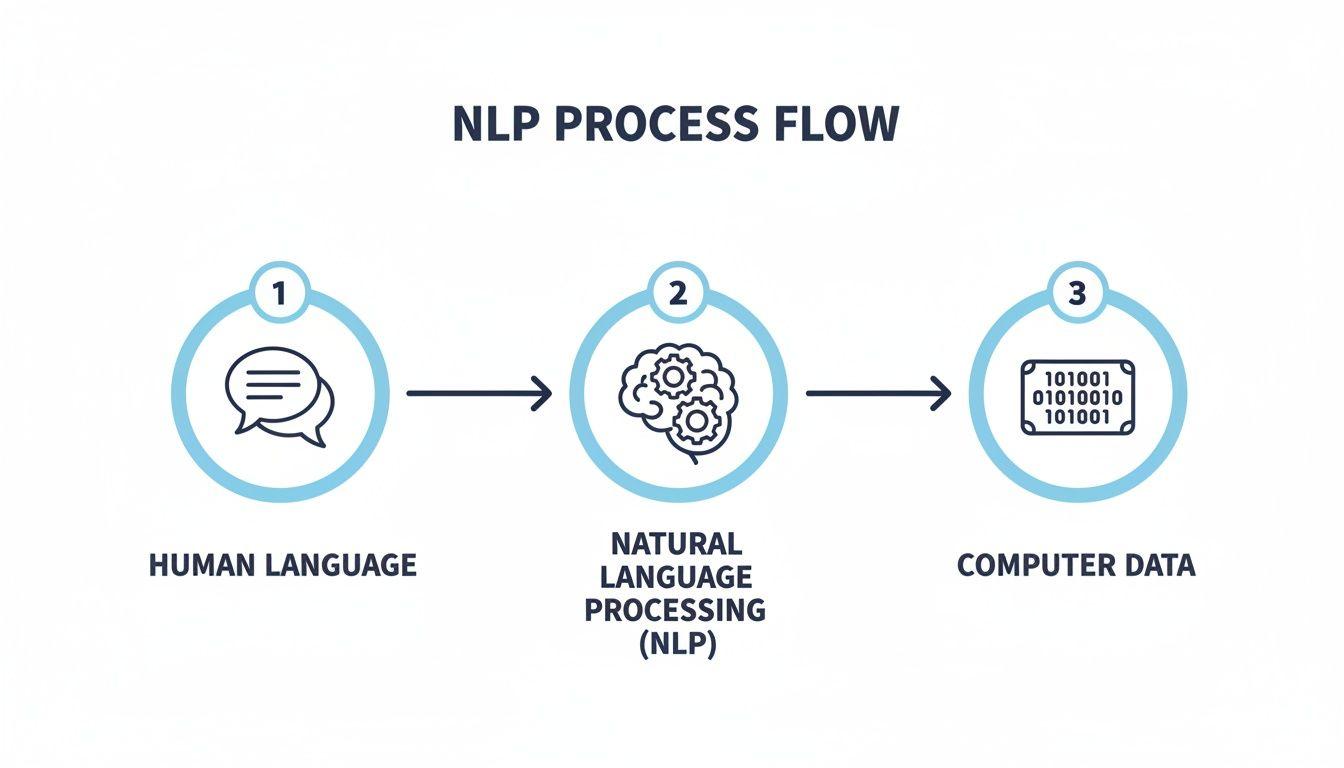
As you can see, NLP is the essential bridge. It’s what translates our unstructured, free-flowing words into the precise, logical format that computers need to get things done.
Breaking Down Sentences into Words
The first stop is a process called tokenization. Think of it like a chef prepping ingredients before starting a meal. You can't just throw whole vegetables into a pot; you have to chop them into smaller, usable pieces first. In the same way, an NLP model takes a sentence and chops it into individual units called "tokens."
For instance, the sentence "The team analyzes customer feedback" gets broken down into these tokens: ["The", "team", "analyzes", "customer", "feedback"]. It seems simple, but this is a critical first move. It gives the machine a basic vocabulary to work with, turning a continuous string of text into a neat list of distinct elements. Without this, the computer would just see a meaningless jumble of letters.
Understanding Grammar and Word Roles
Once the text is broken into tokens, the next challenge is figuring out what each word does in the sentence. This is where Part-of-Speech (POS) Tagging comes into play. It’s basically a grammar lesson for the machine, where every single token gets a label identifying its grammatical role—is it a noun, a verb, an adjective, or something else?
This adds a vital layer of context. Let's go back to our example sentence. The NLP model would tag each word like this:
- "The" is a determiner
- "team" is a noun
- "analyzes" is a verb
- "customer" is an adjective (because it's describing "feedback")
- "feedback" is a noun
By understanding that "analyzes" is the action and "team" is the one doing it, the machine starts to grasp the sentence's actual meaning. It's the difference between just having a list of words and knowing how they all fit together.
Understanding the grammatical role of each word is fundamental for an AI to grasp the relationships within a sentence. It’s the blueprint the machine uses to interpret meaning beyond simple keyword matching.
This grammatical breakdown allows the NLP system to move past a surface-level reading and start interpreting the structural logic of our language, which sets the stage for even more advanced analysis.
Identifying Key Information
With the grammatical structure sorted, the NLP model can now hunt for the most important bits of information using Named Entity Recognition (NER). This task is like taking a highlighter to a document to mark all the critical details. NER is trained to find and classify "named entities"—real-world objects that have a proper name.
It’s programmed to spot key data points like:
- People: "Elon Musk," "Jane Doe"
- Organizations: "Google," "The Red Cross"
- Locations: "New York City," "Mount Everest"
- Dates and Times: "December 25th, 2024," "9:00 AM"
- Monetary Values: "$50 million," "€20"
Imagine a small business using an NLP tool like 1chat to sort through customer support emails. NER could automatically pull out customer names, the specific product models they're asking about, and order dates. This can save a team hours of tedious manual work by instantly flagging the details they need to solve a problem.
In the end, all these steps—tokenization, POS tagging, and NER—work together seamlessly. They allow a computer to systematically deconstruct human language, figure out its structure, and pull out its most valuable information. This foundational process is what powers everything from the simple chatbots we interact with to sophisticated document analysis tools, making technology feel a lot more intuitive and genuinely helpful.
How We Taught Machines to Understand Us: A Quick History
Natural Language Processing didn't just appear out of nowhere. Its journey has been a fascinating evolution, moving from rigid, textbook-style learning to the kind of intuitive understanding we see in today's AI. The first attempts were a lot like giving a computer a dictionary and a grammar book and expecting it to get the job done.
These early systems, known as symbolic NLP, were built on a mountain of handcrafted rules. A programmer had to painstakingly code every single grammatical rule, every exception, and every linguistic pattern they could think of. The system might have a rule like, "a sentence needs a subject and a verb." It sounds logical, but this approach was incredibly fragile. It would break the second it encountered slang, a simple typo, or any of the creative ways we bend language every day.
A New Game: Learning from Data
As computers became more powerful, a completely different idea took root and changed everything. Instead of spoon-feeding machines a list of rules, researchers started feeding them massive amounts of text—books, articles, websites, you name it. This was the beginning of statistical NLP, where machines learned language by being immersed in it, not by memorizing instructions.
Think of it like this: symbolic NLP was like learning French from a textbook in a classroom. Statistical NLP is like moving to Paris. You stop memorizing verb conjugations and start picking up the natural flow, the context, and the intuition of how people actually speak. Statistical models do something similar by identifying patterns and calculating the odds of words appearing together. They don't "understand" grammar in a human sense; they just learn that "thank you" is far more likely to be followed by "very much" than "purple hippopotamus."
This data-first mindset was a huge leap. The 1980s flipped NLP on its head as statistical methods took over, powered by Moore's Law which kept doubling computing power every couple of years. A standout from this era was the 1989 Hidden Markov Model Toolkit (HTK), which was a game-changer for speech recognition by modeling probabilities—essentially guessing the next word based on what came before. By the 2000s, this kind of frequency-based analysis was king, but the next big shake-up came in 2013 with Word2Vec. This technique turned words into numeric vectors, capturing meaning in a way that allowed for incredible associations, like 'king' - 'man' + 'woman' mathematically resulting in 'queen.' You can get a deeper dive into the history of statistical NLP on spotintelligence.com.
The Brain-Inspired Breakthrough: Deep Learning
The latest and most powerful chapter in this story is all about Deep Learning. This is a branch of machine learning that uses complex, multi-layered neural networks that are loosely inspired by the structure of the human brain. These models are incredible at learning extremely subtle and abstract patterns from truly gigantic datasets.
Deep Learning models don't just spot word patterns; they learn to represent the meaning of words and sentences as mathematical concepts. This gives them a much deeper, more contextual grasp of language.
This shift paved the way for entirely new types of models, with one in particular completely redefining what was possible.
The Rise of the Transformers
Today, the undisputed champion of NLP is the Transformer model, which first appeared in 2017. Transformers turned the field upside down with a new concept called "attention." This mechanism lets the model weigh the importance of different words in a sentence as it's processing them, no matter how far apart they are.
This ability to focus on the most relevant context makes Transformers exceptionally good at handling long, complex sentences and understanding nuanced meaning. Their impact is hard to overstate. They are the engine behind the most advanced language models available today, including the one that powers tools like 1chat. It’s this technology that allows an AI to do more than just translate a sentence; it can summarize a dense report, brainstorm creative ideas, or answer complex questions with astonishing accuracy. This long road, from clunky rulebooks to intelligent, predictive models, is what makes NLP such a vital part of our world.
How NLP Powers Your Daily Life and Work
You might think of Natural Language Processing as some far-off, futuristic concept, but it's already woven into the very fabric of your daily life. Every time you ask Siri for the weather, see a movie recommendation on Netflix, or watch an email land perfectly in your "promotions" folder, you're seeing NLP at work. It's the invisible engine making our digital world smarter and more intuitive.
This technology has officially left the research lab and become a genuinely practical tool for everyone. Let's connect the dots and see how NLP offers real-world solutions for your work, your studies, and even your family life.
Driving Growth for Small Businesses
For any small business, really getting your customer is the key to success. Not long ago, that meant someone had to manually sift through every customer review, support ticket, and social media comment. It was a mountain of work. Today, NLP can do the heavy lifting, turning a firehose of unstructured text into clear, actionable insights.
Think about a small online shop that gets hundreds of product reviews every week. Instead of one person spending their entire day reading them, an NLP tool can run sentiment analysis in a matter of seconds. It can instantly flag reviews as positive or negative and even spot recurring themes, like "slow shipping" or "great quality," allowing the team to fix problems and double down on what's working—fast.
On top of that, small teams are using NLP to seriously upgrade their customer support. A Zendesk report found that 70% of CX leaders see bots as becoming key architects of personalized customer journeys. For example, an AI chatbot for small business can field common questions 24/7, which frees up the human team to handle the tricky issues that need a personal touch.
By automating data analysis and customer interaction, Natural Language Processing gives small businesses the kind of powerful insights that were once only available to large corporations with massive data teams.
It’s a true game-changer, leveling the playing field and allowing smaller companies to be just as responsive and data-driven as their biggest competitors.
Transforming Education for Students
Students are also getting a massive boost from new, accessible NLP tools. The old-school research process—spending hours poring over dense academic papers—is quickly becoming a thing of the past. NLP is a lifesaver when you’re facing a mountain of information.
Here’s how students are putting it to work:
- Automated Summarization: Instead of reading a 30-page research paper just to find out it’s not relevant, a student can use a tool like 1chat to get a solid summary of its key points and findings. This makes the literature review process worlds faster.
- Enhanced Q&A: Imagine uploading your textbook or lecture notes and then just asking them questions. That's what NLP enables. It acts like a personal study assistant, finding and pulling together answers directly from your course materials.
- Writing Assistance: Modern writing tools powered by NLP go way beyond basic spell-check. They can offer smart grammar corrections, suggest stylistic improvements, and even help structure an essay for better flow and clarity.
A Safe and Helpful Tool for Families
NLP is also finding a place in our homes, offering safe and productive ways for families to learn and manage their busy lives. For parents, finding reliable, age-appropriate digital tools is a huge priority.
Family-friendly platforms that use NLP are built with safety as a core principle. They can help with homework by explaining a tough math problem or a historical event in simple terms, all without exposing kids to the unfiltered chaos of the internet. These tools can also be creative partners, helping a child brainstorm a story or generate images for a school project within a secure, controlled environment.
This table gives a quick overview of how different people can put NLP to use in their daily lives.
NLP Applications for Different Users
| User Group | Practical Application | NLP Task Used |
| Small Business Owner | Analyze customer feedback from reviews and surveys to improve products. | Sentiment Analysis |
| Student | Quickly get the main points from a long research paper without reading it all. | Text Summarization |
| Marketing Team | Monitor social media for brand mentions and customer sentiment. | Named Entity Recognition (NER), Sentiment Analysis |
| Parent | Get a safe, age-appropriate answer to a child's homework question. | Question Answering (QA) |
| Support Agent | Instantly translate a customer's question from another language. | Machine Translation |
| Product Manager | Identify recurring feature requests from user support tickets. | Topic Modeling, Text Classification |
As you can see, the applications are both practical and incredibly varied, designed to solve real problems for real people.
From streamlining a business to acing a final exam, NLP is proving to be a powerful ally. It's a versatile technology that is already making a real difference in how we all work, learn, and connect with each other.
Putting NLP to Work with Practical Tools
It's one thing to understand the theory behind Natural Language Processing, but it’s another to see it in action. That’s where the magic really happens. The best part? You no longer need a degree in data science to tap into this powerful tech. Accessible platforms like 1chat are built to put sophisticated NLP tools right at your fingertips, making complex tasks feel surprisingly simple.
This is what closes the gap between abstract ideas and real-world results. You can go from learning about NLP to actually using it to solve a problem in minutes—no coding required.
From Dense Documents to Clear Insights
Picture this: you're a student staring down a 40-page academic journal article, or maybe a small business owner trying to make sense of a dense legal contract. Plowing through that kind of text can burn hours of your day. With an NLP-powered tool, you can get to the heart of the matter almost instantly.
The process is incredibly straightforward. You can upload a PDF directly into a platform like 1chat and just start a conversation with it. Instead of reading every single word, you can simply ask:
- "What are the three main arguments in this paper?"
- "Can you summarize the conclusion in plain English?"
- "Does this document mention anything about data privacy risks?"
The tool uses its NLP engine to read, understand, and pull out the exact information you're looking for, giving you a quick, concise answer based on what's in the document. What was once a tedious research project becomes a fast and focused Q&A session.
This screenshot shows the clean, intuitive interface of 1chat, where users can start a conversation or upload files to begin their analysis. The design is all about simplicity, making advanced NLP accessible through a familiar chat format that anyone can pick up and use immediately.
A Smarter Way to Research and Write
These tools are more than just document analyzers; they're powerful research and writing partners. Let's say you're putting together a marketing report. You could use an NLP tool to brainstorm ideas, check your grammar, or rephrase a clunky sentence to make it flow better. The AI can help you find supporting data, generate a solid outline, and make sure your final draft is polished and professional.
For anyone looking to sharpen their writing, an AI paragraph writer can be a huge help. You can learn more about how these tools help structure compelling content in our guide on the topic.
The real power of modern NLP tools lies in their accessibility. They take enterprise-level technology and package it in a way that empowers anyone—from a high school student to a startup founder—to work smarter, not just harder.
These platforms handle all the heavy lifting—the tokenization, parsing, and semantic analysis—behind the scenes. All you have to do is ask your question or give it your text. This approach opens up access to AI for everyone, letting you focus on your goals while the technology does the grunt work. By using these tools, you can smooth out your workflow, get a better handle on complex topics, and find new ways to be productive, all within a secure and private environment.
Understanding the Ethics of AI Language
Natural Language Processing is an incredible tool, but with that power comes some serious responsibility. As we weave these technologies into our businesses and homes, we have to get smart about the ethical speed bumps ahead. The two biggest ones we need to navigate are data privacy and algorithmic bias.
Thinking through these issues helps you become a more discerning and responsible user of AI. It's about making sure the tools you pick are not only effective but also fair and safe for everyone.
Protecting Your Digital Footprint
Every time you chat with an AI, you're leaving behind data. The million-dollar question is: what happens to it? NLP models learn their stuff by sifting through massive datasets pulled from the internet—think public websites, social media, you name it. That's how they learn language, but it also means your information could get absorbed into the system.
This kicks up some major privacy flags, especially if you're using AI for sensitive tasks like analyzing confidential business documents or helping your kid with their homework. That's why choosing a platform that puts privacy first is non-negotiable. For example, 1chat was built from the ground up as a privacy-first tool, so your conversations and uploaded files aren't used to train public AI models.
When you use an AI tool, you're entering into an agreement based on trust. It’s vital to choose platforms that are upfront about their data policies and are truly committed to protecting your privacy, not just profiting from your information.
This commitment is what separates a trustworthy tool from a potential liability. It gives you the peace of mind to use AI without worrying that your personal or professional data is at risk.
The Problem of Algorithmic Bias
Here's a hard truth: an AI model is only as good as the data it’s trained on. Since these models learn from the messy, unfiltered text humans have plastered all over the internet, they inevitably soak up our biases, stereotypes, and prejudices. This is called algorithmic bias, and it can lead to some seriously unfair and skewed results.
For instance, an AI trained on biased historical text might learn to associate certain jobs with specific genders or generate content that reflects outdated, harmful social norms. These prejudices can creep in in subtle but damaging ways, influencing everything from hiring recommendations to the very tone of the content it creates.
Fixing this requires a real commitment from both AI developers and users. Developers need to be more deliberate about creating diverse and representative training datasets. As users, it’s on us to critically evaluate AI-generated content and recognize its potential for bias. Staying aware of this challenge helps us better understand how to humanize AI text and demand more equitable technology.
Ultimately, the ethical side of what is natural language processing comes down to making informed choices. By prioritizing data privacy and staying alert to potential bias, you can use these amazing tools responsibly—ensuring they serve you, your team, and your family in a way that’s both safe and fair.
Common Questions About Natural Language Processing
As you dive into the world of NLP, a few questions tend to surface again and again. Getting these sorted out is a great way to build a solid foundation and feel more comfortable with the technology. Let's walk through some of the most common ones.
What’s the Difference Between AI, Machine Learning, and NLP?
It’s easy to see these terms used interchangeably, but they actually represent different layers of a bigger picture. The best way to think about it is like a set of Russian nesting dolls.
- Artificial Intelligence (AI) is the largest doll on the outside. It’s the overarching concept of building machines that can perform tasks that typically require human intelligence, like problem-solving or learning.
- Machine Learning (ML) is the next doll inside. It's a subset of AI—one of the most important ways we achieve artificial intelligence. Instead of being explicitly programmed for a task, an ML system learns patterns from huge amounts of data.
- Natural Language Processing (NLP) is an even more specific doll tucked inside the others. It’s a specialized field of AI that often uses machine learning techniques to focus on one single, massive challenge: understanding and working with human language.
So, when you hear about NLP, you're really talking about a specific application of AI that frequently relies on machine learning to get the job done.
Can I Use NLP Without Knowing How to Code?
Absolutely. Not too long ago, you needed to be a developer to get your hands on this kind of power. That’s just not the case anymore.
Modern tools like 1chat are built for everyday users, not just programmers. You can jump right into complex NLP tasks—like summarizing a dense report, pulling insights from customer reviews, or even drafting an email—all through a simple chat window. These platforms do all the heavy lifting in the background, making the power of NLP accessible to everyone.
Is NLP Safe for My Children to Use for Schoolwork?
That’s a great question, and the answer comes down to the tool you choose. The underlying NLP technology itself is neutral; what truly matters is the platform that delivers it. This is where choosing a service designed with safety and families in mind becomes critical.
A family-oriented AI platform provides a secure environment where kids can explore, learn, and create. It offers the power of NLP without the risks of unrestricted access to the open internet.
Tools like 1chat are built specifically for safe use, creating a controlled space where kids can get help with homework or explore creative ideas. When you're evaluating a tool, always check that it has strong privacy policies and content filters to ensure the experience is both helpful and secure.