Writing a bibliography means creating an alphabetized list of every source you've looked at for your research. Each entry is formatted in a specific style—like APA, MLA, or Chicago—and includes details like the author, title, and publication date so anyone can track down the original work.
Beyond the Basics: The Real Power of a Bibliography
Think of a bibliography as more than just a required final page; it's the foundation of any credible work. In an age of information overload, a well-organized bibliography tells your reader you've done the hard work, building trust whether you're submitting a term paper or a critical business report.
It’s your way of showing exactly how you built your argument, giving your audience a clear roadmap to explore the topic on their own terms.
Why It Matters More Than Ever
Getting your citations right has never been more important. The output of global scientific publications shot up from 2.0 million articles in 2010 to an incredible 3.3 million in 2022—that’s a 65% jump. This boom, led by China (at 27% of global output) and the United States (14%), makes proper citation essential for navigating this ocean of knowledge.
For students, researchers, or small business teams, a solid bibliography isn't just a box to check. It’s your best defense against plagiarism and a powerful signal of your credibility.
A bibliography does more than just give credit; it creates a verifiable trail of evidence. It invites your readers to engage with your sources, transforming your work from a standalone piece into a conversation with a larger body of knowledge.
Laying the Groundwork for Success
The secret to a stress-free bibliography is to start thinking about it long before you write your first draft. By keeping a meticulous record of your sources as you go, you’ll avoid that last-minute panic of trying to track down a missing detail.
This proactive habit ensures your work stands on a solid foundation of academic integrity and professional polish. It also sharpens your ability to identify what makes a source truly credible in the first place.
Building a great bibliography really comes down to three key things, which we'll cover step-by-step:
- When you need one: Figuring out which projects require a formal bibliography.
- The rules of the road: Getting a handle on the specific formatting guidelines for APA, MLA, and Chicago.
- Putting it all together: Assembling your list with the right ordering, punctuation, and layout.
Building Your Source Library Before You Write
The real secret to a stress-free bibliography isn't about last-minute heroics. It's about starting on day one. Instead of writing your entire paper and then frantically retracing your steps to find source details, build the habit of capturing what you need as you find it.
Think of it as creating a personal dossier for every source you touch. A simple master document or a dedicated note-taking app is all you need. The moment you find a useful resource, log its essential information. This tiny bit of effort upfront will save you hours of headaches down the road.
Create Your Source Checklist
Before you even begin weaving your research into your writing, have a checklist ready. For every single book, article, or website you review, make it an immediate habit to record the core details. This proactive approach is a game-changer for serious research. In fact, adopting this habit is one of the best ways of improving your research skills overall.
Here’s the essential data you should always grab:
- Author(s): Full names, spelled correctly.
- Publication Date: The year is crucial; for some sources, you'll need the month and day, too.
- Full Title: Get the complete title of the work, including any subtitles.
- Publication Information: For books, that's the publisher and city. For journals, you'll need the journal name, volume, and issue numbers.
- Digital Identifiers: The DOI (Digital Object Identifier) for academic articles is the gold standard. For websites, grab the direct URL.
- Access Date: Always note the date you accessed any online source. Web pages disappear and change.
For example, a tool like ZoteroBib can help you pull this information quickly just by plugging in a URL, DOI, or ISBN.
Tools like this are a fantastic starting point, but always, always double-check what they generate. Compare it against your own checklist to ensure every detail is accurate.
Why This Method Works
This "collect as you go" strategy does more than just prep your bibliography; it forces you to be a more deliberate researcher. When you pause to log a source's details, you're also taking a moment to evaluate its credibility and how it fits into your argument. It transforms research from passive consumption to active organization.
The most common point of failure in creating a bibliography isn't formatting—it's missing information. A meticulously organized source library built during the research phase eliminates 90% of the stress associated with citation.
You’ll never again be that person digging through weeks of browser history, trying to remember the name of that one website you glanced at. Every piece of evidence will be neatly tied to its origin, ready to be cited the moment you need it.
This organized approach means that when it's time to assemble your final reference list, you're working from a complete and accurate dataset. All the pieces are already on the board; you just have to arrange them according to your style guide. It’s a simple shift in workflow that makes the final step of academic writing feel less like a chore and more like a final, satisfying check-off.
Getting to Grips With APA, MLA, and Chicago Citation Styles
Trying to tell APA, MLA, and Chicago citation styles apart can feel like you're learning three dialects of the same language. They all exist for the same reason—to give proper credit to your sources—but they get hung up on different details like punctuation, capitalization, and the order of information.
The style you end up using isn't really a choice; it's dictated by your field. APA is the standard in social sciences like psychology and education. MLA is home turf for the humanities (think English and philosophy). And Chicago is often the go-to for history and the fine arts. The single most important rule? Pick the one you're supposed to use and stick with it. Consistency is everything.
Before you get bogged down in the specific rules for a book versus a website, it helps to zoom out and see the bigger picture. The whole process is about finding a source, grabbing the key details, and then arranging those details according to a specific style guide.
This flowchart breaks that journey down into three simple stages.
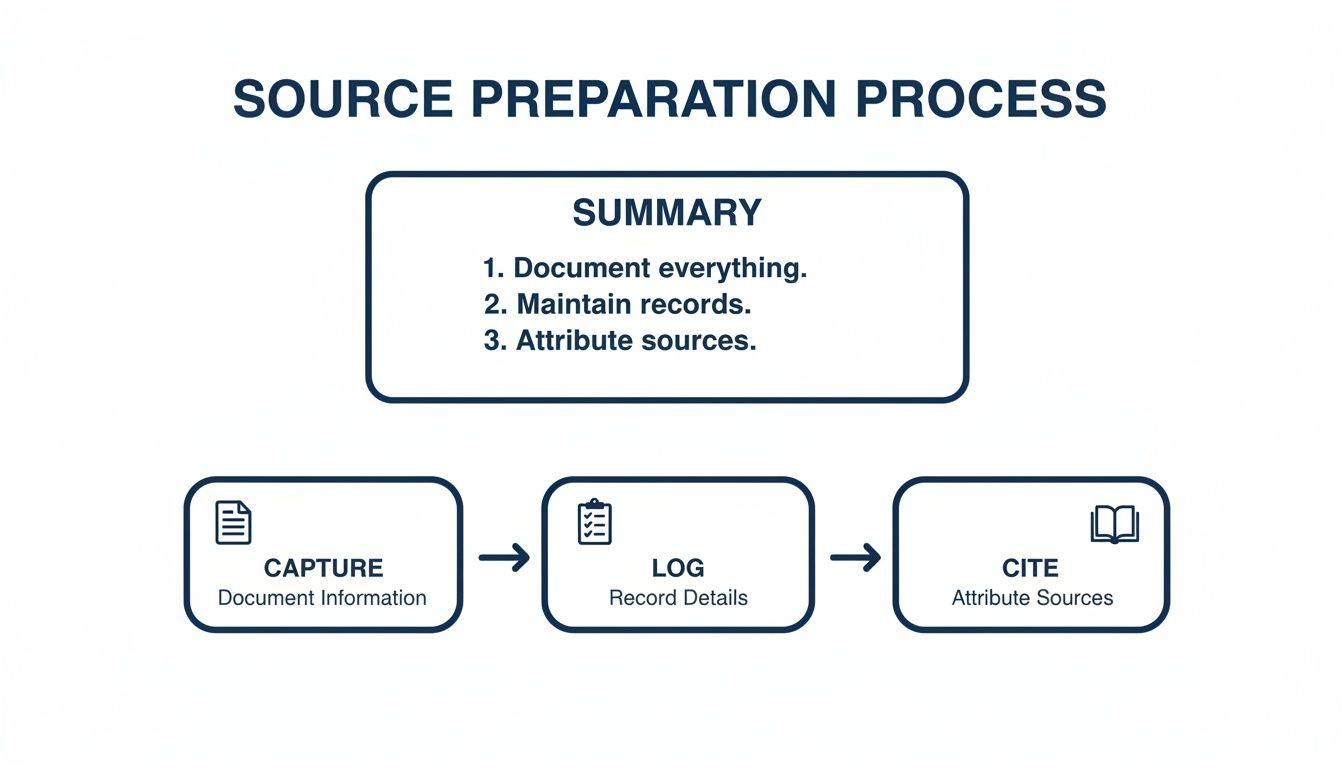
As you can see, good citation habits start the second you find a source you want to use, not when you’re frantically trying to finish your paper at midnight.
Universal Checklist: Gathering Your Source Information
Before you can even think about formatting, you need to collect the right information. The specific details you need will change depending on what you're citing, but you can use this table as a general checklist. Think of it as your pre-formatting toolkit—gather these core components first, and then you can easily slot them into APA, MLA, or Chicago templates.
| Source Type | Information to Collect (Author, Date, Title, etc.) |
| Book | Author(s)/Editor(s), Year of Publication, Full Title (and Subtitle), Edition (if not the first), Publisher, Place of Publication (sometimes needed for Chicago). |
| Journal Article | Author(s), Year of Publication, Full Article Title, Journal Name, Volume Number, Issue Number, Page Range, DOI (Digital Object Identifier) or URL. |
| Website/Webpage | Author or Organization, Publication or "Last Updated" Date, Title of the Page/Article, Title of the Website, URL. For MLA, you'll also need the date you accessed it. |
| PDF/Report | Author(s) or Organization, Year of Publication, Full Title of the Document, Publisher or Sponsoring Organization, Report Number (if applicable), URL or DOI. |
| Video/Podcast | Creator/Host/Uploader, Full Date of Publication, Title of the Video/Episode, Title of the Series/Channel, Platform (e.g., YouTube, Spotify), URL. |
Having this information ready makes the actual formatting process much smoother. You're just assembling the puzzle pieces instead of hunting for them.
Real-World Examples: How the Styles Compare
Let's see how these rules play out with real sources. The differences can be subtle, but they're critical for getting it right.
The Anatomy of a Book Citation
Books are a staple in most research. Let's take Nicholas Carr's 2020 book, The Shallows: What the Internet Is Doing to Our Brains, and see how each style handles it.
- APA 7: Carr, N. (2020). The shallows: What the internet is doing to our brains. W. W. Norton & Company.
- MLA 9: Carr, Nicholas. The Shallows: What the Internet Is Doing to Our Brains. W. W. Norton & Company, 2020.
- Chicago 17 (Author-Date): Carr, Nicholas. 2020. The Shallows: What the Internet Is Doing to Our Brains. New York: W. W. Norton & Company.
Right away, you can spot the differences. APA only uses the author's first initial and places the year in parentheses. MLA uses the full name and puts the year at the very end. Chicago uses the full name, too, but puts the year right after it. Tiny details, huge impact.
Tackling a Journal Article
For any serious academic paper, journal articles are your bread and butter. Let’s cite a fictional article to see how the styles diverge.
Source Details:
- Authors: Jane M. Doe & John A. Smith
- Year: 2021
- Article Title: The Impact of Remote Work on Team Collaboration
- Journal Name: Journal of Business Communication
- Volume: 45
- Issue: 2
- Pages: 112-128
- DOI: 10.1234/jbc.2021.5678
Here's the breakdown:
- APA 7: Doe, J. M., & Smith, J. A. (2021). The impact of remote work on team collaboration. Journal of Business Communication, 45(2), 112–128. https://doi.org/10.1234/jbc.2021.5678
- MLA 9: Doe, Jane M., and John A. Smith. "The Impact of Remote Work on Team Collaboration." Journal of Business Communication, vol. 45, no. 2, 2021, pp. 112-28. JSTOR, https://doi.org/10.1234/jbc.2021.5678.
- Chicago 17 (Notes-Bibliography): Doe, Jane M., and John A. Smith. "The Impact of Remote Work on Team Collaboration." Journal of Business Communication 45, no. 2 (2021): 112–28. https://doi.org/10.1234/jbc.2021.5678.
The differences are even clearer here. APA uses "sentence case" for the article title, while MLA and Chicago use "title case." MLA also asks for the database (like JSTOR) and uses "pp." for the page range.
Pro Tip: For any digital article, the DOI (Digital Object Identifier) is your best friend. It's a permanent link that won't break, unlike a regular URL. If a DOI is available, you should always include it, no matter which citation style you're using.
How to Cite a Website
Websites can be tricky. Authors are often missing, and publication dates can be hard to find. The goal is just to provide as much detail as possible so your reader can find the exact page you used.
Let's cite a fact sheet from the World Health Organization's website.
- APA 7: World Health Organization. (2023, May 5). Mental health. https://www.who.int/news-room/fact-sheets/detail/mental-health
- MLA 9: "Mental Health." World Health Organization, 5 May 2023, www.who.int/news-room/fact-sheets/detail/mental-health. Accessed 10 Oct. 2023.
- Chicago 17 (Notes-Bibliography): World Health Organization. "Mental Health." Last modified May 5, 2023. https://www.who.int/news-room/fact-sheets/detail/mental-health.
When the author is an organization, all three styles just use the organization's name. The standout here is MLA, which requires an "Accessed" date. This is a smart move for web content, which can be changed or disappear overnight.
Proper citation isn't just an academic exercise; it’s about participating in a global conversation. With global S&E publications growing 59% from 2012 to 2022, the need for clear, standardized citations is more important than ever. In 2022, nearly 40% of U.S. papers involved international coauthors, highlighting this collaborative trend. You can dive deeper into these numbers with this comprehensive report on science and engineering indicators from the NSF.
Citing AI and Other Modern Sources
So what happens when your source isn't a book or a website, but a conversation with an AI? Style guides are hustling to keep up. APA, for example, has already released clear guidance on how to cite generative AI.
Here's the APA 7 template for a ChatGPT conversation:
Template: OpenAI. (Year, Month Day). Title of chat [Generative AI chat]. https://url.of.chat
Example: OpenAI. (2023, October 10). Brainstorming sustainable business practices [Generative AI chat]. https://chat.openai.com/share/your-unique-link
This move shows that the core principle of citation is, and always will be, transparency. Your goal is to give readers a clear map of the sources you used to build your argument, whatever form they might take.
Putting It All Together: Your Final Reference Page
Okay, you've done the hard work of formatting each individual citation. Now for the final step: assembling them into a single, polished list. This is where all those pieces come together to create a professional and easy-to-read reference page that backs up your writing.
While the nitty-gritty rules can differ, a few core principles hold true across all major styles. Getting these details right—the page title, the alphabetical order, and that slightly weird "hanging indent"—is the final polish that shows you’ve done your homework.
Naming Your Page Correctly
First thing's first: what do you actually call this page? This isn't a place to get creative. The title is strictly determined by the citation style you're using.
- APA: You'll title the page References.
- MLA: Calls for Works Cited.
- Chicago: Can be either Bibliography or References, depending on whether you're using the notes-bibliography or author-date system.
Whichever one you use, just center the title at the top of a new page. No bolding, no underlining, no italics—just plain and simple text.
The Rules of Alphabetical Order
Alphabetical order is the backbone of any reference list. Every entry needs to be sorted alphabetically by the author's last name. Simple enough. If a source has more than one author, you still use the first author listed to determine its place in the lineup.
But what happens when things aren't so straightforward?
- No Author: If you have a source with no clear author, like some websites or organizational reports, you'll alphabetize it by the first significant word of the title. Just remember to ignore little words like "A," "An," or "The" at the beginning. So, an article titled "The Economics of Wind Power" would be alphabetized under "E" for "Economics."
- Same Author, Multiple Works: Got a few sources from the same expert? List them chronologically, starting with the oldest one first. If you happen to have two works from the same author published in the same year, you'll add a letter to the year (like 2022a, 2022b) and then alphabetize those entries by the title.
A bibliography is more than just a requirement; it's a map of your research journey. Keeping it meticulously organized shows respect for your reader and reinforces your own credibility. For tips on staying organized from the get-go, check out our guide on how to organize research notes.
Mastering the Hanging Indent
The most visually distinct feature of a bibliography is the hanging indent. All it means is that the first line of each entry sits flush with the left margin, while all the lines that follow are indented. This simple trick makes it incredibly easy for a reader to scan down the list of authors' names.
Don't try to do this manually with the spacebar! It’s a simple setting in any word processor.
- In Microsoft Word: Highlight your list. Find the "Paragraph" settings box (it's often a tiny arrow in the corner of the Paragraph tab). In the pop-up, look under "Indentation" for the "Special" dropdown and choose "Hanging."
- In Google Docs: Highlight your citations. Go to the menu and click "Format" > "Align & indent" > "Indentation options." In the dialog box, find "Special indent" and select "Hanging."
Getting these details right is crucial, especially when you consider that worldwide academic publications hit a staggering 3.3 million in 2022 alone. This sheer volume of information, detailed in studies on global publication trends, shows why clear and consistent citation is no longer just an academic exercise—it’s a fundamental skill. Assembling your reference page is your contribution to that clarity.
Dodging Common Bibliography Blunders
You've done the hard work of gathering your sources and building your citations. Now comes the final, crucial step: the proofread. It’s easy to get tunnel vision and miss small mistakes, but these little details are what make a bibliography truly professional and easy for your reader to use.
Let's go over some of the most common tripwires I see and how to sidestep them.
Mixing and Matching Citation Styles
This is, without a doubt, the most frequent mistake. It’s easy to do, especially when you’re pulling sources from different databases. You might end up with an APA-style author-date format for one entry and MLA-style title capitalization for another. The result is a confusing, messy-looking list.
- Before (A mix of styles): Doe, J. (2022). The Study of Things. Publisher. and Smith, John. "Another Article Title." Journal Name, vol. 5, no. 2, 2023, pp. 10-15.
- After (Consistent APA):
- Doe, J. (2022). The study of things. Publisher.
- Smith, J. (2023). Another article title. Journal Name, 5(2), 10–15.
The fix is straightforward: pick one style guide and stick with it. Keep a cheat sheet or your style manual open while you review every single entry for consistency.
Forgetting Crucial Digital Info
In a world where links can break and content can vanish, simply pasting a URL often isn't enough. For digital sources, you need to include specific identifiers that help your reader find the exact version you cited.
Two commonly overlooked pieces of information are:
- The DOI (Digital Object Identifier): Think of this as a permanent social security number for an online article. URLs can change, but a DOI will always point to the right source. If a journal article has one, you absolutely have to include it.
- The Access Date: This is especially important in MLA. Since websites can be updated or taken down at any moment, noting the date you accessed the material gives your reader vital context.
A citation from an automatic generator is a fantastic first draft, but it's rarely a perfect final product. Always double-check its output against your style guide, as generators often miss subtleties like proper capitalization or might pull incomplete information.
Messing Up Title Capitalization
This is one of those tiny details that immediately signals whether you know your stuff. APA and MLA handle title capitalization completely differently, and getting it wrong is a dead giveaway that you haven't polished your work.
- APA Style requires sentence case for titles of books and articles. It’s simple: you only capitalize the first word of the title, the first word of the subtitle (after a colon), and any proper nouns.
- Incorrect (Title Case): The Psychology of Everyday Decisions.
- Correct (Sentence Case): The psychology of everyday decisions.
- MLA Style uses title case. Here, you capitalize all the "major" words—nouns, pronouns, verbs, adjectives, and adverbs. You leave the "minor" words like articles and short prepositions in lowercase unless they're the very first or last word of the title.
- Incorrect (Sentence Case): The road not taken in American poetry.
- Correct (Title Case): The Road Not Taken in American Poetry.
This is something citation generators frequently get wrong, so I always recommend checking every single title by hand. It’s a quick fix that makes a huge difference.
Got Questions About Bibliographies? We’ve Got Answers.
Even the most seasoned writers run into tricky situations when putting together their reference list. It's perfectly normal. Think of this section as your on-call expert for those "what if" moments that inevitably pop up. We’ve pulled together some of the most common questions people ask to help you get unstuck and finalize your bibliography with confidence.
Bibliography vs. Reference List: What’s the Real Difference?
This is probably one of the most common points of confusion out there, and for good reason—the answer isn't always straightforward. It really boils down to the citation style you're using.
A reference list (what you see in APA style) or a Works Cited page (the MLA equivalent) is a very specific thing: it only lists the sources you actually quoted, paraphrased, or referenced directly in your work. It's a precise map showing your reader exactly where your evidence came from.
A bibliography, on the other hand, can be a broader term. While some styles like Chicago use it to mean the same thing as a reference list, it can also refer to a comprehensive list of every single source you consulted during your research, even the ones you didn't end up citing in the final paper.
The bottom line is this: A reference list is about what you cited, while a bibliography can be about what you consulted. If you're ever unsure, the safest bet is to check your assignment guidelines or ask your instructor for clarification.
How Do I Cite a Source I Found Quoted in Another Source?
Ah, the classic secondary source problem. You're reading a brilliant book by Smith, who quotes a fascinating study by Jones. You want to use that Jones quote, but you haven't actually read the original study yourself. What do you do?
The absolute best practice is always to hunt down the original source—in this case, the Jones study. Citing the primary source ensures you're representing the information accurately and within its original context. But let's be realistic; sometimes that's just not possible. Maybe the original is out of print, behind an impossible paywall, or in a language you don't read.
When that happens, you need to cite it as a secondary source.
Here’s a quick look at how you'd handle it in APA style:
- In your in-text citation, you acknowledge both: (Jones, as cited in Smith, 2021). This shows your reader where the idea originally came from and where you actually found it.
- In your reference list at the end, you only create an entry for Smith (2021). Why? Because that's the source you actually had in your hands.
What if My Source Is Missing an Author or a Date?
Don't panic! Missing information is frustrating, but citation styles have built-in workarounds for this exact problem. The goal is to provide as much information as you can and use the standard format for whatever is missing.
Here are the two most common scenarios you'll face:
- No Author: First, double-check if an organization is responsible for the work. Reports from the World Health Organization, for example, would use that as the author. If there's genuinely no author to be found, you simply move the title of the work into the author's spot and alphabetize your list using the first main word of that title.
- No Date: After a thorough search, if you still can't find a publication date, the solution is simple. Just use the abbreviation (n.d.), which stands for "no date," right where the year would normally go. This is the standard fix in APA and other styles.
How Should I Cite Generative AI Like ChatGPT?
With AI becoming a more common part of the writing process, citation guides are moving quickly to keep up. If you used an AI tool like ChatGPT to brainstorm ideas or generate text, transparency is everything. Acknowledging its use is a matter of academic integrity.
Fortunately, major style guides like APA now provide clear instructions. The format is designed to help a reader understand what tool you used and, if possible, access the content.
Here’s the general APA template for a shareable AI chat:
AI Company Name. (Year, Month Day). Title of chat [Generative AI chat]. URL
Putting it into practice, a citation might look like this: OpenAI. (2023, October 26). Brainstorming marketing slogans for a coffee shop [Generative AI chat]. https://chat.openai.com/share/your-unique-link
Your goal is always to provide a clear trail for your reader to follow. Citing AI properly shows that you’re being honest about the tools that supported your work, which is especially critical when using AI for research or proofreading academic essays.