You've probably opened a blank document, typed “Essay on Climate Change,” and then stopped. The topic feels huge. There's science, politics, weather, health, ethics, and a long list of facts that can blur together if you try to tackle everything at once.
That stuck feeling is normal. Climate change is one of those subjects that sounds simple at first, then suddenly becomes hard the moment you try to turn it into a clear school essay.
The good news is that a strong essay on climate change doesn't require you to know everything. It requires you to do three things well: understand the core idea, choose a focused argument, and organize your evidence so your reader can follow it. That's very manageable when you break it into steps.
Your Starting Point for a Great Climate Change Essay
Most students struggle at the same point. They don't know whether to start with facts, opinion, or structure. Start with structure.
If your paper feels messy, it usually isn't because you're bad at writing. It's because the topic is too wide. “Climate change” by itself is like being told to write about “history” or “health.” You need to narrow it into something a teacher can grade and a reader can follow.
Start with one clear essay job
Pick the kind of essay you're writing before you draft anything:
- Explain: What climate change is and why it happens
- Analyze: What effects climate change has on people and ecosystems
- Argue: Why governments, communities, or individuals should act
- Evaluate: Which solutions seem most realistic or most fair
- Explore justice: Why some groups face heavier burdens than others
A lot of weak essays try to do all five. A strong one usually does one main job and supports it well.
Use a simple planning box
Before writing full sentences, jot down four short notes:
- Topic focus
Example: climate change and human health - Main claim
Example: climate change is not only an environmental issue but also a major public health challenge - Best evidence
Use only the strongest facts, not every fact you can find - Ending idea
What should the reader understand by the end?
Practical rule: If your thesis fits in one sentence, your essay usually stays organized. If your thesis takes half a paragraph, you're still thinking, not writing.
Build from a model, not from panic
A helpful way to get unstuck is to look at a clear academic writing model before drafting. The Access Courses Online essay guide gives a useful overview of how introductions, body paragraphs, and conclusions work in academic essays. That's especially helpful if you understand the topic but freeze when it's time to organize your thoughts.
If you want extra writing support after planning, you can also use the 1chat contact page to ask questions about brainstorming or revision support.
What your teacher usually wants
Teachers often reward essays that do these things:
- Stay focused instead of drifting into unrelated climate facts
- Use evidence carefully rather than stacking random statements
- Explain significance so the facts support an argument
- Sound balanced by showing cause, impact, and response
- End clearly instead of fading out with a vague final sentence
That means your goal isn't to sound dramatic. Your goal is to sound clear, informed, and in control.
What Is Climate Change Explained Simply
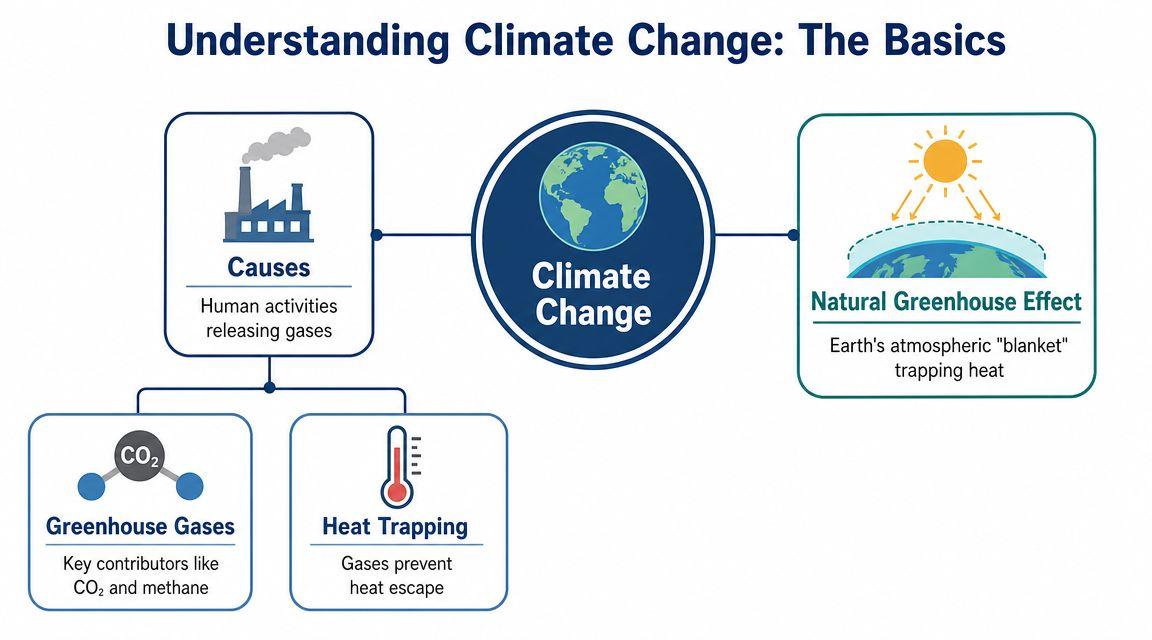
Climate change means long-term changes in Earth's temperatures and weather patterns. Some climate changes happen naturally over long stretches of time, but the current warming trend is different because human activity is driving it.
A useful way to understand this is the blanket idea. Earth has a natural layer of gases in the atmosphere that holds in some heat from the sun. That's a good thing because without it, the planet would be too cold for life. But when people burn fossil fuels and release more greenhouse gases, that blanket gets thicker. More heat stays trapped.
The difference between global warming and climate change
Students often mix up these two terms.
- Global warming is the rise in Earth's average temperature.
- Climate change is the wider result of that warming, including changing rainfall, stronger heat events, shifting seasons, and more disruptive weather patterns.
Think of it this way. If global warming is the fever, climate change is the set of symptoms affecting the whole body.
NASA states that the current warming trend is caused largely by human activities since the mid-1800s, and the planet's average surface temperature has risen about 1°C since the late 19th century. The same source notes that greenhouse gas emissions reached a record high of 57.7 gigatonnes in 2024. For a student essay, that gives you a clean cause-and-effect line you can cite from NASA's climate evidence page.
Why the science matters in your introduction
Your introduction doesn't need every scientific detail. It needs enough explanation to show that you understand the mechanism.
A clear opening might sound like this:
Climate change is the long-term shift in Earth's climate patterns, largely driven today by human activities that release greenhouse gases and trap extra heat in the atmosphere.
That sentence works because it does three jobs at once. It defines the topic, identifies the cause, and sets up the rest of the essay.
If you're studying for a school geography course and want a quick review in student-friendly language, the guide on revising OCR GCSE climate change can help reinforce the basics before you write.
A plain-language explanation you can reuse
If your teacher wants a simpler tone, use this pattern:
- Earth naturally keeps some heat.
- Human activity has added more greenhouse gases.
- Those gases trap extra heat.
- Extra heat changes weather and climate systems over time.
That's the scientific core of an essay on climate change. If you understand that chain, you can explain the topic without sounding memorized.
The Key Impacts of a Warming Planet
Once you've explained what climate change is, your body paragraphs need to answer a second question. Why does it matter?
A common mistake is writing only in vague terms like “it harms the planet.” That's too broad. Strong essays break impacts into categories and show how environmental changes affect human life.
Health impacts make the issue concrete
Climate change isn't only about polar ice or distant future scenarios. It's also a health issue happening in real communities.
The World Health Organization says climate change is expected to cause approximately 250,000 additional deaths per year between 2030 and 2050 from undernutrition, malaria, diarrhea, and heat stress alone. WHO also says 3.6 billion people already live in areas highly susceptible to climate impacts, and it estimates direct damage costs to health at US$2–4 billion per year by 2030. Those details come from the WHO climate change and health fact sheet.
Those numbers are powerful in an essay because they move the topic from abstract to human. Readers understand immediately that climate change affects bodies, hospitals, food systems, and public services.
Environmental and economic effects connect to daily life
You don't need a long list of disasters to make the point. A few well-explained examples are stronger than ten rushed ones.
You can discuss impacts like these:
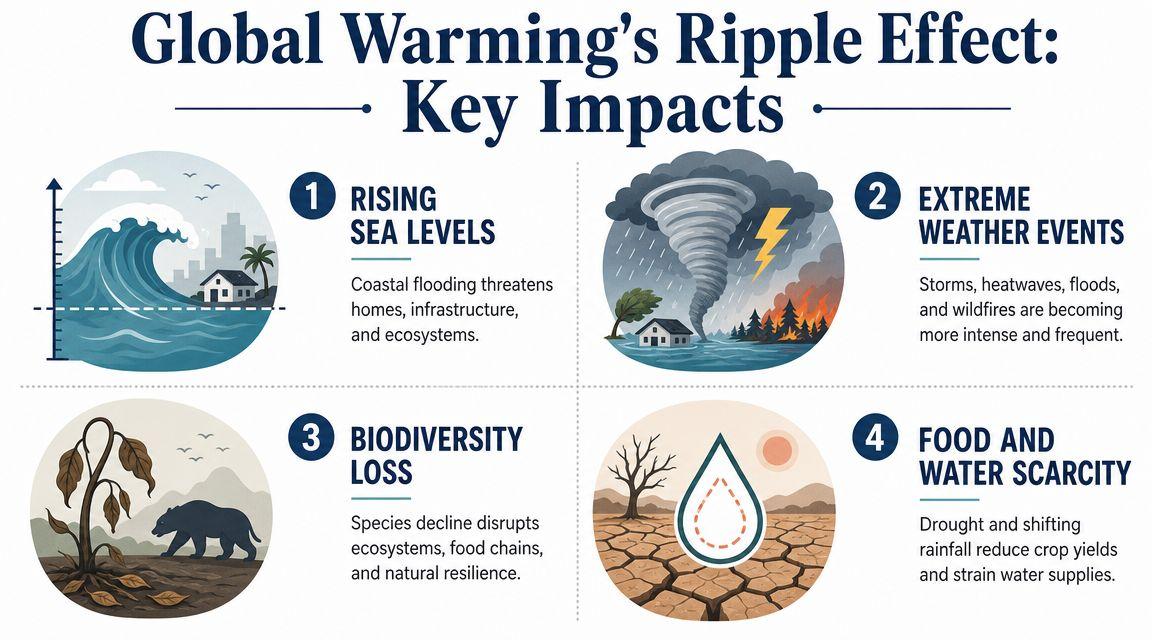
- Extreme weather such as heatwaves, floods, wildfires, tropical storms, and hurricanes that disrupt homes and communities
- Food pressure when changing weather harms crops or water access
- Ecosystem stress when species and habitats struggle to adapt
- Economic strain when governments and families must pay for damage, health care, and rebuilding
WHO also notes that climate change contributes directly to humanitarian emergencies, including heatwaves, wildfires, floods, tropical storms, and hurricanes, which are increasing in scale, frequency, and intensity. That gives you a reliable way to connect climate science to social disruption without exaggerating.
The best body paragraphs don't just name an impact. They explain who is affected, how the harm happens, and why the effect matters.
How to turn impacts into body paragraphs
A body paragraph works well when it follows this order:
- Topic sentence
Climate change threatens human health in direct and indirect ways. - Evidence
Add one strong fact from a reliable source. - Explanation
Show why the evidence matters. - Link back to thesis
Connect the example to your main claim.
If you want a real-world example of how organizations talk about environmental responsibility in plain language, you can look at their commitment to a greener planet. It's useful for noticing tone and clarity, even if your own essay needs a more formal academic style.
How to Build Your Essay Argument and Outline
Good essays aren't built by inspiration. They're built like houses. You need a frame before you add details.
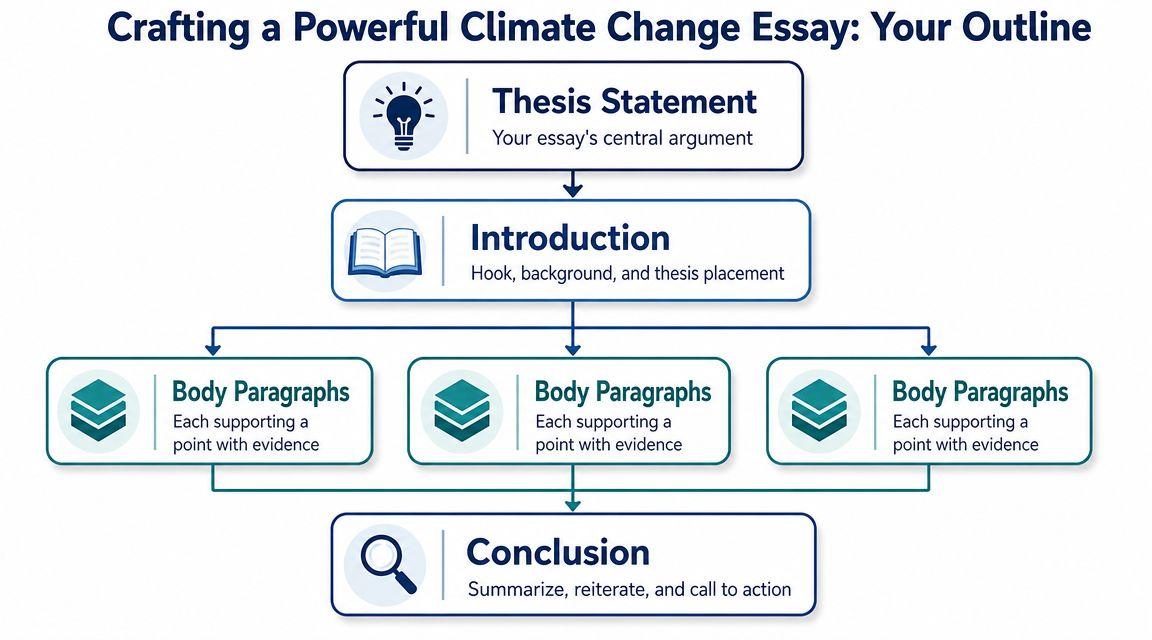
That frame starts with the thesis statement. A thesis is your main claim, not your topic. “Climate change” is a topic. “Human-driven climate change creates serious health and social risks that require immediate action” is a thesis.
A simple thesis generator
Use this fill-in pattern:
Although some people think climate change is mainly a natural process, modern climate change is largely driven by human activity because greenhouse gases trap extra heat, which leads to serious environmental and social consequences.
You can also use shorter versions:
- Climate change is a global crisis because it threatens health, ecosystems, and economic stability.
- Human activity has accelerated climate change, making urgent action necessary.
- Climate justice should be central to climate policy because the heaviest harms fall unevenly.
Three essay structures that work
Different assignments call for different shapes. Choose one road map and stick to it.
| Structure Type | Description | Best For |
| Cause, effect, solution | Explain what causes climate change, what it leads to, and how people can respond | General school essays |
| Problem, consequences, action | Focus on climate change as a major challenge, then show what happens if it's ignored and what should be done | Persuasive essays |
| Definition, evidence, justice angle | Define climate change, present core evidence, then examine unequal impacts | More advanced essays |
A plug-and-play outline
Here's a reliable outline for many assignments:
- Introduction
Hook, brief background, thesis - Body paragraph one
Explain the cause of climate change in simple terms - Body paragraph two
Show one major impact, such as health or environment - Body paragraph three
Discuss solutions, responsibilities, or justice - Conclusion
Restate the thesis in fresh words and leave the reader with a clear final idea
Writing move: If you can label each paragraph in three words, your structure is probably strong. For example: “cause,” “impact,” “justice.”
Keep your outline from becoming too broad
Before drafting, test every paragraph idea against your thesis. Ask, “Does this directly help prove my main claim?” If not, cut it.
Students often lose marks because they add interesting but unrelated points. A paragraph about recycling, for example, won't help much if your essay argues that climate change is mainly a health crisis.
If you want more general writing and idea-development support, the articles on the 1chat blog can be a useful companion while you draft and revise.
Write a More Advanced Essay on Climate Justice
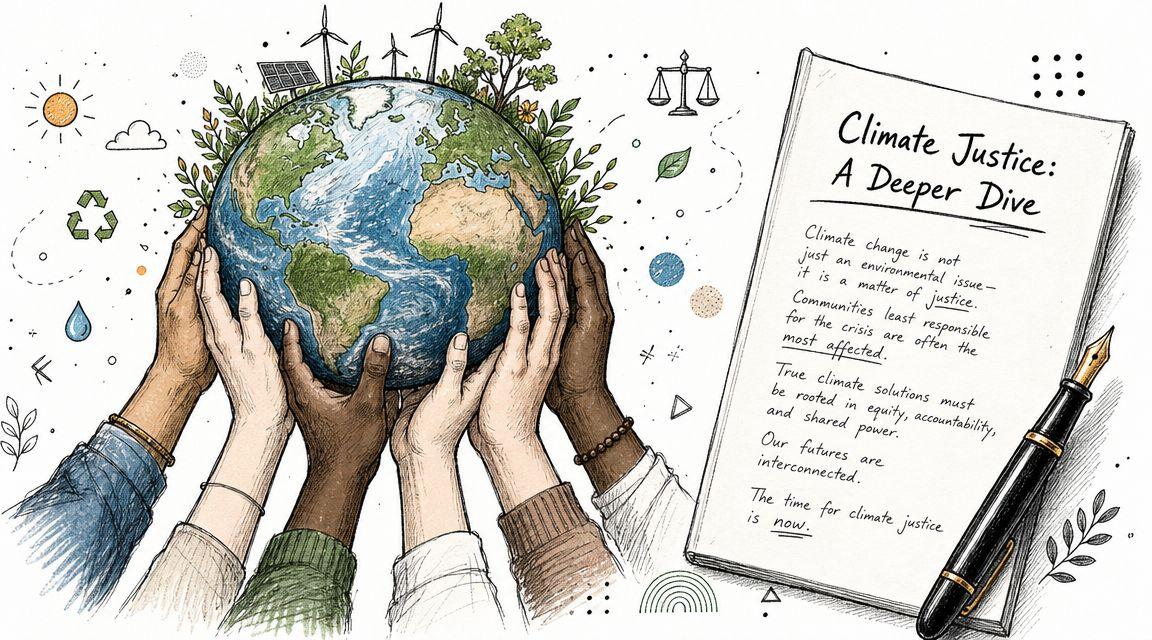
A basic essay says climate change is harmful. A stronger essay asks a harder question. Who is harmed most, and why?
That question leads to climate justice. This approach makes your writing more thoughtful because it moves beyond science alone and into fairness, inequality, and responsibility.
What climate justice means
Climate justice looks at how climate change affects communities differently. The damage isn't spread evenly. Some people have stronger housing, better access to health care, more savings, and more political influence. Others don't.
The World Bank states that extreme weather is closely intertwined with inequality and poverty. It also notes that reaching poor and vulnerable groups is one of the smartest resilience strategies. In the same discussion area, the EPA has found that the most severe harms fall disproportionately on underserved communities, particularly racial and ethnic minorities, who are often least able to prepare for and recover from hazards like poor air quality and flooding. You can anchor that point using the World Bank page on the social dimensions of climate change.
Why teachers often reward this angle
Climate justice shows critical thinking. It tells your teacher that you're not just repeating a textbook definition.
A justice-centered essay can explore questions like these:
- Why do some neighborhoods face more flood risk than others?
- How do income and housing quality affect climate vulnerability?
- Why are recovery and adaptation easier for some groups?
- What does fairness mean in climate policy?
Those questions give your essay depth. They also help you avoid the repetitive “climate change is bad for everyone” argument that appears in many student papers.
A sample justice thesis
Try this model:
Climate change is not only an environmental problem but also a justice issue because underserved communities often face greater exposure to danger and have fewer resources to recover.
That thesis is useful because it's specific and arguable. It points your body paragraphs toward inequality, not just general harm.
How to add nuance without making the essay confusing
Use a simple contrast pattern:
- First, explain the climate impact.
- Then, explain why some groups face more of it.
- Finally, discuss what that means for policy or responsibility.
For example, instead of writing “heatwaves are dangerous,” write “heatwaves are dangerous, but they become even more harmful in communities with weaker housing, fewer cooling options, and less access to health support.”
That kind of sentence sounds more mature because it shows layered reasoning.
Short and Long Essay Examples
Sometimes the fastest way to learn is to see the final product. Below are two model responses you can adapt. Don't copy them word for word for school submission. Use them as patterns.
Short example essay
Climate change is one of the most serious challenges facing the world today. It refers to long-term changes in Earth's temperatures and weather patterns. While some climate shifts happen naturally, modern climate change is largely driven by human activities that release greenhouse gases into the atmosphere. These gases trap heat and warm the planet.
One major reason climate change matters is its effect on people. It is not only an environmental issue but also a health issue. Rising temperatures and changing weather conditions can increase risks linked to heat stress, disease, and food insecurity. This shows that climate change affects daily life, not just distant ecosystems.
Climate change also leads to wider environmental disruption. It can contribute to stronger heatwaves, floods, wildfires, and storms. These events damage homes, harm agriculture, and place pressure on communities that are already vulnerable. The effects often spread from nature into society through rising costs and public health strain.
Governments and communities need to respond seriously. Reducing greenhouse gas emissions, improving infrastructure, and protecting vulnerable populations are all important steps. Climate change is a global problem, but people can still shape how severe its consequences become.
In conclusion, climate change is caused mainly by human activity and has major effects on both the environment and society. A strong response requires awareness, action, and long-term planning.
Why this short essay works
- It has a clear thesis
- Each body paragraph has one main focus
- The conclusion restates the argument, not just the topic
- The tone is formal but easy to read
A short school essay doesn't need to sound complicated. It needs to sound organized.
Longer example essay
Climate change is often described as an environmental problem, but that label is too narrow. It is also a human, political, and ethical issue. Modern climate change is largely driven by human activity, especially the release of greenhouse gases that trap heat in the atmosphere. Because this warming affects health, livelihoods, and inequality, an effective response must combine scientific understanding with social responsibility.
The basic science is clear enough for any student essay. Earth's atmosphere naturally holds some heat, making life possible. Human activity has thickened that heat-trapping layer by adding more greenhouse gases. As a result, the planet is warming and climate patterns are shifting. This matters because climate systems shape farming, water access, health conditions, and disaster risk. When those systems become less stable, people feel the effects in many areas of life.
A strong essay should also show that climate change has real consequences for human well-being. It is easy to talk about melting ice or changing seasons, but readers often respond more strongly when the issue is connected to health and safety. Climate change can worsen heat stress, food insecurity, and the spread of disease. It can also intensify emergencies such as floods, wildfires, and storms, leaving communities to deal with both immediate danger and long recovery periods. These effects reach beyond the environment and into schools, hospitals, jobs, and housing.
The issue becomes even more compelling when viewed through climate justice. Climate change does not affect all communities equally. People with stronger infrastructure, better health care, and more financial security are often better able to prepare for disruption and recover afterward. Underserved communities usually have fewer resources and face greater risk. That makes climate change a question of fairness as well as science. An essay that includes this angle moves past a basic summary and becomes a stronger argument about inequality and responsibility.
Solutions matter too, and many student essays often become vague regarding them. A strong paper should mention concrete benchmarks when discussing action. The IPCC states that to limit warming to 1.5°C, global net human-caused CO2 emissions would need to fall by about 45% from 2010 levels by 2030 and reach net zero around 2050, as summarized by the United Nations climate page. This benchmark helps students evaluate proposed solutions. It shows that action must be rapid and wide-ranging, not symbolic.
That doesn't mean every essay must solve the entire climate crisis. It means your argument should connect causes, impacts, and realistic response. If you discuss solutions, explain whether they reduce emissions, improve resilience, or protect vulnerable groups. If you discuss policy, explain what success would look like. Clear evaluation is more persuasive than a list of good intentions.
Climate change is one of the defining issues of modern life because it links science, public health, and justice. A well-written essay on climate change should do more than define the term. It should explain the mechanism, show the consequences, and argue for a response that is both effective and fair. When students take that approach, their essays become sharper, more thoughtful, and more memorable.
Finding Credible Evidence and Citing Your Sources
A strong essay can weaken fast if the evidence is shaky. For climate writing, use primary or highly authoritative sources whenever possible. That means organizations that collect, assess, or summarize evidence directly.
Good places to find evidence
These are reliable starting points for a student essay:
- NASA for core climate science and evidence
- World Health Organization for health impacts
- United Nations for international climate goals and benchmarks
- World Bank for inequality, vulnerability, and development impacts
Those sources are stronger than random blogs, unattributed infographics, or social media posts. If a website gives dramatic claims but no clear sourcing, don't use it.
A simple rule for citation
Cite a source whenever you include:
- A specific number
- A distinct factual claim
- A specialized definition
- An idea that didn't come from your own reasoning
If you're stating your own interpretation, you don't need a citation. If you're using a statistic or a factual finding, you do.
Quick MLA and APA reminders
You don't need to panic about formatting if your teacher hasn't asked for a highly technical works cited page yet.
- MLA usually uses author or organization name in parentheses
- APA usually uses author or organization plus year
If your teacher gives a required style, follow that exactly. If not, be consistent.
A fast proofreading checklist
Before you submit, check these points:
- Thesis check
Does your introduction contain one clear argument? - Paragraph check
Does each paragraph have one main job? - Evidence check
Is every factual claim supported? - Clarity check
Did you explain why each piece of evidence matters? - Citation check
Are borrowed ideas credited properly?
If you need help with common writing questions before submitting, the 1chat FAQ page may help you troubleshoot research, formatting, or revision issues.
If you want help turning notes into a draft, refining a thesis, or polishing an essay on climate change in a more natural voice, you can try 1chat, a privacy-first AI writing assistant for students, families, and teams.