You've finished the essay. The argument is solid, your quotes are in place, and the conclusion finally says what you meant to say all along. Then you look at the top of page one and freeze.
Do you need a heading? A header? A title page? Is APA the one with the running head, or was that the old version? If your teacher just wrote “use proper format,” that doesn't help much when you're staring at a blank first page.
That confusion is normal. Students mix up heading, header, and title page all the time. A proper essay heading sounds small, but it's one of the first signals your reader sees. When it's clean and correct, your paper feels easier to trust. When it's messy, even a strong essay can look rushed.
Why Your Essay Heading Matters More Than You Think
A proper essay heading isn't just decoration. It tells your reader what they're looking at, who wrote it, and what kind of paper follows. Guidance from UNECE explains that strong headings work as compact summaries and help readers quickly understand what to expect in a piece of writing, especially when they're deciding fast whether to keep reading (UNECE guidance on headings).
That matters in school more than students sometimes realize. Your instructor reads a lot of papers. A clear heading helps them identify your work quickly, follow the assignment requirements, and move into your writing without friction. It's a presentation skill, but it also supports readability.
If you've ever worked on optimizing blog content structure, the same idea applies here. Readers scan first. They look for cues. Structure helps them trust what comes next.
What a heading silently communicates
A good heading says several things before your first sentence begins:
- I followed directions. That matters when formatting is part of the assignment.
- I know which style I'm using. MLA, APA, and Chicago don't organize the first page the same way.
- I'm making this easy to read. Teachers notice when a paper feels orderly.
Practical rule: If your heading makes the first page easier to identify and navigate, it's doing its job.
Heading, header, and title page are not the same
These three terms get mashed together, but they mean different things:
| Term | What it means |
| Heading | Information placed on the first page, usually your name, class details, and date |
| Header | Material at the top margin of each page, such as a last name and page number |
| Title page | A separate cover page used in some styles |
If you're still unsure which one your class expects, checking your assignment sheet first is smarter than guessing. If the instructions are vague, a school writing FAQ or assignment help page like 1chat's student help FAQ can help you sort out the terminology before you format the page the wrong way.
Formatting Your MLA Heading (9th Edition)
MLA is the format many students see first, especially in English classes. It uses a first-page heading in the top-left area of page one, plus a header in the upper-right corner with your last name and page number. Purdue OWL's MLA guidance notes that standard MLA papers include the student's last name and page number in the upper-right header (Purdue OWL MLA general format).
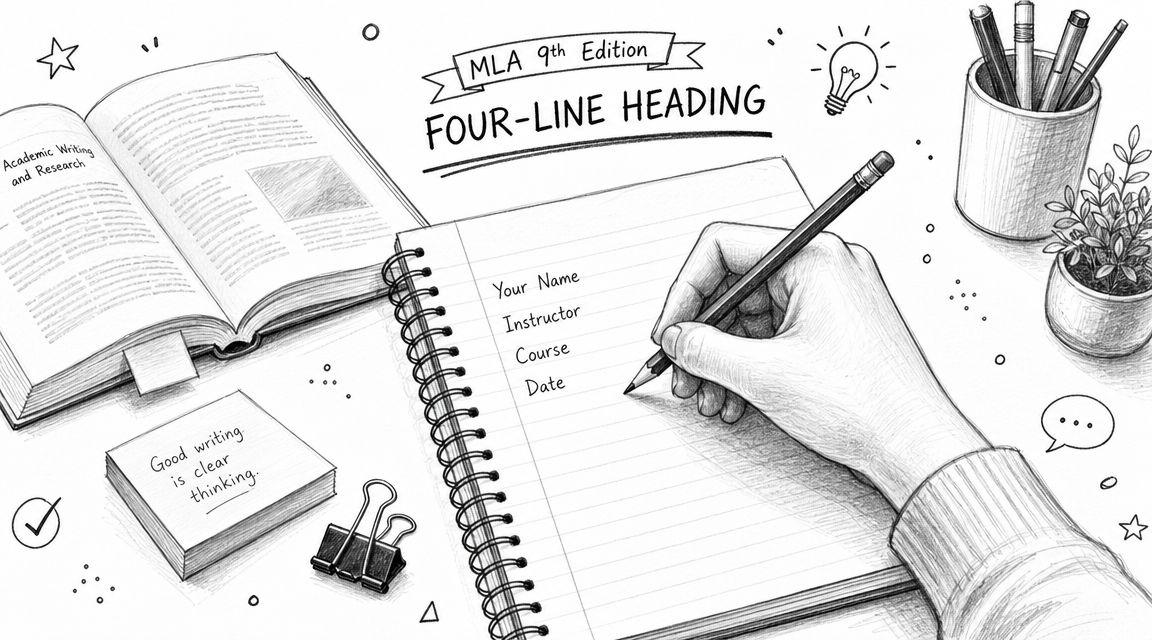
The four lines of an MLA heading
In most student papers, MLA puts these lines at the top left of the first page:
- Your name
- Your instructor's name
- Course name and number
- Date
Then you skip to your centered title and start the essay.
A simple visual looks like this:
Maya Chen
Professor Alvarez
ENG 101
14 February 2026
Media Literacy in Short-Form Video
What students usually miss
The biggest MLA mistakes are usually simple formatting slips:
- Placement matters. The heading goes at the top left of the first page, not centered.
- Spacing should stay consistent. Keep the heading double-spaced like the rest of the paper.
- The title is centered. It is not bold, underlined, or put in quotation marks unless your teacher specifically asks for that.
- The page header is separate. Your last name and page number belong in the upper-right header area on every page.
Here's the part students often forget:
Rivera 1
That short line is the MLA header, not the heading. Different job, different place.
A copyable MLA model
Use this as a safe template:
| Line | Example |
| Line 1 | Jordan Rivera |
| Line 2 | Dr. Patel |
| Line 3 | HIST 201 |
| Line 4 | 14 February 2026 |
If your teacher gives you a sample document, follow that over any general website. If you want a place to compare writing-format examples and student writing guides, 1chat's blog is one option to browse alongside your course instructions.
Creating an APA Heading (7th Edition for Students)
You open a blank document, type your name in the top left, and then pause. MLA taught you one routine. APA uses a different one, and that switch is what confuses many students.
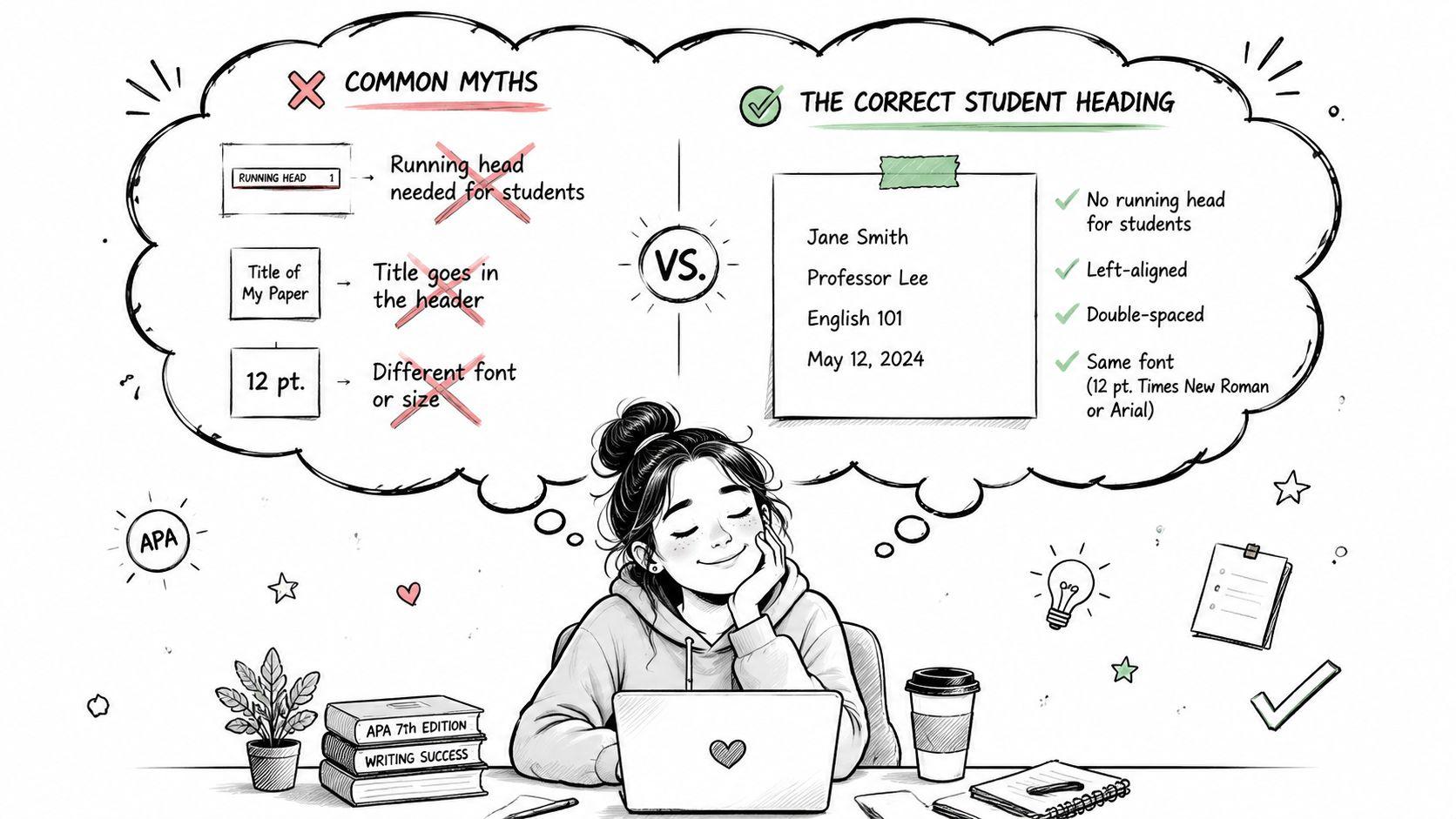
For an APA 7 student paper, the first page usually works like a cover page on a school project. Your identifying details do not sit in a four-line block above the essay. They go on a separate title page, and the header usually includes only the page number in the top-right, as shown in Purdue OWL's APA student paper setup guide.
What goes on an APA student title page
A standard student title page includes these centered items, each on its own line:
- Paper title
- Your name
- School or institutional affiliation
- Course number and course name
- Instructor's name
- Due date
Then add the page number in the top-right corner.
A simple model looks like this:
Effects of Sleep on Study Recall
Maya Chen
North Valley Community College
PSY 110 Introduction to Psychology
Professor Lewis
14 February 2026
If your teacher asks for APA but does not say much more, this is the safest starting point. It gives you the format many students are expected to use in class.
The part that causes the most confusion
Older APA examples often show this line:
Running head: SHORT TITLE
That is the trap. Students still find it in old handouts, recycled templates, and forum posts from earlier editions. In many APA 7 student papers, you should leave that out.
A good memory shortcut is simple. MLA usually starts with a first-page heading. APA student papers usually start with a title page.
APA heading cheat sheet
Use this quick comparison if you freeze at the top of page one:
| What you need | APA 7 student paper |
| Top-left heading on first page | No |
| Separate title page | Usually yes |
| Page number in header | Yes, top-right |
| Running head | Usually no for student papers |
What to do with the title
The title should tell your reader what the paper is about. Short and specific is better than broad and vague.
For example, Sleep Habits and Quiz Performance in First-Year Students is clearer than A Psychology Paper. Your title is the label on the folder. If the label is vague, the reader has to guess what is inside.
If your instructor gives you a sample file or department template, use that first. Classroom directions always beat a general cheat sheet.
Chicago Style and General High School Headings
Chicago style often feels less familiar because many students don't use it until later courses. In many classroom situations, Chicago papers use a title page rather than an MLA-style heading on page one. That means your identifying information usually doesn't sit in the top-left corner above the essay.
Academic writing guidance also stresses that titles should be as concise as possible and should accurately reflect the content. That matters even more on a title page, where the title serves as the main signpost for the whole paper (concise title guidance).
A simple Chicago title page model
Chicago title pages are usually clean and centered. A basic version often includes:
- Paper title
- Your name
- Course name
- Instructor name
- Date
A plain example:
The Role of Public Memory in Civil Rights Education
Jordan Rivera
History 201
Dr. Patel
14 February 2026
Notice what's missing. No four-line MLA block in the top-left corner.
When no style is specified
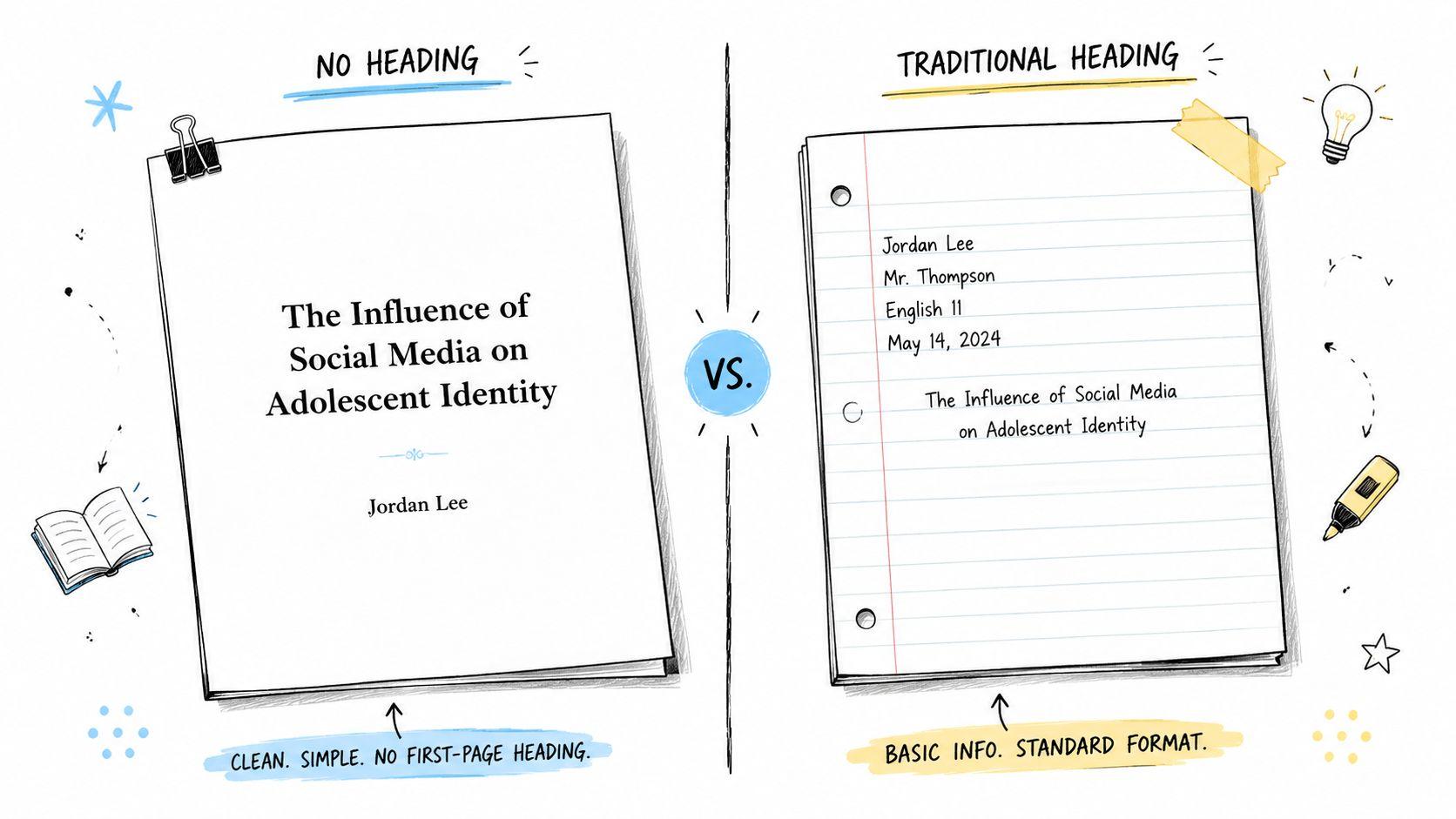
This is the situation a lot of high school students face. The teacher says “write a two-page essay,” but doesn't name MLA, APA, or Chicago. When that happens, a generic high school heading is usually the safest choice unless your school has its own template.
A practical format is:
Your Name
Teacher's Name
Class Name
Date
Title of Essay
That works because it gives the teacher the basic information they need without pretending to follow a style guide you weren't assigned.
The safest default
If you have no style instructions, use this checklist:
- Keep it simple. Don't add decorative fonts, colors, or oversized titles.
- Be consistent. Match the font and spacing used in the rest of the paper.
- Ask when possible. A quick email can save a formatting redo later.
A neat generic heading is better than guessing your way into the wrong style.
Common Heading Mistakes and How to Avoid Them
Students usually don't lose formatting points because the rules are impossible. They lose them because small details get mixed together. A heading from one style gets pasted into another. A title page appears where it isn't needed. The page header gets forgotten until the last minute.
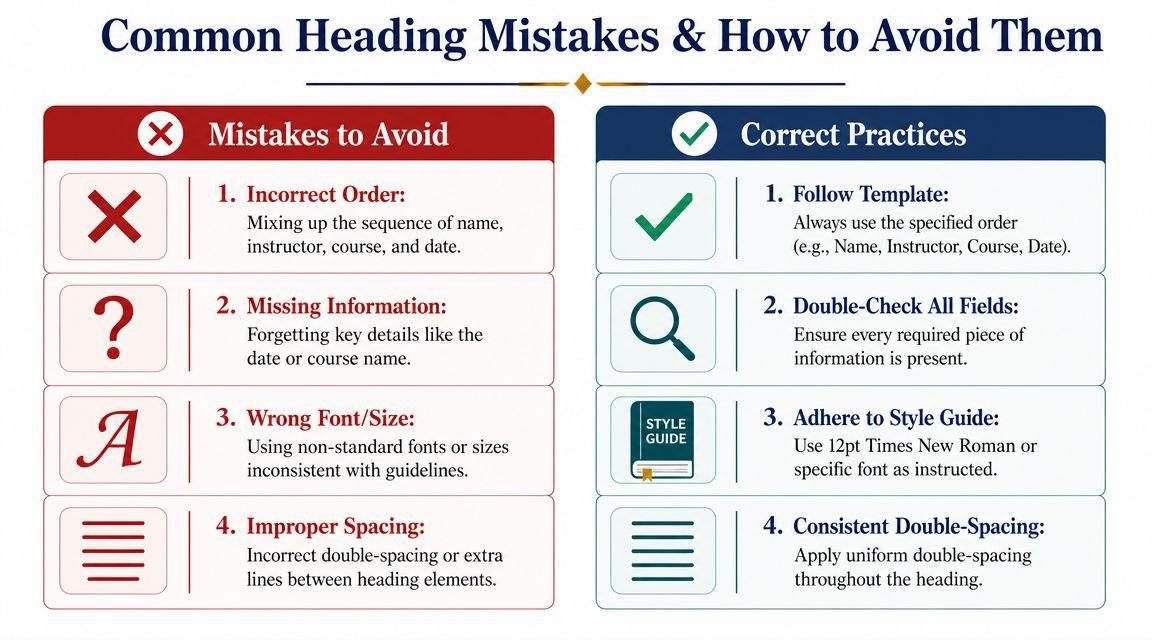
Technical writing guidance also warns against titles that promise more than the paper delivers, or that use unexplained acronyms. Titles and headings should match the order and content of the paper so the reader isn't misled (technical writing process guidance).
Mistakes that show up constantly
- Using MLA and APA together. Students sometimes put an MLA four-line heading on an APA title page.
- Calling every top-of-page item a heading. Instructors may mean heading, header, or title page. Those are different.
- Writing a vague title. “Essay” or “Research Paper” doesn't help your reader.
- Forgetting consistency. A proper essay heading should match the paper's font, spacing, and general format.
Better fixes than last-minute guessing
Try this quick self-audit before submitting:
| Mistake | Fix |
| Wrong first-page format | Match the style guide your teacher assigned |
| Missing page number or last name | Check the top margin before exporting or printing |
| Title too broad | Rewrite it so it names the actual topic |
| Extra formatting clutter | Remove bold, underlining, or decorative styling unless required |
Don't proofread only the body paragraphs. Proofread the first page like it's part of your grade, because it usually is.
One subtle mistake
Students sometimes write a dramatic title that sounds impressive but doesn't match the essay. If your paper discusses one narrow question, keep the title narrow too. A heading should guide the reader, not oversell the paper.
Your Final Pre-Submission Heading Checklist
You've finished the essay, reread the body, and fixed the citations. Then the first page gets one quick glance and you hit submit. That is exactly where small heading mistakes slip through.
A heading check works like a last look at a test name before turning it in. The paper may be strong, but if the first page is set up in the wrong style, your instructor notices that before reading a single paragraph. Instead of relying on memory, use a short cheat sheet and compare your paper line by line.
Essay Heading Requirements at a Glance
| Element | MLA 9th Edition | APA 7th Edition Student | Chicago 17th Edition General |
| First page setup | Four-line heading on page one | Separate title page | Usually title page |
| Top-right page area | Last name and page number | Page number | Depends on instructor or document setup |
| Title placement | Centered on first page after heading | Centered on title page | Centered on title page |
| Student info location | Top-left of first page | Centered on title page | Centered on title page |
| Best use case | Many literature and humanities essays | Psychology, education, social sciences | History and some advanced humanities courses |
If your teacher did not assign MLA, APA, or Chicago, use the plain high school rule: put your name, date, class, and teacher information where your school expects it, keep the title clear, and make the page easy to read. That simple fallback saves a lot of last-minute guessing.
Five final checks before you submit
- Match the assigned style. If your teacher asked for APA, use an APA title page. If they asked for MLA, use the MLA first-page heading. Do not blend them.
- Check the first page by itself. Scroll to page one and inspect only the heading, title, header, spacing, and page number.
- Read the title out loud. A good title sounds specific, not generic. It should match what the essay discusses.
- Scan for visual consistency. Font, spacing, alignment, and placement should look intentional and uniform.
- Open the final file before submitting. PDFs sometimes shift headers, line spacing, or page numbers after export.
Some students keep a small folder of writing tools, sample papers, and assignment sheets so they can compare formats quickly during that final check. If that helps you stay organized, a page like this student writing resource sitemap can be one place to store useful references.
A proper essay heading does not need decoration. It needs to be correct, readable, and appropriate for the assignment. If your first page is easy to identify and read, it is doing its job.
If your teacher gives instructions that conflict with a general guide, follow the teacher's instructions first. When in doubt, ask. That is good academic judgment.