You have an essay due tomorrow, a blank document open, and a vague sense that an AI essay writer could rescue the situation. Maybe you're a student trying to understand a difficult prompt. Maybe you're helping a child organize a first draft. Or perhaps you're running a small team and need a persuasive proposal before the next meeting.
The useful question isn't, “Which tool writes the whole essay for me?” It's, “Which parts of writing should this tool help with, and which parts must remain mine?” An essay writer AI can clarify a prompt, suggest competing thesis ideas, organize notes, critique a draft, and improve sentence-level clarity. It can also produce polished nonsense, invent sources, flatten your voice, or create an integrity problem if you submit its work as your own.
The strongest approach treats AI as a writing partner on a spectrum, from clarifying to outlining, drafting, and revising. The farther you move toward full-draft generation, the more responsibility shifts back to you for accuracy, originality, disclosure, and privacy. If you're comparing several tools, a practical guide to compare AI writing assistants can help you see how their features differ. This guide focuses on the decisions behind the choice.
The Moment You Start Hunting for an Essay Writer AI
The deadline usually arrives before the question is clear. A student has an English assignment, three sources open in separate tabs, and no thesis. A college student understands the topic but can't turn scattered notes into an argument. A small-business owner has the facts for a proposal but needs a readable version before lunch.
In each case, the person isn't really shopping for a magic essay generator. They need help moving from confusion to structure, from structure to sentences, or from a rough draft to something another person can follow. Those are different jobs, and the right tool for outlining may be a poor choice for fact-checking or privacy-sensitive work.
Start with the task, not the brand
Write down the exact assistance you need before opening a product page:
- Prompt clarification: What is the assignment asking you to prove, compare, explain, or evaluate?
- Idea development: Which thesis options are defensible, and what counterarguments might challenge them?
- Organization: Does the outline place evidence in a logical order?
- Drafting: Can the tool turn your notes into a provisional paragraph without replacing your reasoning?
- Revision: Does it identify unclear sentences, weak transitions, unsupported claims, or repetitive phrasing?
That list matters because “essay writer AI” describes a broad category. A chatbot may be useful for questions and brainstorming. A writing editor may be better at tone and grammar. A research-focused system may help organize uploaded documents, but it still won't make unsupported claims reliable.
Practical rule: Choose the narrowest tool that solves the problem. Narrow tools make it easier to see what the human writer contributed.
The workflow matters more than the promise
A tool that produces a fluent essay in one click can be less useful than one that asks you to provide a thesis, sources, and outline. The first may save time immediately while weakening your understanding of the subject. The second may require more effort but leave you with a defensible argument and a revision trail.
That distinction applies beyond school. A small team can use AI to turn meeting notes into a proposal, but someone still needs to check commitments, figures, customer details, and confidential information. Families also need clear boundaries, especially when a child is tempted to submit generated prose instead of learning how to form an argument.
The best choice is therefore not a single “best” brand. It's a system that gives enough assistance to remove friction while keeping authorship visible. Look for control over prompts, drafts, history, and deletion, not just impressive sample output.
What an Essay Writer AI Actually Does Under the Hood
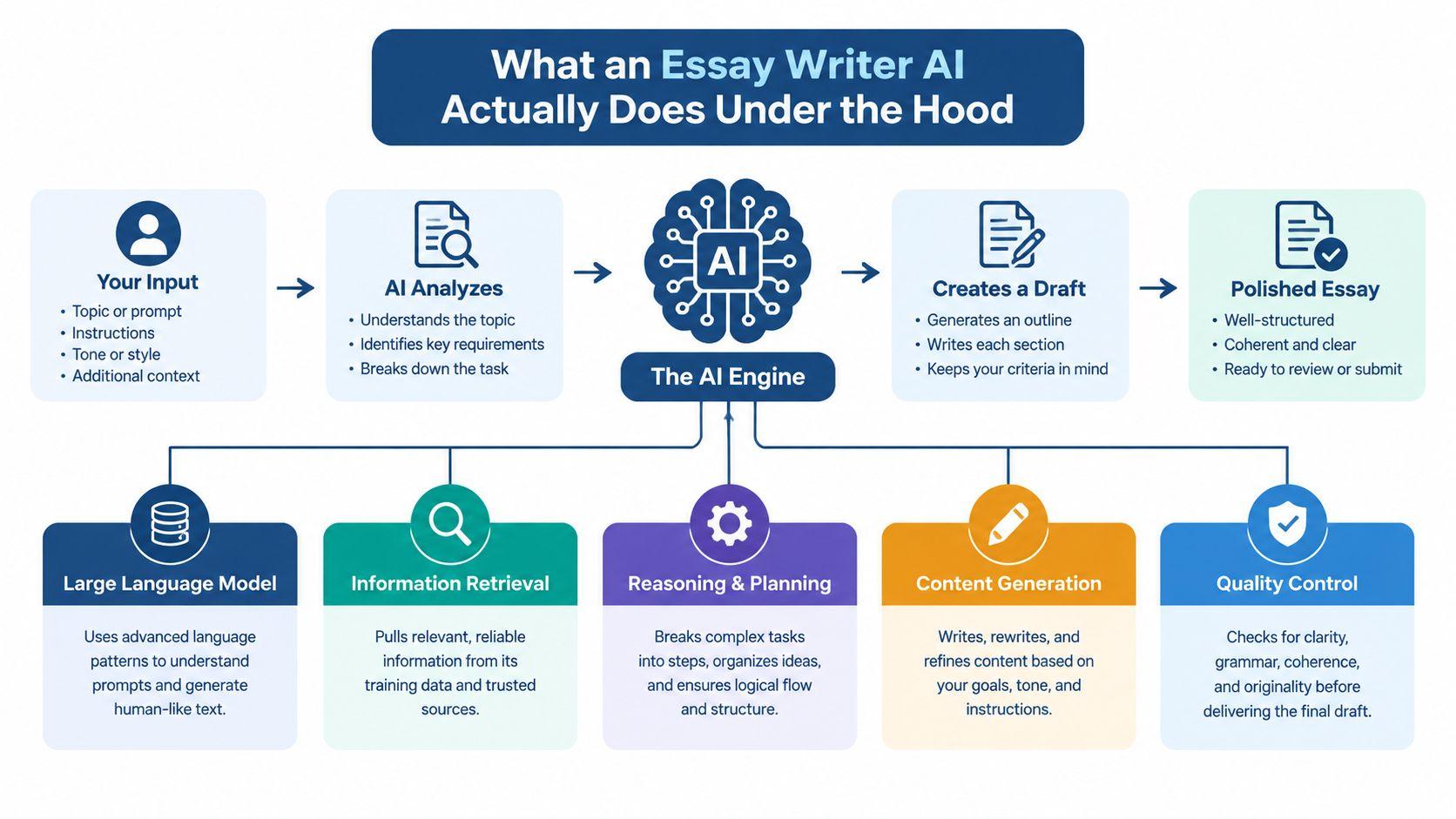
Think of a language model as a kitchen assistant that has learned patterns from a huge collection of written material. You provide ingredients, such as a question, notes, a tone, or a format. The system predicts a plausible sequence of words, then uses your follow-up instructions to reshape the result.
That makes it powerful, but it doesn't make it a human researcher. The model can produce a coherent explanation without possessing a dependable understanding of whether every claim is true. It can imitate the form of an argument while missing the evidence needed to support it.
The basic process
A useful mental model has four stages:
- Input: You give the system a prompt, source material, outline, or draft.
- Prediction: It identifies language patterns that fit the request and generates a response.
- Direction: You refine the result by requesting a different structure, audience, tone, or level of detail.
- Review: You check facts, sources, reasoning, originality, and compliance with the assignment rules.
Suppose your prompt asks for an essay about whether school uniforms improve learning. A drafting system may suggest an introduction, thesis, body paragraphs, and conclusion. If you then provide two verified sources, it can help connect claims to those sources. If you ask it to “make the argument stronger,” it may add counterarguments and transitions, but it may also introduce unsupported assertions unless you constrain the task.
An essay-writing assistant is different from a grammar editor. A grammar editor primarily improves existing prose. A drafting assistant generates new prose. A research assistant may summarize documents or answer questions about uploaded material. Don't assume that one category performs the others equally well.
Scoring isn't the same as writing
Automated writing assessment existed long before generative chatbots. Project Essay Grade, or PEG, was developed by Ellis Page in the mid-1960s and evaluated essays through measurable textual features. Later automated systems showed correlations of roughly 0.86 with human graders for opinion and argument essays, similar to the agreement between human raters, as described in this academic literature review.
Those systems mainly judged text that already existed. Modern generative tools go further by producing outlines, paragraphs, explanations, and revisions. That historical difference explains both their appeal and their risk. A scoring system can assess visible features, while a generative system can help create the material being assessed.
For conversational help, you might use a service that lets you chat with Vedu AI about a prompt or draft. For source-based work, use a research workspace such as 1chat research to organize material, then verify the original documents yourself.
The ceiling is verification
Most language models don't automatically conduct reliable live research because they sound informed. If you ask for citations, the system may produce plausible-looking titles, authors, or links that don't exist. Give it real sources, ask it to distinguish evidence from inference, and open every important citation yourself.
The tool can accelerate thinking and editing. It can't transfer responsibility for the final essay.
How Students and Teams Use Essay Writer AI
Students and teams use AI in different ways, and those differences matter. A student might ask it to explain a hard concept, turn notes into an outline, summarize reading, polish sentences, or draft a full submission. A small team might use the same tool to shape a memo, tighten a client update, or revise a proposal. Those are not equivalent uses. Some support learning and editing. Others move too close to outsourcing the work itself.
The adoption data makes blanket bans unrealistic. A Spring 2024 University of Maryland survey of 38,612 students found that 77% had used generative AI in at least one context, while 41% typically used it for academic coursework. A separate 2024 survey of 1,028 U.S. college students found that 58% used generative AI for academic purposes, up 8 percentage points from that organization's spring measurement. The figures are reported in the University of Maryland survey summary.
High-value uses keep the writer in charge
The best uses let the student or employee do the thinking while the tool removes friction.
- Clarify the assignment: Ask the tool to restate a complicated rubric in plain language, then confirm the interpretation with the teacher or client.
- Generate competing thesis options: Request several positions with likely objections. Choose one and defend it yourself.
- Stress-test an outline: Give the system your headings and evidence. Ask where the logic jumps or where a claim lacks support.
- Question a source: Upload an article and ask for its central claim, method, limitations, and connection to your topic. Check the article itself, not just the summary.
- Revise your own prose: Ask for grammar, clarity, tone, and repetition feedback while keeping the original draft open beside the output.
These uses leave a clear trail of decisions. You can explain why you chose a thesis, where the evidence came from, and how the final argument changed.
Low-value uses create the biggest integrity risk
A one-click final essay can sound polished and still hide the reasoning process. Copying generated prose into an assignment can violate school policy even when the facts happen to be right. Paraphrasing AI output to hide its origin is worse, because it shifts the goal from learning to concealment.
For a small team, the same mistake looks different but follows the same pattern. Someone pastes confidential customer information into an unapproved tool, accepts the output, and sends a proposal without checking the claims. The text may read professionally while misstating a delivery promise or exposing private details.
A practical rule is simple, clarifying inputs ranks high, full-draft generation ranks low. Add more supervision as the tool gets closer to submission-ready text. If you want a plain-language overview of use cases and tradeoffs, the 1chat blog is a useful reference point.
The Limits, Risks, and Ethical Lines Worth Knowing
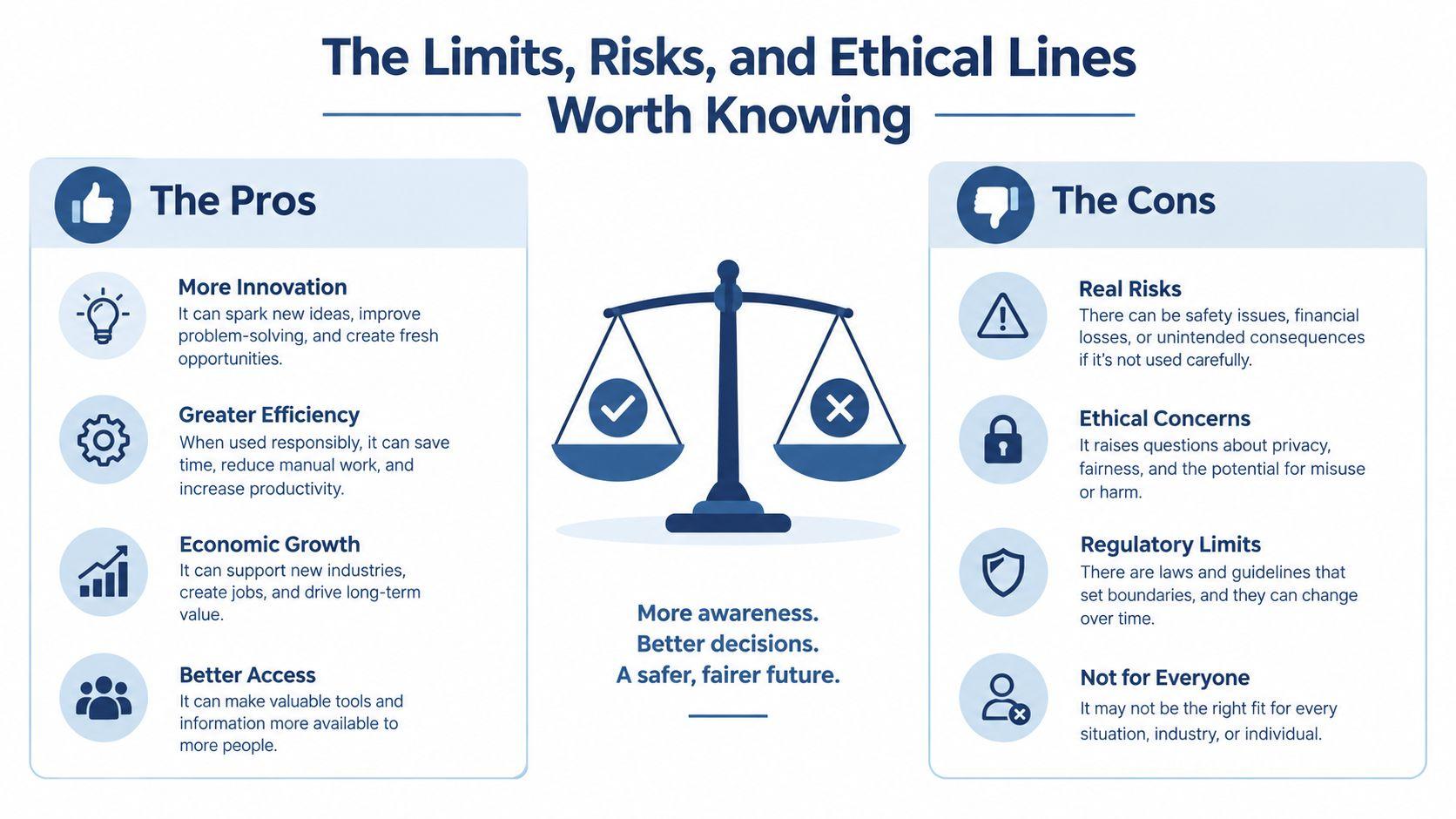
The most dangerous essay writer AI output isn't obviously bad. It's the paragraph that sounds authoritative, includes a plausible citation, and contains a subtle factual error. Fluent prose lowers your guard, especially when you're tired and the deadline is close.
A responsible workflow assumes failure. The system may invent a source, attribute an idea to the wrong author, overstate a study, repeat familiar phrasing, or present a balanced-sounding argument without meaningful evidence. You should treat every factual claim as unverified until you check it against the original material.
Detector scores aren't proof
Many students worry that an AI detector will falsely accuse them. That concern is justified. A 2025 study of 190 undergraduate anatomy-and-physiology writing samples found that detectors incorrectly labeled roughly 1.3% of human-written essays as AI-generated, while human raters produced false-positive judgments around 5.0%. Aggregating detector outcomes substantially reduced false positives, according to the study indexed by PubMed.
A detector score is therefore a signal for further conversation, not proof of misconduct. Students should keep outlines, notes, source annotations, drafts, and revision history. Teachers and institutions should evaluate reasoning and ask follow-up questions instead of treating one automated result as a verdict.
Evidence beats evasion: Don't use “humanizer” tactics to hide AI use. Preserve the work that shows how your argument developed.
Integrity has two sides
The ethical line isn't "AI allowed" versus "AI banned." It depends on the assignment, the institution's policy, the amount of assistance, and whether the student can explain the final work. A grammar check may be permitted in one class and restricted in another. A generated thesis may require disclosure even if the final paragraphs are original.
Read the policy before you use the tool, and disclose assistance when required. Guidance on honesty and responsibility in your coursework is useful because integrity includes accurate attribution, independent reasoning, and responsible handling of sources.
Privacy creates another boundary. Don't upload unpublished research, a child's personal information, client records, or internal business plans until you understand retention, training, access, and deletion practices. Review the relevant 1chat usage policies or the equivalent documentation for any service you consider.
Honest Benefits Worth Expecting and Tradeoffs to Plan For
Essay writer AI tools deliver real value, but only in specific parts of the writing process. They help when you need to clarify a prompt, sketch an outline, draft faster, or revise awkward prose. They do not replace judgment, source checking, or the responsibility to defend the final argument.
Students do report practical gains. In the 2024 University of Maryland survey cited earlier, 61% said AI had helped them become more efficient, and 58% said it had helped them earn better grades. Those responses show perceived benefit, not proof that the tool caused stronger learning. Efficiency often means less time spent producing text, not better understanding of the material.
Fluency is useful, but it is not quality
A benchmark of 2,000 AI-generated essays found that the strongest systems reached mean scores of 4.78 and 4.67 on the GRE analytical-writing scale. The same study reported fewer grammar, usage, and mechanics errors than the human-written baseline, as shown in the benchmark study.
That matters for sentence-level cleanup. It does not answer the harder questions.
- Does the thesis answer the prompt exactly?
- Does each paragraph add analysis, or repeat the same point?
- Are the sources relevant and represented accurately?
- Can the writer explain the argument without reading from the screen?
- Does the prose still reflect the student's own judgment and voice?
Clean grammar can hide weak thinking. A tool that favors smooth wording can make shallow reasoning look better than it is.
Polished prose can still be thin prose
Research using the PERSUADE 2.0 corpus found that GPT-generated essays matched student essays in syntax and discourse structure, while tending to be slightly shorter and using more advanced vocabulary. The Journal of Writing Research article is a good reminder that surface sophistication deserves skepticism.
That is the risk. A tool can replace plain, precise language with impressive vocabulary and leave the argument no stronger than before. Ask it to flag unsupported claims, connect each claim to evidence, and say where confidence is low instead of asking for “better” wording and stopping there.
The tradeoff is straightforward. AI can speed up first drafts, lower friction, and support revision. It also increases the chance of privacy mistakes, weak attribution, and overreliance on generated text. You still own the facts, the sources, the originality, and the final call.
How to Evaluate Essay Writer AI Tools Before You Sign Up
Don't choose an essay writer AI by reading its sample paragraph. Evaluate the system against the risks you face. A high-school student needs understandable controls and safe learning support. A family may need age-appropriate boundaries and history management. A small business needs privacy, workspace permissions, and predictable access for its team.
Score the essentials before comparing extras
Use a simple scale from “doesn't meet the need” to “meets the need clearly.” You don't need a complicated procurement process. Test two or three tools with the same harmless prompt, the same short source passage, and the same revision request.
| Criterion | Why It Matters | What to Check |
| Cost | A low price is irrelevant if limits interrupt regular work or encourage unsafe account sharing. | Trial terms, usage limits, renewal conditions, document costs, and student or team plans |
| Privacy | Your prompt may include personal, academic, or confidential business information. | Retention period, model-training terms, deletion controls, account history, and data access |
| Output quality | Smooth sentences can conceal factual or structural weakness. | Prompt accuracy, argument structure, source handling, citation behavior, and rubric awareness |
| Revision control | A tool should help improve your work without erasing your process. | Version history, tracked changes, export options, and draft comparison |
| Family features | Younger users need guidance rather than unrestricted generation. | Parental controls, age guidance, activity visibility, and educational settings |
| Team features | Shared work can expose drafts or customer information to the wrong people. | Workspaces, permissions, collaboration, administrative controls, and separation of projects |
| Research support | Summaries are useful only when they remain tied to real documents. | PDF analysis, quotations, page references, source links, and a clear distinction between evidence and inference |
Test quality with adversarial prompts
Ask each tool to work within constraints. Provide a short passage and request a summary that distinguishes the author's claims from your own questions. Then ask it to identify what the passage does not establish. A reliable assistant should show restraint rather than fill gaps with confident invention.
Next, give it your outline and ask for objections, missing evidence, and logical leaps. Don't judge only the prose. Judge whether the tool helps you notice weaknesses that affect the argument.
For a student, privacy may outweigh extra stylistic options. For a family, controls and understandable policies may matter more than maximum output length. For a small business, permission management and deletion may outrank a clever paragraph generator.
Avoid feature shopping
A long list of models, templates, or writing styles won't compensate for weak privacy terms or unreliable source handling. The best tool is the one that fits your workflow and makes responsible use easier.
Ask these final questions before signing up:
- Can I remove my drafts and account history?
- Does the service explain whether prompts are used to improve models?
- Can I export my work without losing the original version?
- Does the tool show where a claim came from?
- Can a parent, teacher, or manager understand how the system was used?
- Will the product help me revise my writing, or mostly encourage me to replace it?
A Responsible Workflow That Keeps You in Control
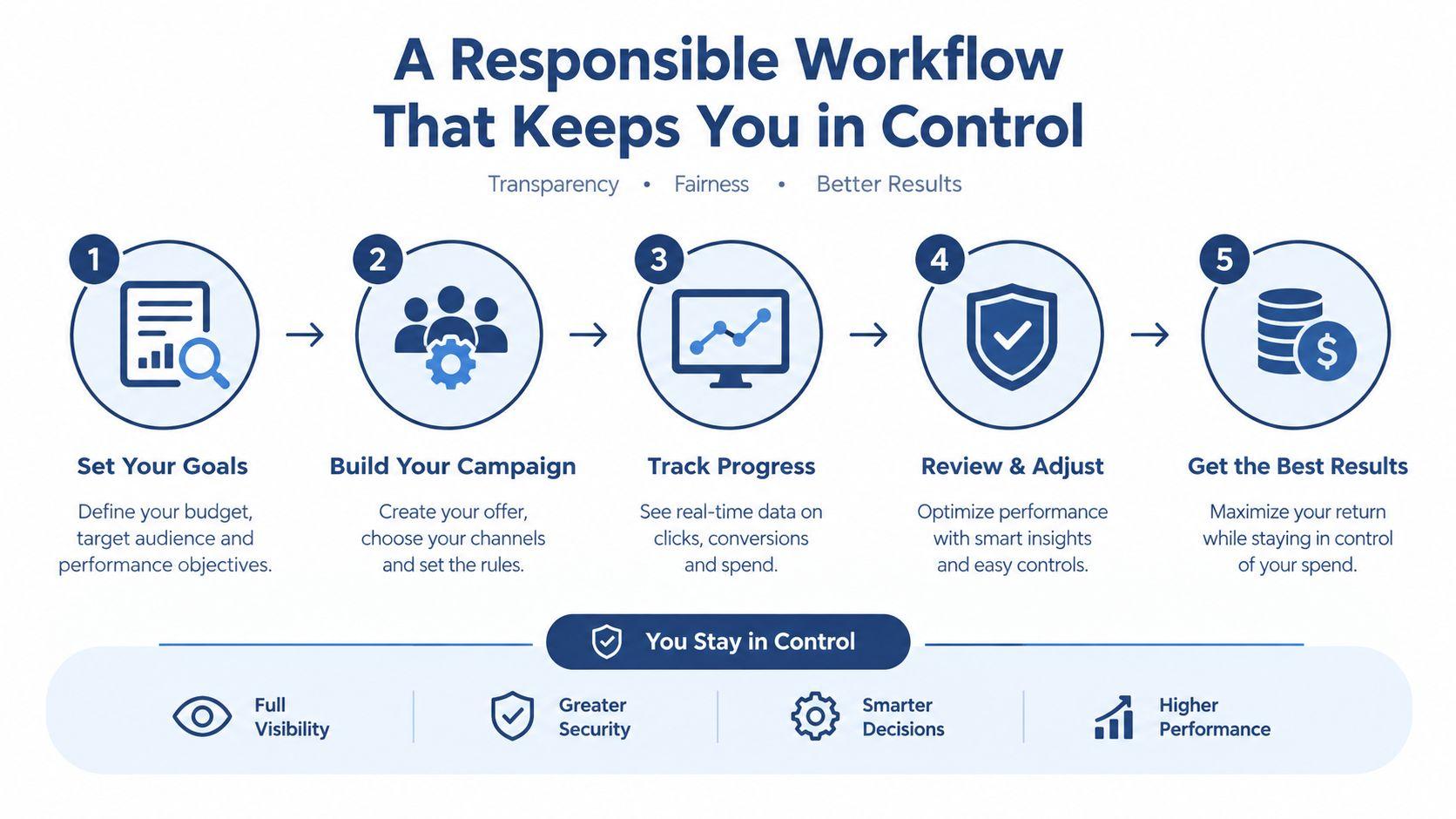
A responsible workflow is slower than one-click generation, but it produces work you can explain. Start with your own understanding, use AI for targeted assistance, and keep evidence of the decisions that shaped the final document.
Build the argument before requesting prose
- Write a provisional thesis. It can change, but begin with your own position.
- Create a rough outline. Add the evidence you expect to use and the objection you need to answer.
- Ask targeted questions. Use AI to clarify the prompt, challenge the outline, explain jargon, or suggest missing counterarguments.
- Draft from your notes. Keep the central reasoning and source selection under your control.
- Revise with constraints. Request help with clarity, grammar, transitions, and repetition. Tell the tool not to add facts or citations.
- Verify everything important. Open each source, check quotations, and remove claims you can't support.
- Preserve the trail. Save notes, outlines, drafts, revision history, and any required disclosure.
A 2025 survey of 1,041 undergraduates found that 92% had used generative AI in some form, while 88% had used it for assessments. Yet only 18% reported inserting AI-generated text directly into their work, suggesting that many students use AI within a broader workflow rather than as a replacement author, as reported in the ERIC survey record.
A defensible final draft should answer three questions: What did you decide, where did the evidence come from, and how did the document change?
Adapt the workflow to the setting
For a family, let the student explain the prompt and outline before opening the tool. Use AI to ask questions about the student's draft, not to produce a submission in secret. For a small business, remove confidential identifiers, define who can review outputs, and require a human check for commitments, pricing, legal language, and customer claims.
Before uploading any document, inspect the platform's privacy settings. Confirm whether it retains prompts, whether your content is used for training, who can access shared workspaces, and how deletion works. If those answers aren't clear, don't submit sensitive material.
Use an essay writer AI to make your thinking easier to express, not easier to avoid. Choose a tool that supports clarification, outlining, source-grounded revision, and visible process. Then keep the final argument, evidence, and responsibility in human hands.
If you're choosing an essay writer AI for school, family use, or a small team, start by testing two tools with the same outline and a non-sensitive source passage. Compare their privacy terms, revision controls, citation behavior, and ability to identify weak reasoning. Choose the one that helps you produce work you can explain, verify, and stand behind.