You've written the chapters, fixed the citations, and survived the formatting pass. Now you're staring at the acknowledgements page, which looks simple until you try to write it. Most students either make it too stiff, like a legal memo, or too personal, like a wedding speech.
That's why examples of acknowledgements in dissertations matter. This page sits in the front matter, and a common convention is to place it directly after the title page and before the abstract. Guidance also notes that it's usually no longer than one page and works best when it follows a clear order, with professional thanks before personal ones, as outlined in Scribbr's dissertation acknowledgements guidance.
A good acknowledgements section does more than say thanks. It shows that you understand academic norms, recognize real contributions, and can communicate appreciation without blurring authorship. If you're also trying to streamline your academic research projects, this final page deserves the same care as your methods section.
1. Academic Advisor and Institutional Support Acknowledgement
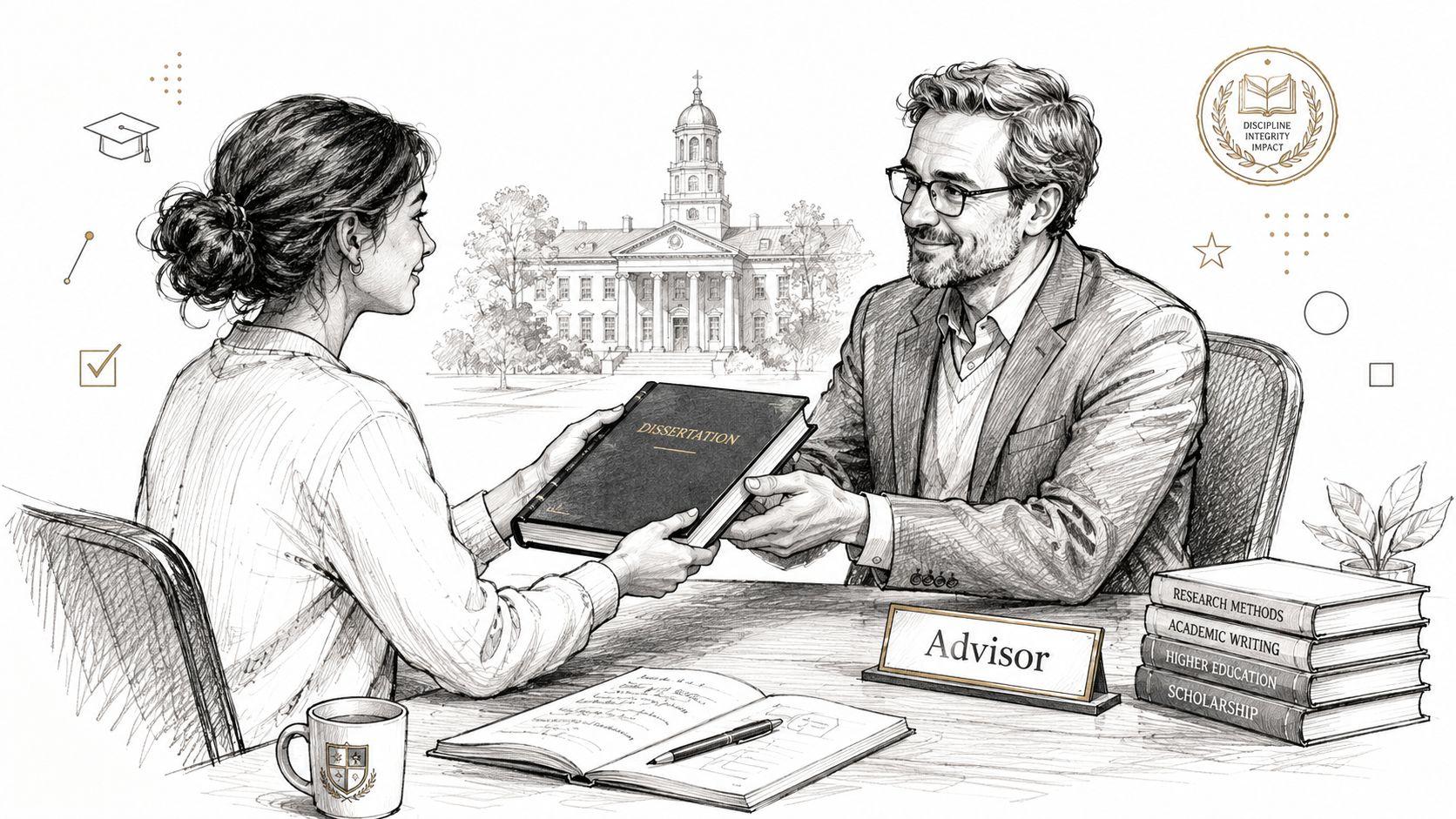
This is the anchor of most dissertation acknowledgements. If your supervisor, committee, graduate coordinator, lab director, or department staff played a direct role in the project, they belong near the top. Readers expect to see academic support first, and that expectation isn't just stylistic. It reflects a stable convention across dissertation-writing guides.
Here's a clean model:
I would like to thank Professor Elena Morris, my supervisor, for her steady guidance, direct feedback, and insistence on clarity at every stage of this dissertation. I am also grateful to Dr. Samuel Reed and Dr. Priya Nair, whose committee comments sharpened both the argument and the methodology. My thanks also go to the graduate program office and library staff for their practical support in accessing materials and managing submission requirements.
What works
This kind of acknowledgement succeeds when each person's role is clear. “Thanks for your support” is weak. “For feedback on Chapter 3” or “for access to the archives” is stronger because it shows you understand the difference between mentorship, review, and administrative help.
A common mistake is flattening everyone into one sentence. Don't thank your supervisor, lab technician, and departmental administrator as if they all contributed in the same way. Name the role, then name the contribution.
- Check titles carefully: Use the exact form of address your department uses, especially for supervisors, committee members, and directors.
- Be precise about help: Mention mentoring, methodological advice, access to facilities, or administrative coordination.
- Keep the tone warm but formal: Gratitude is personal, but the language should still sound like part of a dissertation.
If you used digital research support while drafting, keep it secondary to human academic oversight. A sentence about responsibly using modern tools can fit, especially if you already use platforms discussed on the 1chat blog, but the advisor remains the lead acknowledgement.
2. Family and Personal Support Acknowledgement

Personal acknowledgements belong later in the section, after academic and institutional thanks. That order is widely recommended, and it keeps the page aligned with academic expectations while still leaving room for honesty and warmth.
A strong example sounds like this:
Finally, I thank my parents for their steady encouragement throughout this degree, and my partner for the patience and practical support that made sustained writing possible. I'm also grateful to my close friends, who read drafts, listened to half-formed ideas, and helped make a demanding process feel manageable.
The trade-off between heartfelt and excessive
Many acknowledgements tend to drift off course. Some become so restrained that they feel generic. Others become so intimate that they read like private correspondence. The best version lands in the middle. It sounds human, but it still belongs in a formal document.
If a partner handled childcare while you revised your conclusion, say that. If a friend proofread formatting or references, say that. Specificity gives the gratitude weight.
Personal thanks work best when they describe what someone actually carried with you.
A useful discipline is to limit each person to a clear contribution. That keeps the section sincere without becoming sprawling.
Good judgment matters here
- Name practical support: emotional steadiness, childcare, proofreading, household help, or patience during the writing period.
- Avoid private detail: dissertations are public-facing documents in many institutions.
- Don't overdo jokes: a light line can work in some departments, but humor ages badly and can distract from the rest of the page.
If AI tools helped you save time during drafting or editing, mention that only if it's relevant and your institution allows it. In a personal acknowledgement, that point usually doesn't need center stage.
3. Research Funding and Grant Acknowledgement
Funding acknowledgements are less sentimental and more exact. They often carry institutional or grant-related expectations, so this is one area where improvisation can create problems. If your research was supported by a scholarship, fellowship, grant, travel award, or lab budget, acknowledge it accurately.
A practical model:
This research was supported by the Faculty Research Fund at Westbridge University and by a doctoral scholarship from the School of Social Sciences. I gratefully acknowledge this support, which enabled archive access, fieldwork travel, and dedicated research time.
Formal gratitude and disclosure are not the same thing
This section should sound professional because it isn't only about appreciation. It also signals transparency. University guidance specifically notes that authors must acknowledge grants or funding used to conduct the research, as stated in the UC Irvine graduate manual guidance on acknowledgments.
That matters because funding isn't just another thank-you. It documents how the project became possible.
- Use official funder names: write the organization exactly as it appears in the award letter.
- Follow required wording: some funders specify exact acknowledgement language.
- Separate money from emotion: “I am indebted forever” is the wrong tone for a fellowship acknowledgement.
A frequent error is burying funding inside a long paragraph of personal thanks. Don't. Funding belongs with your formal acknowledgements, usually near supervisors, institutions, and technical contributors.
A realistic scenario
A doctoral student in public health might thank a university fellowship for protected writing time, then separately thank a research center for access to software or secure workspaces. Those are related forms of support, but they shouldn't be collapsed into one vague sentence. Money, facilities, and mentorship are different inputs. Your acknowledgement should reflect that difference.
4. Peer Review and Collaboration Acknowledgement
Many dissertations look solitary from the outside, but most improve through conversation. Lab mates challenge assumptions. Peers catch weak transitions. Conference audiences ask the question you'd been avoiding. A good collaboration acknowledgement makes that intellectual community visible without overstating anyone's role.
Example:
I'm grateful to the members of the Political Communication Research Group for reading draft chapters and offering candid criticism at key moments. I also thank Aisha Khan and Marco Bell for discussing coding decisions and helping me test the clarity of the analytical framework. Their questions improved the final argument substantially.
Credit help without giving away authorship
This is the central balance. You want to recognize meaningful input, but you also need to preserve the fact that the dissertation is your work. The safest way to do that is to acknowledge feedback, discussion, review, access, or logistical help, rather than implying co-authorship.
Say who contributed, then say how. Don't imply they wrote, designed, or concluded the project unless that's formally true and permitted by your institution.
Examples of good phrasing include comments on draft chapters, discussion of coding categories, manuscript feedback after a workshop, or help locating hard-to-find materials. Examples of risky phrasing include “for developing my argument” or “for shaping the findings” unless you can defend that wording.
Where students often misjudge this section
- They thank “everyone in the lab”: broad group thanks are fine, but one or two specific names make the acknowledgement credible.
- They list peers before supervisors: that usually breaks expected academic ordering.
- They confuse critique with authorship: comments and discussion deserve thanks, not shared credit for the dissertation's claims.
This is also where tone can loosen slightly. You can sound collegial here, especially if the people named worked beside you rather than above you.
5. Technical Resources and Tools Acknowledgement
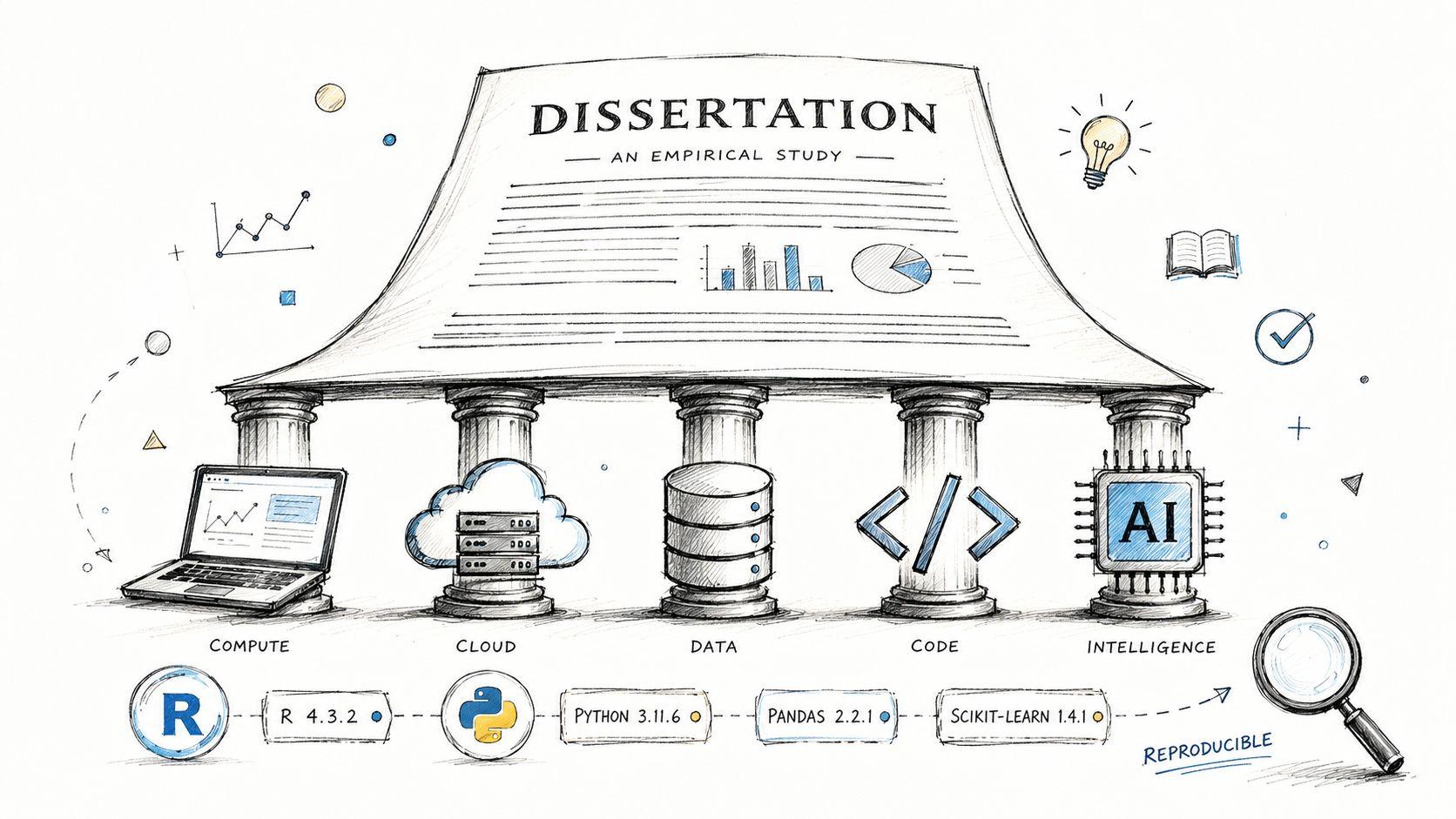
Modern dissertations often depend on more than people. They rely on archives, statistical software, coding environments, transcription workflows, reference managers, cloud platforms, and sometimes AI systems. Most example pages online underplay this category, even though practical guidance often recommends thanking technical staff, librarians, proofreaders, and similar contributors.
Here's a useful example:
I thank the university library's digital scholarship team for their help with database access and document retrieval. I also acknowledge the use of Zotero for reference management, NVivo for qualitative coding, and Python-based data cleaning workflows that supported the organization and analysis of research materials.
Transparency beats tool-showcasing
Students sometimes turn this section into a product parade. That's not the goal. Mention tools only when they materially supported the research process or when your field values transparency about workflows. The point is reproducibility and honesty, not promotion.
Guidance on dissertation acknowledgements commonly places technical or statistical help after supervisors and before more informal thanks, which fits this category well, as explained in ResearchMasterminds' acknowledgement ordering advice.
- Name the actual tool: Zotero, NVivo, R, Python, SPSS, Overleaf, institutional repositories, named archives.
- State the function: reference management, coding, transcription support, data cleaning, visualization, retrieval.
- Keep human oversight clear: a tool assisted the process. It didn't become an author.
If you used an AI platform for brainstorming, summarizing notes, or language polishing, check your institution's disclosure rules before including it. If you mention such use, pair it with responsible framing and the platform's usage policies, especially when the work involved academic integrity constraints or sensitive inputs.
6. Community and Organizational Support Acknowledgement
Applied research often depends on access. A school lets you observe classrooms. A nonprofit opens its records. A small business agrees to interviews. A local association introduces you to participants who would otherwise remain out of reach. These contributors may not fit neatly into “academic” or “personal,” but they deserve careful acknowledgement.
A grounded example:
I thank the staff and leadership of Northside Community Health Initiative for welcoming this research and facilitating access to interviews and program documents. I'm equally grateful to the participating educators and local partners who shared their time, experience, and trust throughout the fieldwork process.
Respect matters more than flourish
This category is easy to mishandle. Some acknowledgements become transactional, as if the organization “provided data” and nothing more. Others become performative, promising solidarity in language that doesn't belong in a dissertation front matter page. Aim for respectful precision.
If a community partner provided meeting space, recruitment support, or practical introductions, say so plainly. If an organization took a reputational or operational risk by allowing research access, recognition should reflect that.
Community acknowledgements should honor access, trust, and participation without exposing private individuals or overstating the relationship.
Strong phrasing choices
- Use official organization names: don't shorten them casually unless that's the public name they use.
- Describe access concretely: interviews, site visits, archival access, recruitment help, introductions, facilities use.
- Protect confidentiality when needed: you can thank a clinic, school, or firm without naming individual staff if privacy obligations apply.
This kind of acknowledgement is common in education, public health, business, sociology, and policy dissertations. It also matters in industry-facing projects where external cooperation made the work possible.
7. Statistical and Methodological Expert Acknowledgement
When someone helps you solve a design, analysis, or interpretation problem, they shouldn't disappear into a generic thank-you line. Methodological support often has a distinct role. It's neither broad supervision nor ordinary peer feedback. It's targeted expertise.
Example:
I'm grateful to Dr. Lian Chen for methodological consultation during the design of the mixed-methods framework and for advice on how to align coding decisions with the study's research questions. I also thank Jordan Patel for guidance on data visualization choices that improved the clarity of the final presentation.
Why this category strengthens credibility
This acknowledgement tells readers that you sought help where specialist judgment mattered. That can subtly improve how the dissertation is received. It signals rigor without making grand claims about perfection.
A strong acknowledgement here names the problem and the help. Maybe a statistician advised on model selection. Maybe a qualitative methods expert clarified coding reliability procedures. Maybe a data visualization specialist helped you present comparative findings more clearly.
Keep the boundary sharp
- Thank experts for guidance, not ownership: they advised, reviewed, or consulted.
- Use accurate terms: “methodological consultation,” “statistical advice,” “visualization guidance,” or “coding framework feedback.”
- Avoid inflated wording: don't imply they validated the entire dissertation unless they formally did.
This is also a good place to mention that digital tools supported workflow while expert oversight remained central. If you used software or AI to test prompts, organize notes, or draft plain-language explanations, the specialist still owns the methodological contribution you're acknowledging. That distinction protects both integrity and clarity.
8. Permission and Ethical Approval Acknowledgement
Some dissertations need more than gratitude. They need formal recognition of the permissions and approvals that made the research lawful and ethically sound. This includes ethics review, data access agreements, archival permissions, copyright clearances, and approval for previously published material.
An example that stays disciplined:
I acknowledge the ethical approval granted by the University Research Ethics Committee for this study and thank the participating institutions for authorizing access to relevant materials. I also recognize the permissions obtained for the inclusion of previously published content and restricted research documents where required.
Don't hide compliance inside emotional prose
Students often know this material matters, but they tuck it into a closing paragraph after thanking family and friends. That weakens it. Practical guidance notes that acknowledgements are often placed near the front of the thesis and that students frequently need help handling strict rules on placement, tone, and institutional formatting, as discussed in Paperpile's dissertation acknowledgments guide.
This category should read cleanly and factually. If your institution requires official phrasing for ethics or privacy-related matters, use it.
Compliance language should match the underlying approval documents, not your memory of them.
What belongs here
- Ethical approval: committee or board approval when required by your institution.
- Permissions: archives, publishers, organizations, or data custodians.
- Sensitive-data awareness: any acknowledgement of tool use should respect institutional privacy expectations and the platform's privacy information.
This is especially important if your project involved interviews, school records, proprietary reports, or other restricted materials. Keep records from the start, and write this section from the documentation, not from memory.
8-Point Comparison of Dissertation Acknowledgements
| Acknowledgement Type | Implementation Complexity 🔄 | Resource Requirements ⚡ | Expected Outcomes 📊 | Ideal Use Cases 💡 | Key Advantages ⭐ |
| Academic Advisor and Institutional Support Acknowledgement | Moderate, requires formal wording and name/title verification | Low, time to confirm names/titles and institutional details | High, enhances credibility and professional ties | Dissertations, theses, formal academic reports | ⭐ Builds professional relationships and enhances dissertation credibility |
| Family and Personal Support Acknowledgement | Low, informal tone but needs balance with professionalism | Very low, personal time and memory to recall contributions | Moderate, strengthens personal bonds and humanizes work | Works with personal narratives and public-facing dissertations | ⭐ Adds authentic human element and creates memorable keepsakes |
| Research Funding and Grant Acknowledgement | High, must follow funder language and compliance requirements | Moderate, collect grant numbers, award details, and records | High, transparency, funder recognition, and impact tracking | Funded projects, grant-funded studies, and reports to sponsors | ⭐ Meets funder obligations and documents research investment |
| Peer Review and Collaboration Acknowledgement | Moderate, specify roles and delineate contributions clearly | Low–Moderate, list collaborators and describe feedback received | Moderate, builds networks and credits collaborative input | Collaborative projects, lab groups, multi-author work | ⭐ Credits contributors and fosters academic networking |
| Technical Resources and Tools Acknowledgement | Low–Moderate, list tools, versions, and check license requirements | Low, document software, databases, platforms, and versions | High, improves reproducibility and methodological transparency | Computational, AI, and data-intensive research | ⭐ Demonstrates reproducibility and acknowledges tool creators |
| Community and Organizational Support Acknowledgement | Moderate, requires cultural sensitivity and accurate naming | Moderate, obtain permissions and confirm organizational details | Moderate, strengthens partnerships and ethical standing | Applied research, fieldwork, NGO or industry collaborations | ⭐ Reinforces community relationships and practical relevance |
| Statistical and Methodological Expert Acknowledgement | Moderate, accurately describe technical contributions and scope | Moderate, verify expert titles, affiliations, and consent | High, increases rigor, validation, and methodological credibility | Studies needing advanced analysis or specialist consultation | ⭐ Enhances research rigor and methodological quality |
| Permission and Ethical Approval Acknowledgement | High, legal wording, multiple approvals, and exact references | High, IRB numbers, approval documents, and data agreements | High, ensures legal/ethical compliance and participant protection | Human subjects research, sensitive data, and copyright use | ⭐ Documents compliance and protects researchers and participants |
Crafting Your Perfect Acknowledgement Page
The best examples of acknowledgements in dissertations don't sound interchangeable. They follow shared academic norms, but they still reflect the actual network behind the work. That's the point. Your page should show who helped, how they helped, and where formal recognition matters more than sentiment.
A strong acknowledgements page usually moves from formal support to personal support. Guidance commonly recommends starting with supervisors, advisors, and academic staff, then moving to funders or sponsors, followed by collaborators and peers, and ending with family and friends. It's also commonly written in first person, kept concise, and framed around names, roles, and specific contributions, as described in GradCoach's thesis acknowledgements advice.
That structure gives you a practical decision rule. Start with the people and institutions most essential to the dissertation's completion. Then work outward. If you're unsure whether someone belongs, ask a simple question: did this person or organization materially affect the project, the process, or the conditions that made completion possible? If the answer is yes, they likely deserve mention.
The biggest mistake isn't being too formal or too warm. It's being vague. “Support,” “encouragement,” and “guidance” can all be accurate, but they don't carry much weight on their own. Replace them with concrete contributions. Feedback on a chapter. Access to field sites. Statistical advice. Childcare during revisions. Funding for travel. Permission to reuse prior publication material. Those details turn a polite page into a credible one.
Keep the final version tight. Many guides note that acknowledgements are typically kept to about one page. That limit is useful. It forces prioritization, and prioritization is part of the craft.
Treat this page as part of your professional identity, not an afterthought. It's one of the few places in a dissertation where your scholarly judgment and your personal voice appear together. When you get it right, the page feels generous, precise, and mature. That's exactly how you want to leave the reader before they enter the rest of your work.