You're probably here because you asked an AI to help with a message, a homework problem, a summary, or a work task, and you want to know what's happening behind that clean reply on the screen. The short answer is simple: a language model is a system that learns patterns in text and uses those patterns to predict and generate new text, one piece at a time. That sounds abstract until you realize it's the engine inside many chatbots, writing tools, translation systems, and search assistants.
A useful first definition is this, a language model estimates which word, token, or sequence is most likely to come next based on the text already seen. Foundational work on statistical language modeling treats language this way, as a probability problem over sequences, not just a chat feature. If you want a deeper starting point for the technical side, you can find LLM training resources that map the topic from basics to implementation.
That definition gets more interesting once you see why it matters in real decisions. A model can sound fluent and still be wrong, biased, or weak in the language your family uses at home. It can also be useful for drafting, brainstorming, and summarizing without being something you trust blindly.
A Plain-English Answer to the Question
You don't need a computer science degree to use the right mental picture. A parent might ask an AI to rewrite a school email, or a small business owner might ask it to draft a reply to a customer, and in both cases the model is doing the same basic thing. It is not “thinking” in the human sense, it is matching patterns in text and producing the next likely piece of language based on context.
A model is a prediction system, not a magic answer machine
Think of the autocomplete on your phone, but much more capable. Your keyboard guesses the next word from a small slice of context, while a language model works with far more text and a richer set of patterns. The core idea comes from statistical language modeling, where the system assigns probabilities to sequences so it can compare possible outputs and pick the most likely one, a foundation described in early research on language modeling in this survey of statistical language models.
That's why every chatbot you've used depends on a language model. The chat interface may look like a conversation, but under the hood the model is still producing text by prediction. It can help with homework, emails, outlines, and translations because it has learned patterns from huge amounts of text, not because it has a hidden person inside.
Practical rule: if the output needs to be exact, verifiable, or high stakes, treat the model as a draft assistant, not a final authority.
What beginners usually miss
People often assume “language model” means “chatbot.” It doesn't. A chatbot is the interface, the model is the engine. That's why the same model can power a support bot, a writing tool, or an internal search assistant depending on how it's wrapped and used.
The other common confusion is that a fluent answer feels like knowledge. Fluency only means the text fits the pattern well. It doesn't guarantee truth, fairness, or suitability for your situation, which is why the rest of the picture matters before you trust the output.
The Core Idea Behind Every Language Model

It guesses the next piece of text
A language model starts with a very ordinary task. Given the text so far, it asks which piece is most likely to come next. That next piece may be a full word, part of a word, or a token, which is the small unit the model handles internally.
That simple idea explains a lot of the behavior people notice. A model can produce different answers because it is choosing from probabilities, not following a fixed script. Small changes in the prompt can shift those probabilities, so two prompts that look almost the same to you may still lead to different outputs.
Tokens, context, and likelihood
A token is the unit the model reads and writes, and it is not always the same as a word. Short words may stay intact, while longer or less common words may be split into several tokens. The context is the text the model can use before deciding what to generate next, and a larger context gives it more clues to work with.
The older statistical view of language modeling explains the basic math behind this idea. A model estimates how likely a sequence is, then uses that score to compare possible outputs and choose among them. That is why early systems could compare a sensible phrase with a similar-sounding nonsense phrase in speech recognition and prefer the one with the higher probability as described in the classic survey of statistical language models. Modern systems still follow the same logic, even though they use much more advanced architectures.
Why long context changes behavior
More context usually gives the model better footing. It can use earlier details for follow-up questions, summaries, and tasks where a later sentence depends on something said before. The tradeoff is that the model has more information to juggle, so outputs can become slower and, at times, less steady as the conversation grows.
A sentence-completion game shows the idea clearly. If the text says, “After dinner, we went to the…,” many endings could fit. Add, “for the school concert,” and the likely ending changes. A language model repeats that probability update token by token until it finishes the response.
For a deeper look at how structured knowledge can support these systems, see this knowledge graph LLM strategy guide. Research teams also use tools like 1chat research to examine how prompts, retrieval, and model behavior interact in practice.
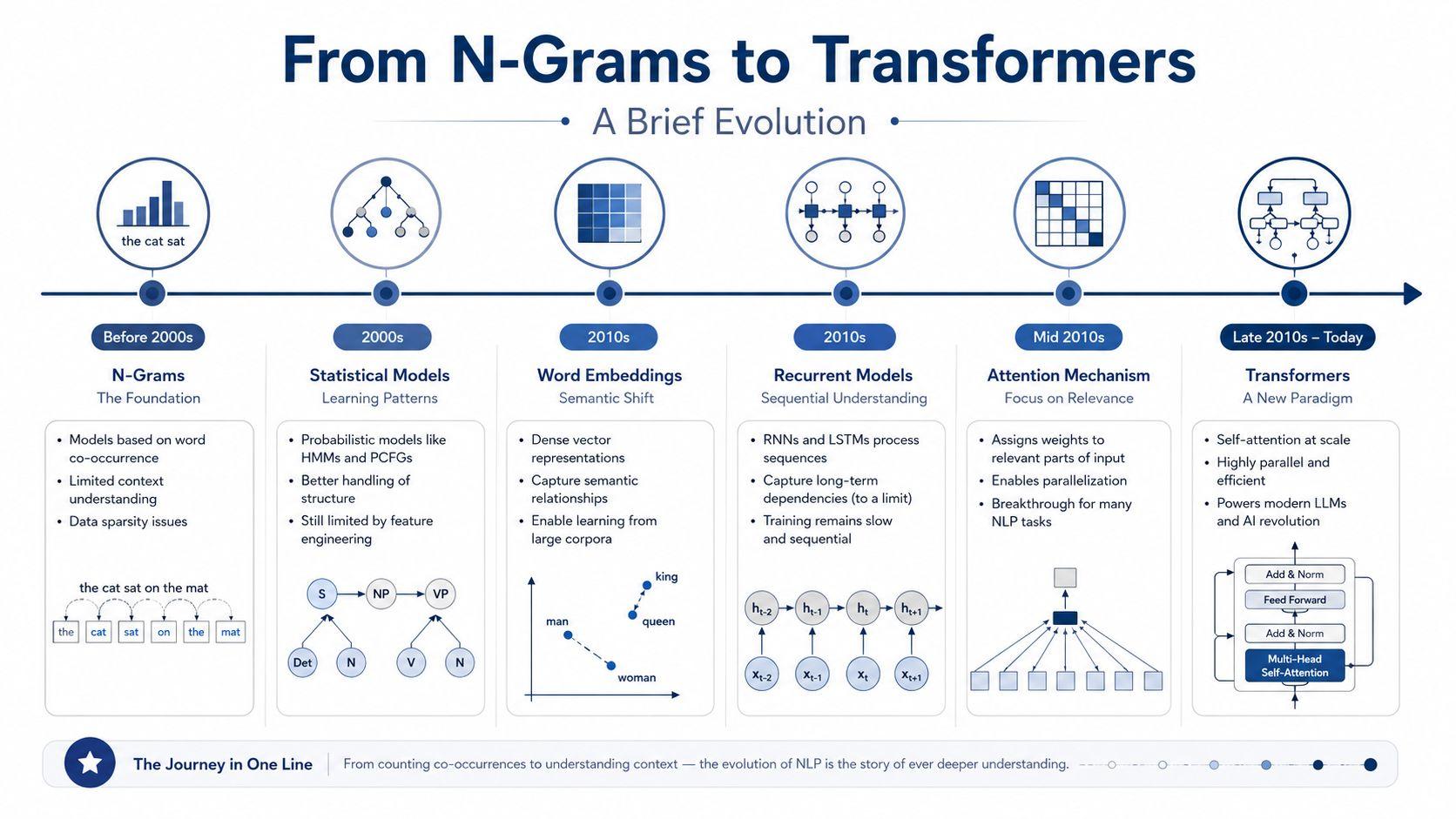
From N-Grams to Transformers, A Brief Evolution
Why older models mattered
The first language models were count-based systems, usually called n-grams. They worked by looking at a short run of nearby words and estimating which word was most likely to follow that run. That simple approach made them useful in speech recognition, machine translation, information retrieval, and spelling correction, even though they could only see a limited stretch of text and struggled with long dependencies.
That limitation shaped what they could do. If the clue that mattered was too far back in the sentence, the model often missed it. Researchers kept pushing toward methods that could hold more context without breaking under the amount of information they had to process.
What neural and transformer models changed
Neural language models kept the same basic goal, but they handled text in a more flexible way. Instead of relying only on local word counts, they learned patterns from data and used transformer architectures to weigh context across a much wider span. Reviews of language modeling describe these systems as neural networks that can generate, summarize, translate, and analyze language while still working as statistical prediction machines in this overview of language models. The key shift is that transformer attention helps the model decide which earlier tokens matter most, even when the useful clue is far away.
This matters in practice because model design affects how well the system handles rare words, long prompts, and multilingual text. For example, Gemma 3 270M uses 12 transformer layers, a 1024 hidden size, 270 million total parameters, and a 32,768-token context window. Its parameter split also shows a tradeoff, since a large share goes to embeddings because of its 256k-token vocabulary, which supports rare tokens, multilingual text, and specialized terminology across 140+ languages according to the model overview. For a broader look at how this technical shift unfolded, see our research page.
Modern models did not erase the earlier idea. They stretched it, refined it, and made it far more flexible.
Why “LLM” is a chapter, not a reset
The phrase large language model can make the field sound brand new, but the core idea is much older. It belongs to a long probabilistic tradition that began with early prediction systems and moved through neural sequence models before reaching today's transformers. The biggest change is not the task itself, it is the system's ability to use more context, scale to larger data, and handle more kinds of language.
For a practical reader, that continuity matters. An LLM is not a different species of software, it is a more capable language model built on the same basic principle. That makes the next question less about whether a model can predict text, and more about which model to trust, when to verify an answer, and how to think about reliability, bias, and privacy when the user is reading, writing, or translating in a family setting or in a non-English language.
How a Modern Language Model Processes Your Prompt
From text to tokens to probabilities
When you type, “Write a friendly reminder about a parent-teacher meeting,” the model doesn't read that like a person reading a sentence. First, the text gets tokenized, which means it's broken into internal chunks. Then those tokens are turned into embeddings, which are numeric representations that let the system compare relationships between pieces of text as IBM explains in its overview of large language models.
After that, the prompt moves through attention layers that help the model track which earlier parts matter most. The output is a distribution over next-token choices, and the model picks one token, then repeats the process for the next token, and the next one. That token-by-token decoding is why output can feel slightly delayed as responses get longer, especially with larger context windows as IBM notes in its explanation of sequence generation.
Key building blocks of a modern language model
| Term | What it means | Why it matters |
| Token | A chunk of text the model reads and writes | It is the actual unit of prediction |
| Context window | The amount of text the model can use at once | Bigger context helps with long prompts and conversations |
| Embedding | A numeric representation of text | It helps the model compare meanings and patterns |
| Attention | A mechanism for focusing on relevant context | It improves handling of long-range dependencies |
| Perplexity | A measure of how well the model predicts text | Lower perplexity means better prediction on a corpus as noted in language model reviews |
Why the mechanics matter to users
This pipeline explains why models can be both impressive and imperfect. If the prompt is clear, the model has a better chance of predicting a useful answer. If the context is messy, ambiguous, or too long, the next-token process can drift into something less reliable.
It also explains why prompt wording matters. A model is sensitive to surface features, so two prompts that mean almost the same thing to a human can still produce different outputs. That sensitivity is part of how these systems work, not a rare glitch.
Where Language Models Show Up in Real Life
A local bakery owner uses a model to draft a reply to a late delivery complaint. A student uses one to turn rough notes into a clearer outline. A parent asks one to explain fractions in simpler language before homework time. In all three cases, the model is not solving life itself, it is speeding up the first pass on language-heavy work.
Small business, family, and student use cases
For a small business owner, a language model can draft proposals, polish customer replies, summarize meeting notes, or rewrite a product description in a more professional voice. For families, it can help with school emails, travel planning, and quick explanations that need plain language. For students, it can support brainstorming, proofreading, and research questions, as long as the final submission reflects their own judgment.
If you want the interface side of that workflow to feel less intimidating, the Chatgrow chatbot design guide is useful because it focuses on how prompts, conversation flow, and response design affect the user experience. The point is not to make the tool seem magical. It's to make the interaction clear enough that people know what to ask and what to verify.
Where the stakes get higher
Language models also show up in healthcare, legal work, and software engineering. In those settings, the value is usually in summarizing, drafting, classifying, or retrieving information faster. The risk is that a fluent answer can look more certain than it really is, so the human still has to review anything that affects a patient, a contract, or production code.
A simple rule helps here.
Use the model to reduce drafting time. Use a human to approve the result when the outcome matters.
For a more hands-on look at workflows, the broader 1chat blog can help readers compare everyday use cases without assuming a technical background. The useful question is always the same, what language task is taking time right now, and where can a model safely do the first draft?
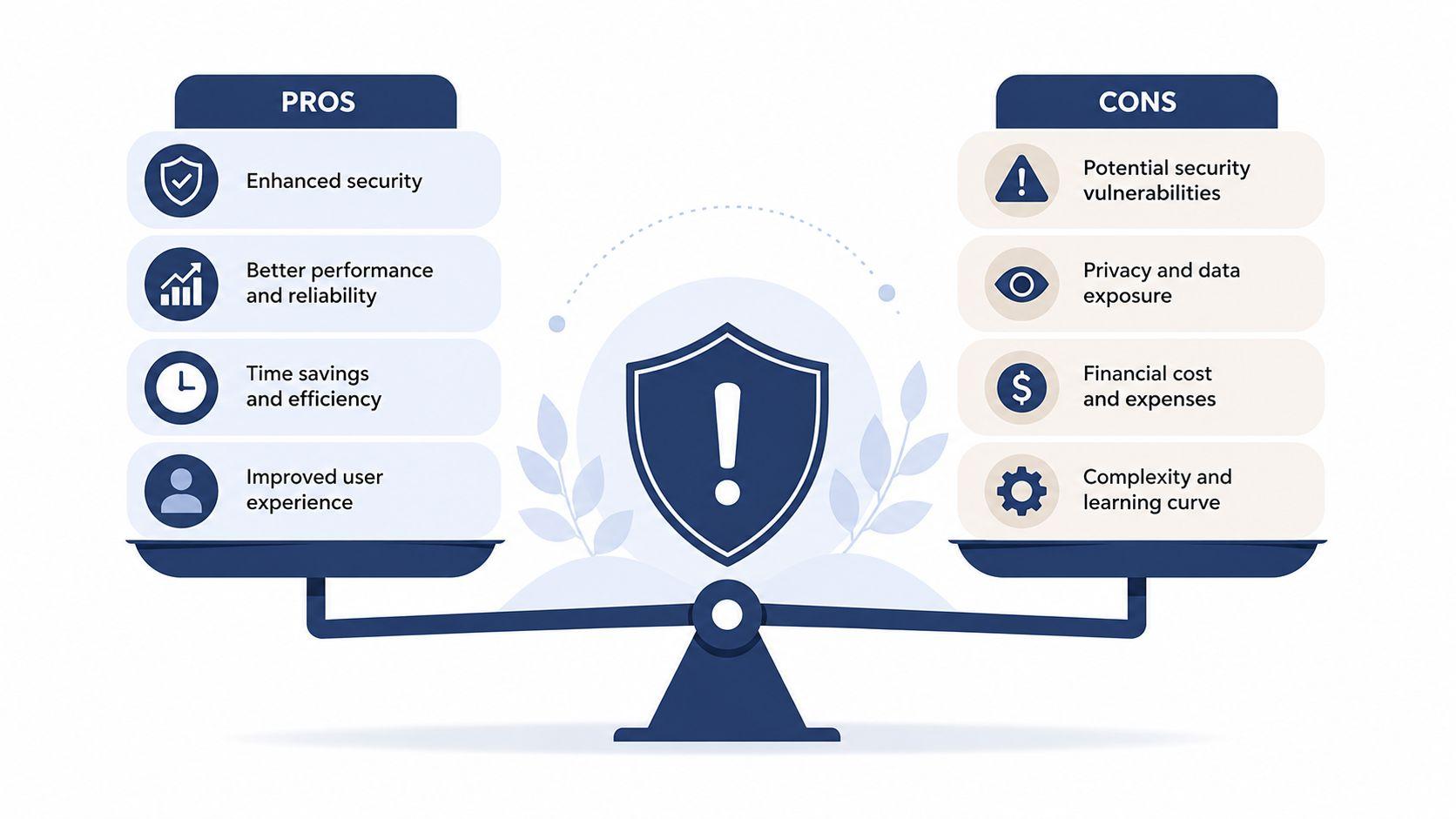
Honest Risks Every User Should Understand
Hallucination, bias, and privacy are real, not edge cases
A language model can sound confident while inventing a fact, mixing up a detail, or filling a gap with something that merely fits the pattern. Research on language model behavior reports unfactual responses, commonsense errors, memorized text, and social biases, and it also notes that outputs are highly sensitive to phrasing and surface features in this comprehensive survey. That means the same request can produce better or worse results depending on how you ask it.
Bias is not just a moral issue, it is an output-quality issue. If the training data reflects uneven coverage, the model can reproduce that unevenness in tone, assumptions, and examples. In practice, that means you should be cautious when the answer touches identity, health, finance, school policy, or any topic where unfair framing can cause harm.
Privacy is different but just as important. If you paste personal, family, or business information into a tool, you should know where that data goes, how it's stored, and whether it's used later. The safest habit is to avoid putting sensitive material into any model unless you understand the provider's policies.
Non-English users should test first, not trust by default
A lot of beginner content assumes English is the main use case. Stanford research says multilingual AI is still leaving non-English speakers behind, and that the right fix depends on the context, whether that means a very large multilingual model, a smaller language-specific model, or a regional model as noted in Stanford's coverage of the digital divide in AI. A related Stanford policy brief says low-resource language development is constrained by data scarcity, compute costs, and participatory research needs, which means the gap isn't accidental, it's structural.
That has a practical consequence for families and bilingual households. If the model sounds fluent in your language but makes odd mistakes in grammar, tone, names, or local references, don't assume the problem is your prompt. Test it on a few real tasks before relying on it for schoolwork, translation, or community communication.
Safer habits that actually help
The fixes are usually simple, but they have to be deliberate.
- Ask for sources or evidence: This gives you something to verify instead of accepting a polished answer.
- Use retrieval-backed tools for factual work: When the model can check a document or database, it has less room to invent details.
- Avoid sensitive inputs unless policies are clear: Family data, client records, and private school information deserve extra care.
- Test non-English output with real examples: Don't rely on one impressive answer, try a few tasks from your own context.
For policy details and acceptable-use boundaries, the 1chat legal usage policies are the right place to check how a tool handles permitted and restricted use. The bigger lesson is simple. Treat the model like a capable assistant that still needs supervision.
Choosing and Using a Language Model the Smart Way
The right model is the one that fits the job and the level of risk. For a draft email or a homework outline, speed and convenience may matter most. For family data, work documents, or anything sensitive, privacy, control, and clear policies matter more than flashy features.
A simple buying and usage checklist
Before you paste in anything important, ask three questions. Can I control what goes into the model? Can I verify the answer against a source or document? Can everyone using it in my home, class, or team understand the limits without a long training session?
That's the same logic behind choosing a privacy-first, family-friendly interface such as 1chat, which gives people a chat layer for working with multiple LLMs in one place and supports PDF analysis and AI image generation. If your household, classroom, or small team needs one shared workflow instead of a pile of separate tools, that kind of setup can make adoption easier.
The habit that protects you most
The best habit is to separate drafting from decision-making. Let the model help you start, organize, and rewrite. Then verify the facts, check the tone, and keep sensitive details out of the prompt unless you trust the platform and its policy.
If you're choosing a tool today, start small. Use one model on a low-risk task, compare the output to what you already know, and only then move it into more important work. The goal isn't to use AI everywhere, it's to use the right language model in the right place, with your eyes open.