You launch a new Facebook campaign. The targeting looks reasonable. The creative looks polished. A few days later, spend keeps climbing and the results still feel thin. Clicks are weak, comments are lukewarm, and the sales that do come in don't justify the budget.
At that point, most business owners change the audience, swap the image, or blame the platform.
Sometimes the actual problem is simpler. The ad never gave people a strong enough reason to stop, care, and click.
That's where a strong Facebook Ad Copywriter earns their keep. Not as a wordsmith who fills in text boxes, but as the person who sharpens the message, matches it to buyer awareness, and keeps the ad angle from going stale after the first burst of performance.
Why Your Facebook Ads Are Failing (And How to Fix It)
A pattern shows up in struggling accounts all the time. The team writes copy that sounds fine in a meeting, but weak in-feed. It explains too much, opens too slowly, and asks for the click before it has earned any attention.
That's expensive because Facebook ads can work very well when the messaging is right. The platform's average conversion rate is 9.2%, and ads that use FOMO phrases such as limited-time offer or exclusive deal generate a 33% higher conversion rate, according to Facebook ad statistics compiled by ElectroIQ. If your copy misses urgency, relevance, or a clear promise, you're wasting performance on a platform where those details matter.
What failure usually looks like
In practice, bad Facebook ad copy rarely looks dramatic. It looks ordinary.
- Generic hooks: The ad opens with “We're excited to announce” or “Learn more about our solution.”
- Feature dumping: The copy lists capabilities before it names a pain point.
- No buying trigger: There's no urgency, no consequence, and no reason to act now.
- Weak audience fit: The same message gets shown to cold prospects and warm retargeting traffic.
A business owner often reads that copy and thinks, “It's accurate.” The audience reads it and keeps scrolling.
Practical rule: If the first line doesn't make the right buyer feel seen, the rest of the ad barely matters.
What fixing it actually means
Fixing poor ad performance doesn't always require a full campaign rebuild. A good Facebook ad copywriter starts by diagnosing the message itself.
They ask questions like:
- Who is this ad talking to right now?
- What stage of awareness is that person in?
- What belief needs to change before the click happens?
- What reason to act belongs in this ad, and what should be left out?
That's a different skill from “writing catchy copy.” It's closer to conversion strategy. The copywriter's job is to make the ad legible to a distracted buyer, not impressive to the internal team.
If your ads are failing, don't assume Facebook is broken. Often the platform is doing its job. It's delivering impressions. Your copy just isn't converting that attention into action.
What a Great Facebook Ad Copywriter Actually Does
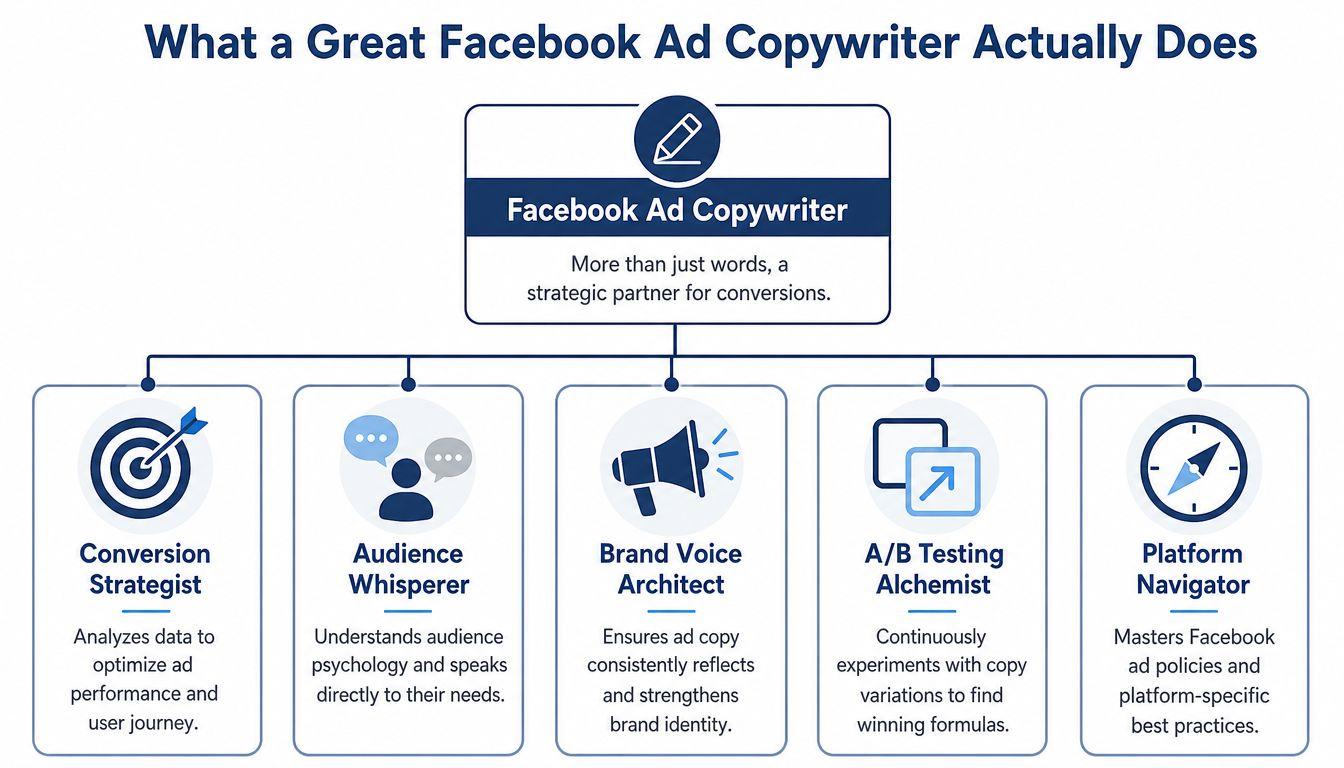
Many companies hire a Facebook ad copywriter expecting headline ideas, body copy, and a call to action. That's only the visible layer.
A strong hire manages the message system behind the campaign. They decide what angle to lead with, which objections to surface, and when to retire a message that has gone stale. That matters because strong copy doesn't stay strong forever. Successful copywriters map messages to awareness stages and rotate angles to fight fatigue. Paid advertising experts also note that ad performance can drop 40–60% within 3–6 months due to creative fatigue, making systematic angle refresh a core part of the role, as discussed in this paid advertising breakdown on awareness stages and fatigue.
They don't just write. They position.
The average weak hire thinks in formats. “Should this be PAS or AIDA?”
The strong hire thinks in buyer state.
Someone who has never heard of your category needs a different message from someone comparing you with two competitors. If you give both people the same ad, one will feel lost and the other will feel underwhelmed.
A good Facebook ad copywriter usually handles these jobs:
- Awareness mapping: They match the ad to whether the audience is unaware, problem-aware, or solution-aware.
- Angle development: They generate multiple ways into the same offer, such as relief, status, convenience, speed, trust, or risk reduction.
- Objection handling: They identify what keeps buyers from clicking and address it directly.
- Message rotation: They refresh tired angles before performance collapses.
- Creative collaboration: They make sure copy and visual work together instead of competing.
They know copy isn't the only variable
There's a common argument in paid social that images matter more than body copy. In many campaigns, that's true enough to be useful. The visual gets the stop. The copy gets the click qualified.
That means your copywriter shouldn't act like the designer is secondary, and your designer shouldn't treat the copy as filler. The best Facebook ad copywriters work with whoever owns creative to decide which message belongs in the image, which belongs in the first line, and which should be saved for the landing page.
Copy and creative should answer the same question from two angles. Why should this person care right now?
They protect the account from message drift
One of the least visible problems in growing ad accounts is drift. Early ads sound sharp because the founder wrote them from direct customer pain. Later ads become broader, safer, and more corporate.
A great Facebook ad copywriter prevents that drift. They keep the language close to real customer problems. They resist internal jargon. And they know when an ad has become “brand-approved” but no longer buyer-relevant.
When you hire well, you're not hiring someone to decorate a campaign. You're hiring someone to manage how the offer is understood over time.
The Unseen Skills That Drive Ad Performance
A campaign starts slipping after three steady weeks. CTR softens first. Then CPA climbs. The offer did not suddenly get worse. The audience got used to the message.
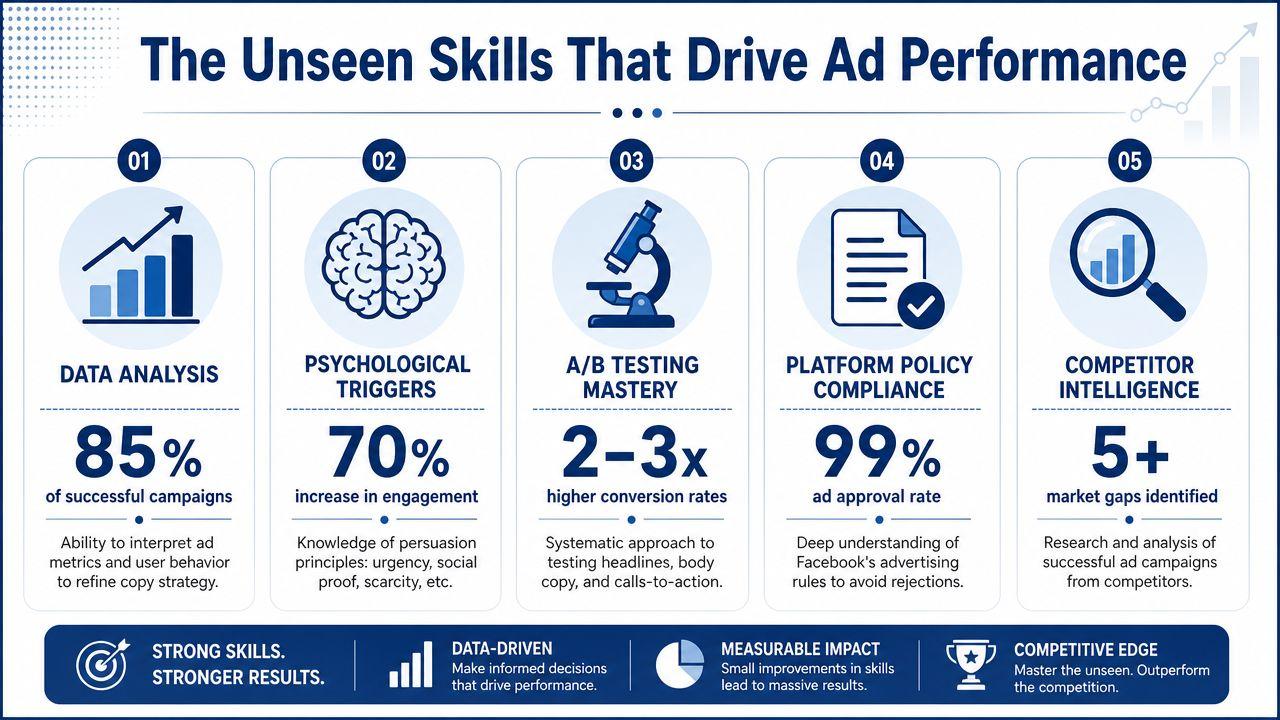
That is the part inexperienced teams miss when they hire a Facebook ad copywriter. They screen for clever phrasing. They should screen for performance habits that keep creative working longer, refresh angles before fatigue gets expensive, and match the message to where the buyer is in the decision process.
A strong writer handles three jobs at once. They write concise copy that survives the feed, build angle variations you can test without rewriting the whole strategy, and adjust the message for cold, warm, and ready-to-buy audiences.
Brevity is a media buying skill
Meta placements reward clarity fast. Guidance cited in this NBC Tribe post recommends keeping primary text short enough to stay visible in-feed, often within the first few lines on mobile.
That matters because short copy is easier to test cleanly. If the ad underperforms, you can usually isolate whether the problem is the hook, the angle, the offer, or the visual. Long copy often hides the underlying issue by stacking too many ideas into one unit.
Good short copy still has to do real work:
- Call out a specific problem or desire
- Show who the ad is for
- Make the promise believable
- Create enough tension to earn the click
- Leave details for the landing page when they belong there
This is harder than it looks. I would rather review five tight variations built around different buyer motivations than one oversized ad trying to sell everything at once.
They rotate angles, not just headlines
A weak copywriter changes wording. A strong one changes the reason the buyer should care.
That distinction affects ROI. If an ad set is tiring out, swapping a few verbs rarely fixes it. Rotating from one angle to another often does. The same product can be framed around saved time, reduced risk, faster setup, clearer reporting, lower waste, or social proof. Those are not headline tweaks. They are different entry points into demand.
This is also where a writer proves they understand awareness stages. Cold audiences usually need problem recognition or curiosity. Warm audiences often need proof, objection handling, or a clearer outcome. Retargeting copy should sound different again. It can assume more context and ask for more commitment.
Ask candidates how they would write the same offer for these three groups:
- Someone who does not know the product
- Someone who clicked but did not convert
- Someone who added to cart or booked a call and dropped
If the answer is basically the same ad with minor edits, keep looking.
They know what belongs in the first line
The hook is not a decorative line. It decides whether the rest of the ad gets a chance.
Strong writers understand truncation, mobile viewing behavior, and message hierarchy. They know the first line should carry the core tension, not throat-clearing copy about the brand. They also know every message does not belong in body text. Some claims work better in the creative itself. Some belong on the landing page where you have space to prove them.
A practical review framework helps here:
| Skill to inspect | What strong work looks like | What weak work looks like |
| Angle rotation | Distinct reasons to care across variants | Same idea rewritten five ways |
| Awareness mapping | Different copy for cold, warm, and hot traffic | One generic message for every audience |
| Length control | Clear first lines and clean hierarchy | Important context buried after “See More” |
| Market language | Uses buyer terms naturally | Uses internal jargon or brand slogans |
| Testability | One variable shifts at a time | Multiple ideas mixed into one ad |
They can explain the business case for each ad
This is one of the best hiring filters.
A serious Facebook ad copywriter can tell you why an ad exists, which audience it is for, what objection it addresses, and what metric should improve if the concept works. They do not hide behind taste. They can connect creative decisions to account performance.
That matters more now because paid social is a creative-dominant channel. Copy still does not work alone, but it shapes how efficiently you spend. Better hooks can improve thumb-stop rate. Better audience-message fit can lift CTR and conversion rate. Better angle rotation can keep frequency from turning into waste too quickly.
When you hire this well, you are not buying lines of text. You are adding a person who can help the account produce more usable creative tests, learn faster, and get more from the same media budget.
Proven Ad Copy Formulas With Examples
Frameworks don't make ads perform on their own. They do give you a clean way to judge whether a candidate can organize a message under pressure.
The mistake is treating formulas like templates to fill in mechanically. Good Facebook ad copywriters use them as scaffolding, then adapt the tone, tension, and proof to the audience.
The quick-reference table
| Formula | Stands For | Best For |
| PAS | Problem, Agitate, Solution | Pain-aware audiences |
| AIDA | Attention, Interest, Desire, Action | Broad offer education |
| BAB | Before, After, Bridge | Transformation-focused offers |
| 4P | Picture, Promise, Prove, Push | Benefit-led campaigns |
| UUU | Useful, Urgent, Unique | Short direct-response ads |
PAS done badly and done well
A weak PAS ad often overdoes the agitation and sounds melodramatic.
Before
Tired of bad marketing results? Many businesses struggle to get leads and sales online. Our agency can help with advanced solutions.
After
Your Facebook ads are getting seen, but not clicked. That usually means the message isn't doing enough work. Hire a copywriter who can fix the angle, sharpen the hook, and give cold traffic a reason to care.
Why the second version works better: it names a specific failure, interprets it, and positions the service as a direct fix.
AIDA for service businesses
AIDA gets dismissed because it's old. It still works when the writer avoids hype.
Before
We offer premium bookkeeping support for small businesses. Learn about our services and contact us today.
After
Messy books make every business decision harder. Get bookkeeping support that helps you close the month with fewer surprises and more confidence. See how the process works and decide if it fits your team.
The “after” version earns interest before asking for action. It doesn't start with the company. It starts with the buyer's friction.
BAB for outcome-focused ads
BAB is useful when the transformation is easy to visualize.
Before
Try our meal planning app. It has many features and is easy to use.
After
Right now, dinner feels like a last-minute scramble. With a simple weekly plan, you already know what's next and what to buy. The app gives you the structure to get there without overthinking it.
What to ask when reviewing formula use
When a candidate shows sample ads, don't ask which framework they used first. Ask better questions:
- What belief was this ad trying to change?
- Why did this audience need this angle?
- What would you test against this version?
- Which line is carrying the conversion load?
That tells you whether the writer understands structure as strategy, not just copywriting trivia.
Your Step-by-Step Hiring Guide
A founder hires a Facebook ad copywriter because CPA is climbing and the first assumption is "the copy needs work." Sometimes that is true. Sometimes the actual problem is that the account has burned through one angle, the offer is mismatched to cold traffic, or the writer is being asked to fix weak creative and muddy positioning with words alone.
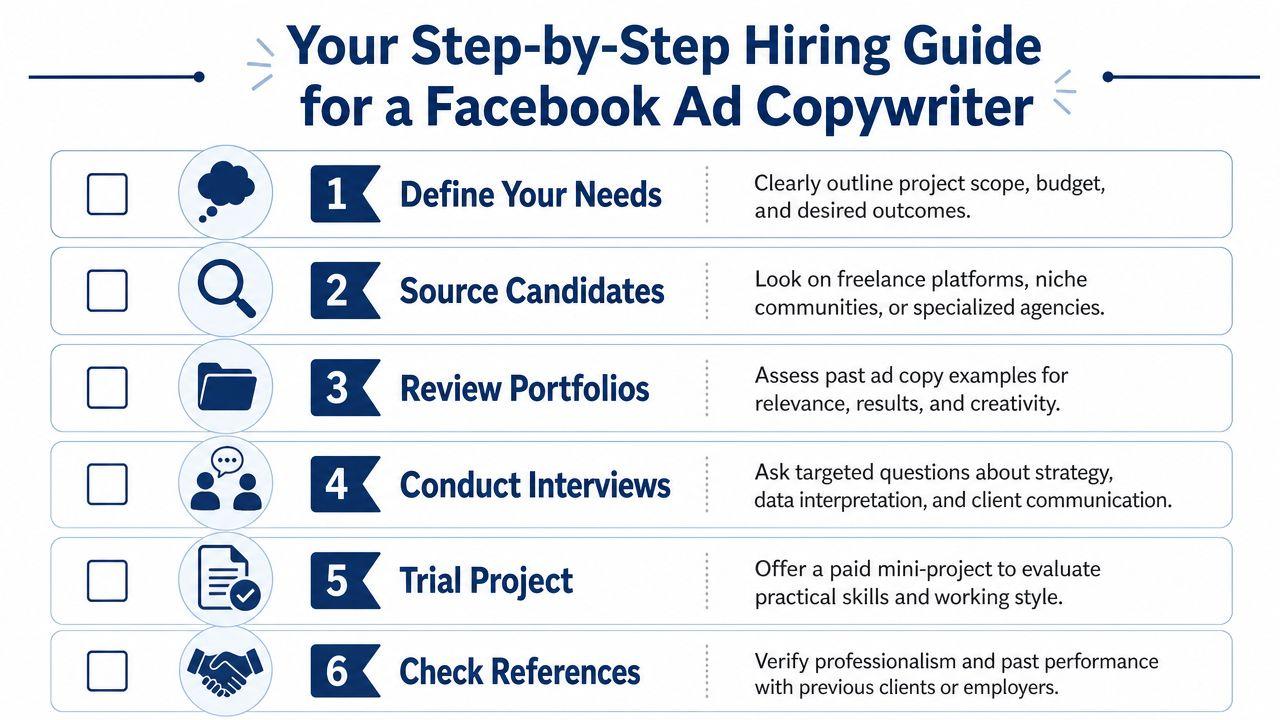
That is why the hiring process has to start with the job, not the person.
Start with the performance problem
Define the problem in account terms before you look at candidates.
Is the issue ad fatigue after two weeks? Weak cold traffic conversion? Retargeting ads that sound identical to prospecting? A thin testing backlog? Each problem calls for a slightly different writer. Some are strong at angle rotation. Some are better at mapping copy to awareness stages. Some can build a testing system that gives the media buyer fresh inputs every week.
Write a short brief that covers:
- Offer priority: Which product, service, or funnel stage needs better copy first
- Traffic temperature: Whether the first assignment is for cold, warm, or retargeting audiences
- Creative role: Whether the writer only writes copy or also develops concepts, hooks, and testing angles
- Team setup: Who owns design, approvals, landing pages, and final launch decisions
- Success metric: What should improve first, such as stronger hook variety, lower fatigue, clearer stage-based messaging, or better lead quality
If you want a useful reference while shaping the role, AdStellar's guide to finding ad copy talent frames the hire around ad performance and testing responsibility, which is the right lens.
Review portfolios for evidence, not polish
A clean portfolio can still hide a weak operator.
The best samples show how the writer thinks. Look for grouped ads built around one offer with different angles, different awareness stages, or different objections. A writer who only shows isolated "best ads" may be good at presentation and weak at iteration.
Use a simple review filter:
| What to inspect | Strong signal | Weak signal |
| Angle work | Multiple distinct messages for the same offer | Minor wording changes dressed up as new concepts |
| Awareness mapping | Clear difference between unaware, problem-aware, and retargeting copy | Same promise repeated across every audience |
| Creative judgment | Notes on what belongs in headline, primary text, and visual | Copy presented without placement or format context |
| Testing discipline | Hypothesis, variant logic, and what they would test next | Finished ad presented as if performance never needs iteration |
The first line matters a lot on Facebook. You do not need a sourced benchmark to know the practical rule. If the opening does not earn the next second of attention on mobile, the rest of the copy rarely gets a chance.
Ask questions that expose trade-offs
Generic interview questions produce rehearsed answers. Better questions force candidates to choose.
Ask things like:
- You join an account where CTR is acceptable but lead quality is poor. What do you change first, the hook, the promise, or the CTA, and why?
- How do you decide whether a drop in performance comes from fatigue, audience saturation, or a weak original angle?
- Show me how you would message the same offer to cold traffic, site visitors, and cart abandoners.
- What should the image communicate so the primary text does not have to carry all the persuasion?
- How do you handle a founder who wants safe, broad copy when sharper positioning usually converts better?
Good candidates answer with account logic. They talk about constraints, sequencing, and what they would test next. Weak candidates fall back on slogans about storytelling or persuasion.
Run a paid trial that matches the real job
A paid trial beats a speculative assignment because it shows how the person works under actual constraints and gives both sides a fair read.
Keep it small. Ask for one deliverable tied to a live business need:
- Three fresh hooks for a current offer
- Two versions by awareness stage
- One new angle for an ad that has likely fatigued
- A short testing note explaining what each version is trying to prove
Review the output like a performance marketer. Did the writer create real message variation, or just rewrite the same idea three times? Did they sharpen qualification if lead quality is the issue? Did they write copy that fits the visual and placement, or copy that reads like a landing page pasted into Ads Manager?
Budget matters here too. If your team wants a human writer supported by faster in-house drafting, compare that workflow against your current spend before hiring. A quick look at 1chat pricing options can help you decide which part of ideation stays internal and which part should sit with the copywriter.
The best first hire usually improves decision quality before they improve sentences. That is what makes them worth the cost.
Drafting Ad Copy With a Privacy-First AI Assistant
AI can speed up ad copy development, but it doesn't remove the need for judgment. If anything, it increases the value of a sharp Facebook ad copywriter because somebody still has to choose the angle, reject generic output, and keep the message grounded in customer reality.
Where AI helps most is volume. It can turn one strategy brief into multiple hooks, awareness-stage variants, objection-handling lines, and testable calls to action much faster than a blank page can.
A practical drafting workflow
The cleanest setup is simple:
- Give the AI a short brief with the offer, audience, and pain point.
- Ask for variants by awareness stage.
- Ask for angle rotation, not just wording changes.
- Cut weak outputs fast.
- Have the human copywriter refine only the strongest directions.
That's where privacy matters. Many small businesses don't want campaign notes, customer language, and positioning drafts floating around without clear boundaries. If your team is evaluating safer ways to use AI in-house, LocalChat's guide for local AI is a useful primer on local-first workflows.
Where it fits in a small team
For a lean business, AI is best used as a drafting partner, not as the final approver.
Use it to generate:
- Hook batches: Multiple first-line options from one promise
- Angle libraries: Different emotional routes into the same offer
- Testing plans: Variant sets organized by audience awareness
- Creative briefs: Suggested copy-image pairings for the designer
Then let the human decide what survives. That combination is often more useful than either extreme. Human-only teams can be slow. AI-only teams usually produce flat, samey messaging.
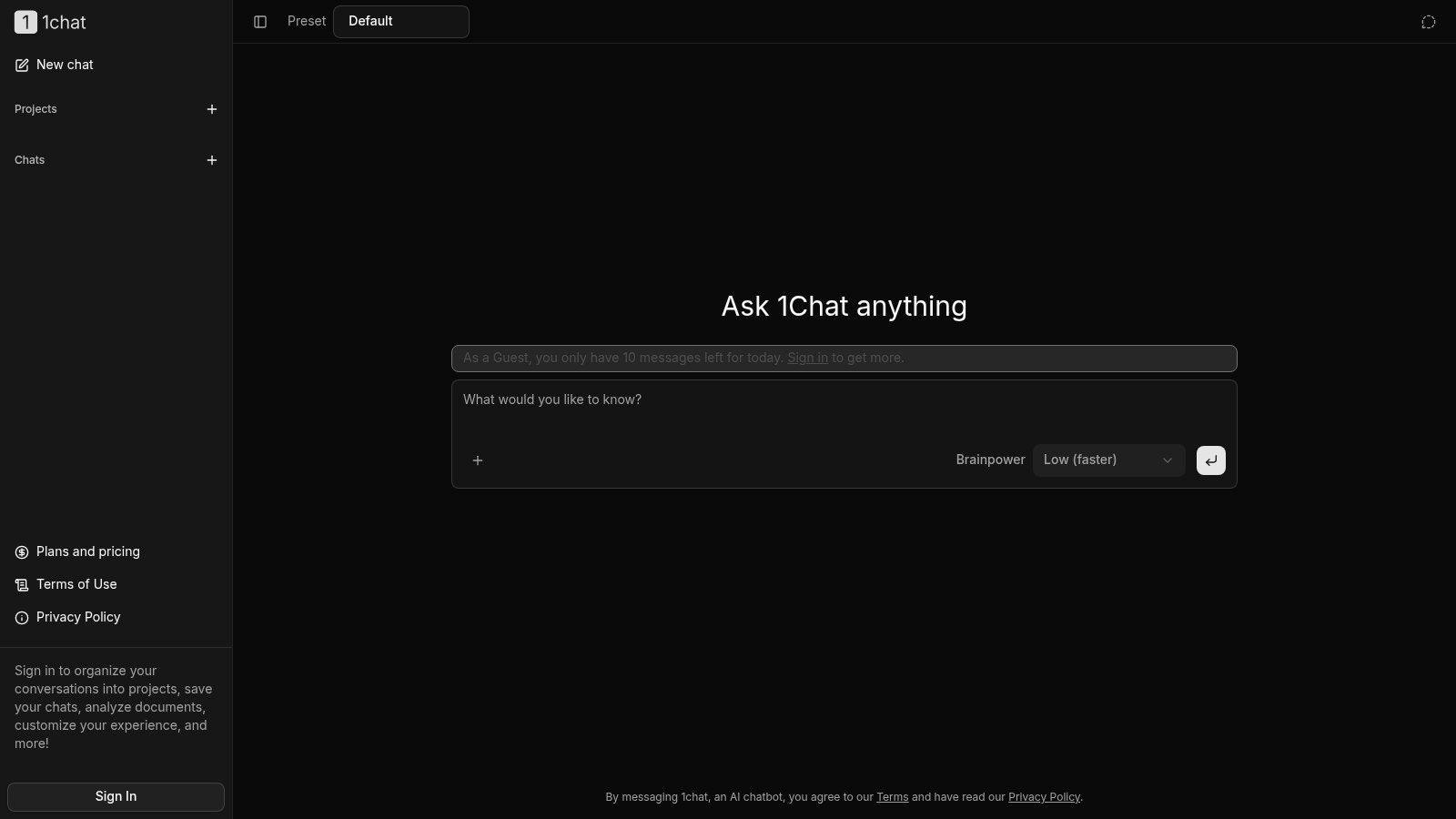
If you want one place to draft, compare outputs, and refine working concepts before they go into ads, teams can experiment with 1chat for AI-assisted writing workflows. The tool matters less than the discipline: brief well, generate widely, and edit hard.
Finding a Partner Not Just a Writer
A great Facebook ad copywriter doesn't just hand over text. They help you decide what to say, who to say it to, and when the message needs to change.
That's why the best hires often feel more like strategic partners than freelancers. They understand awareness stages, spot angle fatigue early, and know how to work with designers and media buyers without turning copy into an isolated craft exercise.
The right hire usually pays back in clearer tests, better messaging discipline, and fewer wasted iterations.
If you're still weighing whether to invest in copy, creative, or creator-led promotion, it can help to look at adjacent options too. Some brands expand performance by combining direct-response ads with UGC and creator content through platforms such as amplify sales for brands. Different channels can support each other when the message is strong.
The next step is simple. Build a short brief, review candidates for strategic thinking, and run a paid trial.
If you want help setting up a privacy-first AI workflow around that hiring process, you can contact the 1chat team.