Most advice on how to improve writing skills fails at the first hurdle. It tells people to “just write,” then acts surprised when they don't.
That advice breaks down because starting is the hard part. Generic tips rarely address procrastination and perfectionism, even though 40% of adult writers struggle to begin because they fear judgment, as noted in Enchanting Marketing's discussion of writing barriers. If the blank page feels threatening, more tips about grammar won't solve the underlying problem.
Writing improves when you build a system that makes starting easier, drafting cleaner, editing sharper, and feedback routine. That system also has to fit modern reality. Students use AI. Teams draft faster than ever. Professionals need writing that sounds human, clear, and credible.
Lay Your Foundation for Better Writing

If writing feels harder than it should, the problem often isn't talent. It's misalignment.
People sit down to write without deciding who the reader is, what the piece needs to do, or what “good enough” looks like for that situation. Then they judge the draft while it's still forming. That combination kills momentum.
Replace vague goals with useful ones
A better starting point is narrow and practical. Don't set a goal like “become a better writer.” Set a goal like:
- For school: explain one argument clearly in one page
- For work: write a team update that answers the main question in the first paragraph
- For business: draft a client email that sounds confident, not defensive
- For personal writing: journal without self-editing for one short session
Those goals create direction. Direction lowers resistance.
A simple planning habit helps even more. Before drafting, define your audience, your purpose, and your rough outline. If you want a deeper craft example, especially for scenes and description, this guide on learn to show not tell is useful because it turns an abstract writing principle into a concrete revision choice.
Practical rule: A draft gets easier when you know exactly who it's for and what the reader should understand, feel, or do after reading it.
Protect your real voice early
A lot of writers think voice appears later, after they “master the rules.” In practice, voice develops while you write regularly and notice your own patterns. It grows when you stop trying to sound like a generic essay generator, a corporate memo template, or the smartest person in the room.
That doesn't mean ignoring craft. It means using craft in service of clarity and personality. If your natural style is direct, lean into directness. If you tend to explain patiently, keep that strength and tighten the wording around it.
A good checkpoint is this question: would someone who knows you hear you in this paragraph?
Make starting smaller than your inner critic
Perfectionism usually shows up before the first sentence, not after the tenth paragraph. The fix isn't motivation. The fix is reducing the size of the task until your brain stops treating it like a performance.
Try this starter sequence:
- Write the assignment in plain language. “I need to explain why this proposal matters.”
- Set a tiny target. One paragraph is enough to begin.
- Write a bad first sentence on purpose. It breaks the spell of getting it right immediately.
- Leave placeholders. If you don't know the exact word or example, mark it and keep moving.
Writers who improve steadily usually stop asking, “How do I feel about writing today?” and start asking, “What is the next small move?”
If you want a tool-supported way to gather background material before a draft, a research workflow like 1chat research tools can help organize inputs. The important part is what you do next. You still have to decide what matters, what belongs, and what sounds like you.
Build a Daily Practice That Actually Sticks
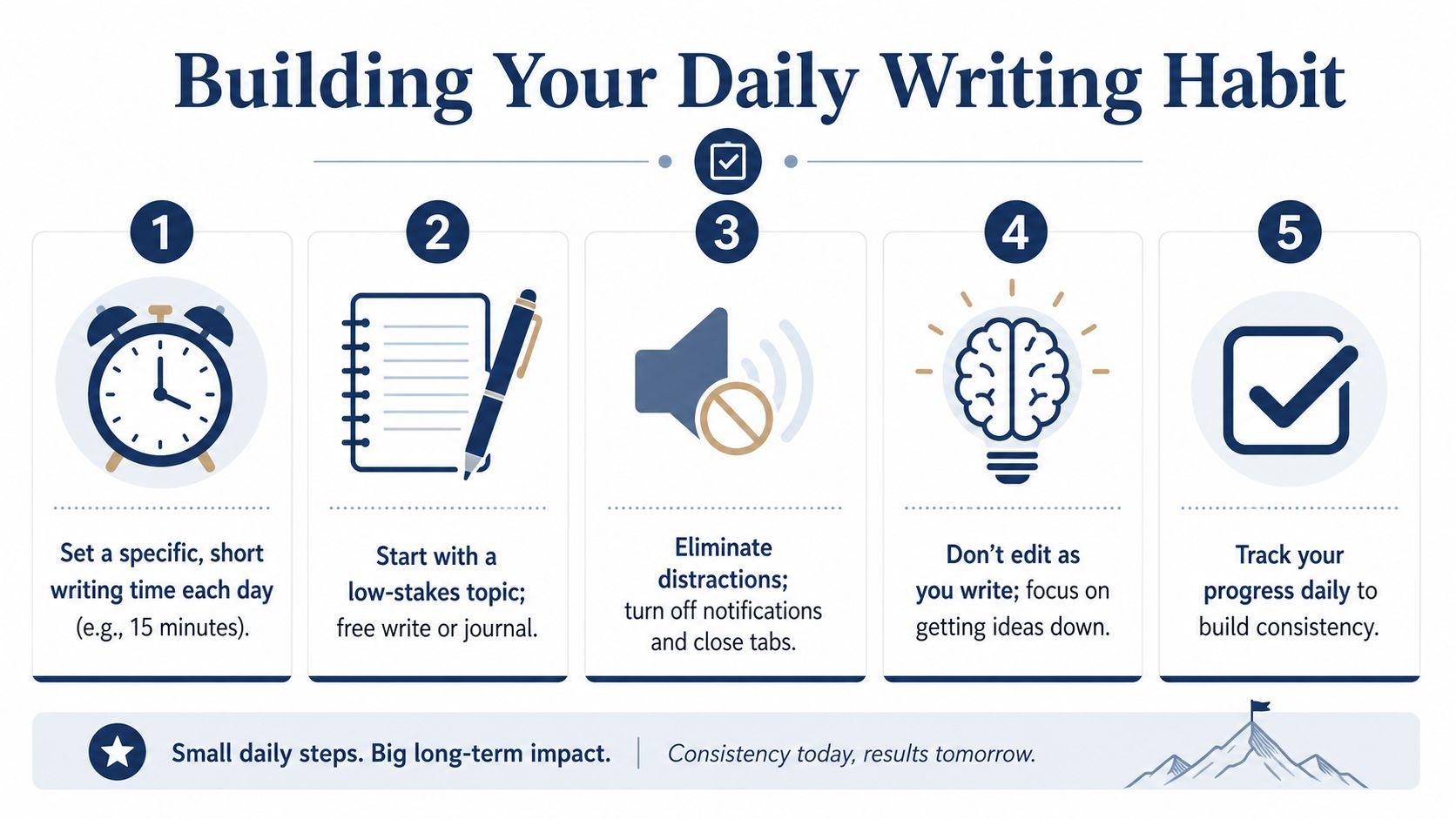
Writers rarely improve because they finally find extra time. They improve because they stop treating practice like a high-stakes event and make it small enough to repeat.
That matters even more now. Between constant notifications, perfectionism, and the temptation to let AI do the hard part, many writers spend more time preparing to write than writing. A daily practice works when it protects attention, reduces startup friction, and gives you a clear win before your inner critic gets loud.
Use a repeatable session with a low starting cost
A good writing routine should survive a busy Tuesday, not just a calm Sunday.
For many people, 20 to 30 minutes is enough to make progress without turning the session into something you avoid. As Tools for Writing's guidance on daily practice notes, consistent daily writing is one of the strongest ways to improve. A key test is whether you can begin without negotiation.
Use a simple sequence:
- Write first for a few minutes. Keep your hands moving and resist the urge to correct every line.
- Work on one real piece. A paragraph for a report, an email draft, a post outline, or notes for an article all count.
- Read a short example in the style you want. This sharpens your ear faster than abstract advice.
- End by marking the next starting point. Leave a note like “finish example” or “rewrite opening.”
That last step matters. It makes tomorrow easier.
Practice one skill at a time
Writers stall when every session becomes a referendum on grammar, clarity, tone, structure, originality, and polish all at once. That is how practice turns into procrastination.
Pick one focus for the week and apply it in actual sentences. Good options include stronger verbs, shorter openings, cleaner transitions, or cutting filler. Narrow practice feels slower in the moment, but it produces steadier gains because your attention is pointed at one problem instead of six.
A simple rule helps: draft broadly, practice narrowly.
Set a floor you can hit on bad days
Sustainable practice depends on a minimum standard, not an ideal one. If the bar is too high, one tired day breaks the routine and gives perfectionism an opening.
Use a baseline like this:
- Time target: complete the session, even if the writing feels rough
- Output target: finish one paragraph, one page of notes, or one rough response
- Skill target: apply your weekly focus at least once in a real draft
- Review target: improve one sentence before you stop
This is also the point where AI can help or hurt. Asking a tool to generate the whole draft often weakens the habit you are trying to build. Using a privacy-first assistant like 1chat to capture ideas, summarize source material, or help you spot patterns after you write is far more useful. You keep ownership of the thinking and still reduce friction.
Build momentum with cues, not pressure
Habits stick when the setup stays consistent.
| Habit | Why it helps |
| Write at the same time | Fewer decisions means less resistance |
| Use the same document or notebook | Starting feels easier when the workspace is familiar |
| Keep sessions short enough to finish | Completion builds trust in the routine |
| Stop with a note for tomorrow | Re-entry is faster and less intimidating |
| Track consistency lightly | A record helps, but missing one day does not become a failure story |
I have seen this work for professionals, students, and people returning to writing after years away. The ones who improve are rarely the ones with the most motivation. They are the ones with a routine that still works when motivation disappears.
Miss a day, then return the next day. Protect the practice before you try to expand it.
Adopt a Professional Editing Workflow
Writing improves faster when revision stops being a vague final step and becomes a repeatable process. Many stalled writers do not have a talent problem. They have a workflow problem. They draft, judge, fix, doubt, and rewrite in the same ten minutes, then wonder why the piece loses energy.
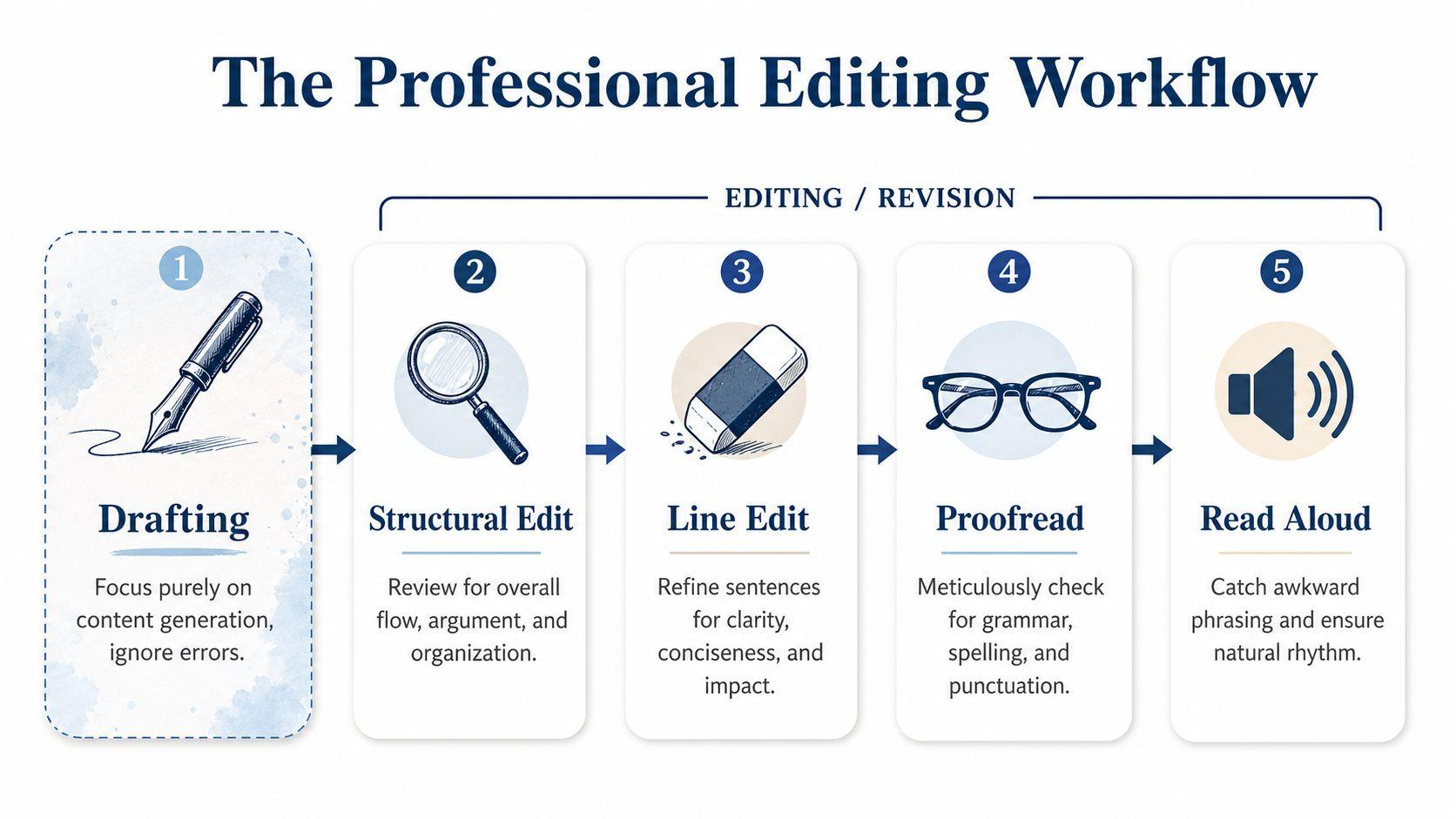
Professional writers separate decisions. They know the trade-off. Fast drafting creates raw material but also mess. Careful editing improves clarity but can kill momentum if it starts too early. Keep those jobs apart.
Follow the Plan, Draft, Proof, Publish cycle
A steady workflow beats mood-based revision because it reduces hesitation. Use four stages: Plan, Draft, Proof, Publish.
| Stage | What to do | What to avoid |
| Plan | Define the reader, the goal, and the main point | Collecting fragments with no direction |
| Draft | Get the full idea down and keep moving | Editing each sentence before the next one exists |
| Proof | Review with fresh attention for clarity and correctness | Checking grammar while the argument is still changing |
| Publish | Send, submit, post, or share for feedback | Hiding in endless private revisions |
BLUF means Bottom Line Up Front. Put the main point early, then support it. That approach works especially well in reports, emails, proposals, and updates where readers need the conclusion before the background.
The point of this cycle is not speed for its own sake. It is cleaner judgment. A writer in draft mode should ask, "What am I trying to say?" A writer in proof mode should ask, "Will this reader get it?"
Edit in passes, not all at once
Trying to fix structure, tone, rhythm, and punctuation in one pass usually creates two bad outcomes. You miss big problems because you are fussing over commas. You also make revision feel so heavy that procrastination starts to look reasonable.
Use separate passes with a narrow goal each time:
- Structural pass Check the order of ideas, weak transitions, repetition, and missing context. Make sure the opening earns the reader's attention and the ending lands.
- Line edit Tighten sentences, cut filler, replace vague phrasing, and keep verbs doing real work. Here, voice gets sharper.
- Proofread
Check grammar, spelling, punctuation, names, links, and formatting. Save this for last so you do not polish sentences you may delete.
That sequence lowers the emotional temperature of editing. You are no longer asking whether the draft is good enough. You are solving one kind of problem at a time.
A rough draft is private construction. A polished draft is the result of deliberate passes.
Read for errors in ways your brain cannot skim
Writers miss mistakes because they know what they meant. Familiarity makes the eye lazy. One reliable fix is to change how you review.
Read one sentence at a time from the end of the piece back to the beginning when you are proofreading. The method feels unnatural, which is exactly why it helps. It breaks the flow of meaning and makes small errors easier to see.
Then read the piece aloud. Clumsy rhythm, accidental repetition, and overlong sentences become obvious when the words have to survive your voice. I recommend this even for short work emails. If a sentence is annoying to say, it is often annoying to read.
Use time limits to prevent perfectionism from running the session
Editing expands to fill the time available. Give it boundaries.
A simple routine works well:
- 10 minutes to draft freely
- 10 minutes to shape the draft or outline
- 5 minutes to cut wordiness and strengthen verbs
This kind of constraint helps writers who overthink every sentence, especially people rebuilding confidence after relying too heavily on AI. It keeps revision practical. It also creates a stopping point, which matters if perfectionism tends to turn one page into a two-hour spiral.
For digital help, use tools that support judgment instead of replacing it. A privacy-first option with clear 1chat pricing for writers and teams can be useful for spotting awkward phrasing, checking consistency, or reviewing a draft after you have done the core thinking yourself. That matches a healthier editing habit and aligns with the insights from the ChatGPT Revolution, which emphasize using AI to strengthen process without handing over authorship.
Readability checkers can help too. Treat them like instruments on a dashboard. They flag possible trouble. You still decide what deserves to stay because good writing is not the same as generic writing.
Leverage AI as Your Writing Co-Pilot
AI has changed writing. Pretending otherwise doesn't help anyone.
The practical question isn't whether writers should use AI. It's how to use it without flattening their thinking or losing their voice. That matters even more now because a 2025 industry report found that 68% of educators require writing that passes AI detectors, as referenced in this discussion about AI-era writing expectations.

That doesn't mean writers should avoid AI. It means they need a better role for it.
Use AI for thinking support, not voice replacement
AI is most helpful before and after the core act of writing.
Use it to:
- Generate options when you're stuck between angles
- Outline a messy topic so you can see possible structure
- Question your logic by asking what a skeptical reader would challenge
- Spot grammar issues after you've written the draft yourself
- Rephrase for tone when you need a version that sounds more formal, warmer, or more concise
Don't use it to produce a full draft you barely understand. That usually creates shallow prose, weak ownership, and revision problems later.
Keep your fingerprints on the page
The best AI-assisted writing still sounds like a person with a point of view.
A practical method is to draft first, then use AI on selected passages. Ask for options, not replacements. For example:
- “Give me three tighter versions of this paragraph.”
- “Where is the logic unclear?”
- “What sounds repetitive here?”
- “Make this more concise without changing my tone.”
That last phrase matters. If you don't protect your tone, the output tends to slide into generic confidence and polished emptiness.
Use AI to challenge, clarify, and compress. Don't ask it to become you.
For writers trying to understand the broader shift in authorship and workflow, insights from the ChatGPT Revolution offer useful context on how AI is changing the writing process without eliminating the need for human judgment.
Choose tools that support responsible use
Not every writing scenario has the same risk. A private journal, a school essay, an internal policy draft, and a client proposal all require different levels of care. Privacy, traceability, and revision control matter more than many people assume.
That's one reason writers and teams look for tools that fit their setting rather than defaulting to the loudest platform. If you're comparing options for family use, student work, or small business writing support, 1chat pricing options are one place to assess whether a privacy-first setup matches your needs.
The standard still holds: the final message should reflect your reasoning, your choices, and your accountability.
Adapt Your Writing for Different Contexts
A student can write a strong personal reflection and still struggle with a lab summary. A founder can speak persuasively in meetings and still send confusing emails. Good writing is not one skill expressed the same way every time. It's adaptation.
Student writing needs structure before style
A college essay, response paper, or research summary usually breaks down when the writer starts with phrases instead of claims. The reader wants a clear position, supporting evidence, and a sense of how the parts fit together.
A useful student workflow looks like this:
- State the point early. Don't hide your thesis in the final lines of the introduction.
- Group evidence by idea. One paragraph, one job.
- Use sources to support your thinking. Don't stack quotes and hope they form an argument.
- Revise for clarity. If a sentence sounds smart but confuses you on reread, rewrite it.
A common student problem is descriptive writing that never becomes analytical writing. The fix is to ask after each paragraph: what does this example prove?
Team writing needs speed and clarity
Inside a team, readers are busy and impatient. They need the point, the status, the blocker, or the request.
That's where BLUF is useful. Open with the answer, then add context.
Compare these two starts:
| Weak opening | Better opening |
| “I wanted to follow up on the project and share a few thoughts about where things stand.” | “The launch is delayed because the final approval hasn't come in. We need a decision by Thursday.” |
The second version respects the reader's time. It also reduces back-and-forth because the problem is visible immediately.
For team updates, internal memos, and project emails, use this order:
- Bottom line
- Key context
- What happens next
- Any action needed from the reader
That structure feels blunt only if you're used to cushioning every sentence. In practice, it reads as competent.
Business writing needs confidence without bloat
Small businesses often lose clarity when trying to sound professional. The writing becomes padded with formal phrases, apologies, and generic enthusiasm.
A client proposal doesn't need inflated language. It needs a clear problem statement, a credible recommendation, and direct next steps. The same goes for sales emails and service explanations.
Here's a simple contrast:
“We are reaching out to explore the possibility of potentially supporting your goals with a customized solution.”
That sentence sounds polished, but it says very little.
A stronger version is shorter: “We can help you simplify onboarding and reduce manual follow-up. Here's how.”
Personal voice still matters in every context
Adapting to context doesn't mean becoming robotic. It means adjusting your emphasis.
Students need precision and argument. Teams need speed and clarity. Businesses need trust and usefulness. In every case, the most effective writing sounds like someone who understands the reader's need and meets it without fuss.
That's the fundamental shift in learning how to improve writing skills. You stop asking, “How do I sound impressive?” and start asking, “What does this reader need from me right now?”
Your Path to Consistent Improvement
Strong writing usually comes from ordinary habits repeated long enough to compound. Not glamorous habits. Not magical ones. Just steady, deliberate practice.
The most useful roadmap is simple. Build a foundation that makes starting easier. Practice often enough that writing becomes normal. Edit with a process instead of panic. Use AI to support thinking, not replace it. Adapt your style to the reader and the moment.
Keep your focus narrow
Trying to master everything at once slows progress. Pick one skill and stay with it for a week.
Good options include:
- Active voice
- Shorter sentences
- Clearer transitions
- BLUF openings
- Reading aloud before submitting
- Backward proofreading
- Daily low-stakes freewriting
This works because attention is limited. Focus beats intensity.
Let feedback do its job
Many writers stay stuck because they only self-edit. You need outside reaction at some point. A teacher, peer, colleague, editor, or trusted tool can show you where your intention and your actual sentence don't match.
The key is to treat feedback as information, not a verdict. If a reader gets lost in the same place twice, that's not bad luck. That's a revision target.
Improvement becomes visible when your process gets calmer, not just when your sentences get prettier.
Progress won't feel linear. Some days the draft will come quickly. Some days every sentence will resist you. That's normal. The habit matters more than the mood.
If you want one practical next step, choose a single writing task today and give it a cleaner process. Plan it. Draft it without editing. Read it aloud. Cut what doesn't earn its place. If you want more guidance on building that kind of repeatable workflow, the 1chat blog is a useful place to continue.
Want a privacy-first AI assistant that can help with research, outlining, proofreading, and document analysis without replacing your voice? Explore 1chat, a family-friendly and small-business-oriented alternative that brings multiple leading LLMs into one place.