You open the document. You read the same sentence three times. The cursor blinks, you check your email, then your notes, then the tab you already had open for “research,” and an hour disappears without a paragraph.
That's writer's block in real life. It doesn't always look dramatic. Sometimes it looks like cleaning up bullet points instead of drafting. Sometimes it looks like “waiting until I can think clearly.” In teams, it looks like three people commenting on a doc and nobody willing to write the next ugly version. For students, it often shows up as panic disguised as preparation. For business owners, it shows up as endless tweaking of a proposal, landing page, or client email.
The important part is this. Writer's block is not proof that you've run out of talent, discipline, or ideas. It's usually a signal that something specific is getting in the way. Once you identify that thing, the fix gets much more practical.
That Blank Page Is Not Your Enemy
A student sits down to draft an essay and suddenly feels incapable of writing a decent first sentence. A small business team opens a shared proposal doc, trades comments for twenty minutes, and still has no draft. A parent and teenager try to write a school project together, then stall because each person wants a different direction.
These situations feel different on the surface, but the mechanism is often the same. Writing has stopped feeling like a process and started feeling like a test. The blank page becomes a judge. Every sentence starts to seem permanent. The result is hesitation, then avoidance.
That's why the most useful way to approach how to overcome writer's block is not with inspirational advice, but with diagnosis. Are you blocked because you're tired, because you're afraid of being wrong, because the task is too large, because your team can't agree, or because you're comparing your rough draft to polished AI output?
The blank page isn't attacking you. It's revealing where your process is weak.
When writers understand that, they stop asking, “What's wrong with me?” and start asking better questions. What needs to get easier? What decision can be delayed? What part can be messy? Who owns the next draft?
Those questions lead to solutions that work.
Understanding the Main Causes of Writer's Block
Most writer's block isn't random. It usually comes from a handful of predictable traps. If you can name the trap, you can choose a response that fits.
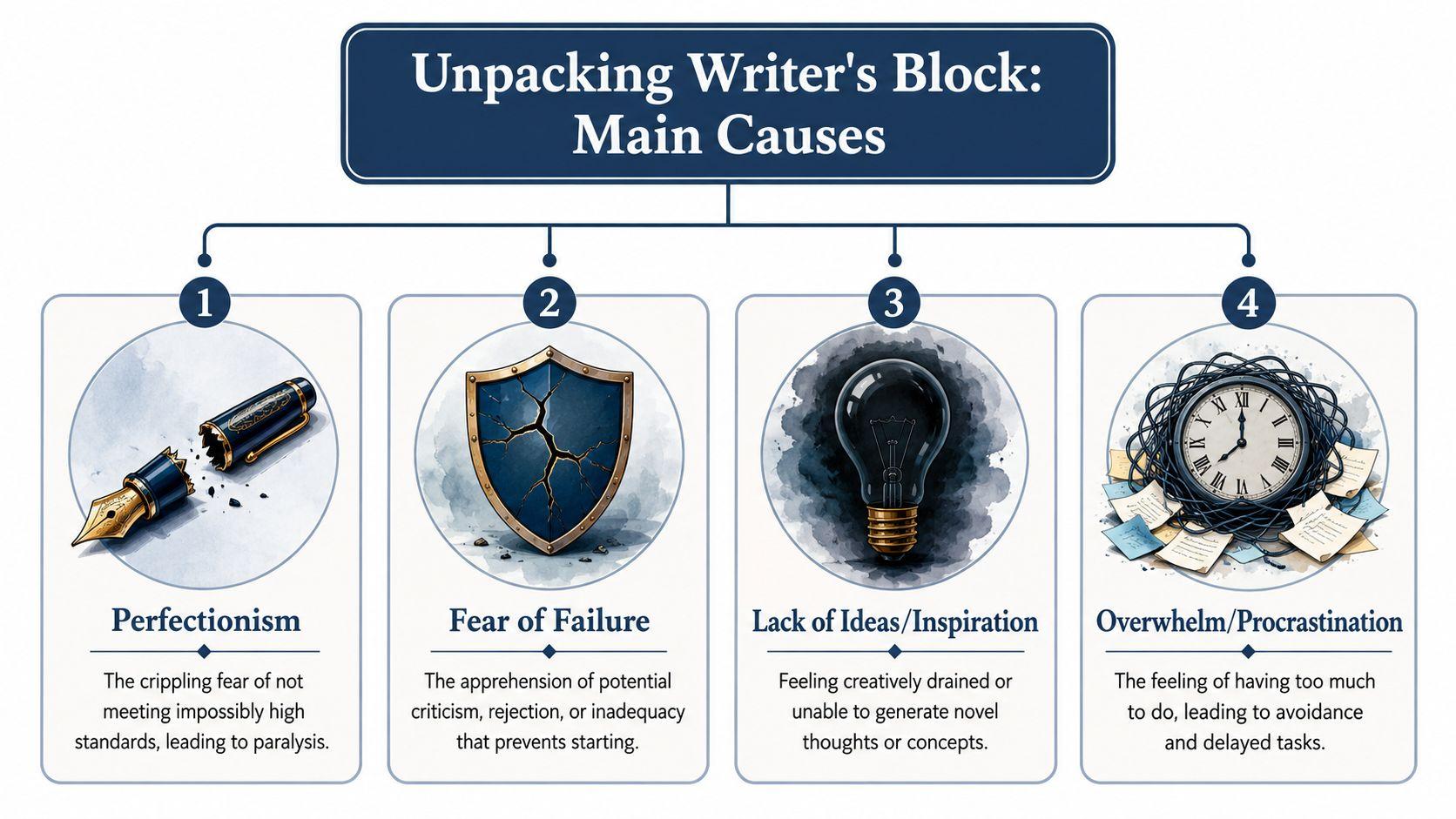
Perfectionism freezes the first draft
Perfectionism sounds high-minded, but in practice it's just a refusal to write badly before writing well. You try to produce the final sentence first. You edit while drafting. You keep reaching for a cleaner phrase before you've earned it.
This is one of the most common causes of stuck writing because drafting and judging use different mental gears. When you force them to happen at the same time, output slows down and often stops.
A useful self-check is simple. If you keep deleting and rewriting your opening lines, you're probably not lacking ideas. You're demanding polish too early.
Fear turns writing into exposure
Some writers aren't blocked by craft. They're blocked by consequences. The essay might reveal they don't fully understand the material. The report might be criticized by a manager. The family newsletter might sound silly. The sales page might fail publicly.
Fear often hides behind respectable behavior. More outlining. More research. More “thinking time.” The underlying goal is to avoid being seen producing something imperfect.
Practical rule: If you keep preparing without producing, fear is probably wearing a productivity costume.
Burnout makes every sentence heavier
Burnout is different from laziness. Burnout makes even simple writing feel expensive. You can know what you want to say and still feel unable to push it into words. This is common among students under deadline pressure, founders writing late at night, and team members juggling many roles.
When burnout is the issue, “push harder” usually backfires. You need a smaller target, a shorter session, and lower expectations for the first pass.
AI-induced perfectionism is a modern version of the same problem
This one deserves separate attention because it's become a real obstacle. A recent piece on AI and writing notes that 78% of professional writers now use AI tools as of 2025, and nearly 60% report increased self-doubt and hesitation to start writing because they fear not matching AI quality (analysis of AI-induced perfectionism).
That pattern matters. Many writers now compare their unformed thoughts to machine-polished language. Of course that comparison hurts. One is a rough internal draft. The other is cleaned-up output generated in seconds.
If you use AI for writing support, treat it as a tool for exploration, not a standard your first sentence must meet. If you want a deeper look at how AI systems are being used in writing workflows, 1chat's AI research hub is a useful place to review the field without treating polished output as the starting line.
Create a Consistent Writing Habit That Works
Writer's block gets stronger when writing is optional. If you only write when you feel ready, your brain learns that discomfort is a reason to delay. A routine breaks that bargain.
Research discussed in Nature recommends treating writing like a mandatory class. You block specific time on your calendar and keep it, whether or not inspiration shows up. That structure helps lower the “high activation barrier” that makes starting so difficult (Nature on treating writing as a scheduled habit).

Build a routine you can actually keep
Many writers make the mistake of designing an ideal routine instead of a repeatable one. They plan to write every morning for a long stretch, then miss two sessions and abandon the system.
A better routine has constraints you can live with:
- Choose a fixed trigger: Write after coffee, after your first class, after school drop-off, or at the start of your workday.
- Protect one specific slot: Put it on the calendar like a meeting, not a wish.
- Define the session narrowly: Draft an opening, revise one section, or write without stopping for a set window.
- Use a visible finish line: End when the scheduled session ends, not when you “feel done.”
Consistency beats intensity. The brain trusts patterns more than promises.
Use goals that reduce friction
S.M.A.R.T.-style planning helps because vague intentions create room for avoidance. “Work on chapter two” is loose enough to trigger overwhelm. “Write in the document from 8:30 to 9:00 and draft three bullet points into full sentences” is concrete enough to start.
Try this format:
- Specific: What exact document or section?
- Measurable: Time-based or task-based?
- Achievable: Can you do it even on a tired day?
- Relevant: Does it move the draft forward?
- Timed: When does it begin and end?
For writers who need outside structure, a writing accountability app can help turn that schedule into a visible commitment. That's useful when the actual problem isn't knowledge, but follow-through.
Don't build a routine around your best day. Build it around the day you're most likely to quit.
Make starting easier than avoiding
Your environment should remove decisions, not add them. If possible, keep the draft open. Put the notebook on the desk the night before. Silence notifications. Close tabs that invite “quick checks.” If you work with printed notes, stack them in the order you'll use them.
Good routines feel boring in the best way. They spare you from renegotiating whether writing will happen. Once the routine becomes normal, the blank page loses some of its drama.
Actionable Exercises to Break Through Today
A writing habit prevents a lot of block. But sometimes you're stuck right now and need a way to get words moving in the next ten minutes.
That's where short, focused exercises work well. Purdue's guidance on writer's block notes that timed writing sessions in the 10 to 20 minute range can break initial resistance, and even a ten-minute focused session can help you get started (Purdue OWL on timed writing bursts).
Three exercises that work when you're frozen
The goal here isn't brilliance. The goal is motion.
- Freewrite without steering: Set a timer and write continuously, even if the writing is clumsy, repetitive, or half-formed. If you don't know what to say, write that you don't know what to say until the next thought arrives.
- Use the one-inch frame: Shrink the task until it feels almost silly. Write one rough paragraph. Write 50 words. Draft only the middle. Tiny targets lower the pressure that keeps you staring.
- Do a timed sprint: Pick a short block and forbid editing until the timer ends. This works because the timer becomes the boss, not your mood.
If you want another perspective on practical tactics for destroying writer's block, that guide pairs well with these short-session methods.
Sample timed writing templates
| Template Name | Work/Write Time | Break Time | Best For |
| The 10-Minute Start | 10 minutes | 5 minutes | Beginning a draft when resistance is high |
| The 15-Minute Idea Dump | 15 minutes | 5 minutes | Brainstorming topics, angles, and examples |
| The 20-Minute Messy Paragraph | 20 minutes | 5 minutes | Turning notes into rough prose |
| The 25-Minute Draft Sprint | 25 minutes | 5 minutes | Building momentum on a real section |
| The 2-Round Restart | 10 minutes x 2 | 5 minutes between rounds | Re-entering a project after time away |
Use the timer to lower standards
A timer changes the assignment. You're no longer trying to “write well.” You're trying to remain in the chair and keep your hands moving until the bell.
That's why timed sessions often help writers who over-edit. The timer creates urgency, and urgency leaves less room for self-judgment.
Here's a simple rescue sequence I recommend when someone feels fully jammed:
- Open the document and write the problem: “I don't know how to start this because…”
- Set 10 minutes: Keep typing, even if the first lines are complaints.
- Circle one usable sentence: Don't judge the whole session. Salvage one line.
- Start a second round only if needed: Momentum often appears after the first imperfect pass.
For ongoing prompts and workflow ideas, 1chat's writing blog can give you more examples of ways to turn a blank page into a working draft.
A good writing exercise doesn't need to feel elegant. It needs to reduce resistance enough for the next sentence to appear.
Solving Writer's Block in a Group Setting
Most advice about writer's block assumes one writer, one desk, one mind. That leaves out a major real-world problem. Groups get blocked too.
This is common in small businesses, family projects, student partnerships, and lean marketing teams. One person wants more research. Another wants to “just get something down.” A third keeps editing tone before the structure exists. The document stalls because nobody agrees on what kind of draft they're making.
Recent data highlights the gap. 45% of small business teams report writing delays due to “collaborative freezing,” yet only 12% of online articles on writer's block mention team-specific strategies (University of Rhode Island on collaborative freezing).

Why teams freeze
Collaborative block usually comes from one of three frictions.
First, unclear ownership. If everybody can edit, nobody feels responsible for producing the next real draft.
Second, mixed stages. One teammate is brainstorming while another is proofreading. Those are incompatible jobs.
Third, feedback overload. Comments pile up faster than decisions. The document becomes a storage bin for opinions.
A family version of this is easy to recognize. One person says, “Let's make it more formal.” Another says, “That sounds too stiff.” A student gets stuck trying to satisfy both voices and writes nothing.
A playbook that works better
Groups write faster when the process is explicit.
- Assign a draft captain: One person owns version control and produces the next full draft. Others suggest, but they don't all rewrite at once.
- Separate stages: Brainstorm first. Outline second. Draft third. Edit later. If your group mixes these stages, tension shows up immediately.
- Limit feedback rounds: Ask for one kind of feedback at a time. Structure, clarity, or tone. Not all three.
- Break the work into owned parts: Give each person a section or task with a deadline, then let one person merge and smooth the voice.
Use structured language for feedback
Loose feedback creates defensive writing. Structured feedback creates actionable revision.
A format I use often is:
- I like: Name what already works.
- I wish: Point to what feels missing or unclear.
- What if: Offer a possible next move instead of a vague complaint.
That method keeps people from saying “This doesn't work” when what they mean is “I'm confused about the audience” or “The opening feels too broad.”
Group writing improves when fewer people touch the sentence and more people clarify the decision.
Reduce decision traffic
Teams don't need more ideas. They need fewer simultaneous decisions.
If you're drafting a proposal, decide the audience first. Then decide the offer. Then assign sections. If you're writing a family project or school presentation, decide who gets final say on tone before anybody starts editing language.
For creative groups that need a warm-up, even something unrelated can loosen the room. I've seen teams use imaginative prompt sets, including resources like find horror novel prompts, just to get people writing without pressure before returning to their main document. The genre doesn't matter. The point is lowering the fear of producing a bad first version in front of others.
Leverage AI as a Creative Partner
AI helps some writers start faster. It also intimidates many of them. Both things can be true.
The productive way to use AI is not to ask it to replace your thinking. It's to use it for low-stakes support at the points where block usually appears. Brainstorming. reframing. outlining. generating a few workable options when your own wording has gone stiff.
That approach lines up with two powerful writing concepts from the University of Illinois Writer's Workshop: satisficing and WIRMI, or “What I Really Mean Is.” Satisficing means choosing the first reasonable sentence instead of chasing the perfect one. WIRMI means writing the clunky, colloquial version first so you can refine it later (Illinois on satisficing and WIRMI).

Better AI prompts for blocked writers
If you ask AI to “write this for me,” you often get polished language that makes you feel even worse about your own draft. If you ask it to help you think, it becomes much more useful.
Try prompts like these instead:
- Turn this mess into options: “Here are my rough notes. Give me three simple ways to structure them.”
- Use WIRMI directly: “What I really mean is [insert clunky explanation]. Help me say that more clearly in plain English.”
- Ask for good-enough versions: “Give me five acceptable opening sentences with different tones. None should sound overly formal.”
- Request questions, not prose: “Ask me five questions that would help me clarify this argument.”
These prompts keep you in control of the idea while reducing the friction of shaping it.
Where AI fits best in the writing process
AI is most helpful before and after the core draft.
Before drafting, it can help you narrow the topic, sort notes, or build an outline. After drafting, it can help with clarity, transitions, and alternate wording.
During the draft itself, use caution. If you pull in polished AI paragraphs too early, you may end up editing the machine's voice instead of developing your own. That's one reason many writers feel blocked around AI. The tool subtly raises the standard of what “starting” is supposed to look like.
A healthier workflow looks like this:
- Brain dump your own rough thoughts.
- Ask AI to organize or reflect them back.
- Draft in your own language.
- Use AI later for alternatives and cleanup.
For writers who want a privacy-first workspace built around this kind of support, 1chat offers a way to work with multiple models in one place at 1chat. Used well, tools like that don't need to become your ghostwriter. They can become your sounding board.
AI should lower the cost of beginning. It shouldn't raise the price of being human on the first draft.
You Have the Tools to Keep Writing
Writer's block feels mysterious when you're in it. It stops feeling mysterious once you see its patterns. Sometimes the problem is perfectionism. Sometimes it's fear. Sometimes it's fatigue, team friction, or the bad habit of comparing your early thoughts to polished AI output.
The fix depends on the cause. A routine helps when writing is too negotiable. A timed sprint helps when starting is the hardest part. Clear ownership helps when a group stalls. A rough, honest WIRMI-style draft helps when your internal editor won't calm down.
This is the answer to how to overcome writer's block. You don't need one magic trick. You need a small set of reliable responses you can reach for when a specific kind of resistance shows up.
Use the smallest tool that gets you moving. Protect the habit. Let early drafts be ugly. In group settings, make ownership explicit. If you use AI, use it to support thinking, not to shame your first attempt.
You do not need to feel ready to write. You need a process that works even when you don't.
If you want a privacy-first AI workspace that can help with brainstorming, outlining, rewriting rough thoughts, and team-friendly writing support, take a look at 1chat.