You’re filling out a grant form, fellowship application, or departmental profile. Then a field appears: “Scopus h-index.” If you’re early in your career, that can feel oddly high stakes for a number you may not fully understand. Is it a score? A ranking? A judgment on whether your work matters?
It’s none of those things, at least not by itself.
The h index in Scopus is best understood as a compact summary of one part of your research record. It tries to combine two things at once: how much you’ve published and how often that work has been cited. That sounds simple, but people get confused because the number changes across databases, grows slowly, and can be misleading when used without context.
Students, postdocs, and small research teams run into this problem all the time. A supervisor asks for the number. A committee compares profiles. A coauthor has one figure in Google Scholar and another in Scopus. Suddenly a basic metric starts to feel like a puzzle with hidden rules.
It helps to treat the h-index less like a verdict and more like a shorthand. It tells a narrow story about consistent citation performance inside a particular database. That can be useful. It can also leave out important parts of your scholarly contribution.
Your First Encounter with the H-Index
A common first encounter with the h-index happens under pressure. You are finishing a fellowship application, updating a department profile, or helping a supervisor assemble a grant packet, and one small box asks for your Scopus h-index. If you are new to research metrics, that request can feel larger than it should.
The discomfort usually comes from what the number seems to imply. A single figure can look like a verdict on your career, even though it is only a partial summary of one part of your publication record.
Why this number gets attention
The h-index gets attention because committees need shortcuts. Hiring panels, funding reviewers, and administrators often scan many applications in limited time, so a metric that combines publication output with citation activity is convenient. It works a bit like a bookshelf check. Not just how many books are on the shelf, but how many have been taken down and used by other readers.
That convenience is also the first warning sign. A tidy number is easy to copy into a form. It is much harder for that same number to show whether your work changed practice, supported a team project, produced a valuable dataset, or appeared in the kinds of journals your field respects. If you are still learning how publication systems work, it also helps to understand how to tell whether an article is peer reviewed, because citation metrics only make sense when you know what kind of research record is being counted.
Practical rule: Treat the Scopus h-index as a filing label, not a final judgment.
Why graduate students often feel unsure
Graduate students and early-career researchers are right to be cautious. The h-index usually favors longer careers because citations accumulate slowly. It also reflects only what a specific database has indexed, which is one reason your Scopus number may not match Google Scholar or Web of Science.
That difference confuses many people at first. They assume there must be one official h-index. In practice, the number depends on the source, the coverage of that source, and how well your publications are grouped under your author profile.
This matters for more than curiosity. If you are applying for a postdoc, reporting outputs for a lab, or comparing profiles across a team, you need to know what the Scopus h-index represents and what it leaves out. Used carefully, it gives helpful context. Used carelessly, it can flatten a complicated research record into a number that looks more certain than it is.
What Is the H-Index A Simple Explanation
You open a faculty profile and see an h-index next to a researcher’s name. The number is small enough to look simple, but it carries a very specific meaning. It is trying to answer one practical question: has this person produced a body of work that is cited across several papers, not just once or twice?
The h-index combines output and attention. A long publication list by itself does not raise it much if those papers are rarely cited. One highly famous paper does not raise it very far either if the rest of the record is quiet.
The simple rule
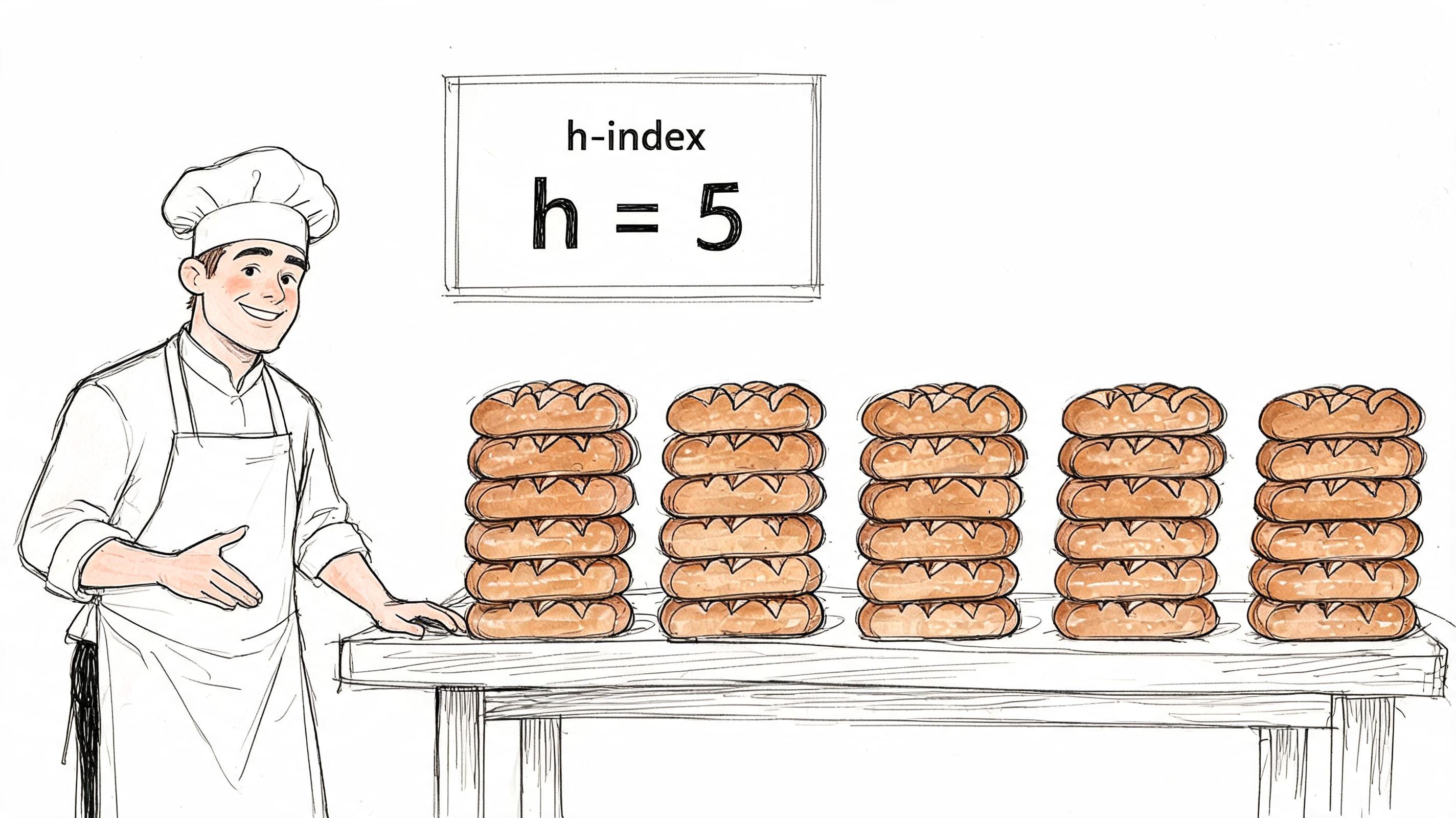
A researcher has an h-index of 8 if they have 8 papers that each received at least 8 citations.
The easiest way to read that is this: the h-index rewards repeated citation across multiple papers. It looks for a pattern of recognized work, not a single breakout success and not a stack of papers that attracted little notice.
Hirsch proposed the metric because simple counts can mislead in two different ways. Publication totals can make a record look stronger than it is if the papers are seldom used by other researchers. Total citations can swing upward because of one unusually well-known paper. The h-index sits between those extremes and asks whether influence is spread across a set of publications.
A librarian’s version of the metric sounds like this:
- Publication count shows how much you published.
- Citation count shows how often your work was referenced overall.
- H-index shows how many papers cleared a shared bar of citation activity.
A concrete example
Suppose your papers are ordered from most cited to least cited, and the citation counts are 20, 14, 9, 6, and 2.
Your h-index is 4. Why? Because the fourth paper has at least 4 citations, but the fifth paper does not have at least 5 citations. That stopping point is the whole idea.
Students often get confused here because they expect the number to reflect their best paper. It does not. It reflects the depth of your cited work across several papers.
That is why the h-index can be useful in hiring, promotion, and team reporting, but only with caution. It gives a quick sketch of steady scholarly recognition. It does not show mentoring, data creation, policy impact, teaching value, or whether the work appeared in the strongest venue for your field. If you are still learning how research outputs are evaluated, it helps to understand how to know whether an article is peer reviewed, because citation metrics make more sense once you know what kinds of publications are usually being counted.
One more practical point matters here. The h-index is not one universal number floating above your career. It changes by database. Scopus may show one value, Google Scholar another, and Web of Science another, because each platform includes different publications and citations. Even field-specific resources, such as Scopus Q4 accounting insights, remind us that coverage and journal selection shape the picture you see.
A good plain-language summary is this: the h-index asks whether your research record contains a run of papers that other scholars keep returning to. That makes it useful. It also explains its limits.
How Scopus Calculates and Displays Your H-Index
You open your Scopus author profile, spot a number beside “h-index,” and wonder why it is lower than what you have seen elsewhere. The answer usually comes down to one simple rule. Scopus only calculates your h-index from the publications and citations inside the Scopus database.
Scopus works like a library catalog with its own shelves. If a paper or a citation is not on those shelves, Scopus does not count it toward your score. That is why the same researcher can have one h-index in Scopus and a different one in Google Scholar or Web of Science.
Scopus is a curated abstract and citation database. It generates h-index values by reviewing the publications linked to an author profile and the citations those publications receive within Scopus, as described in this guide to how Scopus computes the h-index.
What Scopus is counting
The rule itself is still the standard h-index rule. You have an h-index of h when you have h papers with at least h citations each.
Here is the part that often trips people up. Scopus is not asking, “What is your most cited paper?” It is asking, “How many of your papers have cleared the same citation bar?” That makes the h-index more like a row of exam passes than one gold-medal performance. One brilliant paper helps, but the number rises when enough papers meet the next threshold together.
Coverage shapes the result. If someone cites your article in a source Scopus does not index, that citation will not raise your Scopus h-index. If one of your publications is missing from Scopus, that paper cannot contribute either. This is one reason students and research teams should treat the metric as a database-specific snapshot, not a universal verdict on a career.
How the calculation works on the screen
Scopus ranks your papers by citation count, from highest to lowest. Then it checks the list position against the citation total for each paper.
A quick example makes this easier to see. Suppose your top papers have 18, 14, 9, 7, 5, and 3 citations. The fifth paper has 5 citations, so you have at least five papers with 5 or more citations. The sixth paper has only 3 citations, so the pattern stops there. Your h-index is 5.
That is why a single fast-rising article does not always change the number right away. To move from 5 to 6, you need six papers with at least 6 citations each.
Scopus often visualizes this with an h-graph. If you have ever looked at a staircase chart, the idea is similar. The graph helps you see where the ranked paper list and the citation threshold still line up.
What you will usually see in Scopus
A Scopus author profile usually shows:
- Your h-index
- Total citations
- Publication count
- Author details and coauthor links
Those numbers are useful, but they only make sense if the underlying profile is accurate. A split profile, missing paper, or misassigned article can change the displayed h-index more than many early-career researchers expect.
Context matters too. Citation patterns vary by discipline, document type, and database coverage. If your team is also comparing journals, resources like Maeve’s Scopus Q4 accounting insights can help you read the wider publishing context around those numbers.
The practical takeaway is simple. Scopus displays a clean, useful version of the h-index, but it displays only the version that exists inside Scopus. That makes it helpful for evaluation, and also a metric that needs checking before anyone uses it to judge a researcher or a team.
Finding and Managing Your Scopus Author Profile
Scopus author profiles are often created automatically. That’s convenient, but it also means your record can contain missing papers, duplicates, or articles that belong to someone with a similar name. If you want your h index in Scopus to be meaningful, profile accuracy comes first.
Here’s the basic search screen researchers usually start with:

How to locate the right profile
Start with the Authors search in Scopus. Search by your name. If you have a common surname, add your affiliation or use an ORCID if available.
When several similar profiles appear, don’t click the first one automatically. Check:
- Affiliation history
Does the profile list institutions where you’ve worked or studied? - Subject area
Does the research area match your discipline? - Publication titles
Are the article titles clearly yours? - Coauthors
Do the coauthor names look familiar?
Those clues usually reveal whether Scopus grouped your work correctly.
What to do if the profile is wrong
Scopus allows researchers to request corrections. Depending on the issue, you may need to merge multiple profiles, add missing publications, or remove records that were attached by mistake.
A practical review routine looks like this:
- Check for duplicate profiles if you’ve published under name variations.
- Inspect recent publications because new records are often where mismatches show up.
- Review coauthor patterns since namesake confusion often becomes obvious there.
- Confirm affiliation details especially after changing institutions.
If you find errors, act sooner rather than later. Committees and collaborators often pull metrics quickly, and they won’t know your profile needs cleanup unless you tell them.
Why this matters more than people think
A misassigned profile doesn’t just affect vanity metrics. It can change how others discover your work. It can hide papers, distort collaboration networks, and create confusion when someone tries to verify your output.
A clean author profile is part bibliography, part professional identity. It’s worth maintaining the same way you maintain your CV.
If you’re helping a research group or lab, this becomes even more important. Teams often prepare applications under time pressure, and one inaccurate profile can create avoidable back-and-forth when reporting outputs.
Scopus H-Index vs Google Scholar and Web of Science
A common moment of confusion goes like this. You type your name into Scopus before a job application, note your h-index, then check Google Scholar and see a higher number. Later, Web of Science gives you a third result.
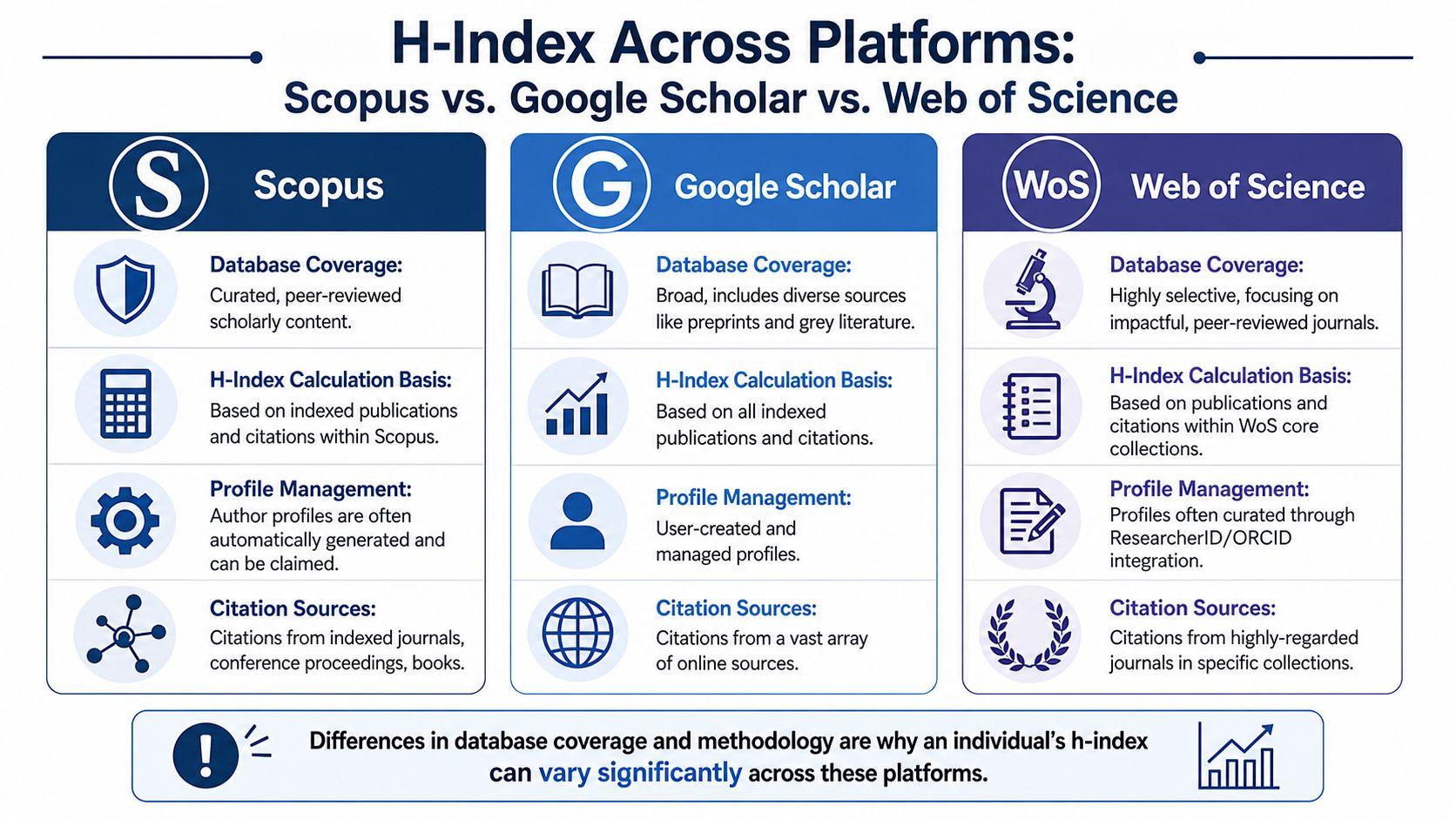
That mismatch usually reflects different coverage, not a calculation mistake. Each platform builds the h-index from its own collection of publications and citations, so the same researcher can look different depending on which database is doing the counting.
Why the numbers differ
Scopus works from a curated database. Google Scholar gathers a much wider mix of material, including theses, preprints, books, and other academic content found on the web. Web of Science is also selective, but it uses its own indexed collections rather than Scopus's.
A library guide from the University of Wisconsin notes these cross-database differences in coverage and explains why Google Scholar often produces higher h-index values than Scopus in practice, especially for researchers whose work appears in formats beyond standard indexed journals and proceedings, such as cross-database h-index differences.
Here is the practical takeaway. Your h-index is not a universal score floating above your career. It works more like a score computed from a specific bookshelf. Scopus counts citations from the books on its shelves. Google Scholar uses a much larger room with more shelves, some carefully cataloged and some less tightly controlled. Web of Science uses a different curated room.
That difference matters a lot in fields where conference papers, working papers, or preprints circulate early and attract attention before formal journal publication. It also matters for books and book chapters, which can shape a scholar's reputation in some disciplines but appear unevenly across databases.
A side-by-side view
| Feature | Scopus | Google Scholar | Web of Science |
| Database coverage | Curated scholarly database | Broad web-based scholarly coverage | Selective scholarly collections |
| What tends to be included | Indexed journals, conference proceedings, books | Articles, books, theses, preprints, web-based academic content | Publications in its indexed collections |
| Profile creation | Often automatic | Usually user-created | Often tied to researcher identity systems |
| Typical h-index result | More conservative | Often higher because coverage is broader | Often selective and dataset-specific |
| Best use case | Formal institutional reporting and database-specific comparison | Broad visibility snapshot | Selective citation analysis within its collections |
If you want to judge these platforms more carefully, it helps to understand what makes a source scholarly. The h-index changes across databases because each one decides differently what counts as scholarly material worth indexing.
How to explain the mismatch to others
A clear explanation can be very simple:
- Scopus reports an h-index based on the records Scopus indexes.
- Google Scholar usually includes a broader range of academic material.
- Web of Science calculates from its own indexed collections.
For students, faculty applicants, and lab managers, the lesson is straightforward. Do not swap one platform's number in for another as if they mean the same thing. If a form asks for the Scopus h-index, give the Scopus number. If you are presenting a fuller picture of research influence, list multiple metrics and label the source of each one.
That is the modern limitation of h-index comparisons. The number looks tidy, but the database behind it shapes the story. A careful reader should always ask, "Compared where?"
Interpreting and Strategically Improving Your H-Index
Most researchers ask the wrong question first. They ask, “Is my h-index good?” A better question is, “What does this number mean for someone at my stage, in my field, with my publication pattern?”
Scopus itself can’t answer that for you. Context does.

Why growth feels slow at first
The h-index follows a position-matching algorithm. Publications are sorted by citations from highest to lowest, and the metric rises only when the paper at the next rank has enough citations to meet that rank. For example, if a researcher has papers cited 10, 8, 5, 4, and 3 times, the h-index is 4, because the fourth paper has 4 citations but the fifth has only 3, based on the standard h-index algorithm explanation.
That creates a frustrating pattern for early-career scholars. A single strong article can boost your visibility without moving your h-index. You need citation depth across several papers.
How to interpret your number sensibly
Use these questions before you attach meaning to the metric:
- What field am I in?
Citation cultures differ a lot. Some disciplines cite heavily and publish quickly. Others move at a slower pace. - How long have I been publishing?
The h-index grows with academic age. A doctoral student and a senior professor aren’t playing the same game. - How collaborative is my area?
In some fields, large coauthored papers are common. In others, single-author work matters more. - What was the purpose of the comparison?
A funding form, a departmental benchmark, and a public profile page don’t always call for the same interpretation.
Smart ways to improve it without gaming it
The sustainable path isn’t trickery. It’s good scholarly practice repeated over time.
- Publish work people can find Strong journals, discoverable titles, clear abstracts, and thoughtful keywords help readers locate relevant work.
- Keep your author identity consistent
Use the same version of your name when possible. Keep ORCID, Scopus, and institutional records aligned. - Write papers that connect to ongoing conversations
Citations usually come when a paper solves a real problem, provides a usable method, or becomes a reliable reference point. - Promote your work professionally
Share published papers through academic profiles, talks, departmental pages, and appropriate scholarly networks. - Use relevant self-citation carefully
If your previous paper is essential to the argument, cite it. Don’t force it.
Improvement is usually cumulative, not dramatic. The h-index rewards a body of work, not one brilliant afternoon.
If you’re still developing your workflow, practical habits around reading, note-taking, synthesis, and writing can matter more than metric-watching. Guides on how to improve research skills are often more useful for long-term impact than obsessing over score changes.
One caution about strategy
Because the h-index is threshold-based, people sometimes talk about “optimizing” it. That can slip into bad habits fast. The better goal is to build a coherent, visible, trustworthy research profile. A healthy h-index tends to follow from that.
The Hidden Limitations and Misconceptions of the H-Index
The h-index is popular because it looks clean. Clean doesn’t mean complete.
It favors researchers who’ve had more time to accumulate citations. It can blur important differences between disciplines. It doesn’t tell you why a work was cited, whether the citation was supportive, or how much of a paper’s success came from one person versus a large team. And because profiles and publication lists can be curated, the metric can be nudged in ways that don’t reflect a real change in scholarly value.
Where overreliance becomes a problem
A committee may treat the h-index like a neutral summary of excellence. That’s risky. The number reflects database coverage, timing, field norms, and publication structure. It’s one indicator, not a universal truth.
There’s also a more serious issue in some areas. Research on Scopus physics datasets found that the h-index’s correlation with scientific awards fell to 0.00 by 2019, down from 0.33 to 0.36 between 1990 and 2010, according to this article on the declining predictive value of the h-index in physics. That finding should make any evaluator more cautious.
Common misconceptions worth dropping
- “A higher h-index always means better researcher.”
Not necessarily. It may reflect seniority, field size, or database coverage as much as quality. - “It’s fair to compare anyone using one number.”
It usually isn’t. Cross-field comparisons are especially shaky. - “If committees use it, it must be reliable.”
Committees often use imperfect tools because they’re convenient.
Use the h-index the way you’d use a map thumbnail. It can orient you, but it can’t show the full terrain.
A strong evaluation should also consider the substance of the work, authorship roles, teaching, service, mentoring, openness, and the actual intellectual contribution behind the publication list.
Frequently Asked Questions About the Scopus H-Index
Can my Scopus h-index go down
Yes. It can drop if Scopus removes or reassigns publications, if duplicate profiles are merged in a way that changes the record, or if items previously counted no longer appear in your profile. That’s one reason profile review matters.
How long does it take for a new paper to affect my h index in Scopus
There isn’t a single timetable. A paper has to be indexed in Scopus, and then it needs citations that are also visible within Scopus. Some papers appear in your profile before they have any effect on the h-index.
Do self-citations count
They can count in database-based citation metrics unless excluded in a separate analysis. The key issue is relevance. Appropriate self-citation is normal in research. Inflated self-citation is a different matter.
Why is my Scopus h-index lower than my Google Scholar h-index
Usually because the databases cover different material. Google Scholar includes many source types that Scopus does not.
Should I put my h-index on my CV
If your field or institution expects it, yes, but label the database clearly. Write something like “h-index in Scopus” rather than listing an unexplained number.
What should I do first if the number looks wrong
Check your Scopus author profile for missing papers, duplicates, name variants, and misassigned records. In many cases, the issue is profile accuracy, not the formula.
If you’re comparing sources, organizing notes, or drafting research writing, tools can help with the busywork. For students and small teams who want one place to work with multiple AI models, summarize PDFs, and get writing support, 1chat is worth a look.