An encyclopedia is not a primary source. In 100% of academic library guidelines reviewed across major institutions, encyclopedias are classified as tertiary sources, meaning they compile and synthesize information from other sources rather than present original, firsthand evidence.
That answer helps, but it usually doesn't end the confusion. If your teacher asks for primary sources, or you're building a report for work and want the strongest evidence, the core question isn't just what label an encyclopedia gets. The crucial question is how to use it correctly without stopping your research too early.
A lot of people get tripped up here because encyclopedias feel authoritative. They’re organized, polished, and often written by experts. That makes them useful. It just doesn’t make them primary.
Think of an encyclopedia as a map, not the place itself. A map helps you get oriented. It shows major landmarks. It can even keep you from getting lost. But if you need to study the ground closely, you still have to go to the actual site.
The Search for Primary Sources
You’re probably here because you hit a familiar research roadblock. You found a clean, helpful encyclopedia entry, and now you’re wondering whether it counts for an assignment that says “use primary sources only.” Or maybe you’re helping your child with homework, checking an AI-generated draft, or building a small business brief and trying to separate summary from evidence.
This distinction matters because different source types do different jobs. A primary source gives you direct access to the original material. An encyclopedia gives you a guided overview of what other materials say.
Practical rule: If the source is summarizing an event, study, or historical period for you, it probably isn’t primary.
People often assume the question is about quality. It isn’t. An encyclopedia can be reliable and still not qualify as a primary source. Those are separate issues.
The better way to think about it is function. Ask, “What is this source doing?” If it records the original event, experiment, speech, interview, or dataset, it may be primary. If it explains those things after the fact, it’s something else.
That’s why “is an encyclopedia a primary source” keeps coming up. The answer is simple, but using that answer well takes a little more skill. Once you understand the source hierarchy, research gets much easier.
The Three Tiers of Information Sources
A simple way to understand source types is to follow information as it moves farther away from the original event.
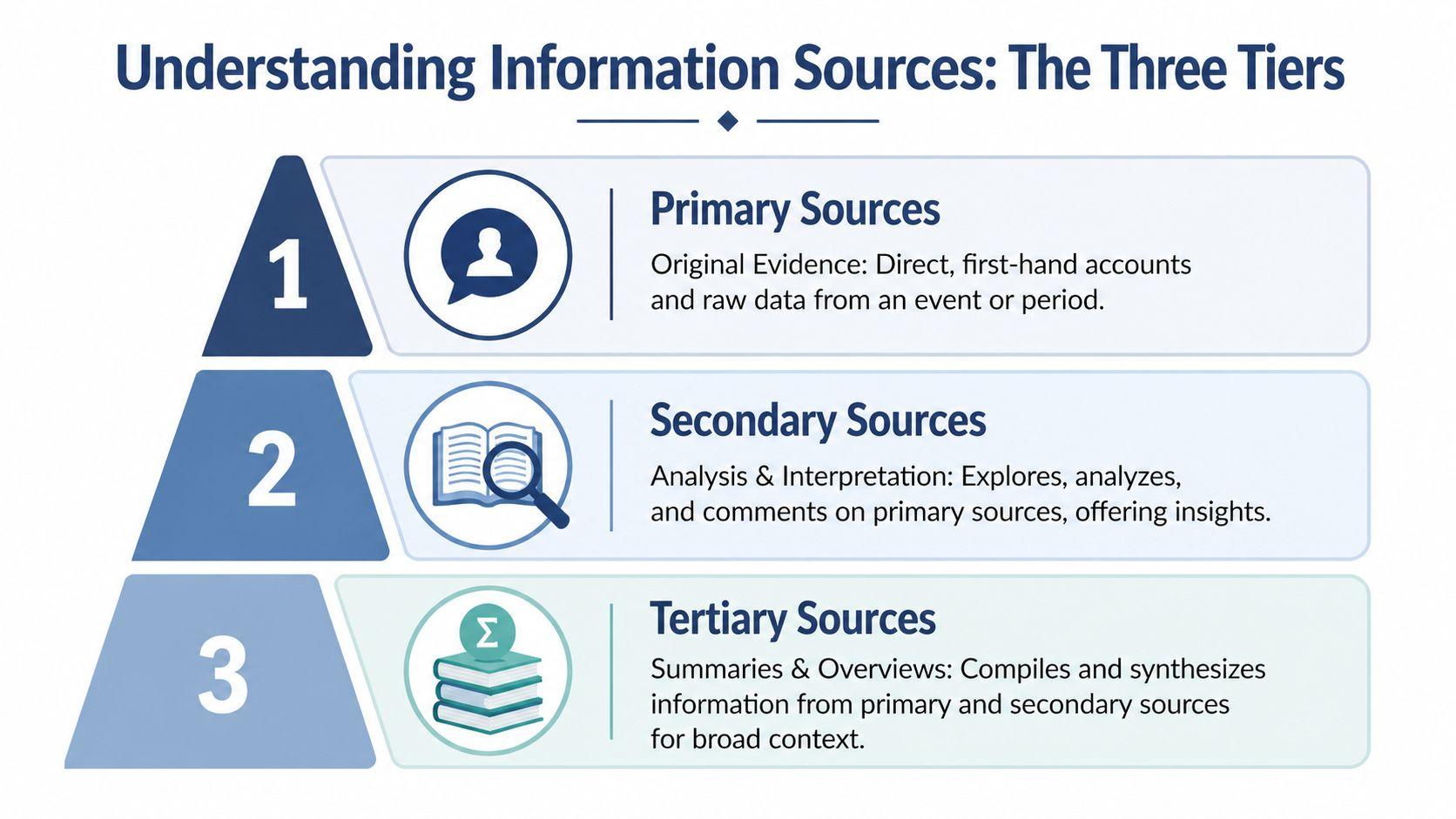
Say a city council holds a public meeting about a new housing policy. The meeting video, the official transcript, and the actual policy document are primary sources. They come straight from the event.
A newspaper article analyzing the meeting is a secondary source. It interprets what happened.
An encyclopedia entry on housing policy that summarizes the issue, past debates, and key terms is a tertiary source. It gathers and condenses information from many places into one overview.
Primary sources
Primary sources are the closest you can get to the original evidence. They are created during the event, by participants, observers, researchers, or institutions directly involved.
Examples include diaries, letters, raw scientific data, photographs, interviews, legal records, speeches, and original manuscripts.
If you were researching a scientific discovery, the lab results would be primary. If you were researching a historical protest, participant interviews or original flyers could be primary.
Secondary and tertiary sources
Secondary sources step back and analyze. A historian writing about those protest flyers is producing a secondary source. A scholar reviewing several lab studies is also producing a secondary source.
Tertiary sources step back even farther. They summarize broad knowledge for quick understanding. According to Jenni AI’s overview of encyclopedia source classification, encyclopedias are classified as tertiary sources in 100% of academic library guidelines reviewed across major institutions, and they’re consulted in 65% of initial research stages for context.
That makes sense. When people start researching, they usually need orientation before they need evidence.
Primary vs. Secondary vs. Tertiary Sources at a Glance
| Source Type | Definition | Examples |
| Primary | Original, firsthand evidence created at the time of the event or study | Diaries, interviews, raw data, speeches, court records, photographs |
| Secondary | Analysis or interpretation of primary materials | Journal articles, biographies, documentaries, news analysis |
| Tertiary | Compiled summaries of primary and secondary sources | Encyclopedias, almanacs, chronologies, fact books |
The closer a source is to the original event, the more likely it is to be primary. The more it summarizes many sources for convenience, the more likely it is to be tertiary.
Why Encyclopedias Are Excellent Summaries Not Original Evidence
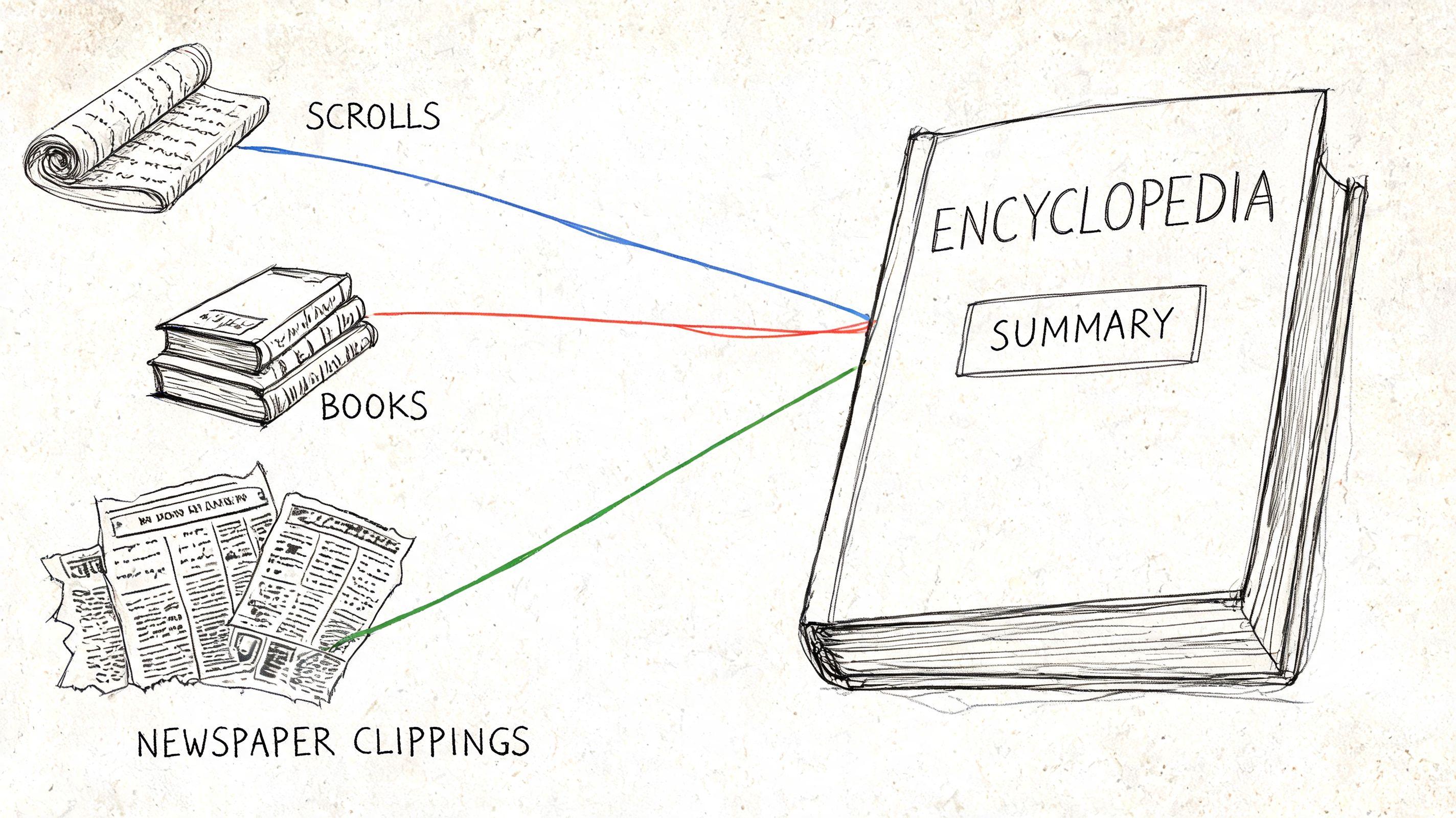
An encyclopedia entry doesn’t appear out of nowhere. Someone writes it by collecting information from many places, selecting what matters most, and compressing it into a short, readable overview.
That editorial process is exactly why encyclopedias are useful. It’s also exactly why they aren’t primary sources.
What gets lost in the summary
A diary preserves the writer’s own words. A lab report records the actual methods and results. Those sources carry the original detail, including uncertainty, context, and sometimes messy contradictions.
An encyclopedia smooths that complexity out. As explained in Voyagard’s research reality check on encyclopedias, the editorial process introduces interpretation and summarization, and scholarly critiques of reference compression estimate that this can reduce nuance by 70-90%. Their example is helpful: a climate change encyclopedia entry may reference studies, but it does not produce the measurements itself.
That doesn’t make the encyclopedia bad. It makes it a different kind of tool.
Credible doesn’t mean primary
Often, readers mix up two separate questions:
- Is it trustworthy?
- Is it primary?
A source can be trustworthy without being primary. Many encyclopedias are carefully edited and written by qualified contributors. But if your assignment calls for firsthand evidence, credibility alone won’t satisfy the requirement.
If you’re unsure how to judge reliability, this guide on what makes a source credible helps separate authority from source type.
Think of it this way. A cookbook recipe may be excellent, but it still isn’t the same thing as the farm, the ingredients, or the chef’s original experiment in the kitchen.
How to Use Encyclopedias for Smart Research
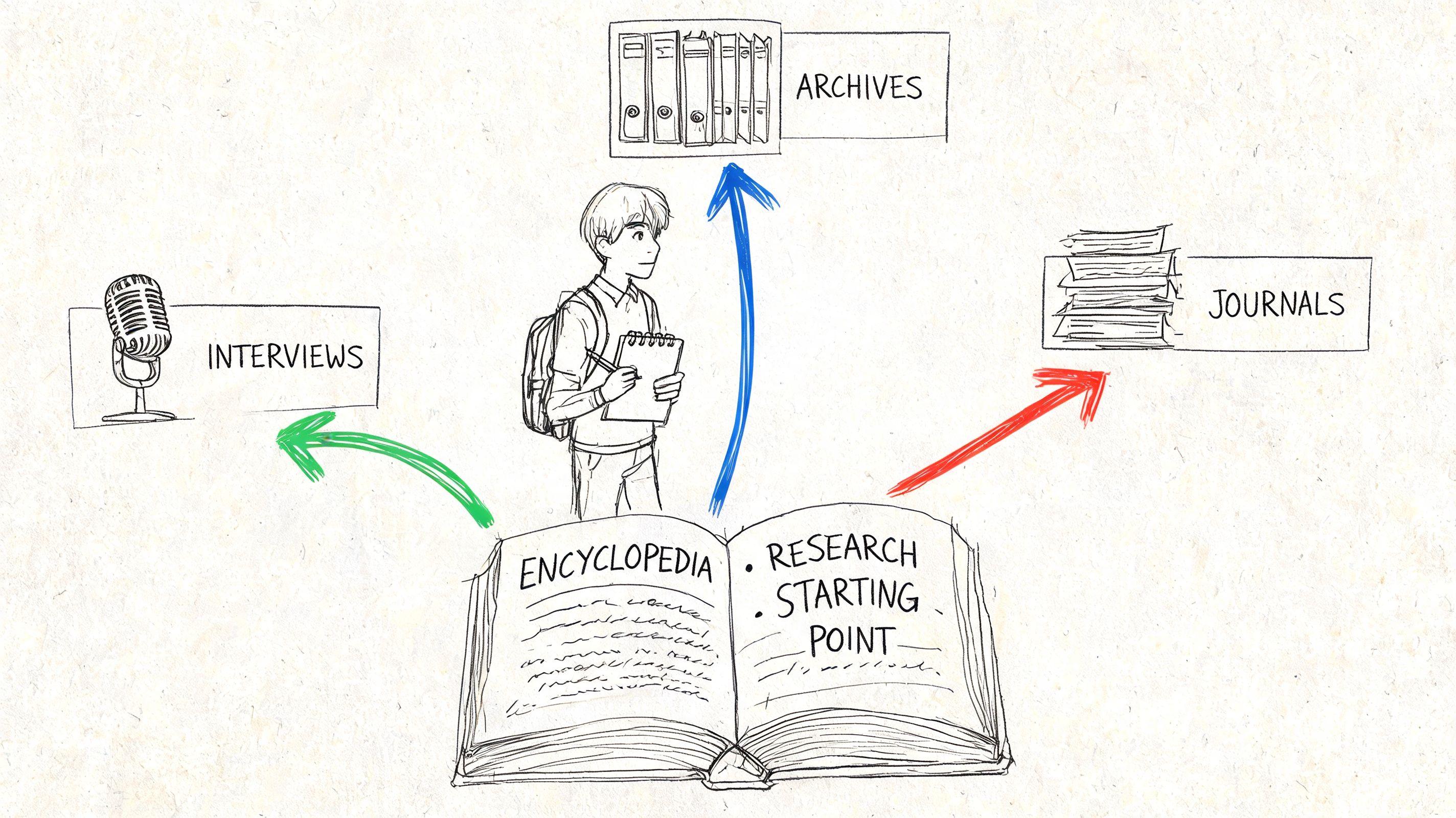
The smartest researchers don’t throw encyclopedias out. They use them early, then move past them.
An encyclopedia works best when you need to understand a topic before you start collecting stronger evidence. That’s true for a student writing about World War I, a parent helping with a history fair project, or a small business owner trying to understand a regulation, industry concept, or social issue.
Best uses at the start of a project
- Build background fast. Use the entry to get the big picture before diving into archives or journal databases.
- Learn the vocabulary. Encyclopedias give you the names, dates, keywords, and related topics that make later searching more precise.
- Spot important people and events. If you’re researching civil rights, climate policy, or a court case, the entry often points you toward central figures and turning points.
- Mine the bibliography. This is the hidden value. Good entries often point you toward books, articles, and sometimes original documents.
A practical workflow
Start with the encyclopedia. Then pull out three things from it:
- Key terms you can reuse in JSTOR, Google Scholar, or library databases
- Named sources from notes or references
- Questions the summary raises but doesn’t answer
Use the encyclopedia to find the trailhead, not to claim you’ve climbed the mountain.
That approach saves time. It also keeps you from quoting a polished summary when your teacher, client, or reader really wants the original evidence underneath it.
Where to Find True Primary Sources
Once you know an encyclopedia is a starting point, the next question is practical. Where do you find primary sources?
The answer depends on what kind of topic you’re researching. A history project, a science paper, and a business brief all lead to different kinds of original evidence.
For historical research
Look for materials created during the period you’re studying. Useful places include:
- National archives for government records, military files, legal documents, and census materials
- Museum digital collections for artifacts, letters, photographs, and exhibition records
- Newspaper archives for contemporary reporting, advertisements, and public notices
- University special collections for manuscripts, oral histories, and rare documents
If you’re researching a war, election, migration pattern, or local event, these collections often hold the documents closest to the action.
For scientific and academic topics
Primary sources in science usually mean original studies and raw findings.
Look in:
- Scholarly databases such as JSTOR, Google Scholar, and your school or library databases
- Academic journals that publish original experiments, fieldwork, and case reports
- Data repositories that host datasets, surveys, and technical documentation
A review article is usually secondary. The original study it discusses is usually primary.
For business and policy questions
Business research has primary sources too. They just look different from diaries and manuscripts.
Try:
- Government data portals for labor, trade, population, and regulatory information
- Company filings and official statements
- Earnings calls and transcripts
- Original survey data collected by your team
- Interviews with customers, staff, or stakeholders
If you’re building your process from scratch, this beginner-friendly guide to research methodology for beginners can help you match the right evidence to the right question.
If your source says what happened, it may be primary. If it says what others think happened, it probably isn’t.
The Wikipedia Question and Modern Edge Cases
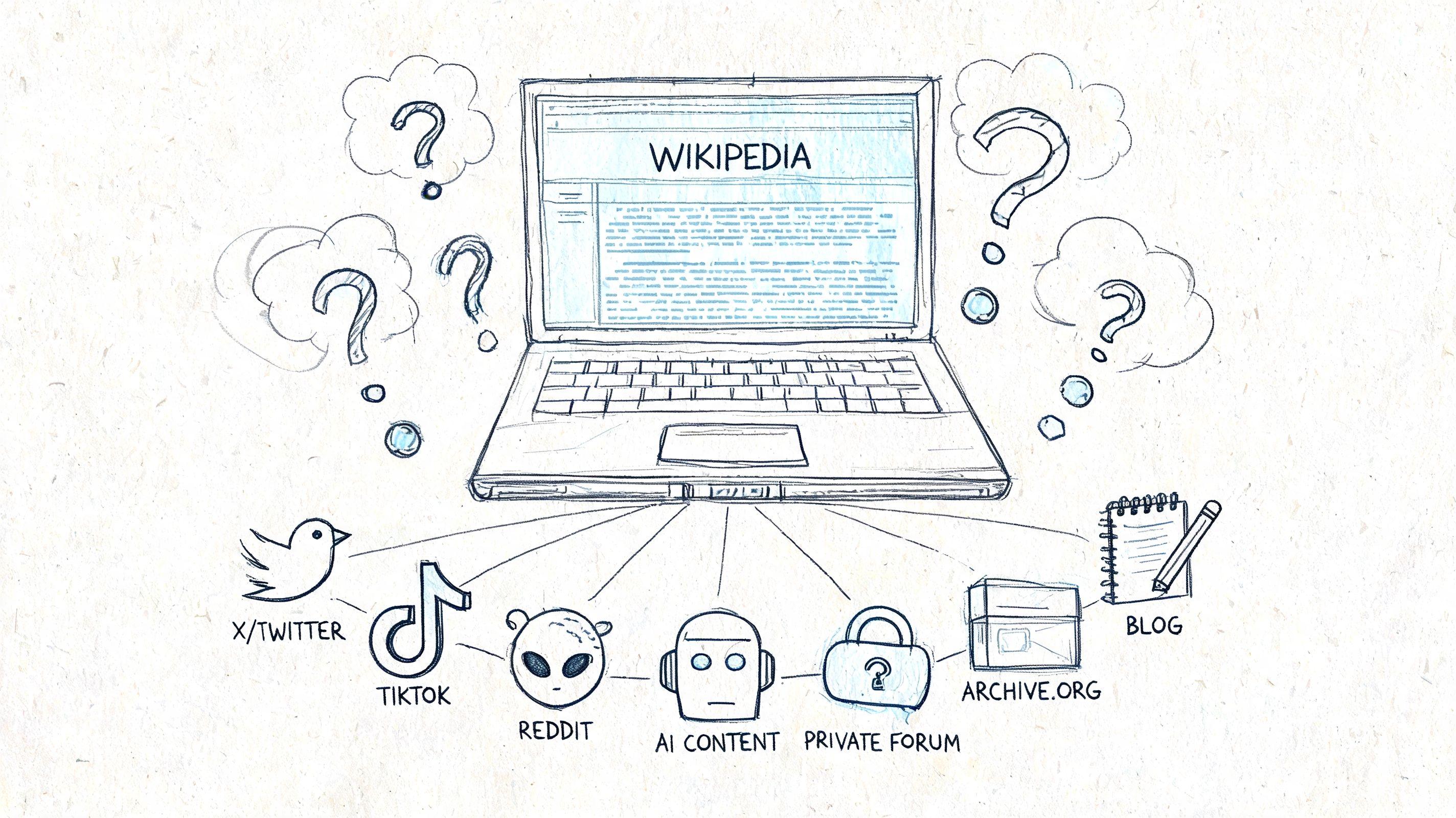
Wikipedia makes this conversation more interesting. The article content on Wikipedia is still generally treated like a tertiary source because it summarizes existing information rather than serving as original evidence.
But there’s an edge case that matters in digital research.
When Wikipedia becomes primary data
If your research topic is Wikipedia itself, its edit history, talk pages, and revision logs can function as primary material. According to Hastewire’s discussion of modern encyclopedia edge cases, Wikipedia’s edit logs record more than 6,000 edits per minute globally in 2025 Wikimedia statistics, and some digital scholars argue that edit wars can be treated as “living primary documents” as of 2026.
That means the classification depends on your question.
If you’re researching climate change, the Wikipedia article on climate change isn’t a primary source. If you’re researching how online communities argue over climate change language in public knowledge platforms, the revision history may be primary data.
Other nuanced cases
Specialized encyclopedias can also confuse people. A scholarly encyclopedia may be deeper, more carefully authored, and more useful than a general reference site. But depth doesn’t change the source category by itself.
The safer habit is to ask two things every time:
- What is my research question?
- What role is this source playing in answering it?
That question-based approach is far more useful than trying to memorize fixed labels without context.
Becoming a Confident Researcher
Good research gets easier when you stop treating source labels like arbitrary school rules. They’re really a way to understand distance from the evidence.
Primary sources give you the original material. Secondary sources help interpret it. Tertiary sources, including encyclopedias, help you get oriented. Each one has a job.
A simple decision test
When you pick up a source, ask:
- Was this created by someone directly involved?
- Is it presenting raw information or analyzing someone else’s material?
- Is it summarizing a whole field for convenience?
Those questions will take you farther than memorizing examples alone.
The real takeaway
An encyclopedia is not the final proof you build your argument on when primary evidence is required. It is the tool that helps you find that proof faster and with less confusion.
That’s a research skill, not just an academic technicality. It helps with school essays, family history projects, nonprofit reports, business planning, and fact-checking AI output.
If you want to keep building that skill, this guide on how to improve research skills is a strong next step.
When you know what each source type is for, you stop guessing. You start choosing evidence on purpose. That’s what confident researchers do.
If you want help organizing source types, checking AI-generated drafts, or pulling insights from PDFs in one place, try 1chat, a privacy-first AI workspace built for students, families, and small teams.