You’re probably here with a tab open for an assignment, a blinking cursor, and the same question most students have: What am I supposed to do in a rhetorical analysis?
The good news is that rhetorical analysis isn’t about using fancy words or hunting for obscure literary devices. It’s about noticing how a speaker, writer, or creator tries to influence an audience. Once you see that, the assignment gets much less mysterious.
It also turns out to be useful far beyond English class. The same skills help you read speeches, opinion pieces, advertisements, and even social media posts with sharper judgment. A strong rhetorical analysis example can show you that persuasion isn’t hidden in some academic vault. It’s everywhere you already look.
What Is Rhetorical Analysis and Why Does It Matter
A rhetorical analysis asks you to study how a message works, not just what it says.
Think of yourself as a detective. A regular reader might say, “This article argues that students should limit screen time.” A rhetorical analyst asks different questions: Why does the writer sound so trustworthy? Why include that emotional story? Why place the strongest statistic near the end? Why is this message aimed at parents instead of teens?
That shift matters. You stop reading passively and start noticing choices.
The simple version
When your teacher gives you a rhetorical analysis assignment, they usually want you to answer something like this:
How does the writer or speaker try to persuade a specific audience, and how effective are those choices?
That’s the whole job.
You are not proving whether the author is morally right. You are not writing a book report. You are not summarizing every paragraph. You are examining persuasion.
Why students get stuck
Most confusion comes from one mix-up. Students often blur together content and strategy.
Here’s the difference:
- Content is the claim itself.
- Strategy is the method used to make that claim convincing.
A student might write, “The author says school lunches should be healthier.” That’s content.
A stronger sentence would be, “The author uses personal anecdotes from students and a serious tone to make unhealthy lunches seem like an urgent problem for parents and school leaders.” That’s analysis.
Why this skill matters outside school
Rhetorical analysis helps you notice when someone is persuading you with evidence, emotion, credibility, or timing. That matters when you watch a campaign ad, read a company statement, or scroll past a viral video that wants your attention in the first three seconds.
It also helps your own writing. Once you understand how persuasion works, your essays, emails, presentations, and scholarship statements get sharper.
Practical rule: If your sentence only tells me what the text says, you’re summarizing. If it explains why a choice affects the audience, you’re analyzing.
That’s why a good rhetorical analysis example is so helpful. It shows that the assignment isn’t a puzzle with secret rules. It’s a pattern you can learn.
The Core Concepts Rhetorical Triangle and Appeals
A text gets much easier to analyze once you stop seeing it as a block of words and start seeing it as a situation.
A speech, ad, TikTok, open letter, or sponsored Instagram post all ask the same basic questions. Who is speaking? Who are they trying to reach? What do they want that audience to think, feel, or do? Those questions give you a practical starting point before you get into techniques and evidence.
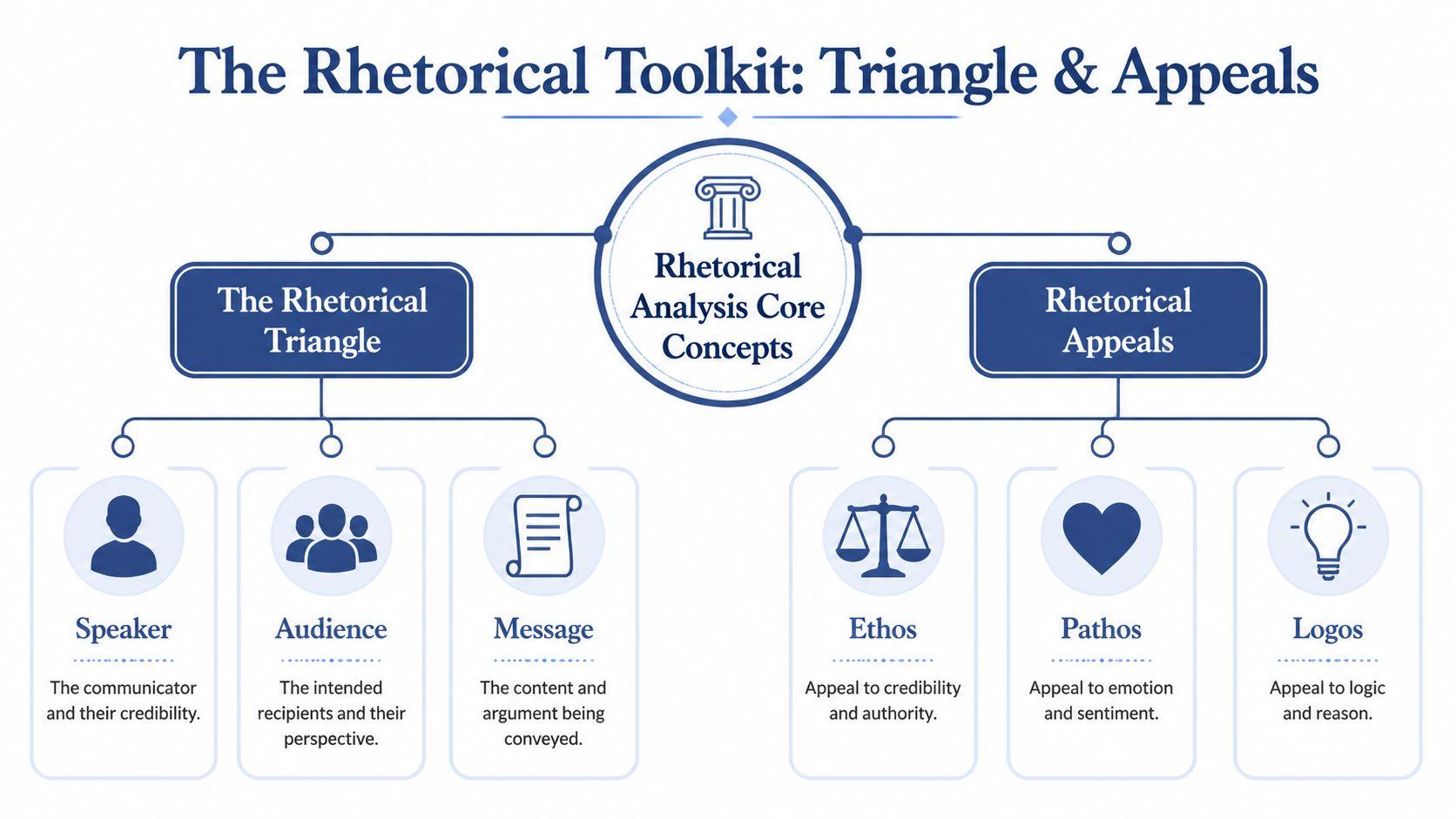
Here’s a visual guide you can keep in mind as you work.
Start with the rhetorical situation
The rhetorical situation gives you the setup behind the message. A helpful overview appears in a summary of Bitzer's framework, but the idea is simple in practice. Every persuasive message happens in a specific moment, for a specific audience, through a specific medium.
Ask these questions first:
- Speaker or writer. Who is sending the message?
- Audience. Who is meant to hear, watch, or read it?
- Purpose. What does the speaker want the audience to think, feel, or do?
- Context. What situation makes this message necessary right now?
- Medium. Is it a speech, essay, ad, video, post, or email?
Students often rush past this step and jump straight to devices. That usually leads to shallow analysis. If you call something “emotional” or “formal” without identifying audience and purpose, you are describing the surface without explaining the reason behind it.
A quick comparison helps. A climate scientist at a research conference will choose different evidence and vocabulary than a skincare brand posting a reel about sunscreen. The topic might overlap, but the context, audience, and platform change the rhetoric.
If you need a clean way to organize these observations before drafting, a simple essay outline example for planning analytical writing can help you sort speaker, audience, purpose, and evidence into a structure that makes sense.
The rhetorical triangle in everyday language
The rhetorical triangle sounds technical, but it works like a three-way relationship. Speaker, audience, and purpose constantly shape one another.
| Part | Plain-language question | Example |
| Speaker | Who is talking? | A principal, activist, influencer, or CEO |
| Audience | Who are they trying to reach? | Students, voters, customers, parents |
| Message or purpose | What do they want? | Trust, action, agreement, attention |
Here is the easiest way to remember it. If your friend asks to borrow your notes, they might sound casual, apologetic, or extra polite depending on what they want and how likely you are to say yes. The same pattern appears in formal rhetoric. A speaker adjusts tone, examples, and evidence because audience and purpose shape the message.
This matters even more in digital media. A brand on X might use short, witty phrasing to get shares, while the same company’s website uses a polished, reassuring tone to get customer trust. Different platform. Different audience expectations. Different rhetorical choices.
The three appeals
Once you understand the situation, the next question is how persuasion works inside the message. Aristotle’s three appeals give you that vocabulary.
Ethos
Ethos is credibility.
A speaker builds ethos when they seem informed, trustworthy, experienced, or fair. Sometimes that credibility comes from credentials. Sometimes it comes from presentation. Clear explanations, a respectful tone, and careful acknowledgment of counterarguments can all make a speaker seem more reliable.
Examples:
- A doctor discussing sleep habits
- A student body president addressing campus concerns
- A creator showing long-term experience with a product or skill
Digital media gives you modern versions of ethos all the time. A fitness influencer may build credibility by posting consistent training content, showing certifications, or speaking in a measured, knowledgeable tone. Whether that ethos is deserved is part of your analysis.
Pathos
Pathos is emotion.
Emotion is not automatically a trick. People make decisions with both feeling and reason, so emotional appeals often help an audience care enough to pay attention.
Examples:
- A charity ad using one person’s story and soft music
- A graduation speech using hopeful language
- A public safety campaign using fear, pride, guilt, or relief
Strong pathos analysis goes one step further. Do not stop at “this makes the audience sad.” Ask why sadness, hope, anger, or nostalgia would matter to this specific audience in this specific moment.
A viral social media campaign often depends on pathos first. A short video might use surprise, humor, or outrage in the opening seconds because the creator is competing for attention in a fast scroll environment. That is rhetoric too.
Logos
Logos is logic.
This includes reasons, examples, structure, comparisons, and statistics. Good logos analysis asks whether the evidence is relevant, clear, and convincing for the intended audience.
Students often label any number as logos and move on. A better approach is to ask sharper questions. Where did the number come from? Is the comparison fair? Does the example support the claim? Are key details missing?
For example, if a company posts “9 out of 10 users prefer our app,” your job is not to praise the statistic automatically. Your job is to ask who was surveyed, how the result is framed, and why that number appears in large text next to upbeat visuals. In rhetoric, evidence is chosen, arranged, and presented for effect.
How the appeals work together
Real persuasion rarely uses only one appeal.
A strong college speech might use ethos through the speaker’s experience, logos through organized evidence, and pathos through a personal story near the conclusion. A viral marketing campaign might reverse that order and open with emotion, then add credibility and facts later. The blend changes, but the principle stays the same.
That is the habit you want to build. Look for the combination of choices and trace their effect on the audience. Once you can see that pattern, rhetorical analysis stops feeling mysterious and starts feeling readable.
Your Step-By-Step Guide to Writing the Analysis
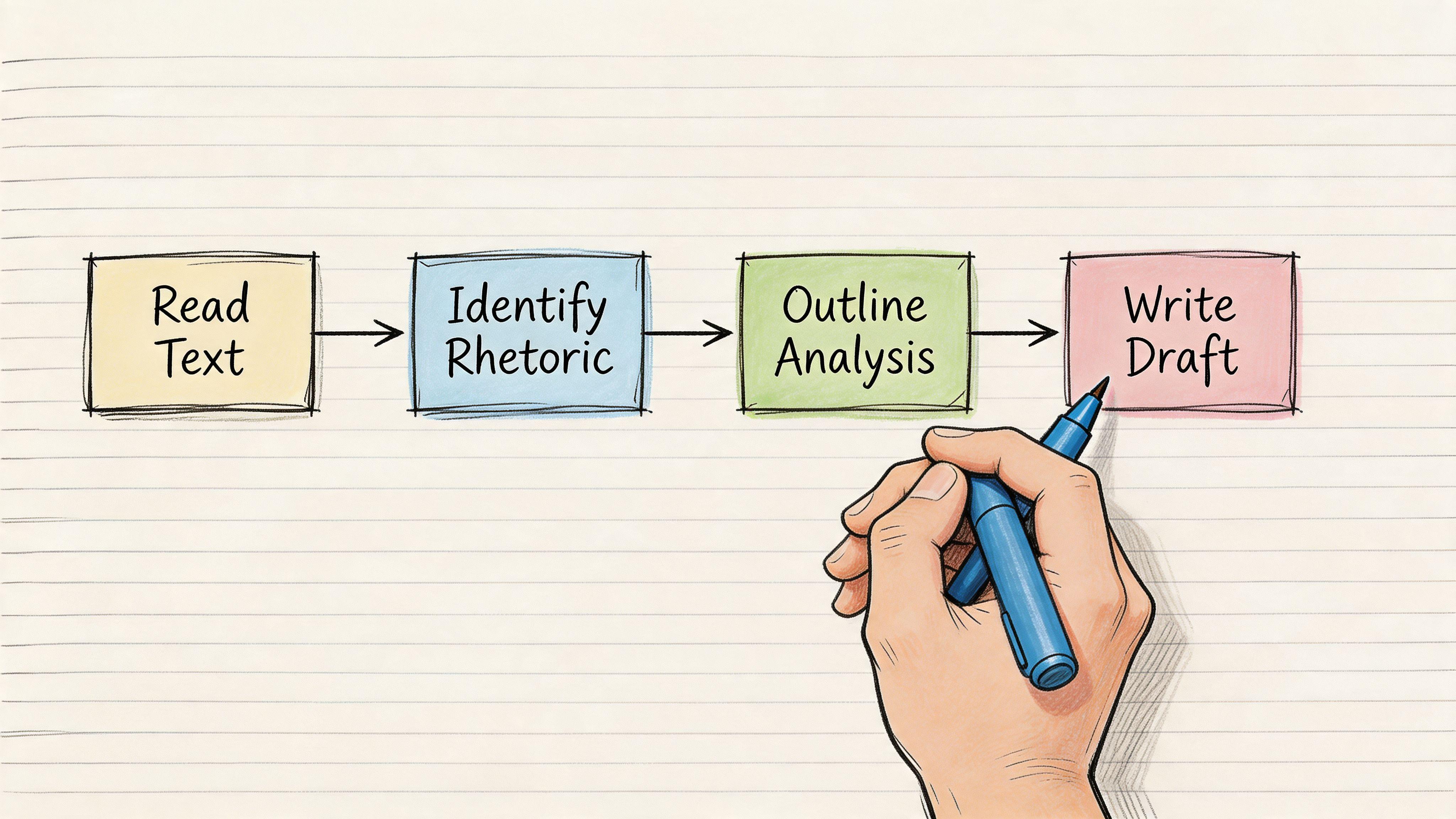
You open a document, reread the speech or post, and still have no idea how to begin. That feeling is common. Rhetorical analysis gets easier once you treat it like tracing a recipe. You are not guessing whether the piece is “good.” You are identifying the ingredients, the order, and the effect on the people consuming it.
Read once for meaning, twice for strategy
Start with a plain reading. What is the message? What is the creator trying to get the audience to believe, feel, or do?
Then read again like a coach watching game film. This time, mark the choices that shape the message.
- Who is the audience?
- What does the speaker or creator want from them?
- Where does the tone shift?
- What kinds of evidence appear?
- What emotions are being pulled in?
- What details seem carefully chosen?
This works for a formal essay, but it also works for digital media. A charity ad on Instagram, a university email, or a viral brand video still uses structure, tone, timing, and evidence to persuade. The platform changes. The rhetorical job stays the same.
If the text uses numbers, pause there. A statistic is not automatically persuasive just because it looks precise. Ask where it came from, how it is framed, and whether it is being used carefully or pushed hard to create confidence.
Use a planning frame that keeps your ideas from scattering
A planning tool like SOAPSTone works like labeled folders. It gives each observation a place, so your notes do not turn into a messy pile.
- Speaker
- Occasion
- Audience
- Purpose
- Subject
- Tone
You do not need to march through all six terms in your essay. Use them while planning. If you can identify the speaker, audience, and purpose clearly, your analysis usually becomes sharper right away.
Write a thesis that actually argues something
A rhetorical analysis thesis should make a claim about how persuasion works in the piece.
Weak thesis:
The author uses ethos, pathos, and logos to persuade the audience.
That statement is too general. It could fit almost any article, speech, advertisement, or social media campaign.
Stronger thesis:
By combining a respectful tone, carefully chosen personal anecdotes, and selective data, the writer presents the issue as both emotionally immediate and socially credible for a skeptical adult audience.
Notice what changed. The stronger version names specific choices, explains their effect, and identifies the audience. That gives the rest of the essay a direction to follow.
Build body paragraphs around strategy and effect
Each paragraph needs a job. One useful pattern is simple:
- Name the strategy
- Quote or describe the evidence
- Explain the effect on the audience
- Connect that effect to the writer’s purpose
That structure keeps you from summarizing. Summary tells what the text says. Analysis explains why the writer says it that way.
Here is the question that helps students the most:
Why this choice for this audience at this moment?
That question works for classic texts and for current media. If a TikTok campaign opens with a shocked facial expression and bold on-screen text, your task is not to call it “attention-grabbing” and stop there. Go one step farther. Explain why that fast, emotional opening fits an audience used to scrolling and why it helps the creator hold attention long enough to deliver the message.
If outlining first helps you stay organized, this essay outline example shows one clear way to map your points before drafting.
A clear essay shape is enough
You do not need a complicated structure. Clear writing usually wins.
- Introduction with context and thesis
- Body paragraph one on the strongest strategy
- Body paragraph two on another major strategy
- Body paragraph three on a final strategy or the combined effect
- Conclusion that reinforces how the rhetoric works
That shape gives you room to think without getting lost. A strong rhetorical analysis example usually succeeds because the writer stays specific, connects each choice to audience and purpose, and explains the effect with care.
Annotated Rhetorical Analysis Examples in Action
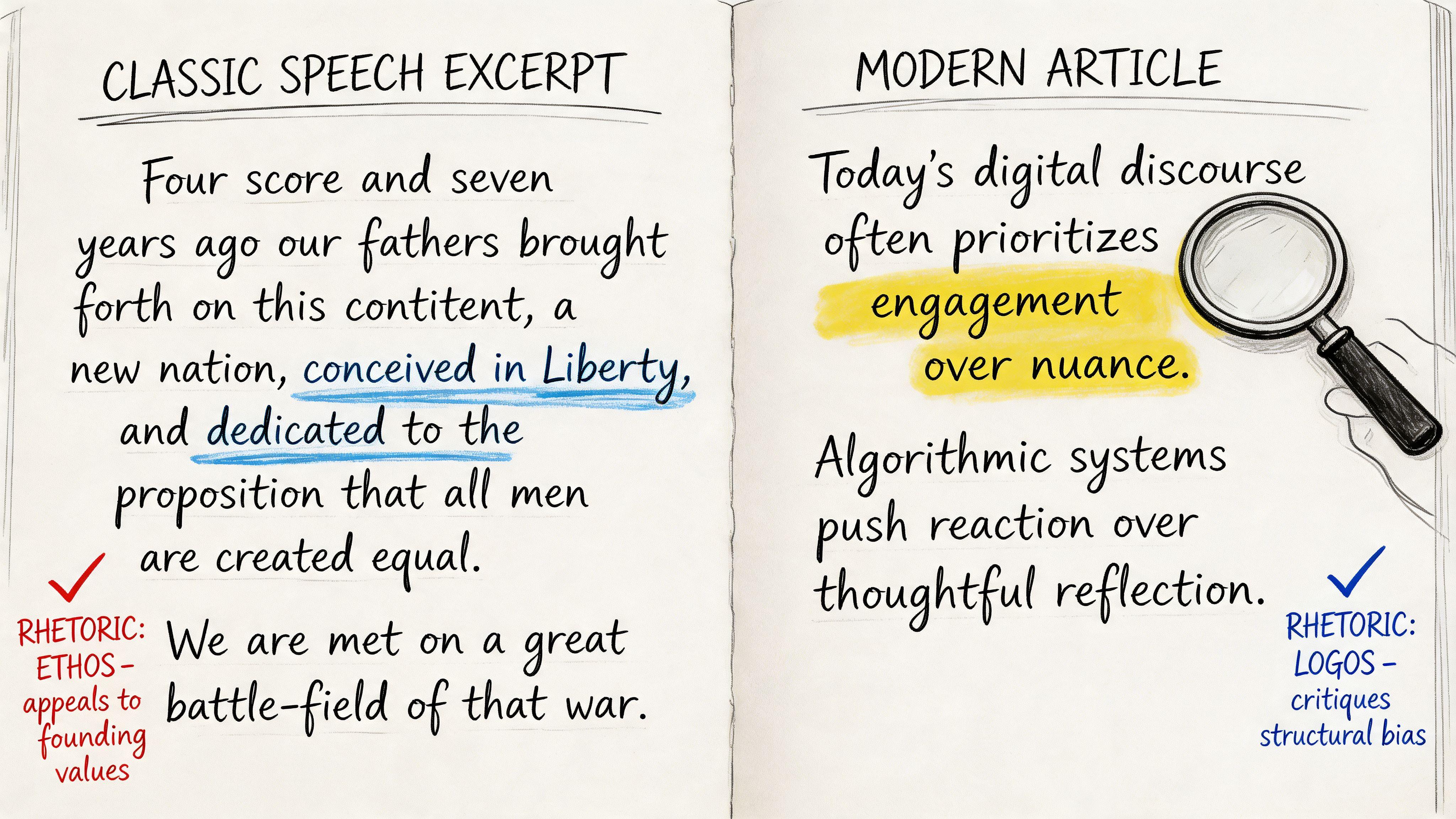
Students learn this fastest when they can see the moves on the page. So here are two rhetorical analysis example models. One is classic and text-based. The other comes from the digital world students spend time in.
A lot of guides stop with speeches and formal essays. That leaves out the media many students are now asked to interpret. That gap matters because 62% of Gen Z prefer video for learning, and educational rhetoric videos on TikTok surpassed 1.2 billion views in 2025, according to this rhetorical analysis guide discussing digital-media gaps.
Example one with a classic speech excerpt
Source text excerpt
“Four score and seven years ago our fathers brought forth on this continent, a new nation, conceived in Liberty, and dedicated to the proposition that all men are created equal.”
Sample analysis paragraph
Lincoln opens with dignified, biblical-sounding diction to give the speech moral weight and historical seriousness. Instead of beginning with battlefield details, he reaches back to the nation’s founding, which helps him frame the Civil War as a test of national ideals rather than a single military conflict. That choice strengthens his ethos because he sounds like a guardian of shared principles, and it also appeals to pathos by inviting listeners to feel reverence toward the country’s original promises. For an audience facing grief and division, this opening turns remembrance into a call to renewed unity.
Why this paragraph works
- It identifies a specific choice. The paragraph doesn’t vaguely say “Lincoln uses good word choice.” It points to formal diction and the decision to invoke the founding.
- It explains function. The analysis shows why Lincoln starts with origins instead of present suffering.
- It connects to audience. Grieving listeners needed more than facts. They needed meaning.
- It ties strategy to purpose. The paragraph shows how the language helps Lincoln unify people around national ideals.
Example two with a modern digital post
For this example, imagine a short social media video from a sustainable clothing brand.
Source text description
The reel opens with quick cuts of overflowing closets, landfill footage, and text on screen that says, “You don’t need more clothes. You need better ones.” Soft piano music plays. The creator then appears in a plain room, wearing a simple outfit, and explains how buying fewer pieces can reduce waste and save money over time. The video ends with a clean shot of three staple items and a calm voice saying, “Start with what you’ll wear.”
Sample analysis paragraph
The reel persuades viewers by pairing visual guilt with a calm, practical tone. Its opening images of clutter and waste create pathos, especially for viewers already uneasy about overconsumption, while the quiet setting and simple outfit build ethos by making the creator seem consistent and sincere rather than flashy. The phrase “You don’t need more clothes. You need better ones” simplifies the issue into a memorable contrast, which makes the message easy to repeat and share. By ending with a small, manageable action instead of a lecture, the creator makes sustainable shopping feel achievable for everyday consumers.
Why this paragraph works
- It treats visuals as rhetorical choices. Students often forget that camera angle, music, text overlays, and editing rhythm are analyzable.
- It doesn’t summarize every second. It selects the most persuasive features.
- It explains combined effect. Pathos and ethos work together here.
- It recognizes platform logic. A short, repeatable phrase matters on social media because users need something memorable fast.
A digital text still has a speaker, audience, purpose, tone, and appeals. The medium changes. The rhetorical principles don’t.
A quick comparison of the two examples
| Feature | Classic speech | Social media reel |
| Main persuasive tool | Elevated language and historical framing | Visual contrast, music, and concise slogan |
| Audience expectation | Reflection and civic seriousness | Speed, clarity, emotional immediacy |
| Best analysis move | Explain diction and historical appeal | Explain visuals, tone, pacing, and shareability |
What students can copy from these models
When you build your own paragraph, aim for this sequence:
- Start with the choice. Name the rhetorical move.
- Add the evidence. Quote or describe it.
- Interpret the effect. What does it make the audience think or feel?
- Return to purpose. Why does that effect help the creator persuade?
That pattern works whether your text is a speech, op-ed, ad, podcast clip, meme, or marketing email.
Common Student Mistakes and How to Avoid Them
Most weak essays don’t fail because the student “doesn’t get rhetoric.” They fail because the writing slips into a few common traps.
One of the biggest is the weak thesis. According to 2025 AP exam data, 78% of student essays failed to show “complex understanding,” often because the thesis only listed devices instead of analyzing their function. The same source notes a 35% increase in submissions linked to AI essay tools since 2024, which makes nuanced, specific thinking even more important, as discussed in this thesis guide on rhetorical analysis pitfalls.
Trap one: device listing
Before
The author uses ethos, pathos, diction, repetition, and imagery.
After
The author uses repetition and emotionally loaded diction to make the audience feel that delaying action would be irresponsible.
The fix is simple. Every time you name a strategy, add so that in your head.
The author uses repetition so that the audience feels urgency.
Trap two: summary disguised as analysis
Before
First, the author talks about pollution. Then she explains its effects. Finally, she says people should help.
After
By arranging the argument from problem to consequence to action, the author leads readers toward the conclusion that personal responsibility is unavoidable.
Summary retells. Analysis interprets.
Trap three: a thesis that says almost nothing
Before
The speaker effectively persuades the audience.
After
Using formal diction, references to shared national values, and a restrained emotional tone, the speaker presents sacrifice as honorable and collective rather than personal and tragic.
If your thesis could fit almost any text, it’s too vague.
Trap four: ignoring audience
Students sometimes write smart observations that float in empty space because they never identify who the message is meant for.
Ask:
- Who would respond well to this tone?
- Who might resist this argument?
- Why this example for this group?
That question often separates a decent essay from a sharp one.
Your teacher usually isn’t looking for more devices. They’re looking for better explanation.
Rhetorical Analysis Final Checklist
| Element | Needs Improvement | Good |
| Thesis | Lists devices only | Makes a defensible claim about strategy and effect |
| Evidence | Drops quotes without explanation | Uses brief evidence tied to a clear point |
| Commentary | Says “this is persuasive” | Explains why it persuades a specific audience |
| Focus | Summarizes the text | Analyzes how the message works |
| Audience awareness | Barely mentioned | Integrated throughout the essay |
| Originality | Sounds generic or machine-made | Uses precise observations and specific interpretation |
Before you submit, it’s also smart to review originality and citation habits with a practical guide to checking for plagiarism using Google, especially if you’ve used digital drafting tools along the way.
From Analysis to Stronger Communication
Rhetorical analysis teaches more than essay structure. It trains you to notice how people earn trust, trigger emotion, and shape logic.
That makes you a stronger student, but it also makes you a harder person to manipulate. You start catching weak evidence, vague claims, and emotional shortcuts in the media you consume every day. At the same time, your own writing gets more intentional because you stop tossing words onto a page and start making choices.
If you want extra help turning rough ideas into clearer academic writing, this guide on how to improve academic writing is a useful next step.
If you want help brainstorming a thesis, organizing evidence, or polishing a rhetorical analysis example into a more natural draft, 1chat offers a privacy-first way to work with multiple AI models in one place for writing support, research help, and revision.