A small business launches an Albanian version of its website on Friday and starts getting replies on Monday. The product details are understandable, but the wording feels imported, the call to action sounds stiff, and one policy page uses terms that do not match how Albanian readers expect formal information to be written. The translation is not broken. It is merely not ready.
That is the point where English to Albanian translation stops being a quick task and becomes a process that needs control. Albanian brings a few challenges generic translation guides usually skip. Sentence structure often needs reshaping, not word swapping. Tone shifts matter. Definite forms, regional preferences, and borrowed technical terms can all affect whether the final text reads like something written for Albanian readers or something copied across from English.
The demand for accurate work is not theoretical. This was highlighted in 2025, when the Observatory for the Rights of Children and Youth in Tirana issued a tender for English to Albanian translation of full statistical reports, with submissions due on 28 June 2025. Cases like that show where translation usually fails in practice: not on isolated words, but on consistency, terminology, and review discipline.
For a first project, the safest approach is a repeatable workflow. Clean the English source before translation starts. Choose the right mix of AI and human input based on the risk of the content. Then review the Albanian text for terminology, tone, formatting, and cultural fit before anything goes live.
That workflow saves money because it catches the expensive errors early.
Choosing Your English to Albanian Translation Path
The first mistake small businesses make is choosing a method based only on speed. The better question is this: what happens if the translation is slightly wrong? If the answer is “nothing serious,” machine translation may be enough. If the answer is “we could confuse customers, weaken our brand, or create compliance risk,” you need human review.
A marketing brochure is a good example because it sits in the middle. It isn’t as risky as a contract, but it isn’t disposable either. Brochure copy has slogans, benefit statements, calls to action, and tone. Those are exactly the places where direct word substitution fails.
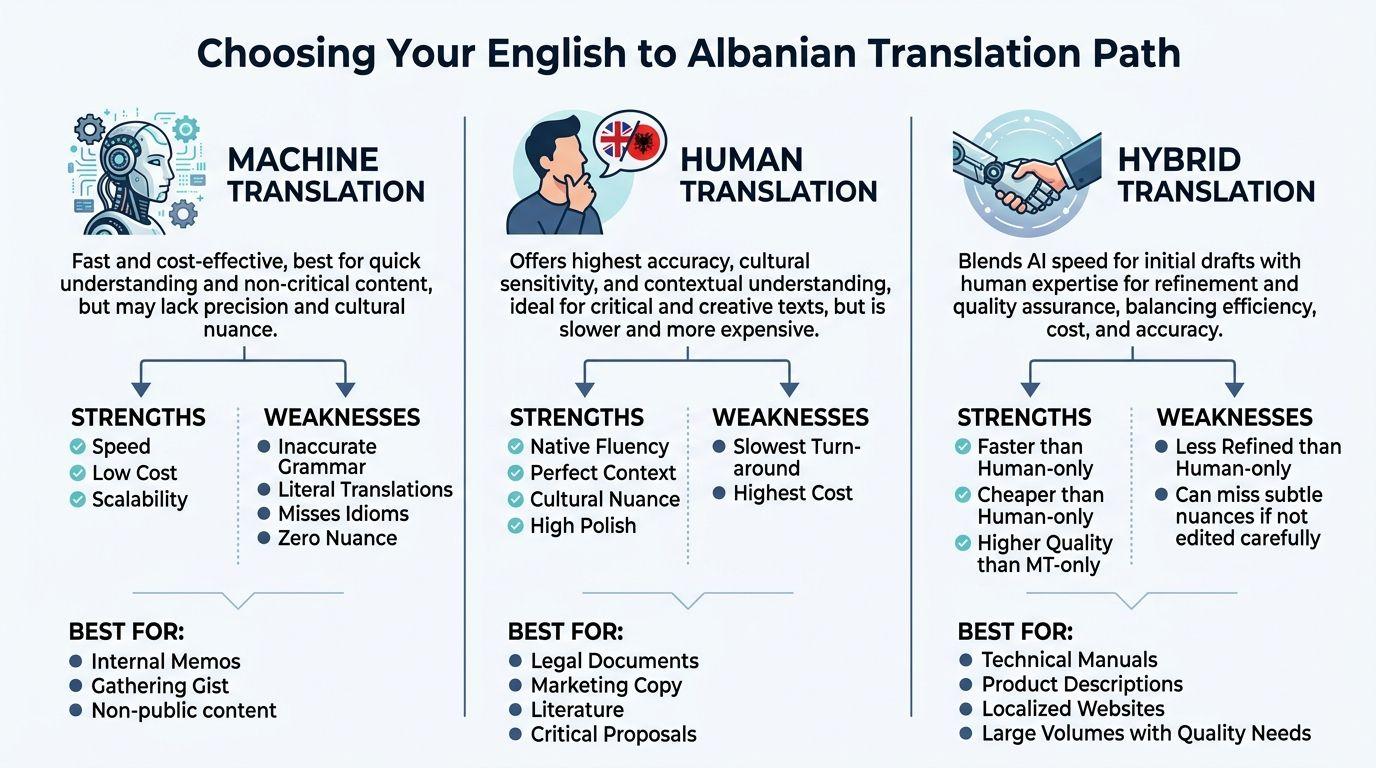
What each path is really good at
Machine translation is strongest when your goal is quick comprehension. Internal notes, rough product research, low-risk support text, or draft understanding all fit. It’s also much more usable than it used to be. MachineTranslation.com says its English to Albanian workflow verifies output across 22 AI models and can reach 85% of professional human quality while cutting costs by 90% (MachineTranslation.com English Albanian overview).
Human translation is the right choice when wording itself carries business value. Sales pages, legal content, policy text, healthcare information, investor-facing material, and anything customer-visible that needs trust should go through a professional translator or reviewer who knows Albanian well.
Hybrid translation is where most small businesses land. AI creates a first draft. A human corrects meaning, tone, terminology, and formatting. That’s usually the most practical balance when budget matters but quality still matters.
Practical rule: If the translation will be published, signed, sold from, or relied on, don't let raw AI output be the final version.
Translation method comparison
| Method | Best For | Cost | Speed | Quality |
| Machine | Internal notes, rough understanding, low-risk text | Lowest | Fastest | Variable, often acceptable for gist |
| Human | Legal, medical, public-facing brand copy, sensitive documents | Highest | Slowest | Highest |
| Hybrid | Websites, brochures, FAQs, product pages, reports needing review | Moderate | Fast | Strong when review is done well |
A brochure scenario
Say a small tourism business wants to translate an English brochure for visitors and local partners. If the brochure is mostly practical information, machine translation can produce a usable draft. If it includes persuasive copy like “Enjoy a smooth coastal escape with curated local experiences,” a human needs to reshape that line into something natural for Albanian readers.
Use this decision filter:
- Choose machine when readers only need the basic meaning.
- Choose human when the translation has legal, reputational, or emotional weight.
- Choose hybrid when you need decent speed, controlled cost, and a final text that still sounds like a person wrote it.
There’s no prize for picking the cheapest method first and paying for rework later.
How to Prepare Your Source Text for Accurate Translation
Bad source text creates bad translations. That’s true whether you hire a native Albanian linguist or use AI. The cleaner your English is, the fewer interpretation problems show up downstream.
A useful benchmark comes from professional human translation practice. Source analysis and disambiguation can reduce ambiguity errors from 35% in naive machine translation to less than 5%, especially when dealing with polysemous words and Albanian’s different grammatical structure (professional source analysis guidance for English and Albanian).
Clean the English before translation
Start by cutting sentences that try to do too much. English marketing copy often packs claim, tone, and metaphor into one line. Albanian usually works better when the meaning is unpacked and made explicit.
Use this checklist before translation starts:
- Shorten long sentences: One idea per sentence is safer than three.
- Replace idioms: “Hit a home run,” “move the needle,” and “on the same page” often create literal nonsense.
- Define loaded words: Terms like “support,” “service,” “delivery,” and “platform” can point to different things in different contexts.
- Mark intended tone: Formal, conversational, instructional, or academic.
- Create a micro glossary: Brand name, product names, repeated technical terms, and approved phrasing.
Remove ambiguity on purpose
A sentence like “We support local businesses with flexible delivery” looks harmless until someone has to translate “support” and “delivery.” Are you funding, advising, or providing customer support? Is delivery shipping, service rollout, or implementation?
That’s why I recommend writing short translator notes beside risky phrases. Even a simple parenthetical note helps: support (customer service), delivery (shipping), partner (reseller), plan (pricing package).
One of the easiest ways to improve a translation is to stop making the translator guess what you meant in English.
This matters for students too. If you’re translating notes, essays, or research summaries, clarify the original claim before translating it. The same editing discipline you’d use for a clean draft applies across languages. A related workflow for another language pair appears in this English to Swahili translator guide, and the core lesson carries over well: cleaner source text produces cleaner output.
Using AI Translators Safely and Effectively
A small business owner copies a product page into a public AI translator at 6 p.m., publishes the Albanian version by 7, and wakes up to three avoidable problems. A button label is too long for mobile. A service term has shifted meaning. A sentence that sounded polished in English now reads like machine-written copy. I see this pattern often, and the fix is usually process, not more software.
AI works well for first drafts, option generation, and terminology checks. It works poorly as an unsupervised publisher, especially for English to Albanian translation, where case endings, regional usage, and sentence rhythm can change whether text sounds natural or foreign. If the text includes pricing, legal terms, product claims, or customer data, use a private, approved tool or remove sensitive content before you paste anything.
The safest setup for a small team is simple.
- Remove sensitive material Take out names, account data, contract terms, unpublished pricing, and anything regulated or confidential.
- Work in small sections Translate by page section, paragraph, table, or UI string set. Shorter units make errors easier to catch, especially when Albanian word order shifts.
- State the audience and use case “Translate for an Albanian hotel booking page” is far better than “translate this text.” Audience context affects formality, vocabulary, and call-to-action wording.
- Set terminology rules before generation Tell the system which brand names stay in English, which product terms must stay consistent, and whether you want standard Albanian rather than a regional feel.
- Ask for a constrained output Request one draft, one alternative if needed, and a note on uncertain terms. Too many options create noise and slow review.
Good prompting reduces cleanup, but it does not remove the need for review. For marketing copy, I often ask AI to produce a plain, accurate Albanian draft first, then a second pass that improves flow without changing meaning. That gives the reviewer something usable. If you need public-facing text to sound less machine-written before review, this guide on how to humanize AI text without losing clarity is a practical reference.
A few prompt patterns work reliably:
- Business page: “Translate into standard Albanian for a formal company website. Keep product names in English. Keep the meaning exact.”
- Ecommerce listing: “Translate into natural Albanian for online shoppers. Keep dimensions, model numbers, and warranty terms unchanged.”
- Support article: “Translate into clear Albanian for customers. Use direct instructions. Keep menu labels consistent.”
- Comparison check: “Compare the English source and Albanian draft. Flag meaning shifts, awkward phrasing, and inconsistent terminology.”
English to Albanian machine output tends to fail in predictable places. Slogans are one. Buttons and menus are another, because Albanian can run longer and break layouts. Words such as “support,” “plan,” “charge,” “issue,” and “delivery” also cause trouble because the right Albanian choice depends on context, not dictionary equivalence. AI also struggles with text that assumes English cultural context, especially humor, sports references, and casual sales language.
Use AI for speed, coverage, and draft generation. Use it to compare phrasings, check consistency, and surface terms that need a human decision. Do not let it approve legal copy, medical text, regulated content, or brand messaging on its own. That is where expensive mistakes usually start.
The Crucial Human Touch for Post-Editing and QA
Human review is where the translation becomes publishable. This is not just a typo pass. A strong reviewer checks whether the Albanian text means the same thing, sounds natural, fits the audience, and stays consistent from top to bottom.
This is also where hybrid workflows pay off. Human-AI workflows can improve accuracy by 30% to 50% over pure machine translation, largely because human post-editors catch contextual errors that automated metrics miss (research on Albanian English hybrid translation workflows).
What post-editing actually changes
Take a common English sentence from a brochure: “We deliver customized support for growing teams.”
A raw machine draft may preserve every concept but still sound stiff, overly literal, or vague in Albanian. A human reviewer asks better questions. Does “adapted” need a direct equivalent, or would a more natural phrase better match how Albanian business readers speak? Does “support” mean onboarding, consulting, or customer assistance? Does “growing teams” refer to company size, hiring stage, or scale-up companies?
That’s the difference between readable and reliable.
A lean QA checklist
If you don’t have an in-house localization team, use a simple review checklist:
- Meaning check: Does every sentence still express the original claim?
- Tone check: Does the text sound formal, friendly, or instructional in the intended way?
- Terminology check: Are repeated terms translated consistently?
- Formatting check: Do headings, bullets, buttons, and tables still fit after translation?
- Audience check: Would a native Albanian reader say it this way?
A reviewer should also flag text expansion. Albanian can run longer than English in menus, banners, labels, and interface copy. If your page layout is tight, wording has to be edited with the design in mind.
The best post-editor isn't just bilingual. They know when a sentence is technically correct and still wrong for the reader.
If you’re reviewing AI-generated copy before translation or after it, this broader guide on how to humanize AI text is useful because the same principle applies in localization. Smooth grammar isn’t the same as natural communication.
Avoiding Common Pitfalls and Cultural Blunders
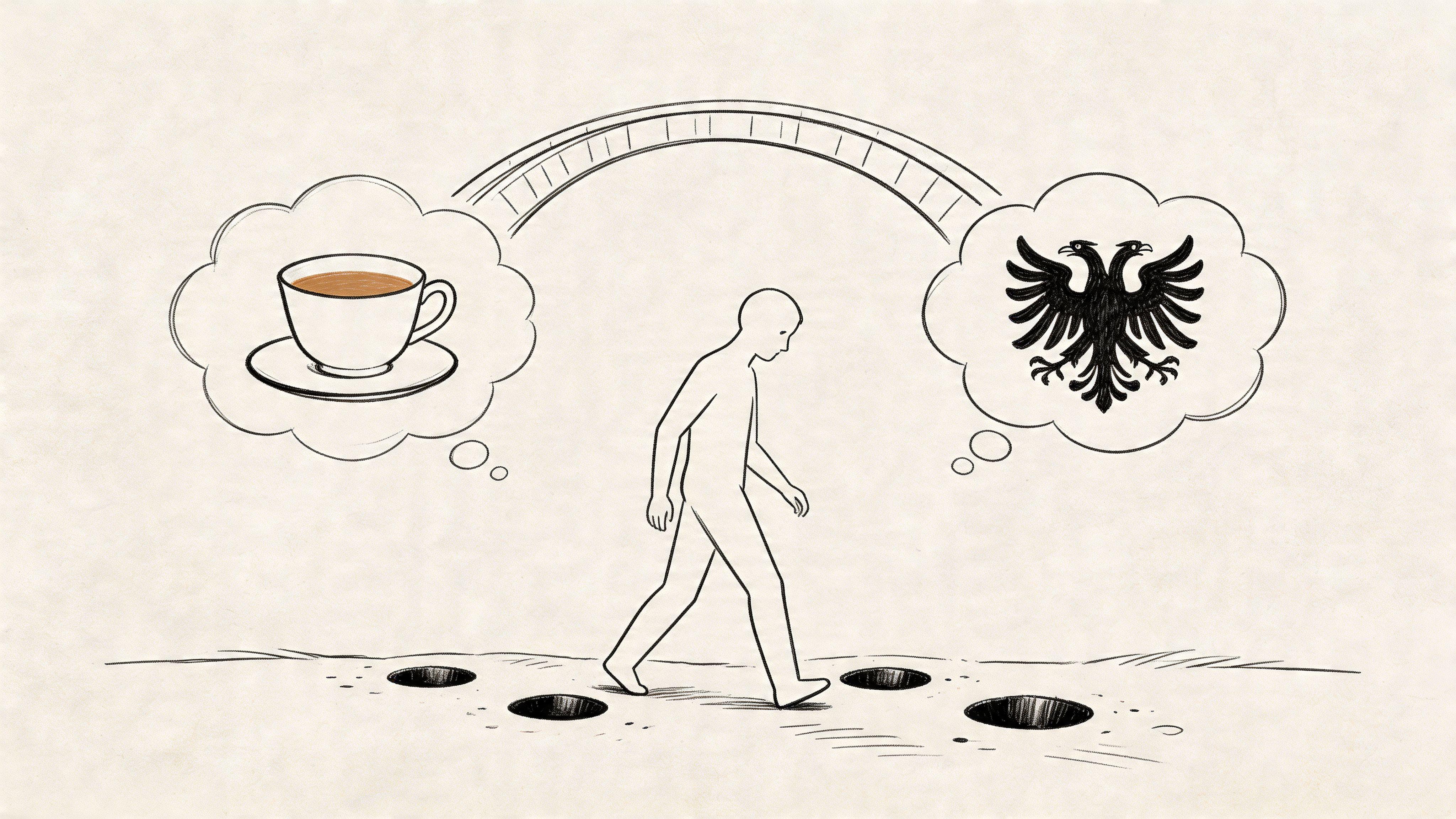
Most bad Albanian translations don’t fail because the translator missed every word. They fail because the text sounds imported. The message arrives, but the voice is off, the dialect doesn’t fit, or an idiom lands badly.
That’s why this stage deserves more than a quick skim.
Dialect can break an otherwise decent translation
A company writes customer support content in English, runs it through a standard translator, and publishes the Albanian version. The wording is grammatical. The problem appears when the audience includes readers from northern Albanian-speaking contexts or Kosovo. The text feels oddly southern, formal, or distant.
That’s not a minor detail. Dialect-unaware AI tools often default to standard Tosk, and one cited analysis reports accuracy dropping to 62% in informal northern Gheg contexts, with idiomatic expression errors rising by 40% (dialect handling problems in English to Albanian tools).
If your audience is broad, standard Albanian may still be the right choice. If your audience is regional, especially informal and community-facing, you need to ask the reviewer which variety fits.
Idioms are where embarrassment starts
An English founder writes, “Our new process helps your team hit the ground running.” The literal translation may preserve every image and still sound unnatural or confusing. Albanian business readers usually respond better to direct benefit statements than borrowed English-style figurative language.
A safer rewrite in English before translation would be: “Our new process helps your team start quickly and work effectively from day one.”
That pattern solves many problems at once.
- Sports metaphors: Often don’t travel well.
- Startup clichés: “Move fast,” “game changer,” “low-hanging fruit” usually need rewriting, not translating.
- Friendly slang: Can sound childish or out of place in formal Albanian copy.
- Over-politeness from English email habits: Sometimes reads as padded or unnatural.
Tone mistakes are expensive
I’ve seen businesses get the words mostly right and still lose trust because the tone misses the situation. A legal notice translated with promotional warmth sounds unserious. A family-oriented school message translated in rigid bureaucratic language sounds cold. A product page written in textbook Albanian can feel distant.
Check these red flags before publishing:
| Red flag | Why it matters |
| Overly literal phrasing | Reads like translation instead of natural Albanian |
| Wrong level of formality | Signals the wrong relationship with the reader |
| Unchecked regional fit | Can alienate audiences who don't use standard phrasing in daily life |
| English syntax copied over | Makes sentences feel stiff and foreign |
If a translation sounds like it came from English, native readers notice immediately, even when they can't explain exactly why.
The practical fix is simple. Review for audience first, language second. Ask, “Would our Albanian customer say this?” That question catches more issues than a dictionary ever will.
Your Albanian Translation Toolkit
A good workflow doesn’t need a huge stack of tools. It needs a small set of dependable habits. For most first-time projects, that means one drafting tool, one glossary, one reviewer, and one final QA pass before anything goes live.
Keep these resources in your working setup
- A term list: Your brand name, service names, industry terms, and phrases that must stay consistent.
- A native reviewer: Ideally someone who knows the audience and not just the language.
- A layout check: Especially for websites, PDFs, menus, and app screens.
- A controlled AI workspace: Useful when you want to compare drafts, summarize notes, or refine wording. Teams exploring local or privacy-conscious models may find this overview of the best local LLM options useful for internal workflows.
Useful business phrases
| English | Natural Albanian |
| Best regards | Me respekt |
| Kind regards | Përshëndetje të përzemërta |
| We look forward to hearing from you | Presim me kënaqësi përgjigjen tuaj |
| Please let us know if you have any questions | Ju lutemi, na njoftoni nëse keni pyetje |
| Thank you for your time | Faleminderit për kohën tuaj |
| Attached please find | Bashkëngjitur do të gjeni |
Don’t treat phrase tables as plug-and-play for every context. Email etiquette, sector norms, and audience age all affect what sounds natural. Use them as a starting point, then let a native reviewer smooth the edges.
The simplest reliable process is still the best one. Clean the English. Draft carefully. Review with a human. Check tone, dialect, and layout. Then publish.
If you want a privacy-first place to draft, compare, and refine multilingual content with leading AI models in one workspace, try 1chat. It’s built for small teams, students, and families who want a more controlled alternative for writing, document analysis, and AI-assisted workflows.