Getting the right english to swahili translator is about more than just swapping words. It's about connecting authentically with one of Africa's most important linguistic communities, whether for business, education, or keeping in touch with family.
Moving past basic, word-for-word translation is the only way to avoid costly mistakes and build real trust.
Why a High-Quality Swahili Translation Matters
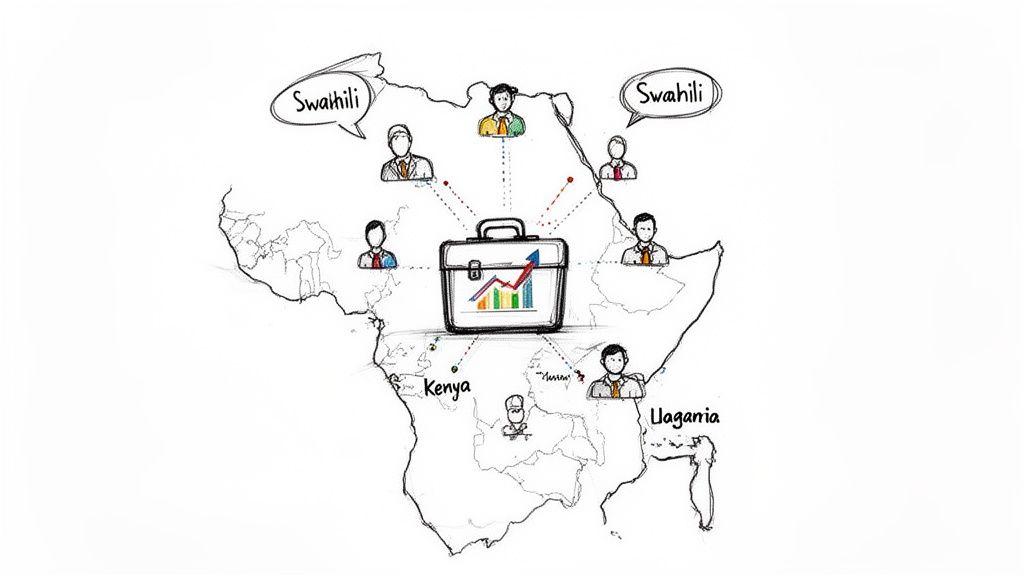
For any business with an eye on growth, the Swahili-speaking markets across East and Central Africa are a huge opportunity. The problem is, many companies just plug their marketing copy into a standard online tool and hope for the best. This almost always backfires, leading to translations that are awkward, unprofessional, or just plain wrong.
Generic software simply can't handle the rich cultural nuances and regional differences in Swahili. A phrase that lands perfectly in Kenya might completely miss the mark or sound strange in Tanzania. This is where an advanced english to swahili translator gives you a serious edge.
It's About Meaning, Not Just Words
Your goal isn't just to convert English words into Swahili ones. It's to make sure your meaning, tone, and intent all come through loud and clear.
Think about these real-world situations where precision is everything:
- Legal & Business Documents: A poorly translated contract can introduce dangerous loopholes, putting your operations and finances at risk.
- Marketing Campaigns: A clever slogan that loses its punch in translation is a wasted ad budget. Worse, it can damage how people see your brand.
- Educational Content: When students encounter inaccurate translations of key terms, it stalls their learning and creates lasting confusion.
- Family Messages: For personal communication, preserving the warmth and emotion behind your words is just as crucial as getting the facts right.
The difference between a basic tool and a sophisticated AI translator is simple: one gives you words, the other delivers understanding. It’s like having a dictionary versus a fluent interpreter.
This need for deep comprehension is magnified by the sheer number of speakers. Swahili, or Kiswahili, is a powerhouse of African communication. With over 200 million speakers globally, it stands as the continent's most widely spoken indigenous language and a vital link for commerce and culture. You can find excellent analysis on Swahili's global importance from language industry experts.
The table below breaks down the practical differences you'll encounter.
Standard vs. AI-Powered Swahili Translation Approaches
| Feature | Standard Free Translators | Advanced AI Platforms (e.g., 1chat) |
| Contextual Accuracy | Often fails, providing literal, word-for-word translations. | Understands surrounding text to provide context-aware translations. |
| Idiom & Slang Handling | Translates idioms literally, creating nonsensical phrases. | Recognizes and correctly interprets idiomatic expressions. |
| Tone & Formality | Ignores tone, producing flat or inappropriate results. | Can adapt the translation to be formal, informal, or professional. |
| Regional Nuances | One-size-fits-all; ignores dialects (e.g., Kenyan vs. Tanzanian Swahili). | Can be guided to account for regional vocabulary and phrasing. |
| User Control | Limited to no control over the output. | Allows users to provide context and refine results with follow-up prompts. |
As you can see, relying on a standard tool is a gamble. Advanced platforms give you the control needed for truly effective communication.
The Hidden Costs of Getting It Wrong
Using a subpar English to Swahili translator carries risks that go beyond a few awkward phrases. A mistranslated product description can turn away thousands of potential buyers on your e-commerce site. A confusing customer support response can frustrate users and spark a wave of negative reviews.
Each of these small errors chips away at trust—the very foundation of any good relationship, whether business or personal.
By choosing tools and methods that put accuracy first, you're not just translating words. You are building bridges. This ensures your message arrives exactly as you meant it to, creating genuine engagement with a massive, vibrant, and growing audience.
Choosing the Right English to Swahili Translator
Finding a great English to Swahili translator isn't a one-size-fits-all deal. If you just need to translate a quick, informal text message, a simple online tool will probably do the trick. But for anything more serious—business proposals, academic papers, or sensitive family letters—your choice of tool matters a lot more.
The market for these tools is booming, and for good reason. It’s a direct result of Africa’s incredible digital growth, making high-quality AI translation a necessity for businesses, students, and families. Ever since around 2017, we've seen a huge spike in demand for translating Swahili variants from Kenya, Tanzania, and the DRC into different English dialects, especially for things like e-commerce and marketing. You can see how translation services are adapting to this demand at translate4africa.com.
This rapid expansion means there are different kinds of translation tech out there. Knowing the difference is the key to getting accurate results while keeping your data private.
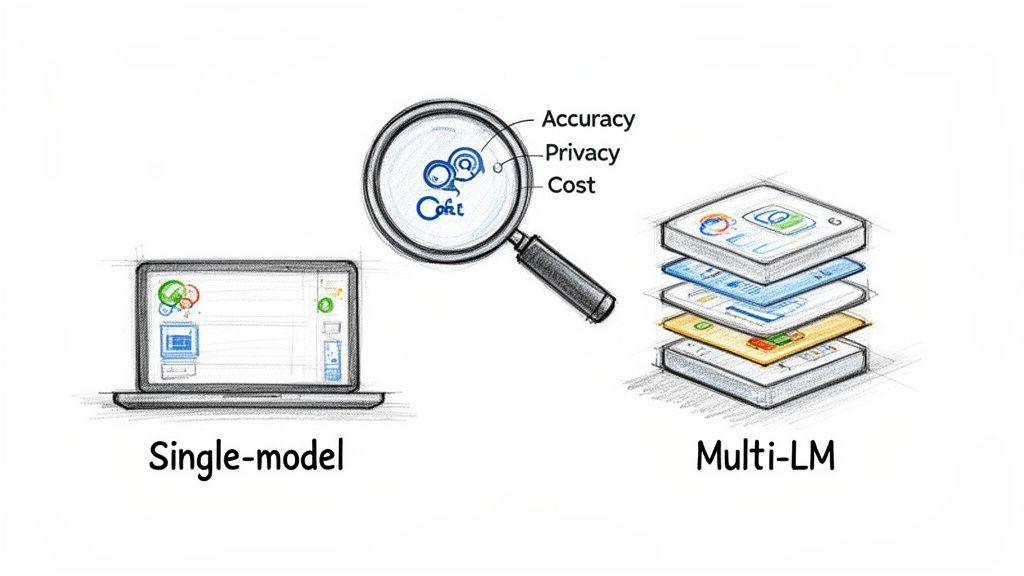
Single-Model Tools Versus Multi-LLM Platforms
Most of the free, quick-translation websites you find run on a single Large Language Model (LLM). They're convenient for a fast lookup, but they often fall short when the language gets complex. They can easily get tripped up by regional dialects or miss the subtle context of a phrase, giving you a translation that feels awkward or is just plain wrong.
This is where multi-LLM platforms, like 1chat, really shine. Instead of being stuck with one AI, you get access to several different models all in one interface.
Think of it like having a team of specialized interpreters instead of relying on one generalist. If one model fumbles a tricky phrase, you can instantly check its work against another model that might understand the nuance perfectly.
This approach gives you a massive advantage, especially with a language as rich as Swahili. A multi-model system essentially gives you a built-in "second opinion," letting you compare outputs and pick the translation that best fits what you’re trying to say.
Key Features to Look For
When you're sizing up an English to Swahili translator, you need to look past basic word-for-word conversion. Focus on the features that actually give you control and produce better results.
- Privacy and Security: This is non-negotiable. Does the platform have a crystal-clear privacy policy? For any confidential documents, you need to know your data isn't being logged or used for training. Privacy-first platforms like 1chat are designed specifically for this.
- Document Analysis: For students and professionals, being able to upload a whole PDF or Word doc is a game-changer. It allows the AI to see the full context of your work, not just isolated sentences, which leads to far more accurate translations.
- Cost-Effectiveness for Teams: If you're working with a team, you shouldn't have to pay a fortune for collaborative tools. Look for affordable team plans that don't come with a steep enterprise price tag.
- Real Contextual Understanding: The best tools use natural language processing to figure out your intent. They don't just translate words; they understand meaning. You can learn more about the power of natural language processing in our detailed guide.
At the end of the day, the right tool should feel like a partner. It gives you the flexibility and confidence you need to connect with Swahili-speaking audiences accurately and securely.
How to Write Prompts for Flawless Swahili Translations
I’ve learned over the years that the quality of an AI translation doesn't just hinge on the tool you pick; it comes down to how you talk to it. An english to swahili translator, even the smartest one, is essentially a very literal-minded expert. To get the best results, you need to give it clear, specific instructions. This whole process is called prompt engineering, and getting good at it is what separates a frustrating experience from a fantastic one.
Think of it like this: just pasting text and hitting "translate" is like handing a professional chef a bag of groceries with zero instructions. You might get a decent meal, but it probably won't be what you had in mind. When you provide details about context, tone, and your audience, you’re essentially handing the AI a recipe for success.
For instance, a simple phrase like "Let's grab a coffee" needs more information. Are you asking a potential business client in Nairobi or a good friend in Zanzibar? The Swahili will be completely different.
Specifying Tone and Formality
One of the first things you need to lock down is the tone. Swahili has very distinct formal and informal registers, and getting it wrong can make your message sound clunky, awkward, or even disrespectful. You have to tell the AI what you need.
- For formal situations: Try a prompt like, "Translate this into formal, professional Swahili. This is for a business email to a new client in Kenya."
- For informal chats: You could use, "Translate this into casual, friendly Swahili, as if I'm texting a close relative in Tanzania."
Adding this simple layer of direction steers the AI away from a generic, one-size-fits-all answer. Instead, you get a translation that feels natural and lands just right for your specific situation.
Never assume the AI understands your audience or your intent. The biggest jump in translation quality comes from spelling out the context clearly in every single prompt.
This is especially crucial when you're dealing with regional differences. A word that's common in Kenyan Swahili might be unfamiliar in the Democratic Republic of Congo. If you know where your audience is, add it to the prompt. You'll get a much more localized and effective translation.
Providing Essential Context
Context is, without a doubt, the most powerful ingredient you can add to a prompt. An AI translator has no idea about the backstory of your text unless you give it some clues. Without that, ambiguity becomes its worst enemy.
Let's say you need to translate, "The project launch was a great success."
A basic, low-effort prompt would be: Translate to Swahili: The project launch was a great success.
Now, look at how much more a context-rich prompt gives the AI to work with: Translate the following sentence for a company-wide announcement. The tone must be celebratory and professional. Our audience is the team in Dar es Salaam, Tanzania. "The project launch was a great success."
This detailed prompt clarifies everything: the purpose (company announcement), the tone (celebratory, professional), and the audience (Tanzanian team). The Swahili it produces will be far more precise and culturally on-point. If you want to get really good at this, you can learn more about the fundamentals of prompt engineering in our comprehensive guide.
By taking a few extra seconds to write a thoughtful prompt, you're not just translating words anymore. You're actively shaping the AI's understanding to make sure it delivers the exact meaning you're aiming for, saving you a ton of time on edits and preventing embarrassing miscommunications.
Where AI Translators Stumble: Idioms and Culture
This is where things get tricky—and where most automated tools fall flat on their face. A direct, word-for-word translation of an English idiom is a recipe for disaster. It can lead to confusion, unintentional humor, or even come across as offensive.
Just imagine telling a Swahili-speaking colleague to literally "break a leg" (vunja mguu) before a big presentation. They'd be more concerned for your sanity than thankful for the good wishes. The real magic of translation isn't just swapping words; it's about conveying the intended meaning. This is especially true when you're dealing with the unique expressions and cultural references baked into both English and Swahili.
From Literal Nonsense to True Meaning
Your first job is to spot the idioms in your own writing. Phrases like "bite the bullet," "the ball is in your court," or "it's raining cats and dogs" feel completely natural to an English speaker, but they're landmines for a basic translation engine.
You have to steer the AI away from a literal translation and point it toward the actual meaning.
- A weak prompt sounds like this:
Translate to Swahili: He really spilled the beans. - A much stronger prompt is:
I need to translate "he really spilled the beans" into Swahili. The original English phrase means someone revealed a secret they shouldn't have. Can you provide a common Swahili idiom or phrase that carries the same meaning of revealing a secret?
See the difference? The second prompt explains the intent. It gives the AI a concept to work with, not just a string of words. This is how you get a culturally rich equivalent like "amepasua mbarika" (he has burst the castor oil seed)—a fantastic Swahili idiom for letting a secret slip.
The biggest translation failures are almost always cultural. Grammar is getting easier for machines to handle, but a genuine feel for cultural context is what separates a basic tool from a truly professional one.
Checking for Cultural Blind Spots
Even when you're not using obvious idioms, culture can trip you up. A marketing slogan that sounds bold and exciting in English might feel arrogant or pushy in another context. You can actually use your AI translator as a first-pass cultural sensitivity checker.
This is a crucial step. Don't assume the tool is always right. For example, one study found that even a powerful tool like Google Translate only hit a 56% accuracy rate when translating newspaper headlines between English and Swahili. That’s a huge margin of error. It shows just how important smart prompting and a final human review really are. You can read the full study on translation accuracy to see the data for yourself.
Here’s how you can proactively check for these issues.
Example Prompt: I'm translating this marketing slogan for a new mobile app aimed at a Tanzanian audience. The English is: "Conquer your day with the ultimate productivity tool!" Could this "conquer your day" phrasing feel too aggressive or individualistic in that context? I'm looking for a more community-oriented tone. Please review for cultural appropriateness and suggest an alternative if you think it's needed.
Asking questions like this turns the AI from a simple dictionary into a helpful cross-cultural sounding board. It helps ensure your message doesn't just get translated, but is actually welcomed.
Your Post-Translation Quality Check Workflow
Think of your AI-generated translation not as the final product, but as a really strong first draft. It’s a huge head start, for sure, but getting it from "good enough" to "perfect" requires a human touch. A solid quality check is what separates a message that’s just understood from one that truly connects and commands respect.
Your first job is to do a side-by-side comparison. Pull up the original English and the new Swahili text and go through it, sentence by sentence. You’re looking for the big stuff here—any glaring omissions or places where the core meaning got twisted in translation.
Don't get bogged down in grammar just yet. This initial pass is purely about making sure all the key information made the journey from English to Swahili.
Consistency and Tone Review
Once you've confirmed the basic translation is solid, it's time to zoom in on consistency. If you’re translating a business proposal, for example, you need to make sure the Swahili term for a key concept like "stakeholder" or "deliverable" is the same every single time it appears. Inconsistency is a dead giveaway of a rushed translation and can confuse your reader.
Now, read the Swahili text by itself. Forget the English original for a moment.
- Does the tone feel right? Is it formal enough for that business proposal, or is it friendly and casual for a social media post?
- Do the sentences flow naturally? Or do they have that stiff, slightly "off" feeling that screams machine translation?
- This is also your chance to check every proper noun. AI can sometimes get creative with names of people, brands, and places. Make sure they were carried over exactly as they should be.
The goal here isn't just to hunt for errors. It's about smoothing out the awkward edges and breathing life into the text, something even the smartest AI can't fully replicate on its own.
We talk a lot more about this finishing process in our guide on how to humanize AI text. Applying those principles here will make a massive difference.
Using AI as Your Quality Partner
Here's a neat trick: you can actually use the AI to help quality-check its own work. One of the most effective methods I’ve found is "back-translation." Just take the Swahili text the AI gave you and ask it to translate it back into English.
If the resulting English is clunky, confusing, or a far cry from your original message, that's a huge red flag. It tells you that the nuance was likely lost in the first translation. It’s a simple test that can quickly highlight major misunderstandings.
This process helps you prompt the AI to find a cultural equivalent, not just a literal one.
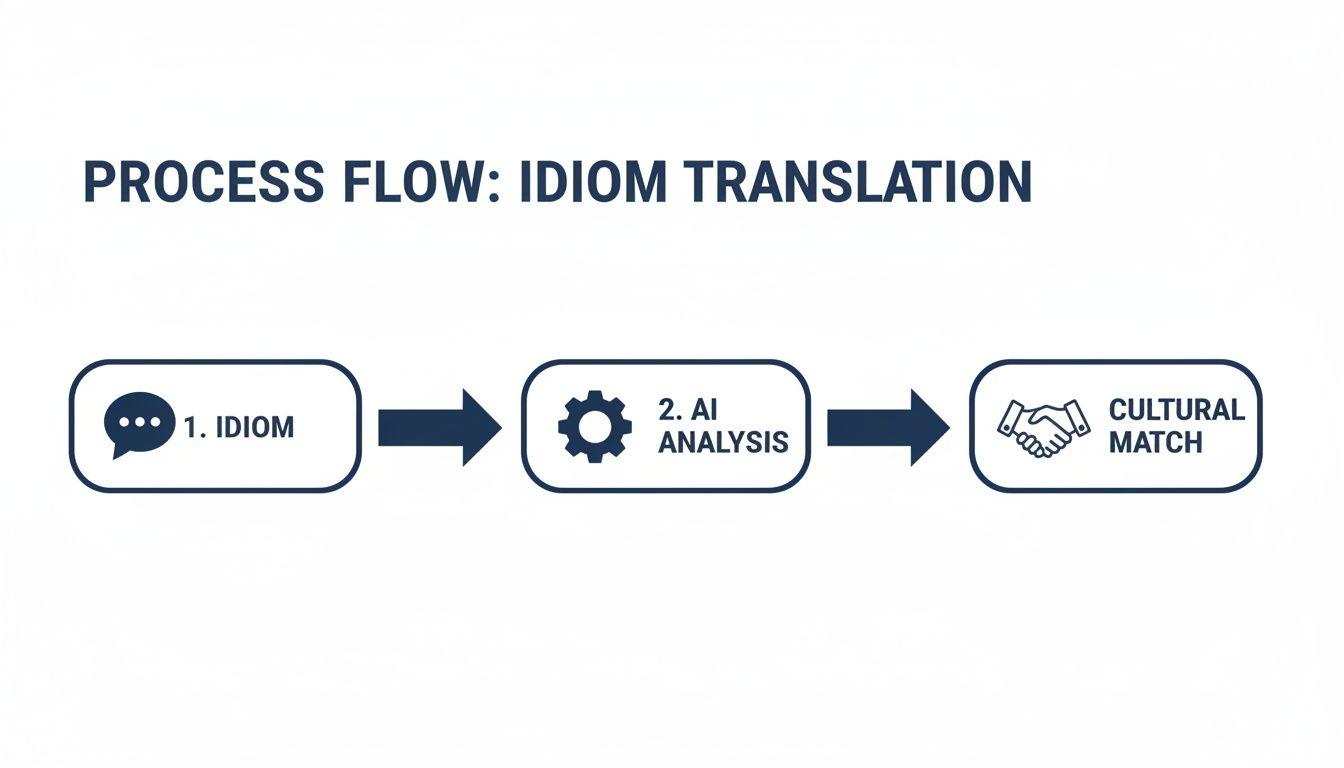
The real takeaway is that great translation goes beyond words to match the underlying ideas and cultural context.
You can also give the AI a direct proofreading assignment. Try a prompt like this:
Example Prompt: Please review the following Swahili text. It should sound natural to a native speaker. Flag any awkward phrasing or grammatical mistakes. The original English was: [insert original English text for context]. Give me a corrected version and briefly explain your changes.
When to Bring in a Human Expert
Let’s be clear: for anything mission-critical, the buck stops with a human. If you're working on a legal contract, a major ad campaign, or an important medical document, an AI-assisted workflow must end with a review by a native Swahili speaker. There's no substitute.
To make this collaboration as efficient as possible, give your reviewer the original English text, the AI-generated Swahili draft, and any notes you have. This gives them the context they need to quickly spot issues and focus their expert attention on the subtle cultural nuances and expressions that an AI might miss. This final human review is what turns a good translation into a flawless one.
Common Questions About Swahili Translation
When you start using AI for English to Swahili translation, you’re bound to have some questions. It's only natural. After working with these tools for years, I've heard just about all of them.
Let's walk through some of the most common concerns I hear from people, from hitting the right level of accuracy to dealing with tricky industry-specific language.
How Accurate Can AI Translation Really Be?
This is the first question everyone asks, and for good reason. The honest answer? It depends. Modern AI translation has come a long way, but its accuracy hinges entirely on what you're translating and how you ask.
For simple, factual sentences or internal memos, you can often get a translation that’s nearly perfect straight away. But the moment you introduce idioms, marketing slogans, or culturally specific ideas, the AI needs more help.
- Low-Stakes Content: For a quick email or understanding the gist of a document, the raw output is often good enough.
- High-Stakes Content: For anything customer-facing, like website copy or legal text, think of the AI's translation as a very strong first draft. It still needs a human touch.
The best results always come from giving the AI solid context upfront and having a native speaker review the output. That combination is what truly elevates the final accuracy.
Is It Expensive to Get Good Translations?
Many people assume that getting high-quality translation means signing a pricey enterprise contract. Thankfully, that’s not the case anymore.
For most day-to-day business or personal projects, you don't need a top-tier, enterprise-only tool. An affordable multi-LLM platform like 1chat often gives you the perfect mix of power and value. The real cost savings aren't just on the subscription price; they're in the time you save by avoiding embarrassing mistakes and endless manual corrections.
Think of it this way: a small investment in the right tool prevents costly errors down the line. It quickly pays for itself by saving you hours of cleanup and protecting your brand's reputation.
How Do I Handle Technical or Industry-Specific Jargon?
This is where many people get stuck. Translating something like a medical report or an engineering spec is tough because a standard AI model won't know the specific jargon for your field. If you just paste the text in, you'll likely get a literal—and wrong—translation.
The trick is to guide the AI. Before you translate a whole document, feed it a mini-glossary of the most important terms.
Here’s a prompt I’ve used that works well:
Translate the following paragraph into Swahili. This is for a technical manual, so the tone should be formal. Please use these specific terms: "data encryption" must be "usimbaji fiche wa data," and "user interface" must be "kiolesura cha mtumiaji."
By defining your key terms at the start, you're essentially teaching the AI the correct vocabulary. This ensures consistency and accuracy across your entire project. Of course, for anything in a regulated or highly sensitive industry, the final step should always be a review by a subject-matter expert who is also a native Swahili speaker.