Solid academic writing doesn't just happen. It's not about a sudden burst of genius or waiting for the perfect sentence to arrive. The best papers I've ever read—and the best ones I've ever written—were built on a strong foundation long before the first word of the introduction was drafted. This pre-writing phase is where the real work begins, turning a vague topic into a focused, compelling argument.
1. Master Your Planning and Research Workflow
I've seen it a thousand times: the paralyzing fear of a blank page. The root cause is almost never a lack of ideas. It's a lack of preparation. When you invest time upfront in planning your research and structuring your thoughts, writer's block simply doesn't stand a chance.
A messy start almost guarantees a messy, disjointed paper. Let's walk through how to build that solid foundation methodically.
From Vague Ideas to Strategic Research
First things first, you have to move past a simple Google search. That might be a fine starting point for getting a general feel for a topic, but serious academic work demands you dig deeper into credible, peer-reviewed sources.
Your university library’s databases are your best friends here. They unlock a world of scholarly journals, articles, and books you won't find on the open web. Get familiar with them.
Some of the heavy hitters you should know are:
- JSTOR: A massive repository for the humanities and social sciences.
- Google Scholar: Great for finding papers and, crucially, seeing who has cited them.
- PubMed: The go-to source for anything in the life sciences and biomedical fields.
- Field-specific databases: Always ask your professor or a research librarian what the top databases are for your specific discipline.
The real skill in research isn't just finding information—it's finding the right information. Your goal is to identify the key scholars, foundational texts, and current debates in your field. This shows you understand the conversation you’re about to enter.
It's also worth noting how much the research landscape has changed. A recent bibliometric analysis reviewing over 1,000 papers found a significant spike in academic writing publications since 2020. The study showed that top-contributing countries like the US, China, and the UK are rapidly adopting new digital research and writing methods. This just goes to show how intertwined technology and modern scholarship have become.
How to Organize Your Notes and Ideas
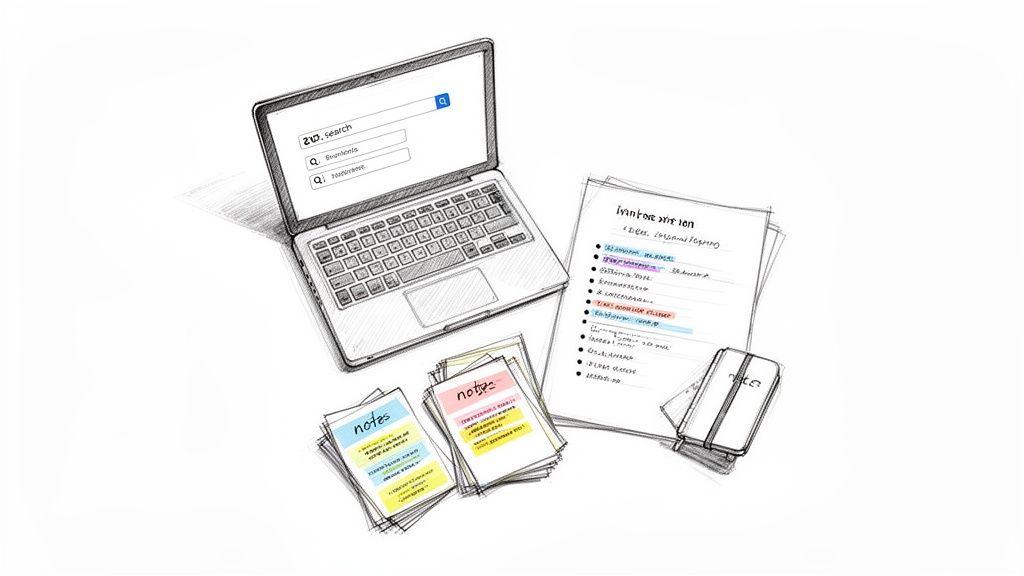
Once the research starts flowing, you need a system to catch it all. A folder full of random PDFs is digital chaos, not a research base. Your goal is to create a "second brain" where you can instantly find the quote, data point, or counterargument you need.
I always tell my students to start using a citation manager like Zotero or Mendeley from day one. Seriously, don't wait. These tools not only organize your sources but will save you countless hours by automatically generating citations and bibliographies later on.
As you read, practice active note-taking. Highlighting is passive. Instead, for every source, write a short summary of its core argument in your own words. Jot down how it supports or challenges your own developing thesis and how it connects to other sources you've found. This process forces you to actually engage with the material and starts building the skeleton of your paper.
For a detailed look at how to turn these notes into a coherent structure, our guide on creating an effective essay outline is the perfect next step.
Finally, don't be afraid to use modern tools ethically. For instance, a privacy-first AI assistant like 1chat can be a fantastic organizational partner. You can feed it your messy brainstorms or a list of key quotes and ask it to cluster them into potential themes or draft a preliminary outline. It gives you a structured starting point without sacrificing the integrity of your own critical thinking.
Building an Argument, Not Just a Report
Here's a hard truth I've learned from years of writing and editing: a paper packed with facts and sources isn't necessarily a good academic paper. It might just be a report. The real magic happens when you move beyond presenting information and start building a compelling, debatable argument.
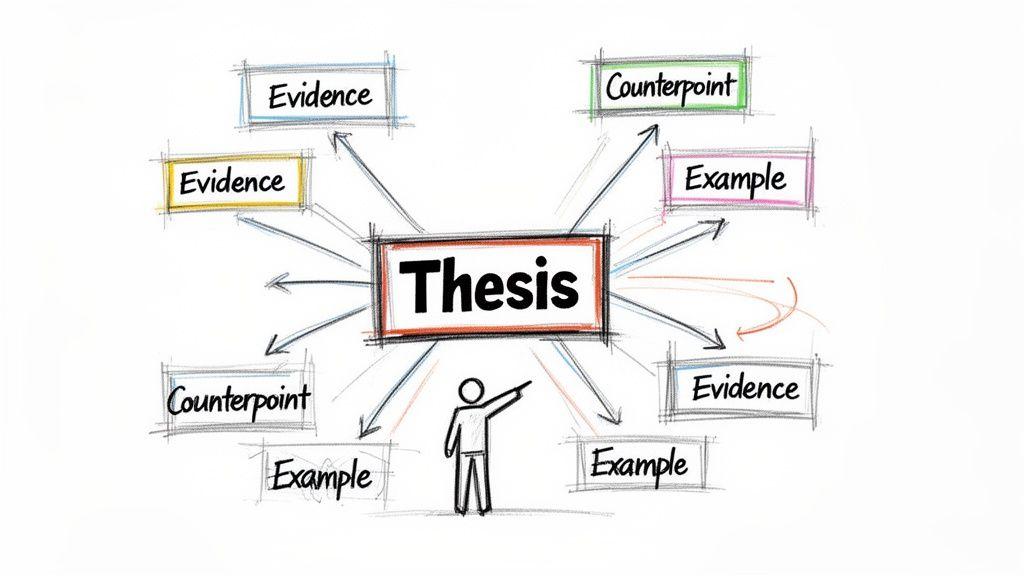
Your goal is to enter a scholarly conversation, offering a perspective that adds something new. This is what turns your work from a simple summary into a genuine contribution to your field. Everything in your paper—every paragraph, every piece of evidence—should be built to support this central argument.
Your Thesis: The Foundation of Your Argument
The entire backbone of your paper is your thesis statement. Think of it as the promise you make to your reader at the very beginning. A common trap is to mistake a topic for a thesis.
A topic is just a territory. For example, "renewable energy policies" is a topic. It's broad and doesn't make a claim. A thesis, on the other hand, takes a stand within that territory: "While national incentives are common, local, community-led solar projects provide a more equitable and resilient path to a sustainable energy transition." See the difference? The second one is an arguable position.
Your thesis shouldn't be an obvious fact that everyone agrees on. It has to be a claim that a reasonable person could challenge, which is what gives you room to build your case.
A truly effective thesis has a few key qualities:
- It's specific, zeroing in on a focused idea.
- It's debatable, presenting a claim that needs backing up.
- It’s a roadmap, signaling to the reader how the paper will unfold.
If you want to dig deeper, we have a whole guide on how to write a thesis statement that works. It’s a skill that pays dividends.
How to Weave Evidence Into Your Argument
Once your thesis is locked in, you can start weaving your research into a cohesive story. The biggest mistake I see is writers "dropping" quotes or data into a paragraph without any context. You can't just present evidence; you have to interpret it and explain why it matters to your argument.
A great way to do this is by using the "They Say / I Say" framework. You start by presenting what another scholar or source has found ("They Say"). Then, you connect it to your own point, explaining how it supports, complicates, or reframes your thesis ("I Say").
The best academic arguments are really just moderated conversations. You bring different sources to the table, let them "talk" to each other, and then step in to guide the reader toward your own conclusion.
For example, you could write: "Smith (2020) makes a compelling case that economic incentives are the primary driver of urban gentrification. While his analysis is valuable, my research in the Glendale neighborhood reveals that city-led cultural branding plays an equally critical—and often overlooked—role in resident displacement."
This shows you're not just a reporter summarizing sources; you're a thinker actively engaging with them.
Giving Your Argument a Logical Structure
A powerful argument needs a solid skeleton. The structure of your paper should logically follow the structure of your thesis. If your thesis has three main points, it’s a good bet that your paper’s body will have three main sections, each dedicated to exploring one of those points.
Use your topic sentences—the first sentence of each paragraph—as signposts. A strong topic sentence does two things: it introduces the paragraph's main idea and clearly links it back to your overall thesis.
This simple technique creates a clear path for your reader, making your reasoning easy to follow. It ensures your argument isn't just strong, but also perfectly clear from start to finish.
Writing With Clarity and Impact
You’ve done the heavy lifting—the research is solid and your outline is strong. But even the most groundbreaking ideas can get lost if they're hidden behind clunky sentences and academic jargon. A good structure gets your reader in the door, but clear, impactful writing is what convinces them to stay and listen.
This is where we get into the real craft of writing. It’s about making deliberate choices at the sentence and paragraph level so your ideas land with the force they deserve. When it's done well, the writing feels effortless to the reader, but that's only because of the careful work you put in.
Anchor Your Paragraphs with a Strong Claim
Think of each paragraph as a self-contained unit with one specific job to do. The very first sentence—the topic sentence—is its mission statement. It needs to make a clear, arguable claim that tells the reader exactly what point you're about to prove in that paragraph.
It’s easy to fall into the trap of starting with a simple statement of fact. For instance, you might write: "Many studies have explored the effects of social media on teenage mental health." That’s true, but it doesn’t give the reader any direction. It’s a passive observation.
A much stronger approach is to lead with your analysis. Consider this instead: "While often blamed for a decline in well-being, social media platforms can also foster crucial support networks for marginalized teens, complicating the narrative of uniform harm." See the difference? This sentence makes a specific claim that the rest of the paragraph must now back up with evidence. It immediately engages the reader and keeps your own writing focused.
Cut Through the Clutter with Precise Language
Academic writing has a reputation for being dense, and frankly, it's often earned. We sometimes think complex words and tangled sentences make us sound smarter, but they usually just frustrate the reader and muddy our point. Your real goal should always be precision and directness.
Your best friend in this fight is the active voice. It instantly makes sentences shorter, more dynamic, and clearer by putting the person or thing doing the action right at the front.
This is one of the most common issues I see. A sentence like, "It has been suggested by researchers that a significant reduction in emissions can be achieved through the implementation of new policies" is a mouthful at 22 words.
Let's clean that up. How about: "Researchers suggest new policies can significantly reduce emissions." That’s just 8 words. It's not only shorter but also has more energy. Be ruthless in hunting down phrases like "it is believed that," "it has been found that," or "the fact that." You can almost always say the same thing more directly.
Weave Your Ideas Together with Smooth Transitions
Transitions are the ligaments of your paper, connecting the bones of your argument. Without them, your writing can feel like a disconnected list of facts, leaving the reader to guess how one idea relates to the next.
Good transitions are more than just dropping in a "however" or "therefore." They are signposts that signal the logical relationship between your thoughts.
- To add or reinforce an idea: moreover, furthermore, in addition
- To signal a contrast or shift: conversely, in contrast, on the other hand, however
- To introduce an example: for instance, to illustrate, specifically
- To show a result or consequence: consequently, as a result, thus, therefore
Using these cues helps your reader follow your train of thought effortlessly. It’s what separates disjointed drafts from polished, persuasive arguments and is a key skill for improving your academic writing.
As academic culture shifts, there's a welcome move toward plain English. This is happening just as AI writing assistants are becoming more common. While these tools can be helpful, students have real concerns. Recent findings show 85% are afraid of losing their unique voice, 75% worry about their critical thinking skills declining, and 70% fear becoming too dependent on the tech.
The smart approach is to use these tools as a partner for improving clarity—like a grammar coach—not as a ghostwriter. For a deeper look at this, you can check out more findings about academic writing trends.
A Modern Approach to Revision and Editing
Let’s be honest: great academic writing rarely, if ever, happens in a single draft. The real magic happens during the rewriting process. This isn't about a quick, last-minute spell-check. It’s about adopting a strategic, multi-layered approach to editing that can elevate a rough draft into a polished, compelling paper.
By breaking the process down into distinct phases, you can focus your attention and methodically improve your work.
First, Look at the Big Picture
Before you worry about a single comma or awkward word, you need to act like an architect reviewing the building's foundation. This is the structural editing phase, and it’s all about the logic and flow of your argument.
At this stage, I completely ignore grammar and word choice. Instead, I ask myself some hard questions about the paper's core:
- Does the argument make sense? Is there a clear, logical path from my introduction to my conclusion?
- Is my thesis statement easy to find, and does every single paragraph actually support it?
- Have I gone off on a tangent anywhere? (It’s easy to do, and this is the time to catch it).
- Is my evidence compelling and presented in an order that builds a strong case?
This is where you make the big, sometimes painful, decisions. You might find yourself moving entire paragraphs, rewriting a clunky thesis, or even deleting a whole section that, while interesting, just doesn't serve the main point. The goal is to make sure the skeleton of your paper is solid before you move on.
Sharpening Your Style and Clarity
Once you're confident in the structure, it's time to zoom in for the line editing. Here's where you get down to the sentence and paragraph level, polishing your prose to make it clear, concise, and authoritative. Every word should earn its place.
A brilliant argument can get completely lost in a fog of confusing sentences and jargon. Line editing is how you clear that fog so your ideas can shine.
During this stage, I zero in on cutting wordiness, swapping out weak verbs for powerful ones, and making sure my sentences flow together smoothly. One of the best tricks I’ve learned is to read my work aloud. It’s amazing how quickly your ear catches clunky phrasing that your eyes just skim over. This is where good writing starts to feel great.
The infographic below captures the essence of what you're trying to achieve here.
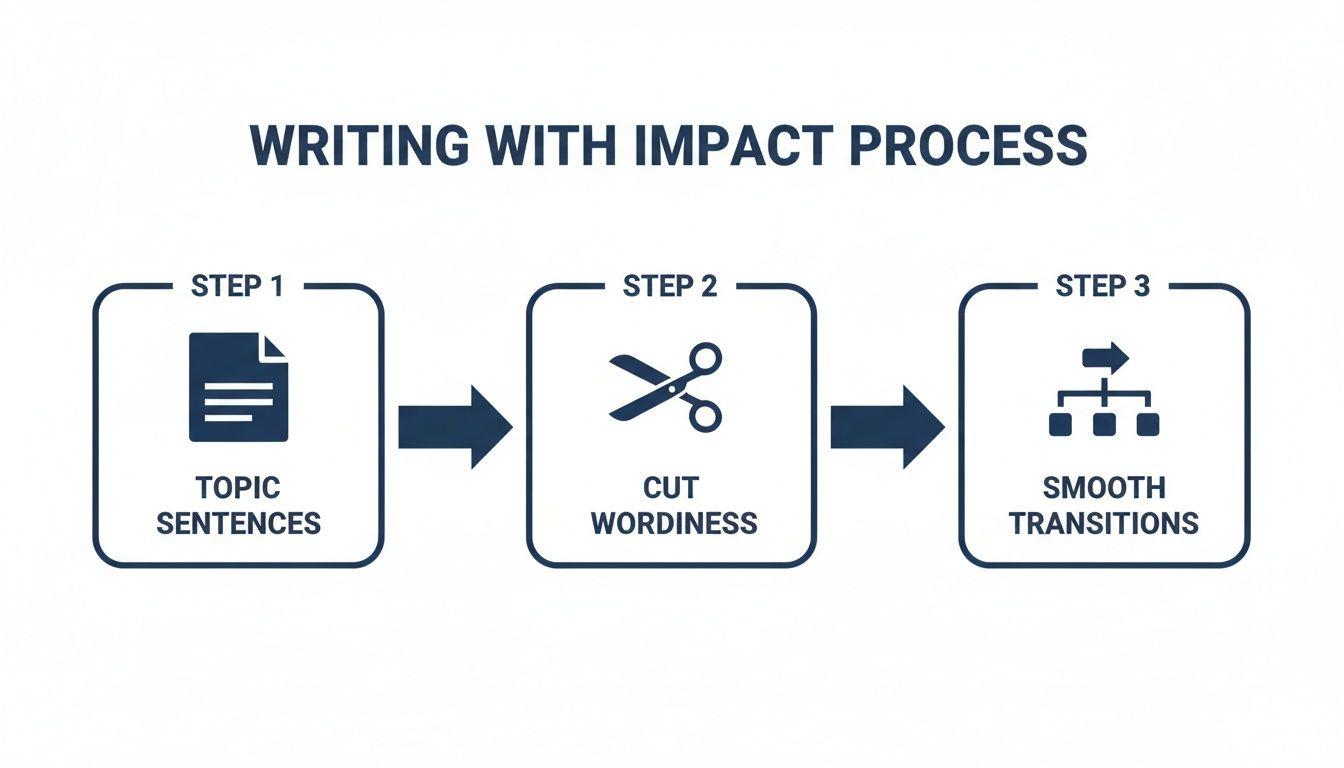
Focusing on strong topic sentences, ruthlessly cutting fluff, and building smooth transitions is the heart of effective line editing. It turns dense academic text into clear, impactful communication.
The Final Polish and Ethical AI Use
Finally, we have proofreading. This is your last line of defense. By now, your argument is solid and your style is sharp, so your only job is to hunt down typos, grammatical goofs, and formatting errors. To trick my brain into seeing the text fresh, I’ll often change the font or read the paper backward, one sentence at a time.
This is also where modern tools can be a huge asset. The academic world is becoming more digital every year. Projections show that by 2025, nearly 80% of academic publications will incorporate digital or AI-driven elements, making tech literacy more important than ever. You can read more on these evolving academic writing trends on Rescrito.com.
Using a privacy-first AI writing assistant like 1chat can be an ethical and effective way to supercharge your proofreading. You can ask it to check for grammar, find repetitive words, or suggest more concise phrasing. The key is to treat it as a highly advanced proofreader, not as a co-author. The ideas, the argument, and the final say on every word must remain yours. This way, you preserve your academic integrity while giving your work a final, professional polish.
Navigating the world of academic tools, especially AI, can feel like walking a tightrope. It’s a new kind of digital literacy, and frankly, it’s easy to get wrong. But learning how to use these tools smartly and ethically is a skill that will set you apart—it’s all about building a workflow that’s efficient without compromising your intellectual honesty.
The most important thing to grasp is the difference between two kinds of AI. Generative AI is what most people think of—it creates new text from a prompt. Assistive AI, on the other hand, acts more like a super-powered grammar checker, helping you refine what you’ve already written. Using generative AI to write any part of your paper is a serious breach of academic integrity. The real value for students lies in using assistive AI as a tool to become a better writer.
Drawing the Line: Ethical AI Assistance vs. Plagiarism
Where’s the boundary between a helpful tool and a cheating machine? It all comes down to who is doing the actual thinking. If you’re using AI to generate ideas, structure your argument, or write the sentences themselves, you’ve crossed the line into academic misconduct.
Think of it this way: asking a writing tutor to point out a confusing paragraph is a great way to improve. But asking them to rewrite it for you? That's not your work anymore. Ethical AI use is like having that tutor on call 24/7. It can flag weak spots and suggest alternatives, but you remain the author. You make the final call, and the intellectual work remains yours.
The guiding principle is simple: AI should be your assistant, not your author. The moment it starts generating the core ideas or phrasing for you, you’re not just cheating—you’re cheating yourself out of the learning process.
Knowing when and how to use AI ethically is crucial for maintaining academic integrity. This table breaks down common academic tasks, showing the clear difference between using AI as a legitimate assistant and using it to plagiarize.
Ethical AI Use in Academic Writing
| Task | Acceptable Use (Assistance) | Unacceptable Use (Plagiarism) |
| Brainstorming | Generating a list of potential research questions or keywords based on your initial topic. | Asking the AI to create a full research question and thesis statement for you. |
| Outlining | Submitting your rough notes and asking the AI to organize them into a logical structure. | Having the AI generate a complete outline from a simple prompt without your own ideas. |
| Summarizing | Pasting a long scholarly article to get a summary for your personal notes to speed up research. | Using an AI-generated summary of a source directly in your paper without reading the original. |
| Clarity & Style | Highlighting a sentence you wrote and asking for alternative phrasings to improve clarity or conciseness. | Copying and pasting AI-generated sentences or paragraphs into your draft. |
| Grammar | Running your completed draft through a tool to catch typos, grammatical errors, and punctuation mistakes. | Accepting all AI suggestions without review, potentially changing the meaning of your sentences. |
As you can see, the key is always ownership. When you guide the process and make the critical decisions, AI is a tool. When you outsource the thinking, it becomes a violation.
Choosing Privacy-First Tools for Academic Work
Here’s something many students overlook: privacy. When you use a free, public AI tool, you're often feeding your work directly into its training data. This means your unpublished research, brainstorming notes, and half-finished drafts could be absorbed by the model, posing a real threat to your intellectual property.
For any serious academic work, you should stick to privacy-first tools. These platforms are built with confidentiality in mind and explicitly state that they don't use your input to train their models. Your work stays your own.
A privacy-focused assistant like 1chat can be a game-changer when used correctly. Here are a few ethical ways to fold it into your workflow:
- Summarize Sources Efficiently: Drop in a dense, 20-page journal article to get a quick summary. This helps you instantly decide if it's relevant to your research, saving you hours of reading dead ends.
- Check Grammar and Style: Once your draft is done, use it as an expert proofreader. It will catch the sneaky typos and grammatical mistakes you’ve read over a dozen times.
- Improve Sentence Flow: Got a paragraph that just feels clunky? Highlight it and ask for suggestions on improving the transitions to make it read more smoothly.
- Explore Counterarguments: After you've locked in your thesis, ask the AI to play devil's advocate. This is a brilliant way to anticipate critiques and strengthen your own arguments before you ever submit the paper.
If you’re looking to explore more options, this guide to the best AI tools for writing papers offers a solid list of platforms that prioritize ethical and effective academic use.
The Non-Negotiable Role of Citation Managers
Finally, we have to talk about citations. All the ethical AI use in the world won’t save you if your citations are a mess. Remember, accidental plagiarism is still plagiarism, and sloppy source management is one of its leading causes.
A citation manager is not optional in modern academia—it's essential. Tools like Zotero, Mendeley, or EndNote are your best defense. They organize your sources, store your notes, and automatically generate perfect in-text citations and bibliographies in whatever style you need. Get into the habit of using one from day one of any project. It will save you from a world of stress and protect your academic career.
Common Questions on Academic Writing
No matter how much you prepare, certain questions always seem to pop up on the path to becoming a better academic writer. Let's tackle some of the most common ones I've heard from students and researchers over the years. These are the real-world hurdles many of us face.
How Can I Make My Writing Sound More Academic?
This is probably the question I get asked most, and the answer surprises people. Sounding "academic" has very little to do with using ten-dollar words or convoluted sentences. In fact, that's a classic rookie mistake.
The real goal is to write with precision, objectivity, and a clear structure.
Instead of trying to sound smart, focus on being specific. Don't just say something "negatively impacts" a situation. That's too vague. Does it "exacerbate tensions"? Does it "hinder progress"? Each phrase paints a much clearer picture. That's what academic writing is all about.
A huge part of this is objectivity. You need to build a case based on solid evidence, not just your personal feelings. Ground every single claim in your research and steer clear of emotional or biased language.
On a practical note, stick to formal language. That just means no contractions (write "do not" instead of "don't") and avoiding slang. The aim is to sound authoritative and clear, not complicated.
What Is the Most Common Mistake in Academic Writing?
After reading thousands of papers, I can tell you the single biggest stumbling block is a weak or unclear thesis statement. It's the mistake I see more than any other. Too often, a paper just summarizes sources or describes a topic without actually arguing anything.
Your paper isn't a book report; it's a persuasive argument.
Your thesis is the one central claim that your entire paper must defend. Every paragraph, every piece of data, and every example should circle back to support that argument. If a section doesn't, you have to ask yourself why it's there.
Here's the difference:
- Weak Thesis (just a topic): "This paper will discuss the effects of social media on society."
- Strong Thesis (a real argument): "While often viewed as a tool for connection, social media algorithms actively foster political polarization by creating echo chambers that limit exposure to diverse perspectives."
See how the second one gives the paper a clear direction? It presents a specific, debatable claim. A fuzzy thesis leads to a wandering, unfocused paper, but a strong one is a roadmap for both you and your reader.
Is It Okay to Use AI Writing Tools?
Absolutely, but you have to be smart about it. The key is to use them ethically and as an assistant, not as a substitute for your own critical thinking. The line between help and cheating is all about who is doing the actual intellectual work.
It's perfectly fine—and often very helpful—to use a privacy-first AI assistant like 1chat for a few specific jobs. Think of it as a writing partner.
Good uses include:
- Brainstorming keywords for a literature search.
- Running a final grammar and spelling check on your finished draft.
- Rephrasing a clunky sentence that you have already written to make it clearer.
- Summarizing a dense article for your own notes to see if it's relevant to your project.
Where you cross the line into plagiarism is when you ask an AI to generate the core ideas, sentences, or paragraphs for you. Always check your university's specific policies on AI, as the rules can differ. The goal is to use these tools to sharpen your own skills, not to have them do the thinking for you.
How Do I Know if My Sources Are Credible?
Learning to vet your sources is non-negotiable. The strength of any academic paper is built on the quality of its evidence.
Your university library's academic databases (like JSTOR, PubMed, or Google Scholar) should be your first stop. You're looking for the gold standard: peer-reviewed journal articles, books from respected academic publishers, and reports from well-known research institutions. Always look at the author's credentials. Are they a recognized expert in this field?
Be highly skeptical of any source that has no clear author, fails to cite its own evidence, or shows no sign of an editorial review process. A credible source is never afraid to show you where its information came from.