You’re probably here because a paragraph is fighting back.
Maybe you’re staring at a blank line in an essay, trying to start the next paragraph without sounding repetitive. Maybe you’ve drafted a business email and the first sentence feels weak, vague, or buried under too much explanation. Or maybe you wrote a paragraph that seemed fine at first, then drifted halfway through and ended somewhere you never intended to go.
That happens to almost everyone.
A strong paragraph usually starts with one strong sentence. When that opening sentence is clear, the rest of the paragraph gets easier to write, easier to organize, and easier to read. When it’s weak, every sentence after it has to work harder.
If you’re also trying to sharpen your overall writing habits, this collection of expert advice on better writing is a useful companion. Good topic sentences don’t exist in isolation. They grow out of clear thinking, precise wording, and a strong sense of purpose.
Why Your Paragraphs Need a Strong Starting Point
A paragraph without a clear opening feels like entering a room in the dark. You can move around, but you’re not sure where anything belongs.
I see this often with students and professionals alike. A student begins a body paragraph with something broad like “Social media is important in modern life.” A manager starts a report paragraph with “There are several things to consider.” Both sentences are technically acceptable. Neither gives the reader a firm grip on what comes next.
That’s where a topic sentence earns its keep.
What a strong opening does for the reader
A strong topic sentence tells your reader two things right away. It tells them what the paragraph is about and what specific point the paragraph will make about that topic.
That matters because readers want direction. They don’t want to guess whether the paragraph is explaining a cause, making an argument, giving an example, or introducing a contrast.
A good topic sentence works like a road sign. It points forward before the paragraph starts moving.
When writers skip that sign, paragraphs tend to wander. One sentence introduces an idea, the next adds a loosely related detail, and by the end the paragraph is doing three jobs badly instead of one job well.
What a strong opening does for the writer
This isn’t just about helping the reader. It helps you write faster.
When your first sentence sets a clear direction, it becomes easier to decide what belongs in the paragraph and what doesn’t. You spend less time second-guessing and less time trying to fix a messy draft later.
Consider the difference:
- Weak start: “School uniforms are a common topic.”
- Stronger start: “School uniforms can reduce visible peer pressure by making student clothing less of a social signal.”
The second version gives you a path. You already know the next sentences should stay focused on peer pressure, clothing, and school environment. You’re much less likely to drift into cost, discipline, or school identity unless you choose to.
It matters outside school too
A lot of advice about how to write a strong topic sentence stops at essays. Real life doesn’t.
You need this skill in project updates, proposals, reports, business emails, client summaries, and marketing copy. In those settings, a topic sentence often does even more work because readers are busy and impatient. They want the point early.
If your paragraph starts well, your reader relaxes. They know where you’re taking them. That’s a small change with a big effect.
The Anatomy of a Powerful Topic Sentence
A topic sentence is not just the first sentence in a paragraph. It’s the sentence that gives the paragraph its job.
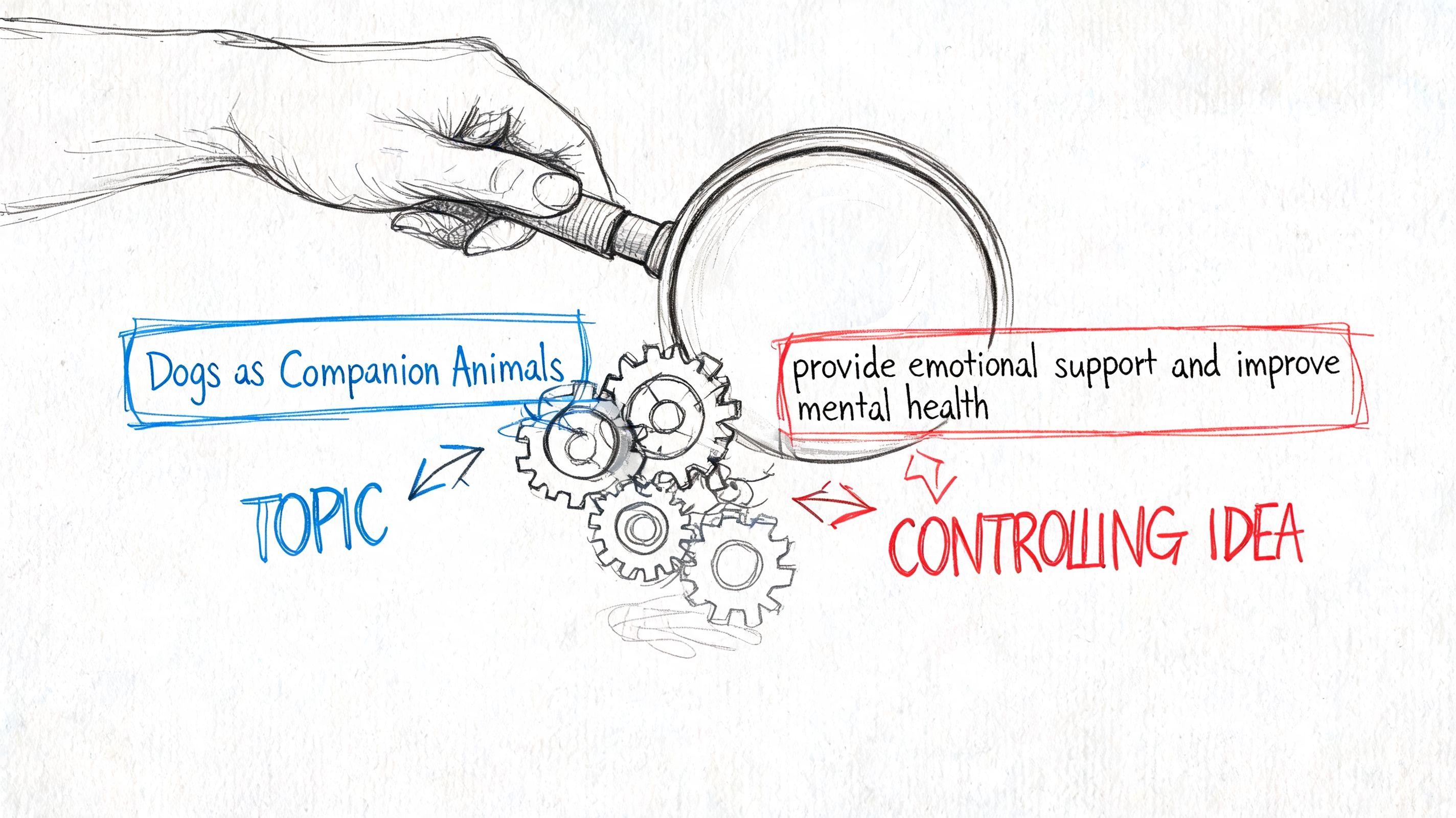
According to guidance on topic sentence and paragraph organization, effective topic sentences rely on a two-part structural foundation. They identify the topic and the controlling idea that narrows the focus. That’s the core design.
The topic is the subject
The topic is the general subject of the paragraph. It answers the question, “What is this paragraph about?”
Examples of topics:
- remote work
- electric cars
- recycling programs
- employee training
- Shakespeare’s imagery
A topic alone isn’t enough. If you write, “Remote work is changing business,” your reader knows the subject, but not your exact point.
The controlling idea is the focus
The controlling idea tells the reader what specific angle, claim, or takeaway the paragraph will develop. It narrows the topic so the paragraph doesn’t sprawl.
Examples:
- Remote work improves scheduling flexibility for working parents
- Electric cars still depend on charging access to become practical for more drivers
- Employee training reduces preventable mistakes when teams use new software
That second part is what gives the paragraph boundaries. It tells you what details belong and what details should stay out.
Practical rule: If your topic sentence names a subject but doesn’t limit the discussion, it’s probably too broad.
Put them together like a paragraph headline
Think of a topic sentence as a headline for one paragraph, not for the whole piece.
A headline doesn’t tell you everything. It tells you the main subject and the specific angle. Strong topic sentences work the same way. They make a promise the paragraph should keep.
Here’s a quick comparison:
| Weak topic sentence | Why it struggles | Stronger version |
| Technology affects education. | Too broad. No clear point. | Classroom technology helps teachers give faster feedback on daily assignments. |
| Exercise is good for people. | Generic and obvious. | Regular exercise can improve mood by giving people a steady routine and physical outlet. |
| Our sales team had a difficult quarter. | Vague. No direction. | Our sales team struggled this quarter because product messaging changed too often. |
A topic sentence acts like a mini-thesis
If a thesis statement guides the whole paper, a topic sentence guides one paragraph.
That’s why it helps to think of it as a mini-thesis. It doesn’t just announce the subject. It makes a smaller, more focused claim that the paragraph will support.
If you’re still working on the relationship between a thesis and body paragraphs, this guide on how to write a thesis statement can help connect the bigger picture.
Why this structure improves coherence
When your topic sentence includes both the topic and the controlling idea, your supporting details have a target. They aren’t floating.
That’s also why repeating key words from your thesis inside your topic sentences can strengthen the connection between paragraphs. If the language lines up, the reader can feel the structure. The writing starts to sound organized because it is organized.
Writers often think coherence is something mysterious. Usually, it’s much simpler. Clear paragraph openings create clear paragraph development.
The sentence should match what follows
This part trips people up. A strong topic sentence isn’t strong only because it sounds polished. It’s strong because the rest of the paragraph develops it.
If your topic sentence says, “Hybrid meetings create communication problems when remote staff cannot read in-room cues,” then the paragraph should stay on hybrid meetings, communication problems, and in-room cues. If you drift into office rent, commute time, or team lunches, the sentence and paragraph stop matching.
That mismatch is one of the fastest ways to lose clarity.
The Simple Formula for Crafting Perfect Topic Sentences
Topic sentences are often treated like inspiration. This makes the blank page feel worse than it needs to.
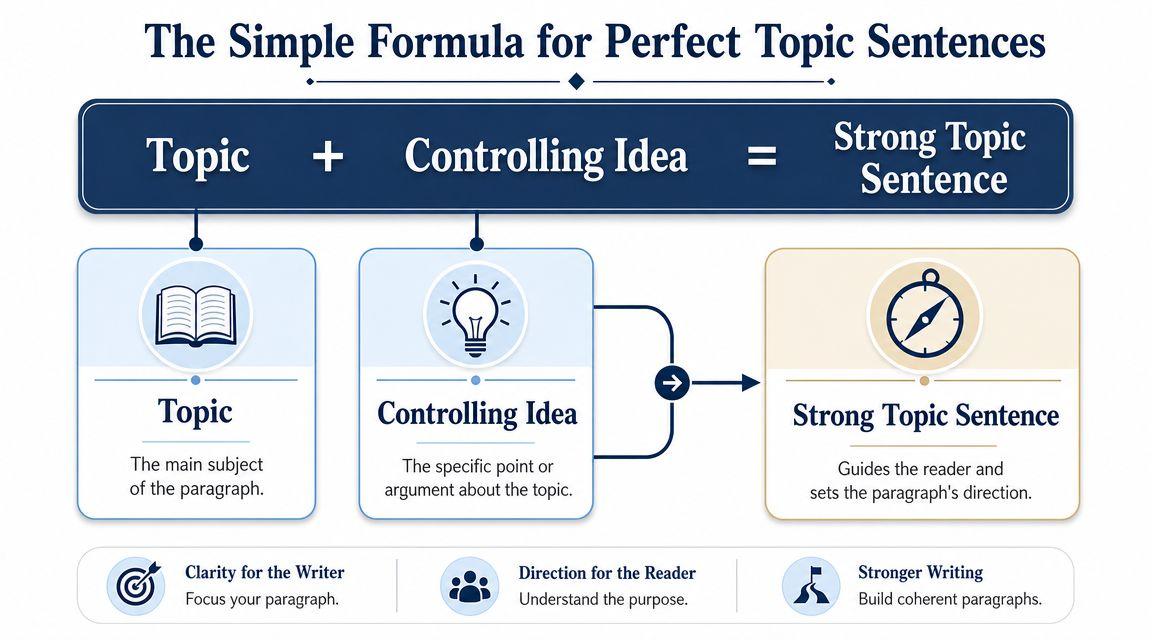
A better approach is to use a repeatable formula:
Topic + Controlling Idea = Strong Topic Sentence
That’s it. Simple, but reliable.
Start with the topic
First, name the subject of the paragraph as plainly as possible.
Don’t reach for fancy language yet. Just identify what you’re discussing.
Examples:
- customer onboarding
- the novel’s setting
- after-school jobs
- climate policy
- staff training
If you can’t name the topic in a few words, you probably don’t know the paragraph’s purpose yet. Stop and clarify that before drafting the sentence.
Add the controlling idea
Next, ask yourself one useful question:
What specific point am I making about this topic in this paragraph?
Your answer becomes the controlling idea.
Try these examples:
- customer onboarding → confuses new users when instructions arrive in the wrong order
- the novel’s setting → creates a feeling of isolation that mirrors the main character’s fear
- after-school jobs → help teenagers build time-management habits
- staff training → works best when it includes hands-on practice
Now you have direction.
Combine them into one sentence
Once you have both parts, join them in a sentence that sounds natural.
Examples:
- Customer onboarding confuses new users when setup instructions arrive in the wrong order.
- The novel’s rural setting creates a sense of isolation that mirrors the main character’s fear.
- After-school jobs help teenagers develop stronger time-management habits.
- Staff training works best when employees can practice tasks instead of only reading instructions.
Notice what these sentences do well. Each one names a subject and narrows the paragraph to one manageable idea.
Use a quick drafting process
When students say, “I know what I want to say, but I can’t write the sentence,” this short process usually helps:
- Write the subject in a word or phrase.
Example: “team meetings” - Write the point you want to make about it.
Example: “run long when no one sets a decision goal” - Turn that thought into a sentence.
Example: “Team meetings often run too long when leaders don’t set a clear decision goal.”
That sentence now gives the paragraph a lane.
If your paragraph could wander into five different directions, the topic sentence isn’t doing enough yet.
Improve weak sentences with before-and-after edits
Here are some common weak starts and stronger revisions.
| Weak version | Stronger version |
| College can be challenging. | First-year college students often struggle most when they haven’t built a consistent study routine. |
| Our company needs better communication. | Our company’s project delays often begin when design and sales teams use different deadlines. |
| Recycling is important. | City recycling programs work better when residents understand exactly what belongs in each bin. |
| This character changes a lot. | Macbeth’s ambition grows more dangerous once he begins to trust prophecy over judgment. |
The stronger versions are easier to support because they’ve already chosen a focus.
Add transitions when you need flow
A topic sentence also helps connect paragraphs, not just start them.
The CCSU guide to strong topic sentences notes that transitional term deployment matters for inter-paragraph coherence. It identifies continuity transitions, along with divergence transitions such as “However” and “On the other hand.”
That means your topic sentence can do two jobs at once. It can introduce the paragraph’s point and signal how that point relates to the paragraph before it.
For example:
- Flexible scheduling helps remote teams work across time zones more effectively.
- But flexible scheduling can also create delays when no shared response window exists.
- Yet the novel’s ending weakens that hopeful tone by returning to isolation.
Use transitions when the relationship between paragraphs needs to be clear. Don’t force them into every paragraph. If the connection is already obvious, a direct topic sentence is often better.
Keep the sentence clear before making it stylish
Some writers try to make the first sentence dramatic. That’s understandable, especially in essays and articles. But clarity has to come first.
A topic sentence can be vivid, elegant, or sharp. It just can’t be confusing. If the reader finishes the sentence and still doesn’t know the paragraph’s focus, the sentence needs revision.
A good test is this: after reading only the topic sentence, could someone predict what kind of support the paragraph will include?
If yes, you’re close.
Topic Sentences in Action with Real World Examples
Theory helps. Examples make it stick.
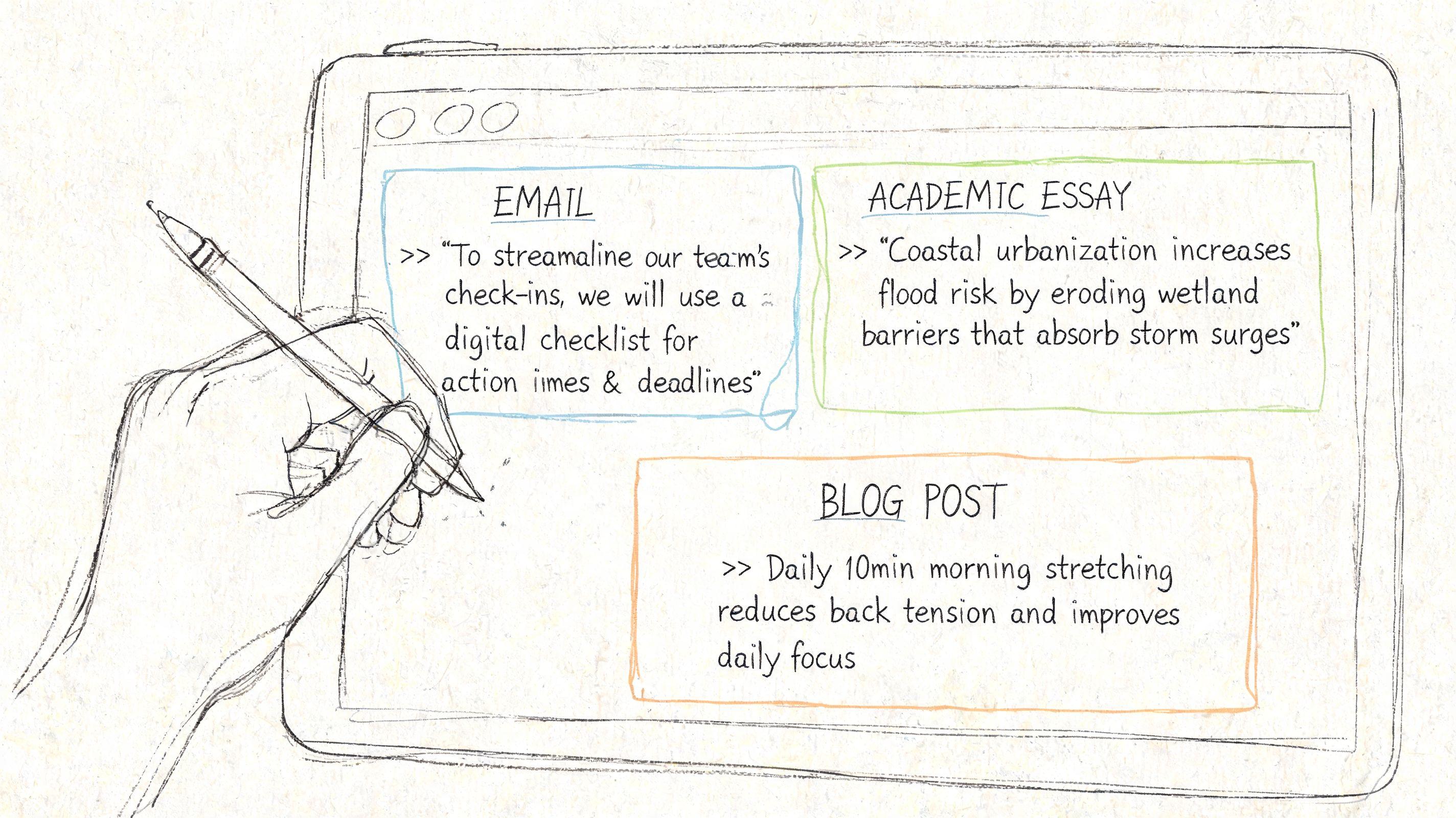
Often, guides on topic sentences stop too early. They show one school paragraph, maybe two, and move on. But people need topic sentences in more than essays. Non-academic writing has become a major need, and reporting on topic sentences in professional writing contexts notes rising search interest for business email topic sentences, with Google Trends data showing a +45% year-over-year increase. The same source says LinkedIn Learning reported 68% higher engagement in reports with quantified openers.
That helps explain why business writers increasingly want sharper first lines in reports and emails, not just school assignments.
For the high school essay
Students often write broad topic sentences because they’re trying to sound formal.
Here’s a typical example:
- Weak: “Bullying is a serious issue in schools.”
- Stronger: “Bullying often damages student confidence by making school feel unsafe and unpredictable.”
Why the second one works: it narrows the paragraph to confidence and school safety. That gives the writer a clear path for examples and explanation.
Another one:
- Weak: “Reading books is good for students.”
- Stronger: “Reading fiction helps students understand characters’ motives and emotions more.”
Now the paragraph knows where to go. It can focus on empathy, character perspective, and interpretation.
For the college research paper
College paragraphs usually need more precision. The reader expects a claim that can be developed with evidence, analysis, or interpretation.
Consider this pair:
- Weak: “Climate policy is an important issue around the world.”
- Stronger: “Local climate policy often succeeds faster when city leaders tie environmental goals to public transit improvements.”
The strong version gives the paragraph a specific argument. It doesn’t try to cover all climate policy.
Another example from literary analysis:
- Weak: “Symbolism is important in the story.”
- Stronger: “The recurring image of the locked door symbolizes the narrator’s growing fear of emotional exposure.”
That sentence gives the paragraph something to prove.
Strong academic topic sentences don’t try to sound grand. They try to sound precise.
For the business report
This is the gap many readers care about most.
In business writing, a topic sentence often needs to be direct, practical, and useful on first read. Readers may skim. They may read on a phone. They may only remember the first line of each paragraph.
Compare these:
- Weak: “There were several issues with the onboarding process.”
- Stronger: “The onboarding process slowed new hires because training materials were spread across too many platforms.”
The revised version identifies the process problem and the cause. A manager can act on that.
Another example:
- Weak: “Customer support has had some challenges recently.”
- Stronger: “Customer support response times slipped when agents had to switch between chat, email, and ticket tools.”
That topic sentence gives the paragraph structure. The rest can explain the workflow problem, show examples, and recommend a fix.
If you want more opening-line ideas for paragraphs in any setting, this list of good paragraph starters can help you vary your phrasing without losing clarity.
For the professional email
Emails need topic sentences too, especially when the message has more than one paragraph.
People often forget this because email feels informal. But if your email includes an update, request, explanation, or proposal, each paragraph still needs a clear opening.
For example:
- Weak: “I wanted to follow up about the timeline.”
- Stronger: “The revised timeline moves testing into next week so the design team can fix the final approval issues first.”
That sentence does more than “follow up.” It tells the reader the point immediately.
Another one:
- Weak: “There are a few reasons I think we should change vendors.”
- Stronger: “We should change vendors because the current platform makes invoicing slower and harder to track.”
Now the paragraph has a purpose. The next sentences can support that claim with specifics.
One topic, four contexts
Let’s use one general subject, remote work, and adapt it across contexts.
| Context | Strong topic sentence |
| High school essay | Remote work can help families spend more time together during the workweek. |
| College paper | Remote work changes team communication by shifting informal office exchanges into scheduled digital channels. |
| Business report | Remote work reduced scheduling friction for our team because fewer meetings required commuting buffers. |
| Professional email | Remote work will help this project move faster if we agree on a shared check-in window each day. |
Same general topic. Different readers. Different goals. Different topic sentences.
That’s the skill. You’re not memorizing one formula and forcing it everywhere. You’re learning how to match the sentence to the job.
Common Topic Sentence Mistakes and How to Fix Them
Most weak topic sentences fail in predictable ways. That’s good news, because predictable problems are fixable.
A lot of writers assume they just “aren’t good at openings.” Usually, the issue is more specific than that. The sentence is too broad, too hidden, too factual, or too disconnected from the paragraph that follows.
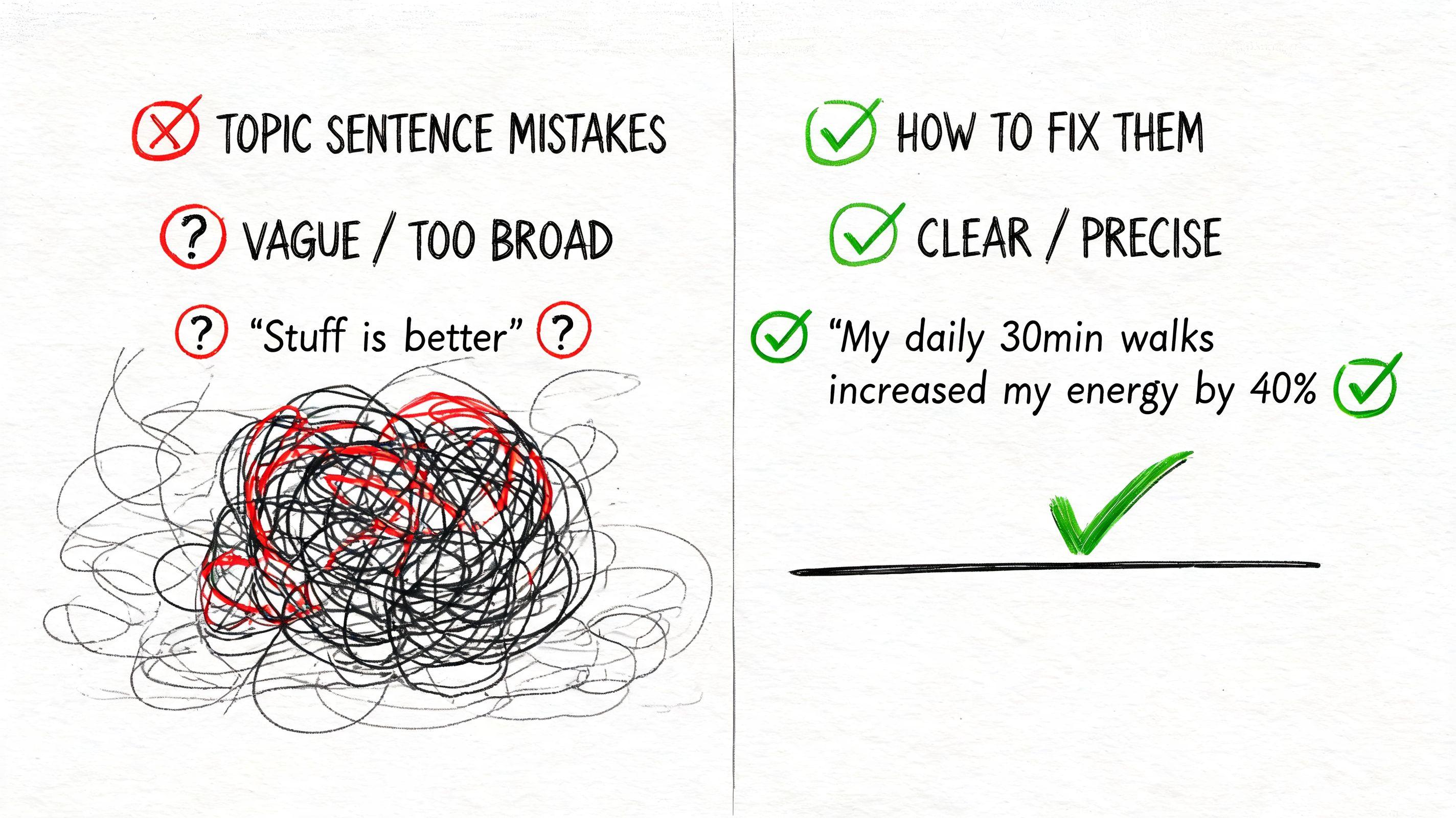
Mistake one: being too broad
Broad sentences sound safe, but they don’t guide the paragraph.
- Too broad: “History teaches many lessons.”
- Fix: “Studying the Great Depression shows how financial panic can reshape public trust in government.”
The revision gives the paragraph a clear frame. “History” is enormous. The Great Depression plus public trust is manageable.
Mistake two: stating a fact instead of making a point
A fact can appear in a topic sentence, but the sentence should still point somewhere.
- Flat fact: “The company changed its logo last year.”
- Fix: “The company’s logo change signaled a wider shift toward a younger and more digital brand identity.”
The first version reports. The second version interprets.
Mistake three: asking a question instead of giving direction
Questions can be interesting in introductions, but they rarely work well as topic sentences inside body paragraphs. Readers need orientation, not suspense.
- Weak: “Why do some students procrastinate?”
- Fix: “Many students procrastinate because large assignments feel harder to begin than smaller, defined tasks.”
That answer creates a paragraph. The question only opens one.
Mistake four: hiding the topic sentence in the middle
Sometimes the topic sentence is good, but it appears too late.
Example:
- Sentence 1: “Students face pressure from grades, family expectations, and social demands.”
- Sentence 2: “Many also struggle with sleep.”
- Sentence 3: “Lack of sleep makes it harder for students to concentrate in class.”
Sentence 3 is probably the primary topic sentence. It belongs at or near the start if that’s the paragraph’s main point.
Put the paragraph’s main claim where the reader can find it quickly.
Mistake five: promising one thing and discussing another
This is one of the most common drafting problems.
- Topic sentence: “Public libraries help communities by giving people free access to technology.”
- Actual paragraph: mostly discusses children’s story time and reading clubs
Those are worthwhile ideas, but they don’t match the sentence. Fix the problem one of two ways:
- revise the topic sentence to fit the paragraph, or
- revise the paragraph to fit the topic sentence
Writers often try to save both. That rarely works.
Mistake six: translating directly from another language pattern
This matters for multilingual writers, and it isn’t discussed nearly enough. The K12 topic sentence resource points to a British Council 2025 finding that 60% of English learners struggle with paragraph cohesion due to L1 interference. One reason is that direct translation may not match English expectations for paragraph structure, especially the expectation that the main point appears early.
That doesn’t mean your first language is wrong. It means English paragraph logic may ask for a different level of directness.
For example, some writers naturally build toward the point gradually. In English academic and professional writing, readers often expect the point first.
Try this adjustment:
- Indirect version: “In modern workplaces, with many communication styles and many kinds of technology, several issues can affect collaboration.”
- More direct English version: “Too many communication tools can make workplace collaboration slower and more confusing.”
The second sentence feels firmer because it leads with the claim.
A quick repair routine
If one of your topic sentences feels off, use this checklist:
- Underline the topic. Can you identify the subject in a few words?
- Circle the controlling idea. Does the sentence make a specific point about that subject?
- Read the rest of the paragraph. Do the details support that point?
- Move it upward. If the best sentence appears later, bring it closer to the beginning.
- Trim vague words. Replace words like “things,” “aspects,” “important,” or “good” with concrete language.
Most topic sentence problems aren’t signs of bad writing. They’re signs that the paragraph’s purpose hasn’t been made visible yet.
An Editing Checklist and Templates for Quick Starts
When the sentence feels slippery, a checklist can steady you. You don’t need to guess whether your topic sentence is working. You can test it.
A fast editing checklist
Read your topic sentence and ask these questions:
- Can I identify the topic immediately? If the subject is blurry, the paragraph will be blurry too.
- Does it include a controlling idea? A topic without a point is only half-finished.
- Is it specific enough for one paragraph? If it could lead to five unrelated directions, narrow it.
- Does it match the paragraph that follows? The sentence should preview the support, not compete with it.
- Is it clear on first read? If a reader has to reread it, simplify.
- Is it placed early enough? In most cases, it belongs at or near the beginning.
- Does it avoid filler language? Cut openings like “There are many reasons why” unless you truly need them.
- If it uses a transition, is the transition logical? “However” should signal contrast. “Furthermore” should continue an idea.
Read the topic sentence alone. Then read the paragraph alone. If they feel like they belong to different pieces of writing, revise one of them.
Templates that help you start faster
Templates are useful when you know your idea but can’t get the sentence moving. They’re especially helpful for students, report writers, and busy professionals drafting under time pressure.
Here’s a quick reference table.
| Writing Context | Template Example |
| Argument essay | [Topic] is most effective when [controlling idea]. |
| Literary analysis | [Element in the text] reveals [interpretive point about character, theme, or setting]. |
| Compare and contrast | While [subject A] emphasizes [feature], [subject B] focuses on [different feature]. |
| Cause and effect | [Cause] often leads to [effect] because [reason]. |
| Explanatory paragraph | [Topic] works by [specific explanation or process]. |
| Research paper | [Narrow subject] matters because it influences [specific outcome or issue]. |
| Business report | [Process or result] improved or weakened because [specific factor]. |
| Professional email | The main issue is [problem], which affects [task, timeline, or outcome]. |
| Proposal | [Recommended action] would help because it addresses [specific need]. |
| Marketing content | [Product, service, or feature] helps [audience] solve [specific problem]. |
Fill-in examples for non-academic writing
Business and workplace writers often need examples that sound natural outside the classroom.
Try these:
- This update matters because [change] affects [deadline, budget, or workflow].
- Our current process slows down when [specific obstacle].
- The strongest reason to choose [option] is that it [specific benefit].
- Customer feedback points to one recurring issue: [specific problem].
- This campaign performed well because [specific strength].
These don’t need to sound academic. They need to sound useful.
A simple revision trick
If you already have a weak draft, don’t start over immediately. Add a phrase that forces specificity.
For example:
- “Training is important.”
Add: for whom? for what? why?
Revised: “Training is most useful for new hires when it shows them how to handle common client questions.” - “The article is interesting.”
Add: how? in what way?
Revised: “The article becomes especially persuasive when it connects local flooding to everyday housing decisions.”
That one move often turns a vague sentence into a workable one.
Practice Prompts to Sharpen Your Topic Sentence Skills
The fastest way to improve is to practice on small, low-pressure prompts. Don’t wait for a full essay or major report. Write single topic sentences on purpose.
Try these academic prompts
Write one strong topic sentence for each:
- a paragraph arguing for or against school uniforms
- a paragraph about why learning a second language helps students
- a paragraph analyzing how setting affects mood in a novel
- a paragraph explaining why procrastination happens
- a paragraph about the effects of part-time jobs on teenagers
Try these professional prompts
Now switch contexts:
- a business email about a delayed shipment
- a report paragraph on why customer support tickets increased
- a proposal paragraph recommending a new scheduling process
- a marketing paragraph about the value of a loyalty program
- a team update about why a project timeline changed
Make the practice more useful
For each prompt, write:
- one weak version
- one stronger revision
- two or three supporting sentences that would belong under it
That last step matters. It tests whether your topic sentence can carry a paragraph.
If you want extra material to practice on, these creative writing prompts for students can give you fresh subjects to work with, even if your goal is academic or professional writing. A new prompt often helps you focus on sentence craft instead of overthinking content.
One final habit that builds skill quickly
Keep a small running list of topic sentences you like. Pull them from essays, reports, articles, newsletters, or your own drafts. Not to copy them. To notice how they work.
Ask:
- What is the topic?
- What is the controlling idea?
- How narrow is the focus?
- Would the rest of the paragraph be easy to predict?
That habit trains your eye. Once you can spot a strong topic sentence, you’ll write better ones.
A strong topic sentence doesn’t need to sound fancy. It needs to do its job. Name the topic. Narrow the focus. Guide the paragraph. That’s how to write a strong topic sentence in school, at work, and anywhere else clear writing matters.
If you want help drafting, revising, or testing your topic sentences with AI, try 1chat. It’s a privacy-first, family-friendly writing assistant for students, families, and small business teams who want help creating clearer, more natural writing.