That blinking cursor can feel louder than it should. You know what you want to say, but the first sentence of the paragraph will not cooperate. A student hits backspace six times trying to start an essay. A manager rewrites the opening of a report because it sounds flat. A parent helping with homework pauses over the same problem. How do you begin in a way that feels clear, natural, and strong?
The answer is not memorizing one magic phrase.
Good paragraph starters work because they match purpose. Some open a new idea. Some show contrast. Some introduce evidence. Some help you explain cause and effect. When you choose a starter based on the job it needs to do, your writing sounds more confident and your reader follows your thinking with less effort.
That matters more than many writers realize. Statistical openers can be especially persuasive because they replace vague claims with specific proof. One writing guide points out that phrases grounded in concrete numbers, such as “a significant portion of employees report that remote work has improved their productivity,” carry more authority than broad wording like “many people work remotely” (Try UniBox on statistical paragraph starters). You do not need statistics in every paragraph, but you do need intention in every opening line.
This guide gives you that intention.
Instead of dumping a long list of transitions, it organizes good paragraph starters by rhetorical function. You will see when to use them, why they work, and how to adapt them for student essays, workplace writing, and modern topics such as AI. You will also get practical templates you can reuse right away.
If your paragraphs often feel repetitive, abrupt, or hard to start, this is the fix. Start with the kind of paragraph you are trying to write. Then choose an opener that fits the task.
1. Introduction Starters
An introduction starter creates context fast. It tells the reader where the discussion begins and why the topic matters now.
That is why phrases describing a current context, like “In the modern professional environment” or “As more students use AI tools for research,” can work well. They place the reader inside a current situation before you make your main point.

When this kind of starter works best
Use this approach when the reader needs a frame before the argument begins.
A student writing about AI in schools might open with: “In modern classrooms, students are expected to research, draft, and revise faster than ever.” A business writer preparing an internal report might begin: “In the contemporary work environment, teams rely on AI tools to summarize information, draft messages, and organize research.”
Both examples do the same job. They set the scene, then point toward a problem or need.
A strong introduction starter often does one of these things:
- Names the setting: “In the current business environment…”
- Names the shift: “As more families use AI tools at home…”
- Names the pressure point: “With deadlines getting tighter…”
Templates you can borrow
These are flexible, not fixed. Adjust them to your audience.
- For essays: “In recent discussions about [topic], one concern stands out.”
- For reports: “In today’s [industry or workplace], teams face a growing need to [action].”
- For AI topics: “As AI tools become part of everyday work, users need clearer standards for [privacy, accuracy, or trust].”
- For education writing: “As students rely more on digital tools, writing clearly has become just as important as writing correctly.”
One mistake to avoid is staying too general for too long. If you open with broad context, follow it with a concrete issue.
Good opening lines create direction, not fog. Context should help the reader enter the topic, not wander around it.
If your introduction paragraph keeps growing, watch its length and shape. This guide on how many words should be in a paragraph is useful when you want your opening to feel readable instead of overloaded.
A practical example for an AI article could look like this: “In the evolving digital world, students and small teams often use AI to draft faster, but many still struggle to make that writing sound focused and human.” That opener works because it connects a current trend to a real writing problem.
2. Transition Starters
Some paragraphs do not need a flashy opening. They need a bridge.
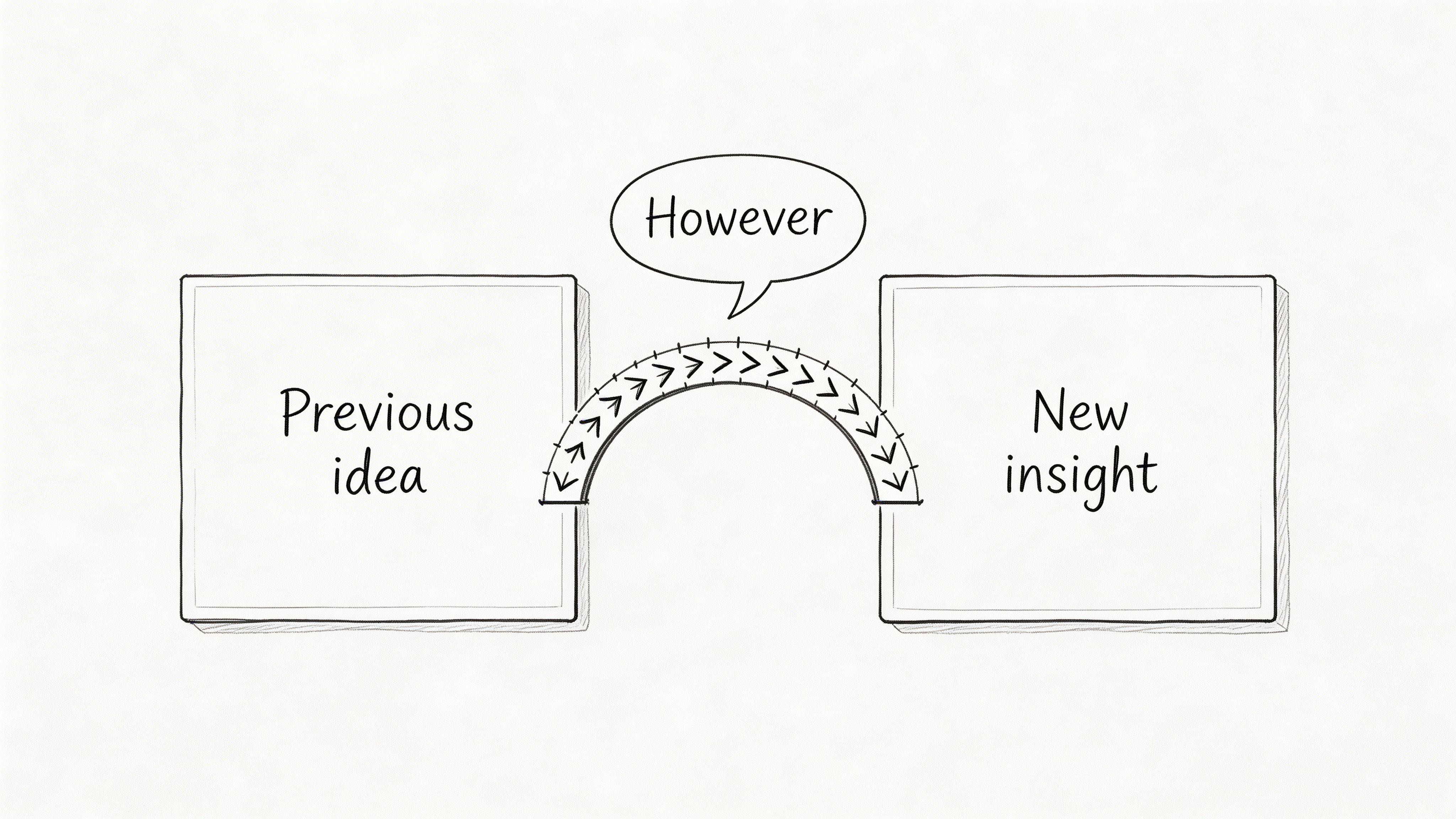
Transition starters help readers move from one idea to the next without feeling jarred. Good paragraph starters in this category include “However,” “Building on this idea,” “In addition,” and “By contrast.”
Match the transition to the relationship
Do not choose a transition because it sounds academic. Choose it because it describes the logic.
If your new paragraph disagrees with the previous one, use contrast: “However, speed is not the only factor students care about.” “On the other hand, a fast answer is not always a clear answer.”
If your new paragraph adds support, use addition: “Beyond that, the tool also helps organize source notes.” “Building on this foundation, the team can review drafts together.”
If your paragraph shows a result, use consequence: “As a result, writers spend less time fixing unclear structure.” “Consequently, the final report reads more smoothly.”
Real examples in everyday writing
A student essay might move like this:
“Many students use AI to brainstorm ideas for papers.”
Then the next paragraph begins:
“However, brainstorming alone does not solve the problem of weak paragraph structure.”
A business memo might work this way:
“The team adopted AI tools to speed up first drafts.”
Then:
“Building on that early success, managers began using the same tools for meeting summaries and internal updates.”
Those openings guide the reader without overexplaining.
Here are a few practical starter sets:
- For contrast: “However,” “In contrast,” “Even so,” “At the same time”
- For addition: “Further,” “Another reason is,” “Building on this”
- For shift in focus: “Meanwhile,” “In a different context,” “From the student’s perspective”
- For outcome: “As a result,” “Consequently,” “Because of this”
A common student mistake is overusing certain single-word transitions until every paragraph sounds the same. Strong transitions vary. Sometimes a full phrase works better than a single word.
For example, instead of “However,” try “However, there is a better approach for teams that need privacy and shared review.” That sounds more purposeful because the transition leads directly into the new point.
3. Example Starters
Abstract writing becomes easier to understand when you give the reader a clear case. Example starters do exactly that.
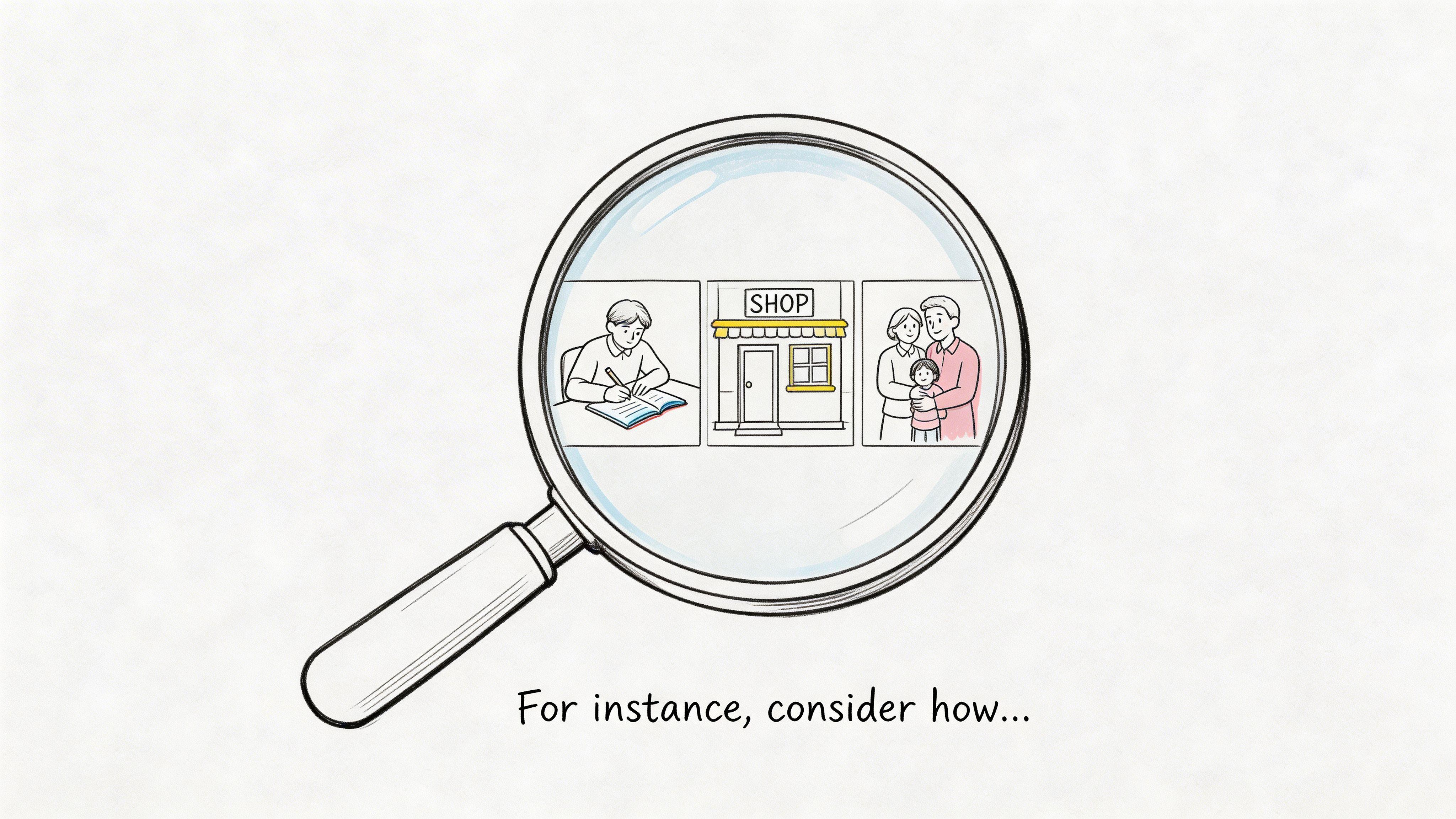
Useful openers include “For instance,” “A practical example would be,” “One clear case is,” and “Consider a student who…”
When you use good paragraph starters of this kind, you turn theory into something the reader can picture.
Why examples make writing stronger
Readers usually understand a concept faster when they see it in action.
Take this sentence: “AI tools can support different kinds of writing.” It is true, but vague.
Now compare it with this: “For instance, a college student might upload a PDF article, ask for a summary, and then use that summary to draft a clearer response paper.” The second version gives the idea shape.
The same principle works in professional writing. Instead of saying, “Teams can use AI for efficiency,” you could write, “A practical example would be a small marketing team using one workspace to draft email copy, summarize a client brief, and compare different wording styles before sending a campaign for review.”
Templates that keep examples focused
You do not need long stories. One or two sentences can be enough.
- Student template: “For example, a [grade level] student working on [assignment] could use [tool or method] to [specific task].”
- Workplace template: “A practical example would be a [team type] using [tool or process] to [specific outcome].”
- AI template: “One clear case is a writer using AI to generate a rough draft, then revising the tone and structure manually.”
Try these starter lines:
- For instance, a high school student revising a history essay may need help turning scattered notes into a coherent paragraph.
- A practical example would be a manager using AI to summarize a long PDF before writing a short recommendation memo.
- One clear case is a family comparing writing suggestions from different AI models before choosing the most age-appropriate response.
If a paragraph explains a concept that feels slippery, add a real scenario. Readers trust examples they can recognize from daily work or school.
One caution matters here. Do not force numbers or outcomes you cannot verify. A clear example can stay qualitative and still be strong. The point is to make the idea tangible, not to make it sound more scientific than it is.
4. Evidence and Support Starters
You draft a paragraph about AI in education or remote work, and the claim sounds reasonable. Then a reader asks, “Based on what?” An evidence starter answers that question in the first few words.
These starters are useful when the paragraph's job is to prove, not just explain. They signal rhetorical function right away. The reader knows that support is coming, whether you are writing a school essay, a policy memo, a business report, or an article about a fast-changing topic.
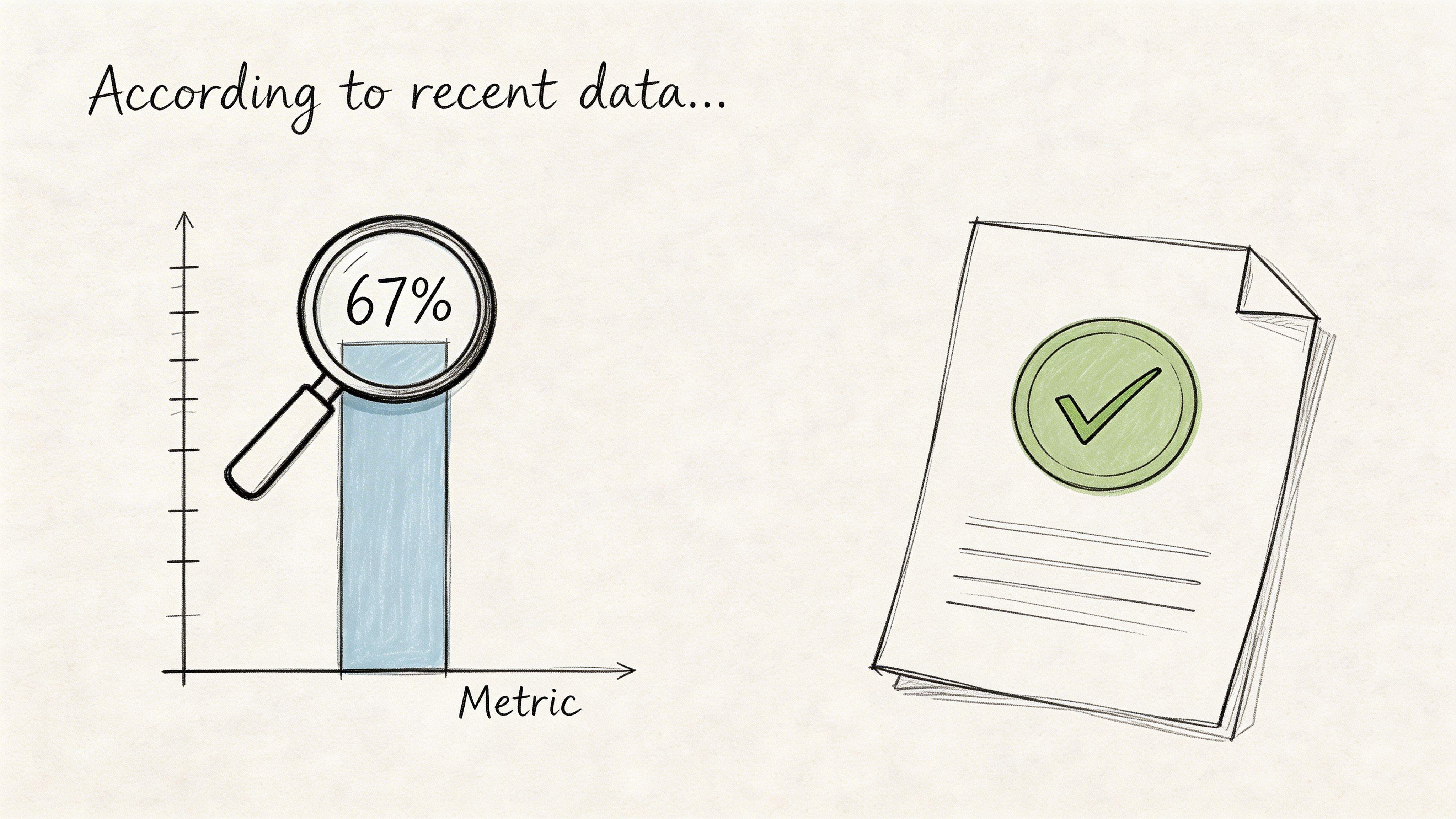
Common options include “According to recent data,” “A report from [source] found,” “Researchers at [institution] found,” and “Company guidance recommends.” Each one does a different job. Some introduce statistics. Some point to formal research. Some cite expert guidance or primary documents.
Match the starter to the kind of support you have
A good evidence starter works like a label on a folder. It tells readers what kind of proof they are about to open.
Use a data-led starter when numbers matter. Use a research-led starter when you want to show a pattern or finding. Use a source-led starter when credibility depends on who made the claim. If you are unsure whether a source is strong enough to lead a paragraph, this guide on what makes a source credible can help you choose more carefully.
For modern topics such as AI, this distinction matters even more. A paragraph about adoption trends needs different support than a paragraph about classroom use, privacy risk, or writing quality.
What strong evidence starters sound like
Here are practical patterns you can adapt:
- According to recent data, [group or trend] is changing in [clear way], which matters because [reason].
- A report from [source] found that [finding], suggesting that [practical takeaway].
- Researchers at [institution] found [result], which supports the idea that [your point].
- Company guidance recommends [practice], especially when [situation].
These templates keep you from making a common mistake. Writers often drop in a source and stop there. Evidence should not sit on the page like a loose brick. It should help build the paragraph's main point.
For example, compare these two openings:
Weak: “Research shows AI matters.”
Stronger: “According to recent data, organizations are using generative AI in more day-to-day tasks, which increases the need for clear prompts, human review, and plain-language policies.”
The second version gives the evidence a job. It connects the support to a conclusion the reader can use.
Practical templates for different writing situations
You do not need the same evidence starter for every audience.
- Student essay: “According to [author or study], [finding], which supports the argument that [claim].”
- Business report: “A report from [organization] found that [finding], pointing to a need for [action].”
- Analytical article: “Researchers at [institution] found [result], adding support to the view that [interpretation].”
- AI topic: “Recent reporting on AI use suggests that [trend], raising questions about [policy, accuracy, or workflow].”
Notice the pattern. The source comes first, then the finding, then the reason it matters. That structure keeps the paragraph clear even when the topic is technical.
Two habits improve these openings fast:
- Name the source clearly. Replace vague lines like “experts say” or “industry reporting indicates” with the actual source, or rewrite the sentence as general advice if no source belongs there.
- Interpret the support. Do not stop after the citation. Explain what the evidence helps prove.
A strong evidence starter does more than sound formal. It earns trust, frames the paragraph's purpose, and gives your reader a reason to keep going.
5. Contrast Starters
Contrast starters help you show difference with precision. They are useful when two ideas look similar at first glance, but lead to different conclusions.
Good paragraph starters in this group include “Unlike,” “In contrast,” “By comparison,” and “Rather than.”
Contrast creates clarity
Writers often think contrast is only for argument essays. It is not. It also helps in product comparisons, literature analysis, classroom reflection, and process writing.
For example:
“Unlike a generic list of transitions, a function-based approach helps writers choose a starter that matches the job of the paragraph.”
That sentence does not attack the old method. It explains why one approach is more useful.
You can use the same move in AI writing:
“In contrast to prompts that generate text without much guidance, a structured prompt gives the model a role, audience, and purpose.”
Or in source evaluation:
“Unlike a blog post that only offers opinion, a credible source gives evidence, context, and clear attribution.”
If you are teaching students to compare evidence, this resource on what is a credible source pairs well with contrast writing because it helps them explain not just that two sources differ, but how they differ.
Templates for clean comparisons
Here are a few easy structures:
- Unlike [common option], [better option] focuses on [key difference].
- In contrast to [idea A], [idea B] emphasizes [different value].
- Rather than [habit or approach], writers should [stronger approach].
- By comparison, [second example] shows [different result or feature].
A classroom example: “Unlike a weak topic sentence that announces the subject only, a strong paragraph opener also suggests the claim the writer will support.”
A workplace example: “In contrast to a rushed status update, a well-structured report paragraph makes the decision point easy to find.”
This category is especially useful when writing about AI tools, because many comparisons get muddy fast. If you want the reader to understand why one writing method feels more natural than another, contrast is one of the cleanest ways to do it.
6. Cause-Effect Starters
Some paragraphs need to explain why something happened or what happened next. Cause-effect starters make that relationship visible.
Strong options include “As a result,” “Because of this,” “Consequently,” “This leads to,” and “For that reason.”
Use these when your reader needs the chain of logic
This style works well in science writing, persuasive essays, policy analysis, and practical workplace communication.
For example: “Students often rely on repetitive openers in every paragraph. As a result, their essays can sound mechanical even when their ideas are good.”
That cause-effect line explains not just what happened, but why the result matters.
Here is another one for AI writing: “Users sometimes accept the first AI-generated paragraph without revising it. Consequently, the final draft may sound generic or mismatched to the assignment.”
The same pattern works in professional settings: “Teams often draft reports from scattered notes and long documents. Because of this, important points can get buried unless the writer creates clear paragraph openings that signal purpose.”
Simple formulas that help
Try one of these templates:
- Because [cause], [effect].
- As a result of [cause], [effect].
- This leads to [effect], which means [larger implication].
- For that reason, [action or conclusion].
These starters are especially helpful when you need to teach reasoning.
A student writing about AI in education might say: “Because students can generate ideas quickly with AI, teachers now place more value on revision, citation, and original analysis.”
A manager writing a report might say: “As a result of unclear handoff notes, the team spent extra time retracing earlier decisions.”
Cause-effect starters are useful when the reader might otherwise ask, “Why does this matter?” They answer that question immediately.
One warning: do not force causation where you only have correlation. If you cannot prove that one thing caused another, use softer wording such as “may contribute to” or “can lead to” unless your evidence clearly supports a direct link.
7. Emphasis Starters
Sometimes the reader needs a signal that a point deserves special attention. Emphasis starters help you highlight what matters most without sounding dramatic.
Useful versions include “Significantly,” “A key point is,” “A major observation is that,” and similar phrases.
Emphasis works best when used sparingly
If every paragraph announces itself as important, none of them feel important. Use emphasis when you want to spotlight a central takeaway, a caution, or a practical distinction.
Here is a writing example: “A strong paragraph starter should match the purpose of the paragraph, not just sound formal.”
That sentence is helpful because it points the reader to the main lesson.
Here is an AI-related example: “A key point is that AI can help generate options, but the writer still needs to choose, refine, and verify what belongs in the final draft.”
That keeps the human role visible.
Good ways to emphasize without sounding inflated
Try these patterns:
- A key takeaway: [main takeaway].
- A key point is that [central insight].
- A significant point is that [important limit or distinction].
- Significantly, [meaningful implication].
You can also use emphasis to correct a common misunderstanding.
For instance: “A key observation is that good paragraph starters are not just transitions. They can also introduce evidence, examples, definitions, or conclusions.”
Or: “Significantly, not every strong paragraph needs a stock phrase at the beginning. Sometimes the clearest opener is a direct sentence that states the point.”
That second example matters because many students think every paragraph must start with a transition word. It does not.
A useful real-world angle appears in writing guidance for non-native English learners. Some resources argue that generic starter lists do not serve every audience well, and that more context-specific support for ESL writers remains underdeveloped (Spines on good sentence starters). That is a reminder to emphasize fit, not formula. A phrase that feels natural for one reader may feel stiff or unnatural for another.
8. Conclusion Starters
Conclusion starters help you close a paragraph, section, or full piece with control. They are not just summary phrases. They signal that the main point has been gathered and shaped into a takeaway.
Useful openers include “Ultimately,” “In summary,” “Taken together,” and “The key takeaway is.”
What a strong concluding opener does
A conclusion starter should help the reader land, not just stop.
For example: “Ultimately, clear paragraph openings help readers follow complex ideas without extra effort.”
That sentence does more than repeat earlier wording. It compresses the value of the discussion into one clean takeaway.
A stronger conclusion often combines three elements:
- Synthesis: pull ideas together
- Judgment: say what matters most
- Direction: suggest what the reader should remember or do next
Templates for essays, reports, and AI topics
Use these when you need a concise ending:
- Ultimately, the key takeaway is that [main conclusion].
- In summary, this shows that [final point].
- Taken together, these examples suggest that [bigger meaning].
- Overall, the most effective approach is to [recommended action].
A student conclusion might say: “In summary, good paragraph starters improve not just flow, but the clarity of the argument itself.”
A workplace conclusion might say: “Ultimately, the report is more persuasive when each paragraph opens with a sentence that tells the reader what kind of information is coming next.”
An AI writing conclusion could say: “Taken together, these examples suggest that AI helps most when writers use it to develop ideas and then revise for accuracy, tone, and structure.”
If you want to strengthen endings in essays or reports, this guide on how to write a conclusion paragraph is a useful companion.
There is also a creative lesson worth keeping in mind. Some writing advice now pushes back against overusing preset starters, arguing that fixed opening formulas can weaken originality and authentic voice (Journal Buddies on paragraph starters). That does not make conclusion starters bad. It means they should support thinking, not replace it.
8-Point Paragraph Starter Comparison
| Starter Type | 🔄 Complexity | ⚡ Resource Needs | 📊 Expected Outcomes | 💡 Ideal Use Cases | ⭐ Key Advantages |
| Introduction Starters (e.g., describing current trends) | Low: one-line setup, needs minor tailoring | Minimal: quick customization and context research | High engagement and immediate relevance | B2B articles, student-facing content, family-focused posts | Establishes context quickly; sets professional tone |
| Transition Starters ("Building on this foundation..." / "However...") | Low–Moderate: requires logical alignment between sections | Low: editing to match flow and argument structure | Improved coherence and easier comparison | Comparisons, long-form explainers, implementation guides | Smoothes flow; signals contrast/addition clearly |
| Example Starters ("For instance, consider how...") | Moderate: needs audience-specific scenarios | Moderate: crafting concrete examples and metrics | Better comprehension and memorability | Students, small businesses, family use-cases | Makes abstract ideas tangible; increases relatability |
| Evidence/Support Starters ("Research demonstrates..." / "According to recent data...") | Moderate–High: requires accurate sourcing and currency | High: data access, citations, verification | Stronger credibility and persuasion for skeptical readers | C-suite decision-makers, administrators, privacy-conscious audiences | Builds trust with research-backed claims; differentiates on evidence |
| Contrast Starters ("Unlike traditional ChatGPT," / "In contrast...") | Moderate: needs accurate competitive knowledge | Low–Moderate: competitor research and careful wording | Clear differentiation and decision-making support | Users evaluating alternatives, budget-conscious buyers | Highlights unique positioning (privacy, affordability, multi-LLM) |
| Cause-Effect Starters ("As a result..." / "Consequently...") | Moderate: requires defensible logical links | Low–Moderate: framing and occasional supporting evidence | Persuasive narratives tying features to outcomes/ROI | Business ROI explanations, implementation case studies | Connects features to tangible benefits; clarifies impact |
| Emphasis Starters ("Significantly..." / "A key point is...") | Low: strategic placement required | Minimal: selective emphasis editing | Increased retention of key points | Privacy/family messaging, cost-savings highlights | Draws attention to critical differentiators; reinforces takeaways |
| Conclusion Starters ("Ultimately, the key takeaway is:" / "In summary:") | Low–Moderate: synthesize without redundancy | Low: concise summarization and CTA crafting | Strong final impression and clearer next steps | All article types aiming to convert or summarize | Reinforces core value propositions and motivates action |
From Blank Page to Polished Prose
The best good paragraph starters do not come from a giant list you memorize once and copy forever. They come from understanding what the paragraph needs to do.
That is the fundamental shift.
When your paragraph needs context, use an introduction starter. When it needs connection, use a transition. When the idea feels abstract, lead with an example. When your claim needs weight, open with evidence. When two ideas are easy to confuse, use contrast. When the reader needs logic, show cause and effect. When a point matters more than the others, use emphasis. When it is time to close, choose a conclusion starter that gathers the meaning instead of repeating the topic.
This function-first approach helps almost every kind of writer.
A middle school student can use it to stop every paragraph from starting with “First” or “Also.” A college student can use it to make research writing sound more controlled. A manager can use it to make a report easier to skim. A small business team can use it to draft clearer updates, proposals, and summaries. Even experienced writers benefit from it, because the hardest part of many paragraphs is not the idea itself. It is finding the right doorway into that idea.
There is another benefit too. Better paragraph starters often improve the whole draft. When the opening line is clear, the sentence after it usually becomes easier to write. The paragraph develops more naturally. The structure tightens. Revision gets simpler because each paragraph has a visible role.
That matters in modern writing about AI especially. The topic moves fast. Readers need signposts. They need to know whether a paragraph is introducing a trend, presenting evidence, giving an example, warning about a risk, or drawing a conclusion. If you choose your opener well, you reduce confusion before it begins.
Keep your standards simple:
- Match the starter to the job.
- Use plain language.
- Avoid repeating the same opener too often.
- Support strong claims with real evidence.
- Revise for natural tone, not just correctness.
One more point is worth remembering. A strong paragraph starter does not have to sound impressive. It has to sound useful. Clear beats clever most of the time. Readers stay with writing that helps them move forward.
If you want help generating, testing, and refining these kinds of openings while writing essays, reports, summaries, or AI-assisted drafts, 1chat offers a practical workspace for it. You can chat with multiple leading LLMs in one place, analyze PDF documents, generate images, and draft in a privacy-first environment built for students, families, and small teams. That makes it easier to experiment with wording, compare versions, and revise with more confidence.
The next time the cursor blinks at you, do not ask, “What should I say first?”
Ask, “What does this paragraph need to do?”
Your opening line usually gets much better from there.
Have a chat with all best LLMs in ONE place at 1chat.com.