A scholarly source is information that has been put through the wringer—in a good way. It’s been rigorously tested, checked, and approved by a community of experts before it ever reaches you.
Think of it like the difference between a Michelin-star restaurant and a fast-food joint. One involves a master chef, carefully sourced ingredients, and a meticulous process. The other is designed for speed and mass appeal. Both can serve a purpose, but only one is built on a foundation of deep expertise and quality control.
How to Spot a Scholarly Source in Seconds
In a world overflowing with articles, blogs, and opinions, knowing how to separate the deeply researched from the superficial is a superpower. This is a vital skill whether you're a student building a thesis or a business owner making a critical decision.
The secret isn’t just the topic, but the entire process behind the information. A scholarly work isn't just one person's bright idea, shouted into the void. It’s a formal, public conversation where an expert presents new research, and that research is then systematically torn apart and evaluated by their peers before it's published. This peer-review process is the ultimate quality filter, catching weak arguments, shoddy data, and unsupported claims.
Key Distinctions to Make
So, how do you tell them apart in the wild? It’s easier than you think once you know the signs.
Popular sources, like a news report or your favorite blog, are written for everyone. Their goal is to inform or entertain quickly, using everyday language and eye-catching images. They rarely show their work with a full list of references. For a closer look at what makes any source generally trustworthy, you can check out our guide on what is a credible source.
Scholarly sources have a completely different mission. They are written by experts, for other experts. The language is precise, technical, and objective because its purpose is to contribute new, verifiable knowledge to a specific field. The biggest giveaways are a formal structure (look for sections like an abstract, methodology, and results) and, most importantly, a long list of citations.
This table breaks down the differences for a quick side-by-side comparison. Keep it handy as a mental checklist when you're evaluating information.
Scholarly vs. Popular Sources at a Glance
| Characteristic | Scholarly Source (e.g., Journal Article) | Popular Source (e.g., Magazine Article) |
| Authors | Experts with credentials (e.g., PhD) and institutional affiliations. | Staff writers, journalists, or freelance authors; expertise varies. |
| Audience | Other researchers, scholars, and students in a specific field. | The general public; no specialized knowledge assumed. |
| Purpose | To report original research or new findings to the academic community. | To inform, entertain, persuade, or report on current events. |
| Evidence | Data from original experiments, extensive citations, and a full reference list. | Anecdotes, interviews, general facts, and rarely includes formal citations. |
By keeping these core differences in mind, you can quickly and confidently identify the kind of high-quality, authoritative information you need.
The Peer Review Gold Standard
If there's one thing that truly separates a scholarly source from all the noise out there, it's peer review. This isn't just a quick spell-check. It's a rigorous, often anonymous, gauntlet where a piece of research has to survive the intense scrutiny of other experts in the same field.
Think of it like a chef trying to earn a Michelin star. Their new dish isn't just served to random customers; it's meticulously judged by a secret panel of the world's most demanding chefs. That's the essence of peer review. It’s a formal process designed to ensure that only the most methodologically sound, original, and significant research makes it into the academic conversation.
How Does the Peer Review Process Actually Work?
The journey from a researcher's draft to a published article is a tough one. First, an author submits their manuscript to a journal. The editor gives it an initial read to see if it’s a good fit and meets basic quality standards. If it clears that first hurdle, it's sent out to a handful of "peers"—fellow experts who volunteer their time to tear the work apart, constructively.
These anonymous reviewers look at the work from every angle:
- Validity: Is the methodology solid? Are the experiments repeatable? Do the conclusions logically follow from the data?
- Originality: Does this work bring something new to the table, or is it just rehashing old ideas?
- Significance: Does this research actually matter? Will it push the field forward in a meaningful way?
This simple flowchart shows how peer review fits into a larger process of verifying a source's credibility.
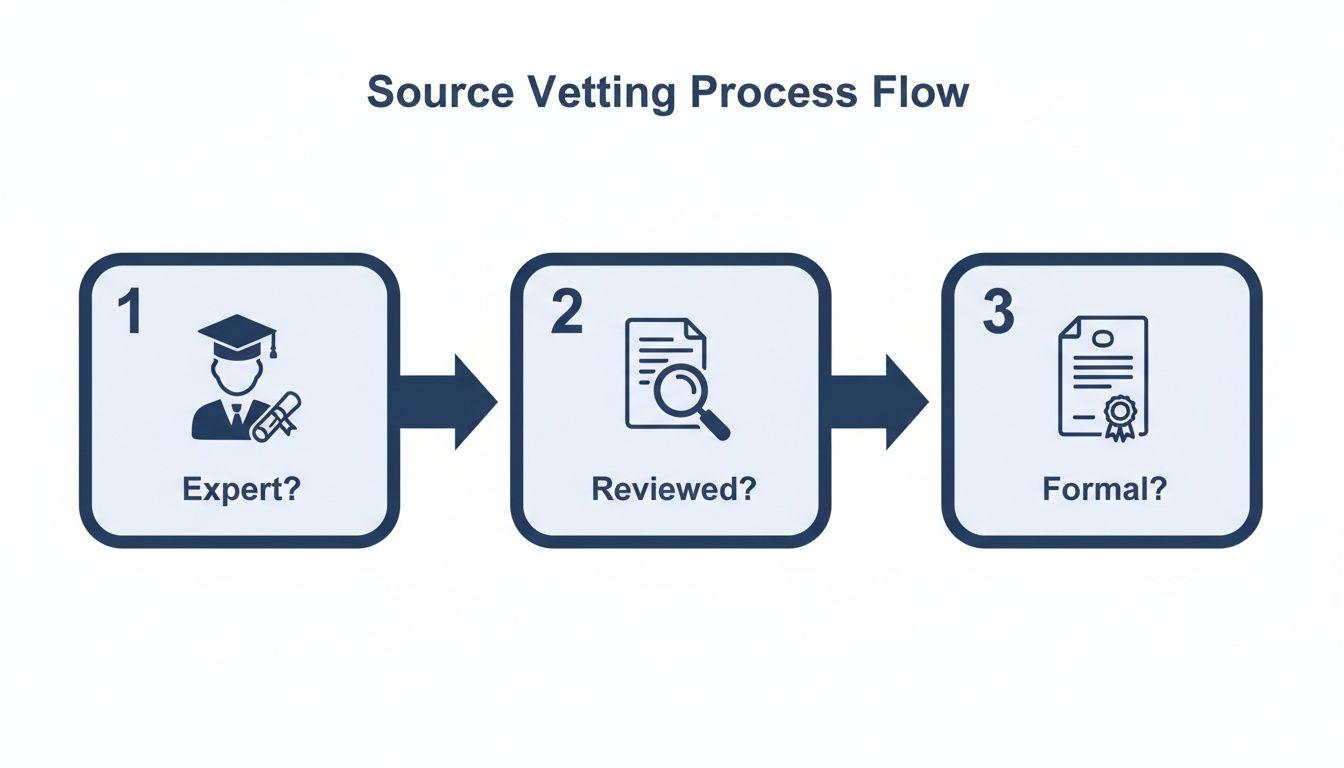
As you can see, review is the critical middle stage that validates an expert's work against the formal standards of their discipline. Based on the reviewers' feedback, the editor will make a final call: accept, reject, or send it back to the author for revisions. Often, it's the latter.
Why This Matters for You
Getting published in a top journal is incredibly difficult for a reason. Prestigious publications like Nature and Science are known to reject over 90% of the papers submitted to them. This brutal filter is what makes the scholarly literature so reliable.
For a student working on a paper or a small business trying to make a data-driven decision, this process is your guarantee of quality. Knowing a source is peer-reviewed means you can stand on the shoulders of giants, trusting that the information has been thoroughly vetted and isn't just one person's opinion. You can explore how universities articulate these standards on the University of Illinois website for a deeper dive.
Key Takeaway: Peer review is the engine of academic quality control. It's the mechanism that transforms a researcher's claim into a verified contribution to our collective knowledge. This makes it the absolute cornerstone of a scholarly source.
Why the Author’s Name and Affiliation Are So Important
When you're trying to figure out if a source is truly scholarly, the content is only half the story. You also have to ask: who wrote this? Trustworthy academic work is never anonymous; it’s created by people with a proven track record.
Think about it this way. If you needed serious medical advice, you’d want a board-certified doctor, not just someone who’s read a lot of health blogs. The same principle applies to information. Scholarly sources are written by experts—people with advanced degrees like a PhD or years of verifiable, hands-on experience in their field.
Their connection to a university, research institute, or other respected organization is your first clue. This affiliation isn't just a detail; it's a signal that they are part of an academic community and are held to its rigorous standards.
How to Check an Author’s Expertise
So, how do you actually verify that an author is a legitimate authority? It's easier than you might think and adds a critical layer of confidence to your research.
Start by looking for their credentials right in the article, usually on the first page or in a short author bio. Then, a quick web search is your best friend. Look for their professional homepage on a university or research center website. You’ll typically find:
- Their official title (e.g., Professor of Neuroscience, Senior Fellow).
- A summary of their education and the degrees they hold.
- A list of their other publications, which shows their research history and focus.
This trail of evidence helps you build a clear picture of the author’s standing in their field. An expert with a long list of peer-reviewed articles on a topic is always a more reliable source than an anonymous writer or a self-proclaimed guru.
Expertise in Context: When you cite a source, you're putting your trust in the person who wrote it. Making sure they have the right qualifications isn't just good practice—it's an essential step in doing responsible research.
The Power of an Institutional Stamp of Approval
An author’s affiliation is more than just a line in their bio. It connects them to a larger system of quality control. Universities and research institutions have their own reputations to protect, so they have a vested interest in making sure their faculty and staff produce work that is sound, ethical, and credible.
Scholarly sources are almost always written by experts with credentials, which immediately sets them apart from popular articles or blog posts. As Virginia Tech’s research guide points out, authors of scholarly work usually have formal degrees, professional experience, or clear institutional ties, with 95% of scholarly articles providing these details.
In fact, a 2022 analysis of over 50 million academic papers found that 82% of lead authors in peer-reviewed journals hold a doctoral degree. To dig deeper into these kinds of evaluation criteria, you can explore more about evaluating information sources on the Virginia Tech website.
Decoding the Anatomy of a Scholarly Article
Let’s be honest: opening a scholarly article for the first time can feel intimidating. The dense text, the rigid format, the specialized language—it all seems designed to keep you out.
But here’s the secret: that structure isn’t a barrier; it’s a map. It’s a universal format that researchers use to present their work logically and transparently. Once you know how to read the map, you can navigate any scholarly paper with confidence.
Think of it like a detective's case file. Every section has a purpose, building the argument piece by piece, from the initial question to the final conclusion. Understanding this layout lets you pinpoint exactly what you need, whether it's a specific data point for a report or the core findings of a study for your business plan.
The Blueprint of Scholarly Research
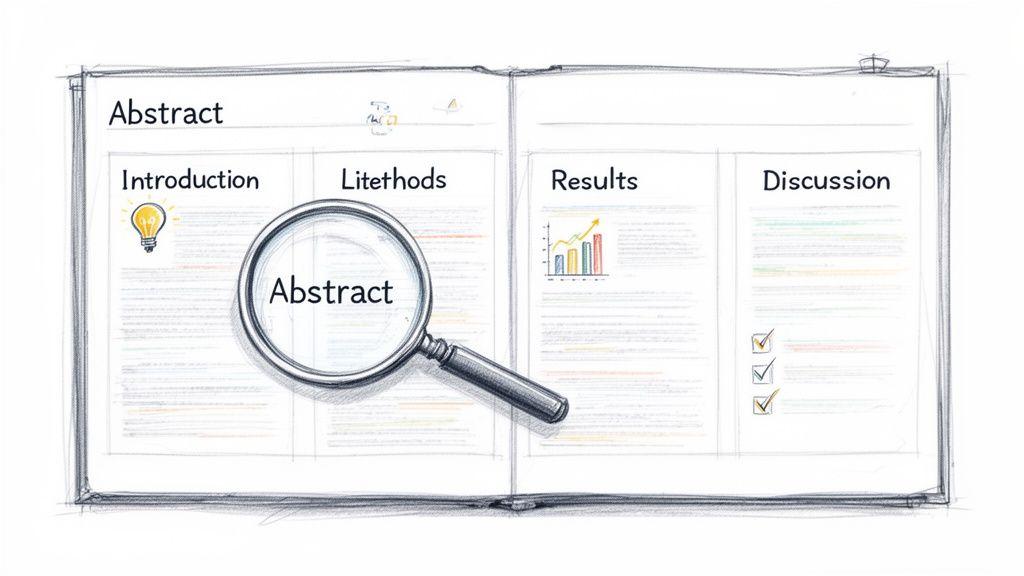
Most articles in the sciences and social sciences follow a standard format known as IMRaD, which stands for Introduction, Methods, Results, and Discussion. It's the skeleton that gives the paper its shape.
- Abstract: Your first stop. This is the 150-word elevator pitch for the entire paper. It quickly summarizes the research question, the methods used, the most important findings, and the main takeaway. Always read this first to decide if the article is worth your time.
- Introduction: This is where the story begins. The introduction sets the stage by explaining why the research matters. It provides background on the problem, highlights what we don't yet know, and then states the specific question or hypothesis the authors are about to investigate.
Pro Tip: Think of the introduction as the "origin story." It tells you what gap in our collective knowledge the author spotted and why they felt compelled to fill it.
Showing the Work: From Method to Conclusion
After setting the stage, the paper gets into the nuts and bolts of the actual research. This is where the authors lay all their cards on the table.
- Literature Review: Sometimes folded into the introduction, this section is a tour of what other experts have already said on the topic. It shows the authors have done their homework and are consciously building upon, or challenging, the existing conversation.
- Methodology: This is the "how-to" guide for the entire study. The authors provide a detailed, step-by-step account of exactly how they conducted their research. What did they measure? Who were the participants? What tools did they use? The goal here is transparency, allowing other researchers to replicate the study and verify the results for themselves.
- Results: Just the facts. This section presents the raw data collected during the study, often using charts, graphs, and statistical tables. There’s no interpretation here—it simply reports what they found. It’s the unfiltered evidence.
- Discussion: This is where it all comes together. The authors step back and explain what the results actually mean. They interpret the data, connect their findings back to the original research question, and acknowledge any limitations of their study. They often end by suggesting what new questions their work has opened up for future researchers to tackle.
Following the Trail of Citations and References
Ever skipped to the end of a dense academic article and seen that massive list of citations? It’s easy to dismiss it as just a formality, some kind of academic bookkeeping. But in reality, that reference list is one of the most powerful clues that you’re dealing with a truly scholarly source.
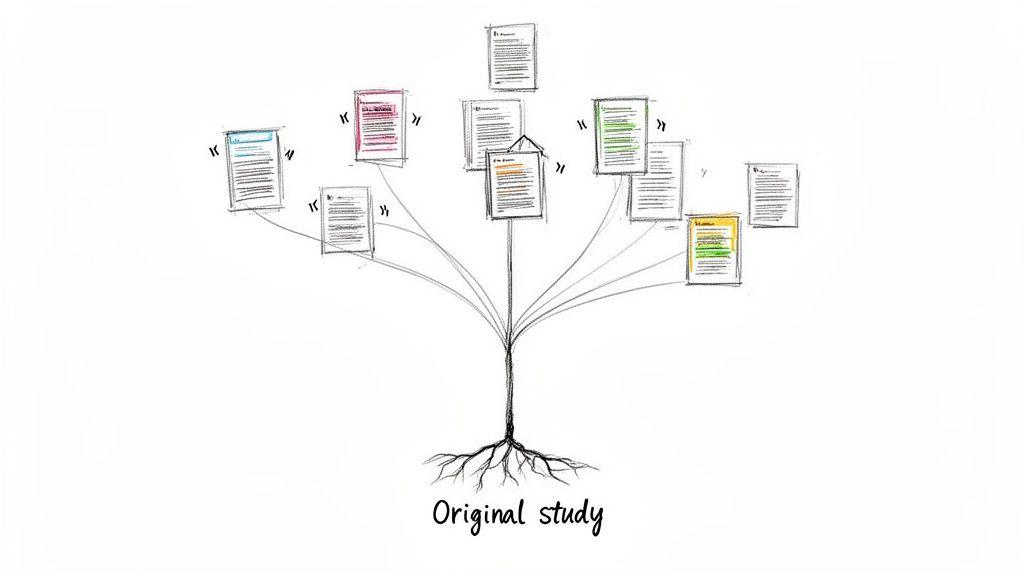
Think of it as a family tree for an idea. Every citation is a branch connecting the new work to its intellectual ancestors. It’s the author's way of saying, "I've done my homework, and my argument is standing on a solid foundation of existing research." This transparent paper trail is what elevates rigorous scholarship above simple opinion.
Your Reference List Is a Treasure Map
That long list of sources isn’t just for show—it's an incredibly useful tool for you. A well-built bibliography is a goldmine for discovering other high-quality, relevant materials on your topic.
This is where the real magic happens. When you find one fantastic article, its references can instantly lead you to a dozen more. This strategy, often called “citation mining,” lets you trace an argument back to its roots and understand the scholarly conversation that shaped it. You can see how experts organize these conversations in our guide on how to write a literature review.
For a student, this is your secret weapon for building a powerful, evidence-based paper. For a business professional, it's how you independently verify the claims behind a new strategy or market analysis.
Key Insight: A scholarly source doesn't just make assertions; it shows its work. The reference list is an open invitation to check the evidence, explore the wider context, and even join the intellectual conversation yourself. It’s a fundamental commitment to transparency.
By following the breadcrumbs in the bibliography, you can:
- Discover Foundational Work: Pinpoint the essential articles and key researchers in any field.
- Verify an Author's Claims: Go straight to the original source to see if an author is interpreting it fairly.
- Expand Your Research: Quickly build a network of related, pre-vetted scholarly articles without starting from scratch.
This web of interconnected knowledge is a defining feature of academic work. It ensures that research is a cumulative process, where each new discovery is firmly anchored in the work that came before it.
Where to Find Trustworthy Scholarly Sources
Okay, so you know what a scholarly source is. That’s half the battle. Now, where on earth do you actually find them?
A standard Google search can feel like trying to find a needle in a haystack—it throws everything at you at once, mixing legitimate research with ads, opinions, and blog posts. To work efficiently, you need to skip the general haystack and go straight to the curated collections where scholars publish their work.
Think of it this way: you wouldn't go to a flea market to buy a high-end, certified diamond. You'd go to a jeweler. Academic databases and specialized search engines are the jewelers of the research world.
Essential Search Engines for Scholars
The best place to start is usually with a tool that acts as a bridge between a regular search and a deep academic dive. These platforms are designed specifically to index and rank scholarly literature, saving you a ton of time and frustration.
- Google Scholar: This is the most popular and accessible starting point for a reason. It combs through a massive index of scholarly literature, including articles, theses, books, and conference papers. One of its most powerful features is showing how many times an article has been cited—a great clue to how influential a particular study has been in its field.
Here's a look at what you see when you start a search on Google Scholar.
The interface feels familiar and simple, but the results are laser-focused on academic and research-driven content.
Powerful Academic Databases
When you need to get more focused, academic databases are the heavy hitters. Most university and public libraries pay for subscriptions to these powerful services, giving you free access. Their real power lies in advanced filters that let you pinpoint exactly what you need.
A few of the most respected databases include:
- JSTOR: A go-to digital library for the humanities and social sciences. It’s packed with millions of journal articles, books, and primary source documents.
- PubMed: This is the undisputed champion for biomedical literature. It offers access to more than 36 million citations from life science journals, online books, and MEDLINE.
- Scopus: A massive abstract and citation database that covers peer-reviewed literature across scientific, technical, medical, and social science fields, including journals, books, and conference proceedings.
Practical Tip: When you’re inside one of these databases, always look for a "peer-reviewed" filter or checkbox. Ticking this box is the single fastest way to guarantee you're only seeing sources that have passed that rigorous quality-control process. Honing your search strategy is key to effective research. For more guidance, check out our guide on how to improve your research skills. Using these tools means you stop hoping to find a good source and start searching where they're guaranteed to be.
Frequently Asked Questions About Scholarly Sources
Even with the best guidance, research can get tricky. Certain questions pop up time and again when you're trying to figure out if a source truly counts as "scholarly." Let's clear up some of the most common gray areas.
Is a Source from a .edu Website Always Scholarly?
Not always. This is a common and understandable trap to fall into.
While university websites (those ending in .edu) are home to a massive amount of scholarly material, they also host everything else under the sun. You’ll find student club pages, campus news, course catalogs, and even personal faculty blogs.
The trick is to stop looking at the domain name and start looking at the document itself. Who wrote it? Is it published in a formal journal found on the site? Does it have a bibliography? The content’s characteristics are what matter, not the web address.
Are Books Considered Scholarly Sources?
Some are, but many aren't. It all comes down to the book's purpose and publisher.
- Academic Books: These are the real deal. They are typically published by a university press (like Princeton University Press or University of Chicago Press) and are written by experts for other experts. They are packed with deep research, original ideas, and extensive citations.
- Popular Books: On the other hand, popular nonfiction, bestsellers you see piled high in a bookstore, and most textbooks are not scholarly. They can be incredibly valuable and well-written, but they’re created for a general audience and skip the rigorous peer-review process.
Rule of Thumb: If a book is penned by a leading expert in the field, published by a university press, and features a detailed bibliography, you've likely got a scholarly source. If it’s a bestseller you could grab at an airport, it almost certainly isn’t.
How Can I Tell If an Article Is Peer-Reviewed?
This is probably one of the most critical skills to develop. The good news is, there are a couple of straightforward ways to check.
First, go directly to the journal's website. Most will have an "About Us" or "Submission Guidelines" page that clearly outlines their editorial process and confirms whether they use peer review.
Second, let the academic databases do the heavy lifting for you. Services like JSTOR, Scopus, and PubMed almost always have a filter to limit your search results to only peer-reviewed articles. Ticking that box is the fastest and most reliable way to guarantee the quality of your sources.
Can a Scholarly Source Be Wrong or Biased?
Yes, absolutely. It's vital to remember that "scholarly" is not a synonym for "perfect" or "infallible."
The peer-review system is designed to catch major errors, weak logic, and unsupported claims, but it's not foolproof. Science and academia are constantly evolving. What is considered a fact today might be challenged or completely overturned by new evidence tomorrow.
Likewise, even though the formal structure of academic writing pushes for objectivity, researchers are still human. Their personal perspectives or the prevailing theories of their time can introduce subtle biases. This is exactly why you should always read critically and compare the findings from several different scholarly sources to build a complete picture.