A literature review is so much more than a simple summary of what you've read. It's an act of synthesizing existing research to build a powerful argument about the current state of knowledge on a topic. You're tasked with finding the right scholarly works, pulling them apart to see what makes them tick, and then weaving them all together into a story that reveals a gap—a gap your research is perfectly positioned to fill.
Why a Great Literature Review Matters
Before we get into the nuts and bolts of how to write one, we need to understand why it's such a foundational piece of any academic project. I've seen countless students and new researchers treat the literature review like a chore—just a hurdle to clear before they can get to the "real" research.
That perspective misses the entire point. A great literature review isn't a prelude to your work; it's the strategic foundation your entire project is built on.
Think of it as stepping into an ongoing conversation with the top experts in your field. You aren't just a reporter summarizing what everyone else said. You're an active participant, mapping out the debate and carving out a space for your own voice.
More Than a Summary: It's Your Research Compass
A well-crafted review achieves several critical goals that set your project up for success. It’s your chance to show you’ve done the background reading and are ready to push the conversation forward.
Here’s what a strong literature review really does for you:
- Establishes Your Credibility: It shows your audience you know the topic, its history, and the key debates. You're proving you're qualified to contribute.
- Prevents "Reinventing the Wheel": By surveying the field, you confirm that your research question is fresh and hasn't already been answered a dozen times over.
- Identifies the Research Gap: This is the big one. A good review points a spotlight on what's missing, what’s contradictory, or what remains overlooked. That's the opening for your study.
- Develops a Theoretical Framework: It helps you uncover the key concepts, models, and theories that will guide your own methodology and analysis.
For instance, a computer science student wouldn't just list machine learning algorithms chronologically. They'd trace their evolution to pinpoint a specific performance bottleneck that current models haven't solved. In the same way, a sociologist studying urban gentrification would synthesize findings to show how past research consistently ignored the impact on multigenerational small businesses, creating a clear niche for their work.
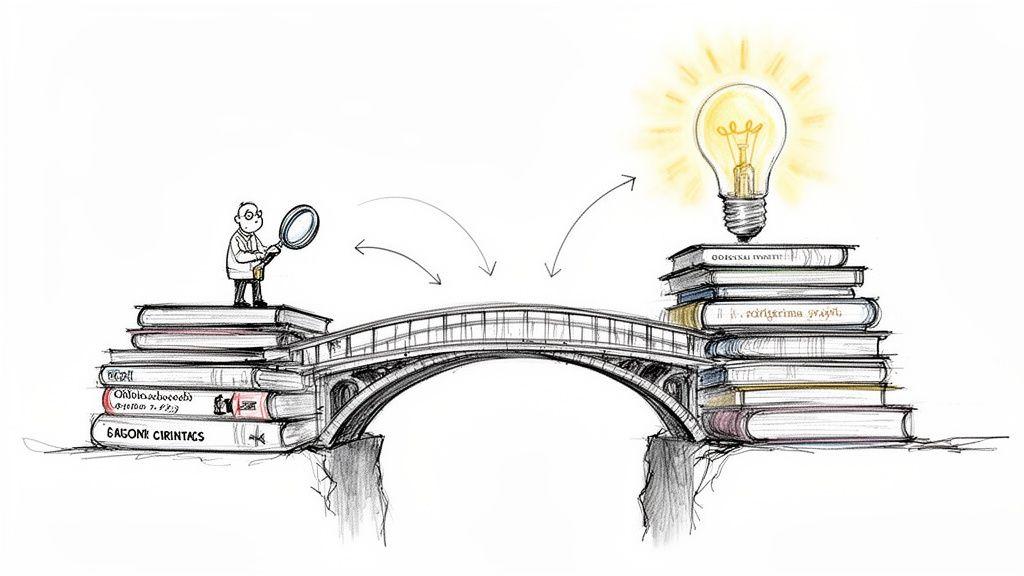
A literature review is your chance to build a bridge from what is already known to what is not yet known. It’s the architectural blueprint for your own contribution, showing exactly where and how your work fits into the larger structure of knowledge.
An Unexpected Benefit: Impact and Visibility
Beyond just supporting your own project, a high-quality literature review can have a massive impact on your academic career. These articles are often the most influential papers in their fields—far from being academic busywork.
Time and again, research shows that review articles get cited and downloaded far more often than other types of publications. You can dig into the data on this in analyses published by the National Center for Biotechnology Information.
Why? Because a good review is an invaluable roadmap for other researchers. By synthesizing a complex and scattered field, you're providing a genuine service to your academic community, making your paper the first stop for anyone new to the topic.
Laying the Groundwork: Scope and Search Strategy
Every great literature review starts with a question, not just a topic. If you try to tackle something as massive as "social media's effect on teenagers," you're setting yourself up for a long, frustrating journey. The very first thing you need to do is wrestle that broad idea into a sharp, focused question. This question becomes your north star, guiding every single decision you make from here on out.
Think of it this way: a vague interest is just a starting point. A powerful research question is a tool. For instance, instead of the broad topic above, you might land on something like: "How does using image-based platforms like Instagram correlate with body image dissatisfaction in adolescent girls aged 14-18?" See the difference? This new question is specific, measurable, and gives you clear boundaries for your search.
A well-defined research question is your most important filter. It tells you exactly which papers matter and—just as critically—which ones you can confidently ignore. This alone will save you countless hours.
Building Your Keyword Arsenal
Once your question is locked in, it's time to translate its key ideas into a list of search terms. This isn't just about grabbing a couple of obvious words. A really effective search depends on a smart mix of primary keywords, synonyms, and related concepts. This is how you cast a wide net that’s still precise enough to catch what you need.
Let's break down our example question: "How does using image-based social media platforms like Instagram correlate with body image dissatisfaction among adolescent girls aged 14-18?"
From that, your keyword list could expand into something like this:
- Primary Concepts: "social media," "Instagram," "body image," "adolescents"
- Synonyms & Related Terms: "social networking sites," "visual platforms," "body dissatisfaction," "self-esteem," "teenagers," "youth"
- Broader Terms: "mental health," "peer comparison," "online behavior"
Mixing and matching these terms ensures you find articles that are highly relevant, even if they don't use the exact phrasing from your original question.
Mastering Your Search with Boolean Operators
Having a great keyword list is a solid start, but to really take control of your search results, you need to get comfortable with Boolean operators. These are simple commands—AND, OR, NOT—that work in almost any academic database to help you slice through the noise.
- AND narrows your search. It tells the database that all your terms must appear. For example,
"body image" AND "adolescents" AND "Instagram"will only pull up articles containing all three of those phrases. - OR broadens your search. It’s perfect for synonyms, finding articles that contain at least one of the terms. A search for
"adolescents" OR "teenagers" OR "youth"covers all your bases for that age group. - NOT excludes terms. This is a lifesaver when you need to remove irrelevant contexts. For instance,
"social media" NOT "adults"would instantly filter out studies focused on older populations.
When you start combining them, you get real precision. A search string like (Instagram OR TikTok) AND (“body image” OR “self-esteem”) AND (adolescents OR teenagers) is infinitely more powerful than just plugging in a few keywords.
Choosing the Right Academic Databases
Not all databases are built the same, and where you look is just as important as what you look for. While a general search on Google Scholar is a decent place to start, you absolutely have to dive into specialized databases for a thorough review. This is where the highest-quality research lives. It's also critical to make sure you’re pulling from trustworthy publications. If you need a quick refresher, our guide on what is a credible source is a great resource.
Knowing the best hunting grounds for your specific field will save you a ton of time and dramatically improve the quality of your findings.
Here’s a quick-reference guide to help you find the most relevant research databases for your specific field of study.
Essential Academic Databases by Discipline
| Discipline | Primary Databases | Key Features |
| Health & Medicine | PubMed, MEDLINE, CINAHL | Focus on biomedical literature, clinical trials, and nursing research. |
| Social Sciences | PsycINFO, SocINDEX, JSTOR | Strong coverage of psychology, sociology, political science, and history. |
| STEM | Scopus, Web of Science, IEEE Xplore | Comprehensive databases covering science, tech, engineering, and math. |
| Humanities | JSTOR, Project MUSE, MLA Bibliography | Access to journals, books, and primary sources in literature, arts, and history. |
Finding the right databases for your discipline is a game-changer for the quality and relevance of the literature you uncover.
One final piece of advice: document everything. Keep a simple log of which databases you used, the exact search strings you ran, the dates you searched, and how many results you got. This bit of administrative work is crucial for your review’s methodology section and saves you from accidentally re-doing searches later.
From Reading to Real Synthesis
So, you've gathered a mountain of articles. That's a great start, but it's just the first checkpoint. The real work—the intellectual heavy lifting—begins now. It's time to transform that pile of individual studies into a single, coherent story. This is the crucial leap from simply summarizing papers to genuine synthesis.
Your goal is to stop thinking about each source in isolation. Instead, you need to start weaving them together to reveal patterns, arguments, and, most importantly, the gaps in the existing research. True synthesis is what separates a laundry list of annotations from a compelling literature review. It’s about building a conversation between authors, even those who may never have read each other's work.
The Synthesis Matrix: A Game-Changing Tool
One of the most effective tools I've ever used for this is the synthesis matrix. Forget about scattered notes spread across a dozen different documents. A synthesis matrix is essentially a well-organized spreadsheet that lets you map out your sources by theme, giving you a bird's-eye view of the entire scholarly conversation.
The structure is simple but powerful. You create a grid where each row represents a single source (e.g., Smith, 2021). The columns, however, aren't just for bibliographic data. This is where the magic happens. Each column represents a key theme, concept, methodology, or argument you've identified across all your readings.
This concept map illustrates how a central research question branches out into keywords, operators, and databases, forming the core of an effective search.
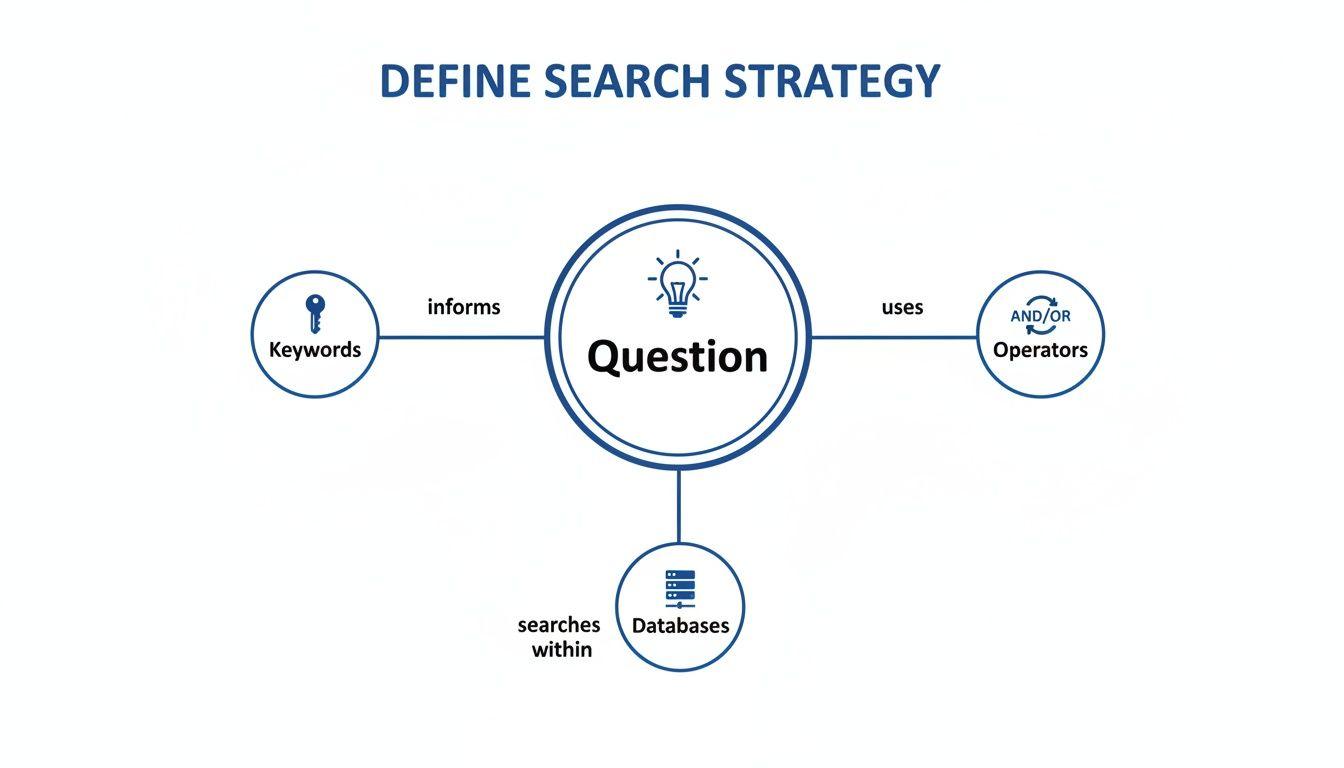
This visual approach really drives home the point that a solid question is the bedrock of a structured and comprehensive search plan.
Setting up your own matrix is surprisingly easy. Here’s a basic template you can run with:
| Source (Author, Year) | Main Argument | Theme 1: Policy Impact | Theme 2: Methodological Approach | Theme 3: Key Contradictions |
| Jones (2022) | Argues for decentralized policy. | Found positive local outcomes. | Qualitative case study. | Contradicts Smith's findings on cost. |
| Smith (2021) | Claims centralized policy is more efficient. | Highlights high costs of decentralization. | Quantitative analysis. | Agrees with Jones on community buy-in. |
Once you start filling this in, the connections practically jump off the page. You can instantly see who agrees with whom, which research methods are most common, and where the most interesting debates are taking place.
From Grid to Narrative
A synthesis matrix isn't just an organizational tool; it’s a narrative-building machine. Once it’s populated, you can start asking the critical questions that will form the backbone of your literature review:
- Where do the authors agree? This helps establish the foundational, accepted knowledge in the field.
- What are the main points of conflict? These disagreements are gold. They often point directly to your research gap.
- How have themes evolved over time? A quick scan of the publication dates in your rows can reveal a fascinating chronological story.
- Are there any glaring gaps in the grid? An empty column or a theme with only one or two entries is a huge signpost for an under-researched area.
The real power of the synthesis matrix is that it forces you to think thematically. It shifts your focus from "What did this one author say?" to "What is the collective conversation about this specific idea?"
Beyond the Matrix: Visualizing Connections
While the matrix is fantastic for structured analysis, sometimes you need a more fluid way to visualize the relationships between ideas. For this, I’m a huge fan of concept mapping.
Grab a blank page (or a digital whiteboard) and put your central research question right in the middle. As you read, draw branches out to major themes. From those themes, create smaller branches to connect individual studies or key findings. This spider-web-style diagram helps you see how different sub-topics relate to each other and, crucially, back to the core question of your review.
Concept mapping is especially helpful for spotting emerging trends. For example, the field of academic writing research is currently in a massive state of flux. Between 2020 and early 2025, scholars published an incredible 1,051 English-language articles on the topic. A keyword analysis shows a huge spike in terms like 'generative AI,' 'ChatGPT,' and 'academic integrity,' clearly signaling a major technological shift in the conversation. You can dig deeper into these academic writing trends yourself.
Ultimately, whether you use a matrix, a map, or your own unique method, the goal is always the same: move past summarizing and start building a new, insightful narrative from the existing literature. This synthesis is what makes a literature review truly great.
Weaving Your Sources into a Cohesive Story
Okay, you've done the heavy lifting. Your synthesis matrix is filled out, and you're starting to see the big picture. Now, the real art begins: transforming that deep analysis into a clear, persuasive narrative. A great literature review isn't just a laundry list of who said what. It's an argument that masterfully guides your reader from a broad understanding of the field to the very specific, unanswered question your own research will tackle.
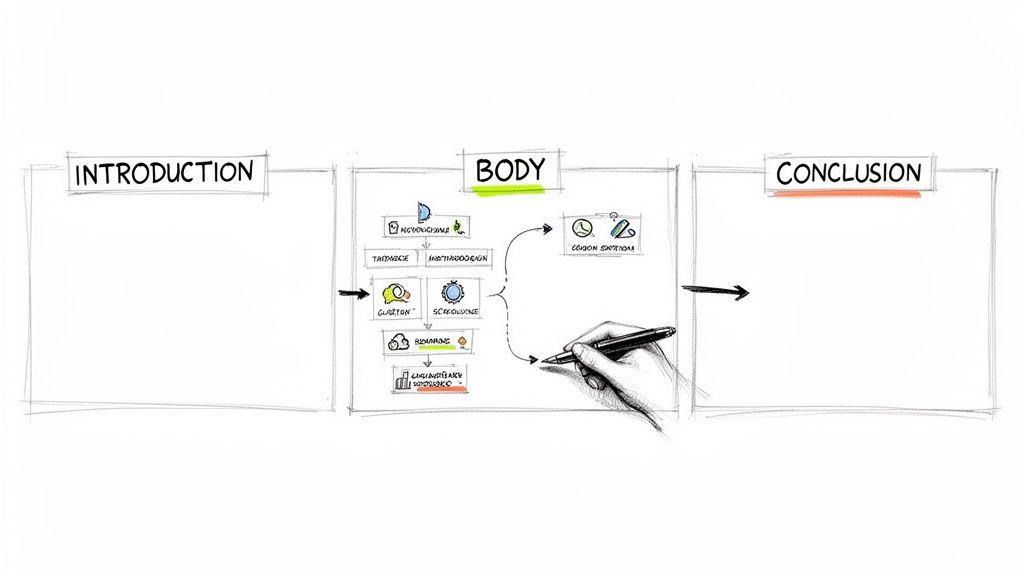
Think of yourself as a storyteller. Your narrative needs a beginning, a middle, and an end—an introduction, a body, and a conclusion. Each part has a critical job to do. Get them right, and you'll have a literature review that not only informs but truly persuades.
The Introduction: Setting the Stage and Hooking the Reader
Your introduction is your first, and frankly, your best chance to hook your reader. You need to quickly establish why this topic is important and then gracefully narrow the focus down to the specific scope of your review. This is where you convince them to keep reading.
A solid introduction has three core jobs:
- Introduce the topic and why it matters. Start with the broader context. Are you exploring a persistent social issue, a rapidly evolving technology, or a foundational debate in your field? Make it clear why this is a conversation worth having.
- Define the boundaries of your review. You can't cover everything, so don't pretend you can. Clearly state what you're focusing on—a specific timeframe, a particular methodology, or a certain demographic group. This manages reader expectations.
- State your purpose or thesis. This is the north star of your review, a single, concise sentence that lays out your central claim. Often, this means pointing out a significant trend, a major conflict, or, most importantly, a critical gap in the existing research.
For instance, instead of a flat opening like, "This review will cover research on remote work," try something with a pulse. Something like, "The global shift to remote work, once a crisis response, has ignited a fierce debate over its long-term effects on productivity and corporate culture." See the difference? One is a statement; the other is a story.
The Body: Building Your Argument, Piece by Piece
The body is where you make your case. This is not the place for a book-report-style parade of summaries. You need to organize the discussion around the themes, debates, and patterns you discovered during your synthesis. How you structure this section is everything.
You've got a few solid options for organizing the body:
- Thematic: This is usually the strongest approach. You create sections based on the recurring themes you found across your sources. It’s a fantastic way to show off your analytical chops by drawing connections and highlighting disagreements between different studies.
- Chronological: This structure works best when the historical evolution of a topic is the whole point. You might trace how a theory has changed over decades, showing how it's been challenged, adapted, or even discarded. It’s about telling the story of an idea over time.
- Methodological: Sometimes, it makes the most sense to group research by the methods used. You could contrast the findings from qualitative case studies with those from large-scale quantitative surveys, for example. This is great for highlighting how how we ask questions shapes the answers we get.
The right structure really depends on your field. A historian might naturally lean toward a chronological approach, while a computer scientist will likely focus on the most current, thematic breakthroughs. A humanities paper might draw on sources from a century ago, whereas in some medical fields, a source older than two years might be considered obsolete.
Whatever structure you choose, make sure every paragraph kicks off with a strong topic sentence that clearly states the point you're about to make. Use transitions like "Furthermore," "In contrast," or "Consequently" to guide your reader smoothly from one idea to the next.
The goal of the body is to tell a story with the literature. It's the story of what we know, how we know it, and—most importantly—what we still don't know. Each section should build on the last, leading your reader logically toward your conclusion.
The Conclusion: Landing the Plane
Your conclusion is your final chance to drive your point home. It’s more than just a simple summary; it’s the pivot point from the established research to your own contribution. A weak conclusion can make the entire review fall flat, so make it count.
A powerful conclusion accomplishes three things:
- Summarizes the key takeaways. Briefly restate the major themes, debates, and the overall state of the literature you just walked the reader through.
- Explicitly identifies the research gap. This is the moment everything has been building toward. Articulate precisely what's missing, what's contradictory, or what remains unexplored in the field.
- Points the way forward. End by explaining how your proposed study will step in to address that specific gap. This creates a perfect, seamless transition into the methodology and argument of your own paper. You can get more insights on this by checking out our guide on how to write a research paper outline, which details how to structure these critical sections.
Polishing Your Draft and Avoiding Common Mistakes
Getting that first draft down is a massive win, but don't pop the champagne just yet. The real work—the kind that elevates a good paper to a great one—happens during the revision process. This is where you move beyond just catching typos and start sharpening your argument until it's razor-sharp.
So many literature reviews fall flat at this final hurdle, usually by tripping into a few predictable traps. The most common is what I call the "laundry list" review—a boring, disconnected parade of summaries. Another major issue is simply accepting every source's findings at face value without a hint of critique. Remember, a great review is a critical conversation, not just a book report.
A Self-Editing Checklist for a Stronger Review
Before you even think about showing your draft to someone else, you need to be your own toughest critic. A thorough self-edit can catch 80% of the problems and will make any feedback you get later much more valuable.
Pour yourself a coffee and go through your draft with these questions in mind:
- Does it actually flow? Seriously, read it out loud. You'll immediately hear where the transitions are clunky or nonexistent. Use connecting phrases to guide your reader from one idea to the next.
- Is your voice present? Is this just a collection of what other people said, or are you driving the narrative? Your voice should be the thread that ties everything together, using the sources as evidence for your points.
- Have you moved beyond summary? For every source you mention, ask yourself: did I analyze it? Did I question its methodology or compare its findings to another study? Don't just report—interpret.
- Is the research gap glaringly obvious? By the end, a reader should be able to state the gap you've identified in a single, clear sentence. If they can't, you haven’t made it explicit enough.
The difference between a B+ literature review and an A+ is the author's critical voice. You're not just a librarian cataloging facts; you're a curator of ideas, building a case and guiding the reader to an inevitable conclusion.
Sidestepping the Most Common Pitfalls
Knowing what makes a literature review weak is the best way to avoid those mistakes yourself. Keep an eye out for these all-too-common errors that can sink even the most diligent research efforts.
The absolute biggest mistake is creating a descriptive list instead of a critical synthesis. It’s so easy to fall into the "Smith (2020) found this, then Jones (2021) found that" pattern. This tells the reader nothing about how these studies relate to each other or to the bigger picture.
Another credibility-killer is sloppy or inconsistent citation. Mixing up APA and MLA, or worse, forgetting a citation entirely, makes you look unprofessional. This is exactly why reference management software is a non-negotiable part of the academic toolkit.
I've put together a quick table to help you spot and fix these common mistakes before you submit your work.
Common Literature Review Mistakes and How to Fix Them
This table breaks down the most frequent errors I see and gives you actionable ways to correct them, ensuring your final draft is as strong as it can be.
| Common Mistake | Why It's a Problem | How to Fix It |
| The "Laundry List" | It presents sources in a disconnected sequence, failing to build a coherent argument. It reads more like an annotated bibliography than a review. | Organize your review thematically. Structure paragraphs around key debates, concepts, or trends, not individual authors. |
| Lack of Critique | Simply accepting sources at face value undermines your authority. It shows you haven't engaged deeply with the material. | For the most important sources, briefly evaluate their methods, assumptions, or limitations. Ask yourself, "How do they know that?" |
| Losing Your Argument | Your own critical voice gets drowned out by an endless stream of summaries, leaving the reader wondering what your point is. | Start each paragraph with a strong topic sentence that makes your point. Then, use sources as evidence to support that claim. |
By actively looking for these issues, you shift from being a passive reporter to an active, critical scholar.
The Power of Peer Feedback and Proper Citation
No matter how many times you reread your own writing, your brain will eventually start filling in the gaps and seeing what you meant to write, not what's actually on the page. Getting a fresh pair of eyes on your draft is absolutely crucial.
Ask a professor, a mentor, or a trusted classmate to read it. Specifically ask them to check for clarity, flow, and the strength of your argument.
Finally, do yourself a massive favor and manage your citations from day one. Tools like Zotero, Mendeley, or EndNote are lifesavers. They don't just store your research; they automatically format your bibliography in any style you need, which helps ensure academic integrity and prevents accidental plagiarism. To make sure your summaries are truly your own, it’s worth reviewing our guide on how to paraphrase without plagiarizing. Using these tools frees you up to focus on what really matters—your ideas.
Got Questions? We’ve Got Answers.
When you're deep in the trenches of writing a literature review, it's natural for a bunch of practical questions to pop up. How many sources are actually enough? What's the real difference between this and an annotated bibliography? Let's clear up some of the most common sticking points so you can move forward with confidence.
How Many Sources Do I Really Need?
Forget about finding a magic number—it doesn’t exist. The right amount of sources is dictated entirely by the scope of your project.
For an undergraduate paper, you might find that 15-25 well-chosen sources are plenty to build a strong argument. But if you're working on a PhD dissertation, that number could easily swell to over a hundred. The real goal here isn’t quantity; it’s depth.
You should be aiming for what’s called theoretical saturation. It's that point you reach when you stop finding new major themes or groundbreaking studies and start seeing the same names, theories, and debates over and over again. Honestly, a deep, critical analysis of 20 truly relevant articles will always be more impressive than a superficial mention of 50 barely related ones.
Is This Just an Annotated Bibliography in Disguise?
This is a classic point of confusion, but the distinction is a big one. Think of it this way: they're two different tools built for two very different jobs.
An annotated bibliography is basically a list. It's a collection of your sources, with each citation followed by a short paragraph (the "annotation") that summarizes and maybe offers a quick evaluation of that single source. It’s organized alphabetically, and its job is to catalog what you’ve found.
A literature review, on the other hand, is a single, cohesive narrative. It takes all those individual sources and weaves them together to tell a story about the current state of research on your topic. You're not just describing your sources; you're using them to identify trends, highlight ongoing debates, and ultimately, build your own argument.
How Do I Find the “Gap” in the Research?
Hunting for a research gap isn't about finding a topic that no one has ever touched. That's nearly impossible. Instead, it’s about spotting a specific question, a unique angle, or a missing connection that the existing literature has overlooked. This takes more than just summarizing—it requires you to read with a critical, detective-like eye.
Keep your eyes peeled for these clues as you read:
- Conflicting Results: When two studies looking at the same thing come to completely different conclusions, that's a huge signal. Why the disagreement? Was it the methodology? The population they studied? The specific context? That "why" is often where your research gap is hiding.
- What's Being Ignored: Pay just as much attention to what isn't being said. Are researchers in the field consistently overlooking a particular demographic, a specific geographic area, or an important variable? These patterns of omission are fertile ground for new research.
- "Future Research" Sections: This is my favorite tip because it's so direct. The conclusion of nearly every academic paper is a goldmine. Authors will often spell out the limitations of their own work and suggest exactly what should be studied next. They're basically handing you an invitation to fill the gap they've identified.
Finding the gap is an act of intellectual detective work. It’s about listening to the scholarly conversation and noticing not just what is being said, but also what is being left unsaid.
Can I Use AI Tools to Help Me Write This?
Absolutely, but you have to be smart about it. Think of an AI tool like 1chat as a research assistant, not the author. It's there to support your thinking, not replace it.
Here’s how you can use AI effectively:
- Brainstorming a wider net of search terms and keywords.
- Getting a quick summary of a dense article to see if it's worth a full read.
- Helping rephrase a clunky sentence or checking your grammar.
However, the real intellectual heavy lifting—the critical analysis, the synthesis of disparate ideas, and the crafting of your unique argument—has to be all you. You must always double-check any information an AI gives you against the original source and be crystal clear on your school's academic integrity policies.
Treat AI as a powerful intern: it can handle the busywork, freeing you up to do the actual thinking.