A great persuasive essay isn’t just about having a strong opinion. It’s about building a rock-solid case, piece by piece, with compelling evidence. The real magic happens before you write a single paragraph of your draft. It's all in the prep work—unpacking your prompt, landing on a debatable topic, and forging a killer thesis.
Building Your Argument Before You Write a Word
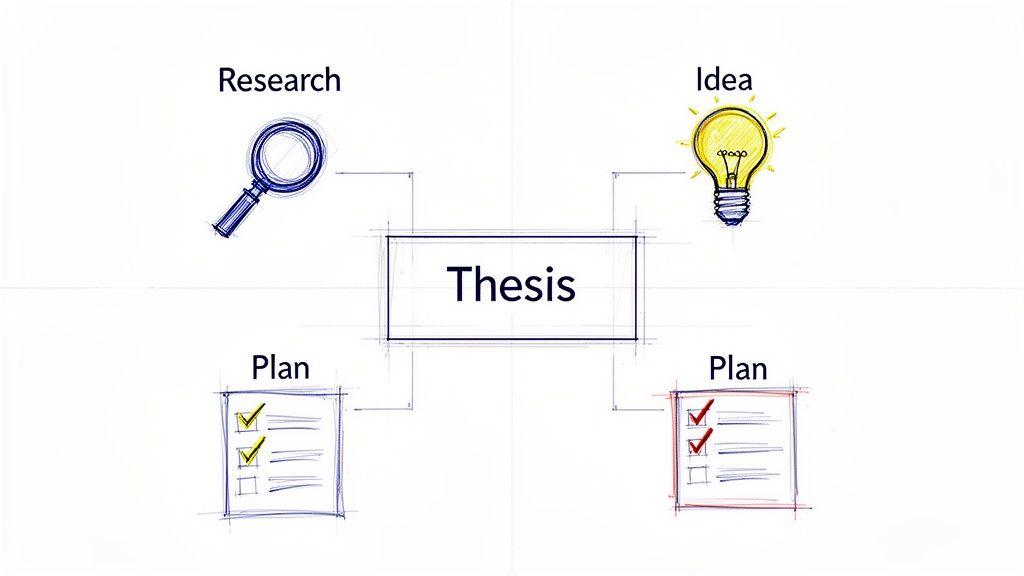
The best arguments are constructed with care, not stumbled upon mid-sentence. Jumping into a draft without a plan is like trying to build a house without a blueprint. You might end up with something standing, but it won’t be structurally sound or convincing. This pre-writing stage is where the battle is truly won or lost.
Break Down the Assignment and Brainstorm Ideas
First things first: really dig into the essay prompt. Hunt for those keywords that tell you exactly what you need to do. Words like “analyze,” “evaluate,” “argue for,” or “defend” are your clues that you need to plant your flag and take a firm stance. I always tell my students to literally circle or highlight these words, along with any other constraints like word count or required sources.
With a clear understanding of the goal, it’s time to brainstorm topics. The sweet spot is a topic that you’re actually curious about and that’s genuinely debatable. This means that smart, reasonable people could hold different views on it. Steer clear of simple facts (e.g., "Water is H2O") and look for something with a bit of tension.
A few brainstorming methods that work well:
- Mind Mapping: Grab a piece of paper, put your main idea in the middle, and let your thoughts spiderweb out. Connect related concepts, questions, and possible arguments as they come to you.
- Freewriting: This one's simple. Set a timer for five minutes and just write. Don't stop, don't edit, don't worry about making sense. The goal is to get your raw, unfiltered thoughts onto the page.
- Pros and Cons: If you have a topic in mind, make a quick T-chart and list every argument you can think of for and against it. This is a great way to quickly see if you have enough material to work with.
Do Some Light Research to Test Your Topic
Once you have a topic that feels promising, it's time for a quick research test drive. You’re not trying to find every source for your paper just yet. Instead, you're just trying to see if there's enough credible evidence out there to back you up. A quick 15-minute search on Google Scholar or your school's library database is usually all it takes.
This step is a lifesaver. It keeps you from hitting a dead end hours into the writing process. If you can’t find any solid information, it's far better to pivot now. As you search, keep your eyes peeled for what is a credible source so you know your future evidence will have weight.
Key Takeaway: Your persuasive essay is only as good as the evidence holding it up. A little preliminary research confirms your topic is viable and gives you the confidence to build a case on facts, not just feelings.
Draft a "Working" Thesis Statement
Now that you have a topic you know you can support, it’s time to draft a working thesis. Think of this as the anchor for your entire essay. It's one sentence that states your specific, debatable claim, and it will guide every decision you make from here on out. We call it a "working" thesis because it's not set in stone; you can and should tweak it as your argument becomes more refined.
A strong thesis makes a bold, clear claim. It's the difference between a signpost and a destination.
- Weak: "There is a lot of debate about school uniforms." (This is just a fact, not an argument.)
- Strong: "Implementing mandatory school uniforms is a key strategy for reducing classroom bullying and improving academic focus in public schools." (This makes a specific, debatable claim that you can prove.)
This single sentence becomes the roadmap for your entire essay, keeping your writing focused, organized, and much easier to tackle.
To make sure you've got all your bases covered before moving on, run through this quick checklist.
Persuasive Essay Pre-Writing Checklist
This table is your final checkpoint before you start drafting. A quick "yes" to each of these means you've built a strong foundation and are ready to write with confidence.
| Checklist Item | Why It Matters | Quick Tip |
| Analyzed the Prompt | Ensures your essay meets all assignment requirements and addresses the core question. | Circle or highlight keywords like "argue," "defend," or "evaluate" in the prompt. |
| Chose a Debatable Topic | A topic without conflict has no room for persuasion. You need a claim that can be argued against. | Ask yourself: "Could a reasonable person disagree with my stance?" If yes, you're good to go. |
| Confirmed Source Availability | A great idea is useless without evidence. This check prevents you from hitting a research dead end. | Spend 15 minutes on a library database or Google Scholar to see if there's enough material. |
| Drafted a Working Thesis | This single sentence is your essay's roadmap, guiding your argument and structure. | Your thesis should be a specific, arguable statement, not a question or a statement of fact. |
Once you've checked these boxes, you’re not just ready to write—you’re ready to persuade.
Crafting a Thesis That Can Withstand Debate
Your thesis is the engine of your entire persuasive essay. It’s not just an opinion—it's a specific, debatable claim that you'll spend the rest of your paper proving. A weak thesis creates a flimsy argument that collapses under pressure. But a strong one? That gives you a clear path forward and immediately shows your reader what’s at stake.
Think of it this way: saying "Pollution is bad for the environment" is a statement of fact, not an argument. It’s true, but who’s going to disagree? It gives you nowhere interesting to go.
Now, consider this instead: "To significantly curb urban air pollution, city governments must prioritize funding for electric public transportation over the expansion of highway infrastructure." Now that's a thesis. It’s specific, it takes a firm stance, and it practically invites debate. Your job is to defend that precise claim against all comers.
From Vague Idea to Sharp Argument
So, how do you get from a fuzzy topic to a laser-focused thesis? You have to narrow your focus. Start with a broad subject and keep asking "how?" or "why?" until you land on a point you can actually prove with evidence.
Let's walk through an example:
- Broad Idea: "Social media is bad for teenagers." (Too vague.)
- Narrower: "Instagram's algorithm harms teenage mental health." (Getting closer.)
- Sharp Thesis: "By promoting unrealistic social comparison, the visual-centric, algorithm-driven nature of Instagram directly contributes to higher rates of anxiety and body dysmorphia among teenage girls."
See the difference? This final version is a powerhouse. It names the platform (Instagram), the specific cause (its visual, algorithmic nature), the affected group (teenage girls), and the exact outcomes (anxiety and body dysmorphia). You now have a perfect roadmap for the evidence you need to find.
For a deeper dive, our guide on how to write a thesis statement breaks this process down even further.
Gathering Evidence That Builds Your Case
Once your thesis is locked in, it's time to go on the hunt for evidence. Remember, your argument is only as strong as the proof you use to back it up. Ditch the flimsy, biased sources and aim for credible, authoritative information.
Great places to find evidence for persuasive essays include:
- Academic Journals: These offer peer-reviewed studies and hard data.
- Reputable News Organizations: Look for in-depth reporting from established journalists.
- Government and NGO Reports: These are goldmines for statistics and official findings.
- Expert Interviews or Quotes: Citing a recognized authority adds instant weight to your claim.
A classic mistake I see all the time is students focusing so much on the five-paragraph structure that they forget about the quality of their proof. In fact, one NIH-funded study found a fascinating pattern: while students aged 11-17 often got good scores for organization on their persuasive essays, the actual content quality was 15-20% lower than in their informative essays.
The lesson here is critical: a perfect structure can't save an argument built on weak evidence. You can read more about the full research on student writing patterns to see how common this issue is.
Pro Tip: Don't just look for evidence that confirms what you already believe. Actively search for information that challenges your thesis. Understanding the counterarguments from the very beginning will make your own position much stronger when you address them later on.
It's also smart to mix up the types of evidence you use. A blend of different proofs makes for a much more compelling case. A shocking statistic can establish the scale of the problem, a real-world example can make it feel personal and relatable, and a quote from an expert can provide that authoritative final word.
Structuring Your Essay to Guide and Persuade
A powerful argument can easily fall flat if it’s a jumbled mess. Think of your essay's structure as the invisible force that transforms a collection of good points into a truly compelling case. It’s what guides your reader from your opening sentence to a conclusion that feels both natural and totally convincing.
Getting this structure right is what separates a decent essay from one that genuinely changes someone's mind.
The Anatomy of a Powerful Body Paragraph
The body of your essay is where the real work happens. This is your chance to prove your thesis, one paragraph at a time. The key is to dedicate each paragraph to a single, distinct idea that directly supports your main claim.
To keep your paragraphs sharp and focused, many seasoned writers rely on a simple framework. A classic one that works incredibly well is TEAL:
- T (Topic Sentence): This is the mini-thesis for the paragraph. It clearly states the point you're about to make and shows how it connects to your overall argument.
- E (Evidence): Now you bring in the proof. This could be a hard statistic, a quote from an expert, a real-world example, or a finding from a study.
- A (Analysis): This is where you shine. Don't just drop a piece of evidence and move on. You have to explain why it's important and how it proves your point. This is your voice, your critical thinking, on full display.
- L (Link): Wrap up the paragraph with a sentence that either summarizes the point's significance or creates a smooth bridge to the next idea.
Don't just take my word for it—this structured approach gets results. A quasi-experimental study found that when students were trained in scientific argumentation, their persuasive essay scores jumped from an average of 13/30 to 24/30. That's a huge leap. It proves that using a clear model isn't just a helpful tip; it's a proven strategy. You can dive into the specifics of these findings on argumentative writing if you're curious.
Mapping Out Your Argument
Before you even think about writing full paragraphs, sketch out a blueprint. A solid outline is your best friend for keeping your argument logical and ensuring every single point serves a purpose. It’s your chance to see the big picture and arrange your points for maximum impact.
This is the fundamental flow: you start with a core idea, refine it into a sharp thesis, and then back it up with solid evidence.
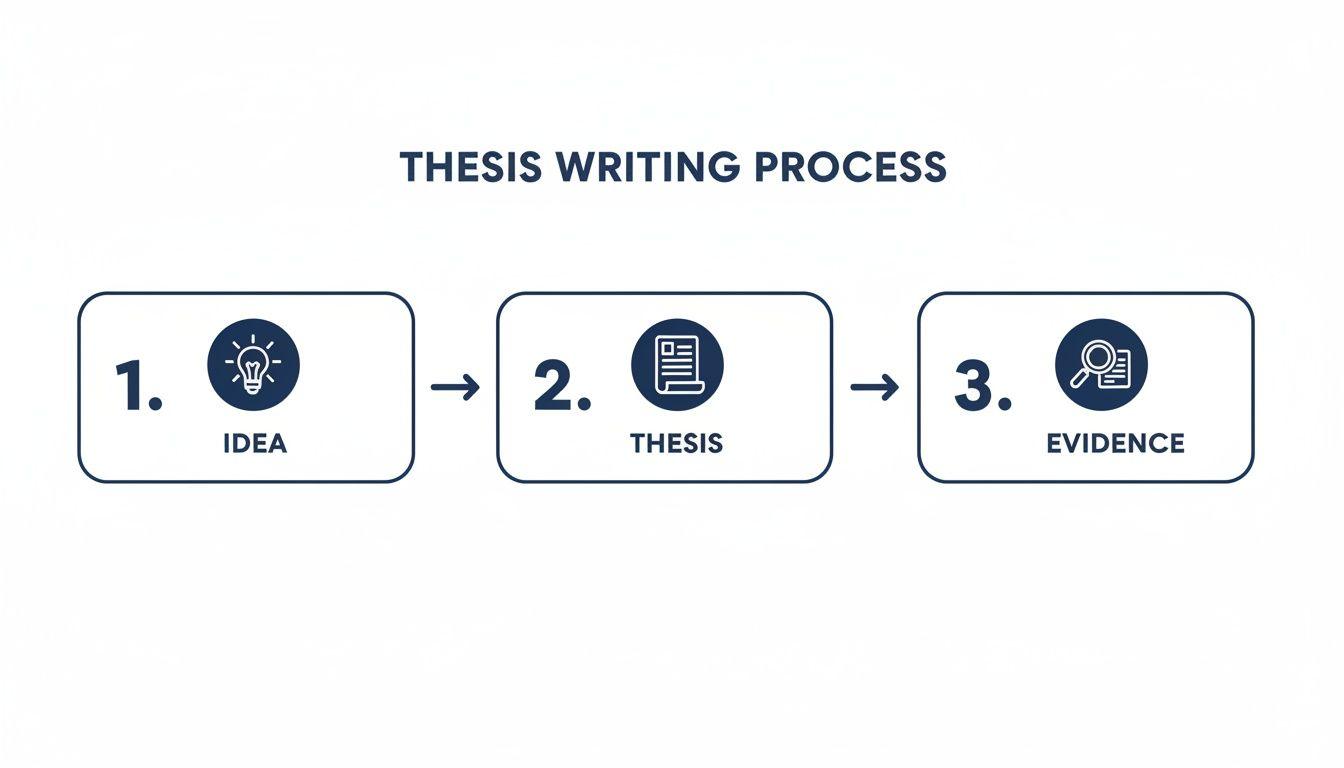
As you can see, a strong thesis becomes the central hub, with all your evidence-based arguments branching out from it. If you need more detailed guidance on this, our complete guide with an essay outline example breaks it down even further.
Key Insight: A great persuasive essay isn't just written; it's constructed. You start with a solid foundation (your thesis), build the framework (your outline), and then carefully lay the bricks (your body paragraphs), making sure each one is perfectly placed to support the whole structure.
From your hook in the introduction to your final thought in the conclusion, every part has a job. The intro needs to grab the reader and present your thesis. The conclusion needs to do more than just repeat what you’ve said—it should leave a lasting impression that reinforces why your argument matters.
Winning the Argument by Addressing the Other Side
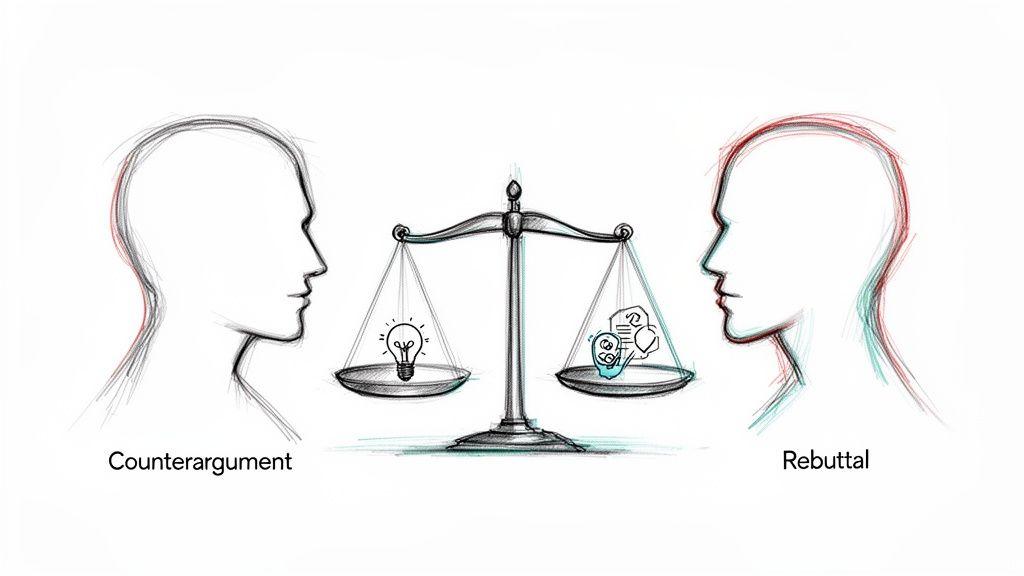
Here's a secret that separates a good persuasive essay from a truly great one: the best arguments don't just push their own agenda. They anticipate what the other side is thinking and take it on directly.
This is all about the counterargument and the rebuttal. By bringing up the opposition, you aren't showing weakness—you're showing confidence. You're telling your reader that you’ve thought about the issue from every angle, which makes you sound much more credible and trustworthy. An essay that ignores its critics seems flimsy, but one that confronts them head-on feels solid and well-reasoned.
Finding and Framing the Counterargument
Before you can knock down the other side's points, you have to find them first. Think about it: what’s the most logical, intelligent objection someone could have to your thesis? You need to find their strongest point, not a weak one you can easily dismiss. Attacking a flimsy point is a logical fallacy called a "straw man," and it just makes your own argument look cheap.
Once you have a solid counterargument, state it fairly in your essay. Use neutral language to introduce it. This shows you respect the opposing view, even if you’re about to dismantle it.
Here are a few ways to introduce the other side’s perspective:
- Some might argue that...
- It's understandable why some believe...
- A common concern is that...
- On the other hand, many point to...
Presenting the counterargument without a biased tone builds a bridge to your reader. They're more likely to listen to what you have to say next.
Mastering the Art of the Rebuttal
Now for the knockout punch: the rebuttal. This is your direct response, where you use logic and evidence to show why the opposing view is mistaken, incomplete, or simply not as important as your own. A good rebuttal doesn't just say, "That's wrong." It proves why it's wrong.
Let’s say you’re arguing for a four-day school week, and the counterargument is that it would hurt student learning. Your rebuttal could bring in data from school districts that have already made the switch, showing how their academic performance stayed the same or even improved because students and teachers were more rested and focused.
There are several ways to approach a rebuttal, each with a slightly different flavor.
Effective Rebuttal Strategies
| Strategy | Description | Example Sentence Starter |
| Direct Refutation | Use facts, data, or logic to directly disprove the counterargument. This is a head-on approach. | "While that may seem true on the surface, the data actually shows..." |
| Minimization | Acknowledge the counterargument has some merit but show why it's a minor or insignificant issue. | "Although this is a valid concern, it overlooks the much larger issue of..." |
| Alternative Cause | Agree with the problem raised by the counterargument but argue that its cause is different than what they claim. | "The opposition correctly identifies the problem, but they misdiagnose the cause, which is actually..." |
| Redefinition | Challenge the very definition or assumption the counterargument is built on. | "This argument rests on the assumption that..., but if we redefine the goal as..., a different picture emerges." |
Choosing the right strategy depends entirely on the specific point you're trying to counter.
This isn't just a stylistic trick; it’s backed by hard data. Research from the AI company Anthropic found that arguments that addressed objections from a resistant audience were a staggering 35% more persuasive. This echoes what we see in academic settings, where College Board data shows essays with multi-sided arguments consistently score 25% higher.
When you master the counterargument and rebuttal, you're no longer just making a point—you're controlling the entire conversation. You see the doubts in your reader's mind, you address them directly, and you leave them with no choice but to agree with your well-reasoned conclusion.
Transforming Your Draft Through Smart Revision
Finishing that first draft feels fantastic, but let's be honest—the real work is just beginning. This is where you elevate a decent collection of ideas into a truly powerful argument. Smart revision isn't just about hunting for typos; it’s about stepping back and looking at your work with fresh eyes, first from a distance and then up close.
Think of yourself as a film editor. First, you watch the "rough cut" to make sure the story holds together, the pacing works, and the main scenes land with impact. Only after the big picture is solid do you start tweaking individual shots, sound effects, and color grading. Your essay deserves that same two-pass approach.
Start with Big-Picture Revisions
Before you even think about commas or word choice, take a break. Then, come back and read your essay as if you were the intended audience. For now, you're not the writer; you're a critical reader trying to be convinced. Your goal here is to test the strength and clarity of the argument itself.
Ask yourself these crucial questions:
- Does my thesis still hold up? Often, our understanding of a topic deepens as we write. Reread your introduction and then the rest of the essay. Does the argument you actually made still perfectly match the claim in your thesis? Don't be afraid to sharpen your thesis to better reflect your final points.
- Does every paragraph pull its weight? Read just the topic sentence of each body paragraph, one after another. Do they form a logical, easy-to-follow mini-outline that proves your thesis? If not, something is out of order or off-topic.
- Is the flow logical? Does one idea transition smoothly into the next, or are there jarring jumps that might lose your reader? You might realize that paragraph four actually makes more sense if it comes before paragraph two. Now’s the time to move things around.
- Is my evidence convincing enough? Look for the weakest link. Is there a claim you made that feels a bit thin or unsupported? Have you relied too heavily on one source? This is your chance to swap out a weak quote for a more authoritative one or find that killer statistic you need.
This macro-level work is what makes an essay persuasive, not just a list of facts. It ensures your argument is built on a rock-solid foundation.
Pro Tip: Read your essay out loud. Seriously. It’s the single best way to catch awkward phrasing, clunky sentences, and gaps in your logic. If it sounds weird to say, it will feel even weirder to read.
Fine-Tune with Line-by-Line Proofreading
Once you’re confident that the structure is solid and the argument is sound, it’s time to zoom in. This is the final polish, the micro-editing that makes your work look professional and keeps distracting errors from undermining your credibility.
When you switch your focus to the sentence level, you're looking for different things. Your proofreading checklist should include:
- Clarity and Word Choice: Hunt down vague words and replace them with precise, impactful ones. Are you using lazy words like "things" or "stuff"? Find a better noun. Did you use the same adjective three times in one paragraph? Open a thesaurus.
- Sentence Fluency: Good writing has rhythm. Read your paragraphs again. Are they a series of short, choppy sentences? Or a marathon of long, winding ones? Mix it up. Varying sentence length makes your writing more engaging and easier to follow.
- Grammar and Punctuation: Now you can sweat the small stuff. Look for common culprits like run-on sentences, subject-verb agreement issues, and misplaced commas.
- Spelling and Typos: Your spell checker is a good first line of defense, but it's not foolproof. It won't catch correctly spelled but misused words, like mixing up "their", "there", and "they're". A slow, careful read-through is the only way to catch everything.
This final, meticulous pass is what makes all your hard work shine. It presents a convincing argument that is as well-crafted as it is well-reasoned.
Answering Your Top Persuasive Essay Questions
Even with the best outline, a few classic questions always seem to pop up when you're in the thick of writing. Let's clear up some of the most common sticking points I see with students.
How Long Should My Paragraphs Be?
Forget word count and focus on function. A solid body paragraph usually clocks in at around four to six sentences. That’s the sweet spot for introducing your point, backing it up with evidence, explaining why it matters, and tying it all back to your main argument.
Think of it like this: if your paragraph is only one or two sentences, you've almost certainly just made a claim without proving it. On the flip side, if you're pushing past eight sentences, you’re probably either rambling or trying to stuff too many ideas into one place. Keep it focused.
How Much Evidence Do I Really Need?
There’s no magic number here. The real key is quality over quantity. One killer statistic or a perfectly chosen quote from an expert will do more heavy lifting than five weak or irrelevant examples ever could.
A good rule of thumb is to have at least one solid piece of evidence for each body paragraph. If you’re tackling a more complex idea, you might bring in two pieces that work together—maybe a statistic to show the scope of an issue and a quick story to give it a human face.
Expert Tip: The evidence itself isn't the point. Your analysis of that evidence is where the real persuasion happens. You have to connect the dots for your reader and explicitly explain how that fact or quote proves your thesis is correct.
What's the Difference Between a Persuasive and an Argumentative Essay?
Ah, the classic question. They’re similar, but they operate differently. Both want to convince the reader, but they take different roads to get there. I like to think of it as the difference between a passionate plea and a structured court case.
| Essay Type | Primary Goal | Tone & Approach |
| Persuasive | To win the reader over to your side. | Leans heavily on emotional appeals (pathos). The tone is often passionate, personal, and focuses almost exclusively on one side of the issue. |
| Argumentative | To prove your claim is logically sound. | Relies on facts, logic, and evidence (logos). It requires you to acknowledge and then dismantle opposing arguments to show you've thought through the issue completely. |
In most academic settings, especially as you get into high school and college, your teachers are looking for an argumentative essay. Why? Because it shows a higher level of critical thinking. Always scan your assignment for keywords like "evaluate," "address counterclaims," or "consider the opposition"—those are dead giveaways that you need to build a formal argument, not just a persuasive appeal.