Cutting operational costs isn't a one-off slash-and-burn project. It's a strategic mix of auditing where your money actually goes, smartly automating tedious work, and getting the most out of every contract and workflow you have.
The real goal is to identify cost leaks, use technology like AI to your advantage, renegotiate with vendors, and get your team involved in finding efficiencies. When you do it right, cost management becomes a core part of how your business runs every single day.
Why Reducing Operational Costs Matters More Than Ever
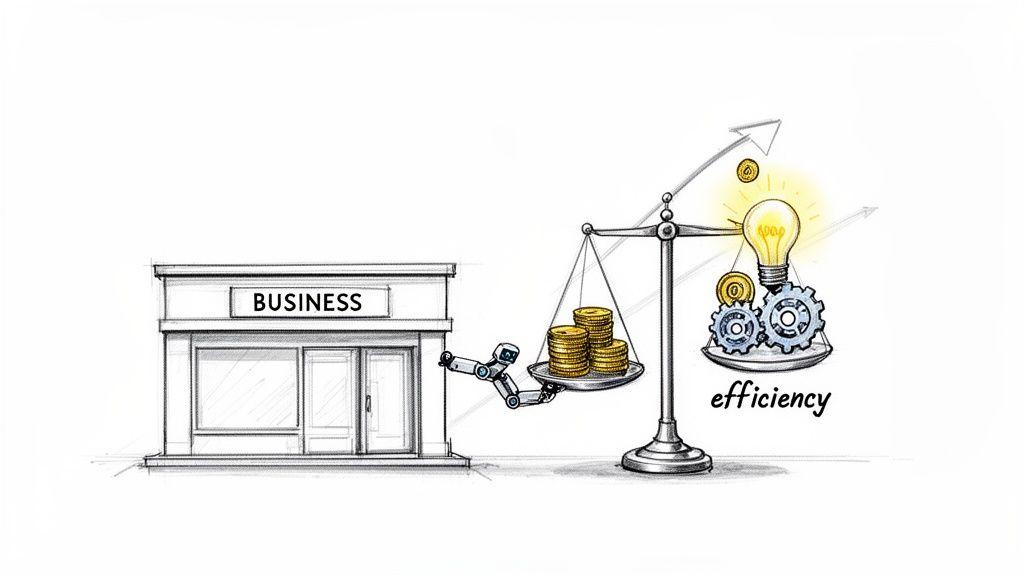
In an economy that always seems to be on a rollercoaster, keeping a tight grip on expenses is more than just good business—it's essential for survival. For most small and mid-sized companies, the pressure never lets up. Things like bloated software subscriptions, clunky manual processes, and contracts that auto-renew without a second thought are silently draining your resources.
These "cost leaks" are sneaky. They often fly under the radar but, piece by piece, they put a serious drag on your profitability.
Taking charge of your costs isn't about making painful cuts that hurt quality or tank team morale. It's about building a more resilient and efficient company. It means looking at every part of your operation and asking a simple question: "Is there a smarter, more cost-effective way to do this?"
The Real Challenge of Managing Costs
Actually achieving significant savings is a lot harder than it sounds. In 2024, executives around the world admitted to hitting only 48% of their cost-saving targets. That’s a huge gap between what companies want to do and what they actually accomplish.
This is why getting a handle on costs is still a top priority for business leaders. The successful ones know it’s about creating a cost-conscious culture and getting employees on board, which can boost production efficiency by as much as 11%. You can dig deeper into these executive priorities in BCG's 2025 report.
This is where modern tools can be a game-changer. Artificial intelligence, which used to be something only massive corporations could afford, is now a powerful and accessible tool for small businesses. AI can take over repetitive tasks, analyze your spending patterns, and pull out insights you’d never find on your own.
"The goal of cost reduction isn't to spend less, but to spend smarter. It’s about reallocating resources from wasteful activities to high-growth opportunities, turning efficiency into your competitive advantage."
Your Strategic Path To Lower Costs
This guide isn't about generic advice. It’s a clear framework designed to help you systematically find, prioritize, and lock in real savings. We'll give you actionable steps you can start using today.
For those who want to jump right in, this table gives you a snapshot of the low-hanging fruit we'll be tackling.
Quick-Win Operational Cost Reduction Checklist
| Strategy Area | Quick Action | Potential Impact |
| Technology & Software | Audit all SaaS subscriptions for redundancy and low usage. | 10-20% reduction in monthly software spend. |
| Process Automation | Identify one repetitive manual task and automate it with AI. | Recoup 5-10 hours of team productivity per week. |
| Vendor Contracts | Review and renegotiate terms with your top 3 suppliers. | Achieve 5-15% savings on key contracts. |
| Workforce Productivity | Implement a centralized communication tool to reduce meetings. | Improve project turnaround time and reduce errors. |
| Energy & Utilities | Switch to LED lighting and install smart thermostats. | Lower monthly utility bills by up to 10%. |
These are just the starting points. In the following sections, we'll dive deep into each one and give you a repeatable system for not just cutting costs, but building a leaner, more agile business ready for whatever comes next.
Diving Deep: Your Operational Cost Audit
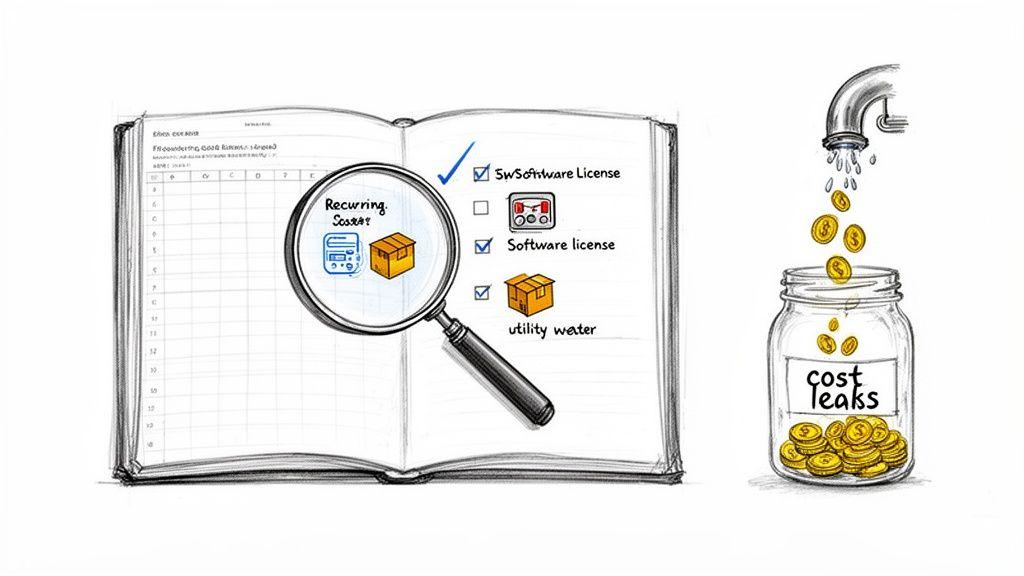
Before you can start slashing costs, you need to know exactly where your money is going. This isn’t about becoming a master accountant overnight. It's about a practical, no-nonsense deep-dive to find those sneaky expenses that quietly bleed your budget dry.
Think of it like plugging leaks in a boat. You have to find them before you can even think about bailing out the water.
In my experience, most small businesses are shocked to find how much money is tied up in small, recurring charges. We're talking about the infamous "cost leaks"—that software license for an ex-employee, redundant subscriptions, or inefficient shipping partners. They seem tiny on their own, but add them up, and you’ve got a serious drain on your profits.
Don’t worry, you don't need a massive finance team for this. A simple spreadsheet and a few hours of focused work are all it takes to get a clear financial picture and spot some immediate wins.
Getting Your Expenses in Order
First things first, you need the raw data. Pull together all your financial statements from the last six to twelve months. That means bank statements, credit card bills, and any reports from your accounting software.
The goal here is to sort every single expense into one of three buckets. This simple act of categorizing is surprisingly powerful.
- Fixed Costs: These are your non-negotiables, the predictable expenses that hit your account every month no matter what. Think rent, salaried payroll, insurance premiums, and loan payments. They're the foundation of your budget.
- Variable Costs: These are the costs that move up and down with your business activity. We're talking raw materials, hourly wages, shipping fees, and sales commissions. When you’re busier, these go up.
- Hidden Costs: This is where the real treasure hunt begins. These are the expenses you’ve forgotten about or just accepted without a second thought. That SaaS tool your team hasn't touched in months? The automatic renewal you missed? Even inflated utility bills fall in here.
Just going through this exercise will give you a few "aha!" moments. You'll immediately start to see which costs are essential, which are tied to growth, and which are just plain waste.
Hunting for Cost Leaks
With all your spending neatly categorized, it's time to put on your detective hat and hunt for those leaks. This isn’t about looking for one giant mistake; it’s about finding the dozens of small, consistent drains. You'd be amazed at how quickly they add up.
Start asking tough questions about every line item. Challenge the status quo and make every dollar justify its existence.
Don’t treat this like a routine chore. Turn your cost audit into a strategic investigation. You’re not just tracking expenses—you’re actively managing the financial health of your company.
For example, pull up your list of software and subscriptions. Is there overlap? Do you really need a separate project management tool, a team chat app, and a document-sharing service, or could one integrated platform do it all? The goal is to consolidate and simplify wherever you can. We have some solid frameworks for this in our guide on how to streamline business processes.
Building Your Action Plan
An audit is useless without action. Now that you've identified a list of potential savings, it's time to build a smart plan to tackle them.
Open up your spreadsheet and add two new columns next to each potential cut. You’re going to prioritize them based on two simple factors:
- Ease of Implementation: How fast can you get this done? Canceling an unused subscription takes five minutes. Renegotiating a major vendor contract? That’s a bigger project.
- Potential Impact: How much money are we talking about? Axing a $500/month software license is a much bigger win than trimming a $20/month service.
By scoring each item, you can quickly build a prioritized to-do list. Always start with the "high-impact, easy-to-implement" items. These are your quick wins, and they build momentum. Nailing these first makes it much easier to motivate yourself and your team to tackle the more complex cost-saving projects down the road.
Putting Automation and AI to Work on Your Bottom Line

Let’s be honest, "automation" and "AI" can sound intimidating and expensive. For years, they felt like tools reserved for massive corporations with deep pockets. That’s just not the case anymore. Today, these are practical, accessible ways for any business to stop wasting money on repetitive, soul-crushing tasks.
This isn’t about replacing your talented people. It's about getting them off the hamster wheel of manual work so they can focus on what really matters—solving customer problems, innovating, and driving growth.
By smartly automating the right processes, you can claw back countless hours, slash human error, and even consolidate your sprawling, expensive collection of software into one efficient system. The ROI on a well-chosen automation tool can be staggering.
Finding Your First Automation Wins
The trick is to start small. Don't try to automate your entire business overnight. Look for the low-hanging fruit: the tasks that are both frequent and follow a clear set of rules.
Think about the things your team does every single day or week that follow a predictable pattern. These are perfect candidates because they don’t require human judgment, just consistent execution.
- Data Entry and Admin: Manually copying customer info from an email into your CRM and then into an invoice? That's a classic time-sink just begging to be automated.
- Customer Follow-ups: Standard appointment reminders, post-purchase thank you notes, or "we miss you" emails can all be set on autopilot.
- Social Media Management: Instead of carving out time each day to post, you can use a single tool to schedule a full week's worth of content in one block.
- Answering Common Questions: How often does your team answer the same five questions? An AI assistant can handle those 24/7, freeing up your experts for the tricky stuff.
This isn't just theory. A 2025 survey of over 600 executives revealed that 62% see AI as a highly effective way to boost productivity and manage costs. Even giants like Procter & Gamble saved over $900 million in five years by automating administrative tasks—a strategy now accessible to businesses of any size. To see more of these cost-reduction strategies in action, check out the analysis on FlowGenius.ai.
Consolidate Your Tech Stack with AI
One of the sneakiest drains on a small business budget is "software bloat." You're paying for a chat app, a project management tool, another one for document analysis, and yet another for writing marketing copy. They don't talk to each other, and the monthly bills just keep adding up.
This isn't just expensive; it’s a productivity killer. Your team is constantly switching between apps, losing focus and context along the way. This is where modern integrated AI platforms are changing the game.
By switching to a single, unified platform, you can often replace four or five different subscriptions with one. This move alone can chop hundreds of dollars off your monthly software bill.
Imagine one central place where your team can:
- Draft and improve marketing emails.
- Get a quick summary of a long report.
- Handle initial customer questions instantly.
- Work together on projects without jumping between browser tabs.
This consolidation is a powerful cost-cutting move. For example, using a single AI chatbot for small business can do the job of a separate lead capture form, a live chat widget, and an internal knowledge base, streamlining your whole operation.
A Practical Look at the Cost-Benefit of Automation
To see how this plays out in the real world, let's look at what it really costs to do things the old way versus with a little bit of automation. The numbers speak for themselves.
The table below breaks down the time and money spent on common business tasks, comparing the manual approach to an AI-powered one.
Manual Tasks vs AI Automation Cost-Benefit Analysis
| Business Task | Manual Approach (Time & Cost) | AI-Powered Approach (Time & Cost) | Net Savings |
| Onboarding a New Client | 4-5 hours of manual data entry, welcome emails, and scheduling calls. Cost: ~$150 in staff time. | 15 minutes to trigger an automated workflow. Cost: ~$5 in tool usage. | $145 per client & 4.5 hours saved. |
| Creating a Monthly Report | 8-10 hours of pulling data from multiple sources and building charts. Cost: ~$300 in staff time. | 30 minutes to connect data sources and auto-generate the report. Cost: ~$10 in tool usage. | $290 per month & 9.5 hours saved. |
| Managing Social Media | 10-12 hours per month for content creation and scheduling. Cost: ~$360 in staff time. | 2 hours to generate ideas and schedule posts with an AI assistant. Cost: ~$20 for the tool. | $340 per month & 10 hours saved. |
As you can see, the savings are real and immediate. Automating just these three tasks can put thousands of dollars and dozens of hours back into your business every year—resources you can then invest in actual growth.
Fine-Tuning Your Vendor Contracts and Supplier Relationships
Your vendor and supplier agreements are one of the most overlooked areas for finding serious savings. So many businesses sign a contract, file it away, and just let it auto-renew year after year. This "set it and forget it" habit quietly eats away at your budget, but the good news is that it’s also one of the easiest places to make a real financial impact.
Turning these expenses into a strategic advantage doesn’t mean you have to strong-arm your suppliers. It’s about being smart, organized, and focused on building real partnerships that work better for everyone involved.
First, Conduct a No-Nonsense Contract Audit
You can't renegotiate what you don't understand. Before you pick up the phone, you need a perfectly clear picture of what you’re paying for and why. This is all about digging up every single vendor agreement—from software subscriptions to your office cleaning service—and getting them all in one place.
I recommend creating a simple spreadsheet to track the vitals for each vendor. This isn't just about the dollar amount; you need the full story to see where the opportunities are.
- Key Details: Vendor name, service/product, monthly or annual cost, contract end date, and—this is crucial—the auto-renewal date and notification window.
- Real-World Usage: For every service, especially software, get honest answers from your team. "How often do we actually use this?" "What would happen if we didn't have it tomorrow?"
- Spotting Redundancies: Are you paying for three different project management tools? Or two separate cloud storage accounts? Consolidating these overlaps is the fastest way to slash costs.
I guarantee this audit will turn up a few surprises. You'll likely find subscriptions still active for former employees or tools that were used for one project months ago and then completely forgotten. These are your easy, immediate cuts.
Become a Pro at Renegotiating
Once your audit is done, you have the data you need to start having productive conversations. Renegotiation isn't about calling up and demanding a lower price. It's a strategic discussion based on your value as a customer and your goal of creating a long-term, mutually beneficial relationship.
Start with your most important, long-term suppliers. These are the relationships that matter, and a good vendor would much rather give you a better deal than lose your business entirely. When you connect, frame the conversation around partnership, not just price.
A successful negotiation isn’t a battle where one side wins. It’s about finding a new arrangement where both you and your vendor feel you’re getting great value. A 5-10% discount in exchange for signing a longer-term contract is a classic win-win.
Here are a few conversation starters I’ve used that work well:
- "We're planning our budget for the next year and are looking for ways to make our great partnership even more cost-effective."
- "We've been a loyal customer for five years now, and we'd love to explore terms that better reflect that long-term commitment."
- "We're looking to consolidate our vendors. Are there any bundling options or discounts if we move our other services over to you?"
Never forget the power of being a good client—someone who pays on time and is easy to work with. Suppliers value that stability and are often willing to reward it.
Consolidate and Bundle for Bigger Savings
Juggling dozens of different vendors isn't just a financial burden; it's an administrative headache. Every vendor adds another invoice to process, another contact to manage, and another contract to keep track of.
That's why consolidating your spending with fewer, higher-quality suppliers is such a powerful move.
Look for vendors who can offer a whole suite of services you need. For instance, instead of using three different companies for your website hosting, domain name, and business email, find one that can bundle them all together. This move alone simplifies your admin work and gives you much more leverage to negotiate a better overall price.
The same principle works for physical goods. Sourcing several related items from one distributor can unlock volume discounts and slash your shipping costs. It streamlines your supply chain and, by making your business a more valuable client, strengthens your position for any future negotiations.
Boosting Workforce Productivity and Engagement

When business leaders hunt for ways to trim operational costs, they usually go straight for the obvious line items—software subscriptions, office space, marketing spend. But often, the most powerful lever for improving your financial health is right in front of you: your team. An engaged, productive workforce isn't just a "nice-to-have" for company culture; it's a direct driver of efficiency and sustainable savings.
This isn't about squeezing more out of your people for less. It's about empowering them to do their best work with less friction. Smart investments in your team and their daily workflows can deliver incredible returns that go far beyond a simple budget cut.
Rethinking Work for Modern Efficiency
The old-school, 9-to-5 office model is loaded with fixed costs. Think rent, utilities, and a constant stream of office supplies. By offering flexible work arrangements, like hybrid or fully remote options, you can directly tackle these big overhead expenses. You might find you can downsize your office or even get rid of it completely, creating immediate and significant savings.
But the benefits aren't just about real estate. Flexibility breeds autonomy and trust, which are foundational for a motivated team. When employees feel trusted to manage their own time and workload, they often become more focused and effective.
Plus, you instantly broaden your talent pool. By hiring remotely, you're no longer limited to your local area, which means you can find the best person for the job at a competitive salary, without the high costs tied to major cities.
Investing in Skills to Amplify Output
I've seen it time and time again: targeted training isn't an expense, it's a high-yield investment. When your team members are truly skilled and confident in their roles, they make fewer mistakes, need less hand-holding, and get things done faster. The result is a direct drop in wasted time and resources.
Consider upskilling your team in areas with a clear impact on the bottom line:
- Project Management: Better planning and execution mean fewer costly delays and budget blowouts.
- Customer Service: A well-trained support team resolves issues on the first try, which boosts customer retention and lowers the cost of finding new ones.
- Software Proficiency: Make sure your team can actually use the full potential of the tools you’re already paying for. This is key to maximizing the ROI on your tech spend.
Creating a culture of continuous improvement empowers every single employee to actively look for smarter ways to work. Your entire organization becomes an engine for cost reduction. Our guide on how to increase team productivity offers more detailed strategies for building these skills.
Equipping Your Team with Unified Tools
Nothing kills momentum like forcing your people to jump between a dozen different apps all day. The time lost digging for information, copying and pasting data, and getting sidetracked by notifications is a massive hidden cost. This "app-switching" fatigue also destroys morale.
Equipping your team with a single, unified platform for communication and AI-driven tasks can eliminate this friction entirely. Instead of paying for separate tools for chat, document analysis, and content generation, you can consolidate them into one cost-effective solution.
This is where smart technology leadership makes a huge difference. Research from Deloitte’s 2025 GBS Survey found that 55% of organizations with a dedicated business services leader delivered average savings over 20%. By centralizing tools and processes, you're mimicking this successful strategy. Adopting a unified AI platform like 1chat.com can help eliminate the tool silos that drain 15-25% of a typical SMB’s IT budget each year. You can learn more about the findings from Deloitte's global survey and see how strong leadership drives these savings.
Ultimately, investing in your team’s productivity and engagement is one of the most sustainable ways to control and reduce operational costs. It creates a powerful feedback loop where an empowered, efficient team continually discovers new ways to improve the business's financial health.
Weaving Cost Reduction into Your Company’s DNA
Let's be clear: getting your operational costs under control isn't a one-and-done project. You don't just complete a checklist and declare victory. True success comes from making cost-consciousness a fundamental part of how your business operates, day in and day out.
The strategies we've walked through—from the deep dive of a cost audit to getting smarter with your vendors—are the building blocks. The real challenge, and the real reward, is turning those actions into ingrained habits.
Your Cost Control Dashboard: Keeping Score
You can't manage what you don't measure. But this doesn't mean you need a PhD in data science or some ridiculously complex dashboard. A handful of simple, powerful Key Performance Indicators (KPIs) will tell you everything you need to know.
Think of this as your operational health report. These numbers give you a quick, honest look at whether your efforts are actually working. Focus on the metrics that directly relate to the areas you’ve been working on.
- Operating Expense Ratio (OER): An oldie but a goodie. It’s your total operating expenses divided by total revenue. If this number is consistently trending down, you’re doing something right—your business is getting leaner and more efficient.
- Software Spend per Employee: This one is incredibly revealing, especially for modern businesses. Take your total monthly software bill and divide it by your number of employees. It's the best way to spot "software bloat" and make sure you aren't flushing money down the drain on unused seats.
- Cost Per Unit/Service: If your business makes a physical product or delivers a standard service, this is non-negotiable. Knowing exactly what it costs to produce one "thing" is the first step to figuring out how to do it for less. Lowering this number directly boosts your bottom line on every single sale.
Remember, a single snapshot in time isn't the story. The magic is in the trend line. Seeing a small but steady improvement month over month is proof that a cost-conscious mindset is taking root and delivering compounding returns.
The Rhythm of Review: Making It Stick
Once you have your numbers, you need a rhythm for looking at them. This isn't about scheduling another soul-crushing meeting that could have been an email. It’s about creating a dedicated, focused moment to check in on your progress, celebrate what's working, and spot what’s next.
A simple monthly or quarterly cost huddle can be a game-changer. In these sessions, the conversation should be straightforward. Ask your team:
- How are our cost-saving initiatives progressing? Are we hitting our targets?
- Did any new, unexpected expenses bite us this month?
- Based on what we're seeing, where's our next big chance to get more efficient?
This regular check-in is your defense against old habits creeping back in. It keeps smart spending on everyone's radar and reinforces that efficiency is a shared responsibility. By building this continuous loop of measure, review, and adjust, you're not just cutting costs—you're hardwiring operational excellence into your culture. That's how you build a resilient, agile, and more profitable business that's ready for anything.
Got Questions? We’ve Got Answers.
When you start digging into cost reduction, a lot of questions naturally come up. Let's tackle a couple of the most common ones I hear from business owners who are trying to get a handle on their operational spending.
Where Should I Start Cutting Expenses?
It's tempting to go after the big, scary numbers first, but I always advise starting with the low-hanging fruit. Look for expenses you can trim without causing a major disruption to your daily operations. This gives you a quick win and builds momentum.
A great place to begin is with your software subscriptions. You'd be amazed at how many businesses are paying for redundant tools or licenses that no one is even using. Canceling these can free up cash immediately. After that, take a hard look at variable costs like office supplies, marketing spend, or non-essential travel. Small, consistent trims in these areas really do add up over time.
My Two Cents: Don't just think about cutting. Think about consolidating. I once worked with a client who was paying for three different project management and communication tools. We replaced them with a single, more robust platform, which not only saved them a ton of money but also made their team's workflow much smoother.
How Do I Convince My Team This Is a Good Idea?
This is a big one. If your team thinks you're just slashing budgets to boost profits, you'll face resistance. The key here is total transparency.
You have to explain the why behind the changes. Frame it as a strategic move to build a stronger, more resilient company that benefits everyone—not just a top-down order to cut costs.
Even better, bring them into the fold. Ask your employees for their ideas! They're the ones doing the work day in and day out, and they often have incredible insights into where the real waste and inefficiencies are hiding.
- Make them part of the solution: When someone on the front lines suggests a smart way to save, listen. Empower them to help implement it.
- Share the wins: Don't keep the results to yourself. Show them the progress with simple charts or updates.
- Give credit where it's due: Publicly recognize and reward the people who come up with great cost-saving ideas.
When you do this, it stops being your cost-cutting plan and becomes our efficiency initiative. You’re building a culture of ownership where everyone feels invested in the company's financial health.