You've probably had this assignment happen in one of two ways. A teacher writes “essay about problem and solution” on the board, and your mind goes blank. Or you already picked a topic like pollution, stress, or poverty, and now the draft feels so big that every sentence sounds vague.
That stuck feeling is normal. I've seen it hundreds of times in writing centers. Most students don't fail this assignment because they can't write. They struggle because they start with a giant issue and a thin idea of how to solve it.
A strong problem-solution essay isn't really a fill-in-the-template exercise. It's a thinking exercise. You're showing that you can name a real issue, explain why it happens, and argue for a fix that someone could realistically try.
Beyond the Template What Makes a Great Problem-Solution Essay
A lot of writing guides make this essay seem mechanical. Intro. Problem. Solution. Conclusion. That format matters, but it's only the frame.
The task is sharper than that. You need to answer three questions:
- What exactly is wrong?
- Why is it happening?
- What should be done about it?
A helpful way to think about this essay is to picture a doctor's visit. A weak writer says, “People are unhealthy. We should fix that.” A stronger writer identifies a specific symptom, looks for causes, and recommends treatment. Your essay works the same way.
According to Owlcation's guide to problem-solution essay writing, a high-quality problem-and-solution essay is built as a staged workflow: identify and research a real, specific problem; explain its background and causes; present a thesis that signals the proposed fix; and organize the body into distinct sections. That structure matters because it reduces reader cognitive load and makes the argument easier to follow.
Why teachers assign this form so often
This essay type shows up everywhere because it teaches organized thinking. In school, it helps students move beyond summary. In workplaces, the same skill appears in proposals, reports, and recommendations.
When a manager writes, “Customer complaints are rising, here's why, and here's what we should change,” that's problem-solution thinking. When a school committee argues for a policy update, same thing.
Practical rule: Your reader should be able to trace a straight line from problem, to cause, to evidence, to solution.
What great essays do differently
Strong papers usually share a few habits:
- They define a narrow problem. Not “education is broken,” but “first-year students don't know where to find tutoring support.”
- They show causes, not just symptoms. They ask what keeps the problem going.
- They propose an action, not a wish. “Schools should care more” isn't a solution. “Require one orientation session on academic support services” is closer.
- They connect evidence to action. Every fact should help the reader see why the solution makes sense.
If your draft feels foggy, the problem usually isn't your grammar. It's that the essay hasn't become specific enough yet.
Finding Your Focus From a Broad Issue to a Sharp Thesis
Most weak drafts start with an oversized topic. Students choose something morally important, then discover they can't cover it well in a few pages. The issue isn't that the topic is bad. It's that it's too wide to argue clearly.
Writing guidance often misses this step. As noted in MyPerfectWords' advice on narrowing a problem-solution essay topic, the key is to avoid broad issues, choose a topic you can cover with concrete evidence, and make sure you can describe at least two realistic solutions.
Start broad, then shrink the frame
Here's a simple narrowing method I use with students:
| Broad topic | Better focus | Strong essay focus |
| Food waste | Food waste at school | Food waste in the university's main cafeteria during lunch |
| Stress | Student stress | Test anxiety among first-year students in large lecture courses |
| Traffic | City traffic | Morning drop-off congestion outside one middle school |
| Screen time | Teen phone use | Late-night phone use and sleep problems among high school students |
That last column is where essays become arguable. You can describe the setting, explain causes, and suggest realistic fixes.
A broad topic invites broad writing. A narrow topic gives you something you can actually prove.
If you need help turning a vague idea into a clear statement of the issue, this RewriteBar guide on problem definition is useful because it focuses on defining the actual problem before you jump to solutions.
Use questions to pressure-test your topic
Before you commit, ask:
- Who is affected? Be specific.
- Where does this happen? A school, neighborhood, workplace, platform, or age group?
- What causes it? If you can't name causes, you're not ready to draft.
- Who could act on your solution? Teachers, students, parents, managers, local officials?
- Can you imagine at least two realistic solutions? If not, the topic may be too abstract.
For thesis help, it also helps to study examples of strong claims. This guide on how to write a thesis statement can help you shape a thesis that does more than announce a topic.
A simple formula for the thesis
A useful problem-solution thesis has two parts:
Specific problem + proposed response
Example:
Food waste in our university's main cafeteria happens because students receive oversized portions and have limited time to sort leftovers, so the school should reduce default portion sizes and add a clearly marked food recovery station.
Notice what this thesis does right:
- It names a specific place
- It hints at causes
- It previews real actions
- It sets up body paragraphs naturally
That's the hidden key to a powerful essay about problem and solution. The thesis doesn't just tell the reader what the paper is about. It tells the reader what argument is coming.
Structuring Your Argument Two Outlines That Write Themselves
Once your topic is narrow, structure gets easier. Most problem-and-solution essays use one of two patterns: block structure or chain structure. EAP Foundation explains that these essays typically follow either a block structure, with all problems first and all solutions after, or a chain structure, with problem-solution pairs throughout the essay, in a format widely used in academic and policy writing as outlined here.
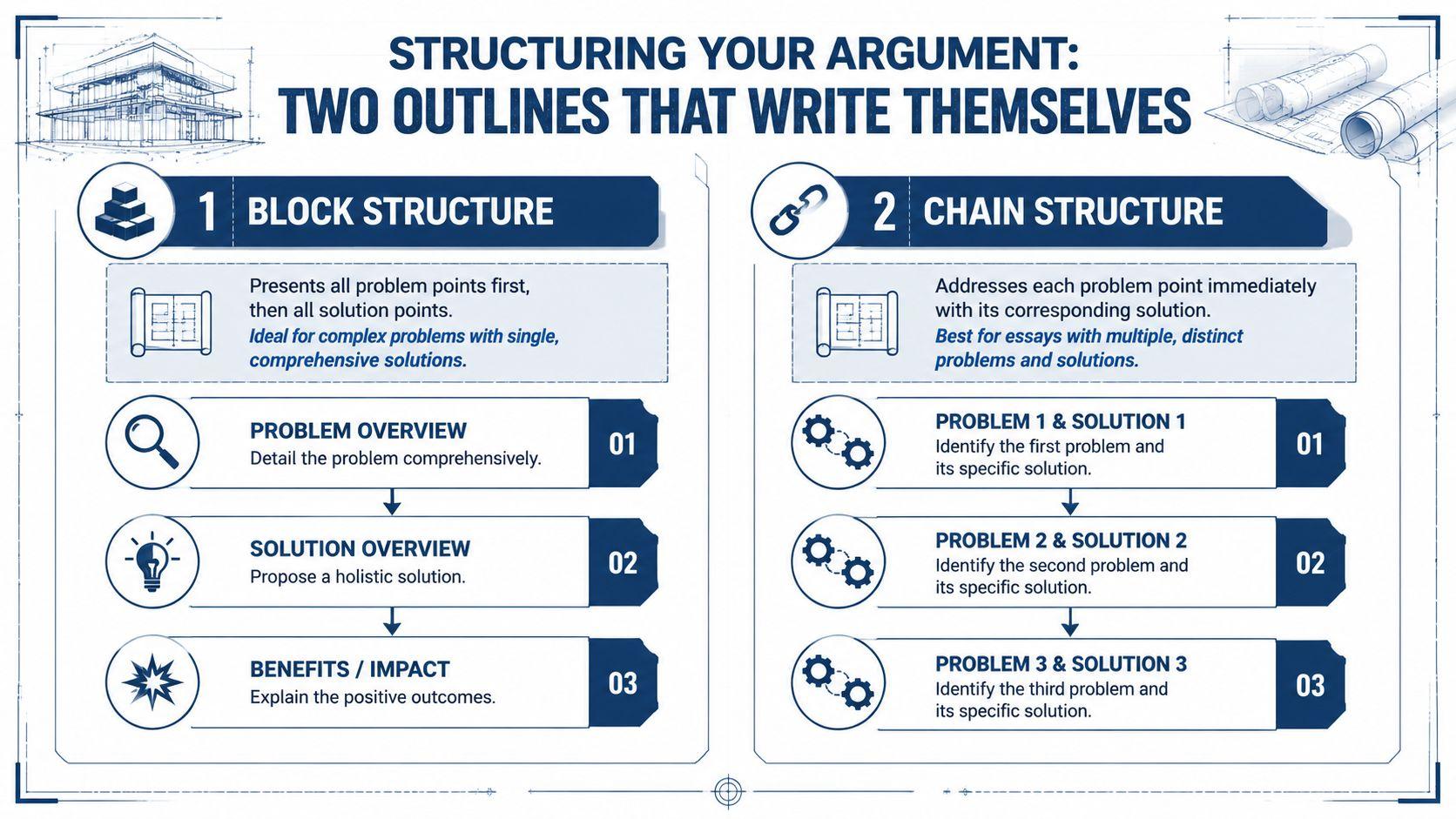
Think of block structure like sorting all your laundry first, then washing it. Think of chain structure like washing each load as you sort it. Both work. The better choice depends on what your argument needs.
When block structure works best
Use block structure when your essay centers on one main problem and one broader solution plan.
A simple version looks like this:
- Introduction with context and thesis
- Problem section explaining the issue and causes
- Solution section explaining what should happen
- Conclusion showing likely results
For the cafeteria topic, a block outline might look like this:
- Food waste is common in the main cafeteria.
- Oversized portions and rushed lunch periods contribute to the waste.
- The cafeteria should reduce default portions and create a food recovery station.
- These changes would make waste reduction more practical for students and staff.
This structure feels clean and direct. It works well when the reader needs to understand the whole problem before judging the fix.
When chain structure works better
Use chain structure when your essay has several distinct causes and each cause needs its own response.
For the same cafeteria topic:
- Problem 1: Portions are too large.
Solution 1: Offer smaller default servings with optional extras. - Problem 2: Students don't know where leftovers go.
Solution 2: Add clear labels and a visible recovery station. - Problem 3: Lunch periods feel rushed.
Solution 3: Adjust traffic flow or pickup layout to reduce line pressure.
Chain structure is often easier for readers because each problem gets an immediate answer.
Choose by reader need: If your reader must understand the whole situation first, use block. If your reader benefits from a problem-answer rhythm, use chain.
If you're practicing timed writing for classes that reward sharp structure, Vivora's AP Lang guide is useful for seeing how organization affects argument quality under pressure. You can also look at this essay outline example if you want a model for turning notes into a usable draft plan.
A fast way to decide
Use this quick test:
| If your essay has... | Better structure |
| One central issue and one main solution plan | Block |
| Several causes with matching remedies | Chain |
| A topic your reader may not understand yet | Block |
| A topic that risks sounding repetitive | Chain |
Students often think structure is just formatting. It isn't. Structure controls how your reader experiences your logic.
Drafting With Impact How to Build Persuasive Paragraphs
At the paragraph level, this essay rises or falls on one habit: every paragraph needs a job. If a paragraph only repeats the thesis in softer words, it isn't doing enough.
A strong body paragraph usually includes:
- a clear topic sentence
- context or explanation
- evidence or example
- analysis
- a link back to the solution
Writing the problem paragraph
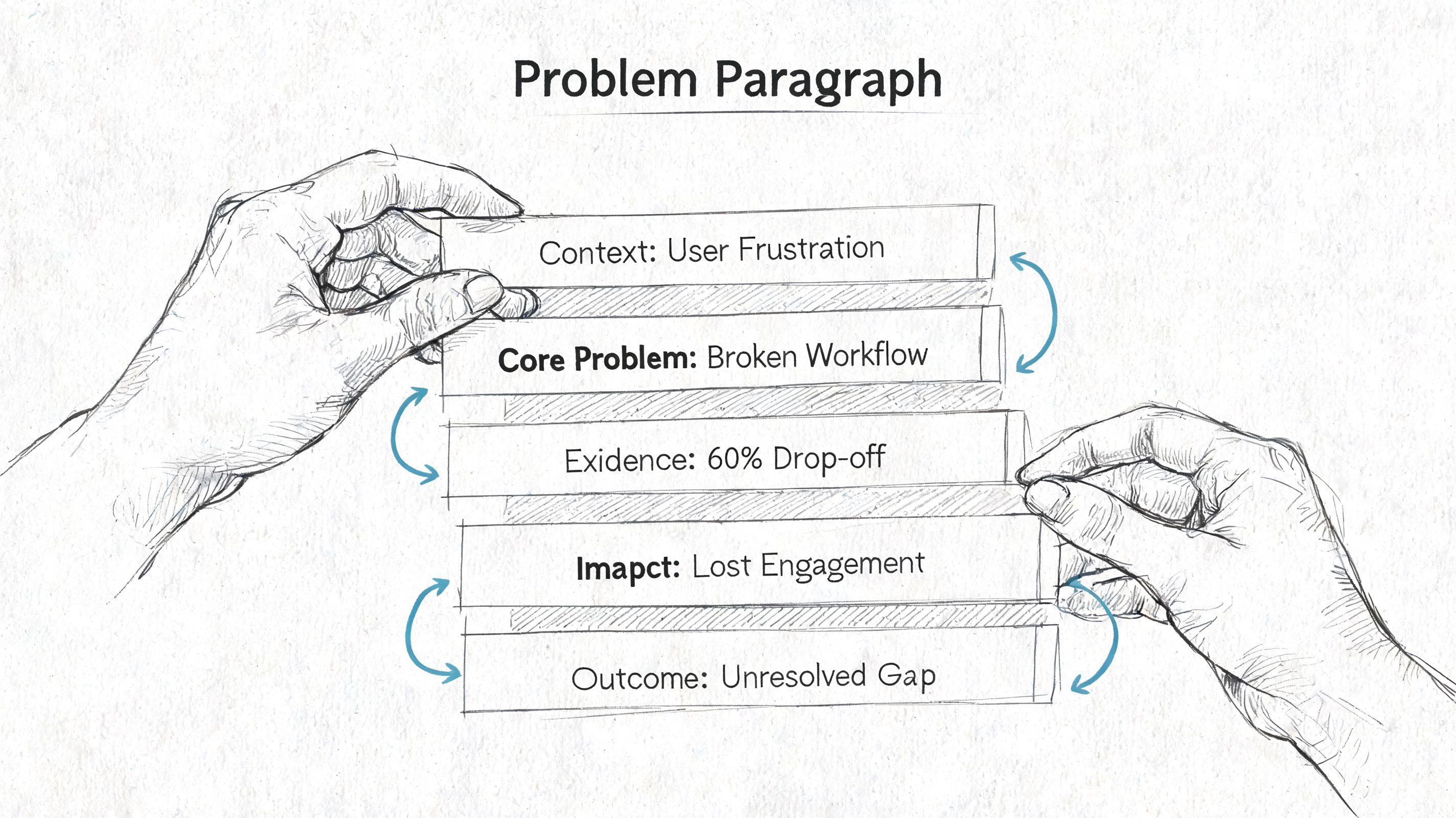
Your problem paragraph must do more than say something is bad. It should help the reader see scale, cause, or consequence. Crowjack notes that strong problem-solution essays often use quantified problems to establish significance before proposing a fix. For example, it gives the statistic that approximately 10% of the world lives on less than $1.90 per day in its discussion of poverty-focused essays here.
That doesn't mean every essay needs a global statistic. It means the writer needs some form of grounding. If you don't have a number, use a specific example, observed pattern, policy detail, or local evidence.
Sample problem paragraph:
In the university's main cafeteria, food waste happens partly because students are served more than they plan to eat. Many students choose a meal quickly, carry it to class, and throw away untouched sides when time runs short. The problem isn't simply personal choice. The system encourages waste by making large portions the default. When oversized servings meet a rushed lunch period, disposal becomes routine rather than occasional.
Notice that the paragraph doesn't wander. It names the problem, explains the cause, and shows why the problem keeps happening.
If topic sentences feel weak, this guide on how to write a strong topic sentence can help you make each paragraph sound purposeful from the first line.
Writing the solution paragraph
A weak solution paragraph sounds like advice. A strong one sounds like a plan.
Compare these:
- Weak: “The school should do more to reduce waste.”
- Stronger: “The cafeteria should make smaller portions the default and let students request extra food if needed.”
Now build that into a paragraph:
A practical way to reduce cafeteria waste is to change the default portion system. Instead of serving the same amount to every student, staff could begin with smaller portions and allow students to request more. This approach is realistic because it adjusts an existing process rather than requiring a new program from scratch. It also matches the cause of the problem. If students receive amounts they're more likely to finish, less food ends up in the trash.
Small moves that improve flow
Transitions matter because they show your reader how one idea leads to the next.
Try phrases like these:
- One reason this problem continues is
- A more realistic response is
- This solution works because
- Another obstacle is
- Unlike broad awareness campaigns
Good paragraphs don't just contain ideas. They move the reader from one reasoned step to the next.
If you're using AI tools while drafting, keep them in the assistant role. For example, Google Docs can help with revision comments, and 1chat can analyze PDFs and help summarize research notes before you turn them into your own argument. The thinking still has to come from you.
Refining Your Essay An Editor's Checklist for a Higher Grade
Revision is where average papers become convincing. Many students stop after the first clean draft because the grammar looks fine. But teachers usually grade the argument, not just the sentence polish.
StudyCrumb's guidance on common failure points notes that weak problem-solution essays often suffer from vague problem framing, missing evidence, and solutions that are asserted but not operationalized. It also recommends one main issue per paragraph, clear transitions, and evidence-backed claims in this checklist-focused guide.
Read your draft like an editor
Don't ask only, “Does this sound okay?” Ask sharper questions.
- Is the problem specific enough? If your topic could apply to the whole world, it's probably too broad.
- Does the thesis include both problem and response? Many students write only half a thesis.
- Does each paragraph do one clear job? If a paragraph discusses three issues, split it.
- Have you explained causes? Readers need more than complaint.
- Is the solution actionable? Could a real person or group carry it out?
A checklist that catches the biggest problems
Use this before you submit:
| Check | What to look for |
| Focus | One clear, narrow problem instead of a huge social issue |
| Thesis | A claim that names the issue and previews the solution |
| Evidence | Specific support, not just opinions |
| Logic | The solution addresses the actual cause, not a side issue |
| Paragraph control | One main point per paragraph |
| Transitions | Clear signals between ideas |
| Feasibility | The solution sounds realistic in the setting you chose |
| Conclusion | Ends with impact, not repetition |
Ask this before finalizing: “If my reader agreed the problem is real, would they also believe my solution could work?”
Three common repair jobs
Some essays only need a few smart fixes.
- If the topic is fuzzy, narrow the location, group, or situation.
- If the solution sounds generic, add who would do it and how.
- If the essay feels repetitive, check whether each paragraph introduces a new point.
That kind of revision does more for your grade than swapping a few adjectives.
Crafting a Strong Conclusion and Finding a Topic
A conclusion in an essay about problem and solution shouldn't just restate the introduction. It should leave the reader with a sense of consequence. What changes if the solution is adopted? Why does this issue matter in this specific setting?
A good final paragraph usually does three things:
- Restates the problem in fresh words
- Reinforces why the solution fits
- Looks forward to the likely result
For example, instead of ending with “In conclusion, food waste is a serious problem,” you might write that reducing portion size and improving food recovery would help the cafeteria waste less food while making student choices easier and more practical. That ending points to an outcome.
Topic ideas that are narrow enough to use
If you're still choosing, try topics with a clear setting:
- School and campus
- Reducing noise in a shared study hall
- Improving attendance in first-period classes
- Cutting food waste in one cafeteria
- Helping transfer students find academic support
- Technology and daily life
- Reducing late-night phone use among high school students
- Improving password habits in a small business office
- Lowering distraction during online classes
- Community and environment
- Reducing litter in one neighborhood park
- Improving recycling signs in an apartment building
- Making a school carpool line safer
- Workplace
- Reducing meeting overload in a small team
- Improving onboarding for new part-time employees
- Preventing miscommunication in shift handoffs
The best topic isn't the biggest one. It's the one you can define clearly, support truthfully, and solve realistically.
If you're drafting, revising, or trying to turn rough notes into a clearer argument, 1chat can help you organize research, analyze PDFs, and refine essay wording while you keep control of the final ideas.