Two weeks before a proposal deadline, a graduate student can have plenty of material and still feel unable to begin. The notes are scattered across articles, the research question keeps changing, and every supervisor or guide seems to recommend a different structure. The blank document becomes intimidating because it appears to demand certainty before the writer has had time to think.
Good help writing a research proposal starts elsewhere. Before polishing sentences or filling headings, you need to turn a broad interest into a problem that matters, a question you can answer, and a method a reviewer can trust. A proposal is both an argument for studying a problem and a plan for carrying out the study, as the University of Southern California research proposal guide explains.
The process below treats the proposal as a working design, not a ceremonial document. You'll test the problem, connect each section to the central question, use AI carefully where it saves time, and revise before submission. Resources such as writing standards-aligned lesson plans can also help you think about sequencing, objectives, and alignment, skills that transfer surprisingly well to research planning.
The Moment You Realize You Need a Real Plan
The first danger is drifting scope. A student begins with “climate change and public health,” adds air pollution, vulnerable communities, policy, and behavioral responses, then discovers that the proposal describes an entire field rather than one study. The second is the recycled literature review, where article summaries accumulate but never establish what remains unknown. The third is generic methodology, a familiar paragraph about surveys or interviews that doesn't show why the chosen method can answer the actual question.
Each problem develops over time. A broad topic sounds important, a long bibliography looks scholarly, and a standard method feels safe. Yet reviewers usually need to understand three things quickly: what is unresolved, why it matters, and how your study will produce evidence.
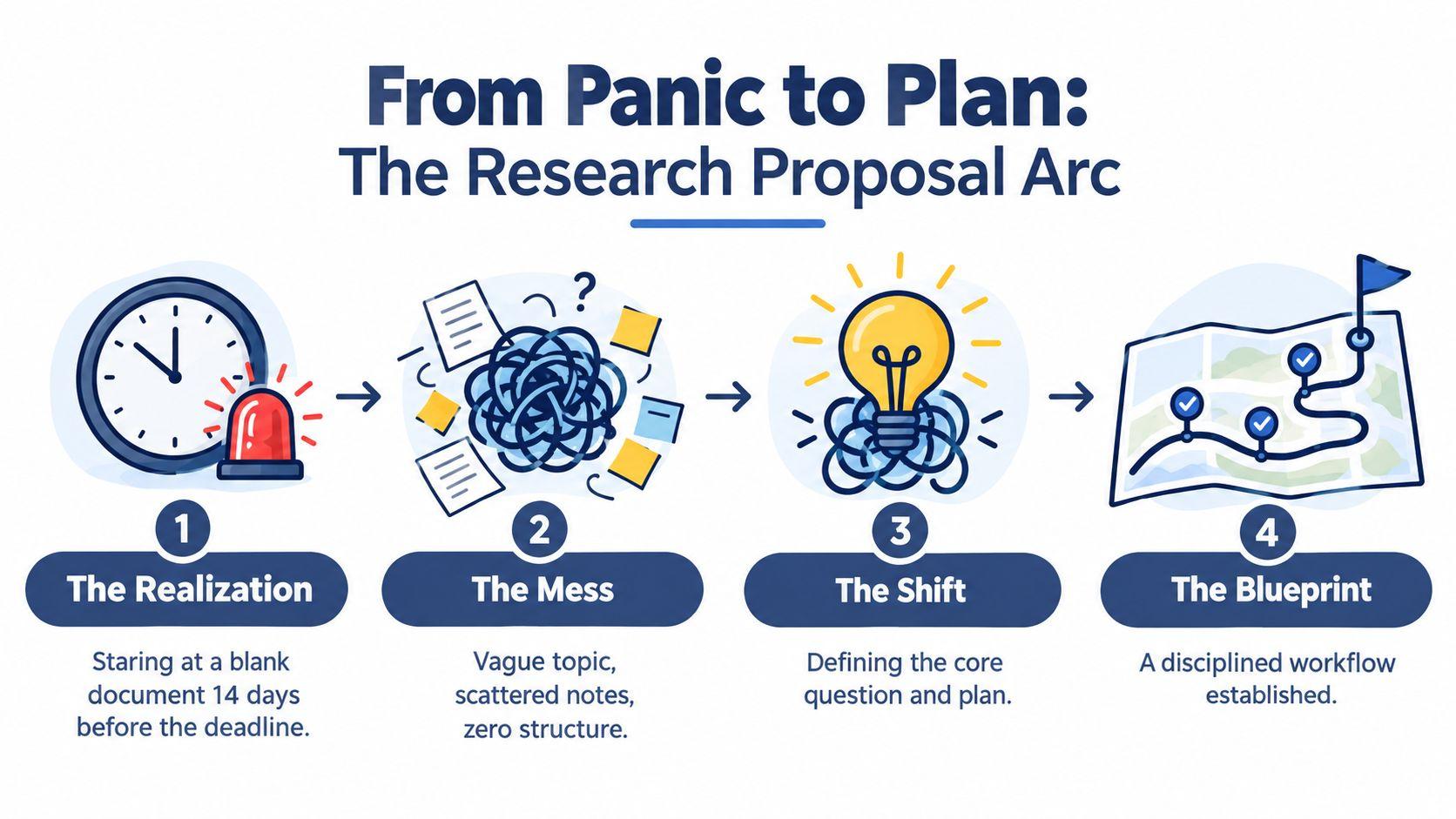
Replace panic with a repeatable sequence
Start by writing the problem in one sentence without mentioning your method. Then identify the specific conversation in the literature, define the question that follows from the gap, and choose a design that can answer it. Only after those decisions should you expand the proposal into its formal sections.
A practical workflow looks like this:
- Define the problem. Name the population, setting, phenomenon, and unresolved issue.
- Validate the gap. Check whether the missing knowledge is real, specific, and consequential.
- Set the questions. Make each question answerable with the evidence you plan to collect.
- Select the method. Explain why this design fits the question better than obvious alternatives.
- Build feasibility. Account for access, ethics, time, resources, and likely obstacles.
- Draft the architecture. Give every section one job and remove material that doesn't serve it.
- Test and revise. Ask whether a skeptical reviewer could follow the logic without guessing.
Strong proposals rarely emerge in perfect linear order. You may revise the research question after reading, change the method after checking access, and rewrite the introduction once the gap becomes clearer. That isn't wasted work. It's how a vague interest becomes a defensible plan.
The Building Blocks Every Reviewer Expects
A reviewer reads a proposal as a chain of decisions. The title establishes the promise, the introduction explains the problem, the literature review demonstrates context, and the methodology shows how the answer will be produced. University guidance commonly includes the title, introduction, literature review, research questions, methodology, outcomes, and bibliography, while expected length varies by institution and application type. The USC guide describes a proposal of about 2,500 words as one recommendation and notes that some doctoral applications may expect about 5–7 pages. These figures are requirements from particular guidance, not universal rules.
Give every section one job
| Section | One-Sentence Job | Reviewer's Question |
| Title | Make the subject, population, and central relationship immediately visible. | What exactly is being studied? |
| Abstract | Summarize the problem, gap, questions, method, and contribution without requiring the full proposal. | Can I understand the whole study quickly? |
| Introduction | Establish the problem and explain why it deserves investigation. | Why does this study need to exist? |
| Literature review | Map the relevant debate and locate the precise gap. | What is known, disputed, or missing? |
| Research questions | Convert the problem into focused, answerable questions. | What will the study actually find out? |
| Hypotheses | State testable expectations where the design requires them. | What result would support or challenge the expectation? |
| Methodology | Show how participants, data, analysis, and procedures fit the questions. | How will you know? |
| Outcomes | Describe the knowledge or practical contribution the study could produce. | What changes if the study succeeds? |
| Timeline | Demonstrate that the work can be completed in a credible sequence. | Is the plan realistic? |
| Budget and ethics | Justify resources and show that participants and data will be handled responsibly. | Have you anticipated obligations and constraints? |
| References | Situate the proposal in the scholarly communities that shape the project. | Does the writer know the relevant conversation? |
A title such as “A Study of Social Media” gives the reader almost no decision-making information. “Algorithmic Curation and Political Polarization Among First-Time Voters in the 2024 European Elections” makes a more useful promise because it identifies the mechanism, outcome, population, and setting. Keep the title precise, but don't overload it with every variable.
Draft the abstract last, even though it appears first. You can't summarize a coherent study before you've settled its problem, questions, method, and contribution. For additional guidance on organizing academic writing and developing a readable argument, consult this VoiceType study writing guide, then adapt the advice to your institution's requirements.
Practical rule: Every paragraph should help answer the reviewer's silent question, “So what, and how will you know?”
Finding a Research Gap That Actually Counts
A longer literature review doesn't automatically create a stronger proposal. A sharp problem with a selective, well-connected body of sources is often more persuasive than a catalogue of everything ever published. Major proposal guidance emphasizes clarity, feasibility, originality, and a specific contribution, rather than sheer volume of reading, as reflected in the European Research Council proposal guidance.
The common trap is to summarize a field and then add “however” before announcing a gap. That move changes the grammar, not the logic. A genuine gap identifies a specific limitation in what researchers know, how they know it, or where their findings apply.
Test the gap before you build around it
Use four checks:
- Search explicit research directions. Read recent systematic reviews, editorials, and discussion sections for clearly stated unresolved questions.
- Inspect design limitations. Ask whether previous studies relied on self-report, used an artificial setting, lacked comparison, or measured the outcome too narrowly.
- Check transferability. Look for evidence across different populations, contexts, institutions, or time periods. A result from one setting may not settle the question elsewhere.
- Apply the “so what” test. Explain whether resolving the gap could influence practice, policy, theory, or future measurement.
Consider the vague idea, “How does remote work affect creativity?” That isn't yet a gap. You need to ask what kind of creativity was measured, whether participants worked in stable teams, whether the studies observed behavior or collected opinions, and whether hybrid arrangements were included. The defensible version might concern how hybrid work affects the generation and evaluation of ideas in established product teams, using observed collaboration alongside participant accounts.
Before committing, paste this into your notes:
“Existing research explains ______, but it does not adequately explain ______ because ______. My study will address this limitation by examining ______ in ______, using ______. The result could matter because ______.”
If you can't complete the final sentence without vague language such as “raise awareness,” keep refining the problem. You can also use 1chat's research workspace to compare notes, organize a preliminary question, or challenge your interpretation, but verify every source and conclusion yourself.
A Worked Example From Vague Idea to Defensible Plan
Take the starting question, “How does remote work affect creativity?” It names a broad relationship, but not the people, setting, meaning of creativity, or evidence required. A reviewer can't tell whether the project concerns individual brainstorming, team innovation, product outcomes, or employee perceptions.
Tighten it by selecting a population and context: established product teams operating in hybrid arrangements. Then define creativity as both the generation of ideas and the team's process for evaluating them. This choice immediately affects the literature review, research questions, data collection, analysis, and budget.
Follow the connective tissue
The proposal might use three questions:
- How do product teams describe the influence of remote and in-person work on idea generation?
- Which communication practices do team members associate with stronger or weaker idea evaluation?
- How do observed collaboration patterns compare across remote and in-person sessions?
A mixed-methods design could combine structured observation with interviews and analysis of team artifacts. The timeline below is illustrative. It shows how to connect activities without pretending that a timeline alone proves feasibility.
| Stage | Research Problem | Sample Question | Method | Timeline (Months) | Budget Link |
| Framing | Evidence about hybrid teamwork may not explain how teams generate and assess ideas in practice. | What aspect of creativity remains unclear? | Literature mapping and question refinement | 1–2 | Database access and researcher time |
| Preparation | The study needs access to suitable teams and a consistent observation protocol. | Which teams can participate ethically and practically? | Recruitment, consent, pilot protocol | 3–4 | Participant communication and pilot materials |
| Data collection | Accounts alone may miss what teams actually do during collaboration. | What happens during remote and in-person sessions? | Observation, interviews, artifact collection | 5–8 | Travel or meeting costs, recording and storage |
| Analysis | Different evidence types must be compared without treating them as interchangeable. | Where do observed behavior and participant accounts converge? | Qualitative coding and cross-case comparison | 9–10 | Transcription and analysis tools |
| Reporting | The contribution must connect findings to the original problem. | What can researchers and practitioners learn? | Synthesis, drafting, revision | 11–12 | Editing, dissemination, and contingency needs |
The plan becomes defensible when each element predicts the next. The problem leads to the questions, the questions determine the evidence, the evidence requires the method, and the method explains the budget. A reviewer may not know the findings in advance, but they should be able to see what kind of finding would answer each question.
Using 1chat to Draft Faster Without Losing Your Voice
AI can reduce mechanical workload, but it shouldn't decide what your study means. Recent guidance on proposal writing has begun to address AI-assisted brainstorming and literature synthesis, while also highlighting the need to protect originality, methodology, and citation quality in AI-supported drafting. The AI Index discussion is useful background for understanding why these tools are becoming more relevant to academic workflows, but it isn't a substitute for your institution's academic-integrity policy.
Use 1chat once your research question and source notes exist. The tool can help organize a project, work with documents, and produce editable text. Treat its output as a draft assistant, not an author. A disciplined workflow has three phases.
Outline before prose
Prompt:
“Using the research question below and only the source notes I provide, create a proposal scaffold with headings, the purpose of each section, two evidence points required, and one unresolved decision. Do not invent citations, findings, participants, or methods. Flag anything uncertain.”
This creates a map while preserving the decisions that still belong to you.
Draft with constraints
Prompt:
“Draft one paragraph for the literature-gap section in a clear, cautious academic voice. Use only the sources and notes supplied. State what is established, identify the specific limitation, and connect it to my research question. Mark every claim that needs a citation. Do not add studies or statistics. Keep the paragraph editable.”
The instruction to mark uncertainty matters. Never accept an AI-generated citation without opening the source and checking that it supports the sentence. Never paste unpublished participant data, confidential supervisor comments, or restricted documents into a tool.
Proofread, then take authorship back
Prompt:
“Review this passage for weak verbs, unnecessary passive constructions, jargon, unsupported claims, and unclear links to the research question. Suggest alternatives in a table, but don't rewrite the passage completely.”
Afterward, complete a human pass. Check every citation, restore discipline-specific nuance, and rewrite the opening and closing sentences yourself. Those sentences carry your argument's voice. For an optional tool workspace, you can visit 1chat, but use it within your institution's rules and keep responsibility for the final document.
The Most Common Reasons Proposals Get Rejected
Rejection is painful, but reviewer criticism often identifies a repairable design problem. A Tanzania-based review of 240 research proposals found that 16% were accepted outright, 38% were rejected, and the remainder required revision and resubmission. The same review identified unsatisfactory sampling procedures in 58%, untestable hypotheses in 53%, inappropriate methodology in 51%, and inadequate literature review in 50% of the proposals examined. These figures come from the Tanzania proposal review, so treat them as findings from that review, not a universal acceptance forecast.
Turn reviewer concerns into an audit
A topic replaces a problem. If your opening says “This study examines social media,” the reviewer can't see the puzzle. Rewrite it around a specific unresolved relationship, population, and consequence.
The literature review summarizes without locating a gap. A sequence of article descriptions shows reading but not reasoning. End each subsection by stating what the evidence establishes and what it leaves unresolved.
The questions don't match the method. Interviews can explore experience and interpretation, but they can't by themselves estimate a population relationship. Either revise the question or select evidence capable of answering it.
The method ignores feasibility or ethics. A design can be intellectually attractive and still fail because participants are inaccessible, consent is unclear, data storage is weak, or the analysis exceeds available skills. Explain access, safeguards, and a fallback route.
The timeline is aspirational. Writers often list tasks without accounting for recruitment delays, approvals, transcription, analysis, or revision. Put dependencies in order and identify what happens if an early task takes longer.
The budget has no argument. A list of expenses doesn't establish necessity. Tie each cost to a method, participant obligation, analysis task, or dissemination activity.
UCLA guidance emphasizes the importance of an appropriate research mechanism, control-group planning where relevant, and budget justification. Other university guidance stresses several drafts and feedback rounds, while Yale's guidance warns that identifying a weakness without proposing a contingency can undermine confidence in the plan. Use those principles during self-review, and consult practical proposal-writing resources from 1chat for additional drafting prompts without outsourcing your academic judgment.
Your One-Page Proposal Action Plan
Turn the proposal into a single working sheet. Create three columns: task, target completion date, and blocker or decision. Add a checkbox beside each task, print the page, and keep it above your writing desk. Update it daily so small decisions don't disappear inside a large deadline.
Complete the moves in order
- Confirm the problem: Write one sentence naming the unresolved issue, population, setting, and consequence.
- Write the title: Make the title specific enough to signal the study's subject and central relationship.
- Draft the abstract: Write a concise summary of the problem, gap, questions, method, and contribution after the main argument is stable.
- Map the literature gap: Group sources by debates, methods, findings, and limitations rather than summarizing them one by one.
- Lock the questions: Check that every question can be answered with the proposed evidence.
- Choose the method: Explain the fit among question, participants or data, procedure, analysis, ethics, and feasibility.
- Build the timeline: Sequence approvals, access, collection, analysis, writing, feedback, and contingency work.
- Address ethics and budget: Justify resources and explain consent, confidentiality, storage, and risk management.
- Run an AI proofreading pass: Use prompts to flag problems, then verify sources and rewrite important sentences yourself.
- Audit rejection risks: Test the problem, literature review, questions, method, timeline, budget, and presentation before submission.
A rough complete draft is more useful than a perfect introduction surrounded by empty sections. Proposals become credible through testing and revision, not through inspiration arriving at the right moment. Set the next target date, write the first imperfect problem statement, and ask a supervisor or trusted researcher to challenge the logic before you polish the language.
If you're ready to begin, open a fresh document and write the one-sentence problem statement today. Then use the action plan to schedule each decision, verify every source, and bring a complete draft to your supervisor for focused feedback.