The cursor is blinking. You've got a prompt open in one tab, three random articles in another, and a rising sense that everyone else learned how to write essays in secret while you were busy being a normal human.
That feeling is common. It doesn't mean you're bad at writing. It usually means nobody showed you the thinking process behind a good essay. You were told to “have a thesis,” “use evidence,” and “add analysis,” but not what those things look like when you're staring at a blank page at 9:42 p.m.
The good news is that essay writing is learnable. It's not some magic talent your classmate was born with. It's a series of choices you can practice. And it matters in school way beyond English. A Pew Research Center survey on student writing found that 92% of AP and National Writing Project teachers view writing assignments as "essential" to formal learning, with many assigning short essays or responses regularly.
This guide is for the student who wants a clear path. Not fluff. Not fake “just be creative” advice. Just what it takes to write a strong paper, raise your grade, and feel less lost while doing it.
That Blank Page Staring Back at You
You sit down meaning to “just start.” Then your brain does that annoying thing where it offers nothing useful except panic. Maybe you type a first sentence, delete it, and decide to check your phone for a minute. Then another minute. Then the assignment starts feeling bigger than it is.
That's how a lot of high school essay writing goes wrong. Not because students are lazy, but because they try to draft before they know what they're building.
A better move is to stop treating the essay like one huge task. It's smaller than it looks. You need to figure out the assignment, decide your main point, map the structure, draft in chunks, and then revise like someone who wants the paper to sound smarter than the first version. That's it.
If writer's block is hitting hard, it can help to improve writing flow with AI insights before you ever draft a paragraph. The point isn't to let a tool write for you. The point is to get unstuck so your own thinking can start moving.
You can also browse the 1chat blog for writing and study ideas if you want examples of how students and families are using AI tools more responsibly.
Practical rule: Don't ask, “Can I write a great essay?” Ask, “What is the next small move?”
For most students, the next small move is not drafting. It's decoding the prompt.
Decoding the Prompt What Your Teacher Really Wants
A lot of weak essays are well-written wrong answers. The student has sentences, examples, even effort, but they didn't answer the assignment their teacher gave.
That's why prompt analysis matters so much. According to guidance discussed in this essay-success resource on prompt deconstruction, a common pitfall is failing to break down the prompt first, and students who spend time analyzing keywords like analyze, explain, and give details produce essays with greater depth.
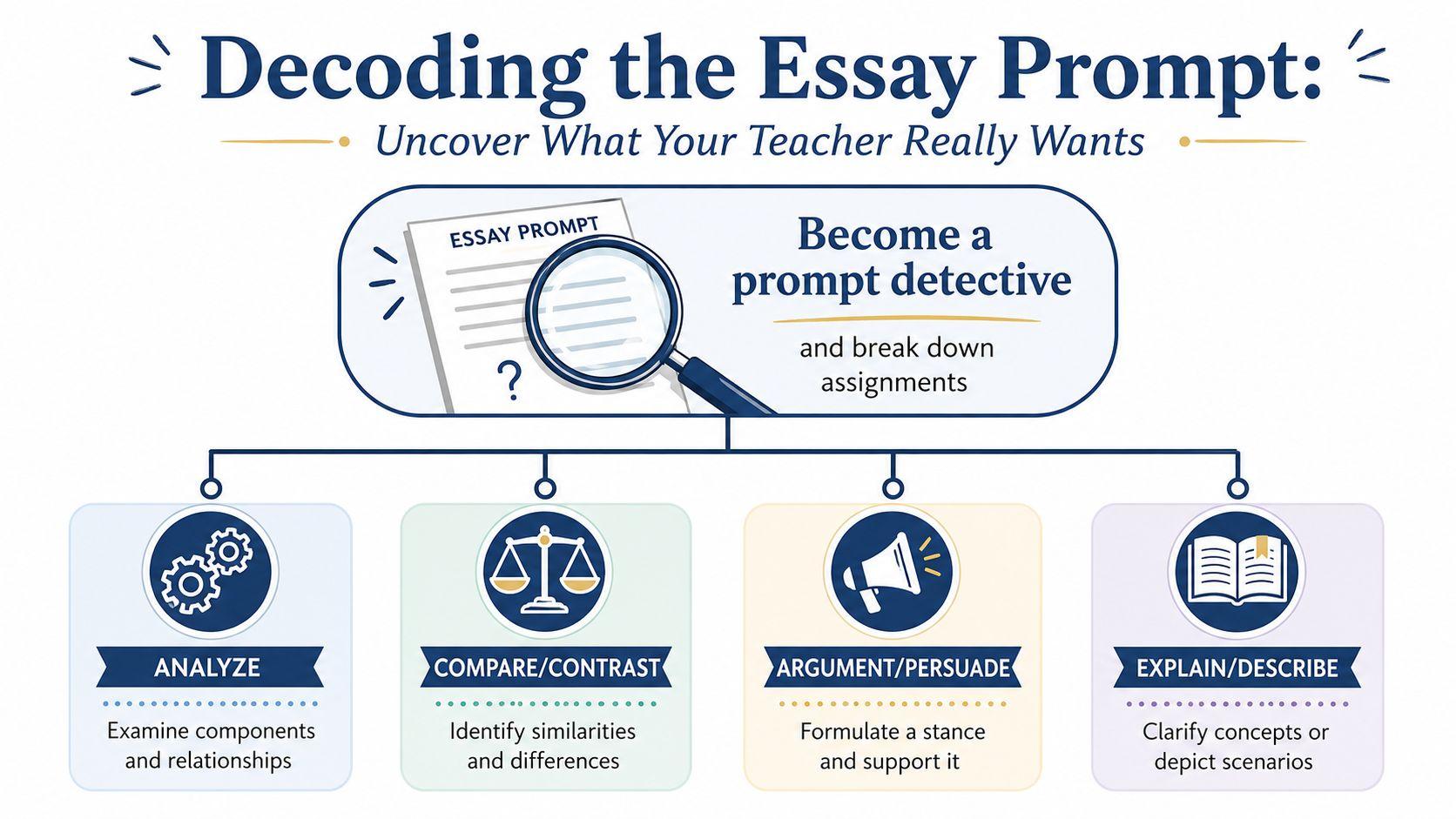
Start with the command words
Before you think about your opinion, look for the verbs in the prompt. Those verbs tell you what kind of thinking your teacher expects.
Here's a quick way to translate them:
| Prompt word | What it usually means |
| Analyze | Break something into parts and explain how they work together |
| Compare and contrast | Show similarities and differences, then say why they matter |
| Argue or persuade | Take a position and support it with reasoning and evidence |
| Explain or describe | Make an idea clear, or paint a detailed picture of something |
If the prompt says “Analyze how the author develops conflict,” you should not spend most of the essay retelling the plot. If it says “Argue whether school uniforms improve learning,” don't write both sides equally and stop there. You need a position.
Core move: Circle the verbs in the prompt first. They tell you the job.
Know the essay type you're being asked to write
Teachers sometimes name the essay type directly. Sometimes they don't. You still need to recognize it.
Narrative essays tell a story and usually focus on experience, reflection, and detail.
A narrative prompt might ask you to write about a time you changed your mind or learned something difficult. Your teacher wants a real scene, specific moments, and insight. Not a vague life summary.
Expository essays explain a topic clearly.
If you're writing about how photosynthesis works, or how social media shapes communication, the goal is clarity. You're teaching the reader something in an organized way.
Persuasive essays ask you to convince.
These need a claim. Not just a topic. “Social media” is a topic. “Schools should teach media literacy because students need tools to judge online information” is a claim.
Analytical essays dig into meaning.
These are common in English class. You examine how a writer, speaker, or creator builds an effect. You're not just saying what happens. You're explaining how and why it matters.
A simple prompt breakdown you can copy
When you get an assignment, write these four lines before your draft:
- Type of essay
Example: analytical - Topic
Example: conflict in Romeo and Juliet - Task
Example: explain how Shakespeare develops conflict - Limits or requirements
Example: use two scenes, include quotations, focus on character choices
That small step saves a lot of pain later. It also keeps you from writing a beautiful essay that belongs to a different assignment.
The Blueprint Crafting a Killer Thesis and Outline
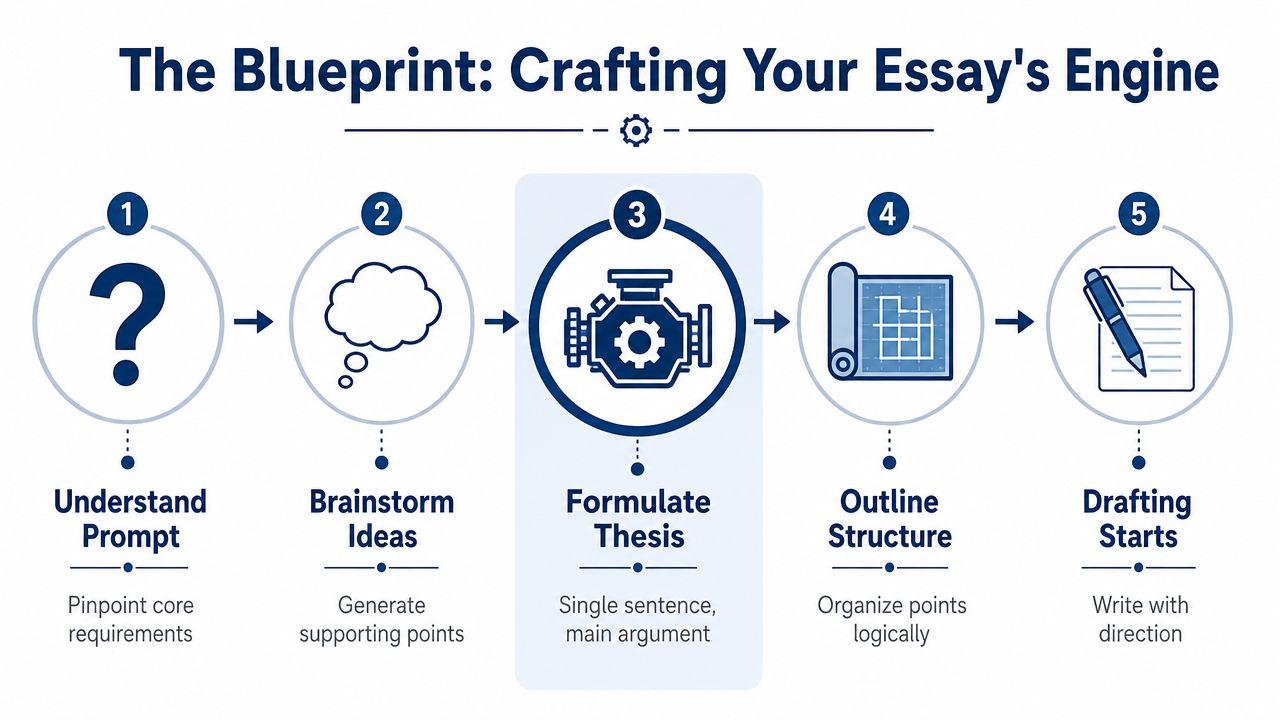
Once you know what the prompt wants, you need an engine. That engine is your thesis.
A thesis is not a fancy sentence you write because your teacher said so. It's your main argument, main answer, or main insight. If the thesis is vague, the whole essay wobbles. If the thesis is sharp, every paragraph has a job.
Research on structured planning backs this up. A summary of SRSD high school writing instruction reports that using a structured planning strategy can lead to more than a 12-fold improvement in planning scores and a 47% gain in understanding genre requirements over a 9-week period.
What a strong thesis actually sounds like
A weak thesis usually does one of three things:
- It states a fact
“School uniforms are used in many schools.” - It repeats the prompt
“This essay will discuss whether school uniforms are good.” - It stays too broad
“Social media affects teens in many ways.”
A stronger thesis makes a claim someone could argue with:
- Better version
“School uniforms can improve focus during the school day, but they don't solve deeper problems like student engagement or school climate.”
That works because it's clear, specific, and gives the essay direction.
Try this thesis formula
You don't need to sound academic right away. Start simple:
Although X, Y because A, B, and C.
Example:
Although many people see group projects as frustrating, they help students build communication skills, divide complex tasks, and practice accountability.
That formula won't fit every essay forever, but it's a solid training wheel.
A good thesis doesn't announce the essay. It drives the essay.
Your outline is a map, not a prison
A lot of students skip outlining because they think it wastes time. Usually the opposite is true. Without a map, you write yourself into a corner, repeat points, and panic halfway through paragraph two.
Use something lean. You do not need Roman numerals and ten levels of indentation.
Here's a copyable outline for most essays:
- Introduction
- Hook or context
- Brief setup of the topic
- Thesis
- Body paragraph one
- Topic sentence
- Evidence or example
- Explanation of how it supports the thesis
- Body paragraph two
- New point
- Evidence or example
- Analysis
- Body paragraph three
- Strongest or most complicated point
- Evidence or example
- Analysis and link back to the thesis
- Conclusion
- Rephrase the thesis
- Show why the argument matters
- End with a final insight, not a copy-paste summary
A fast planning method when time is tight
If the deadline is close, don't overcomplicate it. Open a document and answer these questions:
- What am I arguing?
- What are my three best reasons?
- What example, quotation, or detail goes with each one?
- What order makes the most sense?
That's enough to start drafting with control instead of chaos.
Bringing It to Life Drafting Your Essay Paragraph by Paragraph
Drafting is where students often freeze because they think every sentence has to sound polished immediately. It doesn't. Your job in the draft is to build the essay clearly, one paragraph at a time.
Your outline gave you the skeleton. Drafting adds muscle, movement, and voice.
Write an introduction that does its job
Your introduction does not need to sound dramatic. It needs to orient the reader and lead naturally into the thesis.
A simple structure works well:
- Start with the topic or issue
- Narrow toward the specific focus
- End with your thesis
Example prompt: Should schools start later in the morning?
A weaker opening: “Since the beginning of time, students have gone to school and education has been very important to society.”
That sounds formal, but it says almost nothing.
A better opening: “Many high school students start the day tired before first period even begins. Later school start times can improve students' readiness to learn because they support better rest, stronger focus, and a healthier school routine.”
Clean. Direct. No fake grandeur.
Build body paragraphs with Point, Evidence, Explain
A body paragraph usually falls apart in one of two ways. Either it becomes a list of facts with no analysis, or it becomes opinion with no support.
Use Point, Evidence, Explain.
Weak version
Students need more sleep. School starts early. Teens are often tired in class. This affects learning and mood. Later start times would be better.
Nothing here is technically wrong. It's just thin. There's no developed reasoning.
Stronger version
One reason schools should start later is that tired students struggle to focus during early classes. When students arrive exhausted, even simple tasks like note-taking, discussion, and reading become harder to do well. A later start time gives students a better chance to begin the day alert, which supports stronger attention and more consistent participation in class.
The stronger paragraph does more than state a point. It develops it.
Your evidence should answer this question: “What would make a reader believe me?”
What counts as evidence in high school essay writing
Evidence depends on the assignment. It might be:
- A quotation from a novel
- A detail from a historical event
- A fact from a class text
- An example from a speech, film, or article
- A specific moment from personal experience in a narrative essay
What matters is what you do after the evidence appears. Don't drop a quote into the paragraph and run away. Explain it.
Here's the pattern:
- Make a point
- Add evidence
- Interpret the evidence
- Connect back to the thesis
Don't let every paragraph sound the same
One sign of a rushed essay is paragraph cloning. Every paragraph starts with “Another reason is,” then gives a basic example, then ends weakly.
Change the rhythm. One paragraph might begin with a clear claim. Another might start with a contrast. Another might open by addressing a likely objection.
For example:
- “The strongest argument for later start times is focus.”
- “Some people argue that changing schedules would create transportation problems.”
- “Beyond academics, start times also shape the tone of the whole school day.”
That variation makes your writing sound more natural and more mature.
End with a conclusion that adds meaning
A conclusion is not just “In conclusion” plus the same three points again.
A better conclusion does three things:
- Returns to the thesis
- Shows the bigger significance
- Leaves the reader with a final thought
Later school start times won't fix every challenge students face, but they can create a school day that works better with how students learn. When schools pay attention to readiness, they improve more than schedules. They improve the conditions for learning itself.
That feels finished. It doesn't just stop.
From Good to Great The Secrets of Effective Revision
Most students treat revision like a spelling check at the end. That's editing. Revision is bigger. It's where you step back and ask whether the paper works.
That matters because high school students are often trained to produce essays that look correct on the surface while staying shallow underneath. The problem gets more serious after graduation. According to Digital Promise's discussion of adolescent writing and college readiness, 50% of U.S. high school graduates are not prepared for college-level writing, especially when they need to move beyond rigid formats into more analytical argument. Revision helps close that gap because it forces you to deepen ideas, not just clean sentences.
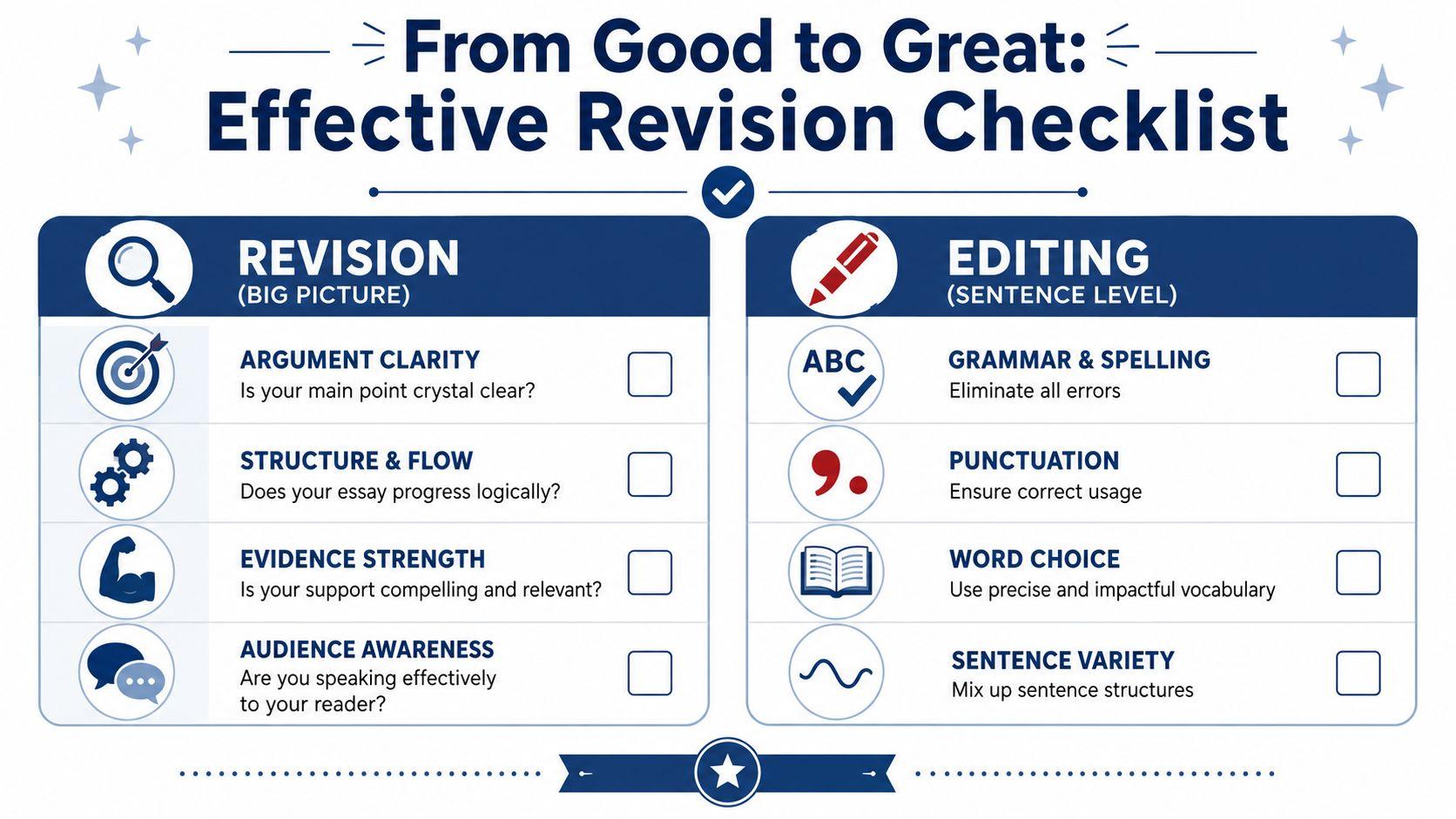
Revision is not the same as editing
Use this distinction:
| Task | What you're checking |
| Revision | Argument, structure, clarity, depth |
| Editing | Sentences, wording, grammar, punctuation |
| Proofreading | Typos, small mistakes, formatting |
If your essay has a weak thesis, correcting commas won't save it.
Questions that actually improve a grade
Read your draft and ask:
- Is my thesis specific enough to argue, not just mention the topic?
- Does each body paragraph support the thesis, or did I drift?
- Have I explained my evidence, or just inserted it?
- Would a reader understand why each point matters?
- Does the conclusion do more than repeat?
If one paragraph feels random, it probably is. Cut it, move it, or rewrite it.
Strong revision sounds like this: “My point is unclear here,” not “I should add fancier words.”
Common mistakes that drag essays down
Some grade drops happen for the same reasons over and over. Watch for these:
- Weak thesis: It names the topic but doesn't make a claim.
- Summary instead of analysis: You retell what happened instead of explaining why it matters.
- Evidence with no commentary: A quote appears, then the paragraph moves on.
- Repetition: Two paragraphs make the same point in slightly different words.
- Conclusion collapse: The ending feels rushed, generic, or copied from the intro.
If you're in an advanced course, study materials that focus on analysis can help you hear the difference between summary and argument. For students working at that level, Magna Education's AP English guide can be a useful companion for practicing that more analytical style.
You can also use 1chat after your draft is done to ask focused revision questions like, “Where is my argument strongest?” or “Which paragraph feels least connected to the thesis?” That kind of targeted feedback is far more useful than asking for a full rewrite.
Read like a teacher for five minutes
This works. Print the essay or change the font so it looks new. Then read it as if your teacher handed it to you.
Ask:
- What is this writer trying to prove?
- Where do I get bored?
- Where do I want more proof?
- Which sentence sounds unclear or forced?
That little mental switch often shows you exactly where the paper needs work.
The Smart Way to Use AI in Your Writing
AI is part of student life now. Pretending it doesn't exist isn't realistic. The key question is how to use it without wrecking your learning or turning your essay into something that doesn't sound like you.
Current discussion around student writing keeps circling back to one core issue. The hard part isn't just producing words. It's learning the shift to more analytical writing. A recent discussion of that challenge noted that using AI for idea generation rather than final drafting can help students get past writer's block while still doing the thinking that college-level work demands, as discussed in this commentary on the high school to college writing shift.
Good uses of AI
AI can help when you stay in charge of the writing.
Useful prompts look like these:
- “Give me three possible angles for this prompt.”
- “Help me turn this broad idea into a specific thesis.”
- “What's another way to phrase this sentence more clearly?”
- “Can you show me an outline based on my claim?”
- “Tell me where this paragraph sounds repetitive.”
That's assistance. You're still making the argument.
Bad uses of AI
Don't paste a prompt into a tool, copy the output, and submit it as your essay. That creates two problems at once.
First, it can become plagiarism or break your school's academic honesty rules. Second, it cheats you out of the exact practice you need. If you never build the argument yourself, you won't get better at building arguments.
A better pattern is this:
| Don't do this | Do this instead |
| “Write my essay on The Great Gatsby” | “Help me identify three arguable themes in The Great Gatsby” |
| “Make this sound smart” | “Point out where my wording is vague” |
| “Finish my conclusion” | “Give me two ways to make my conclusion more meaningful” |
If you're worried about how schools evaluate AI-generated writing, these tips for using AI detectors can help you understand the issue better. The safest route is still the simplest one. Use AI as a coach, not a ghostwriter.
A clean ethical rule
Use AI to brainstorm, question, clarify, and revise. Don't use it to replace your thinking.
If you want a place to do that kind of guided research and drafting support, 1chat Research is one option for asking focused questions, comparing ideas, and getting unstuck while keeping your own voice at the center.
You do not need to be a “naturally gifted writer” to succeed at high school essay writing. You need a method. Decode the prompt. Build a real thesis. Outline before you draft. Develop each paragraph with evidence and explanation. Revise for depth, not just errors. Use AI carefully, and keep the thinking yours.
That's how better essays happen. Not by magic. By moves you can repeat.
If you want a privacy-first AI tool for brainstorming, outlining, and research support without turning writing into a copy-paste shortcut, try 1chat.