It's 8:47 p.m. Your backpack is still half-unzipped. There's a math sheet you don't fully understand, a history response due before midnight, and a science assignment that looked manageable until you opened it. So you try AI.
That's where a lot of students get stuck. AI can make homework feel lighter in the moment, but it can also make your learning thinner if you use it like a vending machine for answers. The win in high school homework help isn't finishing faster at any cost. It's getting unstuck without giving away the part that helps you do well on quizzes, tests, and in-class writing later.
Why High School Homework Help Needs a Tutor Mindset
High school students aren't imagining the pressure. Homework is a regular part of school life in many systems, and its role is uneven. An OECD analysis found that 15-year-olds in OECD countries reported an average of 5.9 hours of homework per week in 2003, dropping to almost 5 hours in 2012, while advantaged students still spent 5.7 hours weekly compared with 4.1 hours for disadvantaged students. That's an equity gap of about 1.6 hours each week (OECD homework analysis).
So the question usually isn't whether students need help. They do. The question is what kind of help protects learning instead of replacing it.
Completion feels good. Understanding lasts longer
A student I've seen many times goes like this: they paste in a problem, get a clean answer, copy it down, and feel relief for about ten minutes. Then the same concept shows up on a test with different numbers or in a short-answer question, and they're back at zero.
That's the difference between a shortcut mindset and a tutor mindset.
With a shortcut mindset, you ask:
- What's the answer
- Can you write this for me
- Can you make this look finished
With a tutor mindset, you ask:
- What am I missing
- Can you give me the next step, not the final one
- Can you explain why this works in plain language
Practical rule: If the AI does the thinking you were supposed to practice, the homework may get done, but the learning probably won't.
That matters because homework can help when it's used well. A large 2006 synthesis found the homework and achievement relationship was stronger for secondary students than for elementary students, and across 50 independent studies, 43 reported better test scores or grades for students doing more homework (homework synthesis by Cooper, Robinson, and Patall).
The right kind of support is the whole game
More help isn't automatically better. A later meta-analysis found that students who received more homework help had lower academic achievement overall, with an overall effect reported as d = 0.23 (95% CI [0.21, 0.25]), leading the authors to conclude that quality of help matters more than quantity (meta-analysis on homework help).
That lines up with what teachers and families see every week. Good help nudges. Bad help replaces.
If you're supporting a younger sibling too, something structured like MasteryMind for Year 7–9 can help bridge the gap between “I don't get it” and “I can do the next step myself.” For high schoolers, the same principle holds. Use AI like a patient tutor, not like a hidden answer key.
What the tutor mindset looks like tonight
A tutor mindset is simple:
| Situation | Shortcut response | Tutor response |
| Stuck on math | Copy the solution | Ask for one hint and a similar example |
| Essay due | Paste a full prompt for an essay draft | Ask for thesis options and outline feedback |
| Science reading confusing | Request a summary to submit | Ask for a plain-language explanation and 3 check questions |
When students use AI this way, they keep ownership of the work. That's what protects both grades and confidence.
How to Prompt 1chat for Learning Not Just Answers
Bad prompts usually sound rushed. “Do this.” “Answer these.” “Write my paragraph.” AI often follows your lead. If you ask for speed, it gives speed. If you ask for teaching, it can slow down and help you think.
One option students use for this is 1chat, which brings multiple large language models into one place and supports things like PDF analysis and image generation. If you want examples of student-oriented AI workflows, the 1chat blog includes study and writing use cases.
Build a prompt that teaches
Use this fill-in pattern:
- Name the class and level
“I'm in 10th grade geometry.” - Paste the exact task
“Solve for x in this triangle problem.” - Say what you already tried
“I used the Pythagorean theorem but got stuck after isolating the variable.” - Ask for the kind of help you want
“Don't give the final answer yet. Give me one hint at a time.” - Ask for a check at the end
“After I solve it, check my work and point out the first mistake only.”
That last part matters. It keeps you doing the cognitive heavy lifting.
Before and after prompt makeovers
Here's how weak prompts turn into useful ones.
Math
- Weak: “Do number 12.”
- Better: “I'm in Algebra 2. I'm solving a quadratic equation and got confused after factoring. Show me a similar problem first, then give me a hint for my actual problem without solving it.”
Essay brainstorming
- Weak: “Write my intro about Macbeth.”
- Better: “I'm writing a short literary analysis on ambition in Macbeth. Give me 3 thesis options at a high school reading level. For each one, explain what kind of evidence from the play would support it.”
Science
- Weak: “Answer these biology questions.”
- Better: “I'm studying cell transport. Explain osmosis like I'm in 9th grade, then quiz me with 4 short questions before helping me answer my worksheet.”
Ask for the next step, not the whole staircase.
When the first answer misses the level
Students often think they need a perfect first prompt. You don't. The fastest way to improve a response is to tell the AI what was wrong with it.
Try follow-ups like:
- Too advanced: “Make that explanation simpler and use one school-level example.”
- Too vague: “Be more specific about step 2.”
- Too direct: “Don't solve it for me. Ask me a question that helps me see the pattern.”
- Too wordy: “Cut this to five sentences and keep the key idea.”
That back-and-forth is where real tutoring happens.
Use extra features carefully
PDF tools are useful when the assignment comes from a chapter, article, or teacher handout. Instead of saying “summarize this,” be more directed.
Try prompts like:
- For reading comprehension: “Summarize this PDF in bullet points using language a 10th grader would understand.”
- For test prep: “Turn this handout into 8 study questions with answers hidden until I ask.”
- For writing support: “Find 3 lines in this document that could support a paragraph about causes and effects.”
Image tools can help too, but only when they support the assignment instead of replacing it. A science student might ask for a simple labeled diagram to understand a process before drawing their own version by hand.
Protect focus while you prompt
The hardest part of AI homework isn't always the homework. It's staying on task long enough to use the tool well. If your phone keeps pulling you into other apps, tools with enforced Android app blocking can make a real difference during homework time.
A useful rule is this: write your prompt, wait for the response, then spend one full minute doing something with it before opening anything else. Solve a step. Rewrite the idea in your words. Mark what still confuses you.
That's how prompts start teaching instead of just producing.
How to Verify Answers and Build Real Understanding
AI can sound confident when it's wrong. That's why the most important homework habit isn't asking for help. It's checking whether the help deserves your trust.
This matters even more now because student AI use for schoolwork has become mainstream. A RAND survey reported AI use for homework rose from 48% in May 2025 to 62% in December 2025 among middle school, high school, and college students. A College Board brief also reported 84% of high school students used generative AI for schoolwork by May 2025, and 69% used ChatGPT for assignments and homework. The same evidence summary noted a study in which homework scores rose 18% and homework time fell from 64 to 45 minutes, yet exam performance later declined for frequent users (education evidence summary on AI and homework use).
Fast completion can hide weak retention. Verification fixes that.
A five-minute check that catches most problems
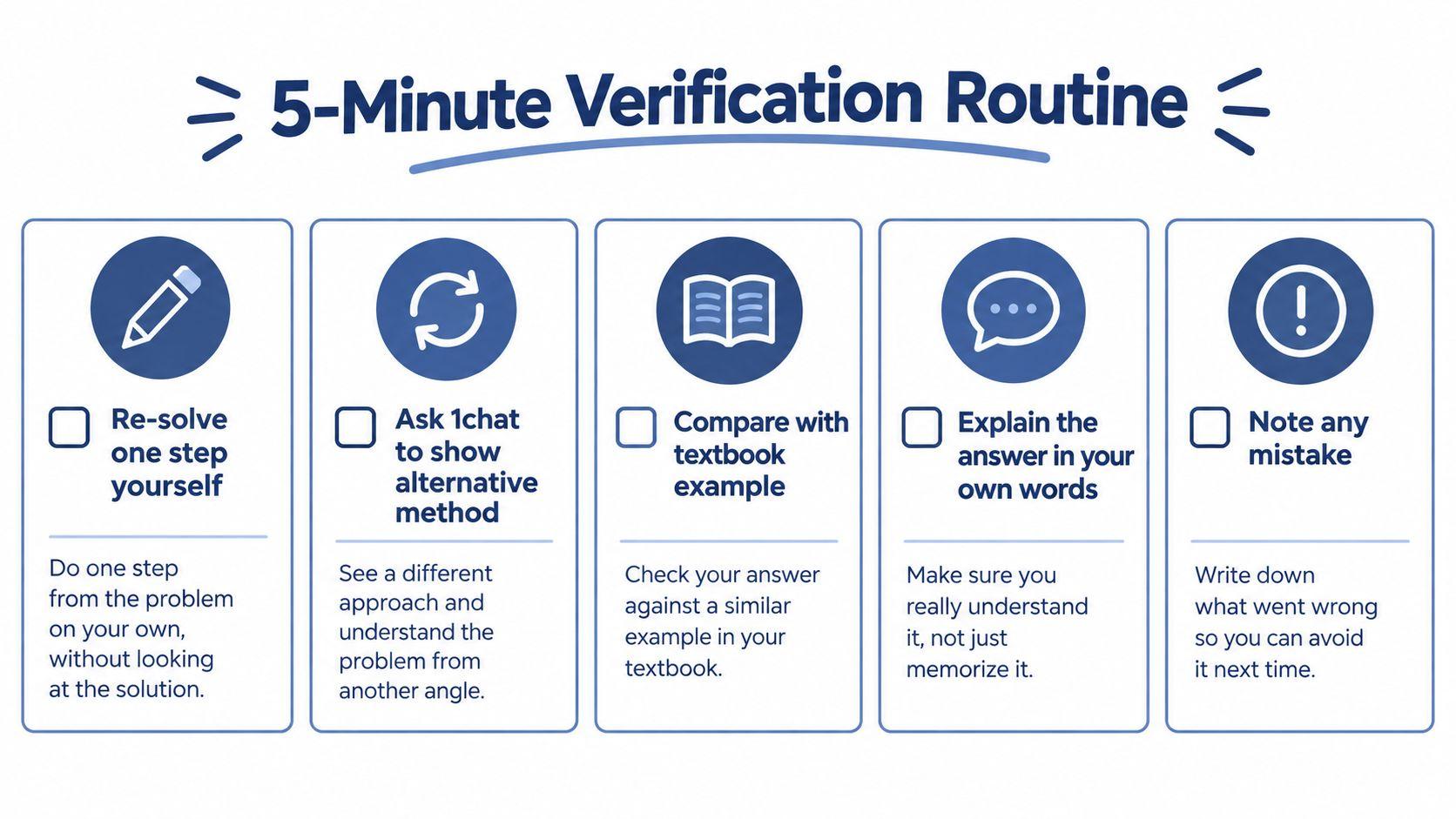
Run this quick routine before you submit anything:
- Re-solve one part yourself
In math, redo one step without looking. In writing, restate one claim in your own words. In science, explain one concept from memory. - Ask for an alternative method
If the AI solved a problem one way, ask for another route. If both routes point to the same result, confidence goes up. - Compare against your class materials
Check your textbook example, class notes, rubric, or teacher slides. If the AI uses vocabulary your class never covered, slow down. - Test the explanation out loud
If you can't explain the answer clearly, you probably don't own it yet. - Mark one thing you learned or corrected
That tiny reflection turns checking into memory.
What to watch for when AI sounds polished
Students often trust neat formatting too much. A clean answer can still be flawed.
Look for these warning signs:
- Missing steps: The final result appears, but the logic jumps.
- Odd vocabulary: The wording sounds like a college textbook in a 9th grade assignment.
- Invented support: A literature response mentions details that aren't in the passage.
- Overgeneralized science: The explanation is mostly true, but not specific enough for your class.
A believable answer isn't the same thing as a correct answer.
Cross-check in a way that saves time
You don't need a giant fact-checking process. You need a fast one.
Here's a simple comparison table:
| If the task is | Best verification move | What you're checking |
| Math problem | Rework one line by hand | Whether the logic actually holds |
| History response | Match claims to notes or text | Whether evidence is real and relevant |
| Science concept | Compare with class vocabulary | Whether the explanation fits your course |
| Essay paragraph | Read it aloud | Whether it sounds like your thinking |
The point isn't to distrust every answer. The point is to build a habit where trust is earned.
Understanding beats dependence
Students sometimes think checking slows them down. At first, it can. Then it speeds up future homework because you start spotting patterns.
That's especially important because homework is distributed very differently across school systems. An international analysis linked to OECD reporting found 43.3% of students across sampled countries received mathematics homework in every or almost every lesson, while 7.0% reported never getting homework. It also showed sharp variation by country, including more than 90% receiving frequent math homework in Germany and Hungary, compared with 63.6% of students in the Netherlands reporting they never received math homework (international homework distribution summary).
If homework is a steady part of your school life, verification isn't extra. It's the skill that keeps homework help from turning into homework dependence.
Staying Honest and Citing AI Help the Right Way
Most students don't need a lecture about cheating. They need a clear line they can use when they're tired and under deadline.
Here's the line: if AI helps you think, check, organize, or revise, that can fit legitimate support. If it replaces the thinking your teacher assigned to you, you're in risky territory.
Read the assignment, then read the policy
Before you use AI on an assignment, check two things:
- What the teacher asked for
- What your school allows
Some teachers are fine with brainstorming and proofreading. Others want no AI use at all on a specific task. If you're not sure, ask directly. It's much easier to ask beforehand than explain afterward.
If you want to understand one platform's rules before using it, review the 1chat usage policies.

What honest use looks like
These uses are usually easier to defend:
- Brainstorming: asking for thesis options, topic ideas, or practice questions
- Clarifying: getting a simpler explanation of a concept you already studied
- Checking: asking the AI to flag unclear sentences or possible mistakes
- Organizing: turning your notes into an outline you'll then revise
These uses are much riskier:
- Ghostwriting: submitting an AI-written response as your own
- Hidden paraphrasing: pasting source text and asking AI to disguise it
- Fake evidence: using claims or examples you didn't verify
- Voice replacement: submitting prose that doesn't sound like your level or style
A simple way to disclose help
Teachers usually respond well to plain honesty. You don't need a dramatic confession. A short note is enough when disclosure is appropriate.
You can write something like:
- “I used AI to brainstorm thesis ideas, but I wrote and revised the final paragraph myself.”
- “I used AI to check my explanation of the math steps, then corrected my work based on that feedback.”
- “I used AI to simplify the reading so I could understand the source before writing my response.”
Keep this test in mind: If your teacher asked, “Show me how you got this,” could you explain it calmly in your own words?
Keep your voice in the final draft
A fast way to protect your integrity is to make the final version sound like you.
Try this checklist before submitting:
- Swap stiff phrases for words you'd naturally use in class.
- Add one detail from your notes that you personally chose.
- Read the piece aloud and listen for anything you wouldn't say.
- Keep some rough edges if they're honest. Perfect-sounding writing that isn't yours often raises more suspicion than solid writing that is.
Students often think honesty makes their work look weaker. Usually it does the opposite. It shows control. It also gives teachers a better chance to help you improve.
Subject Specific Strategies That Work in 1chat
Different subjects need different kinds of help. A good history prompt often fails in chemistry. A useful algebra prompt can be terrible for an essay. Students get better results when they match the tool to the task instead of using one generic command for everything.
Math and science need guided steps
For math, don't ask for the solved page. Ask for a hint ladder.
A hint ladder sounds like this:
- “Give me the first clue only.”
- “If I still don't get it, give me the second clue.”
- “Show a similar solved example, then let me try mine.”
That structure keeps your brain engaged.
For science, ask the AI to separate concept understanding from assignment completion. For example:
| Subject | Better prompt | Avoid |
| Algebra | “Check my first two steps and ask me what I should do next.” | “Solve this worksheet.” |
| Geometry | “Explain why this theorem applies here before we calculate.” | “Give the answer and formula.” |
| Biology | “Explain photosynthesis in simple terms, then quiz me.” | “Answer all these questions.” |
| Chemistry | “Help me identify the reaction type and what clues to look for.” | “Finish my lab questions.” |
English and history need structure, not ghostwriting
Writing assignments are where students most often slide from help into replacement.
Use AI for:
- Thesis options
- Outline checks
- Counterargument ideas
- Sentence-level clarity
Don't use it to produce the entire essay you submit.
A strong prompt might be: “I'm writing about how power changes a character in this novel. Give me three thesis ideas, each arguable, and tell me what kind of quotes would support each one.”
A weaker prompt is: “Write a literary analysis essay for me.”
Good writing help leaves you with a stronger plan. Bad writing help leaves you with someone else's paper.
Research tasks work better with chunking
Research can feel messy because there are too many moving parts. Break it into chunks.
Try prompts like:
- For a long article: “Summarize this reading in bullet points, then list 3 terms I need to understand.”
- For note-making: “Turn these notes into flashcards with a question on one side and a short answer on the other.”
- For reading level support: “Explain this paragraph in simpler language without removing the main idea.”
Turn output into your own work
The best subject-specific trick is simple. Always add a student step after the AI step.
For example:
- AI gives a concept map. You redraw it from memory.
- AI suggests thesis options. You choose one and rewrite it your way.
- AI explains a formula. You solve one new problem without help.
- AI summarizes a PDF. You write the class-ready notes yourself.
That's the move that keeps high school homework help aligned with actual learning.
Privacy Family Controls and Your Homework Routine
A good homework routine doesn't just help you finish. It protects your attention, your data, and your habits over time.
That matters because today's homework help often happens on personal phones, shared laptops, and family accounts. Background reporting on student AI use also points to a practical gap: families want support that is trustworthy, private, mobile-friendly, and aligned with school rules, not just fast answers (student-focused summary on AI homework help needs).
What not to paste into an AI chat
Students often overshare without realizing it. Keep personal details out of prompts.
Avoid pasting:
- Full name and school ID
- Passwords or account details
- Private teacher comments not meant to be shared widely
- Personal health, discipline, or counseling information
- Photos with visible private information in the background
If you want to review platform privacy details directly, read the 1chat privacy information.
A family-friendly homework setup
Families don't need a complicated system. They need a repeatable one.
A workable setup looks like this:
- Shared expectations: agree on when AI is for hints, checking, and brainstorming, and when it isn't allowed
- Visible use for younger teens: homework help happens in a common space when possible
- Short review habit: student explains one answer out loud before submitting
- App boundaries: distractions are limited during study time
- Teacher alignment: if a class bans AI for a task, the family treats that as mandatory
If you're running tutoring, study support, or a small education team around a student, tools like their student management feature can help organize progress and communication without relying on memory alone.
A nightly routine that actually sticks
Keep it short enough to use on busy nights:
- Ask for help with the next step, not the final answer
- Verify one part yourself
- Check whether any AI help should be disclosed
- Rewrite or explain the idea in your own words
- Submit only what you understand
That routine is realistic. It doesn't require perfect discipline. It just creates a pause between getting help and turning work in.
Keep the tool in its proper place
AI can reduce friction. It can help a stressed student start, continue, or check work they might otherwise avoid. That's useful.
But the tool should carry the load, not your learning. The assignment still belongs to you. The thinking still belongs to you. When students keep that boundary clear, high school homework help becomes what it should be. Support that makes the next class easier, not harder.
If you're using AI for school tonight, use it like a tutor. Ask smaller questions. Check the answer. Keep your voice. Protect your privacy. That's the version of homework help that still helps tomorrow.