
Most advice about homework help for college students starts in the wrong place. It tells you to find a tutor, open an AI chatbot, or search for a worked solution as soon as an assignment becomes difficult. That approach may get you through tonight, but it can leave the underlying gap untouched.
Effective academic support works differently. You first identify what you understand, what you can't explain, and where your reasoning breaks. Then you choose the right help, use it to test your thinking, and complete the work in your own voice. The goal isn't merely a correct submission. It's a repeatable, ethical workflow that helps you learn under pressure without making you dependent on any single person or tool.
Redefining Academic Support for Modern Learners
Homework help should begin with diagnosis, not rescue. Before asking someone to solve a problem, write down the exact point where you became stuck. Did you misunderstand the question, forget a concept, choose the wrong formula, misread a source, or lose track of your argument? Each problem requires a different intervention.
A student who confuses correlation with causation needs conceptual explanation. A student who understands the theory but can't organize an essay needs structure and feedback. A student who made an arithmetic error needs a verification process. Sending all three students the same finished answer treats the symptom while preserving the cause.
Completion is not comprehension
A completed assignment can create a false sense of progress. You may submit polished work while remaining unable to reproduce the method on an exam, explain the conclusion in a conversation, or apply the concept to a new question. That's why homework help should function as augmentation, not substitution.
Use support to make your own thinking stronger:
- Expose the gap: Attempt the problem first, even if your attempt is incomplete.
- Ask for explanation: Request the principle, sequence, or decision that leads to the answer.
- Test your understanding: Close the tool or leave the tutoring session, then solve a similar problem independently.
- Record the pattern: Add the error and correction to a personal review sheet.
A useful AI prompt is, “Don't solve this yet. Ask me questions that help me identify the next step.” That instruction changes the interaction from answer retrieval to guided reasoning. You can also ask for a simpler explanation, a counterexample, or a new practice problem that uses the same concept.
Students working with lectures, recorded classes, or dense readings can also benefit from workflows that turn videos into actionable outputs, such as summaries, questions, and revision prompts. Used carefully, that kind of transformation reduces passive rewatching and gives you something concrete to check against your notes.
Build a support loop
Your workflow should contain four stages: attempt, explain, verify, and retrieve. The attempt shows your current understanding. The explanation addresses the gap. Verification checks whether the correction makes sense. Retrieval proves that the knowledge remains available without assistance.
The 1chat blog offers examples of prompt-guided academic support, but the principle applies to any tool. Don't ask, “What's the answer?” Ask, “What assumption am I making?” or “Which step in my reasoning is unsupported?” Those questions keep responsibility for learning with you.
Practical rule: If help makes the assignment easier but leaves you unable to explain the method, you received completion support, not learning support.
Campus Tutoring and AI Adoption Today
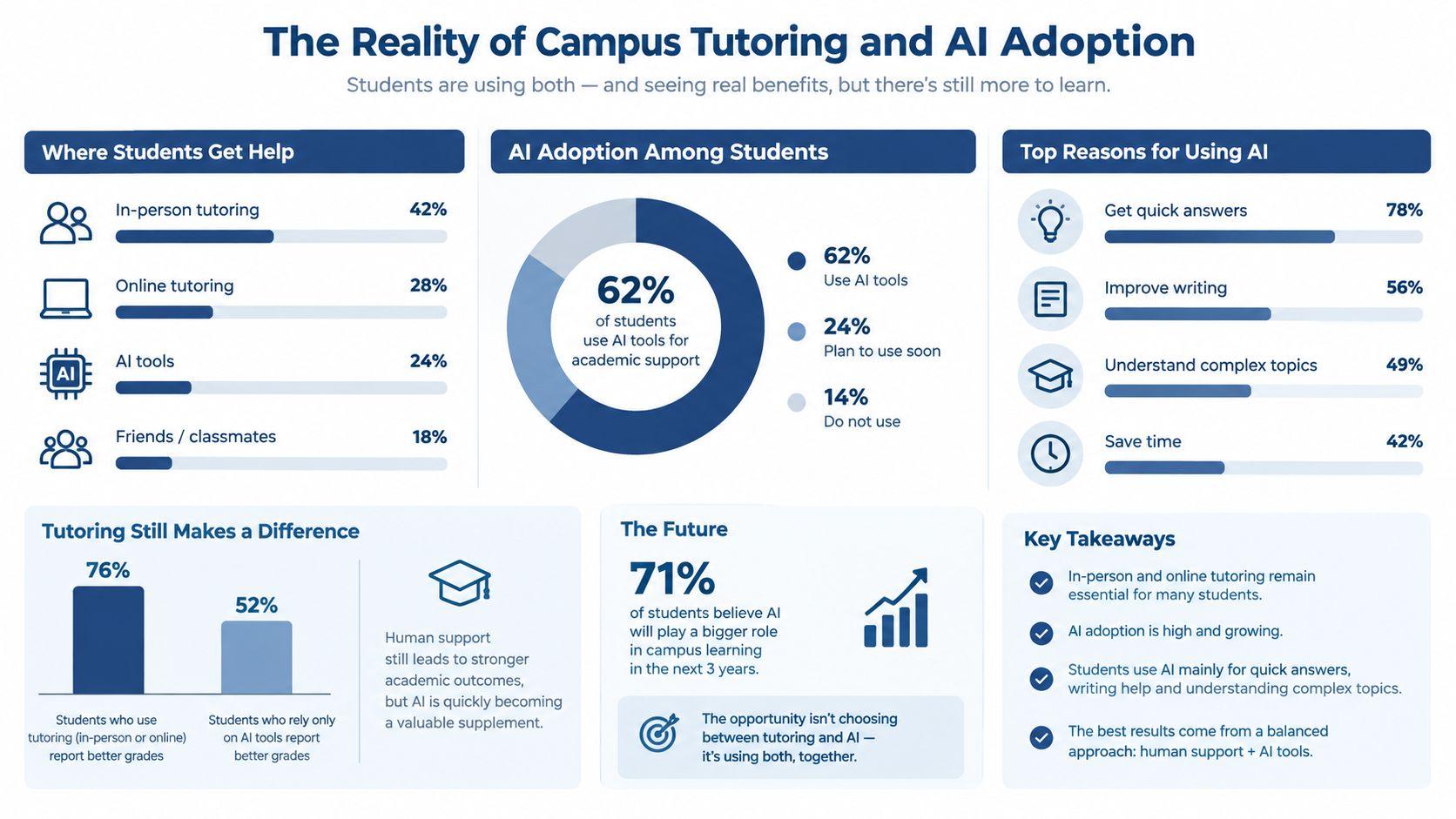
Campus tutoring remains a major source of academic support, but students now work within a broader system that includes online services and AI tools. A 2022 survey of American college students found that 34.82% had used tutoring at their current or a previous college. Usage ranged from 31.56% among students aged 18 or under to 45.12% among students aged 22, and stood at 27.5% among students over 35, according to the 2022 survey of American college students.
Online support also became part of ordinary academic routines. The same survey found that 23.1% of students had used online tutoring during the pandemic period. Digital access continued to matter after campus schedules and services resumed because students could seek clarification outside appointment times.
Colleges are using a mixed model
Colleges are combining in-person, online, embedded, group, and peer tutoring. The 2025 benchmarking report on college tutoring programs found that online tutoring was offered by 53.33% of surveyed colleges. In-person tutoring still represented 75.71% of sessions, with a median share of 85%, according to the 2025 college tutoring benchmarking report. Both formats are operating at the same time.
The report found that 48.89% of programs used tutors embedded in ongoing classes. Private colleges offered online tutoring at a rate of 58.82%. Group tutoring was most common in doctoral and research universities, while currently enrolled peer tutors conducted 31.23% of sessions at community colleges. At four-year colleges, the average tutoring relationship lasted 8.14 weeks.
Each format addresses a different need. Embedded tutors understand the course sequence and current assignments. Peer tutors often know the instructor's expectations and the practical obstacles students face. Online tools, including AI services such as 1chat, can provide immediate clarification, brainstorming, practice, or a second check when a scheduled tutoring session is unavailable. Use them to support a learning workflow, not to replace your own attempt or a tutor's explanation.
AI has moved into routine study behavior
AI adoption is advancing faster than many campus policies. A 2026 Gallup-Lumina study reported that 64% of college students use AI daily or weekly for coursework they do not understand, while 60% use it that often to check homework or assignment answers, as described in Gallup's report on routine college AI use. Understanding complex material was the leading motivation.
A separate 2026 HEPI/Kortext survey reported that 95% of students use AI in at least one way and 94% use it to help with assessed work. Only 36% felt encouraged by their institution to use AI, and only 38% said their institution provided AI tools. These findings are summarized by EdChoice's summary of the HEPI/Kortext findings. Students are adopting AI while institutional guidance remains uneven.
Choose the support channel according to the task. Ask a tutor for interpretation, accountability, and difficult feedback. Use AI for low-stakes clarification, brainstorming, practice, and verification, always within your course policy. The goal is a sustainable, ethical workflow that helps you understand and explain the work independently.
Building an Ethical AI Research Workflow
AI can support academic work without becoming a ghostwriter. The boundary is practical: the tool may help you understand the assignment and evaluate your ideas, but you must remain responsible for the reasoning, evidence, wording, and final submission.
Start by reading the course policy. Some instructors allow brainstorming and proofreading but prohibit generated prose. Others require disclosure, restrict AI use for assessments, or provide specific approved tools. Save the policy, assignment instructions, and any permission you receive so you aren't relying on memory later.
Use AI before drafting
The first safe use is prompt analysis. Paste the assignment in a tool only when your institution's rules and privacy practices permit it, then ask:
- “List the deliverables in this prompt without answering it.”
- “Separate the required evidence from the optional discussion.”
- “Turn the grading criteria into a checklist.”
- “Identify ambiguous terms I should ask my instructor about.”
Next, create your own preliminary thesis or solution path. Ask the AI to challenge it rather than replace it. For example: “Give me three objections to this argument and explain what evidence would answer each one.” This preserves your intellectual ownership while exposing weaknesses early.
Use the tool for clarification, too. Ask it to define unfamiliar terminology in plain language, compare two theories, or explain why a method applies. Then verify every important explanation against assigned readings, lecture notes, textbooks, or authoritative sources. AI can produce confident errors, so fluency isn't evidence of accuracy.
Move from outline to original work
Build the outline yourself after the clarification stage. A useful outline should contain your claim, supporting evidence, reasoning, and unresolved questions. You can ask an AI system to inspect the structure, but don't ask it to fill every paragraph with finished language.
A strong prompt sounds like this: “Review this outline for missing logic and unsupported claims. Don't write paragraphs or supply citations. Ask me questions that force me to justify each section.” That prompt creates friction in exactly the right place. It makes you think before you write.
If you're handling confidential research, personal information, unpublished work, or sensitive course material, review the platform's privacy terms first. For legal, policy, or evidence-heavy research, resources on how to audit AI answers with Vera provide a useful model for checking sources, recording uncertainty, and preserving a defensible research trail.
You can also explore 1chat's research workflow for tasks such as discussing documents and developing research questions. Treat any platform as an assistant, not an authority. Keep your notes, sources, drafts, and verification decisions in your own system.
Keep an audit trail
Save the prompts that materially influenced your work, the sources you checked, and the changes you made. Your record doesn't need to be elaborate. A simple note stating the tool's role, the date, the relevant course rule, and your verification steps can help you explain your process if a professor asks.
Never paste an entire assignment into a tool merely because you can. Remove personal details, unpublished research, student records, and information that your institution or research supervisor has restricted. Ethical AI use protects both your academic integrity and your intellectual privacy.
Proofreading and Concept Verification Strategies
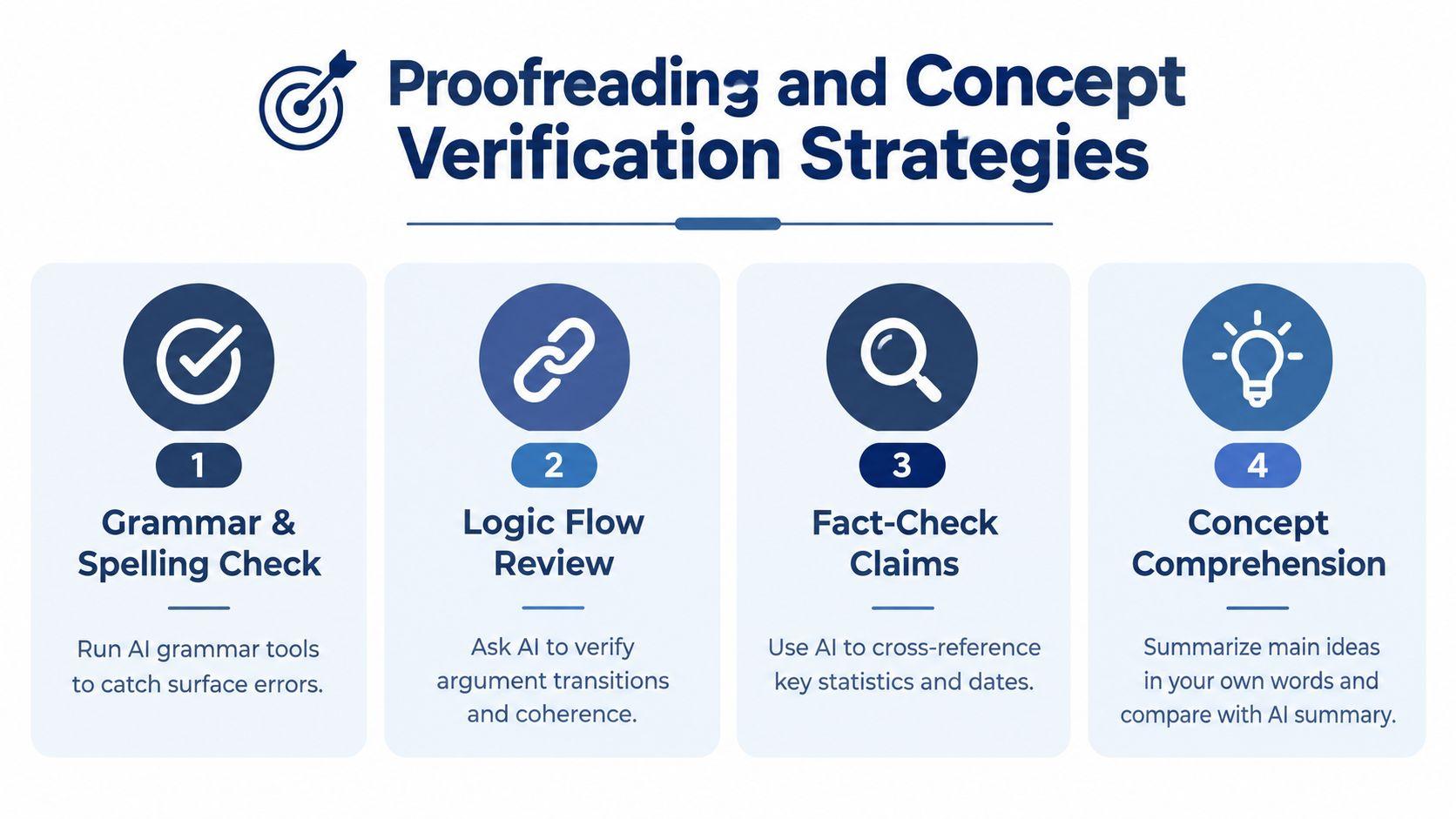
Proofreading shouldn't be the final cosmetic pass. It's a second opportunity to test whether your work says what you think it says. Use AI to identify possible problems, then make the final decisions yourself.
Review the draft in separate passes
Don't ask for “a full edit” and accept every suggestion. Broad editing can flatten your voice, change your meaning, or introduce claims you didn't intend to make. Run focused passes instead.
Pass one, surface errors. Ask the tool to flag grammar, spelling, punctuation, and unclear sentence construction. Request explanations rather than automatic replacement. You'll learn more from seeing why a sentence is ambiguous than from accepting a silent correction.
Pass two, logic flow. Give the tool your thesis and outline, or a limited excerpt, and ask it to identify unsupported transitions, circular reasoning, contradictions, and sections that don't answer the prompt. Don't ask it to rewrite the argument. Ask for questions that you can answer in your own words.
Pass three, evidence alignment. Create a claim-and-source list. For each claim, verify that the cited source supports it, that you haven't overstated the evidence, and that dates, names, and definitions are accurate. AI can suggest a potential mismatch, but you must open and inspect the source yourself.
Turn review into retrieval practice
After editing, close the draft and reconstruct its central argument from memory. Explain the thesis, the strongest evidence, the weakest point, and the conclusion without looking at your document. If you can't do that, the draft may be polished without being understood.
Ask an AI tool to generate practice questions from your own notes, then answer them before reviewing any suggested response. Useful prompts include:
- “Create questions that test application, not definition recall.”
- “Give me a new example and ask me to identify the relevant concept.”
- “Ask one question at a time and wait for my answer.”
- “Tell me what part of my explanation is incomplete, but don't supply the answer.”
A correct sentence can still express an incorrect idea. Check the reasoning, not just the grammar.
For mathematics, science, economics, and statistics, show every meaningful step and compare the result with course methods. For humanities and social sciences, distinguish your interpretation from what the source explicitly says. In every field, treat AI feedback as a prompt for inspection, not proof that your work is correct.
Choosing the Right Help Channel for the Task
The right question isn't “Which homework-help option is best?” It's “What kind of difficulty am I facing?” A campus tutor, peer group, instructor, and AI platform each solve different parts of the problem.
| Support Channel | Best Used For | Limitations |
| Campus tutoring center | Course-specific explanations, recurring support, accountability, and guided practice | Hours, appointment availability, and subject coverage may limit access |
| Peer tutor | Instructor context, relatable explanations, study routines, and shared course experience | A peer may misunderstand the material or pass along an inaccurate shortcut |
| Study group | Comparing approaches, verbal recall, collaborative problem-solving, and motivation | Group discussion can drift, and confident students can spread errors |
| Professor or teaching assistant | Ambiguous instructions, grading expectations, advanced concepts, and feedback on interpretation | Office hours may be limited, and instructors may not review complete drafts |
| AI platform | Brainstorming, concept clarification, practice questions, structural feedback, and rapid verification prompts | It can hallucinate, miss course-specific expectations, and create policy or privacy risks |
Match the channel to the obstacle
Choose a human tutor when you keep repeating the same mistake, need to see a problem solved interactively, or need accountability over several sessions. Human tutors can notice hesitation, ask follow-up questions, and adjust explanations in ways a text interface may miss.
Choose a study group when you've already attempted the work and want to compare methods. Bring a specific question, assign someone to challenge the reasoning, and end by solving a problem alone. A group should increase active thinking, not become a shared answer repository.
Choose an AI tool for quick, low-stakes tasks that benefit from iteration. Ask it to explain a term, generate counterarguments, quiz you on notes, or inspect the structure of your outline. Don't use it as the final authority for citations, course rules, or specialized calculations.
Students who need organized revision materials can also create study guides with AI, then compare the result with their syllabus and notes. The guide is useful only if it reflects what your instructor emphasizes.
Use intensity as a decision rule
High-impact tutoring research identifies frequent sessions, very small groups or one-to-one work, and stable tutor-student relationships as important design features. A college-focused meta-analysis of intelligent tutoring systems found a moderate positive learning effect, with reported effect sizes of g = 0.32 to 0.37, while human tutoring produced stronger results, according to the Stanford National Student Support Accelerator brief.
The practical lesson is simple. Use AI for rapid, distributed support between meetings, but don't expect occasional answer checks to replace sustained human instruction when the subject remains difficult.
Protecting Your Academic Integrity and Data
Academic integrity starts with clear boundaries, set before a deadline. Read the syllabus, assignment instructions, department guidance, and institutional policy. If the rules leave room for interpretation, ask your instructor before using an AI tool. Do not make that decision while exhausted, with an unfinished paper open in front of you.
Student anxiety is understandable. HEPI/Kortext reporting found that the share of students who included AI-generated text in assessed work rose to 12%, from 8% in 2025 and 3% in 2024. Roughly 5% said they always or often used AI to generate a full assignment. The findings also described concern about false accusations.
These figures call for a documented process, not panic or complacency. AI detectors can produce disputed results, so keep notes, drafts, source records, and explanations of your reasoning. Your work should show how you reached the conclusion, not merely present a polished answer.
Adopt personal rules
Use these rules throughout the semester:
- Follow the course rule first: If an instructor bans AI for an assignment, do not use it for that assignment.
- Keep authorship yours: Write the thesis, analysis, calculations, and final prose yourself unless explicit permission says otherwise.
- Disclose when required: Record the tool, purpose, and extent of use in the format your instructor requests.
- Verify every substantive claim: Open the original source and confirm that it supports your wording.
- Protect private material: Do not upload personal records, unpublished research, identifiable student information, or restricted course content without permission.
- Preserve your process: Keep notes, drafts, prompts, edits, and source checks when tool use may need explanation.
Protect your data as deliberately as your grades
Privacy affects your academic work directly. Assignments may contain original ideas, personal experiences, research data, or information about classmates and clients. Before using an AI service, check how it stores prompts, whether it uses submissions for training, who can access team accounts, and how you can delete information.
For 1chat's rules about permitted and restricted use, consult its usage policies. Whichever platform you choose, share only what the task requires and use anonymized excerpts whenever possible.
A sustainable workflow leaves you more capable after each assignment. Track the concepts you mastered, recurring errors, supporting sources, and the role each tool played. Use human tutoring for difficult reasoning, then use AI for verification or brainstorming within the course rules. That process protects your academic record, privacy, and independent judgment.
Build this system this week. Read your course AI policies, schedule a human tutoring session for your hardest subject, and create reusable prompts for explanation, questioning, and verification. Complete one assignment through a full attempt, feedback, and independent-recall cycle. Your next submission should show stronger learning, not merely faster completion.