Hook, line, and sinker means completely or without reservation, and it often describes someone who is totally fooled. People also use it in neutral or positive ways when someone accepts an idea, story, or plan fully, not just halfway.
You've probably heard it in a conversation about a scam, a prank, or a friend who believed a wild story a little too quickly. The phrase feels vivid because it sounds physical, and that's exactly why it sticks.
What Hook Line and Sinker Actually Means
A friend tells you that a “free” vacation only needs a tiny deposit, and another friend believes it without asking a single question. That's the kind of moment where hook, line, and sinker fits perfectly. The idiom means someone accepted the story completely, often to the point of being fooled completely.
The phrase isn't limited to deception, though. Major dictionaries also use it for total acceptance, without hesitation, or altogether. Cambridge includes the idea of believing a deception, Merriam-Webster defines it as “without hesitation or reservation: completely,” and Collins frames it as being tricked or drawn in completely. You can see the range clearly in Cambridge's definition of hook, line, and sinker.
A simple way to remember it
If someone believes a story hook, line, and sinker, they didn't just nibble at it. They took the whole thing, every part of it, with no skepticism left over. That's why the phrase works so well for tall tales, scams, hype, and even enthusiastic buy-in.
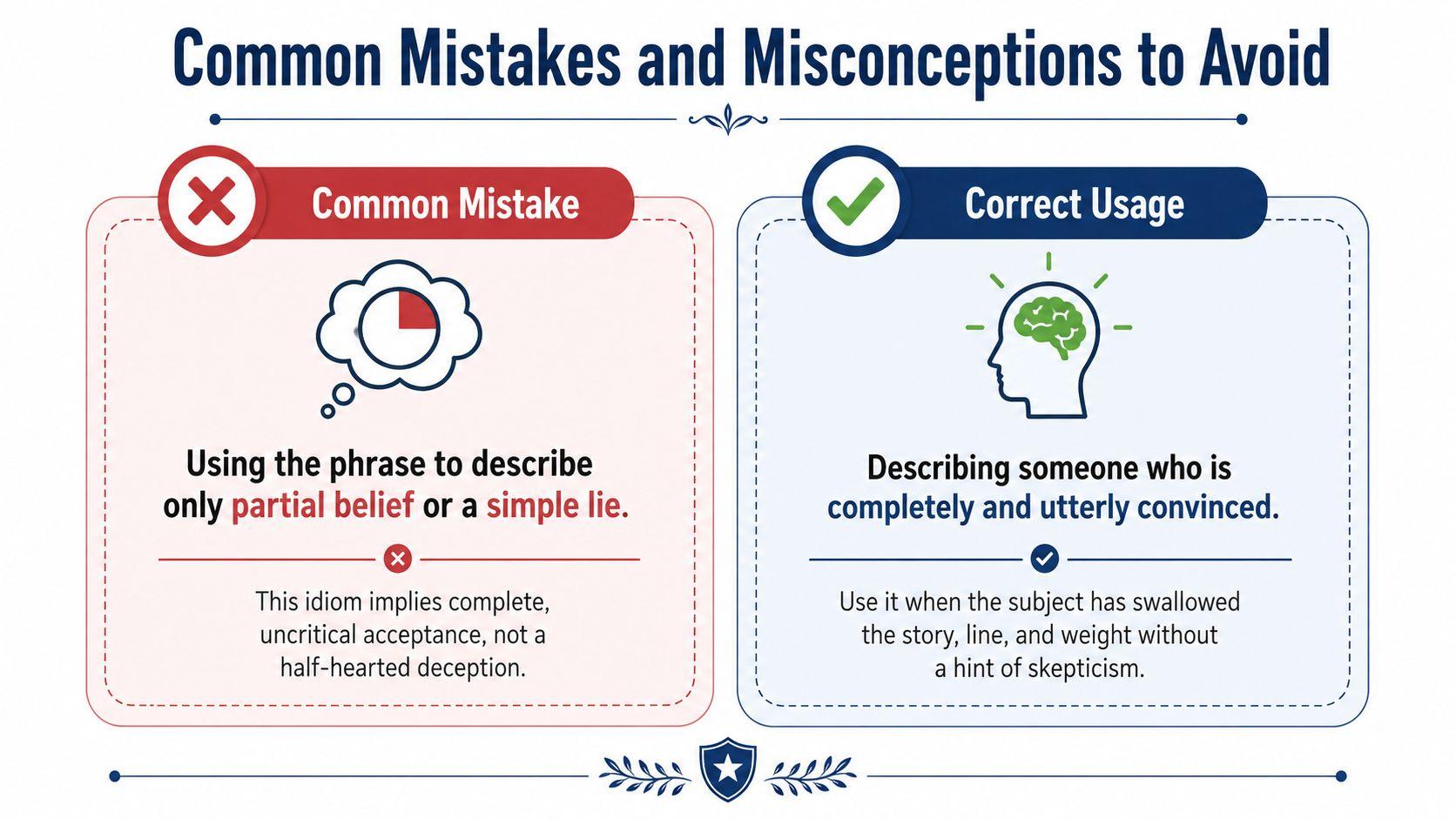
Practical rule: use the idiom when belief is complete, not partial. If someone is only partly convinced, a different phrase will sound more natural.
You can also use it in a more neutral sense. A student might buy into a teacher's explanation hook, line, and sinker, meaning the student accepted it fully. A team might embrace a new process hook, line, and sinker because the idea made immediate sense.
The Fishing Metaphor Behind the Phrase
The image behind the idiom is wonderfully concrete. A hook catches the fish, the line connects it to the angler, and the sinker keeps the bait at the right depth. When a fish goes for the bait, it doesn't just touch one piece of tackle. It takes the whole setup.
That's why the phrase feels so emphatic in English. The fish is not partly caught, and the person is not partly convinced. In figurative use, the mental picture is of someone accepting the entire story with no resistance at all.
How each part maps to meaning
- Hook: the point of capture, which matches the moment a lie or idea “catches” someone.
- Line: the connection, which suggests the story has pulled the listener in.
- Sinker: the weight that holds everything down, which adds the feeling of being fully drawn under.
This is also why the idiom is so memorable for learners. The parts don't just decorate the sentence. They create a complete visual scene, and that scene helps the meaning stay fixed in memory.
One useful way to think about it is this: the phrase doesn't describe a tiny amount of belief. It describes the whole rig being taken at once. That makes it one of the English language's neatest examples of a metaphor that still feels tied to its original material world.
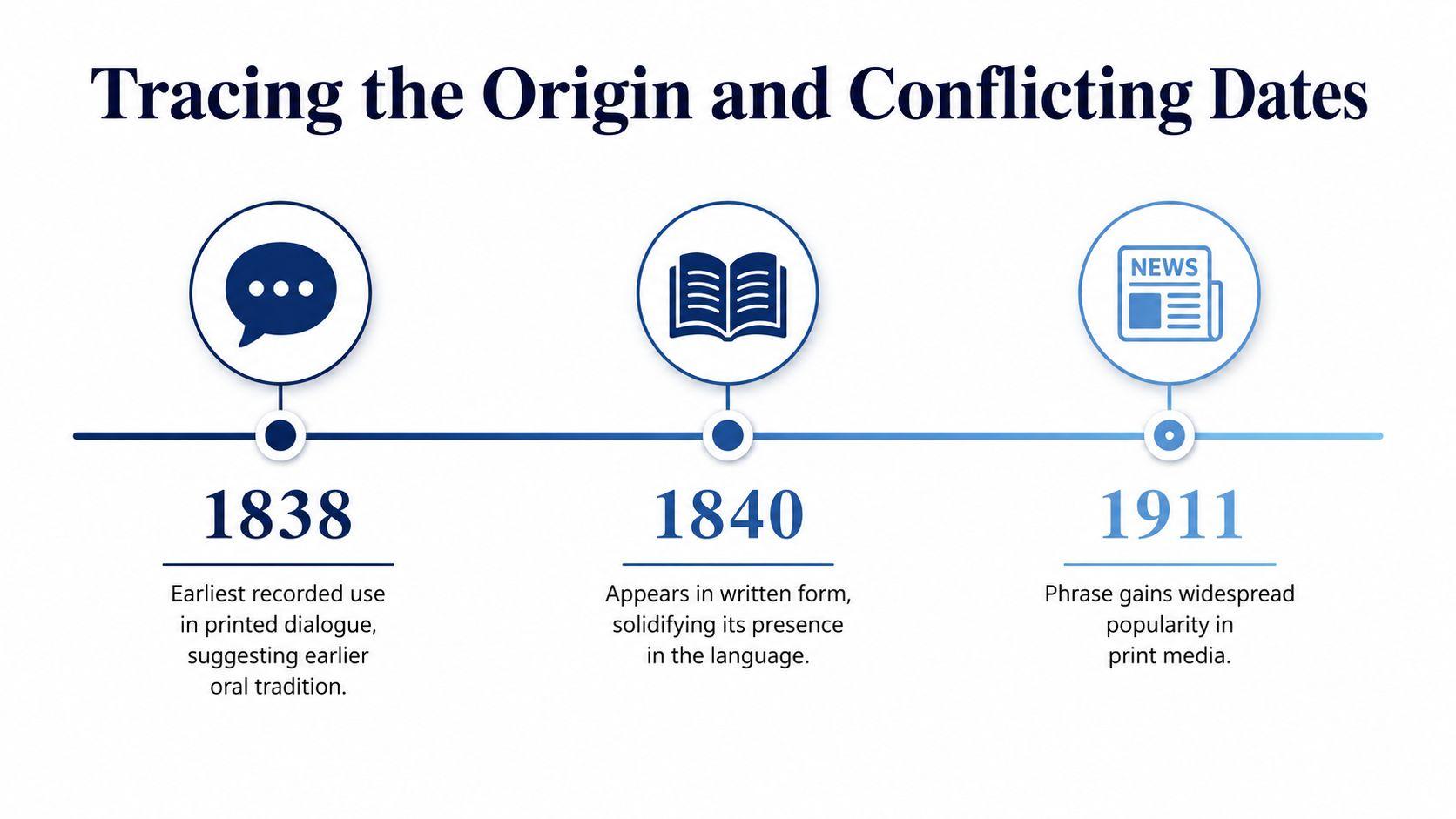
Tracing the Origin and Conflicting Dates
Readers often run into date confusion with this idiom. Some sources point to 1838 as an early appearance in English-language material, while others treat 1865 as the first recorded use in the United States and the point where the expression clearly enters mainstream print. That gap is why origin stories online don't always agree.
The clearest way to reconcile the dates is to separate earliest known appearance from first recorded print use. The phrase may have been circulating earlier in speech or informal writing before lexicographers could pin down a stable printed citation. That is common with idioms, especially ones that likely grew out of everyday work and talk rather than a single invented moment. The historical summary on the research notes page is useful precisely because it points to this kind of distinction.
Why dictionaries don't line up perfectly
Dictionary evidence shows that the phrase had reached broad mainstream usage by the mid-19th century, and the modern meaning has stayed remarkably stable for 160+ years since those early records. The historical record also suggests that the figurative sense developed from a specific fishing metaphor, not from a vague idea of exaggeration.
That matters because it explains the phrase's durability. The idiom never had to drift far from its image. It still means almost exactly what the fishing scene suggests, which is one reason it has survived so long in English.
The safest historical summary is simple. The expression is old, clearly established by the mid-19th century, and tied directly to fishing tackle rather than abstract wordplay.
For learners, that means you don't need to choose between competing dates as if one source must be “wrong.” The dates reflect different kinds of evidence, early appearance versus first firm print record. Both help tell the story of how the phrase moved from angling language into common English.
Real World Example Sentences Across Registers
A phrase like this feels natural only when the level of belief is strong enough. The examples below show how that works in different settings, from casual conversation to more polished writing.
Casual and spoken English
- “He believed the fake lottery email hook, line, and sinker.” This sounds conversational and slightly teasing.
- “She bought his excuse hook, line, and sinker.” This is common in everyday speech.
- “I almost fell for that story hook, line, and sinker.” This sounds natural when you're admitting you were nearly fooled.
Neutral and positive uses
- “The board bought into the new vision hook, line, and sinker.” This shows complete acceptance, not deception.
- “The audience embraced the speaker's message hook, line, and sinker.” This works when the point is full approval.
- “The class accepted the explanation hook, line, and sinker.” This is neutral, and it's often the best choice when no trick is involved.
Formal and written contexts
- “The report's assumptions were accepted hook, line, and sinker.” This sounds analytical and slightly critical.
- “Investors can be persuaded hook, line, and sinker when the pitch is polished.” This feels more editorial than chatty.
- “The staff adopted the new policy hook, line, and sinker after one meeting.” This shows complete take-up without sounding slangy.
The pattern to notice is placement. The idiom usually lands at the end of the sentence, where it carries the punch. That rhythm feels natural in English, and it keeps the emphasis on the totality of the belief rather than on the words themselves.
Synonyms and Related Idioms Compared
Different idioms can look similar, but they don't always carry the same shade of meaning. Hook, line, and sinker is about total acceptance, often with a hint of gullibility. Other expressions overlap, but they're not exact substitutes.
| Idiom | Core Meaning | Formality | Typical Context |
| Hook, line, and sinker | Completely, or completely fooled | Informal to neutral | Belief, persuasion, scams, buy-in |
| Lock, stock, and barrel | The whole thing, every part of it | Neutral | Complete transfer, total inclusion |
| Whole hog | Fully, with no holding back | Informal | Effort, commitment, enthusiasm |
| Swallow something whole | Accept without questioning | Informal | Belief, gullibility, rumor |
| Take the bait | Fall for a trap or trick | Informal | Deception, prank, provocation |
Related fishing idioms overlap but aren't identical. Take the bait means someone responded to a trap. Bite the hook leans even more toward the moment of being drawn in. Hook, line, and sinker goes farther, because it suggests the whole story has been swallowed, not just the first tempting part.
For a fuller idiom comparison, the 1chat blog resource can be a helpful starting point when you're checking how different expressions fit in tone and register.
Use this shortcut: if you mean “the whole thing,” think lock, stock, and barrel. If you mean “they believed it completely,” think hook, line, and sinker.
That small distinction helps a lot in writing. It keeps your sentence precise, and it keeps the idiom from sounding pasted in where a simpler phrase would work better.
Common Mistakes and Misconceptions to Avoid
The biggest mistake is assuming the idiom only means deception. It often does, but not always. Dictionaries also support broader meanings like completely, without hesitation, and altogether, so the phrase can describe full acceptance in neutral or even positive settings.
Small errors that make the phrase sound off
- Partial belief: “I believed it hook, line, and sinker, sort of” sounds contradictory. The idiom needs total acceptance.
- Forced placement: “Hook, line, and sinker, he believed it” can feel awkward in ordinary prose. The end of the sentence usually sounds smoother.
- Narrow context: using the phrase only for scams misses the broader meaning that standard dictionaries recognize.
- Overuse in formal writing: in a business memo, a simpler word like completely may be cleaner.
A small rewrite often fixes the problem fast. Compare these:
- Awkward: “She kind of bought the proposal hook, line, and sinker.”
- Better: “She bought the proposal hook, line, and sinker.”
- Awkward: “The team, hook, line, and sinker, accepted the plan.”
- Better: “The team accepted the plan hook, line, and sinker.”
The phrase also deserves careful punctuation in careful writing. The standard form is hook, line, and sinker, with commas separating the three items.
For quick clarification and learner support, the 1chat FAQ page can be a useful reference point when you want to revisit usage patterns after practicing.
Quick Quiz and Practice Prompts for Learners
Try these five questions without looking back.
- What does “hook, line, and sinker” usually mean?
- Which sentence sounds correct?
A. She believed the story hook, line, and sinker.
B. She believed the story hook, partly, and sinker. - Can the idiom be used in neutral or positive contexts?
- Which idiom is closest to “the whole thing, every part of it”?
- Which sentence sounds more natural?
A. They accepted the explanation hook, line, and sinker.
B. They accepted the explanation a little bit, hook, line, and sinker.
Answer key:
- Completely, or completely fooled.
- A.
- Yes.
- Lock, stock, and barrel.
- A.
Now write your own sentences using the idiom in three ways:
- Deception: write a sentence about a scam, prank, or false claim.
- Neutral: write a sentence about someone fully accepting an idea or explanation.
- Positive: write a sentence about a team, class, or audience embracing a message.
A strong model set would sound like this: “He believed the fake email hook, line, and sinker.” “The committee accepted the proposal hook, line, and sinker.” “The students bought into the teacher's explanation hook, line, and sinker.”
If you can use the phrase naturally in all three settings, you've got the hook line and sinker meaning down well enough to recognize it in books, movies, and everyday conversation. For extra practice, read your own sentences aloud and listen for whether the ending feels firm and complete.
If you want more language guides like this, use 1chat to draft practice sentences, compare idioms, and check your writing before you share it.