
The most popular advice about how to avoid AI detection is also the least durable: paste your draft into a “humanizer,” swap a few words, and hope the score falls. That approach treats writing as camouflage. It can also damage meaning, introduce errors, violate a school or employer policy, and leave you unable to explain how the work was created.
The stronger approach is simpler. Use AI for planning, comparison, research support, or limited editing, then make the argument, examples, evidence, and final language entirely yours. That protects your voice and gives you something more valuable than a low detector score: a defensible writing process.
The Core Question Behind Avoiding AI Detection
People who search for how to avoid AI detection often face one of two problems. Some want AI-assisted text to appear entirely human. Others wrote the work themselves and fear a detector will accuse them falsely. Those cases look alike from the outside, yet they call for different responses.
A detector score does not prove authorship. It offers a probability-based judgment from language patterns. In a 2024 Scientific Reports study, participants identified human versus AI writing with 57% overall accuracy, recognizing human text at 61% but AI text at only 53% (Scientific Reports research on human detection of AI text). Human readers have also struggled with the distinction that automated tools attempt to make.
False positives create a serious problem for legitimate writers. Independent evaluations have reported false-positive rates ranging from 1.6% to 8.0% across tools, while some reviews found much higher rates for non-native English and highly structured academic writing (false-positive benchmark and detector limitations). Formal student essays, technical research, and small-business copy built from a standard brief can resemble a classifier's idea of AI writing without any AI involvement.
Practical rule: Don't optimize for a detector. Optimize for authorship, accuracy, and a process you can explain.
That rule changes the editing job. Do not add random typos or force awkward slang. Replace generic claims with your reasoning, connect conclusions to sources, and keep drafts that show how the work developed. An undetectable content quality evaluation can support that review, but it cannot promise that text will become “undetectable.”
Use AI only as permitted, and disclose its role under the relevant policy. If your human-written work receives a suspicious score, collect process evidence and request human review. The durable answer to “how do I hide AI?” is meaningful ownership of the finished work, not concealment.
How AI Detectors Actually Work Under the Hood
AI detectors don't read intention. They inspect patterns that may correlate with generated language.
Perplexity describes how predictable the next word appears to a language model. Highly predictable prose may score as more machine-like because the wording follows familiar patterns. Burstiness describes variation across sentences and passages. A draft with similar sentence lengths, repeated transitions, and evenly balanced paragraphs can look more uniform than ordinary human writing.
Detectors may also examine token probabilities, repeated phrasing, syntax, punctuation, and stylometric features. Stylometry is the analysis of writing habits, such as preferred sentence structures, function words, vocabulary choices, and rhythm. None of these signals proves AI involvement. A polished student essay and a generated essay can share them.
Modern detector quality also depends heavily on model architecture and training data. A 2025 Scientific Reports study reported that RoBERTa reached 96.1% accuracy and a 0.962 F1-score on human-versus-AI text classification, using a broader benchmark dataset of 30,000 samples (transformer-based AI detection study). The historical lesson is important: transformer classifiers can outperform older rule-based systems by a wide margin, but their results still depend on the model family, dataset, threshold, and type of writing being evaluated.
Why scores change across tools
Different detectors use different training examples and decision thresholds. One may react strongly to predictable sentence openings. Another may emphasize vocabulary distribution. A third may use retrieval or comparison methods that behave differently when text has been paraphrased.
Independent research found detector inter-rater reliability ranging from 0.57 to 0.95, a wide spread that shows how inconsistently tools can evaluate the same general problem (Scientific Reports evaluation of detector reliability). Human judgments have also remained weak, with Penn State reporting laboratory results in which people distinguished AI text only about 53% of the time, barely above random guessing (Penn State report on human AI-text identification).
The practical takeaway is to edit for clarity and ownership, not for a particular score. If you want to compare how different language models approach a draft, use a transparent workspace such as 1chat's multi-model research environment, then make the final decisions yourself.
Editing AI Drafts So They Read as Your Own Work
AI text is a starting draft, never finished prose. Treat each paragraph as notes that may offer structure while still containing weak wording, unsupported claims, factual errors, or a voice that does not belong to you. The goal is not to fool a detector. It is to produce work you can explain, defend, and revise from your own judgment.
Consider this generic sentence:
“In today's rapidly changing business environment, effective communication is essential for organizations seeking to achieve sustainable growth and maintain a competitive advantage.”
It sounds polished but communicates very little. The audience is unclear, the problem is abstract, and the sentence offers no distinct position.
A stronger revision is specific:
“A small retailer can lose a sale because a customer's question sits unanswered for a day. Clear support messages matter less as corporate polish than as a way to remove that delay.”
The revision narrows the subject, introduces a concrete situation, and makes an argument instead of stacking abstract nouns. That is the standard to apply throughout the draft.
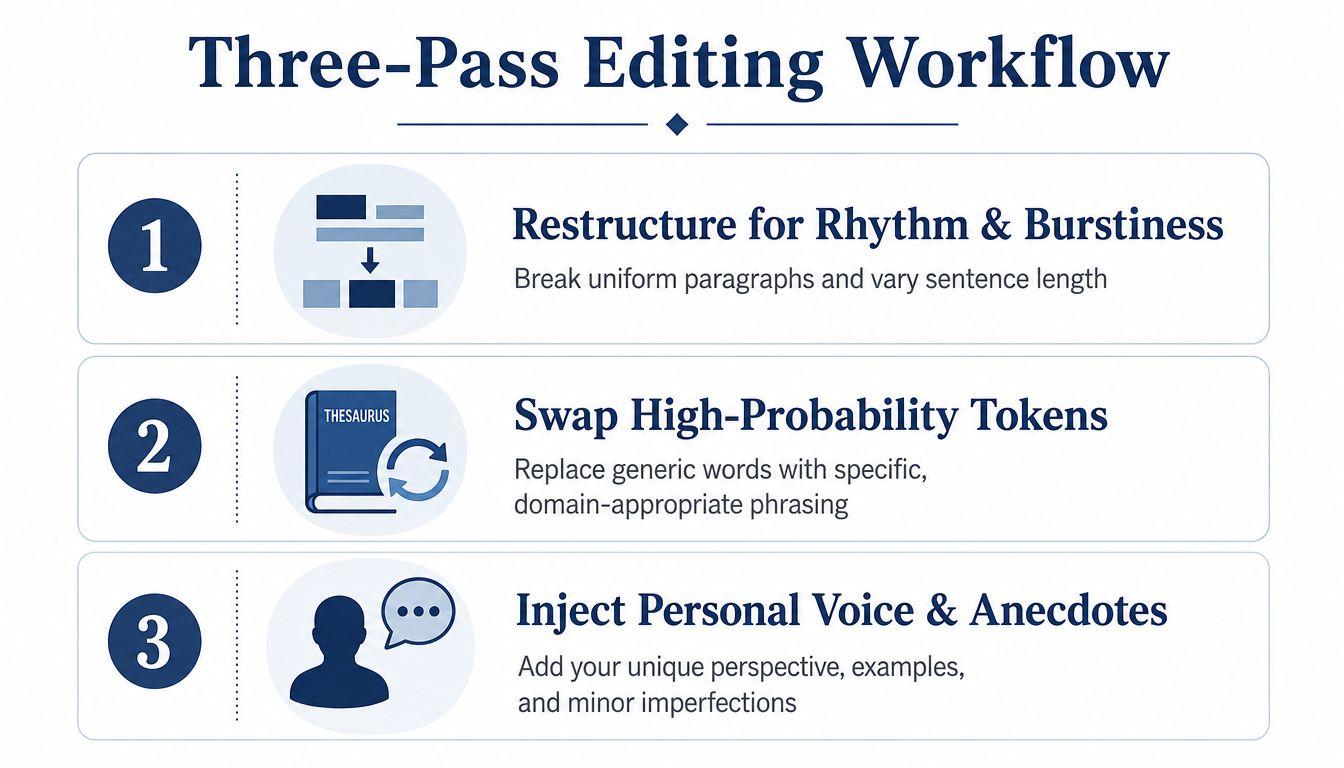
Pass one restructures the rhythm
Break paragraphs that repeat the same sentence pattern. Combine ideas that belong together, then isolate a short sentence when the point deserves emphasis. Read the passage aloud. If every sentence arrives at the same pace, change the structure, not just a few words.
Pass two replaces generic language
Search for phrases such as “plays a central role,” “in today's market,” and “significant impact.” Do not swap them for random synonyms. Ask what happened, to whom, and under what conditions.
“AI improves productivity” is vague. “AI can help a team turn meeting notes into a draft task list, but a person still needs to verify owners, deadlines, and missing context” defines both the task and its limits.
Cut inflated wording even when it sounds professional. Specific verbs and visible consequences make a draft sound more like considered writing than automated summary.
Pass three adds authorship
Insert your interpretation, examples, source connections, and decisions. If you reject a common assumption, state why. If a source supports only a narrow point, keep the claim narrow. Use guidance on how to validate AI-generated claims before allowing an AI-produced citation or factual statement into the final draft.
Paraphrasing still requires care. A NAACL study found that paraphrasing attacks reduced average detector performance by 0.196, while another result in the same research line found that about 13% of passages created from author-style samples went undetected (NAACL study on paraphrasing attacks). That result does not make synonym swapping a sound writing method. It shows that shallow rewriting can change classification without creating original thought.
Use this self-audit before submission:
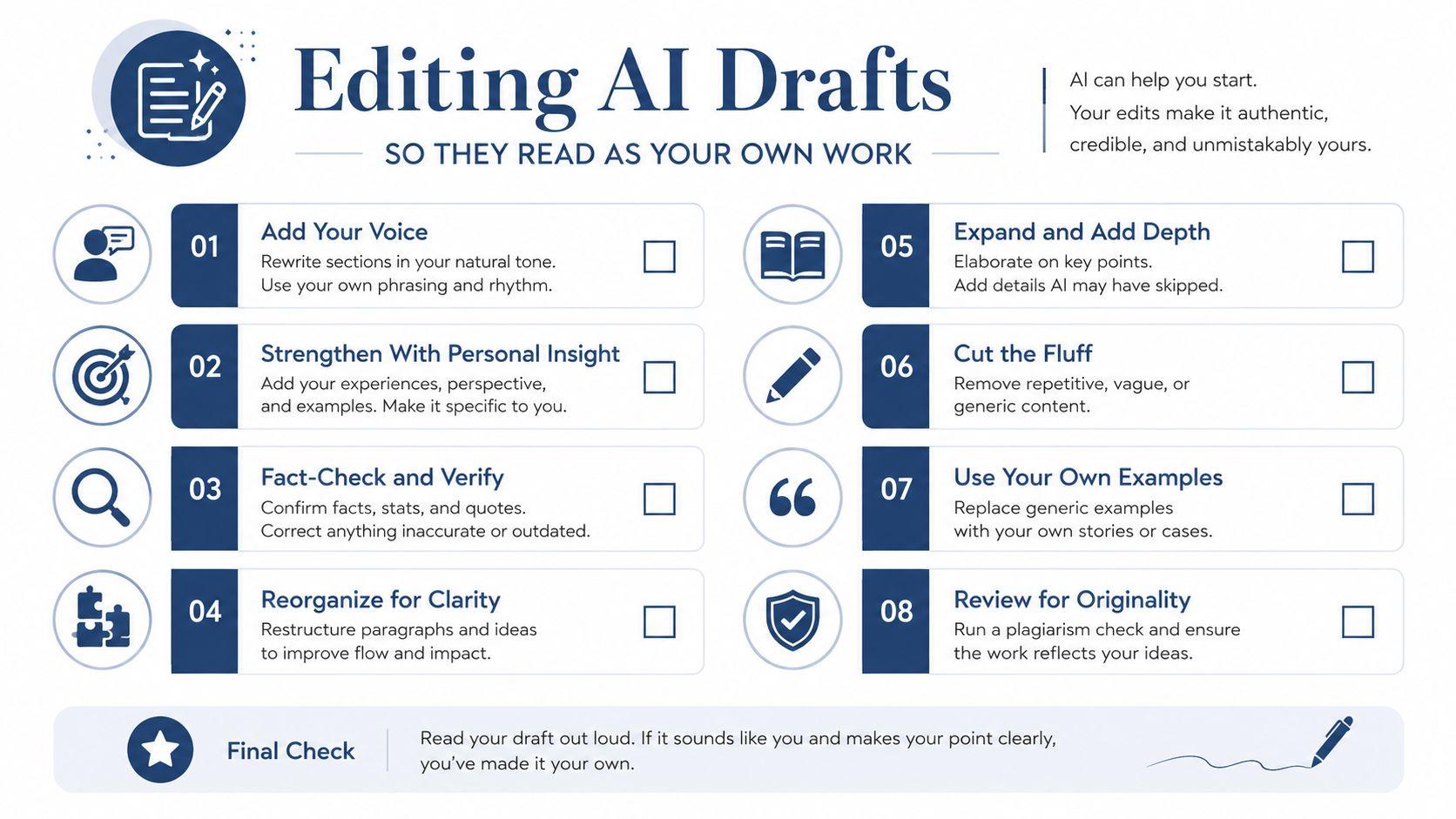
- Own the thesis: Can you explain the central claim without looking at the draft?
- Name the subject: Replace broad references with the actual person, team, product, or problem.
- Cut empty transitions: Remove connective phrases that add no logic.
- Vary the rhythm: Mix sentence lengths because the ideas require it, not because a detector might notice.
- Add evidence: Attach claims to accurate sources and explain their relevance.
- Mark uncertainty: Do not present a suggestion as an established fact.
- Use your examples: Include observations or scenarios that reflect your experience and audience.
- Check every citation: Confirm that the source supports the exact statement.
- Preserve your process: Keep outlines, notes, drafts, and revision history.
The final item can matter more than another pass through a humanizer. A coherent writing trail shows how you developed the argument and helps establish that the finished work reflects your thinking.
Choosing Tools That Respect Privacy and Originality
A writing tool should pass three tests before you place sensitive material into it. You need to understand what happens to prompts, whether your input may be used for model training, and whether the workflow helps you revise rather than merely export polished text.
A dedicated humanizer usually optimizes for surface change. That can produce awkward syntax, altered meaning, or an artificial voice. A general chatbot may help with brainstorming and editing, but you still need to inspect its privacy terms and avoid uploading confidential client information by default.
Privacy isn't a minor preference when the draft is an unpublished essay, client brief, internal strategy, or family document. Review the provider's policy rather than assuming that a familiar interface protects your material. For a concise example of what to inspect, compare available privacy settings and summaries before choosing a summarization or writing service.
A practical tool comparison
| Tool category | Useful for | Main concern | Sensible safeguard |
| Humanizer or paraphraser | Surface-level rewording | Meaning can drift and prose can become unnatural | Rewrite from understanding, then fact-check |
| General chatbot | Brainstorming, outlines, explanations | Data handling and generic output | Remove sensitive details and retain source notes |
| Grammar editor | Clarity and mechanics | Can flatten personal style | Accept only changes you understand |
| Multi-model workspace | Comparing approaches and researching | Requires careful review of provider terms | Use privacy controls and keep a local draft trail |
| Human editor | Audience, logic, and voice | Confidentiality and cost may vary | Agree on handling, access, and deletion expectations |
A privacy-first workspace can be useful when you need to compare model responses, analyze reference PDFs, or generate supporting visual material without scattering the project across several accounts. The tool doesn't create authorship for you. It gives you a more controlled place to do the preparatory work.
Before using any service, read its specific terms and privacy controls. The 1chat privacy policy is the relevant place to inspect how that service describes data handling. Whatever tool you choose, don't confuse privacy with originality. Private AI-generated prose is still not your thinking until you revise, verify, and own it.
Legal and Academic Risks Most Guides Skip
A detector workaround can create a bigger problem than a detector flag. If a school prohibits undisclosed generative AI, changing the wording doesn't remove the policy issue. If a client contract assigns ownership of deliverables or restricts confidential information, uploading the brief to an external system may create a contractual concern even when the final copy sounds excellent.
The safest first step is to read the applicable rule before drafting. Check the syllabus, assignment instructions, workplace AI policy, client agreement, or publication terms. If the language is unclear, ask a specific question in writing: “May I use an AI tool for brainstorming and grammar review if I write and verify the final draft?”
Build evidence before you need it
False positives make documentation practical, not paranoid. One review reported that a free detector labeled a median 27.2% of academic text as AI-generated, while other analyses found false-positive rates of 30% to 78% in some scenarios (University of Chicago analysis of AI detection and false positives). Those figures don't prove that every detector is unreliable in every context. They do show why a score should trigger review, not automatic punishment.
Keep:
- Version history: Save dated drafts in Google Docs, Word, or another system that records revisions.
- Research notes: Store the sources you read and the claims each source supports.
- Outline changes: Preserve discarded ideas and structural decisions.
- Prompt records: If AI use is allowed, retain prompts and outputs that materially influenced the work.
- A process statement: Explain whether AI helped with brainstorming, summarization, editing, or another permitted task.
If someone flags your work, don't respond by arguing that a detector is “bad” and stopping there. Show your draft trail, explain your decisions, identify your sources, and request a human review under the institution's process. For professional writing, notify the relevant editor or manager promptly and separate factual questions from authorship questions.
A low score doesn't prove originality, and a high score doesn't prove misconduct.
A Privacy-First Workflow You Can Reuse Today
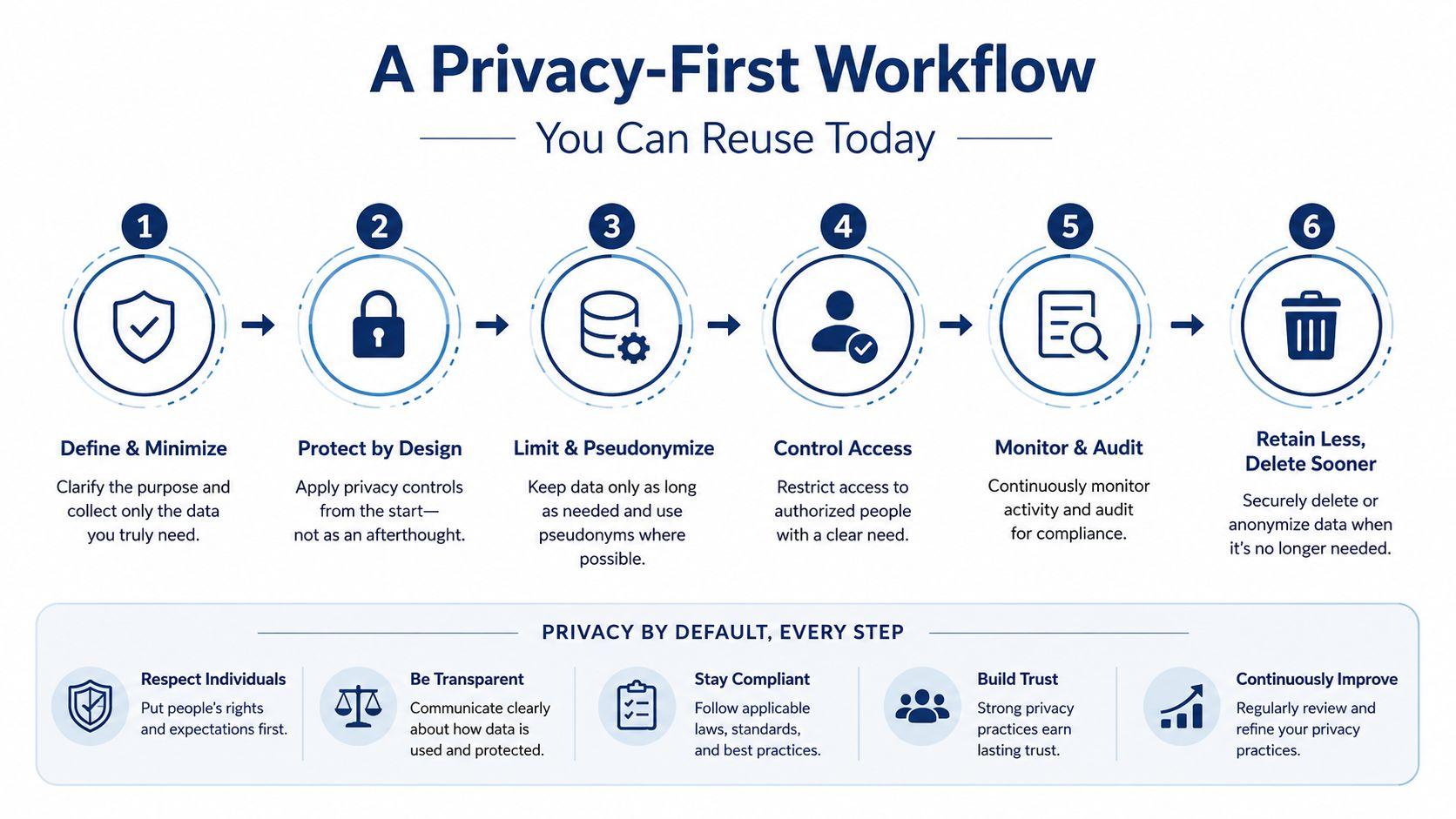
Begin with your own position, not a blank prompt. Write the problem, audience, intended conclusion, and evidence you already trust. Then use AI to challenge the outline, surface missing questions, or compare possible structures. Don't ask it to manufacture a finished identity for you.
The repeatable sequence
- Outline privately. List the claim, supporting reasons, counterargument, and evidence before sending material to a model.
- Minimize sensitive data. Remove names, unpublished figures, customer details, and identifying information unless the tool and your policy clearly permit them.
- Compare outputs. Ask more than one model for alternative structures or objections, not for a paragraph you can paste.
- Draft from notes. Close the AI window and write the core passage in your own language.
- Edit for meaning. Apply the three-pass method. Restructure rhythm, replace vague wording, and add your judgment.
- Verify and document. Check claims against sources, preserve the revision trail, and disclose permitted AI assistance.
Run a detector only as a diagnostic, especially for high-stakes work. The result can identify passages worth rereading, but it can't certify authorship. If tools disagree, prioritize your process evidence and the quality of your reasoning over the most alarming score.
| Tool Type | What It Measures | Typical Failure Mode | Best Use |
| Statistical detector | Predictability, token patterns, and stylistic signals | Flags formal human prose or misses edited AI text | A prompt for manual review |
| Classifier-based detector | Learned features from labeled examples | Results shift across domains and thresholds | Comparative feedback, not proof |
| Plagiarism checker | Similarity to indexed material | May miss uncatalogued sources or poor attribution | Citation and originality review |
| Version history | How the document developed | Doesn't explain every revision automatically | Authorship evidence |
| Human review | Reasoning, source use, and voice | Reviewer bias or incomplete context | Final judgment |
If AI assistance is allowed, use plain disclosure: “I used an AI tool to brainstorm structure and identify questions. I wrote, fact-checked, and revised the final text.” Adjust that wording to the required policy. Transparency works best when it describes actual use instead of making broad claims you can't support.
Smart Answers to the Questions Readers Actually Ask
Why does my human writing get flagged?
Formal, repetitive, or tightly structured prose can resemble patterns detectors associate with generated text. Non-native English writers face added risk because clear, conventional phrasing may be misread as machine-produced. A detector score cannot establish authorship, so keep drafts and supporting notes, then request human review. Do not add deliberate mistakes to satisfy a classifier. Clear writing is not evidence of cheating.
Is rewriting AI text in my own words enough?
Synonym swaps rarely make a draft yours. Rebuild the structure, verify every claim, add your interpretation, and remove material you cannot explain. If a school, employer, or client restricts AI use, substantial rewriting may still violate the policy.
What should I do after a false flag?
Present version history, research notes, and a concise explanation of your process. Ask which policy governs the decision, then request review by a person who can assess reasoning, sources, and voice rather than relying on a detector score.
How should groups handle mixed AI use?
Set rules before drafting. Record who wrote each section, which tools assisted, and how the group checked sources. Use the project's AI and privacy FAQ for initial questions, then follow your school, employer, or client requirements.
Should I use multiple detectors?
For high-stakes work, comparing tools can expose inconsistent results, but it cannot create certainty. Performance changes across text types, and false positives remain possible. Use comparisons to identify passages for review. Then rely on authorship evidence, source quality, and human evaluation.
If you want a privacy-first place to brainstorm, compare language models, analyze reference PDFs, and refine drafts without treating a humanizer as a disguise, try 1chat. Start with your own outline, keep source notes, revise every generated passage, and finish with writing you can explain and defend.