Most advice about brainstorming is wrong.
The popular version says you put people in a room, throw ideas on a whiteboard, tell everyone to “be creative,” and wait for magic. In practice, that setup usually rewards the fastest talker, the safest suggestion, and whatever idea gets said first. The rest of the room edits itself in real time.
Alex Faickney Osborn introduced brainstorming in 1941 with four rules: focus on quantity, withhold criticism, welcome unusual ideas, and combine or improve ideas. In early corporate trials, that structure reportedly produced 200 to 300% more ideas than unstructured meetings. The method mattered. The free-for-all did not.
If you want to learn how to brainstorm ideas that lead somewhere, stop treating brainstorming like a performance. Treat it like a designed process.
The Unspoken Truth About Brainstorming
Traditional group brainstorming has a bad habit of looking productive while quietly reducing output. Research summarized in a landmark meta-analysis reviewing over 100 studies found that individuals working alone often generate 2 to 3 times more ideas than groups of the same size, largely because of production blocking and conformity bias. In one example, six people working alone for five minutes each produced 180 unique ideas, while six people in a group session produced only 60 to 70 ideas, a 60 to 70% reduction in output (research summary).
That gap makes sense if you've ever sat through a messy brainstorm. One person is talking. Two people are waiting to talk. Three people forget their idea while trying to listen. Then someone with authority says something reasonable, and the room starts orbiting that one direction.
Why classic sessions feel flat
Production blocking is simple. People can't share all at once, so they queue their thoughts and lose momentum.
Conformity bias is just as damaging. People hear the first few ideas, then unconsciously shape their own contributions to fit the room. Wild ideas get toned down before they're spoken.
A separate finding deepens the point. A 2012 University of California study found that 65% of participants in traditional brainstorming sessions felt their ideas were ignored or judged, which led to idea suppression. That's not a creativity problem. That's a session design problem.
Practical rule: If your brainstorming method depends on everyone speaking in turn from a blank slate, you've already made the session harder than it needs to be.
Brainstorming still works. It just works better when you stop confusing noise with creativity. The best sessions use structure, silence, prompts, and a clear path from raw ideas to decisions.
Lay the Groundwork for Brilliant Ideas
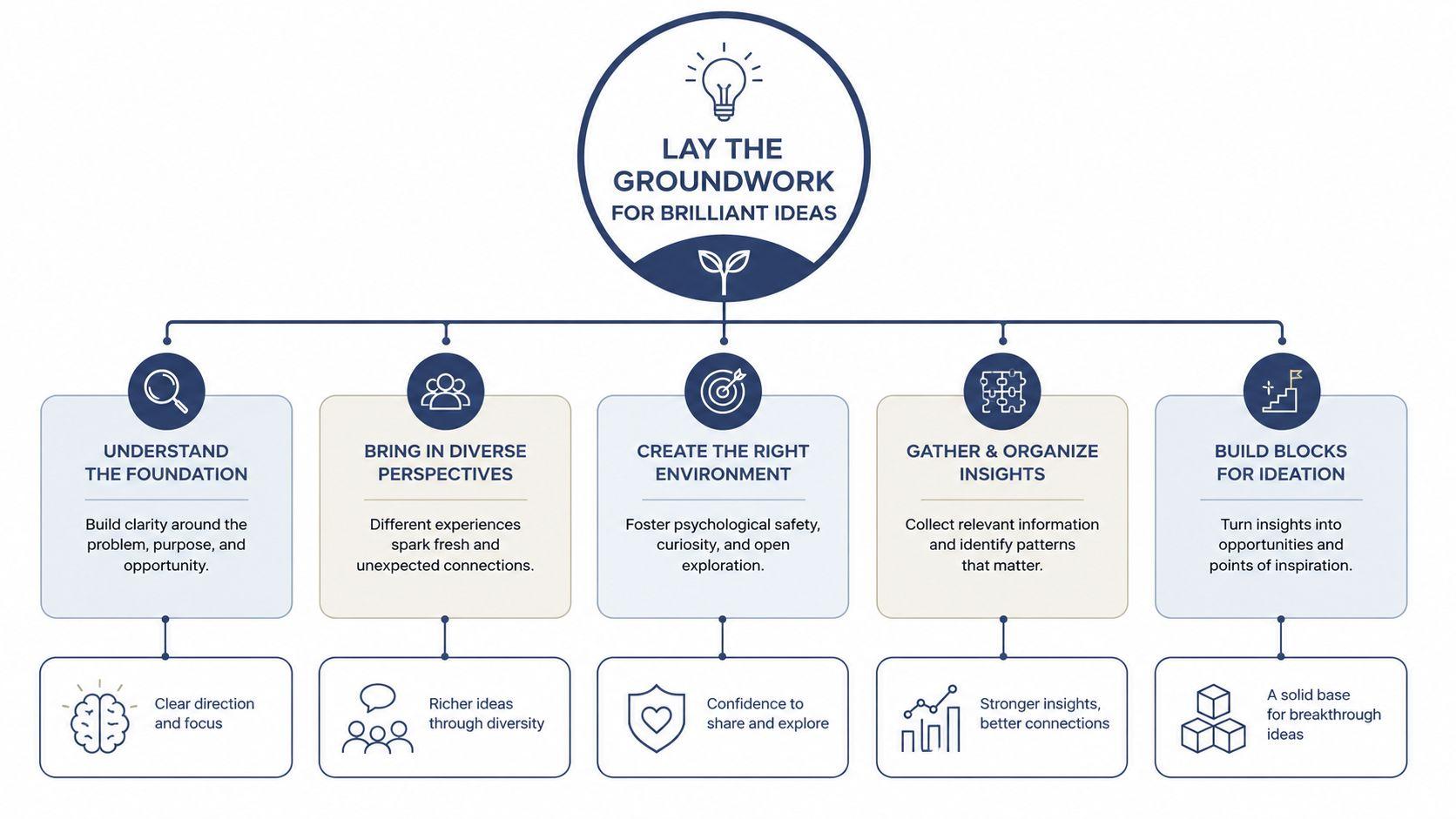
Preparation decides whether a brainstorm produces usable ideas or a pile of vague enthusiasm. Good facilitators know this. They don't start with “Any thoughts?” They start by narrowing the target, setting the rules, and choosing the right people.
Start with a real problem
“Let's come up with marketing ideas” is not a brief. It's a fog bank.
A usable prompt has three parts:
- The challenge: what needs to improve
- The constraint: what you can't ignore
- The outcome: what kind of answer you need
Compare these two prompts:
| Weak prompt | Strong prompt |
| We need new marketing ideas | We need three low-lift ways to generate more local awareness for our business before the next seasonal push |
| How do we make family life easier | What's one repeatable weekend routine that reduces planning stress and works for both kids and adults |
| I need a school project idea | What topic can I research in depth with sources I can actually understand and explain clearly |
The sharper the question, the better the ideas.
Pick for perspective, not rank
A lot of sessions fail before they begin because the invite list is built around hierarchy. That's how you get approval dynamics instead of original thinking.
Use a smaller group and mix viewpoints. If you're brainstorming a customer issue, include someone who talks to customers, someone who handles operations, and someone who can spot feasibility problems early. If you're brainstorming at home, include the people affected by the decision, not just the loudest adult in the room.
Set the rules out loud
Osborn's original rules still hold up: focus on quantity, withhold criticism, welcome unusual ideas, and combine or improve ideas. Those rules were associated with 200 to 300% more ideas than unstructured meetings in early corporate trials. The important part is not historical trivia. The important part is that people need to hear the rules before the session starts.
Use a script if you need one:
For the first phase, nobody evaluates. We collect. Strange ideas are allowed. Half-formed ideas are allowed. Building on someone else's idea is encouraged.
That short reset changes the tone fast.
Prep checklist that actually helps
- Write the problem statement first: Put it where everyone can see it.
- Define the boundary: Budget, time, audience, and fixed requirements shape better ideas.
- Choose a capture method: Whiteboard, shared doc, paper cards, or sticky notes. Don't improvise this mid-session.
- Decide who facilitates: The facilitator protects the process. They don't dominate the content.
- Clarify follow-up: People contribute better when they know ideas won't disappear into a void.
For a useful companion read on framing and generating ideas, Zemith's brainstorming insights cover several practical starting points. If your group is using AI tools in a family or team setting, it also helps to review the guardrails first through the 1chat FAQ.
Master Solo Brainstorming with Individual Techniques
Generally, one should start alone.
That's not anti-collaboration. It's practical. Individual ideation avoids the social friction that drags group sessions down, and it gives you raw material worth bringing into a room later. If you've ever said, “I think better after the meeting,” solo brainstorming is your natural mode.
Use methods that match the way your brain works
Some people think in lists. Others think in sketches, fragments, examples, or questions. Don't force yourself into one format.
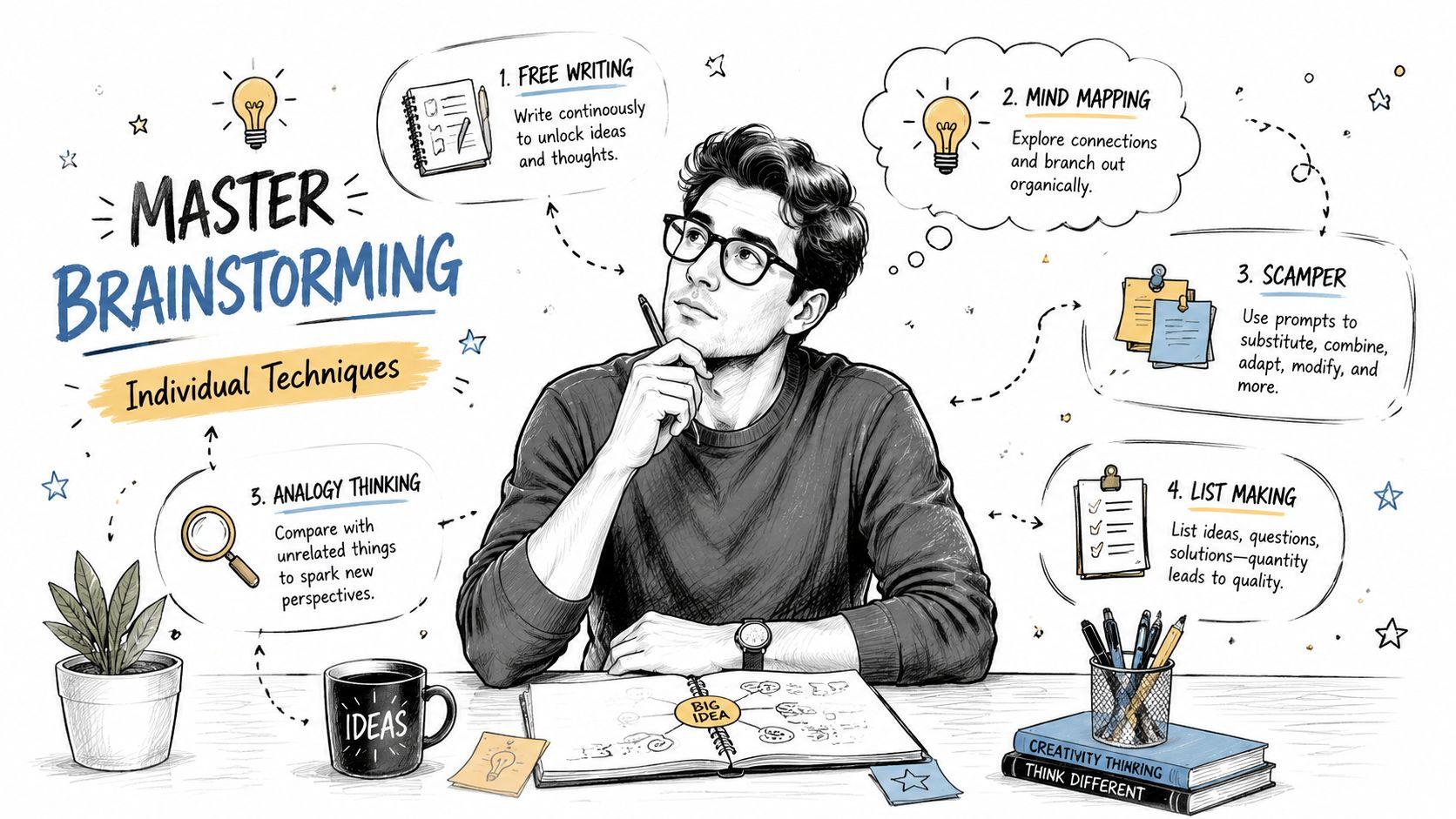
Three reliable solo methods:
Mind mapping for visual thinkers
Put the core problem in the center of a page. Add branches for themes, causes, audiences, obstacles, or possible directions. Then branch again.
This works well when the problem feels tangled. It helps you see patterns instead of hunting for one perfect idea too early.
Timeboxed idea sprints
Set a short timer and generate without editing. The point isn't elegance. The point is momentum.
A useful benchmark from brainstorming practice is 15 minutes for 15 ideas, a constraint recommended to keep energy high and force movement rather than overthinking (Miro's brainstorming guide). If you get stuck at idea seven, that's usually when the better ideas start.
Question burst
Instead of asking for answers, write only questions for a few minutes. Ask what's unclear, what assumptions you're making, what the opposite approach would be, who benefits, who resists, and what would make the idea fail.
Questions expand the problem space. Answers narrow it.
A weak brainstorm hunts for solutions too early. A strong one improves the question first.
Capture ideas in the format you'll actually reuse
People lose good ideas because they record them in a form they won't revisit. If your notes always turn into chaos, change the format, not your willpower.
These note styles help different kinds of thinkers:
- Outline notes for structured planning
- Cornell notes for separating ideas from follow-up
- Chart notes when you're comparing options
- Visual notes when relationships matter more than sequence
If you want practical examples, 10 different note-taking styles from Whisper AI is a helpful reference for matching the format to the task.
Where AI helps and where it hurts
AI is useful for solo brainstorming when you use it as a provocateur, not an oracle. It can help you get unstuck, challenge your assumptions, generate variants, or reframe a boring prompt. It becomes less useful when you ask it to “give me the best ideas” and then accept the first clean list it returns.
That matters more in remote and asynchronous work. AI-assisted asynchronous brainstorming is emerging as a way to tackle idea staleness, a problem affecting 45% of remote teams, but many resources still don't explain how to use AI to diversify ideas rather than just expand them (IMD on brainstorming).
Use prompts like these instead:
- Challenge prompt: “Give me five reasons this idea would fail for a small business with limited time.”
- Constraint prompt: “Suggest options that don't rely on paid ads, extra staff, or technical setup.”
- Audience shift prompt: “How would a parent, a student, and a store manager each describe this problem differently?”
- Opposite prompt: “What would the least obvious but still practical approach look like?”
- Category prompt: “Generate ideas across service, communication, operations, and customer experience. Don't repeat the same type.”
The best solo workflow is simple. First, think on your own. Then use AI to stretch the edges. Then return to your own judgment.
Facilitate Group Sessions That Actually Work
Group brainstorming works when the process protects quieter thinkers, slows dominant voices, and separates idea generation from evaluation. Without that structure, you get theater.
The two fixes I use most are brainwriting and round-robin sharing. They solve different problems. Brainwriting improves idea generation at the start. Round-robin makes sure every person gets heard once ideas are on the table.
Start with silence, not discussion
Traditional group brainstorming can reduce idea output by 60 to 70% because of production blocking. By contrast, brainwriting reverses that pattern. In one experiment, teams using brainwriting generated 40% more ideas than teams using verbal brainstorming.
That's why the opening minutes of a group session should be quiet.
Give everyone the prompt. Ask them to write individually. No discussion. No reacting. No “just to build on that.” Let the room fill with independent thinking before social influence takes over.
A 45 minute agenda that keeps the room useful
Here's a practical format for teams, classrooms, and even family planning sessions.
| Time | Activity | Why it works |
| 5 min | Frame the problem and rules | Gets everyone solving the same thing |
| 10 min | Silent brainwriting | Prevents early anchoring and social pressure |
| 10 min | Round-robin sharing | Every participant contributes without interruption |
| 10 min | Clarify and combine | Improves ideas without judging too early |
| 10 min | Vote and pick next steps | Prevents the session from ending in ambiguity |
Assign two roles:
- Facilitator: guards time, enforces the rules, and keeps evaluation out of the early phase
- Scribe: captures ideas cleanly and groups similar ones without editorializing
Facilitator move: If one person keeps evaluating too soon, interrupt the pattern, not the person. Say, “Hold that for the selection round. Right now we're still collecting.”
Good prompts beat motivational speeches
People don't need to be told to “think outside the box.” They need better prompts.
Try prompts that force a shift in angle:
- For operations teams: What are we doing manually that customers never notice but staff always feel?
- For product discussions: What would we remove if we had to make this simpler?
- For family decisions: What would make this easier to repeat every week?
- For student groups: What question are we avoiding because it seems too obvious?
For distributed teams, AONMeetings for effective collaboration offers useful guidance on running virtual sessions without letting the meeting tool drive the process. If your team is experimenting with AI-supported workflows around meeting prep or idea capture, the 1chat blog is where to look for practical applications.
Brainstorming Prompts for Teams Families and Students
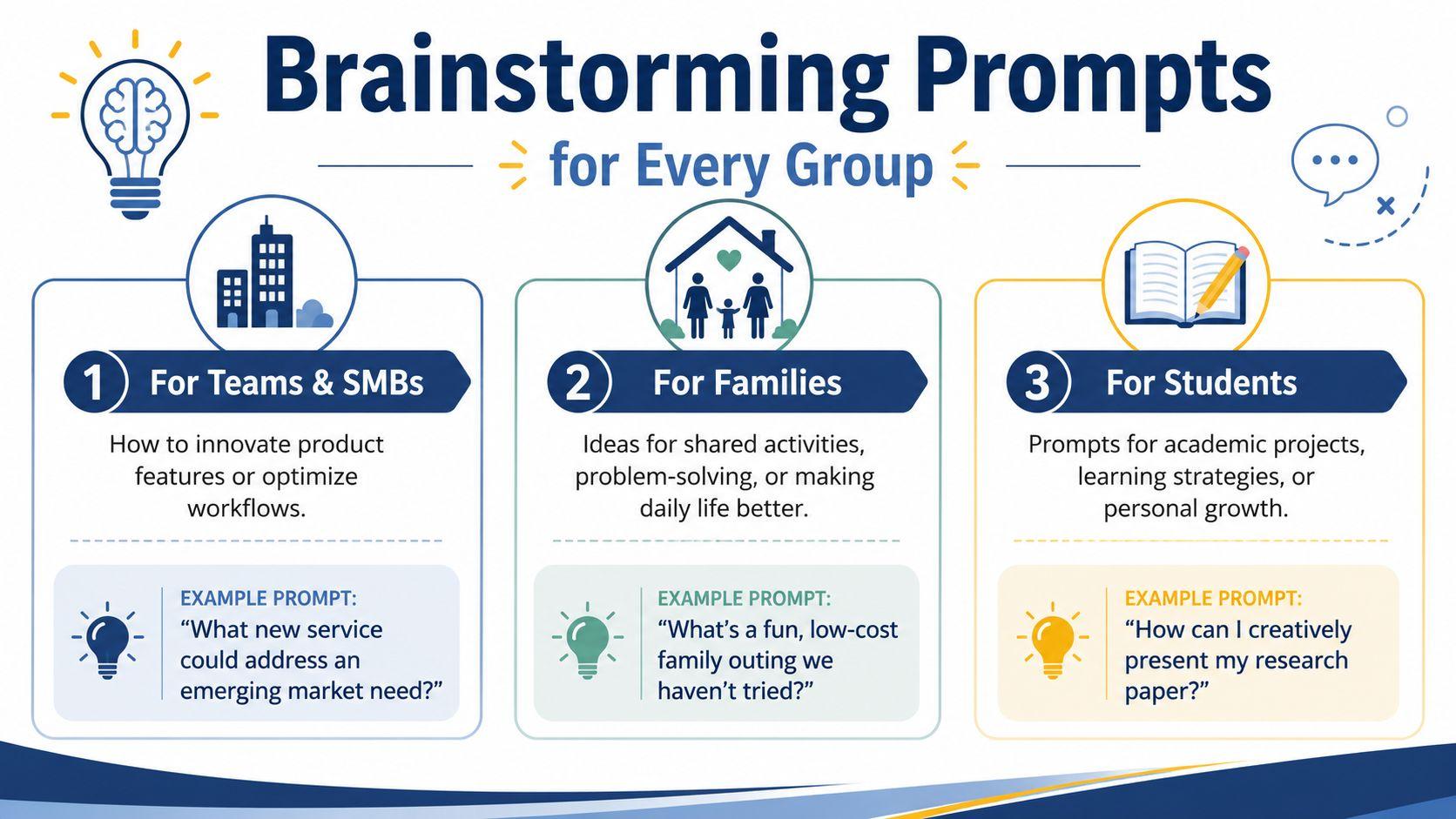
Different groups don't need the same exercise. A small business trying to improve a service offer has a different job than a family planning a trip or a student trying to narrow a project topic. The method should fit the setting.
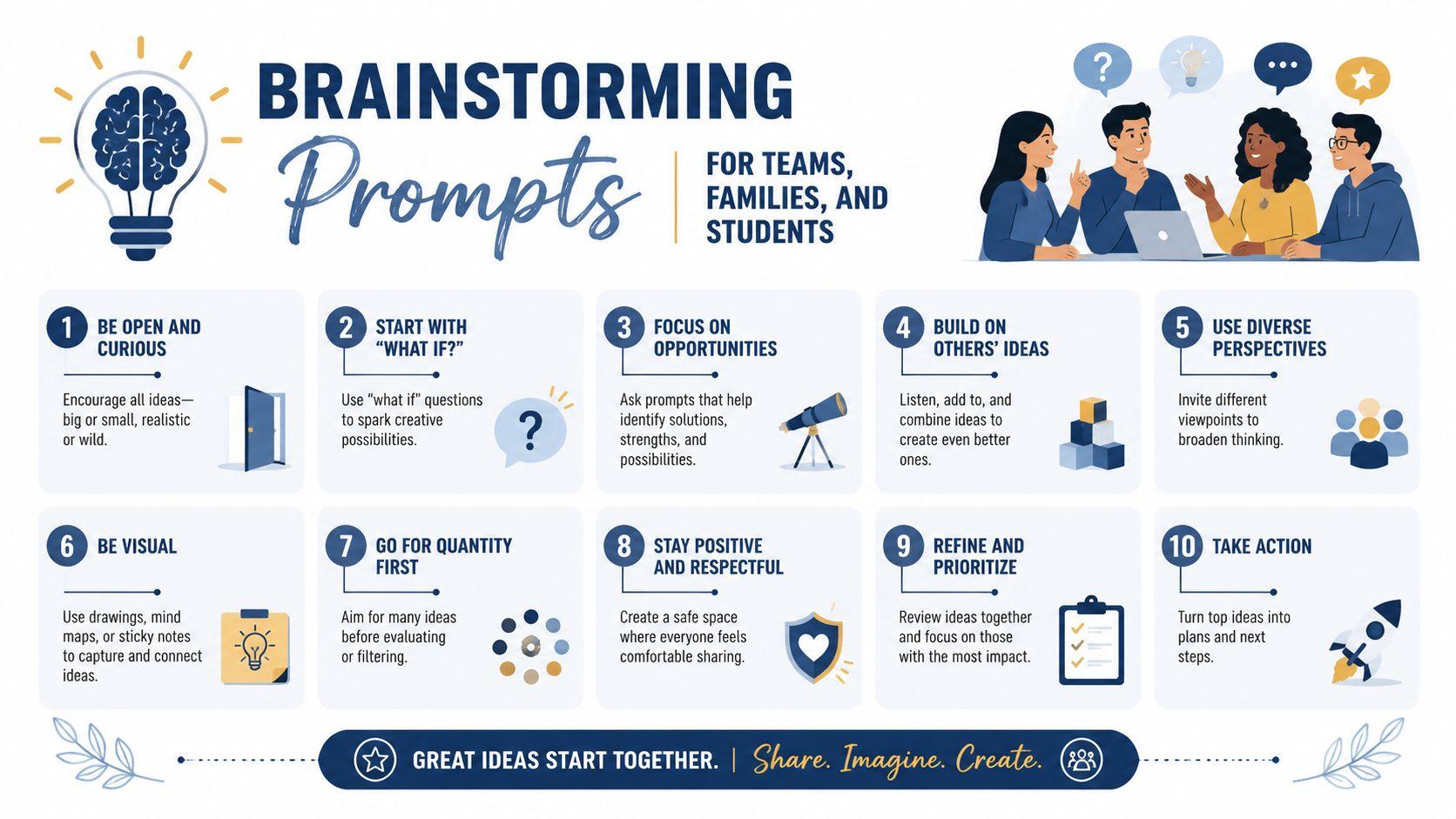
For teams and small businesses
A small business usually doesn't need more ideas. It needs ideas that can survive reality. That's where SCAMPER helps. The prompts force variation without making the session feel academic.
Use questions like these:
- Substitute: What part of the service could we replace with something simpler?
- Combine: Could we merge two customer steps into one?
- Adapt: What process from another industry would work here?
- Modify: What would this look like if we made it faster, smaller, or more personal?
- Put to another use: Is there something we already do that could solve a different customer problem?
- Eliminate: What step adds effort but not value?
- Reverse: What if we did the sequence backward?
A useful group format here is the Nominal Group Technique. It follows a strict sequence: problem identification, silent idea generation for 10 to 15 minutes, round-robin sharing, clarification, and voting or prioritization. That structure is effective at reducing bias (advanced brainstorming techniques).
For families
Family brainstorming works best when it feels light but still has boundaries. Otherwise, it turns into one person making suggestions and everyone else vetoing them.
Try a weekend-planning prompt set like this:
- What's one low-cost outing we haven't tried?
- What would make Saturday easier for everyone, not just more full?
- If this trip had a theme, what would it be?
- What could the kids help plan themselves?
- What's one version of “fun” that doesn't leave everyone tired afterward?
If the group includes younger kids, ask for drawings before discussion. Adults tend to dominate verbal sessions. Pictures level the field.
For students
Students often freeze because the assignment feels too big. Starbursting is a strong fix. Put the topic in the center and ask Who, What, Where, When, Why, and How around it.
For example, a student with “climate change” as a topic could ask:
- Who is most affected in my local area?
- What specific issue can I explain clearly?
- Where can I find examples I understand?
- When did this become a major policy issue?
- Why does this matter to people my age?
- How could I present it in a way that isn't generic?
That question-first approach makes the project smaller and smarter at the same time.
Good prompts don't just create more ideas. They create better angles.
Select and Refine Your Best Ideas
A brainstorm isn't finished when the wall is full.
Most sessions fail after idea generation. That's the neglected part. Small teams and families often see 60 to 70% of generated ideas discarded without a structured decision framework, which creates analysis paralysis and wasted effort (Atlassian's brainstorming techniques overview).
Reduce the pile before you debate it
Don't evaluate a long list one idea at a time. First, cluster similar ideas. Remove duplicates. Merge ideas that belong together. Rewrite vague entries so people are judging the same thing.
Then use one of these filters:
Dot voting for quick group alignment
Give each person a limited number of votes. Ask them to place votes on the ideas they believe are both useful and realistic. This works well when the group needs speed and broad buy-in.
Effort versus impact matrix
Put ideas into four zones:
| Category | What it means |
| High impact, low effort | Do these first |
| High impact, high effort | Worth planning carefully |
| Low impact, low effort | Nice extras, not priorities |
| Low impact, high effort | Usually not worth it |
During brainstorming, many charming ideas die, and that's healthy. Brainstorming should create options. It shouldn't force you to keep all of them.
Ask refinement questions, not just preference questions
“Which idea do we like?” is a weak closing question.
Ask better ones:
- Which idea solves the actual problem we defined?
- Which one can we test quickly?
- What would make this fail in practice?
- What assumptions need checking before we commit?
- Who owns the next step?
The goal isn't to defend the cleverest idea. The goal is to choose the one your group can actually move forward with.
When people resist narrowing the list, remind them that discarded ideas aren't wasted. They go into a backlog, not a graveyard. That simple distinction helps groups make cleaner decisions.
A good brainstorm ends with three things: one or two selected ideas, a reason they were chosen, and a concrete next action.
If you want a privacy-first place to explore ideas, compare outputs from multiple models, or brainstorm with your family or team without turning the article into a sales pitch, try 1chat.