You're probably here because you need to say something hard, and you don't want to say it badly.
Maybe a team member keeps missing the handoff details. Maybe your strongest employee gets results but leaves people bruised in meetings. Maybe your teenager hears any correction as a personal attack. The details change, but the knot in your stomach is the same. You want to be honest without being harsh, clear without sounding cold, and useful without turning the whole exchange into a lecture.
That tension is normal. They don't avoid feedback because they're weak managers, bad parents, or poor communicators. They avoid it because they care about the relationship, and they know a clumsy conversation can do damage.
The good news is that how to give constructive feedback is a skill. It isn't magic, and it isn't reserved for people who love confrontation. It's a learnable way of speaking to people that respects both truth and dignity.
Why Mastering Constructive Feedback Is a Superpower
The people who handle feedback well usually aren't the loudest or toughest people in the room. They're the ones who can say, “This needs to change,” without making the other person feel small. That's rare. It's also valuable in every setting that depends on trust.
At work, feedback shapes performance, engagement, and accountability. At home, it shapes confidence, resilience, and closeness. In both places, silence has a cost. If you don't address a pattern early, you usually end up paying for it later in resentment, confusion, repeated mistakes, or a blow-up that feels bigger than the original issue.
Why timely feedback matters so much
The strongest case for constructive feedback is simple. People need useful information close to the moment when they can still act on it.
According to Gallup's 2026 workplace research on meaningful feedback and engagement, 80% of employees who received meaningful feedback in the past week are fully engaged, whether they work remotely, hybrid, or in person. That finding matters because it connects feedback to something leaders care about every day: whether people are switched on, invested, and willing to bring energy to the work.
That same Gallup research argues for feedback that is frequent and immediate, not saved up for the annual review. That matches what many managers learn the hard way. Delayed feedback often turns into archaeology. You're digging through old moments, trying to reconstruct intent, while the person on the other side wonders why you waited so long.
Practical rule: If feedback has an expiration date, give it before it spoils.
What feedback is really doing
Constructive feedback isn't just correction. It does three jobs at once:
- It clarifies expectations. People can't improve against standards they can't see.
- It protects relationships. Honest, respectful conversations create more trust than polite avoidance.
- It accelerates growth. Specific guidance helps people repeat what works and change what doesn't.
This is why I think of feedback as a superpower, not a management chore. Used badly, it wounds. Used well, it helps people feel seen and stretched at the same time.
And if you've ever been on the receiving end of vague praise like “good job” or fuzzy criticism like “be more proactive,” you already know the difference. One leaves you guessing. The other gives you something solid to work with.
How to Prepare for a Constructive Feedback Conversation
Most feedback conversations are won or lost before they start. Preparation matters because nervous people ramble, frustrated people exaggerate, and rushed people say things they can't unsay.
Good preparation doesn't make the conversation stiff. It makes it cleaner.
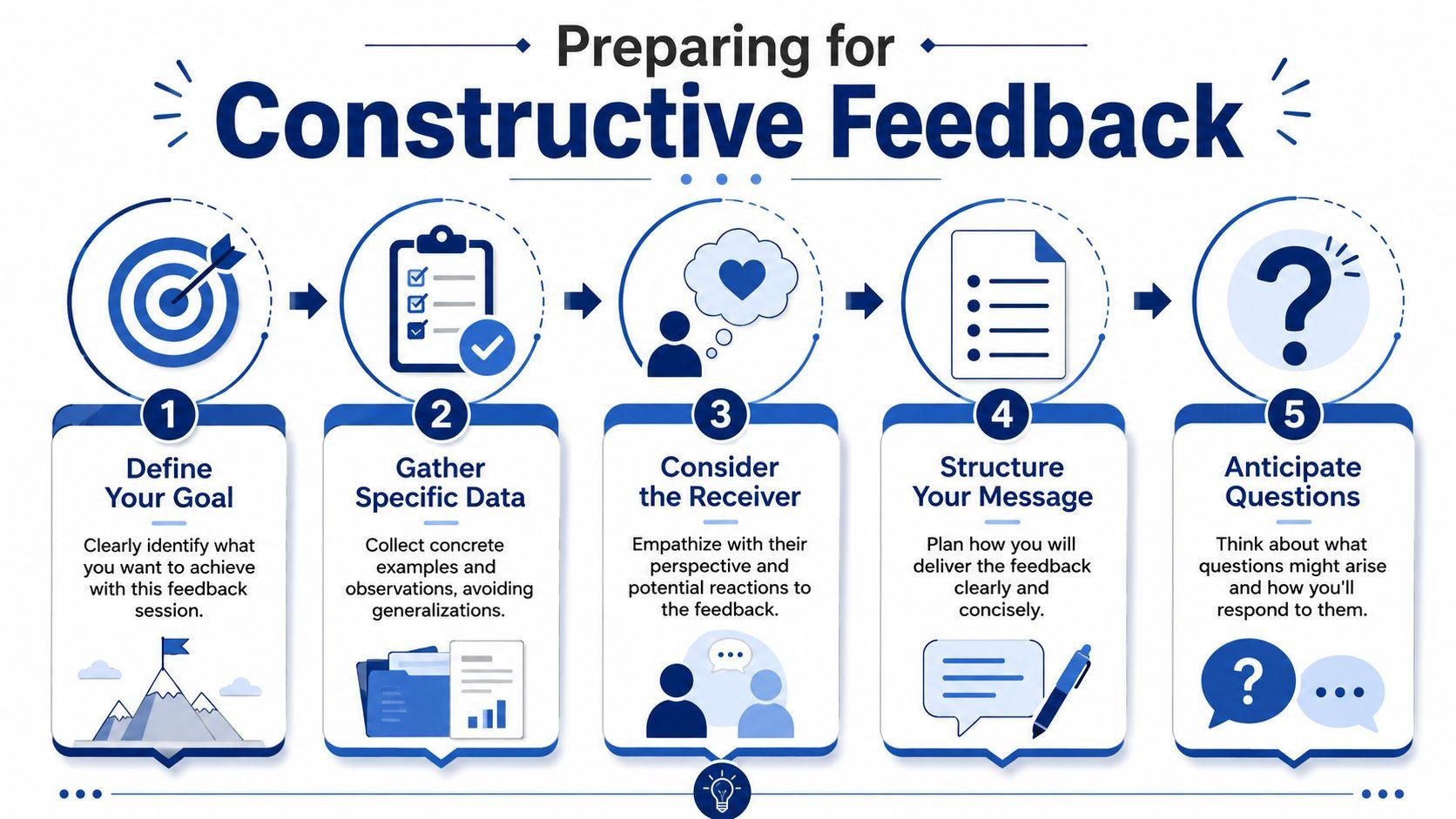
Start with your intent
Before you open your mouth, ask yourself one blunt question: Am I trying to help this person improve, or am I trying to relieve my own frustration?
If your real goal is to vent, wait. Feedback given in that state usually comes out as accusation dressed up as honesty. The other person hears your heat more than your message.
A better internal script is short:
- What needs to change
- Why it matters
- What outcome I want next time
That shift keeps you from turning the conversation into a character judgment.
Gather facts you can actually describe
Strong feedback uses observable details. Weak feedback relies on labels.
Instead of “You've been careless lately,” collect the moments you can point to. Which meeting? Which deadline? Which email? What did the person do or say that another reasonable observer could also notice?
Here's the test I use: Could a camera or meeting transcript capture it? If yes, you're probably in useful territory. If not, you may still be in interpretation.
A few examples:
| Unhelpful phrasing | Better phrasing |
| “You're disrespectful.” | “In Thursday's meeting, you interrupted Maya twice before she finished her update.” |
| “You don't care about details.” | “The client deck went out with the old pricing slide still included.” |
| “You're checked out.” | “You missed the last two project check-ins and didn't post an update in the shared channel.” |
Use the SBI model to organize your message
One of the most practical frameworks for how to give constructive feedback is SBI, which stands for Situation, Behavior, Impact.
The SBI model explanation from monday.com describes it as a way to separate facts from judgment, and notes that leaders who use SBI report a 30% higher success rate in behavior modification than vague feedback approaches.
Here's how it works:
- Situation
Name when and where the issue happened. Keep it specific. - Behavior
Describe what the person did. Stick to what you observed, not what you assume they meant. - Impact
Explain the effect on results, trust, workload, culture, or other people.
Example:
“In Monday's client call, when you answered before Jordan finished explaining the timeline, the client looked confused and Jordan stopped contributing. It made the team seem misaligned.”
That's clearer than “You need to be less controlling.”
Plan for the other person, not just your lines
Preparation isn't only about your words. It's also about the receiver.
Think through what this person is likely to need. Some people need directness with no fluff. Some need a slower pace. Some need time to process and come back with questions. If the issue is sensitive, choose privacy over convenience. Don't “quickly mention” hard feedback in a hallway, Slack thread, or family dinner rush.
Good feedback respects timing without hiding behind it.
If you want a private channel to think through wording before a difficult conversation, a secure place to draft and refine your message can help. That's one reason some people use tools like 1chat contact support when they want help with communication workflows without turning private situations into public ones.
Anticipate questions before they arrive
The best final prep step is to ask: what will they push back on?
You don't need a debate brief. You need calm answers to predictable questions:
- “Can you give me an example?”
- “Was this a one-time issue?”
- “What would better look like?”
- “What do you want me to do differently next time?”
If you can answer those cleanly, you're ready.
The Art of Delivering Feedback That Inspires Change
Delivery is where many good intentions fall apart. People either talk too softly and obscure the point, or they talk too bluntly and trigger defensiveness. The sweet spot is direct, calm, and collaborative.
This part matters because feedback is not a speech. It's a conversation with a purpose.
Open the conversation in a way that lowers resistance
The first minute sets the temperature. If you come in hot, people brace. If you come in vague, people get suspicious.
A simple opener works well:
“Is now a good time to talk about something I noticed in yesterday's meeting? My goal is to help us make the next one go better.”
That opening does two useful things. It asks for permission, and it states intent upfront. Both make the conversation feel less like an ambush.
If you lead managers, it's worth sharpening this part of your communication toolkit. I've found this guide to manager communication excellence useful because it focuses on message clarity, tone, and consistency instead of generic advice about “being a better communicator.”
Balance correction with genuine reinforcement
Constructive feedback should not feel like a relationship that only activates when something is wrong. People are more open to hearing a hard truth when they know you regularly notice what's working too.
According to WeThrive's write-up on effective feedback strategies at work, experts recommend a 5:1 ratio of positive to negative feedback so people feel valued and motivated. That doesn't mean coating every difficult message in sugar. It means the broader pattern of your leadership or parenting shouldn't be mostly corrective.
There's a big difference between these two realities:
- A person who occasionally receives developmental feedback in the middle of many honest affirmations
- A person who only hears from you when they've disappointed you
The first person usually listens. The second person usually defends.
Say the hard thing early, then invite response
Once you open, don't circle the airport. Land the message.
Use your SBI statement, then pause. After that, ask a real question.
For example:
- “What's your read on that?”
- “How did that moment feel from your side?”
- “What do you think got in the way?”
- “What would help you handle that differently next time?”
Many people miss the mark. They deliver a polished monologue and call it feedback. But monologues don't create ownership. Dialogue does.
“I want to understand your perspective before we decide what needs to change.”
That sentence has saved a lot of conversations.
End with one clear next step
Don't finish with “So, yeah, just be better about that.” That leaves the person embarrassed and directionless.
Finish with a concrete agreement. Not ten improvements. One or two.
Examples:
- In meetings, wait until the speaker finishes before challenging the point.
- If a deadline may slip, raise the risk earlier instead of on the due date.
- In family conversations, lower your voice and ask for a pause instead of walking away mid-sentence.
If the person leaves knowing exactly what to do next, the feedback has a chance to turn into change.
Common Feedback Mistakes That Undermine Your Message
Some feedback fails because the content is wrong. Most feedback fails because the delivery makes the content hard to hear.
The painful part is that many of these mistakes are common because they feel polite or safe in the moment. They aren't.
The feedback sandwich problem
A lot of people were taught to soften criticism by placing it between two compliments. The idea sounds kind. In practice, it often creates mistrust.
The Center for Creative Leadership article on different types of feedback notes that 40% of recipients perceive “sandwiching” negative feedback as manipulative and less credible, with a 25% drop in actionable trust. That tracks with what many people report. Once someone has been “sandwiched” a few times, they stop hearing the praise and start waiting for the hit.
The better alternative is cleaner separation. Praise good work when it happens. Deliver developmental feedback directly when it's needed. Don't disguise one as the wrapper for the other.
Vague language creates more work, not less
People often use fuzzy wording because it feels gentler.
It isn't gentler. It's confusing.
Compare these:
| Weak feedback | Useful feedback |
| “Be more strategic.” | “Before the next client call, send the team a short summary of your recommendation and the trade-offs behind it.” |
| “You need better communication.” | “When plans change, update the shared channel the same day so no one is working from an old version.” |
| “Try to be less negative.” | “In team meetings, raise the risk and also name one path forward so people know what to do with your concern.” |
Specificity is a form of respect. It gives the other person a fair shot at improving.
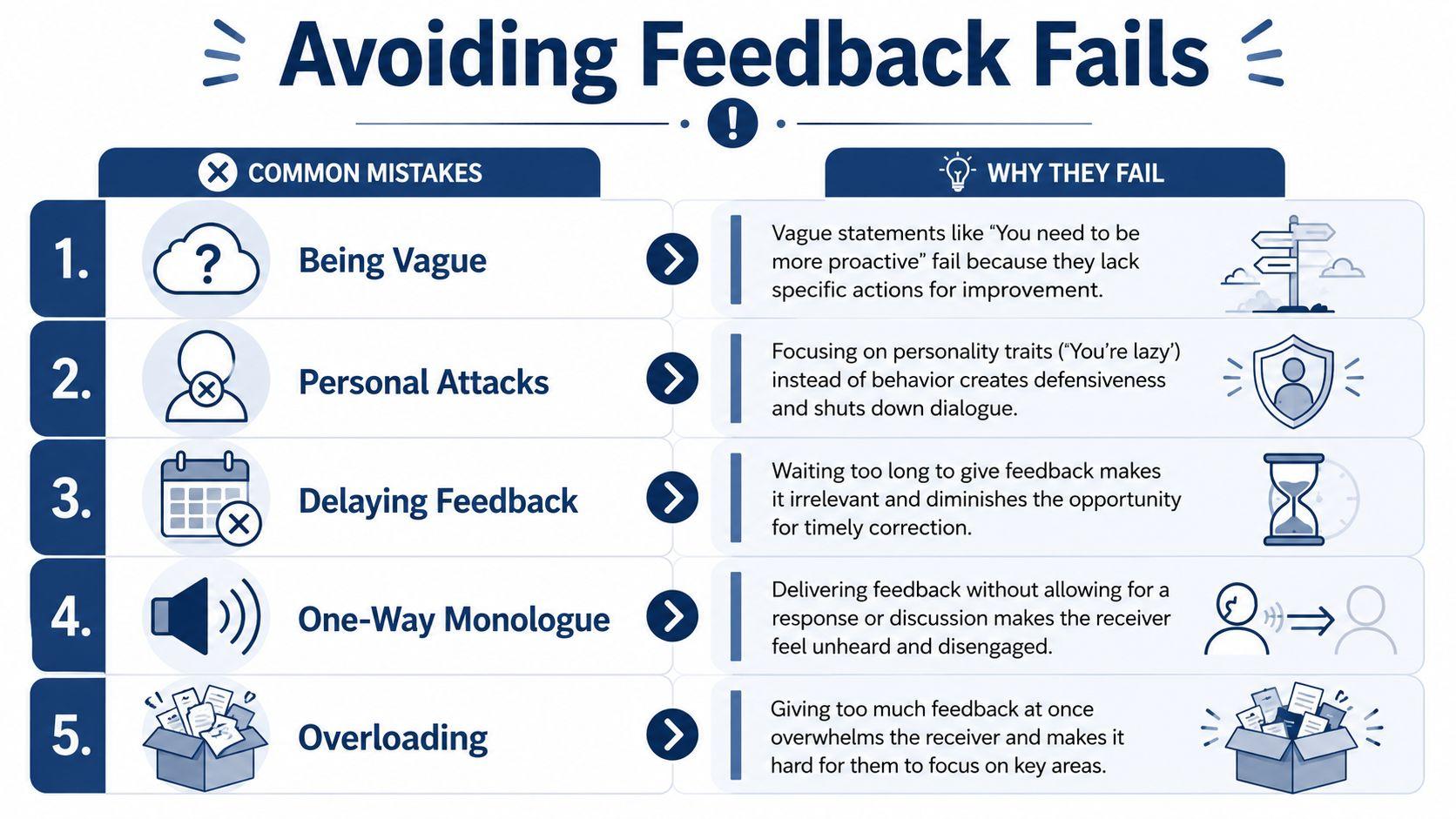
The five mistakes I see most often
- Making it personal
Say “When you interrupted twice in the meeting,” not “You're rude.” - Saving it up
Delayed feedback often sounds like a file you've been building against someone. - Talking too much
If you speak for seven straight minutes, the other person is managing emotion, not absorbing content. - Listing everything at once
Overloading people makes all the points blur together. - Ignoring the emotional impact
You don't have to babysit feelings, but you do need to notice when the person is flooded and no longer listening.
When people feel judged, they argue about fairness. When they feel guided, they think about change.
That's the line to watch. If your message triggers a courtroom defense, your framing probably needs work.
How to Adapt Your Feedback for Different Scenarios
The core principles stay the same, but the delivery should change with the setting. Feedback over Zoom isn't the same as feedback in a private office. Feedback to a gifted but prickly employee isn't the same as feedback to a new hire or a child who's already discouraged.
In such cases, rigid scripts break down. You need judgment.
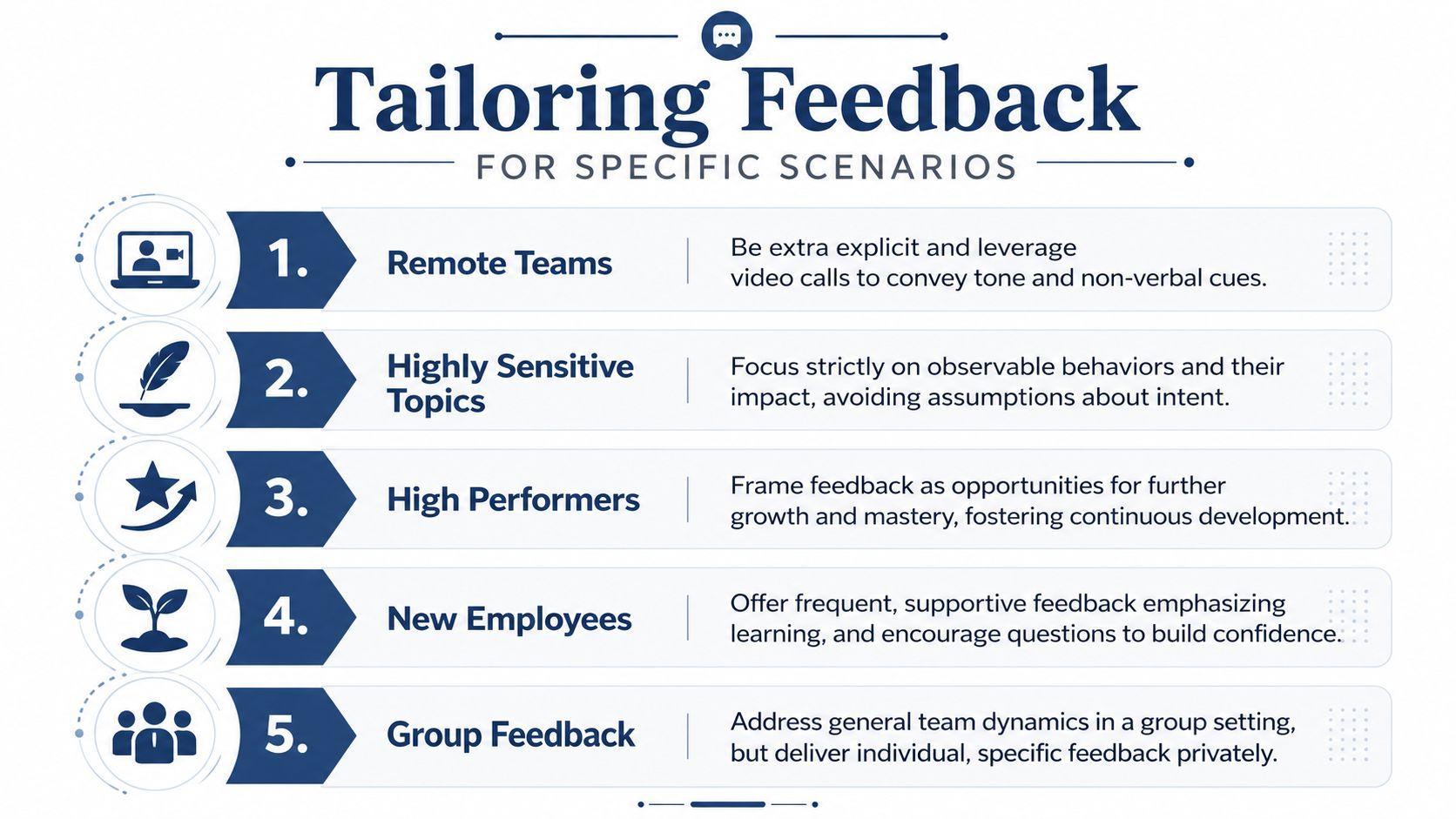
Remote feedback needs more structure
When you can't rely on tone, posture, or facial cues, even neutral words can land badly. In remote settings, I'd avoid giving nuanced corrective feedback in chat unless the issue is minor and unambiguous. Use video or voice if you can.
A practical remote script looks like this:
- Ask permission
“Do you have a few minutes to talk through something from today's call?” - State intent
“My goal is to help the next one go more smoothly, not to pile on.” - Give one specific example
“When the budget question came up, you answered before the implementation piece was clarified.” - Make a clear request
“Next time, pause and let the owner of that section finish before you add detail.” - Invite response
“How did that moment look from your side?”
That extra structure matters more online because people can't fill in your meaning as easily.
High performers need a different entry point
Some of the hardest feedback conversations involve people who deliver results and know it. They often have strong self-belief, high standards, and very little patience for being corrected. If you mishandle the opening, they'll hear the whole conversation as an attack on their identity.
The Rollins College resource discussing feedback challenges for high performers cites a 2024 Harvard Business Review study finding that 38% of high performers interpret feedback as a threat to their identity, while only 12% of organizations have customized protocols for this group.
That explains why generic advice often fails here.
What works better:
- Lead with respect for their strengths
Not flattery. Accurate acknowledgment. - Frame the issue as the next level of mastery
“This is about scaling your impact,” lands better than “You need to fix your attitude.” - Use permission-first language
“Can I offer an observation that may help you be even more effective with the team?” - Focus on consequences, not personality
Keep pointing back to team trust, execution, and influence.
If you manage a team and want to standardize thoughtful communication practices, shared tools and prompts can help. Some teams build that kind of repeatable workflow into platforms like 1chat pricing options for teams and small businesses, especially when they want structured support without overcomplicating the process.
Different audiences need different emphasis
Here's a simple way to adjust your approach:
- With new employees
Be frequent, concrete, and reassuring. They usually need clarity more than intensity. - With peers
Use mutual language. “Can we look at what happened in that handoff?” works better than sounding managerial. - With children or teens
Keep it shorter. One point, one example, one next step. Long lectures usually create shutdown, not insight. - With a group
Address team norms in public, but save individual correction for private conversations.
The goal isn't to become a different person in every setting. It's to make your feedback easier to receive in the reality the other person is in.
Turning Feedback into a Lasting Growth Culture
One good feedback conversation helps. A culture of good feedback changes people.
That's true in companies, families, classrooms, and teams. When people know that correction will be fair, specific, and respectful, they stop treating feedback as a threat and start treating it as part of how things get better around here.

Follow-up is where trust is built
A lot of leaders think the hard part is saying the thing. Often the harder part is returning later and showing that the conversation was meant to help, not just correct.
Follow-up can be simple:
- “How do you think that's been going since we talked?”
- “I noticed you handled that differently today.”
- “What support would make this easier?”
- “What are you still unsure about?”
Those check-ins matter because they prove the conversation wasn't a one-time verdict. It was an investment.
This matters even more in distributed teams. The FeedLearning article discussing remote feedback challenges cites recent McKinsey data saying remote feedback recipients are 3.2x more likely to perceive neutral statements as harsh because contextual cues are missing, while only 15% of corporate feedback training includes virtual-specific protocols. If you lead remotely, you can't assume your intent is obvious. You have to reinforce it through follow-up, clarity, and consistency.
Model the behavior you want around you
If you want a growth culture, ask for feedback yourself.
Not performatively. Sincerely.
Try questions like:
- “What's one thing I could do that would make working with me easier?”
- “Where am I creating confusion?”
- “What should I keep doing?”
- “What should I change next time?”
When leaders or parents can receive feedback without getting defensive, everyone else learns that growth is safe.
The fastest way to make feedback normal is to stop acting like only other people need it.
If you're building a healthier feedback system, it helps to think beyond the conversation itself and improve how you gather input across the team. This overview of essential feedback collection methods is useful for that wider view.
And if you want more practical communication and productivity ideas in one place, you can browse the 1chat blog for teams, families, and students.
Constructive feedback works when people can feel two things at once: you're telling the truth, and you're still on their side.
That balance takes practice. You won't nail every conversation. I certainly haven't. But if you prepare well, speak plainly, stay specific, and follow up with care, your feedback will stop sounding like criticism and start functioning like guidance.
That's the primary goal. Not winning the conversation. Helping the person grow after it.