You're probably here because the blank page is winning.
The assignment is open in one tab. Your notes are scattered across another. The prompt looks simple until you read it a second time and realize you're not sure what your teacher wants. So you type a sentence, delete it, try a dramatic hook, delete that too, and start wondering whether you even know how to start an analytical essay at all.
That feeling is normal. I've seen it in writing centers, classrooms, and late-night draft reviews. Most students don't get stuck because they're bad writers. They get stuck because they try to write too early. They reach for a thesis before they know what question they're answering.
Starting an analytical essay is less like waiting for inspiration and more like building a house. You don't begin by hanging curtains. You begin by reading the blueprint, checking the ground, and deciding what the structure is meant to hold.
The Hardest Part Is Just Getting Started
A student sits down to write about a novel, an article, or a historical event. The deadline is close enough to feel stressful. The prompt seems familiar enough to be deceptive. So the student does what many students do. They try to write an opening line before they've decided what they think.
That usually leads to one of two drafts. The first is a summary wearing a suit and pretending to be analysis. The second is a vague claim that sounds academic but doesn't really say anything. Both feel frustrating because they were built in the wrong order.
If you're working through literature assignments, especially exam-style questions, it can help to see how close reading and argument-building work in a subject-specific setting. Resources for UK A Level English Literature exam prep can be useful because they show how strong analysis grows from the wording of the question, not from a memorized template.
Here's the encouraging truth. You do not need a brilliant first sentence to begin. You need a sequence.
Practical rule: When you feel stuck, stop trying to sound smart and start trying to answer one smaller question at a time.
A workable start often looks like this:
- Read the prompt like instructions: Don't skim it. Circle the task words.
- Find the pressure point: Ask where the text, topic, or evidence becomes interesting or unstable.
- Turn that pressure point into a question: Good analysis answers a question, not just a topic.
- Write the thesis after that: Not before.
Students often want reassurance that they're “doing it right” before they draft. If you want a plain-language reference point for common writing and research questions, the 1chat FAQ guide can help you sort out practical uncertainties before you commit to a direction.
The page becomes less intimidating once you stop treating it like a test of talent. It's a process. And processes are learnable.
First Become a Detective Not a Writer
The first job is not drafting. The first job is decoding.
Marymount University's writing guidance stresses that the foundational first step is reading the assignment prompt carefully enough to distinguish among academic verbs such as consider, explain, and evaluate, because students often produce rejected drafts when they misread the kind of analysis the prompt requires and slip into summary instead of evaluation (Marymount University writing guide).
That sounds simple, but it's where many essays stray.
Why one verb changes the whole essay
Look at these three prompts:
| Prompt verb | What it asks you to do | What goes wrong when students miss it |
| Explain | Clarify how or why something works | They jump too quickly into judgment |
| Evaluate | Judge value, strength, or effectiveness | They only describe what happened |
| Compare | Analyze meaningful similarities and differences | They write two separate summaries |
If the prompt says evaluate, your reader expects judgment. Not opinion without support, but a reasoned claim. If the prompt says explain, your reader expects clarity and cause. If the prompt says analyze, your reader expects you to break something apart and show how the parts create meaning.
A lot of students read the topic and ignore the verb. That's like getting furniture assembly instructions and only noticing the picture on the box.
How to mark up the prompt
Use a pen, highlighter, or comment tool and label three things:
- The task word
- Analyze
- Compare
- Evaluate
- Interpret
- The object
- The character
- The policy
- The speech
- The theme
- The limits
- In the opening chapter
- Using two sources
- From a historical perspective
- In relation to one central symbol
Here's a concrete example.
Prompt: Evaluate how the author uses setting to shape the reader's understanding of conflict.
A weak reading of the prompt produces: “This essay is about setting in the story.”
A stronger reading produces:
- Verb: evaluate
- Object: how setting shapes understanding of conflict
- Limit: reader's understanding, not just plot events
That changes everything. You're no longer listing settings. You're judging how effectively the setting influences the reader's view of conflict.
Don't ask, “What is this paper about?” Ask, “What mental action is this prompt demanding from me?”
If you're gathering notes and source material before drafting, a workspace that helps you organize findings can make this stage easier. A tool for research support and source review is useful when you need help sorting evidence without jumping into a full draft too soon.
A quick prompt-decoding routine
- Underline the verb first: It tells you the kind of thinking required.
- Box the main subject: That keeps you from drifting.
- Circle any limitations: Time period, chapters, methods, or source requirements matter.
- Rewrite the prompt in your own words: If you can't paraphrase it clearly, you probably don't understand it yet.
This stage can feel slow. That's fine. Slow here saves panic later.
Find the Tension That Creates Your Question
Most advice jumps from “read the prompt” straight to “write a thesis.” That leap is exactly where many students get lost.
Harvard's writing guidance explicitly emphasizes forming an analytical question by identifying points of tension within texts, rather than forcing a thesis too early. That missing step is one reason essays become summaries instead of arguments (Harvard guidance on asking analytical questions).
What tension means in plain language
A tension is the place where something doesn't sit neatly.
It might be a contradiction. A gap. A surprise. A pattern with an exception. A text that says one thing but seems to do another. That's where analysis begins, because that's where a real question lives.
For example:
- A speaker claims to value honesty, but uses evasive language.
- A novel praises freedom, but rewards conformity.
- A character seems powerful in public scenes and powerless in private ones.
- A policy promises fairness, but creates unequal effects.
Those are not thesis statements yet. They are pressure points.
Three reliable ways to find tension
Compare what the text says with what it does
A text may make one explicit claim while its imagery, structure, or tone suggests another.
Example:
A poem sounds calm on the surface, but its repeated interruptions create instability.
That gives you a question:
Why does the poem present calmness while structurally undermining it?
Look for patterns, then breaks in the pattern
Patterns matter. Breaks matter more.
If a character consistently avoids conflict but suddenly confronts someone directly, don't just note the change. Ask what caused it and what it reveals.
Notice what the author assumes but doesn't explain
Some of the richest analysis comes from unstated assumptions.
If an argument treats one value as obviously important, ask why. What worldview does that assumption reveal? What gets left out?
A useful test: If your “question” can be answered with a simple fact, it's probably too small. If it opens room for interpretation, you're getting closer.
From topic to question
Here's how the shift works in practice:
| Broad topic | Tension | Analytical question |
| Symbolism in a novel | A symbol changes meaning across scenes | Why does the symbol become less stable over time? |
| A political speech | Calls for unity while dividing audiences | How does the speech use inclusive language to create exclusion? |
| A film character | Appears confident but acts cautiously | How does the film construct confidence as performance? |
A broad topic gives you a room. Tension points to the crack in the wall. The question tells you where to investigate.
A short exercise that actually works
Take your text or source and finish these sentence stems:
- “At first, this seems to suggest... but...”
- “A repeated pattern is... yet one exception appears when...”
- “The author says... however, the language also implies...”
Then turn one of those into a question beginning with how or why.
That question becomes the engine of your essay. Without it, the draft often turns into a report. With it, you have something to prove.
Forge and Test Your Central Argument a Thesis
Once you have a real analytical question, writing the thesis gets easier. Not easy, always. But clearer.
A thesis is not the topic. It is not a fact. It is not a broad observation that everyone would nod at. A thesis is your answer to the analytical question, stated as a claim someone could challenge.
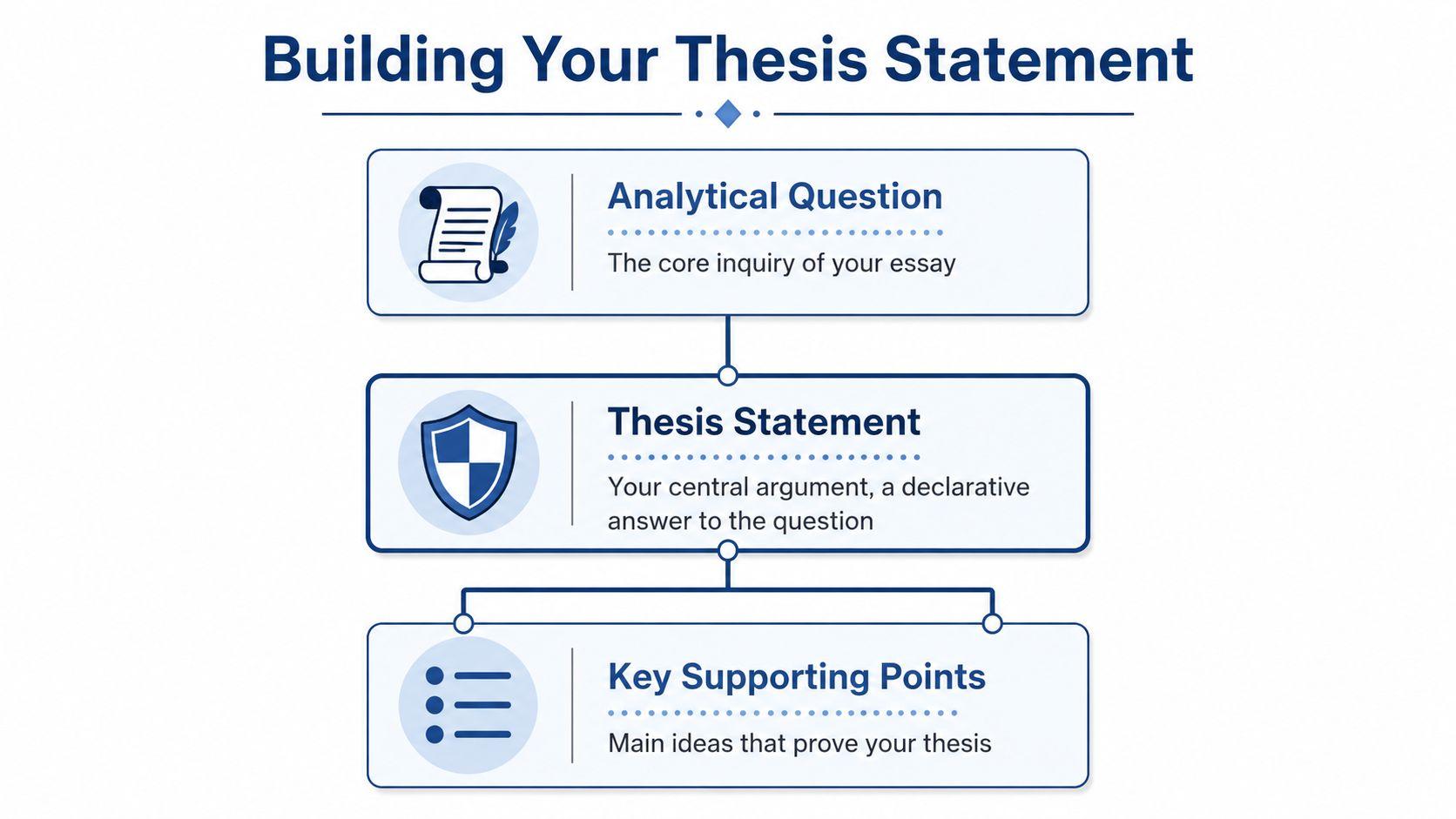
University of Toronto writing guidance recommends a defensibility assessment before drafting, which means actively identifying opposing viewpoints so the thesis becomes a defensible claim rather than a simple observation. The same guidance notes that plot summary accounts for over 60% of failed introductory drafts in some literary analysis courses (University of Toronto analytical essay guide).
What a thesis is and is not
Read these pairs closely.
| Weak version | Stronger version |
| The story uses setting in important ways. | The story uses confined settings to make conflict feel unavoidable rather than accidental. |
| The speaker uses emotional language. | The speaker uses emotional language to present anger as moral urgency, which pressures the audience to accept a simplified view of the issue. |
| The character changes over time. | The character's apparent growth is incomplete, because the novel replaces one form of dependence with another. |
The stronger examples make claims. They don't just point at features.
A simple formula
When students freeze, I often give them this frame:
In [text/topic], [main element] reveals or argues that [claim], which matters because [significance].
Example:
In Macbeth, the play's shifting treatment of prophecy suggests that ambition feeds on uncertainty, which matters because it turns fate into an excuse for human choice.
That works because it includes three things:
- the subject,
- the claim,
- the reason the claim matters.
Test the thesis before you trust it
Try this checklist before you draft body paragraphs:
- Could a reasonable person disagree? If not, it may be too obvious.
- Does it answer your analytical question directly? If not, it may be off-center.
- Can you imagine at least two or three supporting points? If not, it may be too thin.
- Does it avoid plot summary? If it only tells what happened, it's not ready.
Revision lens: A good thesis narrows the field. It tells you what evidence belongs and what doesn't.
Now do the defensibility test. Write a quick sentence that begins, “Some readers might argue...” Then answer it.
Example:
Some readers might argue that the character becomes fully independent by the ending. However, the final scene still frames that independence through approval from others.
That move does two jobs at once. It strengthens the thesis, and it helps generate body paragraphs.
Why this matters for the rest of the essay
An analytical essay's body paragraphs should not be random observations stacked together. Your main point in each paragraph should grow directly from the thesis. If the thesis is blurry, every paragraph after it tends to wobble.
That's why learning how to start an analytical essay really means learning how to build an argument before the introduction appears on the page.
Assemble Your Introduction Paragraph
By the time you reach the introduction, most of the difficult thinking should already be done.
That surprises students. They often assume the introduction comes first because it appears first. But in practice, the introduction works best when you already know your question, your tension, and your claim.
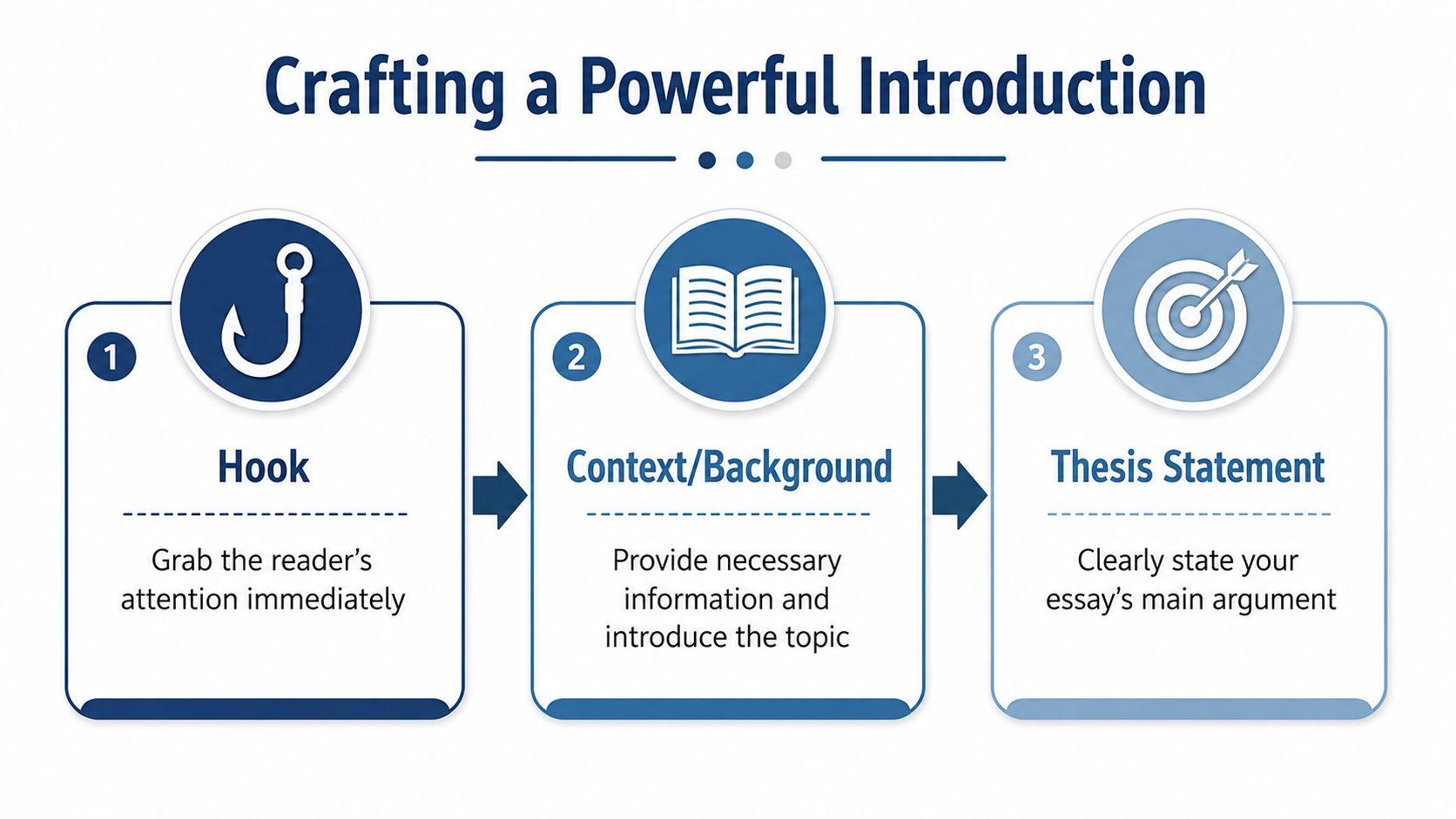
Cornell's writing advice pushes against generic hook-writing and instead encourages writers to complicate the point early by introducing contrast, limitation, or tension in the opening paragraph, so the stakes of the analysis appear immediately (Cornell writing guidance on deeper analysis).
Skip the generic hook
Many weak introductions begin like this:
- “Since the dawn of time...”
- “The dictionary defines...”
- “Have you ever wondered...”
These openings are usually disconnected from the actual argument. They sound like an introduction, but they don't do introductory work.
A better opening begins near the problem.
Compare these:
Generic opening
Power and ambition are common themes in literature.
Argument-driven opening
Although Macbeth is often read as a play about ambition, its most disturbing moments show ambition becoming persuasive only when uncertainty makes action feel justified.
The second version already contains tension. It gives the reader something to think about.
A reliable structure for the whole paragraph
You do not need a flashy opening. You need a functional one.
Try this three-part sequence:
- Start with the tension
- Add just enough context
- State the thesis clearly
Here's a model:
Although the novel presents its narrator as observant and reliable, several scenes expose major gaps between what he notices and what he understands. Those gaps matter because they shape how readers interpret the novel's central conflict. The narrator's selective attention turns apparent honesty into a limitation, revealing that the novel uses perspective not to clarify truth but to complicate it.
That introduction works because each sentence has a job.
How much context is enough
Students often overcorrect here. They either give no context or far too much.
Use this rule of thumb:
- Include what the reader needs to understand the claim
- Cut what belongs in the body paragraphs
- Avoid retelling the plot
If your introduction sounds like a book report, stop and trim.
Your introduction should point forward to an argument, not backward to a summary.
If you want to read more plain-language guidance on drafting, revising, and improving essay openings, the 1chat blog can be a useful supplementary resource.
A quick before-and-after
Before
In this essay I will analyze the theme of isolation in Frankenstein. Mary Shelley wrote this novel a long time ago, and it is still important today. There are many examples of isolation in the book.
After
In Frankenstein, isolation isn't just a condition the characters suffer. It becomes a habit they help create. By showing both Victor and the creature retreat from human connection in different ways, Shelley presents isolation as a destructive choice as much as a painful experience.
The second version sounds more confident because it makes a claim. It also gives the paper direction.
Final Check Avoid These Common Pitfalls
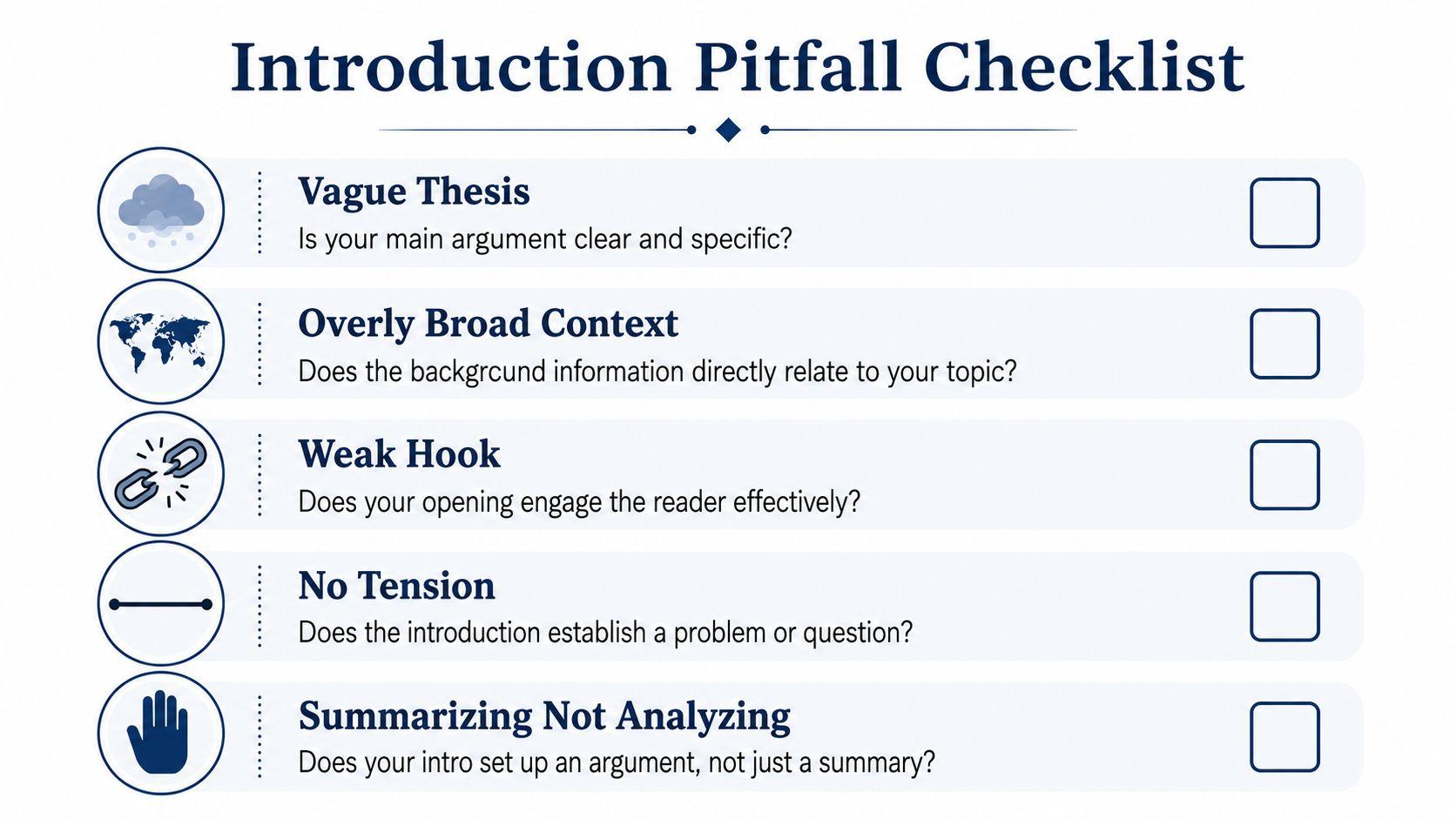
Before you move on to the body paragraphs, pause and test the introduction you have.
Academic guidance on analytical structure emphasizes that body paragraphs need a clear Point derived from the thesis. Without that pre-formed thesis, essays often become disconnected observations rather than sustained analysis (analytical essay structure guidance).
Ask yourself:
- Is my thesis arguable? Someone should be able to disagree with it.
- Did I identify a real tension? If not, the essay may collapse into summary.
- Does my introduction lead to analysis? Or does it mostly provide background?
- Can each body paragraph grow from the thesis? If not, the claim may be too vague.
- Is my wording my own? When you're using source material, mastering ethical rewriting skills helps you keep your draft clear and original without sliding into patchwork paraphrase.
A good start doesn't mean a perfect start. It means you've built a strong foundation. You decoded the prompt, found the tension, asked a real question, and shaped a thesis that can support the rest of the essay.
That's how analytical writing begins. Not with panic. Not with filler. With a clear problem and a defensible answer.
If you want help brainstorming a question, refining a thesis, or checking whether your introduction is moving toward analysis instead of summary, 1chat can help you review drafts, organize research, and talk through ideas in one place.