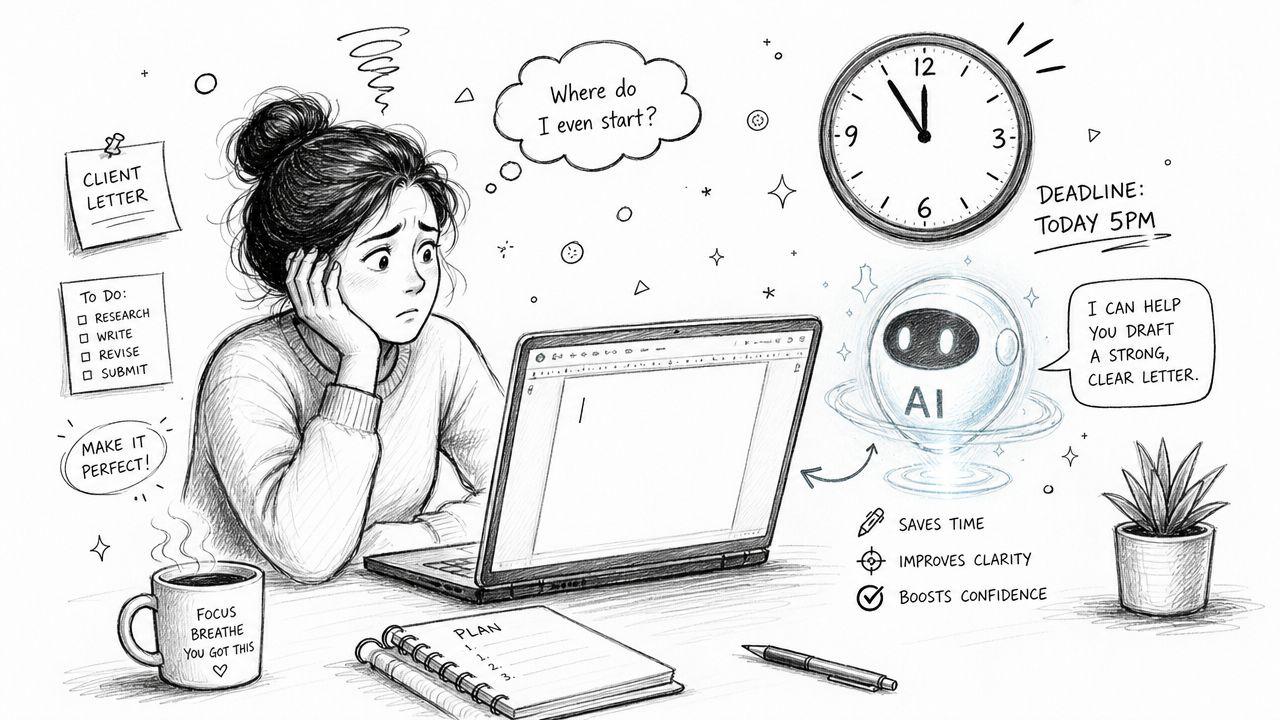
Someone asked you for a recommendation letter yesterday. The deadline is tomorrow. You know the candidate deserves a strong endorsement, but your calendar is already full, your inbox is loud, and starting from a blank page feels harder than it should.
That's the moment when a good AI letter of recommendation maker earns its place.
Used well, it can take your rough notes, old memories, and scattered details and turn them into a workable first draft fast. Used badly, it produces the kind of letter admissions committees and hiring managers forget within seconds. The difference isn't the tool. It's the workflow, the input, and the discipline to edit like the letter carries your name, because it does.
I've seen AI help with the hardest part of recommendation writing: getting started. I've also seen it flatten a vivid candidate into bland praise. The safest way to use it is simple. Let AI handle structure and momentum. Keep judgment, anecdotes, and final wording human.
Why Your Next Recommendation Letter Should Start with AI
The strongest case for using AI is practical. Recommendation letters rarely arrive when your schedule is open. They arrive during grading, hiring cycles, performance reviews, or end-of-quarter chaos. An AI letter of recommendation maker can give you a competent draft in minutes, which is often enough to get past the blank-page problem.
The letter still carries weight. According to FormPros guidance on recommendation letters, over 85% of hiring managers consider a well-drafted letter a critical part of candidate evaluation, and 68% of job seekers who secured competitive positions cited a strong letter as a decisive factor.
What AI does well first
AI is good at a few specific tasks:
- Breaking inertia: It gives you a beginning when your notes are incomplete.
- Organizing content: It usually produces a clean business-letter structure without much effort.
- Rephrasing repetitive language: If you've written ten letters this month, AI can help you avoid sounding like a template.
- Adapting tone: It can shift from academic to professional wording faster than typically achievable manually.
That's why I recommend starting with AI, not finishing with it.
Practical rule: Use AI for the first 60 percent of the job. The last 40 percent decides whether the letter sounds credible.
What AI should never do alone
AI shouldn't make claims you can't personally stand behind. It shouldn't invent context. It shouldn't decide what is ethically fair to say about a person's performance, character, or future promise.
If you treat it as a drafting partner, it helps. If you treat it as an autopilot system, it weakens the letter.
For readers who are exploring broader AI writing habits, the 1chat blog has useful discussions around practical business and writing workflows. The same principle applies here. Speed is valuable, but only when it preserves judgment.
Gathering Raw Materials for a Winning Letter
Most weak letters don't fail at grammar. They fail before drafting even starts. The writer sits down with a résumé, a vague memory, and a deadline. Then the letter turns into generic praise.
A good AI letter of recommendation maker only works when you feed it real material. Before opening any tool, collect a briefing packet from the applicant.
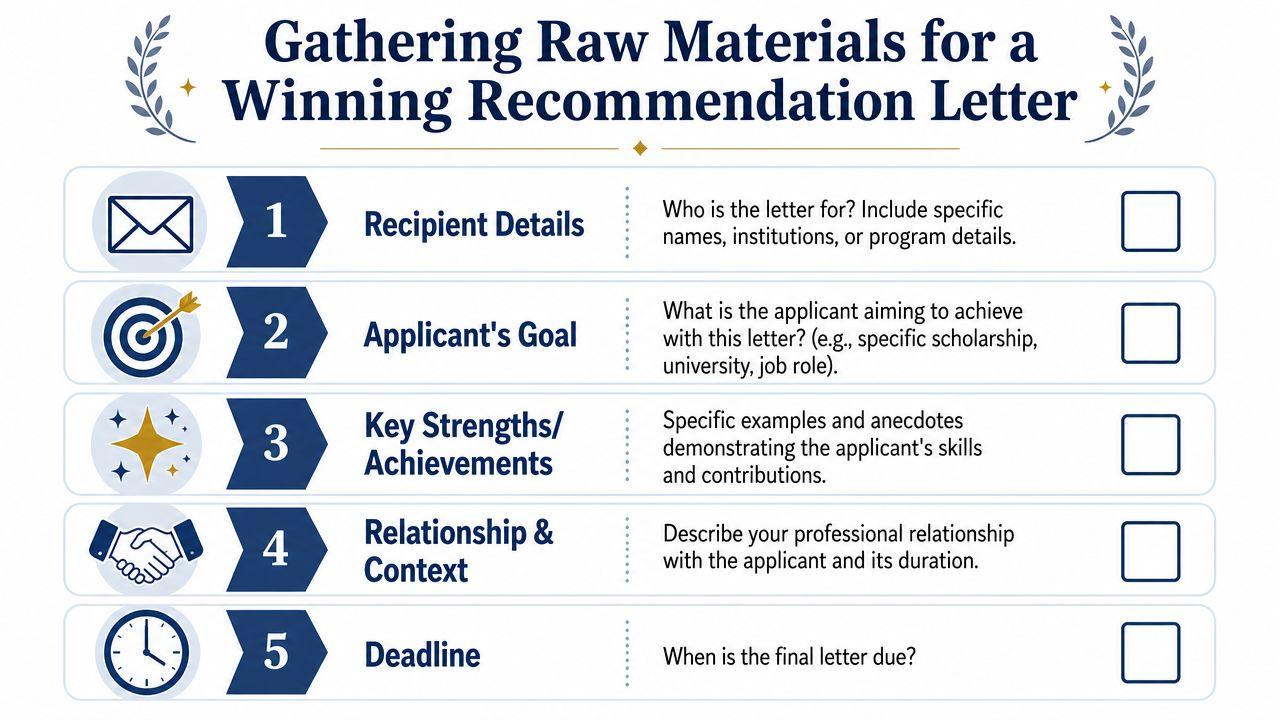
What to request before drafting
Ask for these items in one email so you don't spend three rounds chasing details:
- The target opportunity: Job posting, scholarship description, graduate program page, or fellowship criteria.
- A current résumé or CV: You need dates, titles, and scope.
- Three to five accomplishments: Not broad traits. Actual moments, projects, outcomes, or responsibilities.
- Two short anecdotes: These are often the strongest ingredients in the final letter.
- Your relationship context: How they know you, in what capacity, and for how long.
- The deadline and submission method: Portal, email, PDF upload, or institutional form.
This prep changes the entire quality of the draft. It also protects you from writing a letter that sounds positive but says nothing memorable.
Build a mini dossier, not a document dump
I tell applicants not to send everything they've ever done. I want a curated packet. The best submissions usually fit on a few pages and answer basic questions clearly:
| What you need | Why it matters |
| Role or program details | Helps tailor the letter to the audience |
| Key strengths | Gives the draft a clear focus |
| Evidence and stories | Prevents empty praise |
| Timeline of relationship | Anchors credibility |
| Deadline | Keeps the process realistic |
A recommendation letter gets stronger when the applicant helps you remember specific moments, not when they flood you with credentials.
If you also write public-facing endorsements, some of the same principles show up in RedactAI's tips for crafting LinkedIn recommendations. The audience differs, but the writing lesson holds. Specific examples beat broad adjectives every time.
What applicants often forget
Candidates usually remember achievements. They often forget context. Ask questions that surface behavior:
- What did you do when the project got difficult?
- How did you work with others?
- What would I have seen if I watched you in the room?
- What are you most proud of that isn't obvious from your résumé?
Those answers give you language no template can fake.
How to Prompt an AI Letter of Recommendation Maker
Prompting determines whether users effectively employ the tool or waste its potential. A weak prompt produces a polished nothing. A detailed prompt produces a draft you can readily work with.
According to QuillBot's recommendation letter guidance, optimal AI prompting for this task requires eight contextual elements, including the opportunity, the writer's relationship to the applicant, key strengths, and specific examples of achievement.
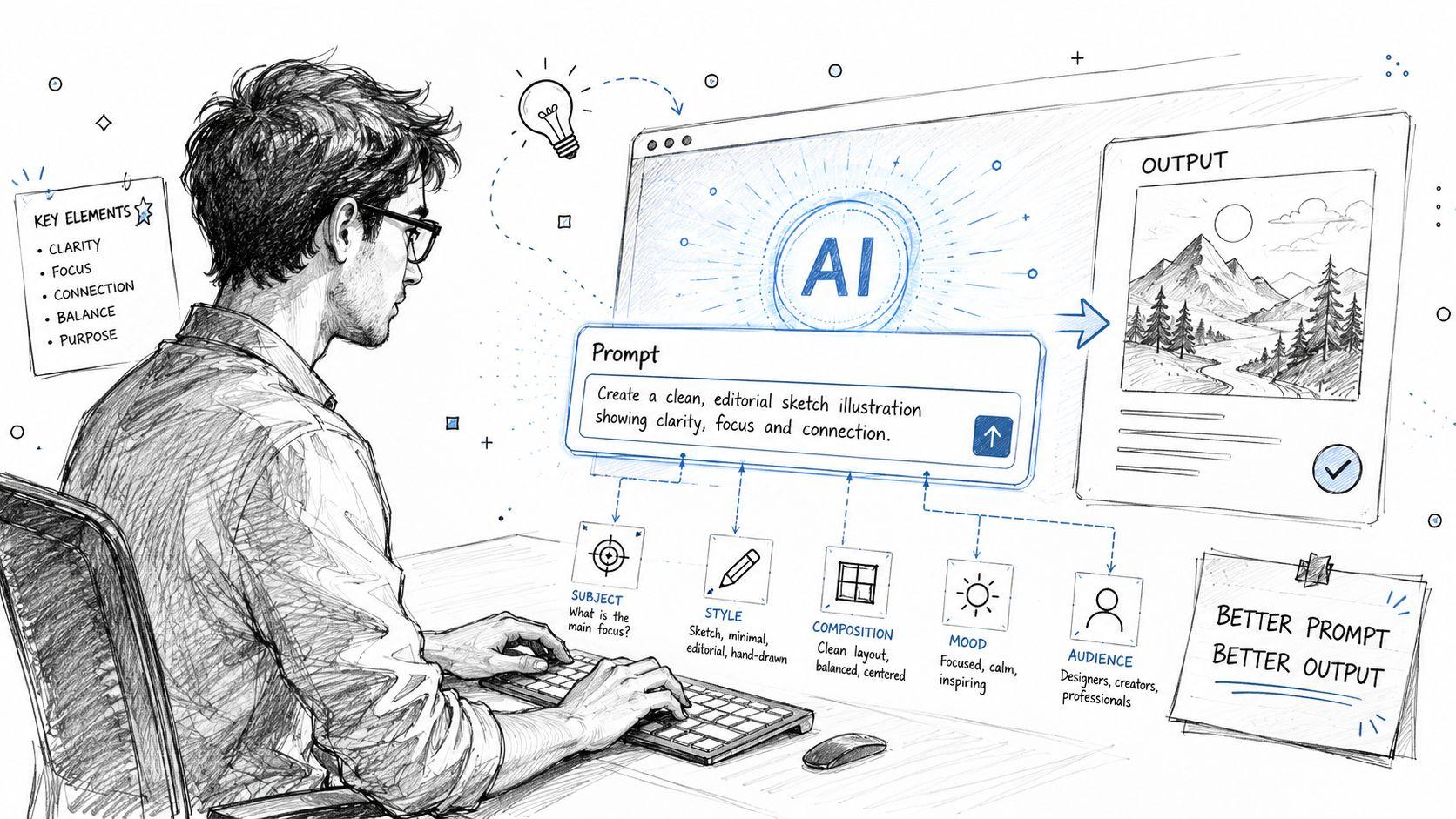
The eight elements that belong in your prompt
Here's the structure I use when prompting any letter of recommendation maker:
- The opportunity Include the role, program, scholarship, or institution. Paste the criteria if you have them.
- Your relationship to the applicant State whether you supervised, taught, mentored, or managed them.
- The duration of that relationship Duration affects credibility and tone.
- The applicant's key strengths Keep this short and concrete. Pick the strongest few.
- Specific examples of achievement Most prompts improve or collapse depending on this.
- What makes the person stand out Not “hardworking.” Something distinctive.
- The reason you recommend them Tie the endorsement to the target opportunity.
- Your confidence in their future success This shapes the closing paragraph and overall strength.
Use STAR inside the prompt
The most reliable way to add substance is the STAR method: Situation, Task, Action, Result. Instead of saying someone is “excellent under pressure,” give the model a structured incident.
For example:
- Situation: The team was behind on a client deliverable.
- Task: The applicant had to reorganize the workflow and present revised timelines.
- Action: They coordinated stakeholders, rewrote the project tracker, and handled communication calmly.
- Result: The team recovered credibility and delivered a cleaner handoff.
That kind of input gives the draft backbone.
Bad prompt versus good prompt
Here's the difference in practice.
Weak prompt
Write a strong recommendation letter for a former employee named Daniel. He is hardworking, smart, and a great team player. He is applying for a project management role.
This usually produces generic language, résumé summary, and praise without proof.
Stronger prompt
Write a professional recommendation letter for Daniel Ruiz, who is applying for a project management role at a healthcare software company. I supervised Daniel as Operations Manager for two years on a cross-functional implementation team. His strongest qualities are calm communication, follow-through, and stakeholder coordination. One example: during a delayed implementation for a high-priority client, Daniel took ownership of the revised rollout plan, organized a recovery meeting across sales, product, and support, clarified responsibilities, and kept the client updated without overpromising. He stands out because he brings order to messy projects and keeps people aligned under pressure. I'm recommending him because he has the judgment and reliability needed for complex client-facing work. Please write the letter in a warm but professional tone, include one detailed body paragraph, and avoid clichés.
That prompt gives the tool something to build from.
Prompting techniques that improve the draft
A few habits make a visible difference:
- Ask for restraint: Tell the model not to exaggerate or invent details.
- Specify tone: “Warm but credible” works better than “enthusiastic.”
- Set length: Request one page or one to two pages.
- Name what to avoid: Clichés, vague praise, résumé repetition.
- Request a business format: It reduces cleanup later.
People who work on adjacent job-search materials often notice the same pattern. The prompt quality determines whether the output sounds usable or synthetic. That's one reason I've found the examples in Resumatic's AI resume prompt insights helpful. The underlying lesson is the same across recommendation letters and résumés.
If you want to think more critically about prompt quality and model behavior, the research examples collected at 1chat research are useful for understanding how AI output changes when context improves.
Transforming AI Output into Your Authentic Voice
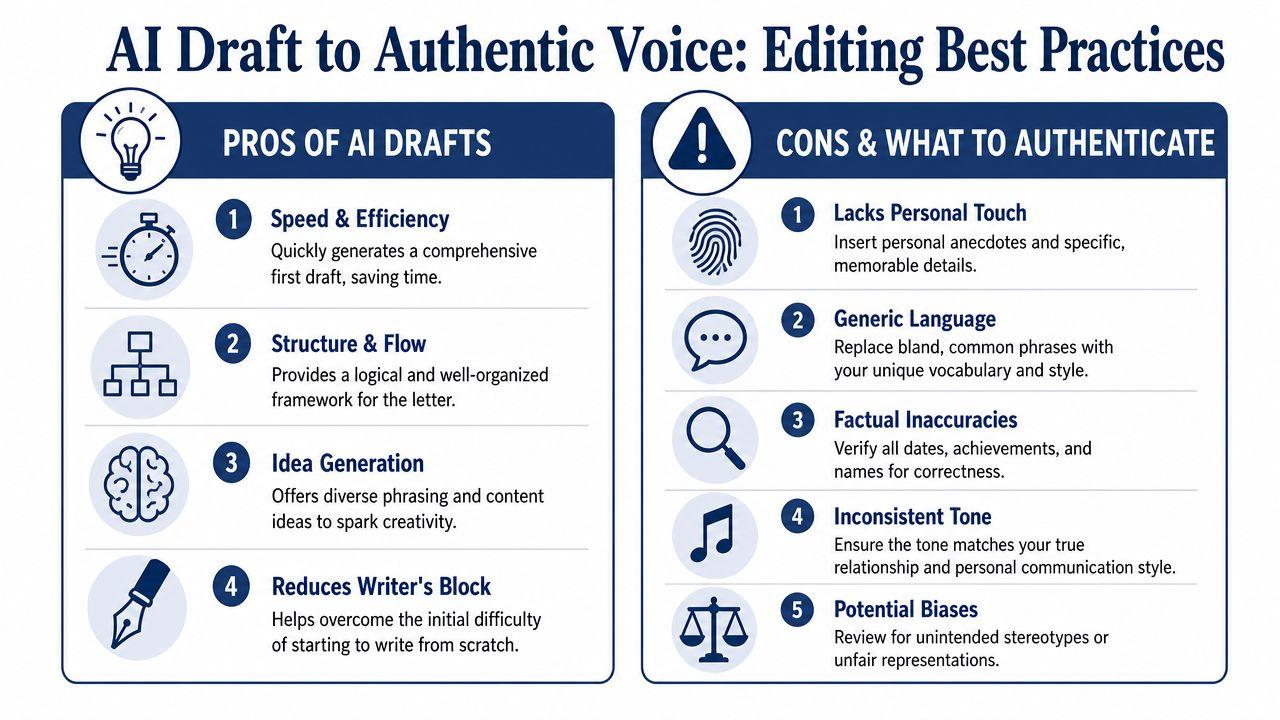
An AI draft can look polished and still feel hollow. That's the danger. The sentences are smooth, the paragraphs are balanced, and the endorsement sounds respectable. But the letter doesn't sound like anyone who knows the person.
That gap is not trivial. In a 2025 peer-reviewed study published in PMC, researchers analyzed 26 recommendation letters for 13 academic applicants and found that AI-generated letters were often professional and well structured, but lacked nuanced personal insights and specific anecdotes. Faculty reviewers gave them a 23% lower perceived credibility score than human-written letters.
The draft is not the letter
I've had AI produce openings that were perfectly competent and completely forgettable. For example:
“I am pleased to recommend Maya for admission. She is diligent, intelligent, and has demonstrated strong leadership abilities.”
Nothing there is wrong. Nothing there is alive, either.
What makes the letter persuasive is the sentence you add next:
“I first noticed Maya's judgment when a team presentation fell apart ten minutes before class, and she quietly reorganized the speaking order, reassured the most anxious student, and delivered the technical section without drawing attention to herself.”
That sentence doesn't just praise. It shows. It sounds like a real observer speaking from memory.
How to revise the draft so it sounds like you
When I edit an AI-generated recommendation, I look for five things:
- A line only I could write: Usually a classroom, project, or team moment.
- Natural phrasing: I replace polished-but-generic wording with language I'd use.
- Sharper claims: If the draft says “excellent communicator,” I add the context that proves it.
- Tone control: Some drafts oversell. Others sound oddly formal. Both need correction.
- Verification: Every date, title, role, and example gets checked.
Don't ask whether the draft is good. Ask whether a reader would believe you wrote it.
A practical editing pass
A simple way to humanize the draft is to edit in layers:
| Editing pass | What to change |
| First pass | Correct facts, names, dates, titles |
| Second pass | Add one anecdote and one distinctive strength |
| Third pass | Remove robotic phrasing and cliché praise |
| Final pass | Tighten tone, format, and closing confidence |
That middle pass matters most. It's where the letter stops sounding machine-assisted and starts sounding endorsed.
What authenticity looks like
Authenticity doesn't mean informal. It means grounded. It means your confidence sounds earned.
A hiring manager can tell the difference between “She is one of the most exceptional professionals I have ever known” and “I trusted her with the client conversations that required the most judgment.” The second line is narrower, but it carries more weight because it implies experience, discretion, and observation.
That's why I rarely send a recommendation letter without rewriting at least a few sentences from scratch. The AI draft gives me momentum. The final letter still has to sound like a professor, supervisor, or manager who is putting their reputation behind the recommendation.
Critical Mistakes That Weaken AI-Generated Letters
The most common mistake is also the easiest to miss. The draft sounds polished, so the writer assumes it's strong. Often it isn't.
According to Berkeley's guidance on recommendation letters, letters with memorable stories illustrating success are ranked 2.5x higher by admissions committees and hiring managers, while letters that repeat résumé points or lean on clichés are less persuasive.
Red flags to cut before you send
Read your draft once with a skeptical eye. If you spot any of these, revise aggressively.
- Résumé retelling: If the body lists roles, awards, or coursework, it adds little value.
- Evidence-free praise: “Highly motivated,” “outstanding,” and “excellent” don't persuade without an example.
- Template openings: If the first sentence could describe anyone, it probably weakens everyone.
- Ambiguous phrasing: Language that hints at doubt can subtly undercut the whole endorsement.
- Overblown claims: If you wouldn't say it aloud in a hiring meeting, don't put it in writing.
Formatting mistakes signal sloppiness
Technical presentation matters more than many writers admit. A recommendation letter should follow a business-letter format, stay within one to two pages, use 12-point Arial or Times New Roman, and include the writer's full contact information, as outlined in the Berkeley guidance above.
Spelling and grammar matter too. That same guidance notes that errors can sharply reduce perceived professionalism. In practice, a single typo in the candidate's name or title can do more damage than a slightly plain sentence.
A clean, specific letter beats a flashy, inflated one every time.
A faster final check
Before sending, ask:
- Did I include one memorable story?
- Does the letter say something the résumé cannot?
- Is every strong claim backed by context?
- Would I stand behind every sentence if asked directly?
- Does the format look like a serious professional document?
If any answer is no, the draft isn't finished.
Using AI Ethically and Securely with Privacy-First Tools
Recommendation letters involve sensitive material. You're often handling employment history, academic performance, interpersonal observations, and judgment about future potential. That's not routine text. It's confidential context tied to a real person.
This is why the choice of tool matters.
According to the Himalayas article discussing AI recommendation letter generators, citing the American Bar Association, 22% of employment lawsuits in 2024 stemmed from misleading or biased reference letters, and most AI generators still don't include built-in safeguards to flag risky language.
The ethical risks are practical, not theoretical
Three problems show up repeatedly in AI-assisted recommendation writing:
- Overstatement: The model amplifies praise beyond what the writer can justify.
- Bias leakage: Gendered, age-coded, or personality-coded wording slips in unnoticed.
- Privacy exposure: The applicant's data gets pasted into systems without enough thought about storage or training practices.
Those are management problems, not just writing problems.
What responsible use looks like
A responsible workflow is simple:
- Strip out unnecessary personal detail before prompting.
- Review for biased descriptors and unsupported claims.
- Keep the final endorsement within the bounds of what you personally observed.
- Use tools with privacy practices you can explain and defend.
If your organization is building broader policy around AI use, AgentStack's AI compliance implementation checklist is a useful operational reference for thinking through governance, review, and risk ownership.
The privacy side matters just as much. If you're entering candidate information into an AI system, read the platform's privacy terms before you use it. For teams that want a clearer standard, 1chat's privacy policy is the kind of document worth reviewing so you understand how a privacy-first tool approaches sensitive input.
The right way to use a letter of recommendation maker is not one-click automation. It's controlled assistance. That means faster drafting, tighter review, and better protection for the person you're recommending.
If you want a privacy-first way to draft recommendation letters without turning the process into a black box, try 1chat. It's a practical option for generating first drafts, comparing model output, and handling sensitive writing tasks with a more security-conscious workflow.