Most advice about writing essays starts with the wrong target. Students are told to find inspiration, write a powerful opening, or produce a polished first draft. Those suggestions can help you begin, but they don't explain how strong essays are made. Better writing usually comes from a repeatable cycle of drafting, feedback, and purposeful revision.
A rough paragraph isn't evidence that you can't write. It's material you can shape. The students I've coached who improved most didn't wait for perfect sentences to appear. They learned to test an argument, notice where readers became confused, and revise the parts that carried the most weight.
Why Your First Draft Is Not the Problem
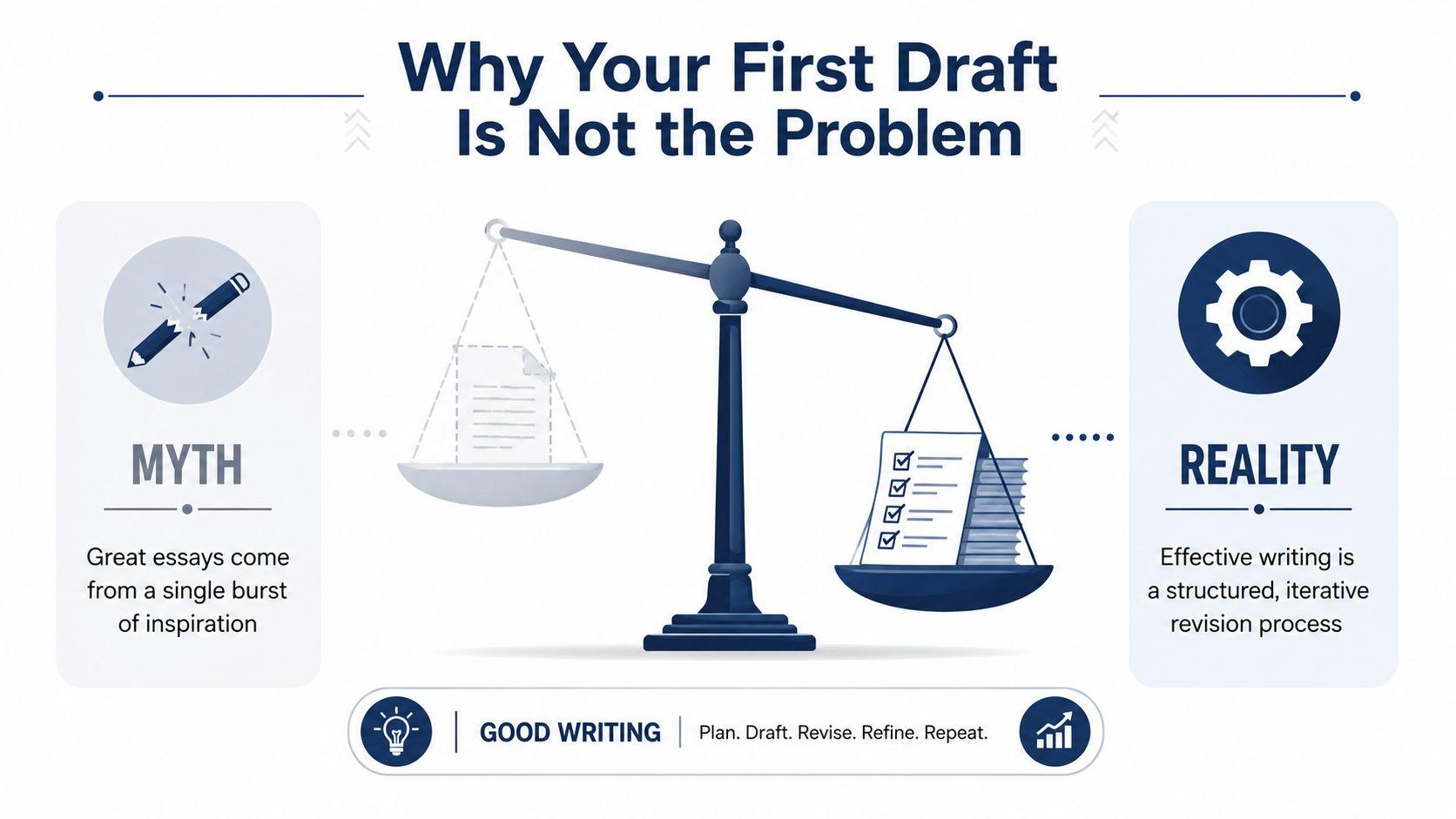
The myth of the perfect first draft creates a needless struggle. You sit in front of a blank document, expect every idea to arrive in order, and treat each awkward sentence as proof that the essay is failing. In practice, a first draft has a different job. It gets your thinking onto the page so you can inspect it.
A revision loop consists of three connected actions: draft an idea, receive useful information about it, and rewrite with a clear purpose. A controlled 2009 study of essay drafting and redrafting found that students who completed a supervised feedback-and-revision process improved enough to raise their final exam performance, with statistically significant gains in 3 of the 4 years studied. The intervention combined a drafting workshop, prompt feedback, and revision under transparent assessment criteria, supporting the conclusion that stronger essays depend on structured revision rather than first-draft perfection. The study record is available through ERIC.
What changes between drafts
Consider a rough paragraph about school uniforms:
School uniforms are a controversial issue. Some people think they help students because everyone looks the same. Other people think uniforms are bad because students can't express themselves. This essay will discuss both sides.
The paragraph names the topic, but it doesn't make an argument. It also promises a balanced discussion without indicating what the evidence will show. A revision might read:
School uniforms can reduce visible economic differences among students, but they don't automatically create a fairer school environment. Their value depends on whether schools pair a uniform policy with practical support for families who struggle to afford clothing and with rules that allow reasonable personal expression.
The second version takes a position, adds a condition, and creates directions for the body paragraphs. It still might change after research or feedback, and that's normal. Revision isn't merely correcting errors. It's where you discover what you mean.
Working rule: Treat the first draft as a map of your current thinking, not as a verdict on your ability.
You should still plan before drafting, but planning can't answer every question. A reader may find that your evidence doesn't support your claim, or that your strongest idea appears too late. Those discoveries are useful. Save time for them instead of spending the entire writing period polishing sentences that may later be cut.
Building a Thesis That Actually Argues Something
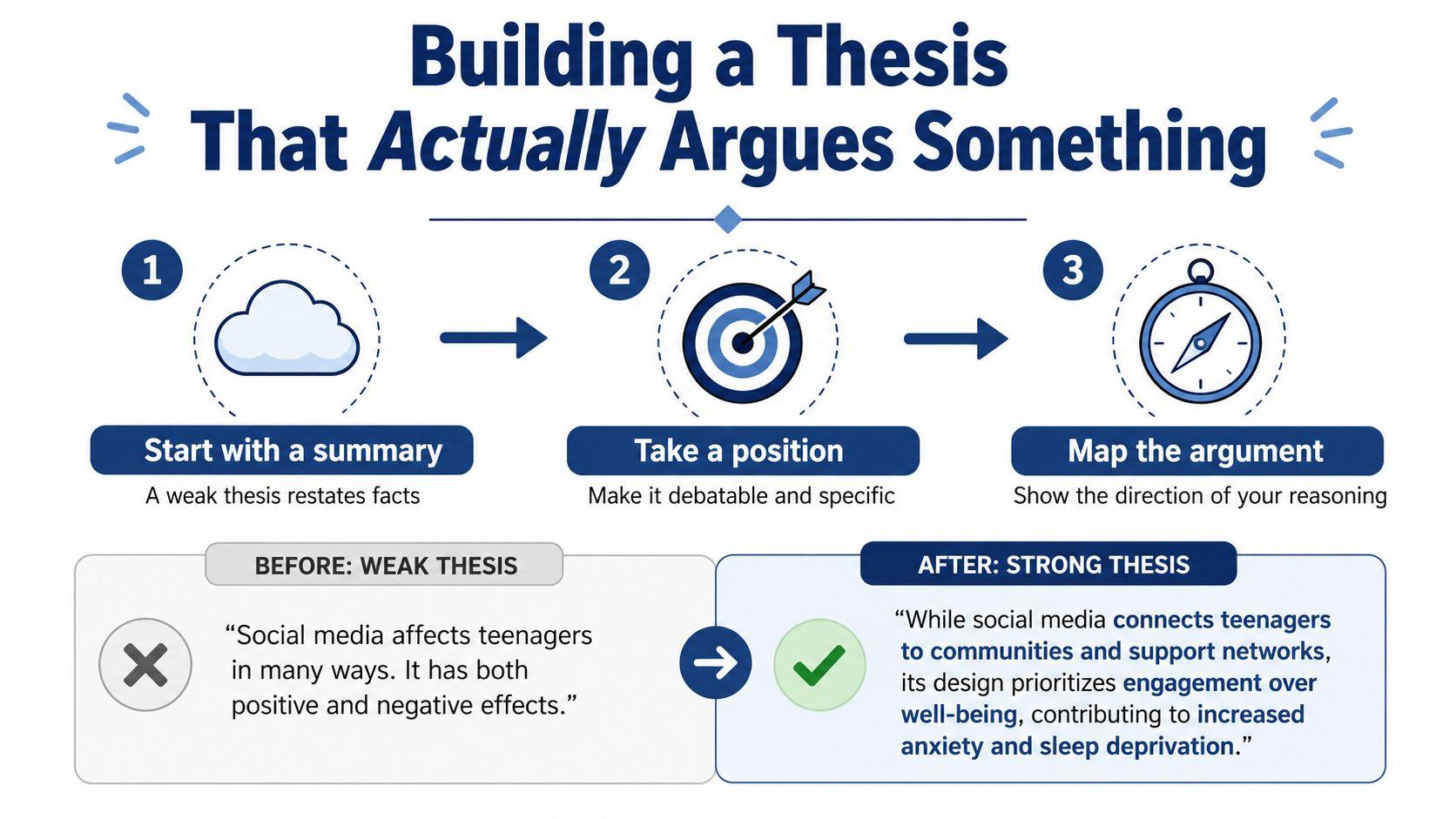
A thesis should do more than announce a subject. It should give the reader a claim that can be examined, challenged, and developed. If your thesis only summarizes information, your body paragraphs may become a collection of facts rather than a connected argument.
Start with a vague statement and ask what it fails to tell the reader:
Weak: Social media affects political participation.
This sentence identifies a relationship, but it doesn't explain how, under what conditions, or why the relationship matters. Strengthen it by adding a position, reasoning, and scope:
Stronger: Social media can broaden political participation by lowering the barrier to discovering campaigns and joining public discussions, but its influence is limited when users encounter information mainly through politically like-minded networks.
This thesis contains three useful parts:
- Claim: Social media can broaden political participation, but its influence has limits.
- Reasoning: It lowers barriers to discovering campaigns and joining discussions.
- Scope: The effect weakens when users mainly encounter like-minded networks.
The formula isn't a sentence mold you must follow mechanically. It's a diagnostic tool. Write your provisional claim, then ask what reason supports it and which boundaries keep the essay manageable.
Stress-test the sentence
Use two questions before outlining your body paragraphs:
- Could a thoughtful reader disagree? If nobody could reasonably challenge the statement, you may have written a fact or definition rather than an argument.
- So what? What consequence, tension, or insight makes the claim worth developing?
Watch for three common problems. A thesis can be too broad, as in “Technology has changed society.” It can repeat the prompt, as in “This essay will discuss the causes of the revolution.” Or it can promise more than the available evidence can support, such as a claim about every country, period, or social group.
A practical template is:
Although [complication or opposing view], [your specific claim] because [main reasoning], particularly in [defined context].
You don't need to include every component in the final sentence. Use the structure while drafting, then make the prose sound natural. For further models and variations, consult this practical guide to master thesis writing with examples, especially when you're unsure whether a statement summarizes or argues.
Structuring Paragraphs for Maximum Clarity
Body paragraphs become easier to follow when each performs a distinct job in the argument. The most reliable architecture is claim, evidence, analysis, or CEA. The claim tells readers what the paragraph is proving. Evidence gives them something concrete to examine. Analysis explains why that evidence supports the claim and the essay's thesis.
Evidence without analysis can make a paragraph look researched while leaving its reasoning unfinished. For example:
A survey found that many students use online resources when studying. Universities also provide digital libraries. Students often watch recorded lectures.
These statements may relate to the topic, but their significance remains unstated. Readers must guess how the examples connect to the argument.
A CEA version makes the reasoning visible:
Digital study tools can expand access to academic support beyond the classroom. Students who use recorded lectures, digital libraries, and online study resources can revisit difficult material according to their own needs. This flexibility matters because access isn't created merely by placing resources online. Students also need the time, guidance, and technical ability to use those resources effectively.
The topic sentence makes a claim. The examples supply evidence. The final sentences interpret that evidence and reconnect it to the larger issue. That last move is often what separates a summary from an argument.
Make the logic easy to follow
Integrate quotations rather than dropping them into a paragraph without preparation. Introduce the source, include only the language you need, and explain the quotation immediately afterward. A statistic or example does not explain itself, even when its relevance seems obvious to you.
Transitions should describe relationships between ideas. “However” signals contrast, while “therefore” signals consequence. Choose the word that shows how one sentence follows from the previous one, rather than adding a connector that merely fills space.
After drafting, create a reverse outline. Write a short note beside each paragraph describing its central claim. If two notes make the same point, combine the paragraphs or give them clearly different roles. If a paragraph has no clear claim, it may be background that belongs elsewhere, evidence that needs analysis, or material that does not serve the thesis.
Ask of every paragraph: Does this prove my thesis, or does it only describe my topic?
That question exposes structural problems before sentence-level editing distracts you.
The Revision Loop That Raises Your Grade
Students often read feedback as a final judgment. A comment such as “develop this point” can feel vague or discouraging, especially when it appears beside a paragraph you worked hard to write. Read it instead as evidence about the reader's experience. Your task is to convert the comment into a revision decision.
Feedback tends to operate at three levels:
- Structural feedback asks whether the thesis, sections, and conclusion form a coherent argument.
- Evidentiary feedback asks whether claims have suitable support and whether the essay interprets that support.
- Stylistic feedback asks whether sentences communicate the reasoning clearly and efficiently.
Revise in that order. A beautifully phrased paragraph still needs major work if it doesn't advance the thesis. A well-supported example still falls short if you never explain its relevance.
What the evidence says about feedback
A 2021 Frontiers study using Turnitin Feedback Studio found that the number and type of feedback comments predicted improvement between first and final submissions. The strongest predictors were specific and general “where to next” comments, while praise, probes, grammar, referencing, and unclear comments were less helpful for improvement. The practical lesson is straightforward: actionable direction usually helps more than vague approval. Read the study in full.
A meta-analysis of writing feedback reported average weighted effect sizes of 0.87 for adult feedback, 0.58 for peer feedback, 0.62 for self-feedback, and 0.38 for computer feedback. These findings support a revision loop that combines teacher or expert critique, peer review, and self-editing rather than depending on one feedback source. Review the meta-analysis and its findings.
Turn comments into actions
Use this process after receiving feedback:
- Collect: Copy each comment into a separate document, including rubric notes and your own observations.
- Classify: Label it structural, evidentiary, or stylistic.
- Translate: Change “unclear” into a question such as, “Which sentence needs a definition or example?”
- Prioritize: Address problems that affect several paragraphs before isolated wording issues.
- Verify: Read the revised passage as someone unfamiliar with your original intention.
Keep a feedback journal with recurring patterns. Record the problem, the signal that reveals it, and the action that fixes it. If several readers question your analysis, make “explain the significance of every example” a required checkpoint in your next draft.
For research and brainstorming support, 1chat's research workspace can sit alongside human feedback, but it shouldn't replace a teacher who understands the assignment's criteria. The point isn't to collect more comments. It's to obtain comments that tell you what to do next.
Editing Passes That Transform Rough Drafts
Editing in one sweep encourages you to fix small errors while missing large weaknesses. A sequenced process protects your attention. Each pass asks a different question, and you shouldn't spend much time on grammar until the argument can survive structural inspection.
Pass 1 checks the structure
Read only the thesis, topic sentences, and conclusion. Do they form a logical chain? Use reverse outlining to summarize each paragraph, then move any section that appears in the wrong place. Cut material that doesn't support the central claim, even if the research was difficult to find.
Pass 2 audits evidence
For every major claim, identify the supporting source or example. Then ask, “So what does this evidence demonstrate?” Add interpretation where the paragraph stops after a quotation or fact. Check that sources are introduced accurately and that your citations follow the required style.
Pass 3 improves style
Look for sentences that repeat an idea, hide the subject, or rely on inflated academic language. Replace “due to the fact that” with “because” where appropriate. Read difficult paragraphs aloud. Your ear will catch crowded clauses, abrupt transitions, and repeated sentence openings that your eyes may skip.
Pass 4 handles mechanics
Only now check spelling, punctuation, grammar, citation formatting, and the assignment's presentation requirements. Use a tool such as a word processor's spelling checker, but review every suggestion yourself. Automated corrections can change meaning or flatten a deliberate choice.
If time is tight, protect the first two passes. A clear argument with a few minor errors is easier for a reader to value than flawless prose built around an unsupported thesis. For additional writing and proofreading workflows, this student writing resource from 1chat offers another place to compare revision techniques.
Using AI Tools as a Private Feedback Partner
AI can support revision when you give it a narrow task and keep ownership of the thinking. It works better as a questioning reader than as a ghostwriter. Ask it to identify gaps, test clarity, or generate objections, then decide whether its suggestions are accurate and appropriate.
Useful prompts include:
- “State my thesis in your own words. What part is ambiguous?”
- “List the claims in this paragraph that need evidence.”
- “Give me two reasonable counterarguments to this position. Don't rewrite my response.”
- “Flag jargon-heavy sentences and explain why a reader might struggle with them.”
- “Compare each topic sentence with my thesis and identify any mismatch.”
Protect privacy by removing names, student numbers, unpublished research, and sensitive personal details before pasting text into an online service. Check your institution's rules before using AI on assessed work, and don't outsource original analysis if the assignment requires your own reasoning.
A simple decision matrix helps:
| Revision need | Useful first reader |
| Argument feels confusing | Professor or writing tutor |
| You want a fresh reader reaction | Peer reviewer |
| You need wording or clarity checks | AI tool, followed by your own review |
| Evidence may be incomplete | Instructor, librarian, or subject expert |
Tools designed for assessment contexts, such as AI marking for A-Levels, can help you think about criteria and feedback, but they can't determine whether an interpretation reflects your course's specific expectations. A privacy-focused workspace such as 1chat may be useful for drafting questions and reviewing clarity, provided your use follows your school's policy.
The final decision should remain yours. If an AI suggestion changes your argument, verify the reasoning and rewrite it in your own voice rather than accepting polished language automatically.
Choose one essay you're currently writing and begin a deliberate revision loop today. Write a provisional thesis, reverse-outline the draft, and ask a teacher, peer, or approved feedback tool for one specific “where to next” comment. Then revise the highest-impact weakness before polishing a single comma.