Both spellings are correct. Use labeled for American English and labelled for British English, then stay consistent for the rest of the document.
You're probably staring at one word in a draft, half sure it looks wrong and half sure spell-check is the problem. That tiny pause happens in emails, essays, product pages, and team docs, and it's usually less about grammar than about audience.
Labeled or labelled is a small choice with a big practical job. The right spelling helps your writing feel native to the reader, keeps documents consistent, and stops tools from flagging words you meant to use.
Why This Small Spelling Question Matters More Than You Think
You finish a sentence, glance back, and the word looks slightly off. Maybe your browser underlines it, maybe a client notices it, or maybe your own eyes just don't trust it. That's the moment many people open a search tab and type “labelled or labeled” because they don't want to guess.
The good news is that this is not a meaning problem. It's a reader problem. Once you know who you're writing for, the choice gets simple, and the rest of your draft becomes easier to keep clean and consistent.
What usually goes wrong
A British client gets an American spelling in a proposal. A student submits an essay with one spelling in the body and the other in the conclusion. A website uses one variant on a landing page and the opposite one in product UI text. None of those situations changes the meaning, but each one can make the writing feel careless.
That's why this question matters in practice. It's not about winning a grammar argument. It's about making a clear choice, then sticking to it in every sentence, every heading, and every product label.
Practical rule: choose the spelling that matches the reader you want to sound natural to, not the one you personally use most often.
If you also work with dates, numbers, or regional formatting, the same logic applies. A useful companion guide on fechas en inglés US vs UK shows how English conventions shift by region in ways that can affect a whole page, not just one word. For collaborative drafting and quick research support, many teams also keep a shared workspace like 1chat research handy so style questions don't slow down the writing flow.
The Transatlantic Split Between Labelled and Labeled
A client in London may send back a draft marked labelled, while a Chicago editor changes it to labeled without touching the meaning. That kind of swap is ordinary, but it still matters because readers notice when a page starts speaking with two spellings at once.
Labeled is the usual American form, and labelled is the usual British form. The split is regional, not semantic, which is why both spellings refer to the same word even though they look different on the page, as explained in the grammar guide on labeled or labelled and Grammarly's guide to labeled and labelled.
A regional convention, not a meaning change
That is the part many writers miss. The spelling choice does not change the idea behind the word, so the core task is matching the reader's expectations, not arguing with the dictionary. A student essay, a product manual, and a homepage can all use the same term cleanly, as long as the spelling matches the audience.
Historical usage helps explain why the divide feels settled. American English moved toward the single-l form in the early 20th century, and one reference notes that American writers adopted the newer forms around 1900. It also notes that labelled and labelling are now scarcely seen in American publications (grammarist on label spelling).
| Labelled vs Labeled at a Glance | Region | Preferred Spelling | Typical Usage Share |
| United States | labeled | 96% vs. 4% preference for labeled | |
| United Kingdom | labelled | 62% vs. 38% preference for labelled |
Those patterns show up in everyday editing too. A spell-check setting can flag one variant as “wrong” even when it is correct for your audience, so writers on mixed teams often need a shared style guide or a quick review of the tool settings before they publish. For teams comparing regional wording across other details, a guide on fechas en inglés US vs UK shows the same kind of split, and a shared workspace like 1chat research can help keep those choices in one place.
If you are writing for business teams across time zones, keep the spelling tied to the reader, then hold that choice steady across the page, the header, the button text, and the final proofread.
The Four Word Forms You Need to Know
Many only check the past tense form, then forget the rest of the word family. That's where consistency slips. Once you know the four forms together, the spelling choice gets much easier to manage.
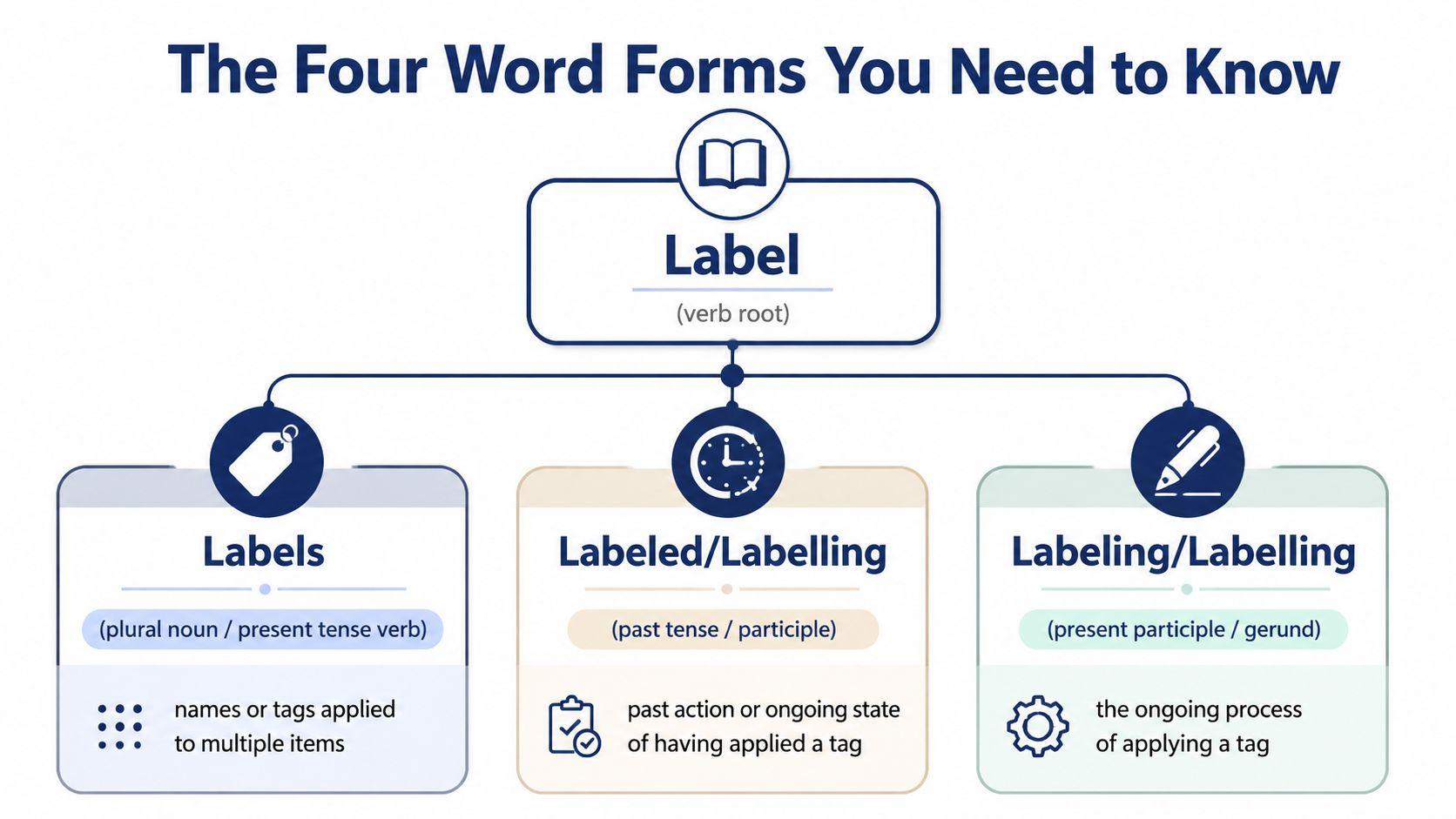
Quick reference for the full family
| Form | US English | UK English | Simple use |
| Root verb / noun | label | label | a tag or category |
| Plural noun / present tense | labels | labels | more than one tag, or “she labels” |
| Past tense / past participle | labeled | labelled | finished action |
| Present participle / gerund | labeling | labelling | ongoing action |
The plural noun labels stays the same in both varieties. So does the root label. The spelling split shows up in the past tense and the ongoing action form, where American English uses -ed and -ing, while British English uses -led and -lling.
Short examples you can copy mentally
- Label the folder before you send it.
- She labels the samples by hand.
- The lab labeled the jars yesterday.
- The lab is labeling the jars now.
The British versions follow the same meaning, just with the alternate spelling family.
The easy mistake is mixing families inside one paragraph, such as writing labeled in one sentence and labelling in the next when the rest of the document is clearly British English.
If you're editing student work, this is the point where spell-check often misses a bigger issue. The word itself may be right, but the family may be wrong for the document. A clean essay usually uses one family throughout, not a mix of American past tense and British participle forms.
Labelled vs Labelling and Labeled vs Labeling in Real Sentences
The fastest way to remember the difference is to see it in ordinary writing. The sentence should feel like something you'd send, submit, or publish today.
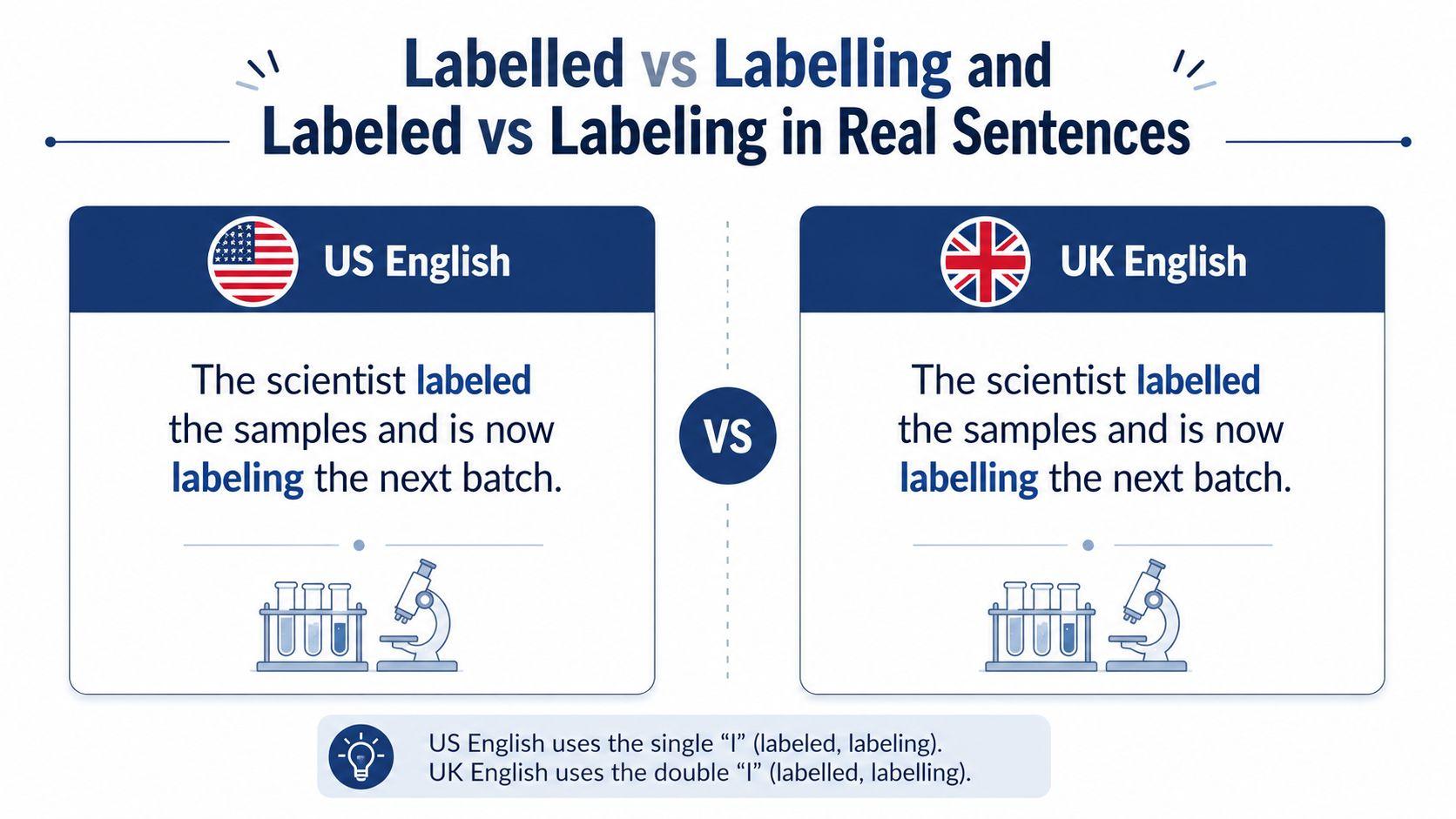
Customer email and product UI
US English: The support team labeled the ticket and is now labeling the follow-up tasks.
UK English: The support team labelled the ticket and is now labelling the follow-up tasks.
That's the version to use when your customer base expects one regional standard. In product text, consistency matters even more because mixed spellings can make the interface look patched together.
Research report and student essay
US English: The researcher labeled each chart before submitting the report.
UK English: The researcher labelled each chart before submitting the report.
US English: The student labeled the evidence correctly in the final paragraph.
UK English: The student labelled the evidence correctly in the final paragraph.
If your teacher, journal, or department uses one national convention, follow it everywhere, including headings and captions. If the institution doesn't specify, match the default English variety used by the course or publication.
For writers who dictate drafts, this is also where a little tool support helps. If you use voice input often, a guide on enable dictation in Word can save time, but the language setting still needs to match the spelling family you want.
Useful habit: once you pick US or UK spelling, read one paragraph out loud and look for any word family that slipped back into the other variant.
How to Choose the Right Spelling for Your Audience
Start with the reader, not the rulebook. If the document is for US customers, use labeled, labeling, and the rest of the American family. If it's for UK, Irish, Australian, New Zealand, or other Commonwealth audiences, use labelled and labelling instead.
Five common situations
- US clients or US websites: use the single-l forms. That keeps your copy aligned with local expectation and reduces friction in review.
- UK or Commonwealth clients: use the double-l forms. That usually looks more polished to local readers and editors.
- Mixed international teams: pick one house style and document it. A team style guide prevents every project from reopening the same debate.
- Student essays: follow the course handbook, school preference, or instructor's regional spelling. If none is stated, match the variety used in the assignment prompt and the rest of the course materials.
- Global websites: choose by page or locale. A US landing page can use one spelling family, while a UK version can use the other.
The main failure mode is mixing conventions because one writer edited the page in a different locale than the original author. That's why style guides matter even for small teams. A one-page guide can settle recurring choices like spelling, capitalization, date format, and punctuation before they turn into review comments.
One decision rule that keeps things tidy
If your audience is regional, follow that region. If your audience is mixed, choose one variant and apply it everywhere in the document, including titles, metadata, alt text, and UI copy. Consistency beats cleverness every time.
Setting Up Your Tools to Stop Second-Guessing the Spelling
A spelling choice becomes much easier when your tools stop arguing with you. Set the document, app, or browser to the right English variety first, and you spend less time fixing red underlines and more time checking meaning.
Word, Google Docs, and browsers
In Microsoft Word, set the proofing language for the document to English (US) or English (UK) before you begin editing. If the language setting is wrong, Word can mark the spelling you want as an error and push you toward the other variant. If you also use dictation, enable dictation in Word after the document language matches your audience so speech input and spelling checks stay aligned.
In Google Docs, go to Tools > Language and choose the spelling family you want to use. That small setting stops the editor from correcting you into the opposite form and helps the whole document stay consistent.
In browsers, check the spell-check dictionary settings in Chrome, Firefox, or Edge preferences. If you write in web apps often, the browser can either protect your preferred spelling or keep flagging it as if it were wrong.
Small settings that save real time
Grammar tools can cause the same problem, so add your preferred spelling to a custom dictionary when the tool allows it. For teams that want a quick check on setup questions, the 1chat FAQ is a simple place to keep nearby. If your team writes by voice, make sure the document language matches the audience before you start dictating, so corrections do not fight your chosen spelling family.
Practical rule: if the tool is set to the wrong English variant, it will make your chosen spelling look wrong even when the spelling is correct for your reader.
For students and small teams, the safest habit is to check language settings at the start of the document, before the red underlines stack up. That one step up front saves repeated edits later and keeps the whole draft from drifting between spelling systems.
SEO and Search Engines How Regional Spelling Affects Your Pages
Search engines don't need you to stuff both spellings onto the same page. For SEO, the better move is usually to pick the spelling that matches the page's audience and write naturally.
One page, one spelling family
Use labeled on a US page and labelled on a UK page. Don't force both onto the same page just because you're worried about keyword coverage. That kind of keyword soup makes copy harder to read and rarely helps the page feel better to humans, which is why a guide on avoid keyword soup in content is worth keeping nearby when teams plan on-page copy.
Search intent matters more than spelling variety. If someone wants to understand your product, your article, or your service, clear language and consistent locale usually do more for trust than repeating alternate spellings.
When both variants make sense
Use separate regional pages when your site serves separate audiences, such as a US landing page and a UK landing page. In that case, the spelling can reinforce locale the same way currency, shipping language, and support hours do.
For mixed-market pages, choose one standard and keep it steady. If you need help shaping that structure, a workflow note in 1chat blog can be useful for teams that draft, review, and localize content in one place. The point is not to game the algorithm with variants. The point is to make the page feel coherent.
A short SEO checklist
- Match locale: use the spelling that fits the target market.
- Stay consistent: keep the same variant across headings, body copy, and metadata.
- Avoid stuffing: don't repeat both spellings just for coverage.
- Localize fully: pair spelling with other regional cues when a page is market-specific.
- Review templates: make sure CMS defaults don't swap spelling behind your back.
Search engines are built to understand intent and context. Readers are too. Clean, regional copy serves both.
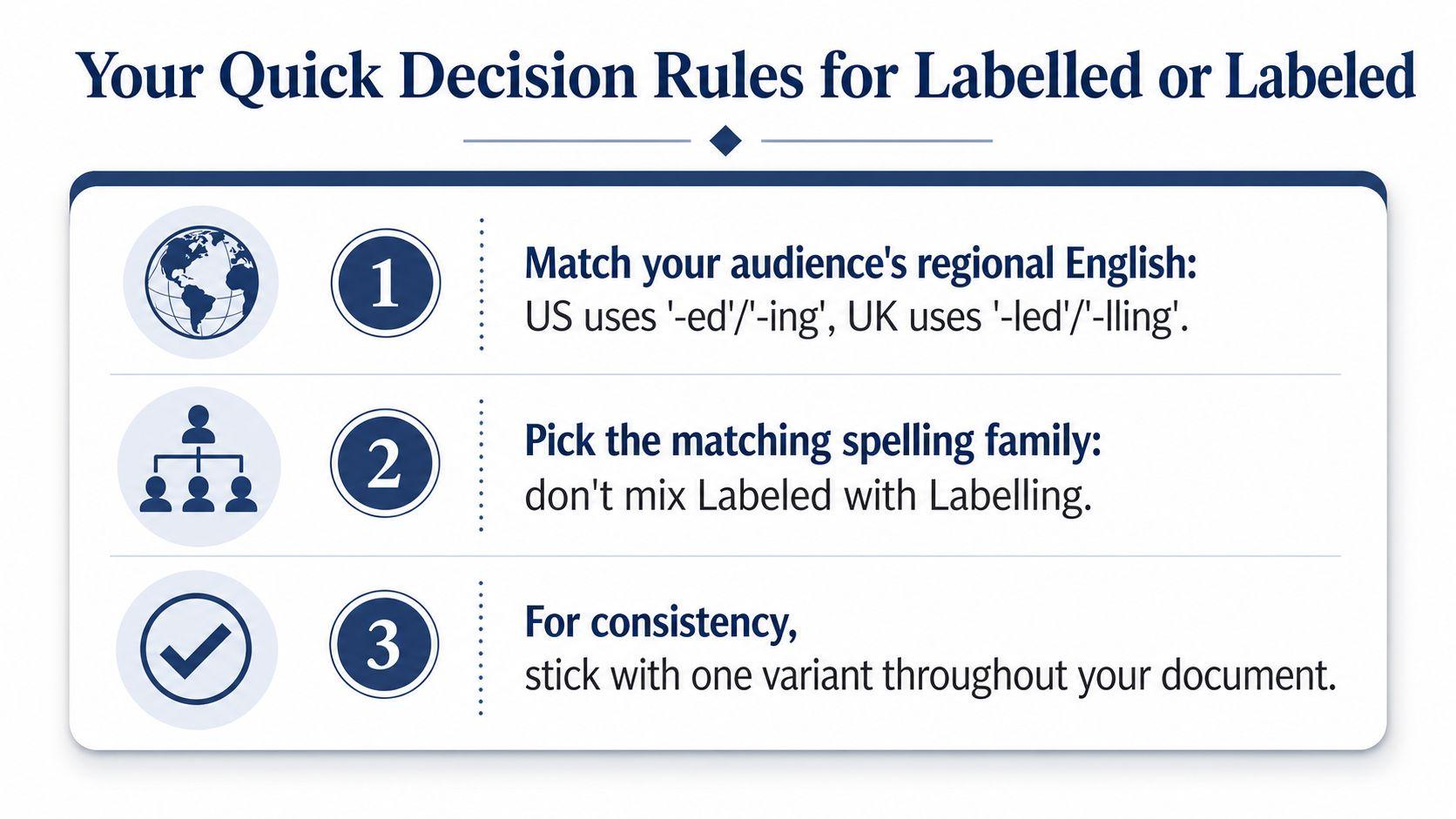
Your Quick Decision Rules for Labelled or Labeled
Rule 1: match your audience's regional English, so US writing uses -ed and -ing, while UK writing uses -led and -lling.
Rule 2: keep the family together, so don't mix Labeled with Labelling.
Rule 3: lock the choice into your tools and style guide, then use it everywhere in the document.
The spelling choice is small, but it still sends a signal. When you match the reader, your writing feels calmer, clearer, and more respectful.
If you want a faster way to check regional spelling, draft cleaner team docs, or compare wording for a US or UK audience, try it in 1chat and keep your style decisions in one place before you publish.