Organic chemistry often presents a significant hurdle, defined by its complex reactions, intricate mechanisms, and challenging problem sets. Fortunately, a new generation of digital tools is here to help demystify the subject. Whether you are a student grappling with homework, a researcher designing a multi-step synthesis, or an educator seeking dynamic teaching aids, the right organic chemistry solver can be a transformative resource. These powerful platforms do everything from predicting reaction outcomes using advanced AI to deciphering complex NMR spectra, providing step-by-step solutions that build understanding.
But with a growing number of options, finding the best fit for your specific needs can be overwhelming. This guide cuts through the confusion. We provide a detailed, practical breakdown of the top digital tools and resources designed to tackle organic chemistry. For each entry, we analyze its core strengths, highlight key features, and discuss potential limitations, complete with screenshots and direct links to help you get started immediately. Our goal is to equip you with the information needed to confidently select the perfect organic chemistry solver, turning a daunting subject into a manageable and even enjoyable challenge. Let's dive into the list and find the tool that will help you succeed.
1. IBM RXN for Chemistry
IBM RXN for Chemistry is a powerful, cloud-based platform developed by IBM Research, positioning itself as a top-tier organic chemistry solver for predictive tasks. It excels at both forward reaction prediction (what product forms from given reactants) and retrosynthesis, which involves planning a synthetic route backward from a target molecule. This makes it an invaluable tool for students and researchers exploring potential synthetic pathways.
The platform's user experience is clean and project-based, operating entirely within a web browser without any installation. Users can easily draw molecules or import them using SMILES/MOL files. The AI, trained on millions of published reactions, provides not just a predicted outcome but also suggests experimental procedures, bridging the gap between theoretical planning and practical lab work. Its strong academic pedigree ensures a focus on scientifically validated predictions, though expert oversight is always recommended.
Key Features and Usage
- Prediction Engine: Provides AI-driven suggestions for reaction outcomes and multi-step synthesis plans.
- Browser-Based: Fully accessible online, requiring only a free account sign-up.
- Atom Mapping: Visualizes how atoms rearrange during a reaction, a crucial aid for understanding mechanisms.
- Practical Tip: Use the retrosynthesis feature to brainstorm multiple potential routes for a target compound in your assignments, then compare the suggested pathways for feasibility.
While it is a fantastic predictive tool, it functions less as a step-by-step homework explainer and more as a sophisticated research assistant. Its AI-driven capabilities for generating complex chemical pathways are impressive; the underlying technology shares principles with advanced language models, much like the AI used to create coherent text. To see how AI can structure complex information, you can explore AI-powered paragraph generation.
Website: https://rxn.app.accelerate.science
2. ASKCOS (MIT)
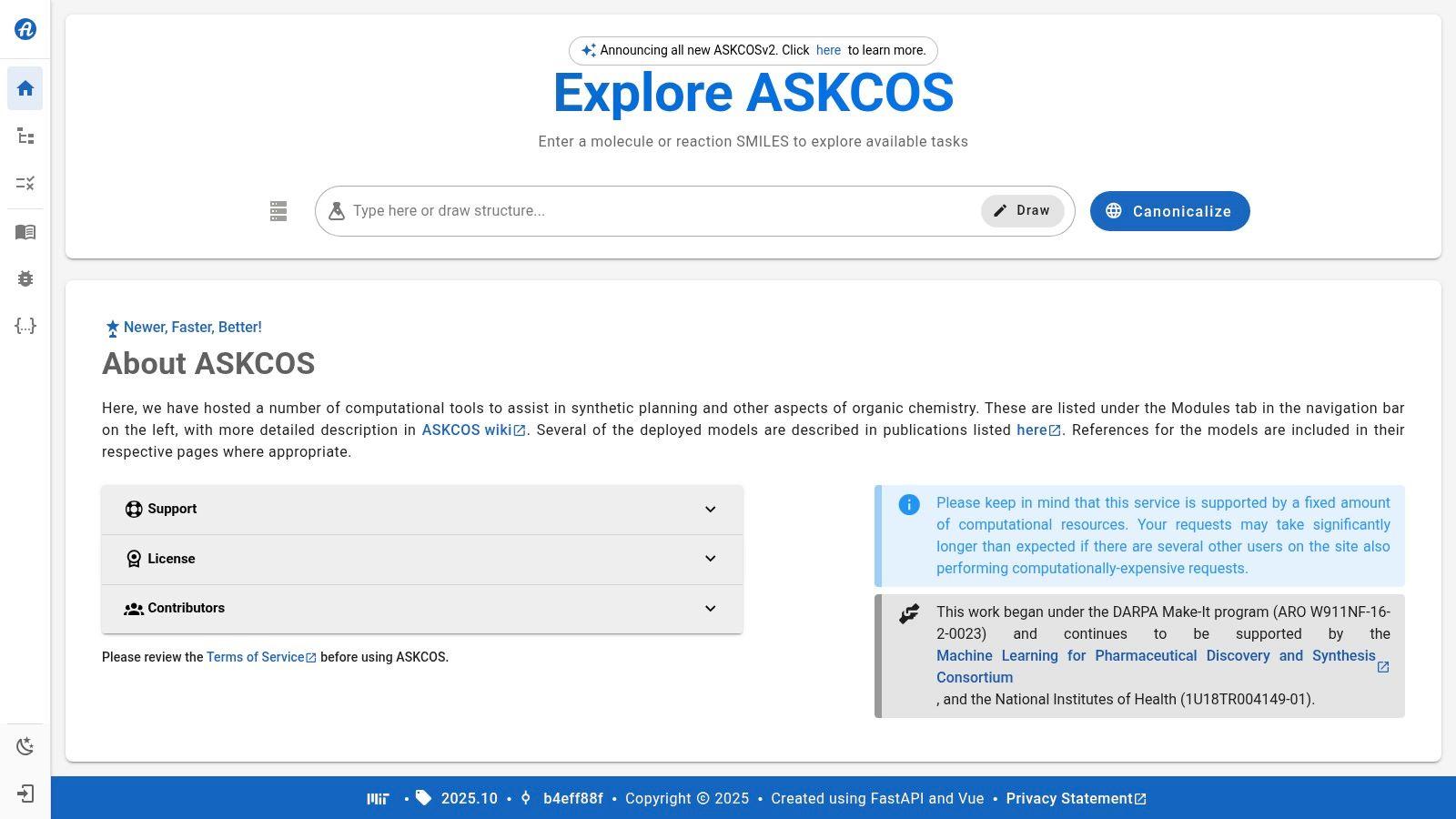
Developed at MIT, ASKCOS (Automatic System for Knowledge-based Continuous Organic Synthesis) is a powerful, open-source organic chemistry solver focused on retrosynthesis. It assists chemists by suggesting synthetic pathways, starting from a target molecule and working backward to identify commercially available precursors. This emphasis on practical, purchasable starting materials makes it a standout tool for designing feasible laboratory experiments.
The platform's strength lies in its interactive synthesis tree, which allows users to explore, prune, and refine potential routes. While its research-oriented interface might feel less polished than some commercial alternatives, its academic, no-cost access model and transparent, template-based methodology make it an exceptional resource for students and researchers learning the logic behind synthetic planning.
Key Features and Usage
- Retrosynthesis Engine: Builds an interactive synthesis tree, suggesting precursor molecules based on a vast library of reaction rules.
- Purchasable Precursors: The heuristics are designed to favor starting materials that are commercially available, adding a layer of real-world practicality.
- Open-Source Access: Free for academic users, providing a high-powered tool without a subscription fee.
- Practical Tip: When planning a synthesis for a class project, use the interactive tree to explore different disconnection strategies and see how the software prioritizes routes based on starting material availability.
ASKCOS is best utilized as a strategic planner for complex syntheses rather than a simple homework answer machine. Its ability to generate and score entire synthetic routes makes it a robust organic chemistry solver for users who need to move beyond single-step problems and think like a synthetic chemist.
Website: http://askcos.mit.edu
3. SYNTHIA (Merck/MilliporeSigma)
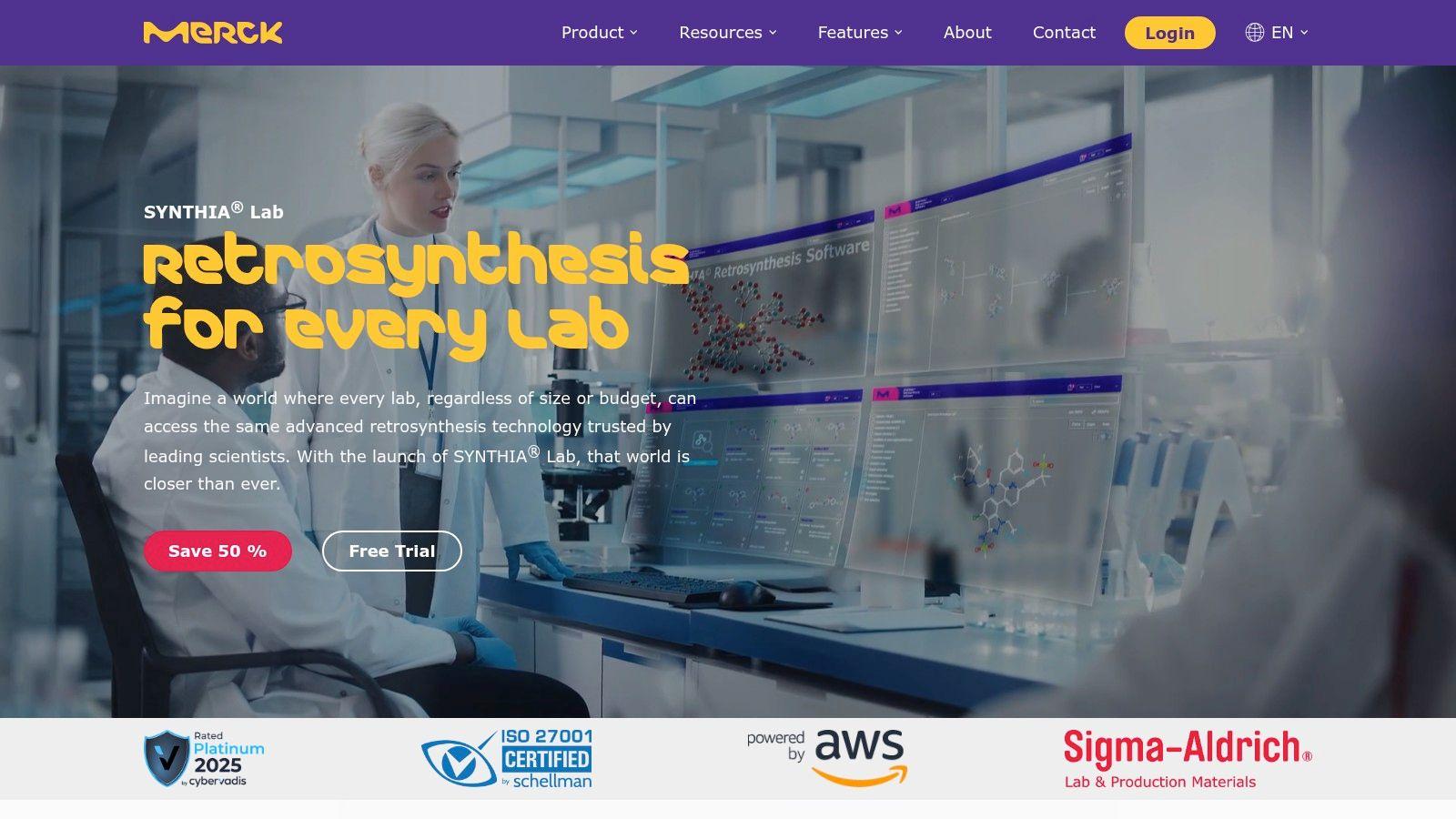
SYNTHIA, a sophisticated retrosynthesis platform from Merck (MilliporeSigma), represents the high end of organic chemistry solver tools. Originally developed as Chematica, it uses a unique combination of expert-coded rules and AI assistance to design synthetic routes from a target molecule backward to commercially available starting materials. This makes it a formidable tool for professional chemists in pharmaceutical and academic research who need to design efficient, practical, and cost-effective synthetic pathways.
The platform is built for serious route design, not casual homework help. Its key differentiator is the deep integration with the Sigma-Aldrich/MilliporeSigma catalog, allowing users to filter potential routes based on the price and availability of building blocks. This commercial focus ensures that the suggested syntheses are grounded in real-world lab logistics, bridging the gap between theoretical possibility and practical execution. It is a premium product that requires an institutional or corporate license for access.
Key Features and Usage
- Advanced Retrosynthesis: Plans complex, multi-step synthetic routes using a massive database of chemical reactions.
- Commercial Integration: Directly links proposed starting materials to the MilliporeSigma catalog for price and availability checks.
- Powerful Filtering: Allows users to customize route searches by setting cost limits, avoiding certain reagents, or prioritizing green chemistry principles.
- Practical Tip: Use the filtering options to set a price threshold for starting materials. This can quickly eliminate impractical, expensive routes from your analysis, saving significant time during the planning phase of a research project.
While its expert-coded approach delivers highly reliable and bench-validated suggestions, SYNTHIA is an enterprise-level tool with a corresponding price tag and learning curve. It is less a quick solver and more a strategic partner for serious chemical synthesis design, ideal for research groups and corporations.
Website: https://www.synthiaonline.com
4. Spaya by Iktos
Spaya by Iktos is a commercial, AI-driven platform that excels as an organic chemistry solver for advanced retrosynthesis and synthetic accessibility scoring. Unlike tools designed primarily for academic homework, Spaya is engineered for high-throughput applications in pharmaceutical and chemical research. It rapidly analyzes molecules to propose viable synthetic routes, ranking them by feasibility and providing valuable scores (RScore/RSpred) to help chemists prioritize compounds in large libraries.
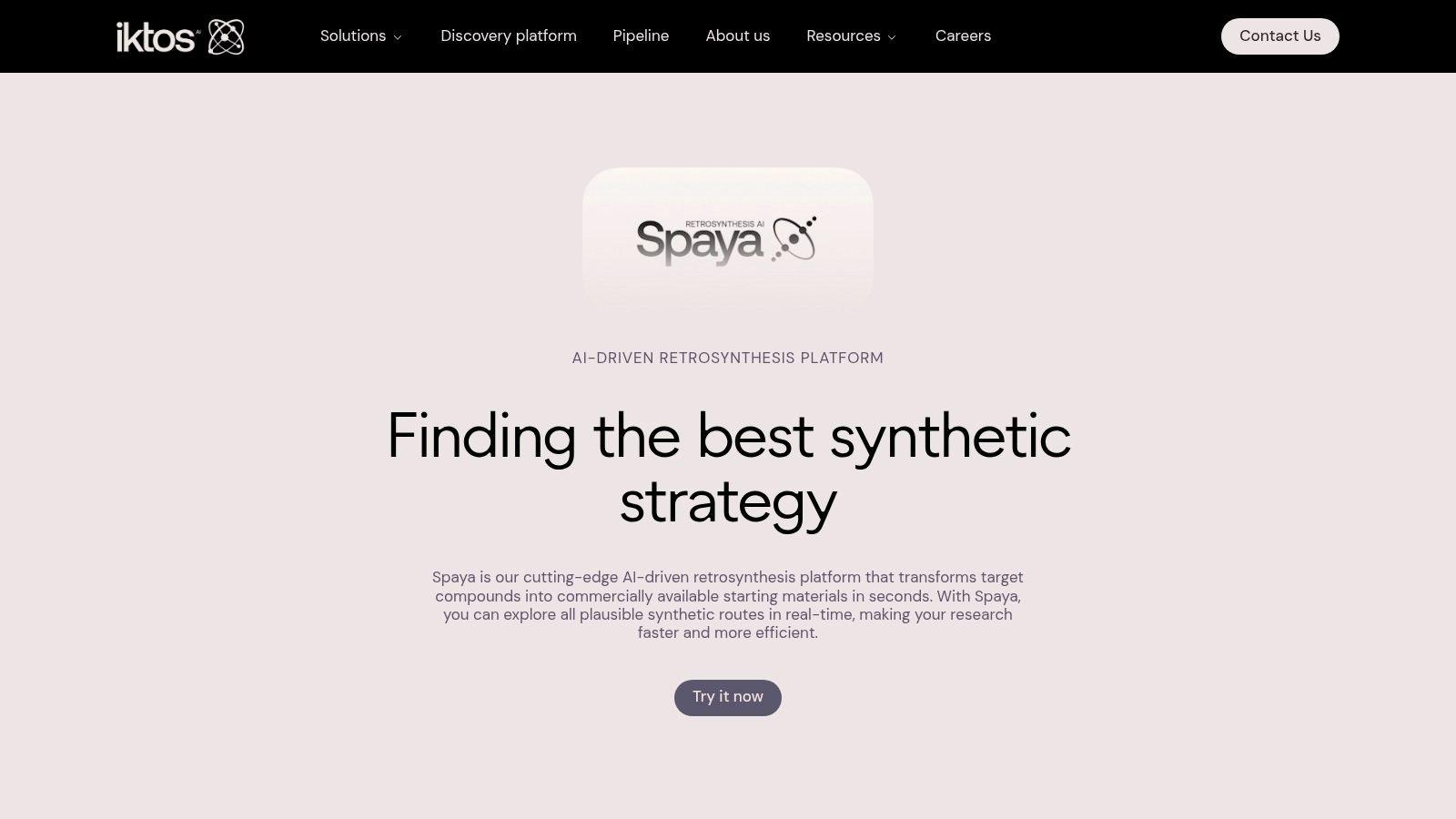
The platform is built for integration into professional research workflows, offering a powerful API that connects with tools like KNIME, Pipeline Pilot, and Jupyter notebooks. Its speed and scalability make it ideal for drug discovery teams needing to quickly triage thousands of potential molecules. While it provides powerful suggestions, the level of detail is geared toward expert chemists who can interpret and validate the proposed synthetic pathways. Access is typically provided through a commercial license after a demo.
Key Features and Usage
- High-Throughput Retrosynthesis: Provides rapid, AI-powered synthetic route suggestions for large sets of molecules.
- Feasibility Scoring: Ranks proposed routes and molecules based on predicted synthetic accessibility, saving valuable research time.
- Enterprise Integration: Offers a robust API for integration into existing data pipelines and private cloud or VPC deployments.
- Practical Tip: Use Spaya's API to build an automated workflow that filters a large virtual library of compounds, keeping only those with a high synthetic feasibility score for further investigation.
Spaya is less a step-by-step educational helper and more a strategic tool for professional chemists. Its core strength lies in its ability to process chemical information at scale, a task that requires sophisticated AI. This is analogous to how modern AI can process and structure vast amounts of text for complex tasks. To better understand how AI handles and organizes data, one can explore how AI-driven outline generators work.
Website: https://iktos.ai/solution/spaya
5. ACD/Labs — ACD/Name
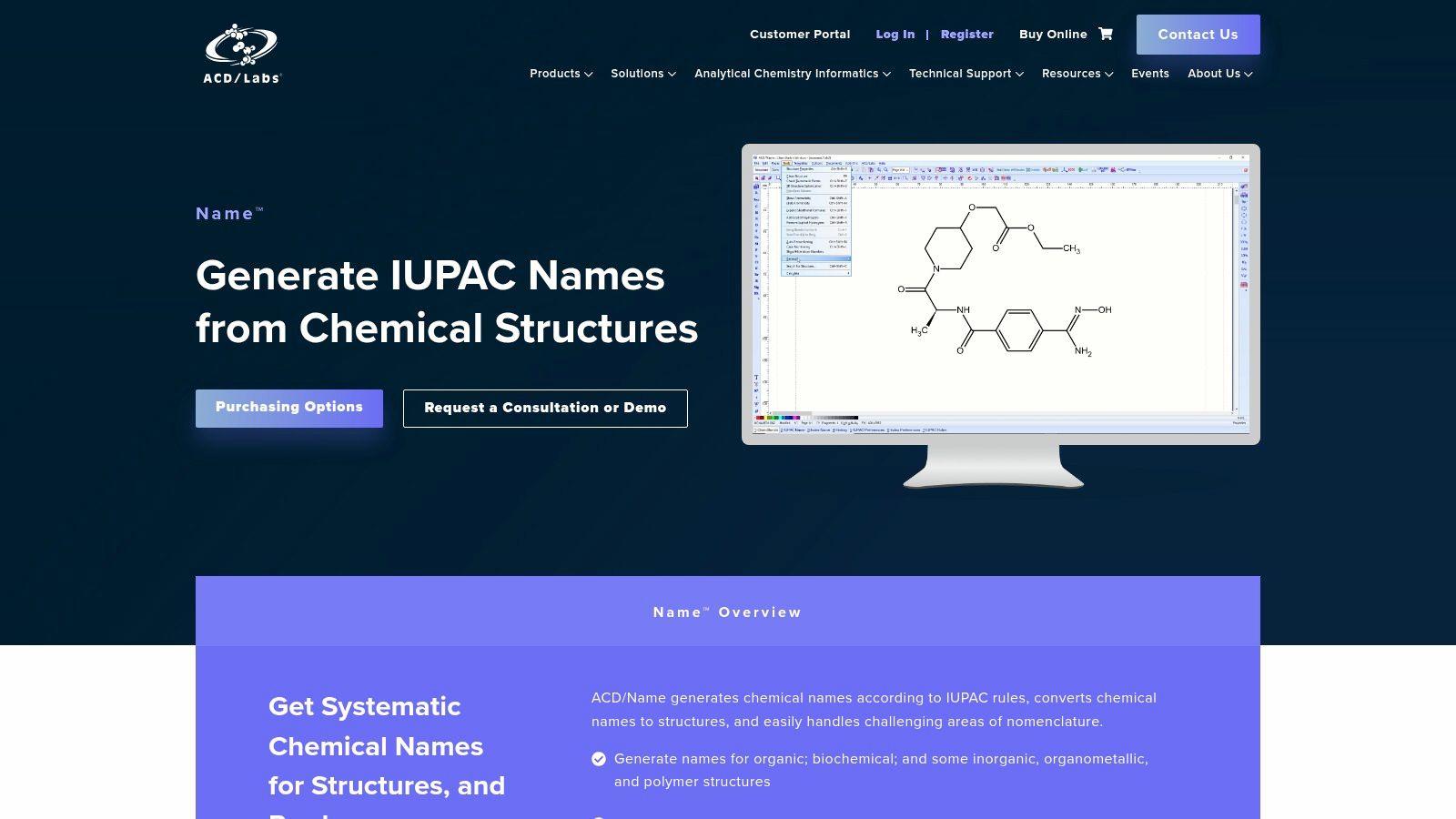
ACD/Labs is a long-standing authority in chemical software, and its ACD/Name tool serves as an industry-standard organic chemistry solver specifically for nomenclature. Rather than predicting reactions, this platform excels at the crucial task of converting chemical structures into precise IUPAC names and vice-versa. It is highly trusted in academic publishing and industrial R&D for generating accurate, rule-based names for even the most complex molecules, including those with intricate stereochemistry or fused ring systems.
For students, its true power lies in its function as a learning tool. When it generates a name, it can provide references to the specific IUPAC rules it applied, offering a clear "why" behind the nomenclature. This direct link between structure and rules makes it an invaluable aid for mastering one of organic chemistry's most challenging topics. The interface is professional and built around its core function, often bundled with its well-known ChemSketch drawing software.
Key Features and Usage
- Bidirectional Conversion: Seamlessly generates IUPAC names from drawn structures and draws structures from IUPAC names.
- Rule Traceability: Provides clear references to the specific IUPAC nomenclature rules used, which is excellent for studying.
- Complex Molecule Support: Accurately names compounds with stereochemistry, tautomers, and complicated ring systems.
- Practical Tip: Draw a complex molecule you are struggling to name for an assignment, generate the IUPAC name with ACD/Name, and then use the rule references to understand how each part of the name was determined.
While a free version is available for academic use, the full suite of advanced features requires a paid license and is primarily Windows-based desktop software. It is not designed for predicting reactions but is arguably the most robust and trustworthy tool available for mastering chemical nomenclature, making it a specialized yet essential organic chemistry solver for any serious student or professional.
Website: https://www.acdlabs.com/products/name/
6. ChemAxon — Chemical Naming and Structure Conversion
ChemAxon offers a suite of enterprise-grade tools focused on a very specific but critical organic chemistry problem: chemical naming and structure conversion. While not a traditional organic chemistry solver for reactions, it excels at accurately translating between chemical structures and their IUPAC, traditional, or even proprietary names. It is designed less for individual students and more for integration into corporate research databases, educational platforms, and software development pipelines where precision in nomenclature is non-negotiable.
Its core strength lies in its powerful engine that can parse a drawn structure and generate the correct IUPAC name, or vice versa, a process known as name-to-structure conversion. The platform is highly customizable, supporting custom dictionaries and even multi-language inputs, making it invaluable for global organizations. This focus on developer integration and backend processing sets it apart from student-facing homework helpers.
Key Features and Usage
- Bi-Directional Naming: Converts structures to IUPAC/common names and names back to structures.
- Developer Focused: Provides SDKs and APIs for integration into other software, not a standalone end-user app.
- Multi-Language Support: Uniquely capable of handling name-to-structure conversion from inputs in Chinese and Japanese.
- Practical Tip: Developers building educational chemistry software can leverage ChemAxon's API to add a reliable nomenclature module to their application, saving significant development time.
The service is geared towards organizations, and access requires licensing and setup. It functions as a powerful backend engine, meaning there is minimal user interface for direct interaction. It's the "engine under the hood" for many professional chemistry applications.
Website: https://chemaxon.com/chemical-naming-and-structure-conversion
7. nmrdb.org
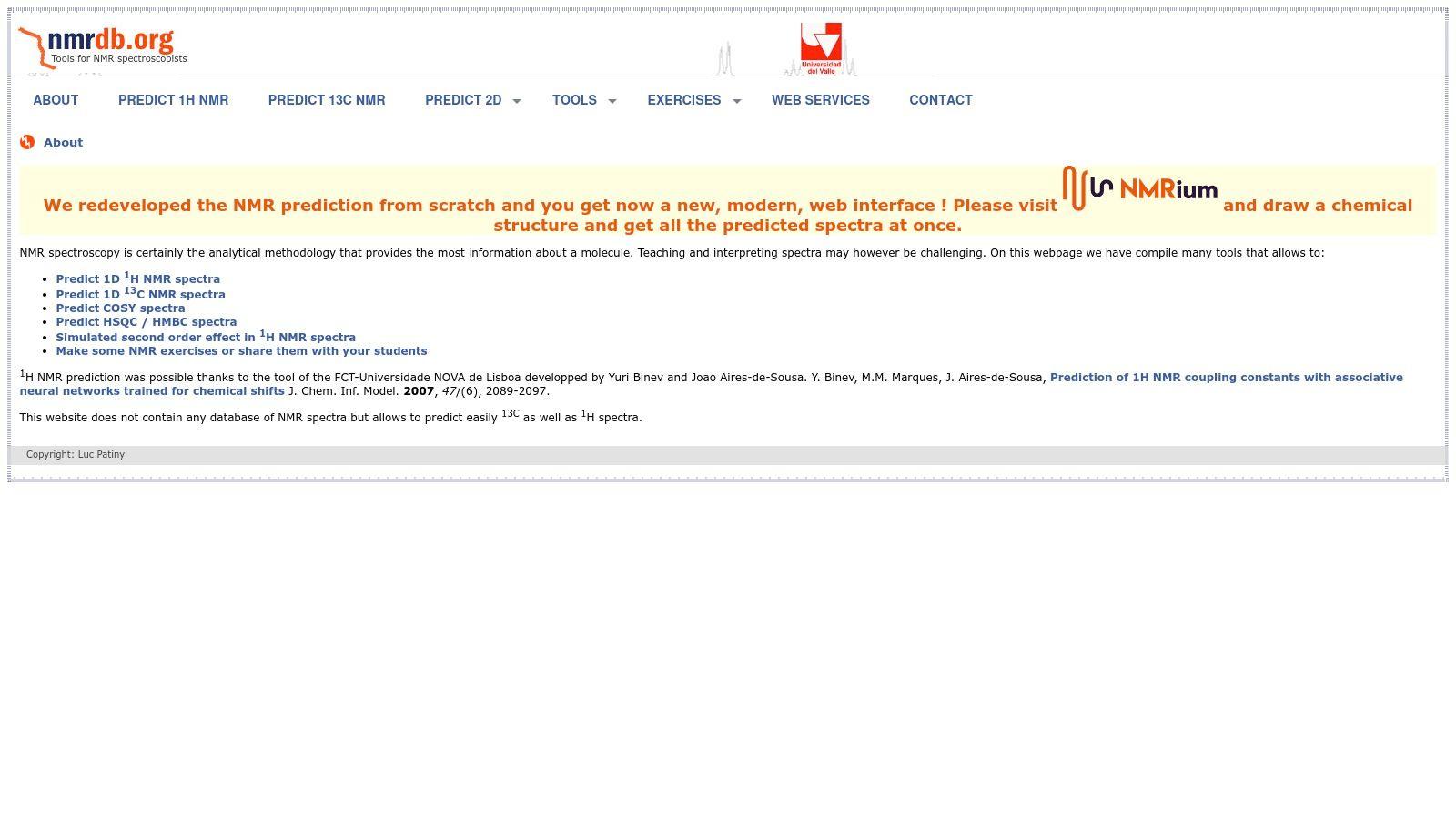
nmrdb.org is a specialized academic website that serves as a powerful organic chemistry solver for predicting and interpreting Nuclear Magnetic Resonance (NMR) spectra. Unlike reaction predictors, this tool focuses exclusively on one of the most critical analytical techniques in organic chemistry. It allows users to draw a molecule and instantly receive a predicted 1H and 13C NMR spectrum, making it an excellent resource for students checking homework or researchers verifying proposed structures.
The platform is entirely web-based and free, offering a straightforward user experience without requiring any software installation. Users can easily access sophisticated predictions, including 2D NMR spectra like COSY and HSQC, and even simulate complex second-order effects. Its primary strength lies in its educational value, providing a safe and accessible environment for students to practice structure elucidation and connect molecular structures to their spectral data.
Key Features and Usage
- 1D and 2D NMR Prediction: Generates predicted 1H, 13C, COSY, HSQC, and HMBC spectra from a drawn structure.
- Completely Free and Web-Based: Fully accessible online with no account or payment required, making it ideal for quick checks.
- Teaching Exercises: Includes built-in problems for students to practice interpreting spectra and determining unknown structures.
- Practical Tip: Draw the structure you propose for a lab or homework problem and compare its predicted spectrum to the experimental data you were given. Mismatches in chemical shifts or splitting patterns can help you identify errors in your proposed structure.
While its predictions are based on robust models, they are not a substitute for experimental data from real-world compound libraries. The tool is best used as a learning aid and for making quick plausibility checks rather than for definitive structure confirmation in a research setting.
Website: https://www.nmrdb.org
8. ACD/Labs — Structure Elucidator Suite
ACD/Labs Structure Elucidator Suite is a professional-grade desktop software that serves as an advanced organic chemistry solver for identifying unknown compounds. Unlike simpler homework tools, this platform specializes in computer-assisted structure elucidation (CASE) by taking raw experimental data, such as NMR and mass spectrometry, and generating a ranked list of the most probable molecular structures. It is an industry-standard tool used by researchers in pharmaceuticals, academia, and chemical industries to solve complex structural puzzles that are beyond manual interpretation.
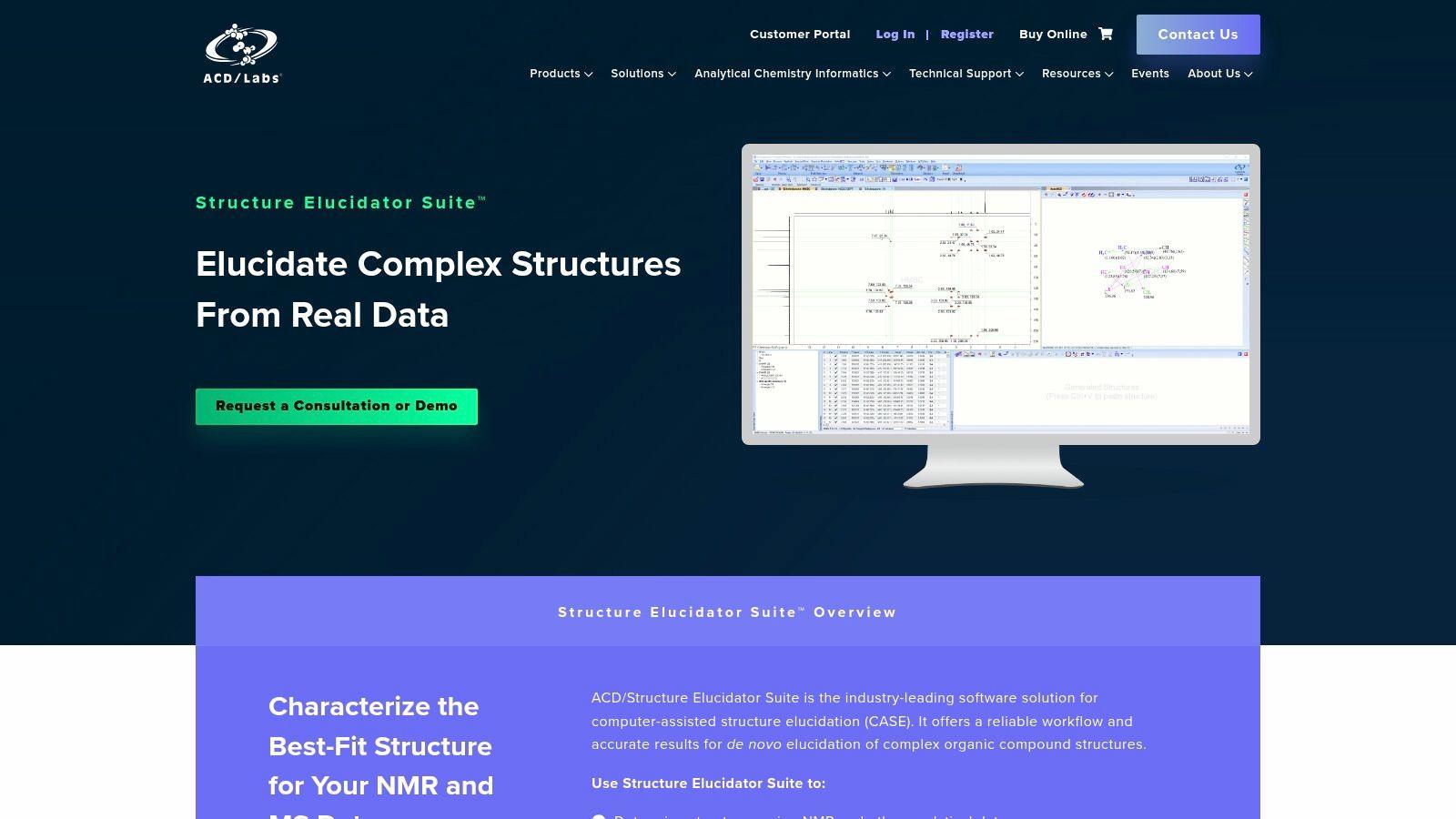
The software excels by combining sophisticated algorithms with user expertise to narrow down possibilities from vast chemical spaces. Its strength lies in its robust, data-driven approach, which makes it indispensable for postgraduate studies and commercial R&D. While its focus is on structure identification rather than reaction prediction, its ability to definitively solve for a molecule's identity from spectral data makes it a powerful, specialized solver.
Key Features and Usage
- Automated Candidate Generation: Ingests spectral data (NMR, MS) to automatically propose and rank possible chemical structures.
- Data-Driven Ranking: Uses advanced metrics like DP4 to compare proposed structures against experimental data for the best fit.
- Stereochemical Assignment: Employs NOESY/ROESY and other advanced NMR data to help determine the correct 3D arrangement of atoms.
- Practical Tip: Ideal for a final year project or Ph.D. research involving the identification of a novel natural product or synthetic byproduct; start by inputting your cleanest 1H, 13C, and HSQC spectra.
This suite is a premium, high-end tool requiring a paid license and significant user expertise; it is not a quick answer-finder. Its power is unlocked when high-quality experimental data is available, making it less suitable for introductory students but invaluable for advanced researchers tackling real-world chemical mysteries.
Website: https://www.acdlabs.com/products/spectrus-platform/structure-elucidator-suite/
9. Mestrelab Mnova — NMR Predict
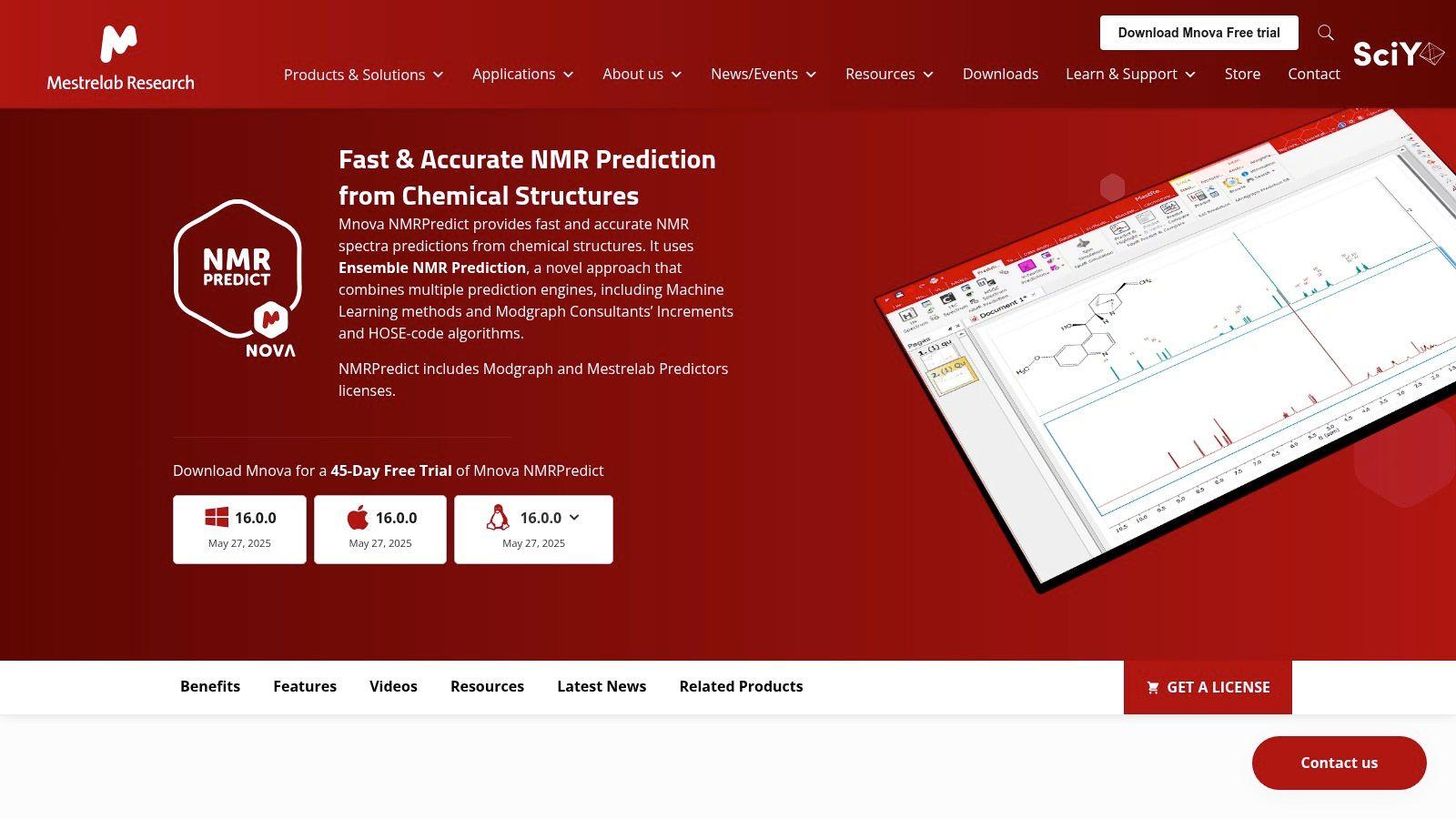
Mestrelab Mnova is a professional-grade software suite widely used in academic and industrial chemistry labs, and its NMR Predict module functions as a specialized organic chemistry solver for spectral analysis. Rather than solving reaction mechanisms, this tool excels at predicting 1H and 13C NMR spectra for a given molecular structure. It uses a sophisticated blend of methods, including HOSE codes, machine learning, and increment-based algorithms, to deliver highly accurate chemical shift and coupling constant predictions.
This makes it an indispensable tool for students and researchers trying to verify a proposed structure against experimental NMR data or to help assign peaks in a complex spectrum. The software is a desktop application, requiring installation, but it offers a seamless workflow for those already using Mnova for processing their NMR data. While it requires a paid license for long-term use, a generous 45-day free trial is available for evaluation.
Key Features and Usage
- Multi-Nuclei Prediction: Estimates spectra for various nuclei, not just proton and carbon, providing comprehensive analysis.
- High Accuracy Engine: Combines multiple predictive models to achieve results that are often very close to experimental values.
- Integrated Workflow: Seamlessly operates within the main Mnova software, allowing you to predict, process, and analyze spectra in one place.
- Practical Tip: Use the predictor to generate a theoretical spectrum for your proposed product and overlay it with your actual experimental data to quickly confirm its identity or spot discrepancies.
Mnova's focused, data-driven approach is a powerful complement to more generalized solvers. Its ability to handle complex spectral data mirrors how AI can manage intricate information sets in other fields; you can explore this further with a free AI writing assistant.
Website: https://mestrelab.com/main-product/nmr-predict
10. Wolfram|Alpha — Chemistry / Reactions
Wolfram|Alpha is a computational knowledge engine, not just a search engine, making it a uniquely powerful organic chemistry solver for quantitative problems. Instead of predicting complex mechanisms, it excels at providing concrete data-driven answers. You can input a chemical name or formula to get detailed properties, balance complex equations, or perform stoichiometry calculations, all within its straightforward, browser-based interface.
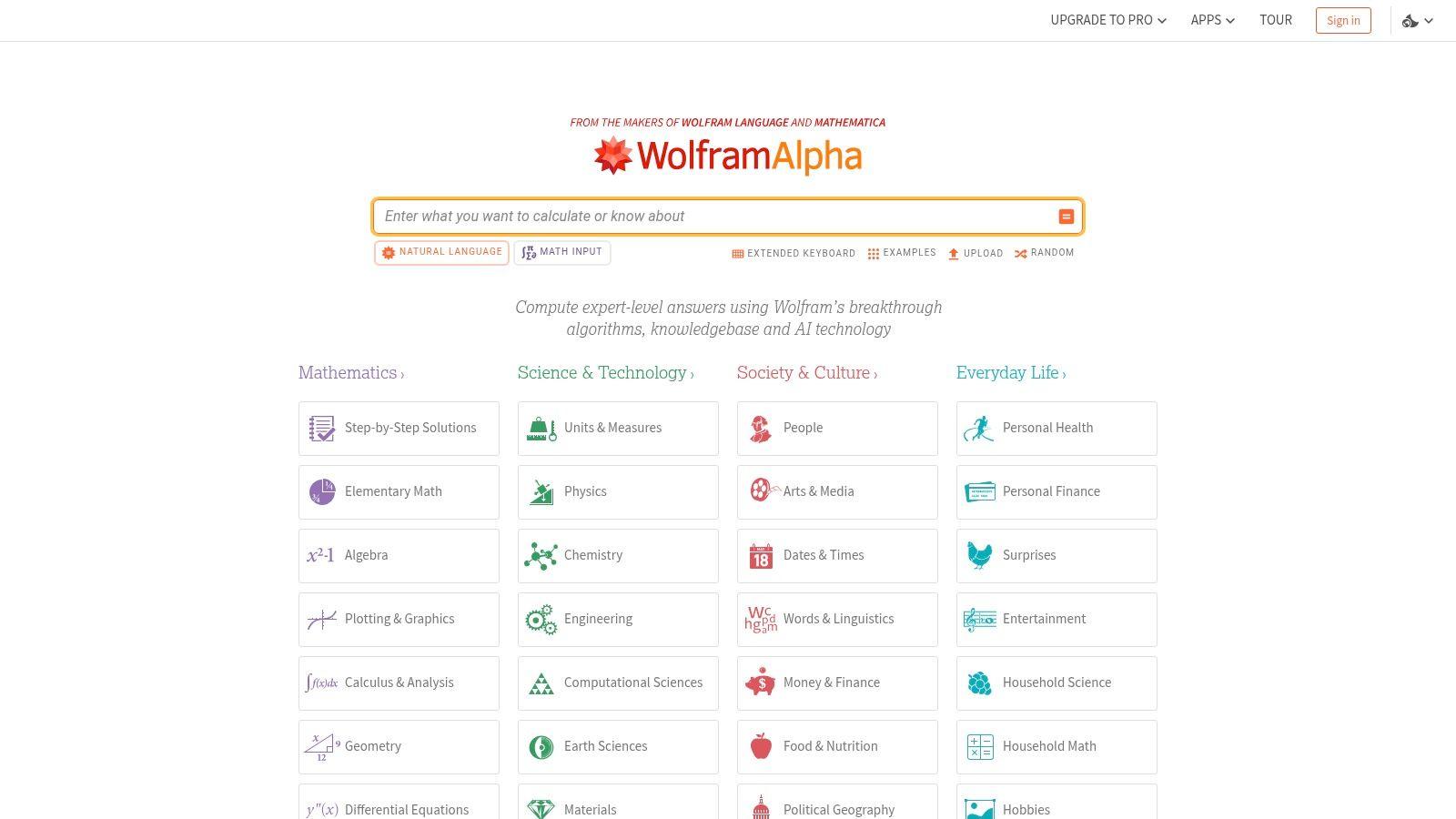
Its strength lies in its vast, curated database and computational power, delivering immediate and reliable results for homework questions related to thermodynamics, structure, and quantitative analysis. While free to use for basic queries, a Wolfram|Alpha Pro subscription unlocks step-by-step solutions, which are invaluable for understanding the process behind a calculation rather than just seeing the final answer.
Key Features and Usage
- Computational Engine: Answers specific questions about chemical properties, reaction balancing, and stoichiometry.
- Broad Chemical Database: Provides data on a vast range of compounds directly from a search query.
- Step-by-Step Solutions: The Pro version breaks down calculations, showing you how to arrive at the answer.
- Practical Tip: Use it to quickly double-check your molar mass calculations or to balance a tricky redox reaction before submitting your work. It is an excellent verification tool.
Wolfram|Alpha is less of a creative synthetic planner and more of a "chemical calculator" on steroids. It is the go-to resource when you need a definitive, computed answer rather than a predicted pathway. Its ability to interpret natural language queries for chemical data sets it apart from more specialized, structure-drawing tools.
Website: https://www.wolframalpha.com
11. ReactionFlash (Elsevier/Reaxys)
ReactionFlash stands out not as a direct organic chemistry solver for unknown problems, but as an essential learning and reference tool developed by Elsevier. Its primary function is to help students and chemists master the vast library of named organic reactions. By presenting these reactions in a flashcard format, it transforms the often daunting task of memorization into an interactive and manageable quiz-based experience. The app provides detailed mechanisms, real-world examples, and direct links to the authoritative Reaxys database for deeper research.
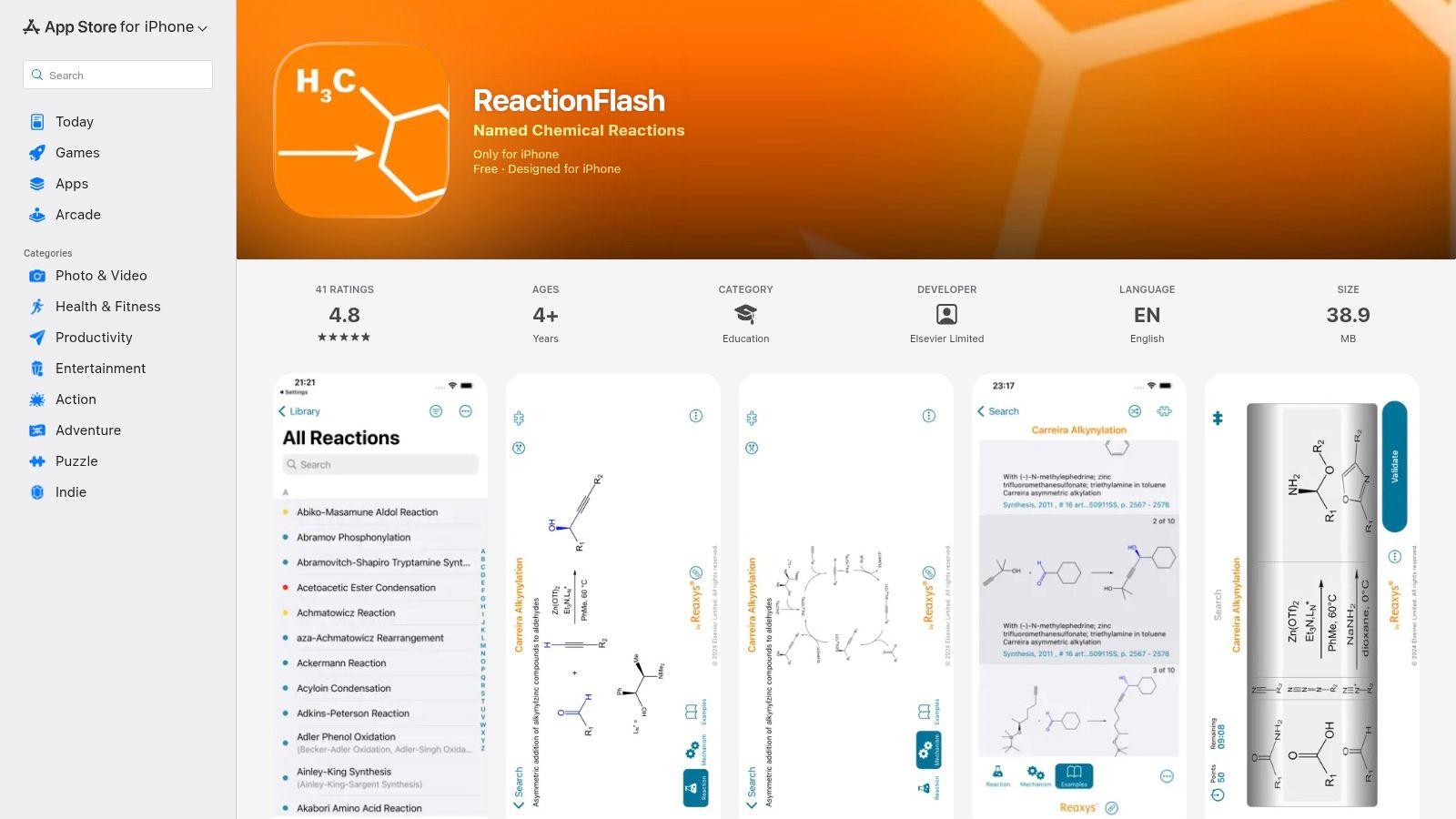
This free and highly-rated app is perfect for building the foundational knowledge required to recognize reaction patterns, which is a prerequisite for successfully using any predictive organic chemistry solver. Instead of predicting an outcome, it teaches you the known rules and transformations that govern organic synthesis, making it an indispensable study companion for exams or lab preparation.
Key Features and Usage
- Named Reaction Library: Access over 1,200 named chemical reactions, complete with detailed mechanisms and published examples.
- Quiz and Flashcard Modes: Test your knowledge and reinforce learning through an engaging, gamified interface.
- Reaxys Integration: For researchers with access, each card links directly to the Reaxys database for comprehensive literature exploration.
- Practical Tip: Use the quiz mode for 15 minutes daily to build a strong mental library of reactions. This will help you recognize multi-step synthesis problems more intuitively.
While ReactionFlash doesn't solve homework problems for you, it equips you with the knowledge to solve them yourself. It's a powerful tool for self-assessment and targeted study, ensuring you understand the "why" behind a reaction, not just the "what."
Website: https://apps.apple.com/us/app/reactionflash/id432080813
12. Schaum’s Outline of Organic Chemistry (book)
Moving from digital tools to a classic, trusted resource, Schaum’s Outline of Organic Chemistry is a quintessential problem-solver in book form. This guide is less of an instant answer generator and more of a training manual, containing over 1,800 fully solved problems that cover the entire organic chemistry curriculum. Its purpose is to teach students how to approach problems methodically, making it an indispensable companion for exam preparation and homework.
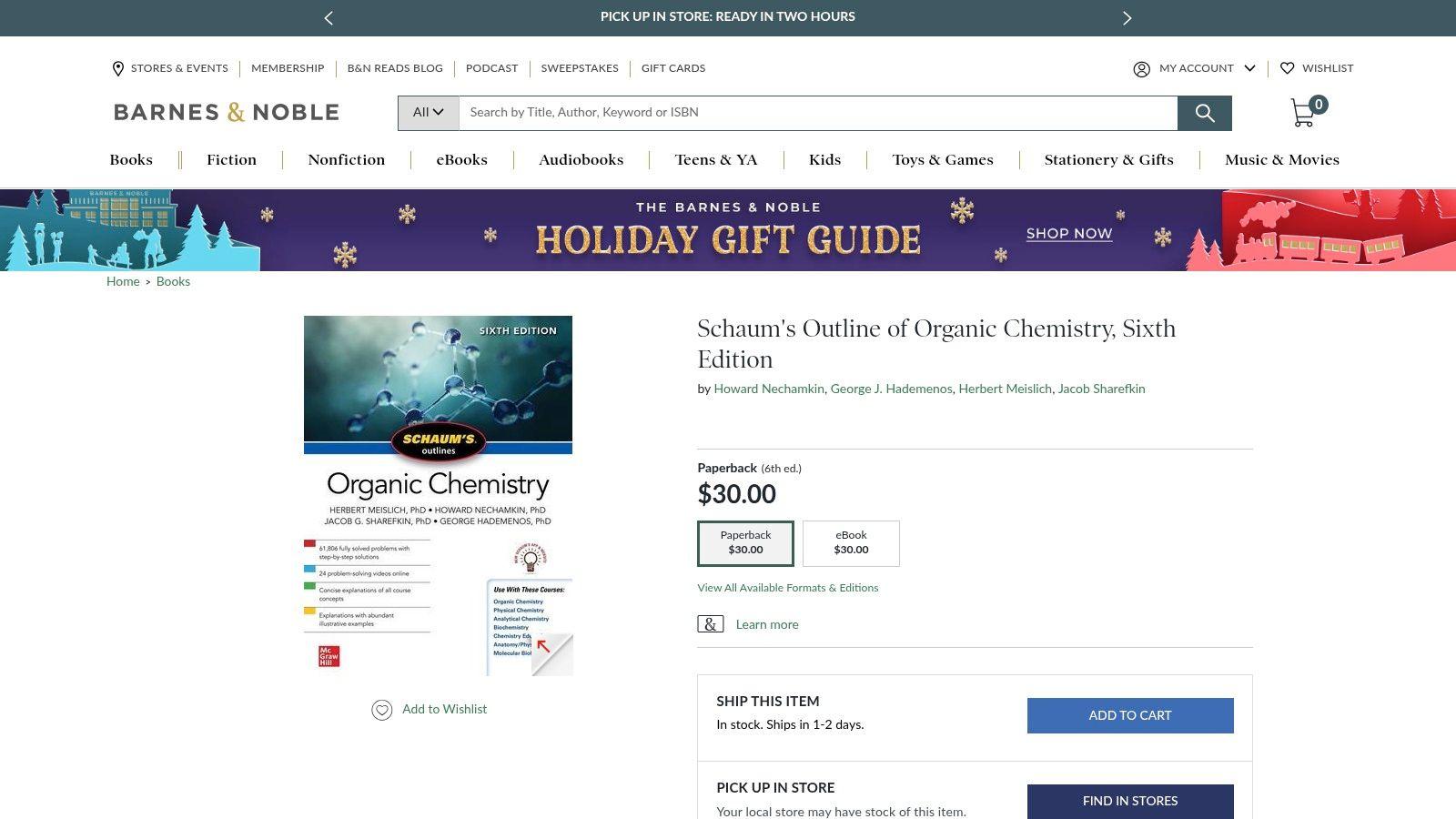
The book’s strength lies in its sheer volume of practice questions with clear, step-by-step solutions that break down complex mechanisms and synthesis questions into digestible parts. While it lacks the interactive nature of AI solvers, its structured, topic-by-topic organization helps reinforce classroom learning in a way that builds lasting problem-solving skills. It serves as a static but incredibly reliable organic chemistry solver for students aiming for mastery through practice.
Key Features and Usage
- Massive Problem Library: Features over 1,800 solved problems with detailed explanations, covering all major topics.
- Topic-Focused: Organized to align with standard organic chemistry course structures for easy reference.
- Affordable and Accessible: Widely available as a physical book or eBook, making it a cost-effective study aid.
- Practical Tip: Use the book to supplement your lecture notes. After a new topic is introduced in class, immediately work through the corresponding problems in Schaum’s to solidify your understanding.
While it's a powerful tool for self-study, it operates very differently from dynamic AI assistants. The structured learning it provides complements the instant feedback from digital tools, demonstrating how different resources can support academic success. To see how modern technology assists with academics, you can explore the best AI tools for students.
Top 12 Organic Chemistry Solvers — Feature Comparison
| Tool | ✨ Core features | 👥 Target audience | ★ Quality | 💰 Pricing/value | 🏆 Unique selling point |
| IBM RXN for Chemistry | Forward prediction, retrosynthesis, atom-mapping, cloud UI ✨ | Academic & industry chemists, students 👥 | ★★★★☆ | 💰 Free (account, usage limits) | 🏆 Browser-based AI retrosynthesis; quick “what-if” exploration |
| ASKCOS (MIT) | Retrosynthetic tree builder, buyable-precursor heuristics, open-source ✨ | Academic researchers & educators 👥 | ★★★★☆ | 💰 Free for research | 🏆 Transparent methods + focus on purchasable starting materials |
| SYNTHIA (Merck/MilliporeSigma) | Expert-coded/AI retrosynthesis, rich filters, sourcing links ✨ | Pharmaceutical R&D & corporate chemists 👥 | ★★★★★ | 💰 Commercial license | 🏆 Bench-validated routes with deep filtering and Sigma-Aldrich integration |
| Spaya (Iktos) | Ranked routes, synthetic-accessibility scoring, high-throughput API ✨ | Enterprise screening teams, cheminformatics 👥 | ★★★★☆ | 💰 Commercial (quote/demo) | 🏆 Scalable API for bulk triage and retrainable models |
| ACD/Labs — ACD/Name | IUPAC naming, name↔structure conversion, batch tools ✨ | Publishers, patent chemists, analysts 👥 | ★★★★★ | 💰 Paid license | 🏆 Industry-trusted nomenclature with rule traceability |
| ChemAxon — Naming & Conversion | Bi-directional naming, multi-language, SDKs ✨ | Enterprises & developers 👥 | ★★★★☆ | 💰 Licensed/enterprise | 🏆 Robust developer tooling and custom dictionaries |
| nmrdb.org | 1H/13C & 2D NMR prediction, interactive viewers ✨ | Students, academics, structure validators 👥 | ★★★★☆ | 💰 Free | 🏆 Free web-based NMR prediction and 2D simulators |
| ACD/Labs — Structure Elucidator | CASE solver, candidate ranking, stereochemical assignment ✨ | Analytical chemists, spectroscopy teams 👥 | ★★★★★ | 💰 Premium desktop license | 🏆 Powerful CASE with DP4-style ranking and robust reports |
| Mestrelab Mnova — NMR Predict | Multi-nuclei shift & J prediction, Mnova integration ✨ | NMR spectroscopists using Mnova 👥 | ★★★★☆ | 💰 Paid (trial available) | 🏆 High-accuracy blended predictors integrated into Mnova workflows |
| Wolfram | Alpha — Chemistry | Reaction balancing, property computation, formula interpretation ✨ | Students, educators, quick-check users 👥 | ★★★☆☆ | 💰 Free/basic · Pro for steps |
| ReactionFlash (Elsevier/Reaxys) | 1,200+ named reactions, mechanisms, flashcards/quiz ✨ | Students & researchers learning reactions 👥 | ★★★★★ | 💰 Free (app) | 🏆 Curated named-reaction library with quiz/flashcard learning |
| Schaum’s Outline (book) | 1,800+ solved problems, topic organization, exam prep ✨ | Students prepping courses/exams 👥 | ★★★★★ | 💰 Affordable book/ebook | 🏆 Extensive worked problems for learning problem-solving techniques |
From Problem to Solution: Empowering Your Chemistry Journey
The intricate world of organic chemistry, with its complex reactions and subtle molecular dance, can feel overwhelming. However, as we've explored, a powerful suite of digital tools has emerged to serve as your guide, tutor, and lab partner. The journey from a confusing problem to a clear solution is now more accessible than ever, thanks to the specialized capabilities of the modern organic chemistry solver.
We've seen how tools like IBM RXN and ASKCOS are revolutionizing synthetic planning with AI, while platforms such as nmrdb.org and Mestrelab Mnova demystify the complex data from spectroscopic analysis. For foundational learning and quick reference, resources like ReactionFlash and even the classic Schaum's Outline provide the structured practice necessary to build confidence. The central takeaway is that there is no single "best" tool, only the right tool for your specific challenge.
Your Next Steps: Choosing and Implementing the Right Solver
To make the most of these resources, it's crucial to adopt a strategic approach. Before committing to a tool, consider the following actionable steps:
- Identify Your Primary Need: Are you a college student struggling with reaction mechanisms, a researcher designing a novel synthesis pathway, or a professional needing to quickly name a complex structure? Your primary use case will immediately narrow down the options. For synthesis planning, look to AI powerhouses like SYNTHIA or Spaya. For homework help and conceptual understanding, Wolfram|Alpha is an excellent starting point.
- Evaluate the Learning Curve: Some tools, like the comprehensive ACD/Labs suites, offer immense power but require a significant time investment to master. Others, like ReactionFlash, are designed for intuitive, on-the-go learning. Assess how much time you can realistically dedicate to learning a new platform.
- Consider Data Privacy and Cost: For students and individual learners, free resources like nmrdb.org or the academic version of ASKCOS are invaluable. For teams in a corporate or research setting, the investment in a premium tool like SYNTHIA or a ChemAxon suite may be justified by its advanced features and robust data security. Always review the privacy policy, especially if you are working with proprietary or unpublished chemical structures.
Building Intuition, Not Just Finding Answers
The ultimate goal of using an organic chemistry solver is not simply to get an immediate answer. It's about building a deeper, more resilient understanding of the principles at play. Use these tools as a starting point for inquiry. When an AI suggests a reaction pathway, ask yourself why it chose those steps. When a tool predicts an NMR spectrum, try to rationalize the chemical shifts and splitting patterns on your own first.
By integrating these platforms thoughtfully into your study or research workflow, you transform them from simple answer-finders into powerful educational instruments. They become a digital mentor, available 24/7 to help you visualize mechanisms, predict outcomes, and untangle complex molecular puzzles. Embrace this technological advantage, experiment with the different options, and let them empower you to not just solve problems, but to truly master the elegant logic of organic chemistry.