You're staring at a draft that should sound clear, but each sentence feels like it belongs to a different conversation. The ideas are right, the facts are there, yet the page still reads like a pile of separate notes. That's usually the moment a palabra de transicion is missing, or used in the wrong place.
A strong transition doesn't decorate the sentence, it connects it. In Spanish, in English, and in bilingual writing, that connection is what helps readers follow your logic without stopping to decode every turn. For a quick research shortcut while you write, you can also keep 1chat's research tools open in another tab.
Why Your Writing Feels Choppy (and How to Fix It)
A common writing problem shows up in emails, essays, and even product pages. The draft has good content, but every line starts over from zero, so the reader has to rebuild the logic again and again. That's exhausting, and it makes even a smart point feel less convincing.
A transition word acts like a bridge between the islands. One sentence adds a detail, the next sentence shows contrast, and the following one explains why the idea matters. Without that bridge, readers can still understand the message, but they have to do more work than they should.
The real problem is connection, not vocabulary
Many writers assume they need more elaborate words. In reality, they often need better relationships between ideas. A short paragraph that says “also,” “however,” or “therefore” in the right place can be much clearer than a longer paragraph packed with fancy phrasing.
Practical rule: If a reader has to guess how one sentence relates to the next, the transition is either missing or weak.
This matters in everyday writing too. A small business owner writing a homepage, a student writing a report, or a bilingual marketer localizing a campaign all need the same thing, a smooth path from one thought to the next. That's the job of a palabra de transicion.
What Is a Palabra De Transicion and Why It Matters
A palabra de transicion is a connective word or phrase that signals the relationship between ideas. In plain terms, it tells the reader what kind of move you're making, adding information, contrasting a point, showing cause and effect, or closing the argument. That's why transition words are often described as discourse connectors, not just style flourishes.
The useful way to think about them is as road signs. If you see “however,” you expect a turn. If you see “therefore,” you expect a conclusion or result. If you see “además” or “in addition,” you expect more information, not a change of direction.
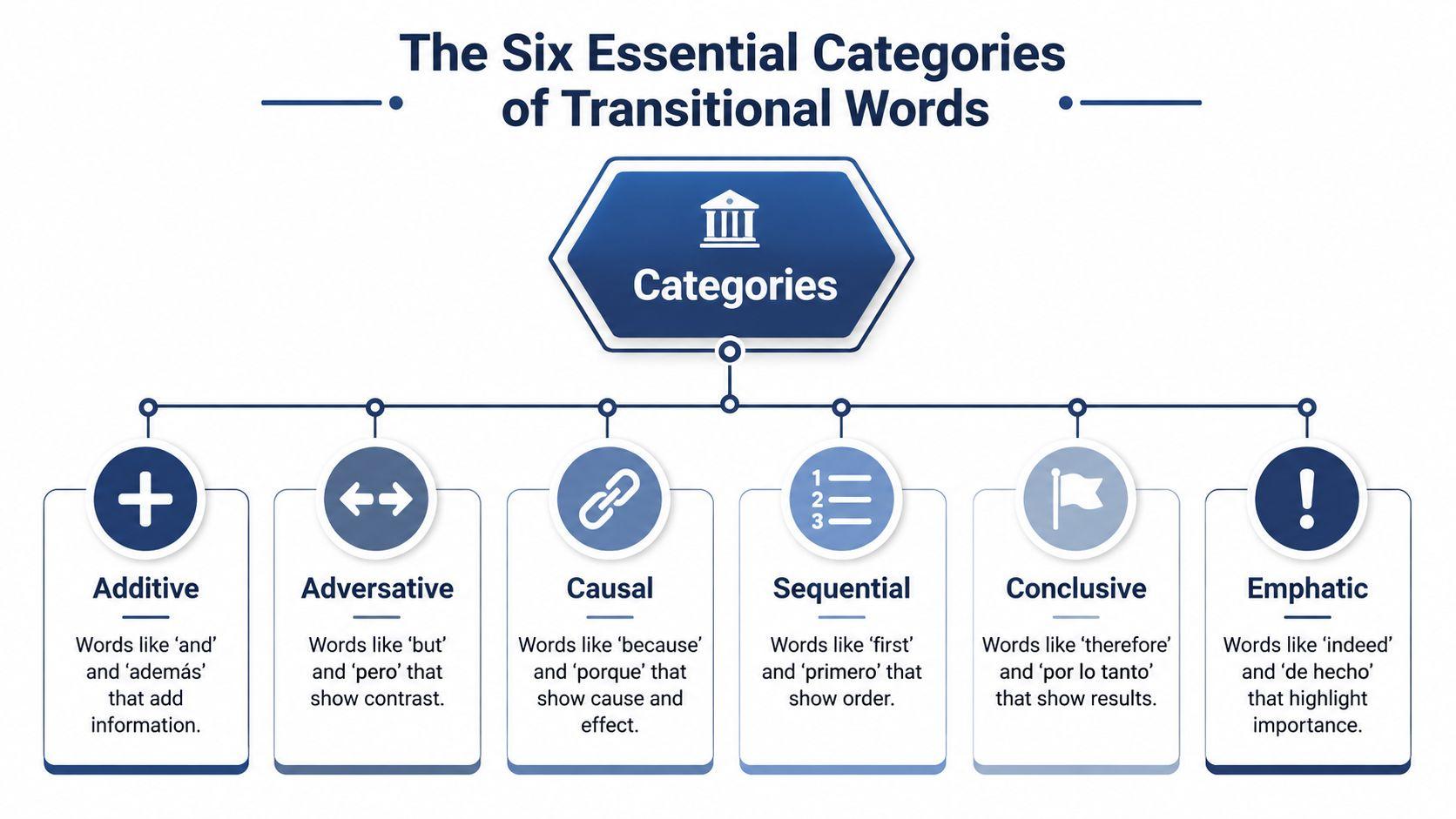
The most useful part of the definition is this, transitions aren't just about sounding polished. They mark addition, contrast, causality, sequence, conclusion, and emphasis. That's why they matter in essays, reports, presentations, and business writing, especially when you're moving between Spanish and English and you don't want a literal translation to sound stiff.
Why readers notice them so quickly
Readers don't consciously track every connector, but they feel the effect immediately. A paragraph with clean transitions feels guided. A paragraph without them feels like it keeps restarting.
One SEO tutorial notes that only 27% of sentences in a sample used transition words, which was below the level considered sufficient for smooth readability, and that number helps explain why many web pages feel abrupt (Webpositer on palabras de transición y SEO). In other words, transition words aren't optional extras when clarity matters.
If you're writing for a classroom, a website, or a team, a useful next step is to test your own draft the way a reader would. A multilingual quiz builder can help teachers, tutors, and teams turn transition practice into a quick self-check without making it feel like a grammar drill.
The Six Essential Categories of Transitional Words
Transitions work best when you match the word to the relationship. That sounds simple, but it's where many writers slip. A contrast word in an additive spot, or a causal word where you only meant to continue the same thought, can distort the meaning.
Additive, contrastive, and causal moves
The first three categories are the ones writers use most often. Additive transitions add information, like and, also, además, or furthermore. Contrastive transitions shift direction, like but, however, pero, or sin embargo. Causal transitions show reason or result, like because, therefore, porque, or por lo tanto.
Here's a simple bilingual pattern:
- Additive: The proposal is clear. Además, it gives the team a timeline.
- Contrastive: The proposal is clear. Sin embargo, it leaves the budget undefined.
- Causal: The proposal is clear. Por lo tanto, the team can review it faster.
Sequence, conclusion, and emphasis
Sequential transitions organize steps, like first, next, primero, or después. Conclusive transitions signal closure, like therefore, in conclusion, por lo tanto, or en conclusión. Emphatic transitions highlight importance, like indeed or de hecho.
The point is not to memorize huge lists. The point is to recognize the job each word is doing.
| Category | Function | Spanish Example | English Example |
| Additive | Adds information | además | also |
| Contrastive | Shows contrast | sin embargo | however |
| Causal | Shows reason or result | por lo tanto | therefore |
| Sequential | Shows order | primero | first |
| Conclusive | Signals a conclusion | en conclusión | in conclusion |
| Emphatic | Highlights importance | de hecho | indeed |
For writers who want a compact reference while drafting, 1chat's blog can be a useful place to compare writing tools and ideas in one spot.
Bilingual Examples and Before and After Rewrites
Theory makes more sense when you can see the change on the page. A transition doesn't just make a sentence “sound better,” it tells the reader how to interpret the relationship between two ideas.
Sentence level rewrites
Weak: The new menu is cheaper. It uses fresher ingredients.
Better: The new menu is cheaper. At the same time, it uses fresher ingredients.
Weak: The client wanted a fast launch. The team delayed the release.
Better: The client wanted a fast launch. However, the team delayed the release.
Weak: The campaign started in March. The team reviewed the results in April.
Better: First, the campaign started in March. Then the team reviewed the results in April.
A small change like this matters because it removes guesswork. The reader doesn't have to infer whether the second idea adds information, contradicts the first, or follows it in time.
Paragraph level rewrites
Before: The store updated its website. The checkout page looked cleaner. Customers still abandoned carts. The owner changed the payment flow.
After: The store updated its website, and the checkout page looked cleaner. However, customers still abandoned carts. As a result, the owner changed the payment flow.
Multilingual writers often run into trouble. English academic style and Spanish business style don't always place transitions in the same rhythm, so a literal carryover can sound repetitive or unnatural. If you're working on a document that needs a natural handoff between languages, the guide on how to translate Spanish documents for business is a practical reference point.
The simplest test is this, read the paragraph aloud. If each transition sounds forced, the text probably needs fewer markers and stronger sentence logic.
Common Mistakes and How to Avoid Them
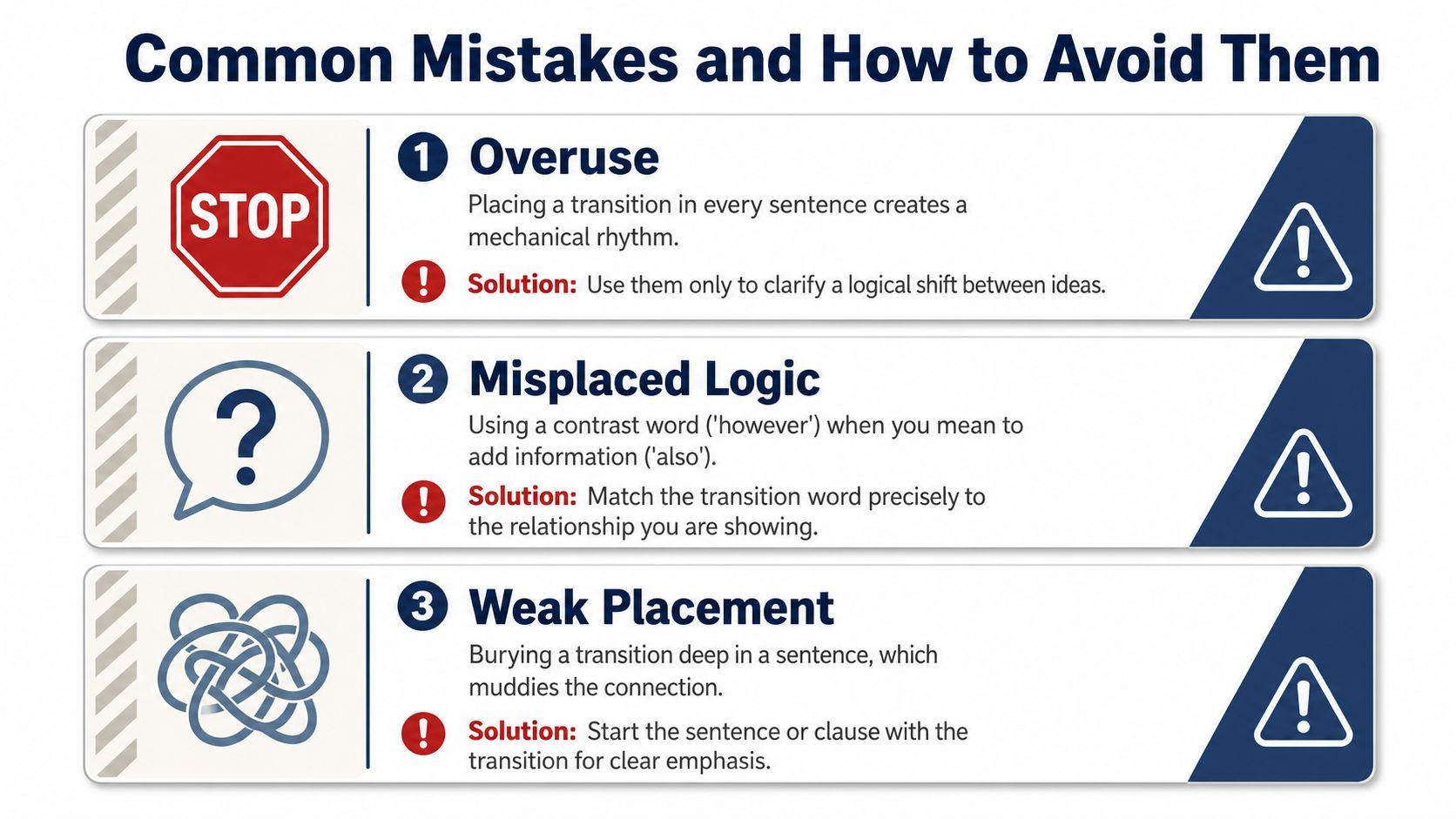
The biggest misconception is that more transitions automatically mean better writing. They don't. If every sentence starts with a connector, the paragraph starts to sound mechanical, like it was assembled from a template rather than written by a person.
Overuse and formulaic rhythm
Academic guides warn writers to prioritize clarity, choose the transition that matches the relationship, and avoid repetition because overloaded transitions sound rigid and repetitive (LibreTexts on transitions in business communication). That advice is especially useful for AI-assisted drafts, which often lean on the same safe connectors again and again.
Here's a quick self-editing check:
- Scan for repetition: If you see the same connector several times in one paragraph, replace at least one of them with a cleaner sentence break.
- Match the logic: Use however for contrast, not for simple addition.
- Watch the register: Some phrases sound fine in conversation but feel too loose in a report or proposal.
Literal translation and awkward placement
Literal translation is the other trap. A connector that sounds natural in English may feel stiff in Spanish, and the reverse is true as well. That's why cross-language writing needs judgment, not just a list of equivalents.
Better writing often uses fewer, more precise transitions, not more transitions.
Placement matters too. If the connector is buried deep in the sentence, the relationship gets muddy. A transition works best when it arrives early enough to guide the reader, not after the main idea has already gone past.
Practice Exercises for Students and Small Businesses
Practice works best when it's tied to real writing. Students can take one paragraph from an essay and label each relationship, addition, contrast, cause, or sequence, then replace any weak connector with a more accurate one. Small business teams can do the same with a product page, an email, or a memo.
Quick exercises that build instinct
Try this routine with a class assignment or a work draft:
- Underline every transition: Mark each connector you already used.
- Name the relationship: Ask what each one is doing, adding, contrasting, ordering, or concluding.
- Remove one third of them: If the text still reads clearly, you probably had too many.
- Rewrite one paragraph aloud: If it sounds stiff, trade one formal marker for a cleaner sentence structure.
For teachers, a good speaking task is to have students explain why they chose one connector over another. For teams, that same exercise helps editors catch awkward phrasing before a campaign goes live.
If you need a fast way to draft a speech for a graduation, award, or company event, Honored Words' AI speech writer for milestones can help you shape the message, then you can refine the transitions by hand for a more natural voice.
A simple daily habit helps too. Pick one paragraph, find one missing connection, and improve only that part. For a quick Q&A on writing help and platform basics, 1chat's FAQ is a good place to check what the tools can and can't do.
If you want cleaner Spanish-English writing, open one draft today and revise only the transitions. Use one paragraph, one pass, and one clear goal, make the logic easier to follow. If you're comparing writing tools for students, teams, or small businesses, try 1chat next and see how much easier it is to edit when your ideas already connect well.