If you can name every section of a research paper, can you explain why each one belongs there? Knowing the headings isn't the same as knowing how to connect a research question to a defensible conclusion.
The parts to a research paper work together as a chain of claims and evidence. Each section gives readers something they need before they can evaluate the next, and each connection gives you a useful place to check your argument.
Research Paper Parts at a Glance
A standard empirical research paper includes a title, abstract, introduction, literature review, methods, results, discussion, and references, with a conclusion often following the discussion. These are functions to fulfill, not necessarily separate headings: a journal may combine the literature review with the introduction or place the conclusion inside the discussion.
Use this lookup table to plan what belongs where.
| Part | Question It Answers | What It Must Include | Length Guide |
| Title | What is the study about? | Main variables or concept, population or context, and design when useful | Follow journal requirements; keep it concise |
| Abstract | What was done and what was found? | Purpose, method, key results, and conclusion; use the required paragraph or structured format | Follow the journal's abstract limit |
| Introduction | Why does this study matter? | Problem, gap in existing research, research question or hypothesis | Set by journal or assignment |
| Literature review | What is already known? | Organized sources that build toward the research gap | Set by journal or assignment |
| Methods | How was the study done? | Design, participants or data, procedure, and analysis, with enough detail to evaluate and repeat the work | Set by journal; use supplements when permitted |
| Results | What did the study find? | Findings addressing the research questions, supported by appropriate tables and figures | Set by journal |
| Discussion | What do the findings mean? | Interpretation, comparison with prior work, implications, and limitations | Set by journal |
| Conclusion | What is the takeaway? | Contribution and future work justified by the findings | Brief; follow journal requirements |
| References | Which sources support the paper? | Every cited source, formatted in the required style | Format set by style guide |
Plan for different reading needs
Readers can use the title and abstract to judge relevance before committing to the full paper. Reviewers examine the methods and results to decide whether the evidence supports the claims, so don't spend your entire writing effort polishing the opening.
Before drafting, save the target journal's author instructions alongside your outline. Record heading requirements, word limits, abstract format, and rules for supplementary materials rather than assuming a familiar template will fit.
For organizing the material behind those sections, BlokNotes' research note-taking use cases offer a starting point for thinking about source notes and research organization. Keep source summaries separate from your interpretations so you can trace a claim back to its evidence.
The reader's logical path is problem, investigation, findings, meaning. Your drafting order can differ: prepare the evidence-bearing sections before trying to summarize the completed argument.
Why Research Papers Follow the IMRaD Order
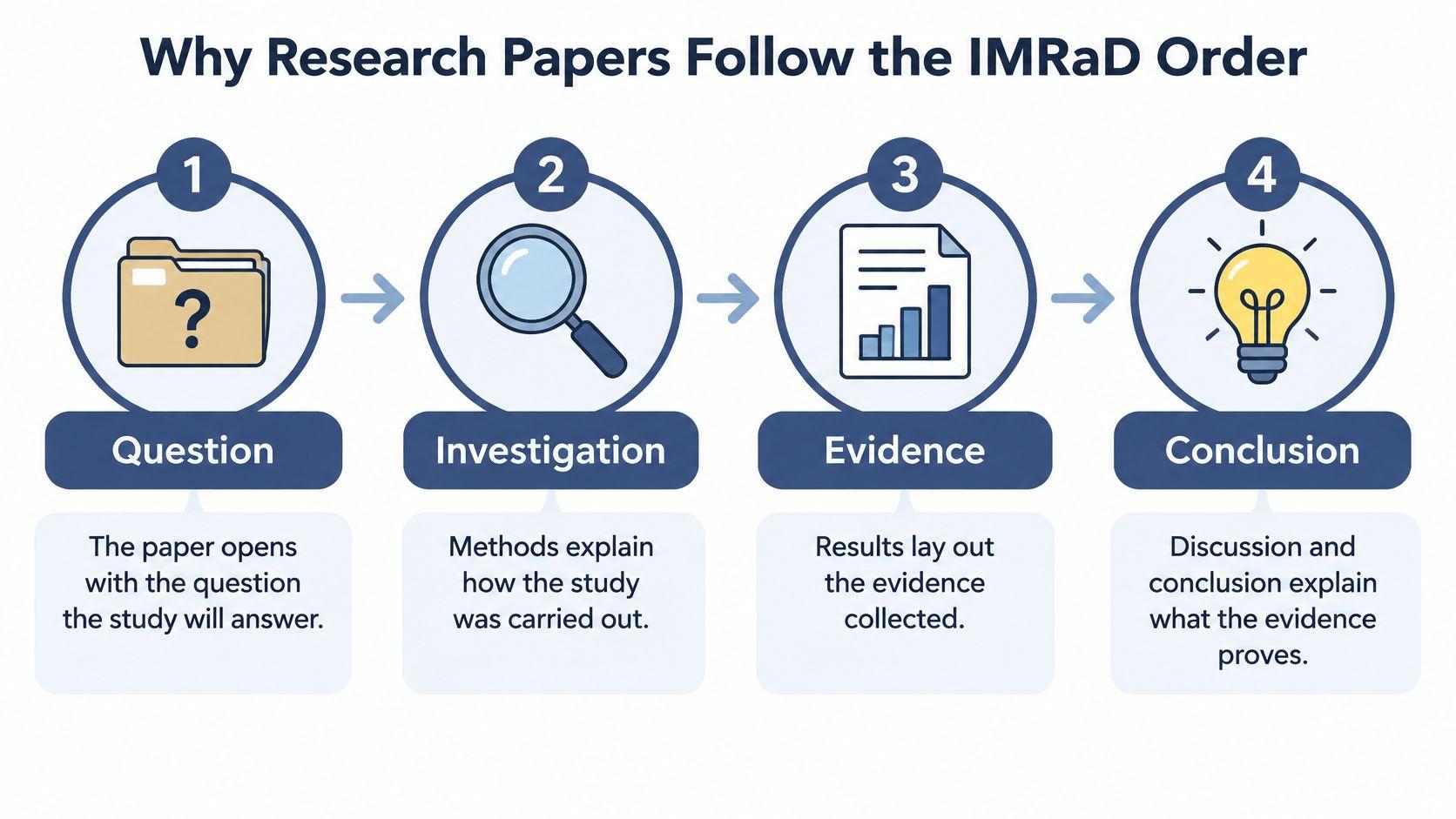
Think of a detective's case file. The investigator identifies the question, explains the investigation, presents the evidence, and evaluates what that evidence supports. A convincing account doesn't begin with a verdict and leave readers guessing how anyone reached it.
IMRaD follows that logic: Introduction, Methods, Results, and Discussion. It separates the question from the procedure, the observations from their interpretation, and the interpretation from unsupported speculation.
A publishing convention with a practical purpose
A historical survey of IMRAD adoption examined randomly selected articles published between 1935 and 1985 in the British Medical Journal, JAMA, The Lancet, and the New England Journal of Medicine, finding no complete IMRAD articles in the sampled 1935 papers and approximately 80% use in the 1970s.
That history helps explain why the structure isn't merely a classroom exercise. Scientific publishers gradually adopted a recognizable arrangement that lets readers locate different kinds of information.
The introduction establishes the problem and objectives. Methods explains how the researchers investigated them, results presents the evidence, and discussion evaluates its meaning and limitations.
Diagnostic check: Could a skeptical reader locate the procedure, the finding, and your interpretation without having to untangle them from the same paragraph?
Say you investigate smartphone use and reading comprehension. Your question concerns a possible relationship, your method explains how you measured both concepts, your results describe the observed relationship, and your discussion considers possible explanations.
The separation matters because an association doesn't automatically establish a cause. Readers need to inspect the design before accepting the interpretation.
An empirical paper therefore needs more than an expanded introduction and a persuasive ending. It must make the investigation inspectable. Humanities papers and some other forms of scholarship may instead organize their evidence thematically, so treat IMRaD as a useful default for empirical work, not a universal requirement.
Title and Abstract as the First Impression
Your title should tell the right reader what you investigated, not merely announce a broad subject. Your abstract should give that reader enough substance to judge whether the full paper is relevant.
Build an informative title
Use this sequence:
- Name the concept or variables. Identify what you studied rather than using a broad category.
- Specify the population or context. Help readers recognize the boundaries of the investigation.
- Add the design when useful. Include it when it changes how readers should understand the study.
A weak hypothetical title is Students and Technology. A stronger version is Smartphone Use and Reading Comprehension in Secondary School Students. The stronger version identifies both the relationship of interest and the group without promising a causal finding.
Write an abstract that represents the paper
The separation of problem, method, results, and interpretation reflects the manuscript functions described in an account of the APA Publication Manual's framework. Apply those distinctions even when your abstract appears as a continuous paragraph.
Build it through these moves:
- Context. Establish the topic without an oversized opening about society.
- Problem. Identify the specific uncertainty your study addresses.
- Method. Summarize the design, sample, and main measures.
- Finding. State the principal result, using the actual estimate where appropriate.
- Implication. Explain what the result supports within the study's limits.
A weak abstract says the paper examines an important topic and discusses implications. A stronger hypothetical version identifies the relationship examined, explains how it was measured, reports the observed direction, and limits its takeaway to the population studied.
For help recognizing those moves in practice, Lumi Humanizer's research abstract structure and examples provide a useful drafting reference. Follow your journal's format and length requirements, and replace every placeholder with verified study details before submission.
Introduction and Literature Review Build the Case
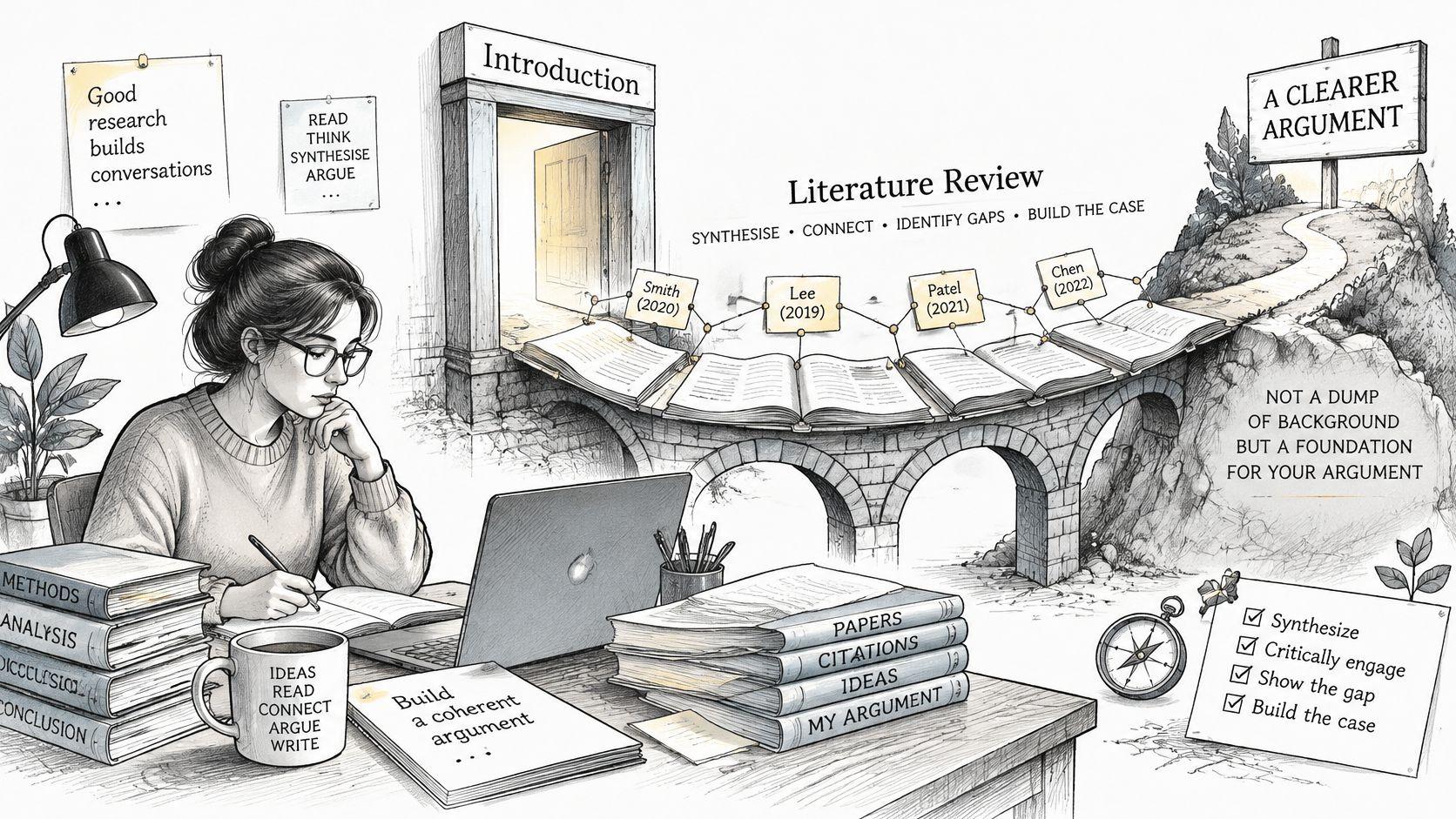
The introduction and literature review should explain why this question follows from what scholars already know. A background summary isn't enough if readers finish it without understanding what remains unresolved.
In a study of early-stage postgraduate writers' challenges, literature-review writing was the most frequently reported difficulty, with 82 recorded problems, followed by methodology with 78. These are reported problems, not percentages of all students.
Turn source summaries into synthesis
Build the introduction through context, problem, gap, research question or hypothesis, and a short roadmap when appropriate. The literature review supplies the detailed reasoning behind that progression.
Consider these hypothetical source relationships, not actual study findings:
- Weak transition. Study A examined sleep. Study B examined memory.
- Stronger transition. Study A associated restricted sleep with poorer recall, while Study B examined a different memory task. Whether that association extends to reading comprehension remains unresolved.
The stronger version explains what the sources jointly establish and what they leave uncertain. It doesn't claim that conflicting findings mean nobody has investigated the topic.
Group sources by theme, method, disagreement, or explanatory approach, rather than giving every author a separate paragraph. Describe differences in populations or measurements when they explain why findings aren't directly comparable.
For source exploration, 1chat's research tools can be considered alongside Zotero for reference management and a spreadsheet for comparing studies. Keep your own record of each source's question, method, finding, and relevance.
A research gap is a specific unresolved issue you can investigate, not simply a topic you haven't read about yet.
Test the connection before moving on: can you state the gap in a sentence, and does the review's final paragraph lead directly to it? Then ask whether your proposed method can answer the resulting question. If you ask about causes but only measure an existing association, revise the question or strengthen the design.
Methods and Results Prove What Was Done and Found
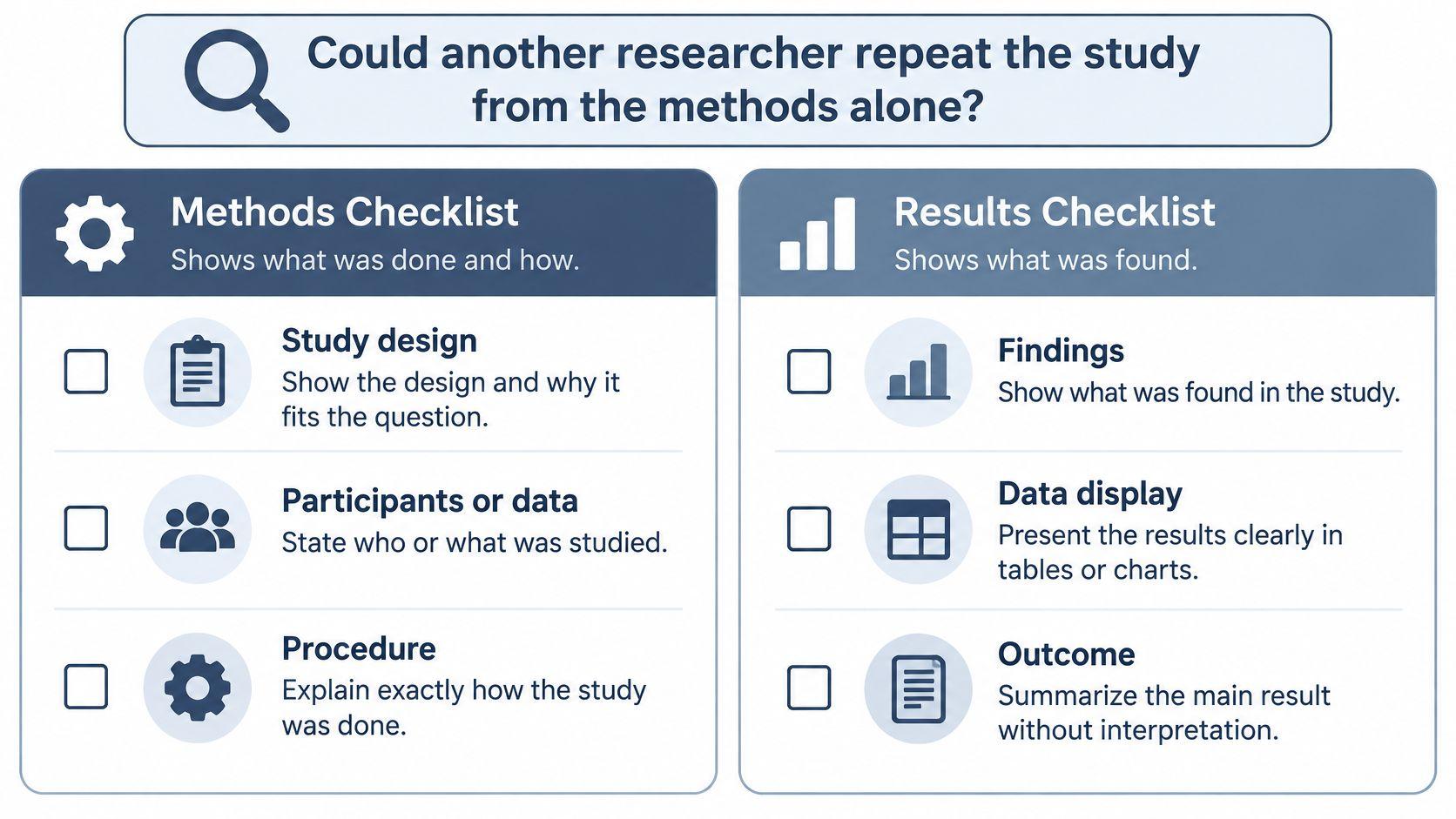
Could another researcher repeat the study from your methods alone? That question exposes missing details more effectively than asking whether the section sounds academic.
Readers also need enough information to judge whether your choices were appropriate. A repeatable procedure can still be poorly matched to the research question.
Make the procedure inspectable
Include the details that let readers reconstruct your investigation:
- Study design. Identify the approach and explain why it fits the question.
- Participants or data. Describe eligibility, recruitment, sample size, exclusions, or dataset selection.
- Instruments and materials. Name questionnaires, tasks, equipment, or documents, and explain the basis for trusting the measures.
- Procedure. Describe the sequence, timing, instructions, and conditions that could affect the outcome.
- Analysis. Specify tests or coding procedures, missing-data handling, and relevant software.
- Ethics. Report approval, consent, confidentiality measures, or the applicable exemption accurately.
For a student survey, don't stop at saying participants completed an online questionnaire. Explain how they received the invitation, who could participate, how incomplete responses were handled, and how the reading-comprehension measure was scored.
Describe what you did, including departures from the original plan. If you changed an analysis after examining the data, identify that change rather than presenting it as planned.
Report findings without overstating them
Organize results in the order of the research questions. Lead with the finding that answers the question, then provide the supporting estimates, uncertainty, and effect sizes when appropriate.
Report relevant non-significant findings rather than leaving them out because they complicate your preferred explanation. In qualitative work, connect themes to supporting material and explain meaningful exceptions.
Reporting rule: Use the text to identify the finding; use tables and figures to make the supporting detail inspectable.
Don't reproduce an entire table in prose. Direct readers to the relevant display and explain what they should notice without adding a speculative explanation.
Keep the observation and interpretation distinct. A difference in comprehension scores is a result; an explanation involving distraction belongs in the discussion unless distraction was measured and analyzed. Finally, reconcile sample counts across recruitment, exclusions, and analyses so readers can follow where every observation went.
Using AI Responsibly in Every Part
A survey of 83 MBA thesis students in Japan found that 88.6% used AI for understanding and organizing literature, while 75.9% identified output accuracy as a concern. The practical lesson is to pair each proposed use with a specific human check, rather than treating readable output as verified output.
The table describes reasonable assistance where your institution, supervisor, and journal permit it. Permission to use a tool doesn't remove your responsibility for the manuscript.
| Part | Permitted Assistance | Human Verification Required |
| Introduction | Brainstorming framing and possible research questions | Confirm the research gap against original sources |
| Literature review | Summarizing and organizing sources by theme | Read each source yourself and check that summaries preserve the original context |
| Methods | Polishing wording for a procedure you supply | Check every detail against what was actually done; no invented procedures |
| Results | Formatting tables and checking internal consistency | Verify every number against the underlying data and analysis output; no AI-generated findings |
| Discussion | Structuring arguments and tightening prose | Separate evidence from interpretation yourself and confirm each claim |
| References | Formatting citations in the required style | Confirm each source exists and matches its title, authors, year, and DOI when available |
Keep control of the evidence
Methods and results require especially close human supervision. Never let a writing assistant fill a procedural gap with a plausible action you didn't perform or replace a missing result with an invented estimate.
Give the tool bounded tasks. Ask it to identify unclear wording in a procedure you supply, flag inconsistent labels in a table, or suggest alternative arrangements for an argument. Then compare its output with your records.
For the literature review, inspect the original source before accepting a summary. Check whether the tool omitted an important qualification, confused a proposed explanation with a finding, or combined evidence from incompatible populations.
Disclosure is a separate responsibility from accuracy. Check the applicable policy and describe the assistance where required, keeping a record of substantive uses so you can report them precisely.
If you're navigating publishing questions about machine-generated text, Simple Unmark's AI text detection explained for publishers offers background on detection terminology. Don't substitute a detector score for checking authorship practices, evidence, or disclosure.
Before accepting any generated citation, locate the original document and compare its bibliographic details. A correctly formatted reference can still identify the wrong article or support none of the claims attached to it.
Conclusion and References Close the Paper
Your conclusion answers the research question at the level your evidence allows. It shouldn't introduce a fresh dataset, a new line of argument, or a citation needed to rescue an unsupported claim.
Keep it proportionate to the paper and follow the target journal's requirements. If the discussion already ends with a clear takeaway, a separate conclusion may be unnecessary.
Finish with a justified contribution
Use these closing moves:
- State the contribution. Explain what readers can now understand more clearly because of the study.
- Preserve the boundaries. Don't turn a finding from a particular sample into a universal claim.
- Identify justified future work. Recommend a next investigation that follows from a stated limitation, rather than adding a generic request for more research.
References provide a different kind of closure: they let readers trace the scholarship behind your argument.
Reconcile citations and entries
Choose the required style, such as APA, MLA, or Vancouver, before final formatting. Then check in both directions:
- Text to list. Every in-text citation should have the corresponding reference entry.
- List to text. Every reference entry should be cited, unless the assignment explicitly requests a broader bibliography.
- Details to document. Compare names, publication information, titles, and identifiers with the original source.
For an author-date style, an in-text citation naming a particular author and publication year must correspond to the entry for that same work. Use the style guide's actual examples for punctuation, capitalization, and source type rather than reconstructing the format from memory.
Check Every Part Against the Central Claim
A paper can contain all the expected headings and still lack a connected argument. The final check is whether readers can trace each major claim from the question through the evidence to a qualified interpretation.
Create a claim-to-evidence map before polishing sentences. For each research question, record the relevant measure or source, the analysis used, the finding, and the interpretation you can defend.
This map also improves the discussion. Instead of repeating results, explain what each finding contributes, how it relates to the literature, and which limitations restrict the inference. If an explanation wasn't tested, label it as a possibility rather than a demonstrated mechanism.
Run the connection check
- List the research questions. Use their actual wording so shifts in meaning become visible.
- Locate each answer and interpretation. Mark the relevant results passage and discussion passage.
- Resolve unmatched material. Explain unanswered questions and label exploratory findings clearly; don't rewrite the study's history.
- Summarize each section's purpose. Read those sentences in order and check whether they form a coherent progression.
- Audit the opening promises. Compare the title with the question and the abstract with the completed findings, including numerical details.
Before drafting, the same exercise can reveal an outline that needs revision. After drafting, it can expose an attractive paragraph that belongs elsewhere or doesn't belong in the paper at all.
Finalize the results and discussion before completing the abstract. You'll then be summarizing a settled account rather than making promises the manuscript may not fulfill.
Take the next step today: open your outline and write a sentence stating what each section must contribute to your central claim. Mark every connection you can't yet explain, then repair those gaps before spending more time on sentence-level polish.