
You're probably staring at a draft with a decent Works Cited page, six open tabs, and a nagging sense that the paper still feels thin. You have sources. You have quotes. You may even have a thesis sentence. But when you read the body paragraphs, they sound more like organized summary than argument.
That's one of the most common problems I see when grading research papers. Students think the issue is weak research, so they go find three more articles. Usually the issue is weaker than that and more fixable. The reasoning is hidden.
A strong research paper argument doesn't just sound confident. It lets a reader see how the conclusion follows from the premises. That's the difference between a paper that gets a polite B and one that earns an A because the logic holds up under pressure.
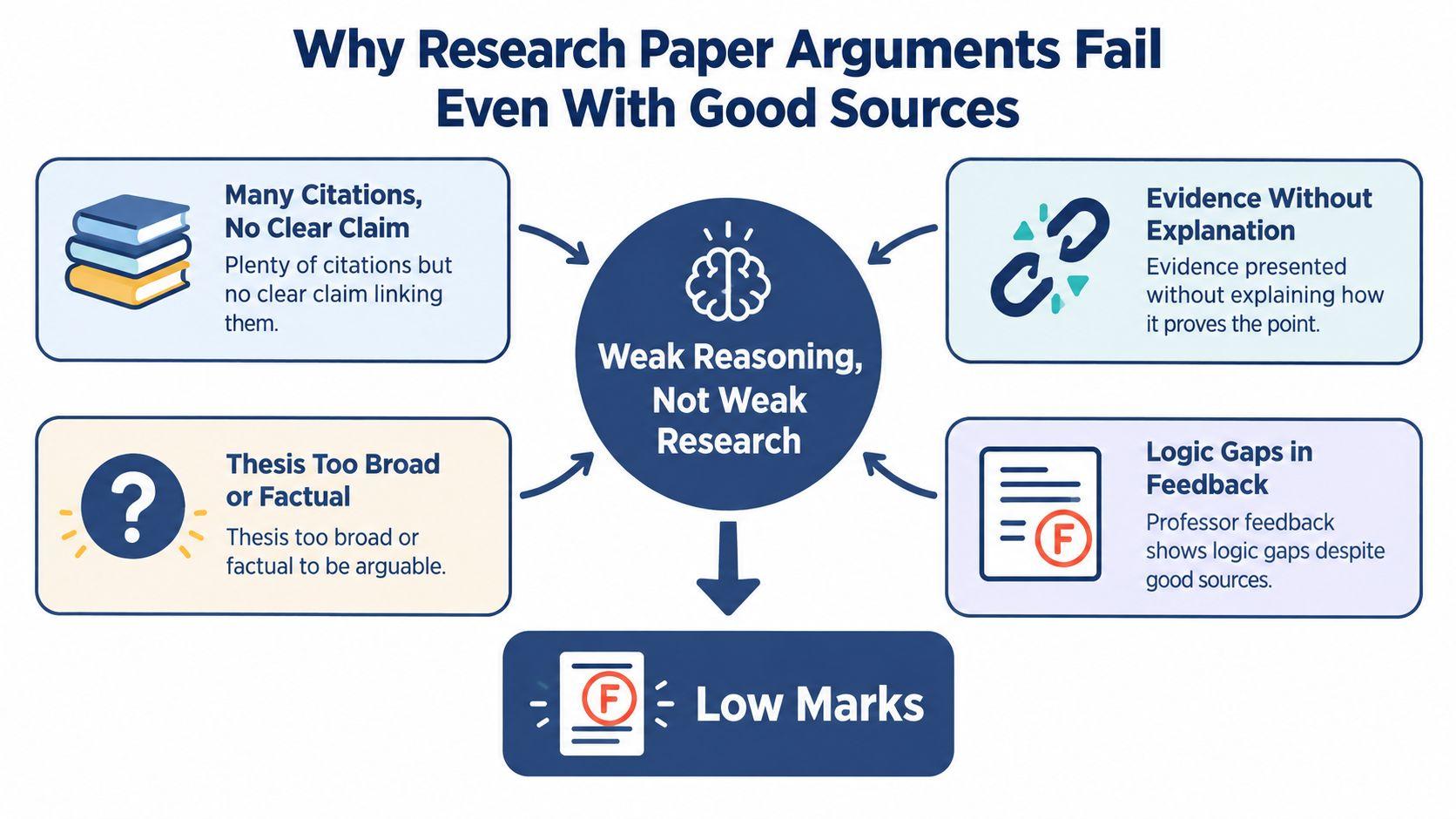
Why Research Paper Arguments Fail Even With Good Sources
A student paper I could describe from memory goes like this: the introduction names an important topic, the body paragraphs each summarize one article, and the conclusion repeats that “this issue is complex.” The bibliography is solid. The grade isn't.
That happens because professors usually aren't only asking, “Did you find credible material?” They're asking, “Did you make a claim, choose evidence that fits that claim, and explain why that evidence supports it?”
What a weak draft usually looks like
Here's the pattern:
- Too much summary: One paragraph says what Source A found. The next says what Source B argued.
- No controlling claim: The reader can't tell what the writer is trying to prove.
- Missing link: Evidence appears on the page, but the writer never explains why it matters.
- Broad conclusion: The paper ends with a claim larger than the evidence can support.
A lot of students assume argument means forceful language. Academic writing usually rewards something else. It rewards transparent logic.
Stephen Toulmin's 1958 model of argument became influential because it treated argument as a visible structure of claim, evidence, warrant, backing, qualifier, and rebuttal, rather than a simple thesis-plus-support pattern, and that matters for research papers because readers are expected to see how the reasoning works, not just what the writer concludes (Toulmin background and writing guidance).
What your instructor is really looking for
When I write “needs analysis” in a margin, I usually mean one of three things:
- Your claim isn't arguable enough. It states a fact, not a position.
- Your evidence doesn't match the size of your claim. You're proving a small point and announcing a big one.
- Your warrant is missing. You haven't shown the logic connecting source material to your conclusion.
Practical rule: If I can remove your citations and your paragraph still makes the same point, the problem is weak evidence. If I can keep the citations and still not tell what point they prove, the problem is weak reasoning.
One helpful way to diagnose this before submission is to map the paper outside the draft itself. A simple argument map on paper, in notes, or with a planning tool can expose gaps quickly. If you use AI for that stage, keep it in the role of organizer, not thinker. A prompt library or workflow guide like the material on the 1chat writing and research blog can help you turn paragraphs into visible claim-evidence-reasoning chains without outsourcing judgment.
The shift that raises grades
A B-level paper often says, “Here are several things experts have said.”
An A-level paper says, “Because these premises are true, this conclusion follows, with these limits.”
That shift sounds small. It changes everything.
Crafting a Thesis That Is Arguable and Narrow Enough to Prove
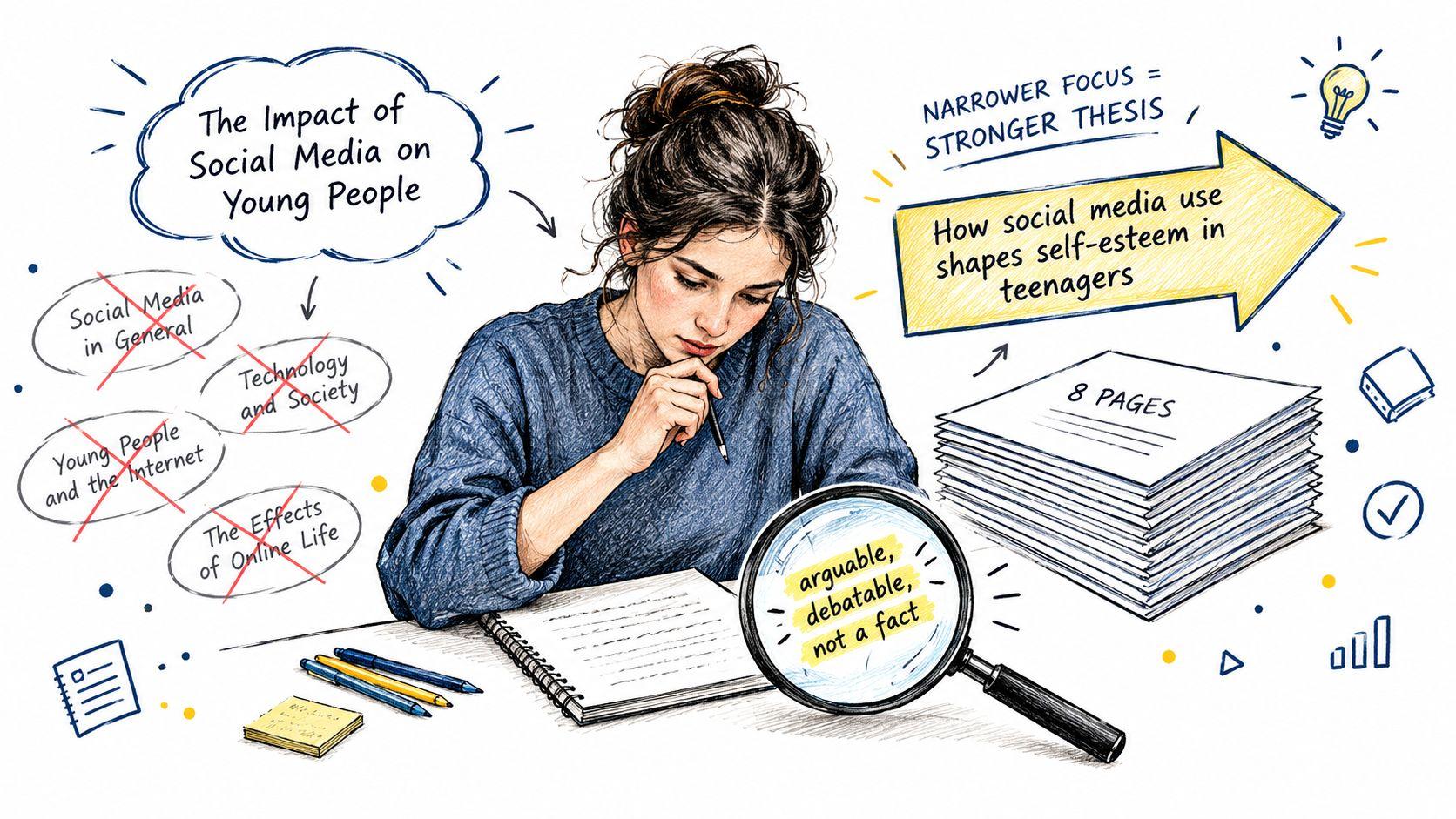
Most weak theses fail for one of two reasons. They're either too broad to prove or too obvious to argue.
“Social media affects teenagers” isn't a thesis. It's a topic.
“Climate change is a serious problem” isn't a thesis either. It's a widely accepted statement.
A research paper argument starts working when your thesis becomes specific enough that a reader could disagree with it, and limited enough that you could defend it in the space you have.
Move from topic to question to claim
Use this progression:
| Stage | Weak version | Better version |
| Topic | Social media and teens | Social media use and teen sleep |
| Question | How does social media affect teens? | How does late-night social media use affect teen sleep habits during the school week? |
| Claim | Social media is bad for teens | Late-night social media use is more defensible as a cause of reduced weekday sleep than as a general cause of poor teen well-being |
Notice what changed. The better thesis names a narrower issue and avoids trying to prove everything at once.
Three tests for a thesis
When students bring me a working thesis, I ask three questions.
Can a reasonable reader disagree
If the answer is no, you don't have an argument yet.
- Too factual: “Exercise improves health.”
- Arguable: “For first-year college students, campus exercise requirements are harder to justify as a health policy than as a retention policy.”
The second version gives a reader something to debate.
Can you prove it with the evidence you actually have
A paper usually improves when the writer shrinks the claim before expanding the source list.
- Too large: “Online learning is worse than in-person learning.”
- Narrow enough: “In discussion-heavy humanities courses, fully asynchronous formats make sustained peer-to-peer argument harder to maintain than live seminar formats.”
That claim has a setting, a comparison, and a limit.
Does it imply a line of reasoning
A strong thesis hints at how the paper will work. The reader should be able to predict your major reasons.
A useful thesis often contains a built-in road map. Not a list of topics, but a line of proof.
For example:
- Weak thesis: “School uniforms should be required.”
- Stronger thesis: “School uniform policies are easiest to justify when schools defend them as an administrative tool for reducing visible status competition, not as a broad solution to discipline problems.”
That version tells me what kind of evidence the writer needs and what kind would be irrelevant.
A quick narrowing exercise
Try this fill-in pattern:
- Topic area: My paper is about ______.
- Specific dispute: The question is whether ______.
- Limited claim: Based on the evidence I can reasonably defend, ______.
- Road map: This is most persuasive because ______, ______, and ______.
Here's an example from a literature course:
- Topic area: surveillance in dystopian fiction
- Specific dispute: whether surveillance mainly controls behavior or identity
- Limited claim: in the novel, surveillance is more effective at shaping self-censorship than at forcing open obedience
- Road map: this is most persuasive because the narrator alters language, private thought, and social performance
That gives you a thesis plus a logic path.
What separates a B thesis from an A thesis
A B thesis names a position.
An A thesis names a position you can prove under stated conditions.
That last phrase matters. Strong research paper arguments don't promise more than the paper can deliver. They choose a claim sized to the evidence.
Building a Logical Chain From Claim to Evidence to Reasoning
Once the thesis is solid, the next question is simple and brutal: Does each paragraph prove part of it?
Many drafts lose force here. The student has a thesis in the introduction, then drifts into source summary in the body. The paragraph contains information, but not an argument.
The three-part paragraph test
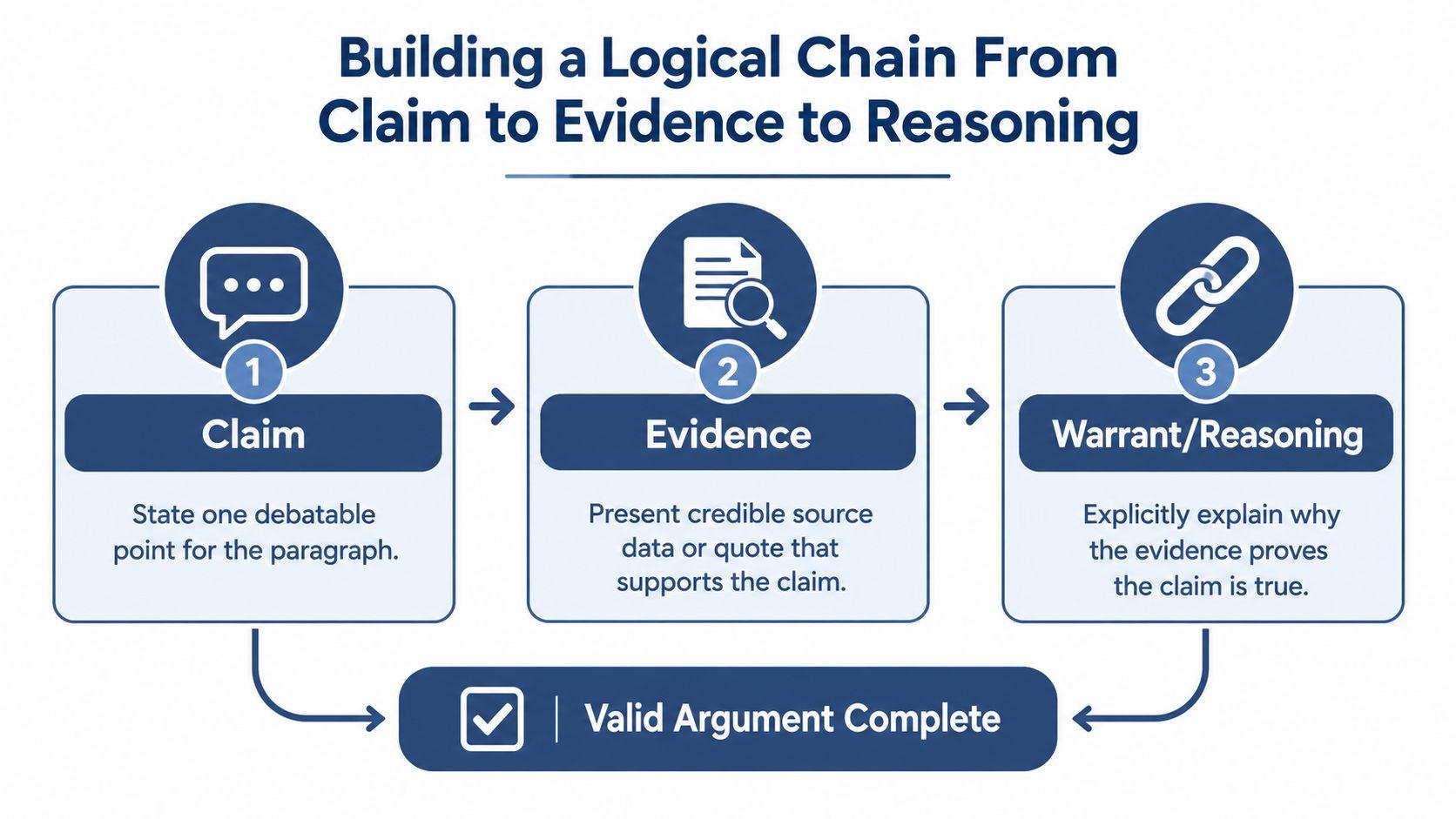
Every body paragraph should contain three distinct moves:
- Claim
One debatable point that advances the thesis. - Evidence
Material from sources, data, or text that supports that point. - Reasoning
Your explanation of why that evidence supports the claim.
Students usually do the first two. The third is where grades change.
Take this weak paragraph move:
“One study discusses student participation in online classes. Another article also mentions that students often feel disconnected.”
That's reporting. It doesn't prove anything.
Now revise it:
“In discussion-based courses, reduced spontaneous exchange weakens argument development because students lose the back-and-forth that helps them test and revise claims. Evidence about lower participation matters here not as a complaint about convenience, but as a sign that the course structure limits the conditions under which arguments get sharpened.”
That second version contains a warrant. It explains why the evidence matters.
Name the hidden assumption
A lot of research paper arguments collapse because the writer skips the assumption connecting evidence to conclusion.
If your paragraph says:
- Claim: school uniforms reduce social pressure
- Evidence: students report fewer visible brand comparisons
- Hidden assumption: visible brand comparison is a meaningful driver of social pressure
If that assumption is weak, contested, or context-dependent, you need to say so. Sometimes the fix is not more evidence. Sometimes the fix is a narrower claim.
Check yourself: If your premises were true, would your conclusion have to follow, or are you smuggling in an unstated assumption?
That question gets at validity over persuasion. A paragraph can sound convincing and still be logically loose.
Use a road map for the whole paper
Try outlining your paper in this format before drafting or while revising:
| Part of paper | Your sentence |
| Main conclusion | Therefore, I argue that… |
| Premise 1 | This follows first because… |
| Premise 2 | It also follows because… |
| Premise 3 | A likely objection is… |
| Limiting condition | This claim holds mainly when… |
That outline forces logic onto the page.
A practical support resource for students who need a plain-language refresher on how academic inquiry works is Captapi academic research insights, especially if you're trying to distinguish background information from evidence that bears on your claim.
Define what you mean by argument quality
This matters more than students realize. In a systematic scoping review, 95 sources were included, and the review found that argument quality is measured inconsistently, with many studies focusing on structural features more than stable measures of reasoning strength or evidence integration (review summary on argumentation research). For your own paper, that means you should decide what you're evaluating when you revise:
- Structure: Do I have a clear thesis and paragraph claims?
- Reasoning strength: Do my conclusions follow from my premises?
- Evidence integration: Do I explain how the sources bear on my claim?
If you treat “argument quality” as one vague thing, revision stays fuzzy. If you separate these categories, you can improve them one by one.
A fast self-audit
Take one paragraph and write these in the margin:
- Claim
- Evidence
- Why this evidence proves the claim
- What assumption this depends on
If you can't fill in all four, the paragraph isn't done.
Choosing and Presenting Evidence Without Overclaiming
You draft a paragraph that sounds confident: This policy improves student success. You have three sources, each respectable, each relevant. Then your professor writes in the margin, “For whom? In what setting? Improves which outcome?” The problem is not that you lacked evidence. The problem is that your conclusion traveled farther than your sources could carry it.
That is the habit to fix here.
Students often assume a stronger argument sounds more certain. In research writing, a stronger argument is one where the claim matches the evidence in size, scope, and type. A small study can support a small claim. Mixed findings can support a conditional claim. Correlational evidence can support an association claim. It cannot prove cause on its own.
A useful way to picture this is load-bearing evidence. A source can hold only so much argumentative weight. If you stack a universal conclusion on top of a context-specific study, the structure bends at the reasoning step, not at the citation step.
Writing guidance connected to argumentation research stresses that readers need enough detail to reconstruct how the evidence supports the claim, including statistical context such as sample size, variability, and p-values when those details matter to the argument (review of scientific argumentation research).
What separates B-level evidence use from A-level evidence use
A B paper often does this: it finds a relevant source and reports the result accurately, but then makes the source do more work than it can do.
An A paper does one extra step. It states what the evidence supports, what it does not support, and how far the conclusion can reasonably go.
Compare the difference:
- B-level move: “This study proves that all students learn worse online.”
- A-level move: “This study supports a narrower claim about the students and course conditions it examined. It does not justify a conclusion about all students, subjects, or online formats.”
- B-level move: “Several authors disagree, but my thesis still stands.”
- A-level move: “Because the sources conflict, the strongest defensible claim is limited to the settings where the findings overlap.”
That revision is not weaker. It is more valid.
Match claim strength to evidence strength
Use this table when a paragraph feels overstated but you are not sure how to fix it.
| Evidence Situation | Better Move | Example Revision |
| One source is relevant but context-specific | Narrow the scope | “This supports the claim in urban public schools like those studied, not in all school systems.” |
| Sources converge on a pattern but use different methods | Make a cautious generalization | “Across these studies, the pattern appears consistent enough to support a limited cross-context claim.” |
| Evidence is correlational | Remove causal wording | Change “causes” to “is associated with” or “may contribute to.” |
| Sources conflict directly | State the disagreement and limit the conclusion | “The evidence does not support a universal claim, but it does support a conditional one.” |
| Evidence supports only part of the thesis | Split the thesis | “The policy is easier to defend on access grounds than on outcome claims.” |
Notice what is happening in each revision. You are not adding volume. You are improving fit.
Present evidence so the reader can test your reasoning
A source summary should do more than report a finding. It should give the reader enough context to judge whether your conclusion follows.
Include details like these when they affect the claim:
- Context: Who or what was studied?
- Method: Experimental, observational, textual, archival, comparative?
- Limits: What can this evidence not establish?
- Claim fit: Which exact sentence in your argument does this support?
Many overclaims begin here. A writer cites a study about one outcome, then slides into a sentence about a larger outcome. Or cites evidence from one population, then generalizes to everyone. The source is not the problem. The jump is.
If you want a structured check before turning in a draft, Rivul AI's pre-submission claims audit can help you review whether each claim is supported by the evidence attached to it.
Coherence makes evidence believable
Readers trust an argument more when they can follow the chain without guessing. That is why coherence matters so much. A paper with fewer sources can still feel stronger if each paragraph makes a clear, limited claim and supports that claim without stretching.
Put plainly, evidence works only when the reasoning around it is visible.
When findings are mixed, strong writers do not hide the mismatch. They mark it, explain it, and narrow the conclusion. That is one of the clearest differences between persuasion and validity. Persuasion tries to sound convincing. Validity asks, “If these premises are true, does this conclusion follow?”
When to narrow the claim instead of adding more sources
Students often respond to a shaky paragraph by adding two more citations. Sometimes fix is smaller and smarter.
Change this:
- “This policy improves student success.”
To this:
- “This policy appears to improve one measure of student success under the conditions studied, though the current evidence does not support a broader outcome claim.”
That sentence makes a professor relax, because it shows control. You are telling the truth about what your evidence can bear.
If you want help tracing that source-to-claim fit, use a narrow prompt in a tool such as the 1chat research workspace: list the paragraph claim, paste the evidence, then ask where the reasoning overreaches and what narrower claim would follow validly. That workflow is useful because it tests the logic of your conclusion instead of rewarding the loudest wording.
Handling Counterarguments and Rebuttals With Integrity
A lot of students treat the counterargument paragraph as a requirement to get out of the way. They write one sentence that sounds like opposition, dismiss it fast, and return to the main point. That usually weakens the paper.
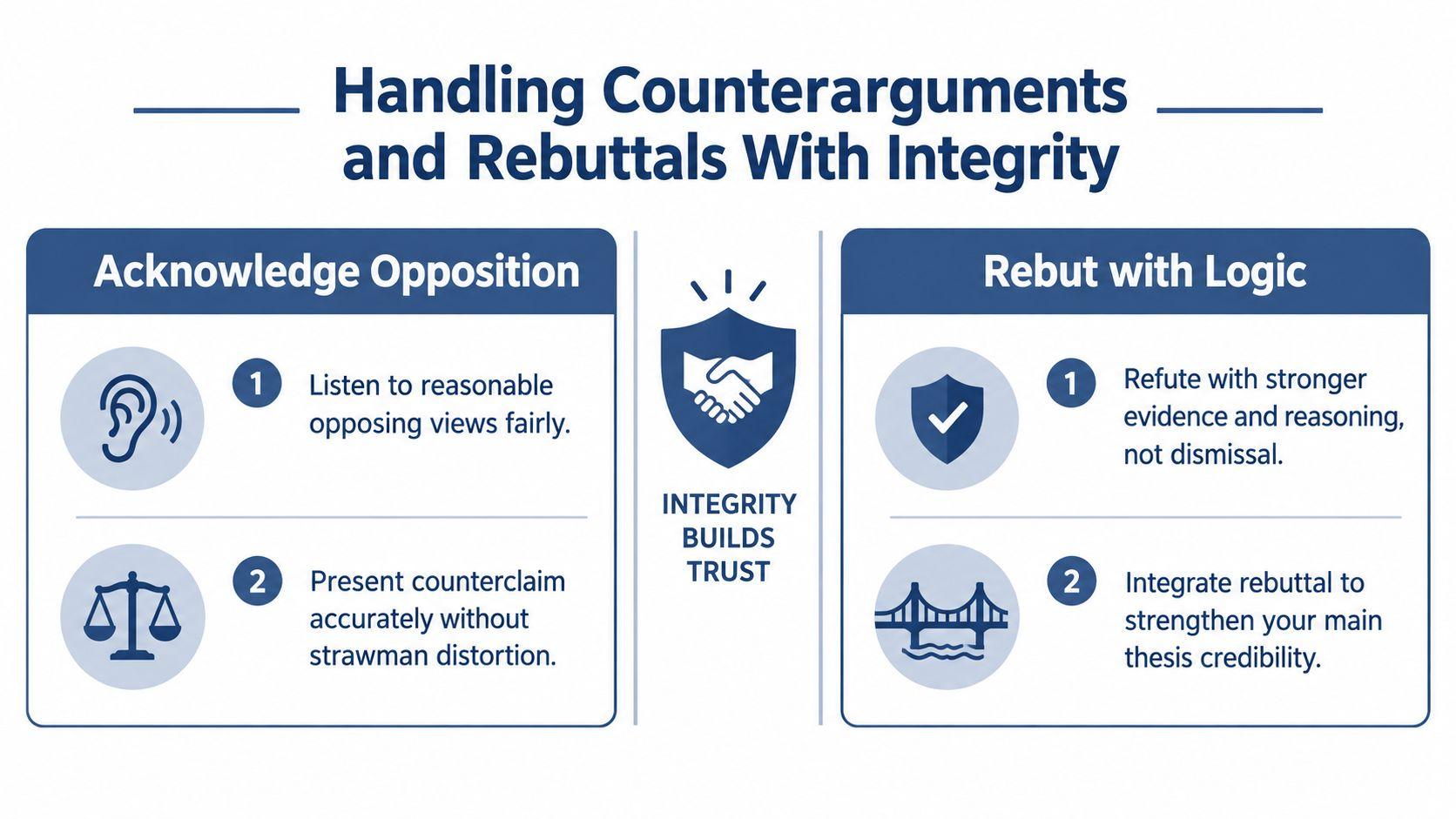
A real counterargument does more than show that you know another view exists. It tests whether your conclusion still holds once a reasonable objection is on the table.
What a fair counterargument looks like
The strongest version of a counterargument has two traits:
- It's something a smart reader could believe.
- It threatens part of your logic, not just a side point.
Harvard's essay guidance stresses that writers should state counterarguments and explain why a reasonable reader could raise them, and university guidance on argument validity emphasizes making the chain of reasoning explicit so the conclusion follows if the premises are true (discussion of validity and counterargument in writing instruction).
That matters because the weak version of counterargument is a straw man. The strong version addresses the best objection available.
Two rebuttal patterns that work
Concede and narrow
Sometimes the objection is partly right.
Example:
- Counterargument: school uniforms don't solve deeper inequality
- Weak rebuttal: yes they do because schools need order
- Better rebuttal: uniforms may not address deeper inequality, but the paper's narrower claim is that they can reduce one visible channel of status display inside school settings
That move often improves a paper more than adding another citation would.
Distinguish conditions
Sometimes both sides are right under different circumstances.
Example:
- Counterargument: asynchronous courses increase access
- Rebuttal: that access benefit doesn't cancel the paper's claim about reduced real-time argument development in discussion-heavy classes
You're not trying to win by force. You're trying to show exactly where your claim still stands.
State the objection in a way that makes your own thesis work harder. If your paper survives that version, readers trust it more.
Sentence templates you can adapt
Use these when you get stuck:
- Fair concession: “A reasonable objection is that ______.”
- Why it matters: “That objection matters because it challenges the assumption that ______.”
- Qualified rebuttal: “Even if that point holds in some cases, the evidence in this paper supports the narrower conclusion that ______.”
- Condition-based rebuttal: “This objection is strongest when ______, but weaker when ______.”
These templates keep you from drifting into vague disagreement.
Common mistakes
- Strawmanning: You choose a weak version of the opposition.
- Topic switching: You answer a different objection than the one raised.
- Overrebutting: You defend the original broad claim instead of refining it.
- Late placement: You save all objections for one isolated paragraph, even though some belong earlier next to the relevant claim.
A mature research paper argument often grows stronger by shrinking. That's not retreat. That's control.
Structuring Citing and Polishing Your Argument With 1chat
You finish a draft at 11:40 p.m., read it once, and feel a flash of relief. The sources are there. The quotes are formatted. The conclusion sounds confident. Then a professor writes in the margin, “I can't tell how paragraph 4 leads to paragraph 5,” or worse, “This doesn't quite prove the thesis.”
That kind of comment usually points to a structure problem, not a research problem. A paper can sound polished and still have gaps in its reasoning. Citation fixes that only in part. Grammar fixes it even less.
A clear argument works like a set of visible joints in a bridge. Readers should be able to see what claim each section makes, what evidence supports it, and why that evidence justifies the next step. If they have to supply the missing connection for you, the paper is harder to trust.
Make the paper's logic easy to follow
At the whole-paper level, a strong draft usually looks like this:
- An introduction that states a claim someone could reasonably dispute
- Body sections organized by reasons
- A counterargument placed where that objection pressures the claim
- A conclusion that stays within what the paper has shown
The key point is organization by reasons, not by reading notes. If your outline says “Smith, then Patel, then Nguyen,” you probably have a source tour instead of an argument. A better outline sounds more like “Reason 1, Reason 2, limitation, qualified conclusion.”
That shift often marks the difference between a B paper and an A paper. B papers collect material. A papers arrange material so each part does a job.
Cite at the point where a reader would question you
Citation is not only a matter of avoiding plagiarism. It also tells the reader which statements come from research and which ones are your interpretation of that research.
Use citations for:
- Facts drawn from sources
- Paraphrased findings or ideas
- Quoted wording
- Method details, dates, and data points
You do not need a citation after every sentence. You do need one whenever a careful reader would stop and ask, “How do you know that?” That question is a useful test because it keeps citation tied to reader needs instead of turning it into decoration.
Revise in the order that protects validity
Students often proofread too early. They fix commas in a paragraph whose conclusion does not follow from its evidence.
Use this order instead:
| Revision pass | Question |
| Logic pass | Does each conclusion follow from its premises? |
| Scope pass | Is each claim narrow enough for the evidence provided? |
| Organization pass | Are paragraphs arranged by reasons rather than by source summaries? |
| Citation pass | Can a reader tell what comes from a source and what comes from your analysis? |
| Style pass | Are wording, grammar, and transitions clear? |
Notice what comes first. Logic, then scope. If the argument is overextended, adding one more source often will not solve the problem. Narrowing the claim will.
That is the validity habit this article keeps returning to. Strong research writing is not just persuasive. It is testable. You should be able to point to a paragraph and ask, “If these premises are true, does this conclusion really follow?” If the answer is only “sort of,” revise the claim before you polish the sentence.
A simple 1chat workflow for mapping reasoning
A tool can help you see structure faster, as long as you keep control of the judgments. One useful approach is to use a 1chat workspace for outlining and reasoning checks after you have a working thesis.
Try a short workflow:
- Import your sources: Ask for each source's main claim, method, and limit.
- Sort by reason: Group sources under the part of your thesis they support.
- Map each paragraph: Identify the claim, evidence, reasoning, and strongest objection.
- Test the inference: Ask whether the paragraph's conclusion follows, or whether the claim should be narrower.
- Check topic sentences alone: Read only those sentences and see whether they reconstruct the paper's logic.
- Proofread last: Clean up wording after the reasoning is stable.
This works well because it forces you to separate support from proof. Three sources can support a point and still fail to prove the larger claim you want. Seeing that early saves time.
Before you submit, ask a classmate one focused question: “Can you explain my argument back to me without opening the sources?” If they can summarize the reasoning clearly, your structure is probably doing its job. If they can only recall the topic, the paper still needs stronger joints between claim, evidence, and conclusion.
Use this final check:
- Is the thesis arguable?
- Is it narrow enough to prove?
- Does each paragraph make one clear claim?
- Does each claim have support?
- Does the paragraph explain why that support matters?
- Does the paper answer a serious objection fairly?
- Does the conclusion stay inside the limits of the evidence?
That last question matters most. A polished paper can still fail if the conclusion reaches farther than the premises allow. An excellent paper knows where to stop.