You've read the prompt, highlighted several sources, and opened a blank document. The evidence is there, but the argument isn't. Many students get stuck at exactly this point because they treat a synthesis essay as a container for summaries instead of a process for building a claim.
A strong synthesis essay format gives each source a role in your reasoning. You'll need to make a defensible thesis, group sources by ideas, introduce evidence clearly, and explain the relationships among those sources. The format matters, but the thinking underneath it matters more.
What a Synthesis Essay Really Asks You to Do
A synthesis essay asks you to make an argument that grows from multiple sources. You aren't just reporting what each writer says. You're deciding what the sources reveal when they're read together, then using your own commentary to show why that combined insight matters.
Consider the difference:
Source A says social media affects sleep. Source B says routines affect sleep. Source C recommends limiting nighttime use.
That sequence may be accurate, but it remains summary. A synthesis move sounds more like this: Sources A, B, and C suggest that sleep problems connected to social media are shaped less by the platform alone than by the habits surrounding its use. The writer has created a claim that no single source states in exactly that form.
The four terms you need
- Claim: The point your paragraph or essay is trying to prove.
- Attribution: A clear signal showing which source supplies an idea or piece of evidence.
- Commentary: Your explanation of how the evidence supports, complicates, or limits your claim.
- Integration: The deliberate weaving of sources and commentary into one line of reasoning.
The College Board describes the task as combining information from multiple sources to inform your discussion, and its rubric requires a defensible thesis, evidence from at least three sources, and explanation connecting that evidence to your argument. You can review related reading and writing concepts through Knobee AI literature subjects, especially when you need help distinguishing analysis from summary.
Start by asking a practical question: What can I argue because these sources are in conversation? That question moves you from notes to reasoning. From there, you can diagnose the stuck point, build a thesis, organize by theme, handle citations, and audit the finished draft for preventable mistakes.
Why the Format Looks the Way It Does
A student facing the AP synthesis prompt has a limited source set, one shared issue, and a short window to form an argument. The format gives that pressure a workable shape: introduce a position, group evidence by reasons or themes, and explain how the sources support the position. The AP English Language synthesis essay became a regular part of the exam in the May 2007 administration, when the synthesis question joined the three free-response questions, as documented by the College Board's synthesis essay materials. Students were expected to build a position from several sources rather than rely on personal opinion or one text.
You can treat the essay's structure like a woven fabric. The thesis is the pattern, sources supply the threads, and commentary ties each thread to the design. Current scoring guidance keeps that architecture: a defensible thesis, evidence from at least three sources, and commentary that connects evidence to the argument.
AP-preparation descriptions commonly present six to seven sources, with at least two visual sources and at least one quantitative source. Students still need to use at least three sources. In some versions, roughly 40% or more of the source set may be non-textual, as described in the College Essay Guy synthesis essay guide. A chart, graph, or image therefore needs interpretation. Ask what claim its labels, comparisons, or trends support, then connect that observation to your paragraph's point.
Timed writing versus research writing
The AP version gives students 40 minutes for writing on one prompt, according to the AP Lang synthesis guide from EduBirdie. A classroom research synthesis may allow weeks to find, evaluate, and cite sources.
The basic structure stays recognizable, but the work before drafting changes. In timed writing, annotate quickly and select the sources that best serve your argument. In research writing, evaluate credibility, record complete publication details, and decide how the sources agree, qualify, or challenge one another.
Building a Thesis That Holds Multiple Sources Together
A thesis should do more than announce a topic. It should state your position and reveal the relationship among the sources that shaped it.
Use this sample prompt: How does social media affect adolescent sleep? For practice, imagine three invented sources:
- Source A, an empirical study, connects frequent evening social media use with fragmented sleep.
- Source B, an expert opinion, argues that notifications and emotional stimulation make it difficult for adolescents to disengage.
- Source C, a longitudinal study, finds that the relationship is mediated by nighttime routines rather than determined by platforms alone.
These sources don't all make the same claim. Their disagreement gives you something to think about.
Read for roles, not just topics
First, identify each source's central claim and evidence type. An empirical study may offer measured findings. An expert may explain a mechanism. A longitudinal study may add context about patterns over time.
Next, cluster the sources by shared ideas. Sources A and B belong together around direct disruption. Source C complicates that cluster by shifting attention toward routines.
Then name the relationship. Do the sources agree, qualify one another, or contradict one another? A useful thesis often emerges from the tension.
You might write:
While Sources A and B argue that social media directly fragments adolescent sleep, Source C's longitudinal data shows that the effect is mediated by nighttime routine, suggesting that effective intervention should target habits rather than platforms alone.
This thesis takes a side. It refers to more than one source. It also previews an order for the essay: direct disruption, then the role of routines, then the implications for intervention.
For research-heavy assignments, a tool such as 1chat's research workspace can help you organize questions and source notes, but you still need to verify the sources and make the interpretive connections yourself. Automated summaries can identify possible patterns. They can't replace your judgment about whether those patterns support your thesis.
Organizing Body Paragraphs Around Themes, Not Sources
The most common structural problem I see is the source-by-source paragraph:
Source A says this. Source B says that. Source C says something else.
That arrangement may use enough sources, but it doesn't make them interact. A theme-based paragraph begins with an argument about the topic, then brings in sources as evidence for that argument.
A reliable sequence is:
- Claim: State the paragraph's analytical point.
- Evidence weave: Introduce evidence from multiple sources.
- Commentary: Explain agreement, contrast, cause, limitation, or significance.
- Link: Connect the paragraph back to the thesis or forward to the next idea.
A working paragraph you can mimic
Suppose the prompt asks about social media's effect on adolescent mental health. Imagine three sources: Source A describes social comparison, Source B discusses online community, and Source C examines platform design.
[Topic sentence] Social media can support adolescent connection, but its mental-health effects become more damaging when platforms turn social interaction into constant comparison. [Signal verb and evidence] Source A observes that repeated exposure to carefully selected images encourages users to measure their lives against idealized ones, while Source B emphasizes that online communities can give isolated adolescents access to support. [Commentary] These sources appear to disagree, but they actually identify different conditions: connection helps when users seek meaningful interaction, whereas comparison intensifies distress when the platform encourages performance and evaluation. [Further evidence] Source C complicates the issue by explaining that design features such as endless feeds and visible engagement signals keep users focused on what others are doing. [Analysis] The problem, then, isn't simply that adolescents use social media. It's that certain design features convert connection into a repeated judgment of personal status. [Link] Because platform design influences whether interaction becomes support or comparison, mental-health responses should address both user habits and the environments that shape them.
Notice the rhythm. The paragraph doesn't pause after each source to summarize it. It uses attribution, then immediately interprets the relationship among the ideas.
Paragraph test: If you remove the source names and the paragraph no longer has an argument, you've probably written a source summary rather than a synthesis.
You can also consult 1chat's blog resources when you need additional support with outlining and revision. Use any resource to clarify your process, not to outsource the central reasoning.
Citing and Formatting in MLA and APA
MLA and APA both require you to identify sources in the essay and list them at the end, but they emphasize different information. MLA foregrounds the author and page location. APA foregrounds the author and publication year, which suits disciplines where the recency of research matters.
Use the same paraphrased idea in both styles:
- MLA: Evening notifications can interrupt sleep by keeping adolescents mentally engaged after they go to bed (Rivera 42).
- APA: Evening notifications can interrupt sleep by keeping adolescents mentally engaged after they go to bed (Rivera, 2024, p. 42).
The wording of your argument doesn't change. The citation framework does.
MLA and APA side by side
| Element | MLA 9 | APA 7 |
| In-text citation | (Rivera 42) | (Rivera, 2024, p. 42) |
| End-page title | Works Cited | References |
| Journal article pattern | Rivera, Ana. “Article Title.” Journal Name, vol. volume, no. issue, year, pp. pages. | Rivera, A. (2024). Article title. Journal Name, volume(issue), pages. |
| Website pattern | Rivera, Ana. “Page Title.” Website Name, date, URL. | Rivera, A. (2024, Month Day). Page title. Website Name. URL |
| Title capitalization | Major words in an article title are capitalized. | Article and webpage titles use sentence case. |
| Page setup | Double-spaced text, readable standard font, and a consistent heading format. | Double-spaced text, readable standard font, and APA title-page conventions when assigned. |
For a journal article, MLA typically preserves the article title in headline-style capitalization, while APA uses sentence case and places the year directly after the author. For a website, check whether the page supplies a named author and publication date. If either is missing, follow the rules for that style rather than inventing information.
Watch the small details:
- Date format: MLA and APA arrange dates differently.
- Italics: Journal and website names usually receive different treatment from article titles.
- Hanging indents: Each entry should make the author's name easy to locate.
- Alphabetization: Organize entries by author or by title when no author is listed.
- Citation matching: Every in-text citation should correspond to an entry on the Works Cited or References page.
Choose the style your instructor requires and stay with it. Mixing MLA parentheses with APA reference entries creates avoidable confusion, even when your reasoning is strong.
Common Mistakes That Cost Easy Points
Your paragraph may contain accurate evidence and still lose points if the reasoning between sources stays hidden. Treat each source as a thread: quotations and paraphrases provide the material, while commentary weaves those threads into an argument. A paragraph filled with evidence but short on explanation remains incomplete, as the scoring guidance indicates.
The deductions to catch first
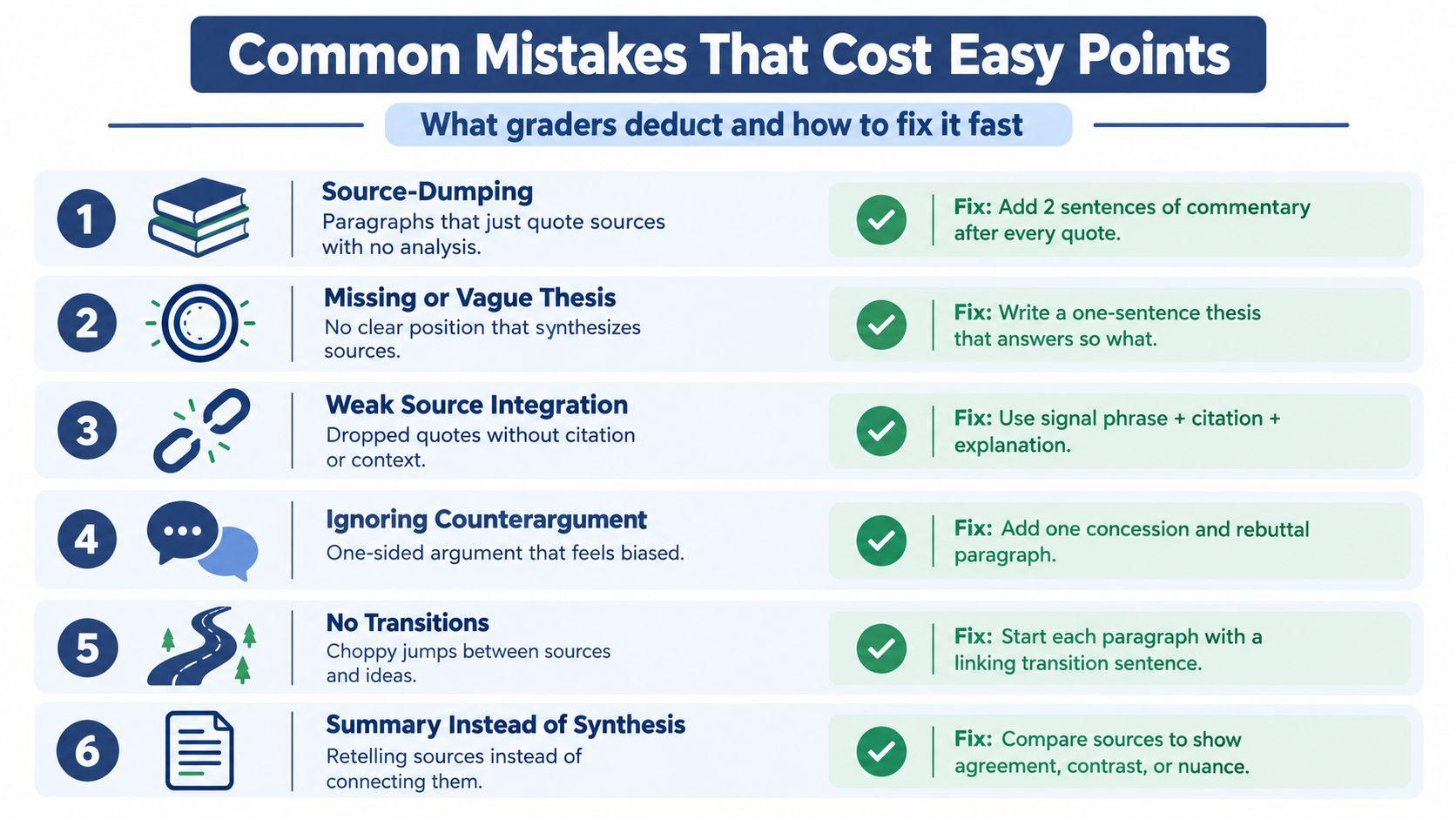
- Source dumping: Several quotations appear in a row, with no explanation of their purpose. Fix: After each important detail, explain how it supports, complicates, or narrows your claim.
- A vague thesis: The introduction names the issue or lists the sources without taking a position. Fix: Answer “So what?” with one arguable sentence.
- Weak integration: A quotation enters without context, so the reader cannot tell who is speaking or why the words matter. Fix: Add a signal phrase, citation, and commentary.
- No counterargument: The essay treats the issue as settled and ignores a reasonable alternative. Fix: Acknowledge what that view explains, then show why your position still holds.
- Missing transitions: Body paragraphs seem like separate stops rather than connected stages of thought. Fix: Link each new theme to the idea before it.
- Summary instead of synthesis: Sources receive separate mini-reports. Fix: Place related sources together and explain their agreement, contrast, or tension.
The Cathoven review of IELTS mistakes offers practice with related issues, including unsupported claims, weak organization, and unclear development. Its assignment differs, but the revision habits apply here.
Before submitting, audit the paragraph's reasoning. Check how many sources contribute to each body paragraph, and ask whether every quotation has an introduction and analysis. Read the thesis by itself. Does it make a debatable claim? Compare each in-text citation with the Works Cited or References page. Clean integration, not grand vocabulary, often separates a competent essay from a high-scoring one.
A Reusable Outline Template and Pre-Submission Checklist
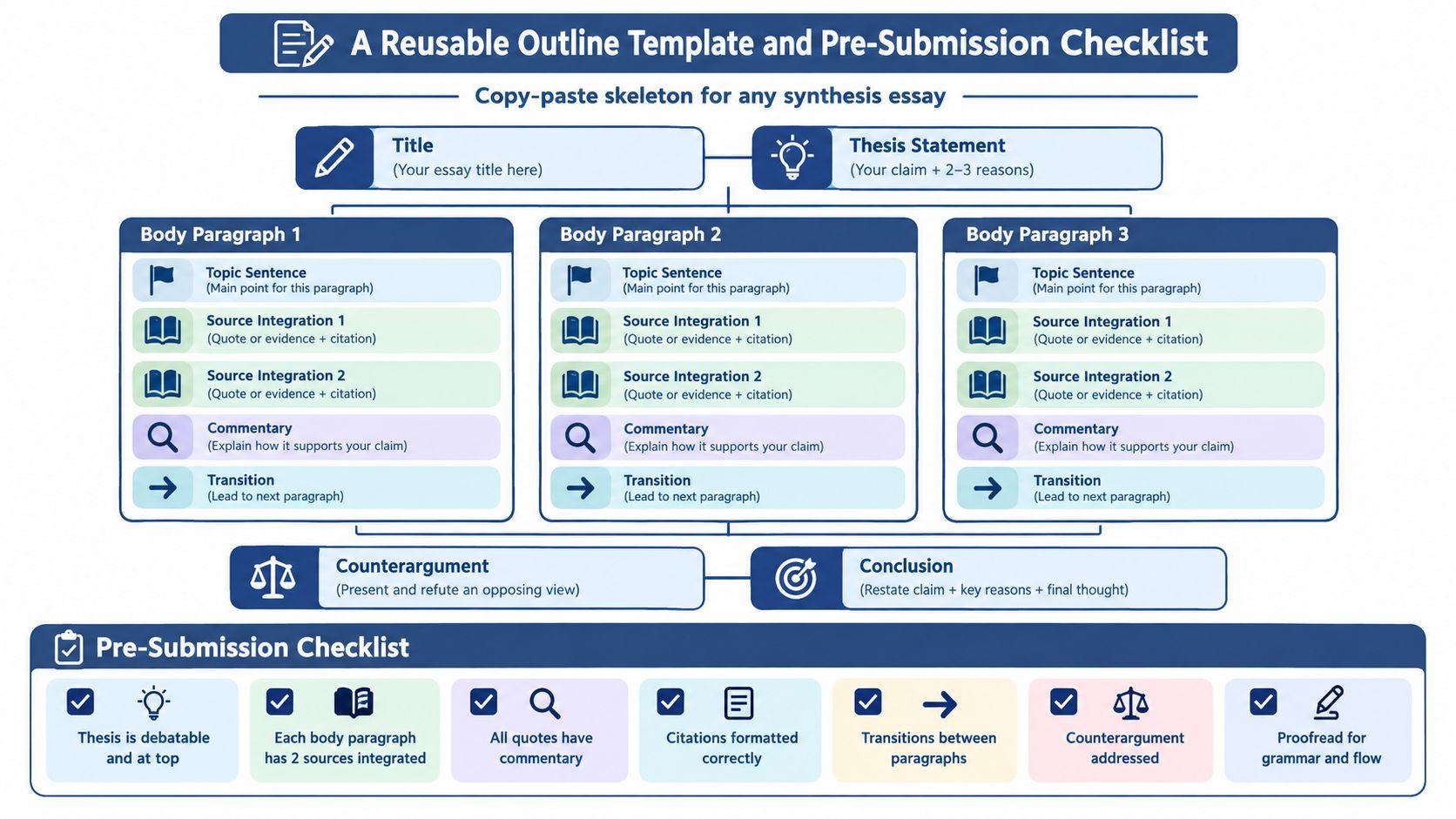
A useful outline should preserve the argument's spine without forcing every topic into identical paragraphs. Copy this skeleton into your notes and adapt the language to your prompt:
- Title: Name the issue and suggest the argument.
- Introduction: Establish the problem briefly, identify the source conversation, and end with a defensible thesis.
- Body paragraph one: State the first theme. Integrate evidence from at least two sources, then explain what their relationship reveals.
- Body paragraph two: Develop a second theme. Use attribution, evidence, commentary, and a transition from the previous idea.
- Body paragraph three: Address a complication, consequence, or opposing interpretation. Explain whether it limits or strengthens your thesis.
- Counterargument paragraph: Present a reasonable alternative, concede what it gets right, and rebut or qualify it.
- Conclusion: Restate the synthesized insight in fresh language. Show why the relationship among the sources matters.
A body paragraph can be short in outline form:
Topic sentence. Source A supports the claim because ____. Source B complicates or extends it by ____. This relationship matters because ____. Transition to the next theme.
The AI-powered outline creator can help you turn a prompt into a starting structure, but revise the result until each paragraph represents a genuine claim rather than a source label. For additional writing and research workflows, 1chat's main platform is another place to organize drafting questions and revision tasks.
Pre-submission checklist
- Thesis clarity: Does the introduction state an arguable position?
- Source coverage: Does the argument integrate at least three provided sources when the assignment requires that minimum?
- Paragraph purpose: Does each body paragraph advance a theme rather than summarize one source?
- Attribution variety: Do signal phrases make source ownership clear?
- Commentary: Does your explanation show why each piece of evidence matters?
- Citation consistency: Are all in-text citations formatted in the assigned style?
- Reference matching: Does every citation appear on the Works Cited or References page?
Revise by checking the argument's spine first. Line editing matters, but it can't repair paragraphs that don't know what they're proving.
Before you submit your next synthesis essay, print the checklist, mark each source relationship in your draft, and revise any paragraph that summarizes without connecting. Your goal isn't to make every sentence sound impressive. It's to make the reader see how your sources combine to support a claim only you have assembled.