
On TikTok, “ts” most commonly means “this sht” or “that sht” as a blunt reaction phrase, though it can also mean “timestamp” or “transition sound” depending on context. The surrounding words, numbers, and video-editing language usually reveal which meaning applies.
You may notice it while scrolling through your child's feed, checking a comment section on a small business account, or reviewing a creator's editing notes. A comment might say “ts is hilarious,” while another uses “TS 1:45” to point to a moment in a video. The letters look identical, but the intended meaning can be completely different.
That's the central lesson behind ts meaning on TikTok: don't interpret the abbreviation in isolation. Read the full comment, identify who's using it, and look for clues around it before deciding whether it's slang, navigation shorthand, or production terminology.
"What TS Means on TikTok at First Glance"
Suppose a parent sees “ts” repeated beneath a teenager's TikTok. The first instinct may be to search for a formal acronym, especially if the comments seem unrelated to school, work, or technology. A small business owner can face the same confusion when several users reply “ts is crazy” beneath a product video.
In everyday TikTok captions and replies, “ts” most commonly means “this sht” or “that sht.” It's usually a blunt reaction phrase that communicates strong attitude. Depending on the surrounding words, the writer may be expressing amusement, disbelief, approval, frustration, or dismissal. The abbreviation often appears in lowercase, as “ts,” or with a capital first letter, as “Ts.”
For example:
- “ts is so funny” usually reacts strongly to something amusing.
- “why is ts happening” expresses disbelief or irritation.
- “I can't believe ts worked” signals surprise or approval.
The phrase isn't formal language, and it isn't generally being used as a neutral replacement for a noun. It carries tone. One widely cited explanation says many users initially misread “ts” as a simple replacement for “this,” which helped create additional confusion as the usage became more visible on TikTok in late 2024 and early 2025. This overview of TikTok culture and “TS” provides useful background for readers who want to understand how the slang entered wider comment culture.
Practical rule: If “ts” appears beside emotional words such as “funny,” “crazy,” “relatable,” or “wild,” read it as slang first.
Parents and teams can also use TikTok platform information from PostPulse when they're trying to understand how the platform's content and engagement environment works. For a separate, privacy-conscious place to ask questions about unfamiliar online language, review the 1chat FAQ, but always consider the complete TikTok context before labeling a comment as harmful.
"The Dominant Slang Meaning and Why It Spread"
The dominant slang interpretation of “ts” is “this sht” or “that sht.” In a reaction comment, it works as a pragmatic intensifier, adding attitude to the writer's response. It can show agreement with a video, signal shock, heighten humor, or dismiss something the writer dislikes.
That function explains its presence in reaction-heavy comments rather than informational posts. In “ts is so relatable,” the writer turns a response into a short, recognizable signal. In “ts got me crying,” the phrase strengthens an emotional reaction and contributes little factual information.
The abbreviation suits TikTok's fast, low-friction commenting style. Short forms take less time to type, fit the rhythm of scrolling, and allow users to participate in a shared social code. Coverage of the trend describes “ts” moving from niche usage into broader recognition, with some users reading it as “this.” The explanation of the TikTok slang trend from Dexerto describes that movement and the confusion around it.
Reading tone instead of isolated letters
Tone comes from the complete sentence. “ts is beautiful” may be an intense compliment, while “delete ts” may be dismissive. The two letters alone cannot settle the meaning.
The slang has also appeared beyond TikTok's comment section, including meme-style exchanges on X and Instagram. That wider circulation means parents, moderators, and brand teams may meet the abbreviation in several online settings. If a comment targets a person or business with harassment, threats, or abusive language, interpreting “ts” is only one part of the review. Teams can consult guidance on removing harmful TikTok posts when content raises safety or reputation concerns.
For broader digital communication questions, privacy-conscious guidance on online language from 1chat's blog offers another research destination. A useful habit is to read “ts” as a tone marker when it appears in an emotional reaction, while checking the surrounding words before deciding what the writer means.
"Alternative Meanings You Might Encounter"
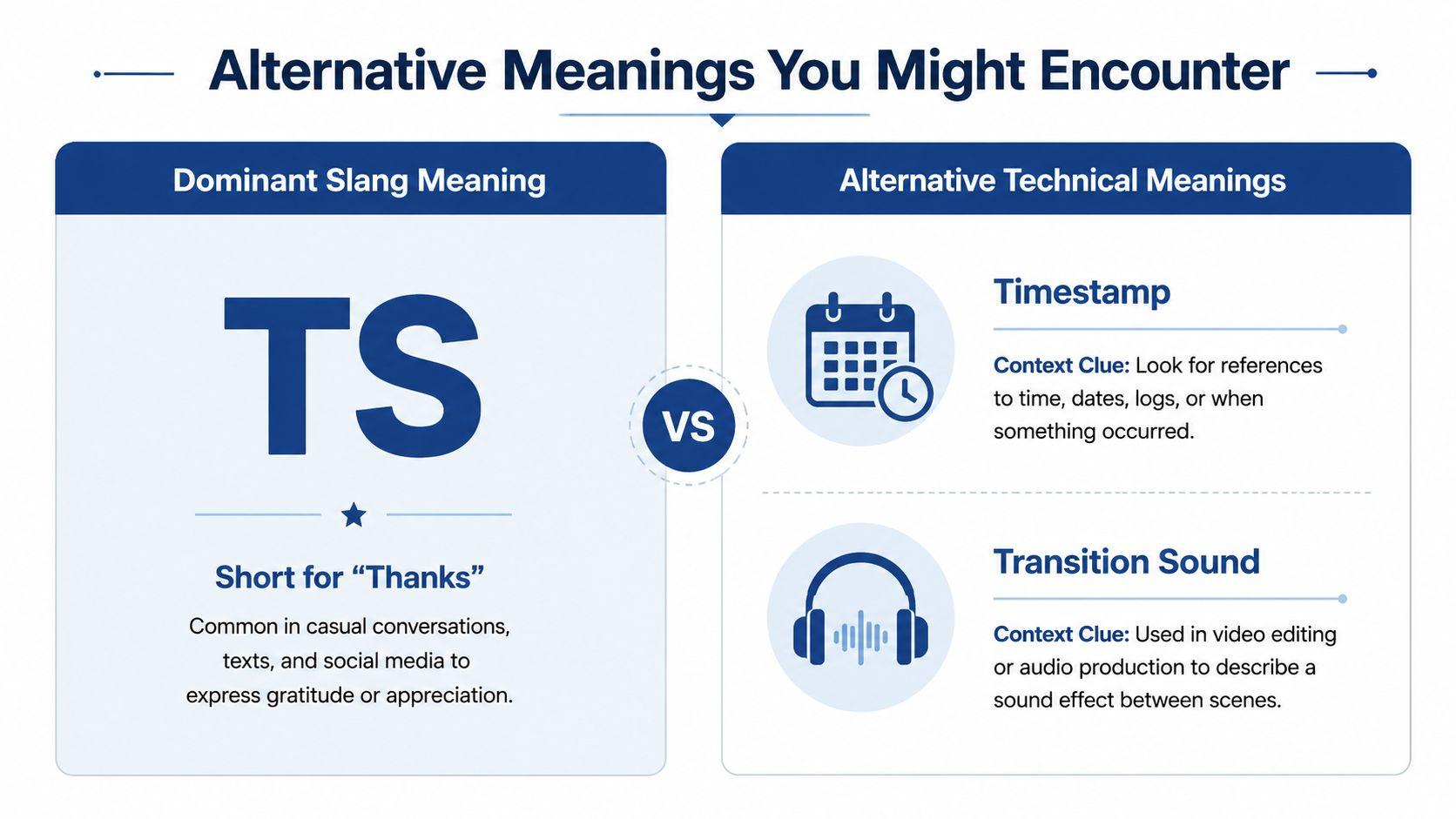
The slang meaning is common, but applying it automatically causes errors. On TikTok, “TS” can also mean “timestamp” or “transition sound” when nearby words point to video navigation or editing.
A timestamp directs viewers to a specific moment. A format such as “TS 2:34” or “TS 1:45” places the abbreviation beside a time marker, so the writer is identifying where to look in the video. Here, “TS” works like a signpost, not an emotional reaction.
A transition sound belongs to the creator or editor workflow. Beside words such as “audio,” “clips,” “edit,” or “transition,” “TS” refers to a sound used to connect scenes. This explanation of context-dependent TS uses describes timestamp and transition-related meanings as alternatives determined by surrounding language.
| Meaning | Context clues | Likely purpose |
| This sht or that sht | Emotional adjectives, reactions, criticism, agreement | Express attitude or emphasis |
| Timestamp | A time marker such as 1:45 or 2:34 | Point to a moment in a video |
| Transition sound | Editing, audio, clips, cuts, or transitions | Describe production terminology |
A three-question context check
Start with the words surrounding the abbreviation. Do they describe feelings, reactions, or opinions? The slang reading is strongest. Does a time marker follow it? Read “TS” as “timestamp.” Does the comment discuss sound, cuts, or clips? “Transition sound” fits the production context.
Creators publishing tutorials, behind-the-scenes clips, or face-free videos often use production shorthand more than casual viewers. People developing content ideas can browse Viral.new's beginner TikTok prompts. Teams researching unfamiliar terms can consult 1chat's research resources as a separate, privacy-first starting point.
Capitalization does not settle the question. “TS,” “ts,” and “Ts” can carry the same slang or technical meaning. Words around “ts” provide better evidence than letter case. For family accounts and small teams, checking the full sentence before replying or moderating prevents a harmless timestamp or editing note from being treated as hostile slang.
"Real Examples of TS in Captions and Comments"
The quickest way to learn the difference is to compare complete examples. The same abbreviation can express attitude in one comment and direct viewers to a video moment in another.
| Example Text | Context | Meaning | How to Interpret |
| “ts is so relatable” | A reaction beneath a personal or humorous video | “This sht” or “that sht” | The writer is emphasizing agreement or recognition |
| “why is ts actually working” | A reaction to a surprising result | “This sht” or “that sht” | The phrase adds surprise and emphasis |
| “ts is wild” | A comment about an unexpected scene | “This sht” or “that sht” | Read it as an emotional reaction, not a definition |
| “TS 1:45 when the plot twist hits” | A viewer points to a moment in the video | Timestamp | The time marker identifies where to look |
| “check TS 2:34” | A navigation-focused reply | Timestamp | The writer directs attention to a specific section |
| “need a better TS between clips” | A creator discusses editing | Transition sound | The production context changes the meaning |
How to interpret a new example
First, read the entire sentence without expanding “ts.” Ask whether the sentence still sounds like a reaction, a direction, or an editing note. Then inspect the words immediately before and after the abbreviation.
A comment such as “ts is embarrassing” uses an evaluative word and likely expresses dismissal. “TS 1:45” contains a time marker and points to a location. “The TS doesn't match the beat” uses audio language, so it likely describes an editing choice.
Read the sentence, not just the abbreviation.
One further clue is the account's role. A casual viewer's reply is more likely to use the slang reading, while a creator discussing a timeline, clip sequence, or soundtrack may be using production terminology. That clue isn't absolute, but it helps you avoid overreacting to an ordinary technical note.
"Why TikTok Slang Matters for Families and Teams"
TikTok slang compresses tone into a few letters. A short comment can signal amusement, agreement, criticism, or shock, while “ts” can also refer to a timestamp or an editing term. Parents and teams therefore need to read the surrounding action before deciding what the abbreviation means.
TikTok's global reach lets short forms cross regions and age groups quickly. As noted earlier, slang can spread before parents, teachers, and business owners share the same explanation. The practical issue is ambiguity: identical letters can point to a reaction, a time marker, or a production note.
For parents
Some children use “ts” casually; others may use it to mock someone. Ask what the writer meant, how the recipient might read it, and what nearby words support that interpretation. This teaches a transferable skill: online meaning depends on context, audience, and intent.
Treat the conduct as the safety signal. A timestamp in a comment, an editing discussion, and a targeted insult call for different responses. Families can review examples together without assuming that every unfamiliar abbreviation signals danger.
Privacy-first tools can support this review by limiting who sees posts, reducing account exposure, and helping adults examine content without collecting more personal information than necessary. Automated settings cannot parse every joke, euphemism, or context, so conversation remains part of digital safety.
For small business teams
A shared account needs consistent interpretation. A team member who reads “ts is overpriced” as a technical reference can miss a customer complaint. Someone who interprets “TS 1:45” as an insult can answer awkwardly to a normal navigation comment.
Create a simple review habit:
- Check the full thread: Read the original caption and nearby replies.
- Identify the audience: Separate a customer reaction from an editor's note.
- Assess conduct separately: Focus on threats, harassment, privacy violations, or targeted abuse.
- Respond proportionately: Clarify genuine confusion, moderate violations, and avoid escalating ordinary slang.
Digital literacy does not require memorizing every trend. It requires slowing down long enough to identify what the user is doing with the language, then choosing a response that protects people and preserves useful communication.
"How to Filter and Report Ambiguous Content"
Families and teams can manage ambiguous comments without trying to ban every unfamiliar phrase. Start with the platform's available controls, then add human review for cases where the same term has multiple meanings.
A practical moderation routine
- Enable keyword filters. Add terms that repeatedly appear in abusive comments, but remember that filtering “ts” alone could hide harmless timestamp or editing discussions. Use broader surrounding terms where the platform allows it, and review settings regularly.
- Use Restricted Mode. For a family device, consider whether a more limited content environment fits the child's age and maturity. No automated setting understands every joke, euphemism, or context, so talk with children about what they encounter.
- Report specific content. Report the comment or video when it includes harassment, threats, exploitation, or another policy violation. Don't report a post solely because “ts” appears in it. The complete conduct matters.
- Discuss the pattern with your team. Shared-account managers should record recurring examples, agree on response language, and decide who reviews borderline comments before someone replies publicly.
Moderation should target harmful behavior, not unfamiliar vocabulary.
For parents, a calm conversation can begin with, “What do you think this person meant?” Follow with, “What words around it helped you decide?” This approach builds interpretation skills instead of turning slang into a forbidden mystery.
For businesses, save examples privately rather than reposting harmful comments. Protect customer and employee privacy, limit access to moderation records, and avoid sending sensitive screenshots to unapproved tools. A privacy-first workflow helps teams investigate language while reducing unnecessary exposure of personal information.
"Common Misconceptions About TikTok Abbreviations"
The first misconception is that every TikTok abbreviation has one universal definition. “TS” disproves that assumption. It can carry a slang meaning in a reaction, a navigation meaning beside a time marker, or an editing meaning beside audio and clips.
Another misconception is that “ts” is a formal acronym. In common TikTok reactions, it behaves more like compressed slang. Its meaning comes from tone and usage, not from a single official glossary or platform feature.
Automated moderation can struggle with this ambiguity. A keyword filter may identify the letters but miss whether the comment is supportive, dismissive, navigational, or technical. Human judgment still matters, especially when a comment combines slang with bullying, threats, or targeted abuse.
Curiosity is a safer starting point than panic.
Parents and small teams can build a simple habit of checking context before acting. Ask what the abbreviation modifies, whether a number or audio reference follows it, and whether the message creates a real safety or conduct concern. For private research into unfamiliar digital language, families and teams may also choose a privacy-first service such as 1chat, particularly when they want a family-friendly environment for asking questions without exposing sensitive TikTok content publicly.
If “ts” appears in a harmful comment, focus on the harmful words and behavior around it. If it appears in a timestamp or editing note, treat it as ordinary platform shorthand.
If your family or team keeps encountering unfamiliar TikTok language, create a short shared glossary with the surrounding context, not just the abbreviation. For a private, family-friendly way to research slang, review comments, and ask follow-up questions, try 1chat and use the results to support calmer, better-informed digital decisions.